
Investigating Atoms and Atomic Theory Students should be
Investigating Atoms and Atomic Theory Students should be able to: l l l Describe the particle theory of matter. Use the Bohr model to differentiate among the three basic particles in the atom (proton, neutron, and electron) and their charges, relative masses, and locations. Compare the Bohr atomic model to the electron cloud model with respect to their ability to represent accurately the structure of the atom.
The History of Atomic Theory
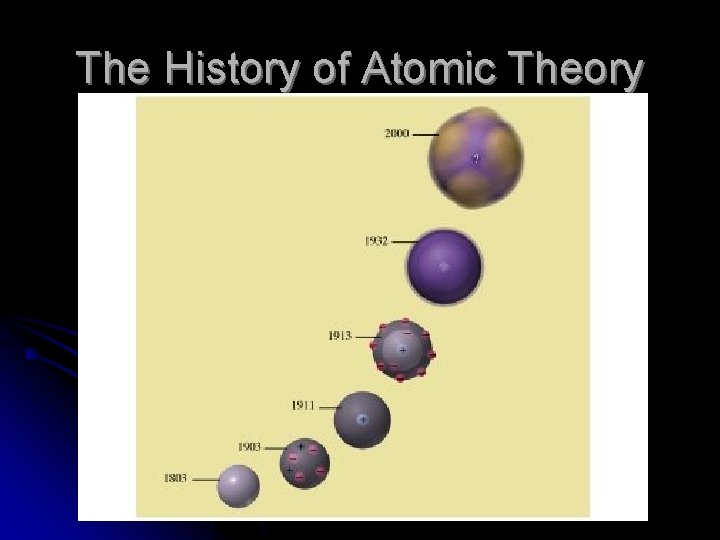
The History of Atomic Theory
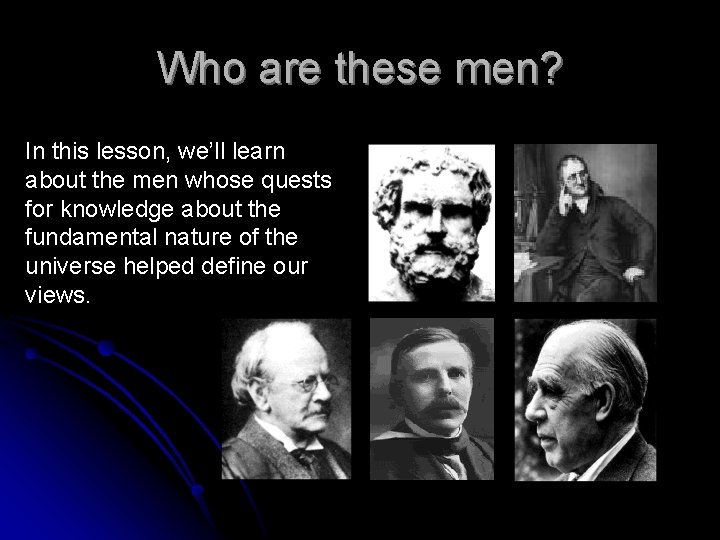
Who are these men? In this lesson, we’ll learn about the men whose quests for knowledge about the fundamental nature of the universe helped define our views.
Democritus Theory l l Greek philosopher who began the search for a description of matter in 400 BC His theory: Matter could not be subdivided into smaller and smaller pieces forever.
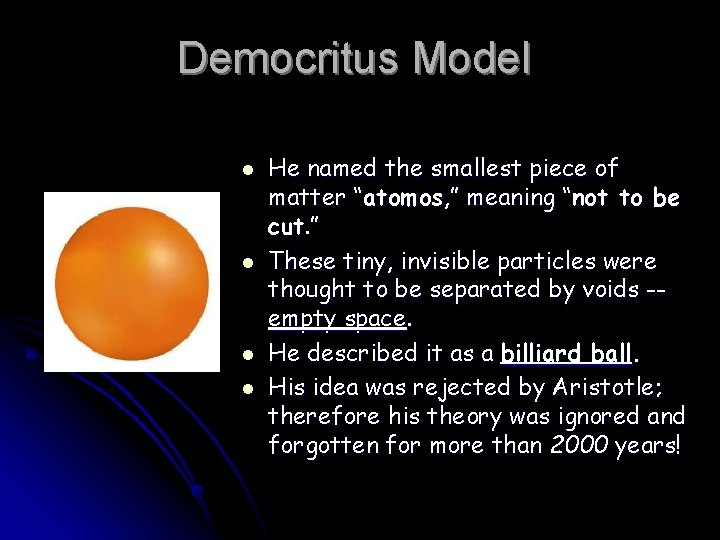
Democritus Model l l He named the smallest piece of matter “atomos, ” meaning “not to be cut. ” These tiny, invisible particles were thought to be separated by voids -empty space. He described it as a billiard ball. His idea was rejected by Aristotle; therefore his theory was ignored and forgotten for more than 2000 years!
Dalton’s Model l l In the early 1800 s, the English Chemist John Dalton Experiments eventually led to the acceptance of the idea of atoms even though he had never seen one.
Dalton’s Theory l l l l He deduced that all elements are composed of atoms. Atoms are indivisible and indestructible particles. Atoms of the same element are exactly alike. Atoms of different elements are different. Compounds are formed by the joining of atoms of two or more elements. In a chemical reaction, atoms are either separated, combined or rearranged. This theory became one of the foundations of modern chemistry.
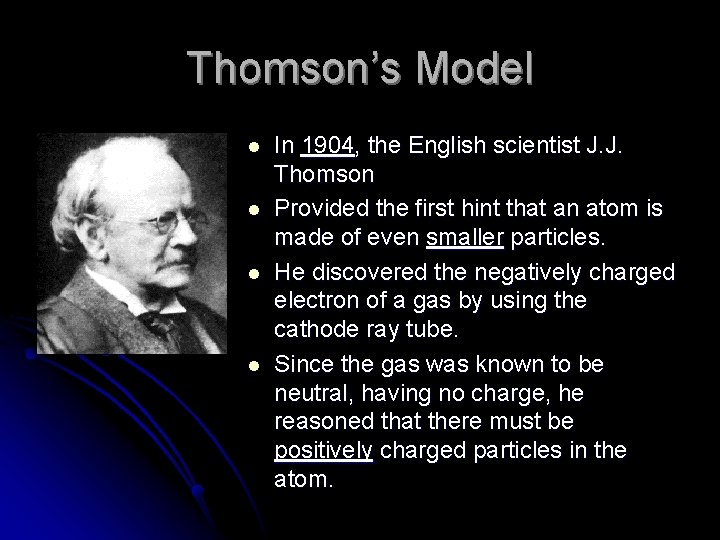
Thomson’s Model l l In 1904, the English scientist J. J. Thomson Provided the first hint that an atom is made of even smaller particles. He discovered the negatively charged electron of a gas by using the cathode ray tube. Since the gas was known to be neutral, having no charge, he reasoned that there must be positively charged particles in the atom.
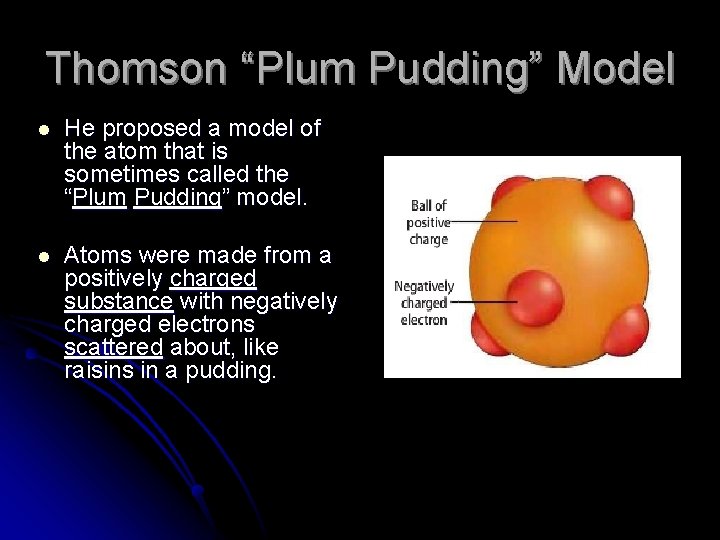
Thomson “Plum Pudding” Model l He proposed a model of the atom that is sometimes called the “Plum Pudding” model. l Atoms were made from a positively charged substance with negatively charged electrons scattered about, like raisins in a pudding.
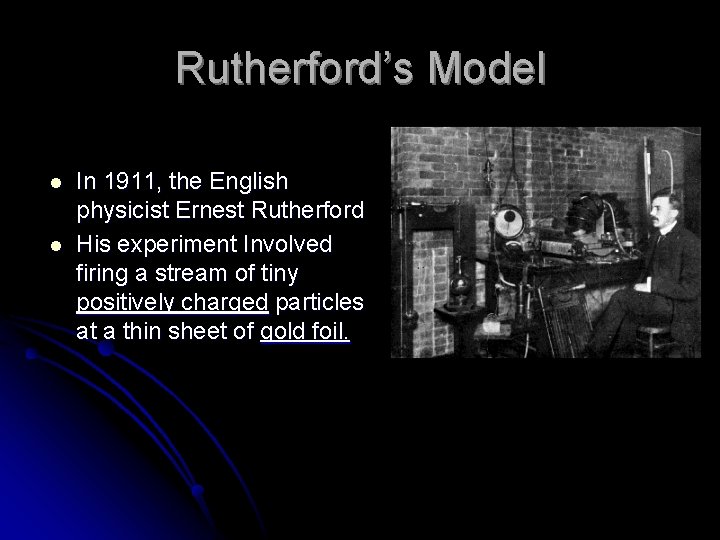
Rutherford’s Model l l In 1911, the English physicist Ernest Rutherford His experiment Involved firing a stream of tiny positively charged particles at a thin sheet of gold foil.
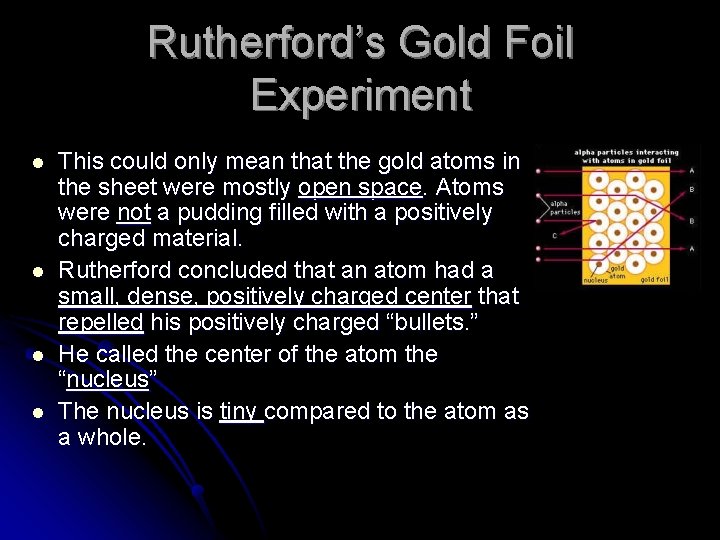
Rutherford’s Gold Foil Experiment l l This could only mean that the gold atoms in the sheet were mostly open space. Atoms were not a pudding filled with a positively charged material. Rutherford concluded that an atom had a small, dense, positively charged center that repelled his positively charged “bullets. ” He called the center of the atom the “nucleus” The nucleus is tiny compared to the atom as a whole.
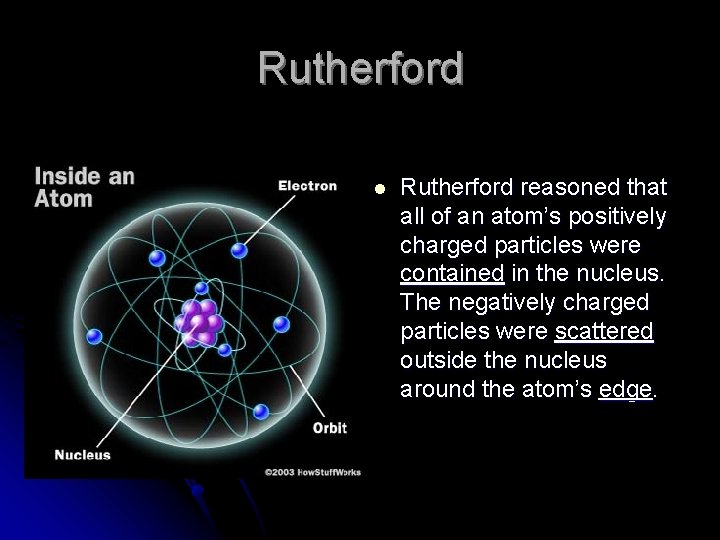
Rutherford l Rutherford reasoned that all of an atom’s positively charged particles were contained in the nucleus. The negatively charged particles were scattered outside the nucleus around the atom’s edge.
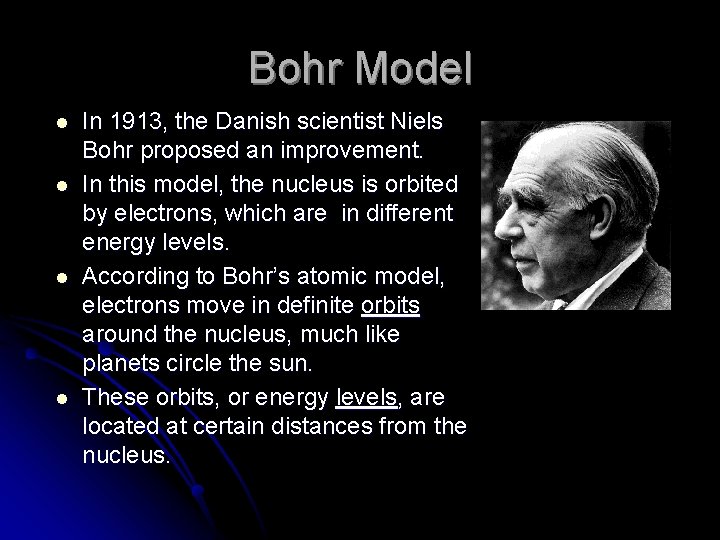
Bohr Model l l In 1913, the Danish scientist Niels Bohr proposed an improvement. In this model, the nucleus is orbited by electrons, which are in different energy levels. According to Bohr’s atomic model, electrons move in definite orbits around the nucleus, much like planets circle the sun. These orbits, or energy levels, are located at certain distances from the nucleus.
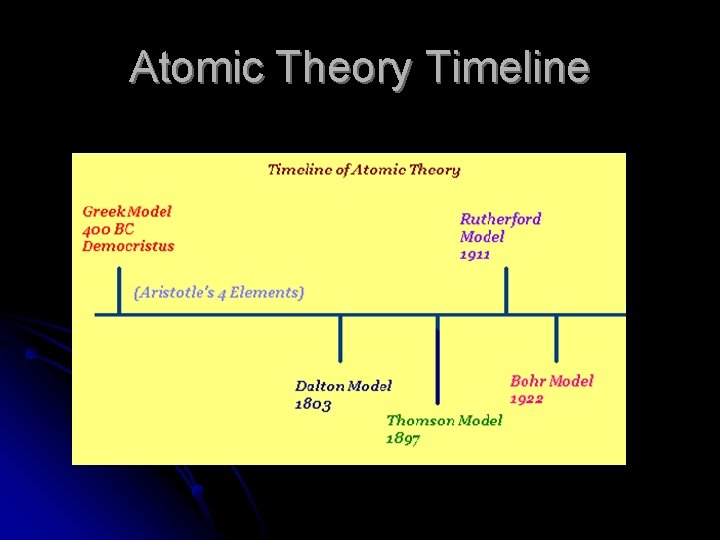
Atomic Theory Timeline
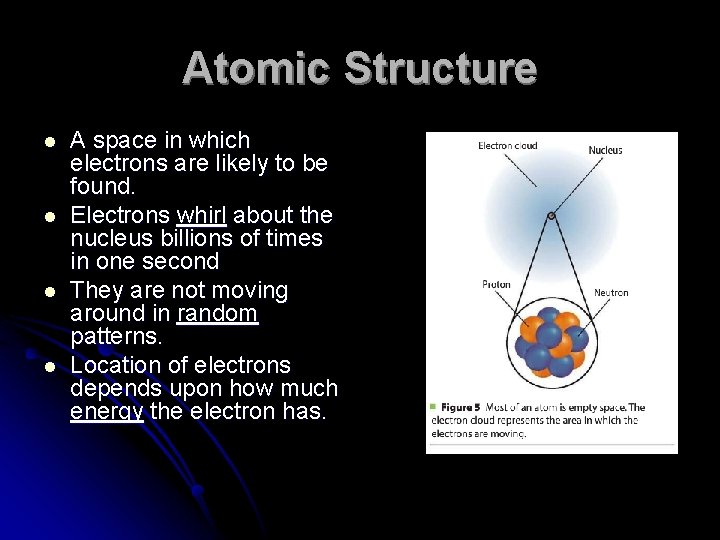
Atomic Structure l l A space in which electrons are likely to be found. Electrons whirl about the nucleus billions of times in one second They are not moving around in random patterns. Location of electrons depends upon how much energy the electron has.
Electron Cloud: l l l l A space in which electrons are likely to be found. Electrons whirl about the nucleus billions of times in one second They are not moving around in random patterns. Location of electrons depends upon how much energy the electron has. Depending on their energy they are locked into a certain area in the cloud. Electrons with the lowest energy are found in the energy level closest to the nucleus Electrons with the highest energy are found in the outermost energy levels, farther from the nucleus.
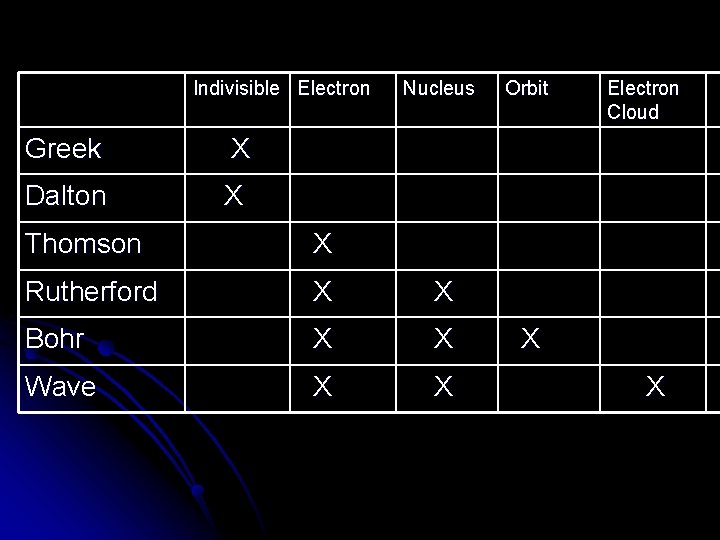
Indivisible Electron Greek X Dalton X Nucleus Thomson X Rutherford X X Bohr X X Wave X X Orbit Electron Cloud X X
- Slides: 18