
Investigate Partial CRC32 Characteristic and Performance for Realtime
- Slides: 1
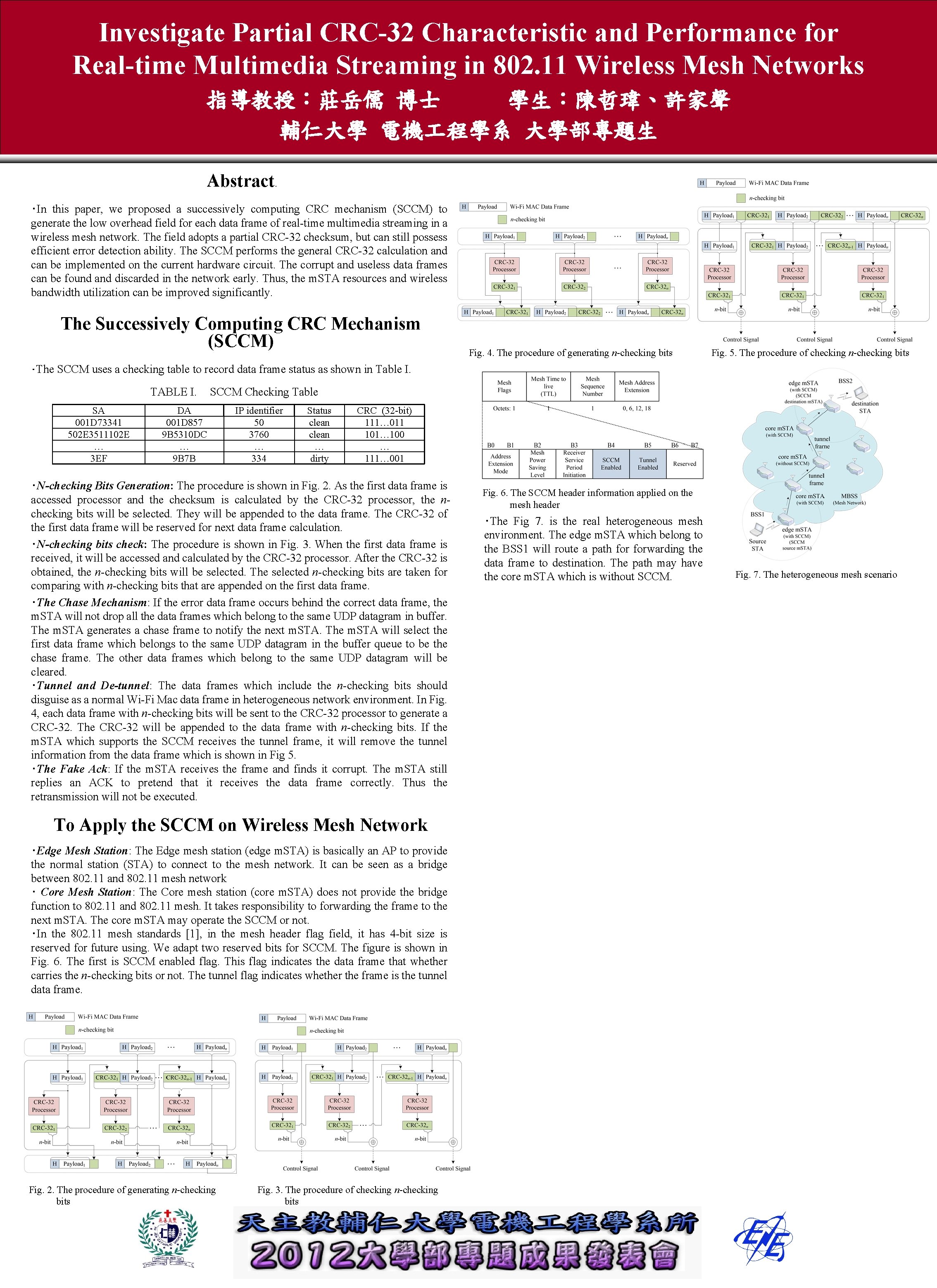
Investigate Partial CRC-32 Characteristic and Performance for Real-time Multimedia Streaming in 802. 11 Wireless Mesh Networks 指導教授:莊岳儒 博士 學生:陳哲瑋、許家聲 輔仁大學 電機 程學系 大學部專題生 Abstract. ‧In this paper, we proposed a successively computing CRC mechanism (SCCM) to generate the low overhead field for each data frame of real-time multimedia streaming in a wireless mesh network. The field adopts a partial CRC-32 checksum, but can still possess efficient error detection ability. The SCCM performs the general CRC-32 calculation and can be implemented on the current hardware circuit. The corrupt and useless data frames can be found and discarded in the network early. Thus, the m. STA resources and wireless bandwidth utilization can be improved significantly. The Successively Computing CRC Mechanism (SCCM) Fig. 4. The procedure of generating n-checking bits Fig. 5. The procedure of checking n-checking bits ‧The SCCM uses a checking table to record data frame status as shown in Table I. TABLE I. SA 001 D 73341 502 E 3511102 E … 3 EF SCCM Checking Table DA 001 D 857 9 B 5310 DC … 9 B 7 B IP identifier 50 3760 … 334 Status clean … dirty CRC (32 -bit) 111… 011 101… 100 … 111… 001 ‧N-checking Bits Generation: The procedure is shown in Fig. 2. As the first data frame is accessed processor and the checksum is calculated by the CRC-32 processor, the nchecking bits will be selected. They will be appended to the data frame. The CRC-32 of the first data frame will be reserved for next data frame calculation. ‧N-checking bits check: The procedure is shown in Fig. 3. When the first data frame is received, it will be accessed and calculated by the CRC-32 processor. After the CRC-32 is obtained, the n-checking bits will be selected. The selected n-checking bits are taken for comparing with n-checking bits that are appended on the first data frame. ‧The Chase Mechanism: If the error data frame occurs behind the correct data frame, the m. STA will not drop all the data frames which belong to the same UDP datagram in buffer. The m. STA generates a chase frame to notify the next m. STA. The m. STA will select the first data frame which belongs to the same UDP datagram in the buffer queue to be the chase frame. The other data frames which belong to the same UDP datagram will be cleared. ‧Tunnel and De-tunnel: The data frames which include the n-checking bits should disguise as a normal Wi-Fi Mac data frame in heterogeneous network environment. In Fig. 4, each data frame with n-checking bits will be sent to the CRC-32 processor to generate a CRC-32. The CRC-32 will be appended to the data frame with n-checking bits. If the m. STA which supports the SCCM receives the tunnel frame, it will remove the tunnel information from the data frame which is shown in Fig 5. ‧The Fake Ack: If the m. STA receives the frame and finds it corrupt. The m. STA still replies an ACK to pretend that it receives the data frame correctly. Thus the retransmission will not be executed. To Apply the SCCM on Wireless Mesh Network ‧Edge Mesh Station: The Edge mesh station (edge m. STA) is basically an AP to provide the normal station (STA) to connect to the mesh network. It can be seen as a bridge between 802. 11 and 802. 11 mesh network ‧ Core Mesh Station: The Core mesh station (core m. STA) does not provide the bridge function to 802. 11 and 802. 11 mesh. It takes responsibility to forwarding the frame to the next m. STA. The core m. STA may operate the SCCM or not. ‧In the 802. 11 mesh standards [1], in the mesh header flag field, it has 4 -bit size is reserved for future using. We adapt two reserved bits for SCCM. The figure is shown in Fig. 6. The first is SCCM enabled flag. This flag indicates the data frame that whether carries the n-checking bits or not. The tunnel flag indicates whether the frame is the tunnel data frame. Fig. 2. The procedure of generating n-checking bits Fig. 3. The procedure of checking n-checking bits Fig. 6. The SCCM header information applied on the mesh header ‧The Fig 7. is the real heterogeneous mesh environment. The edge m. STA which belong to the BSS 1 will route a path forwarding the data frame to destination. The path may have the core m. STA which is without SCCM. Fig. 7. The heterogeneous mesh scenario