
Inverted Index Construction Adapted from Lectures by Prabhakar
Inverted Index Construction Adapted from Lectures by Prabhakar Raghavan (Yahoo and Stanford) and Christopher Manning (Stanford) Prasad L 3 Inverted. Index 1
Unstructured data in 1650 n n Which plays of Shakespeare contain the words Brutus AND Caesar but NOT Calpurnia? One could grep all of Shakespeare’s plays for Brutus and Caesar, then strip out plays containing Calpurnia? n n n Prasad Slow (for large corpora) NOT Calpurnia is non-trivial Other operations (e. g. , find the word Romans near countrymen) not feasible L 3 Inverted. Index 2
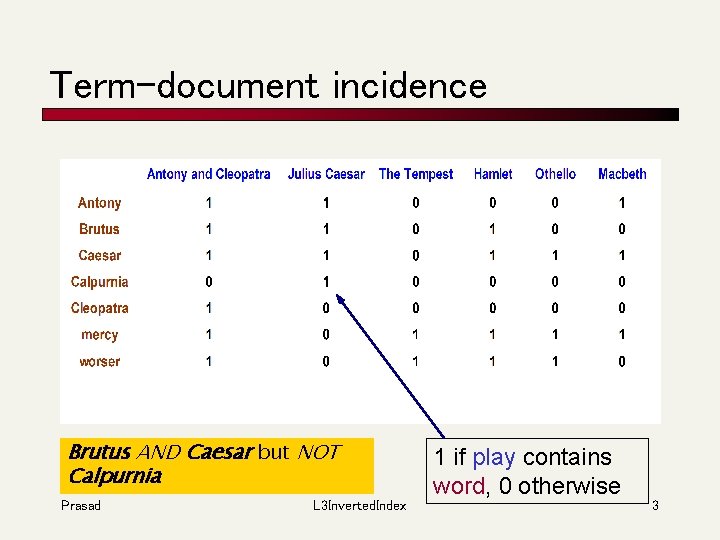
Term-document incidence Brutus AND Caesar but NOT Calpurnia Prasad L 3 Inverted. Index 1 if play contains word, 0 otherwise 3
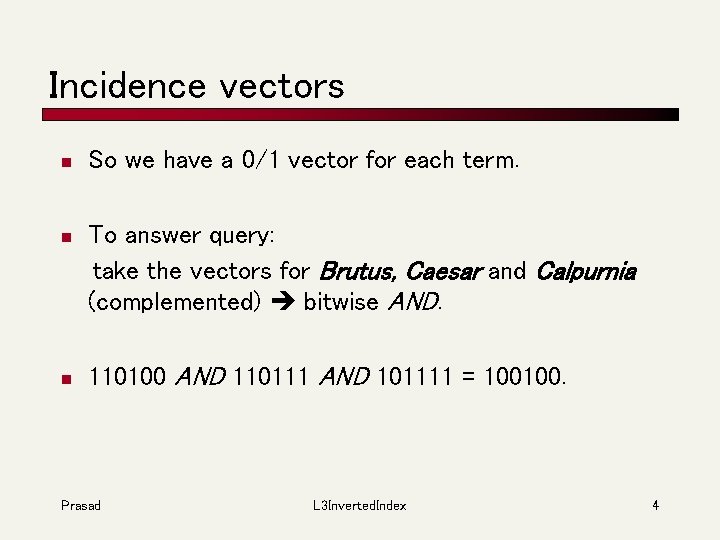
Incidence vectors n So we have a 0/1 vector for each term. n To answer query: take the vectors for Brutus, Caesar and Calpurnia (complemented) bitwise AND. n 110100 AND 110111 AND 101111 = 100100. Prasad L 3 Inverted. Index 4
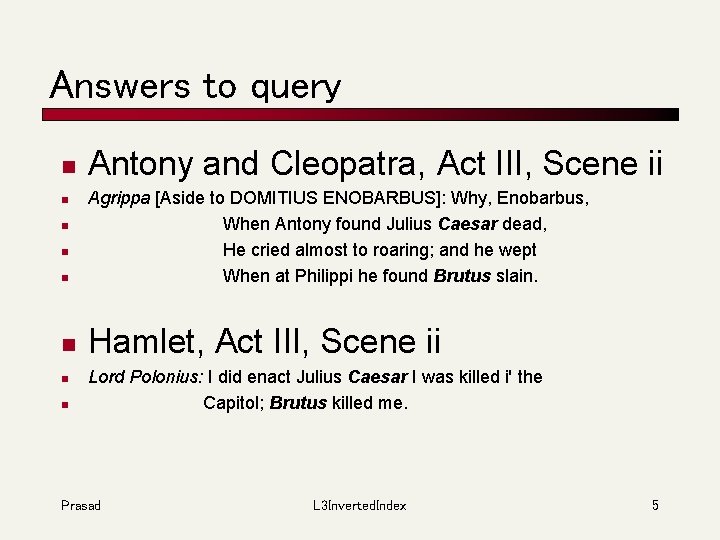
Answers to query n Antony and Cleopatra, Act III, Scene ii n Agrippa [Aside to DOMITIUS ENOBARBUS]: Why, Enobarbus, When Antony found Julius Caesar dead, He cried almost to roaring; and he wept When at Philippi he found Brutus slain. n Hamlet, Act III, Scene ii n n n Lord Polonius: I did enact Julius Caesar I was killed i' the Capitol; Brutus killed me. Prasad L 3 Inverted. Index 5

Bigger corpora n n Consider N = 1 M documents, each with about 1 K terms. Avg 6 bytes/term including spaces/punctuation n n 6 GB of data in the documents. Say there are m = 500 K distinct terms among these. Prasad L 3 Inverted. Index 6
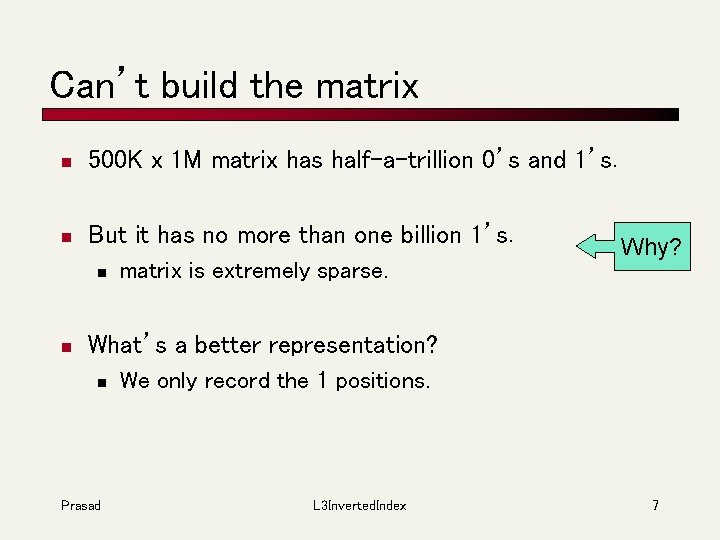
Can’t build the matrix n 500 K x 1 M matrix has half-a-trillion 0’s and 1’s. n But it has no more than one billion 1’s. n n matrix is extremely sparse. Why? What’s a better representation? n Prasad We only record the 1 positions. L 3 Inverted. Index 7

Inverted index n n For each term T, we must store a list of all documents that contain T. Do we use an array or a list for this? Brutus 2 Calpurnia 1 Caesar 4 2 8 16 32 64 128 3 5 8 13 21 34 13 16 What happens if the word Caesar is added to document 14? Prasad L 3 Inverted. Index 8

Inverted index n Linked lists generally preferred to arrays + + − Dynamic space allocation Insertion of terms into documents easy Space overhead of pointers Brutus Calpurnia Caesar Dictionary Prasad 2 4 8 16 1 2 3 5 13 32 8 Posting 64 13 21 128 34 16 Postings lists L 3 Inverted. Index 9 Sorted by doc. ID (more later on why).
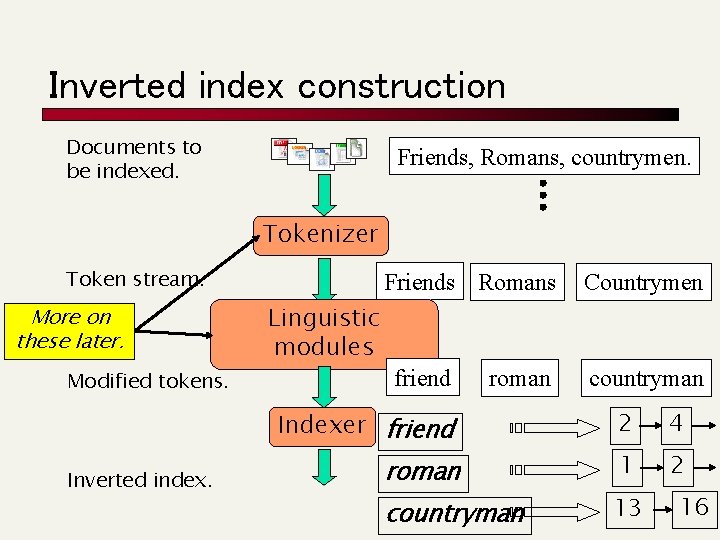
Inverted index construction Documents to be indexed. Friends, Romans, countrymen. Tokenizer Token stream. More on these later. Modified tokens. Friends Romans Linguistic modules friend roman Indexer friend Inverted index. roman countryman Countrymen countryman 2 4 1 2 13 16
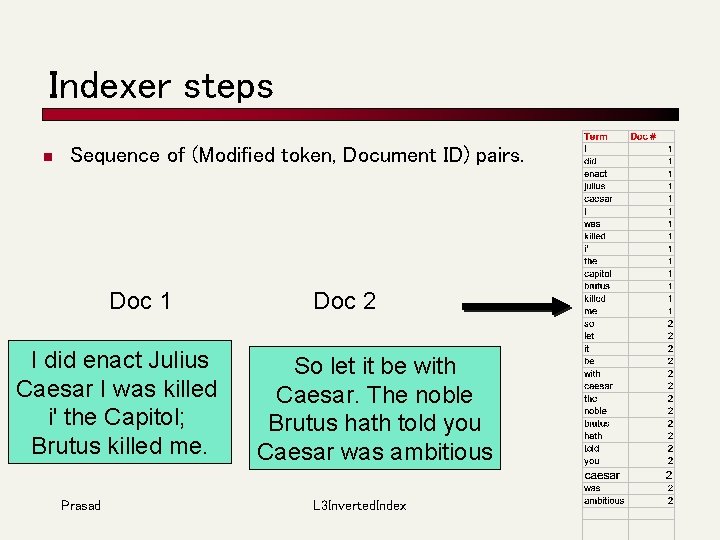
Indexer steps n Sequence of (Modified token, Document ID) pairs. Doc 1 I did enact Julius Caesar I was killed i' the Capitol; Brutus killed me. Prasad Doc 2 So let it be with Caesar. The noble Brutus hath told you Caesar was ambitious L 3 Inverted. Index
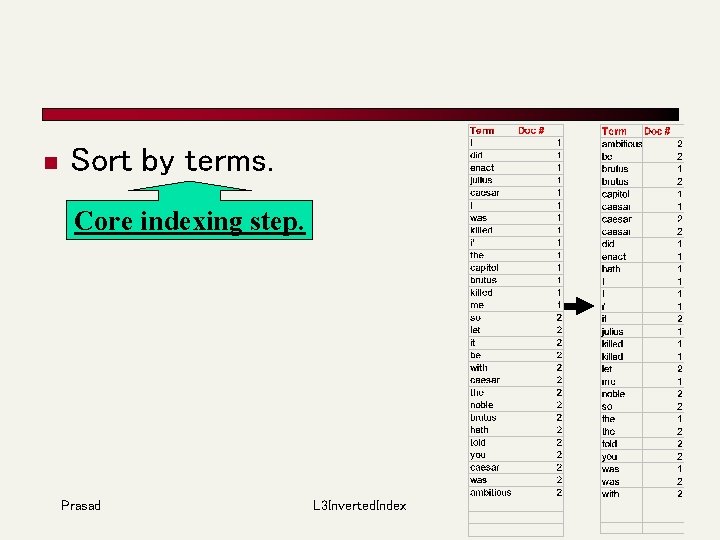
n Sort by terms. Core indexing step. Prasad L 3 Inverted. Index
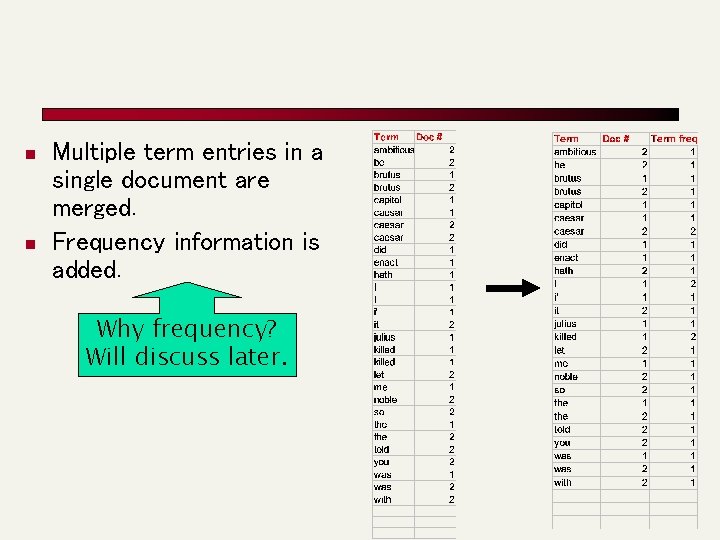
n n Multiple term entries in a single document are merged. Frequency information is added. Why frequency? Will discuss later.
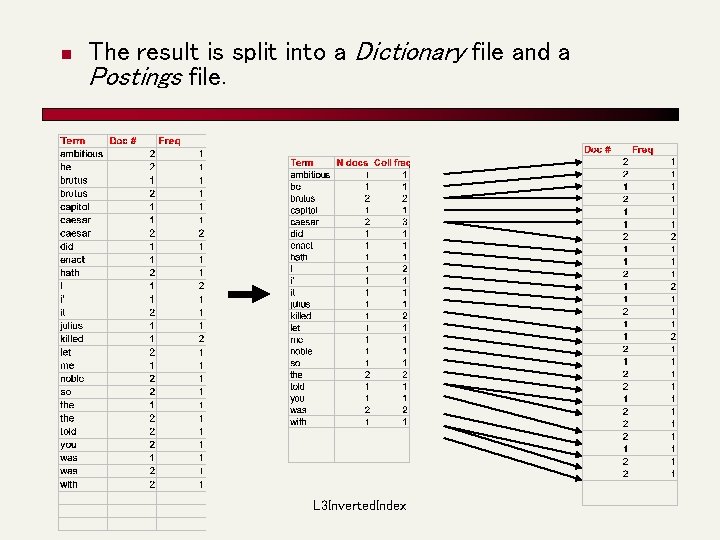
n The result is split into a Dictionary file and a Postings file. L 3 Inverted. Index
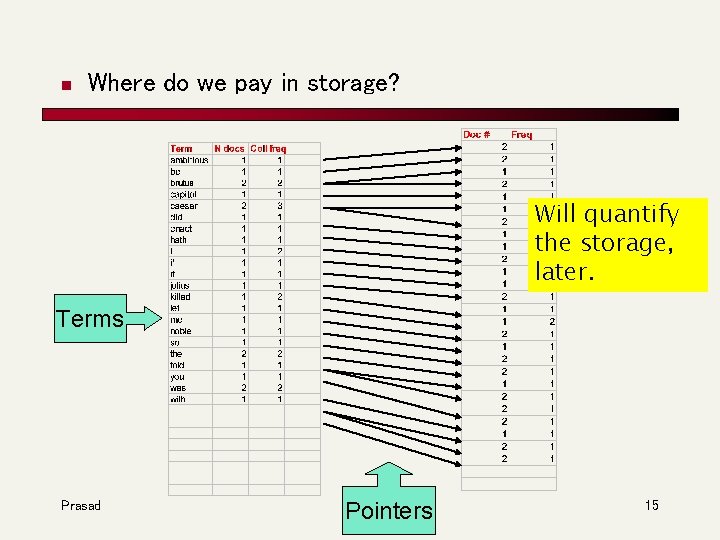
n Where do we pay in storage? Will quantify the storage, later. Terms Prasad Pointers 15
Query Processing How? What? Prasad L 3 Inverted. Index 16
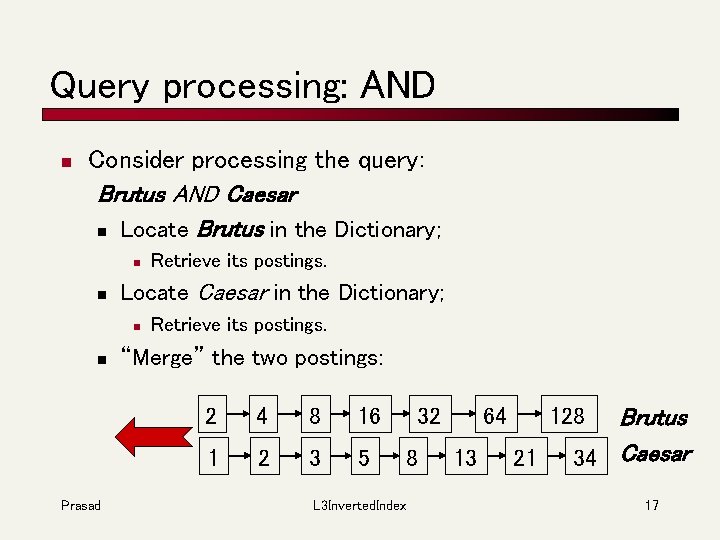
Query processing: AND n Consider processing the query: Brutus AND Caesar n Locate Brutus in the Dictionary; n n Locate Caesar in the Dictionary; n n Prasad Retrieve its postings. “Merge” the two postings: 2 4 8 16 1 2 3 5 32 8 L 3 Inverted. Index 64 13 128 21 Brutus 34 Caesar 17
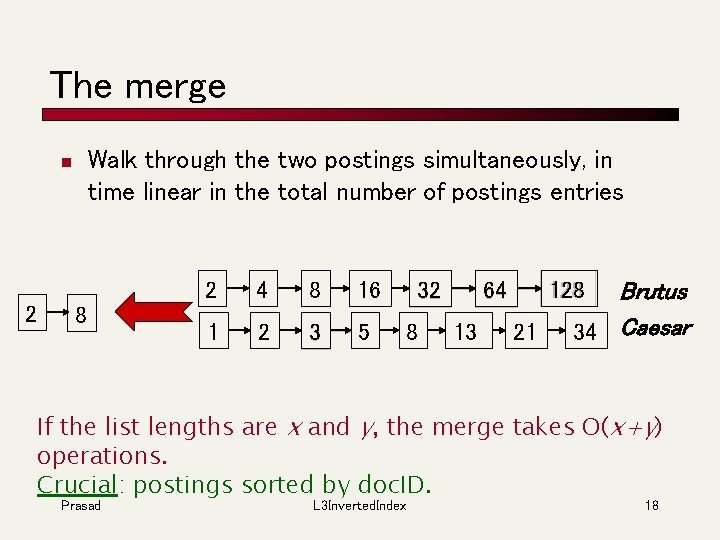
The merge Walk through the two postings simultaneously, in time linear in the total number of postings entries n 2 8 2 4 8 16 1 2 3 5 32 8 13 Brutus 34 Caesar 128 64 21 If the list lengths are x and y, the merge takes O(x+y) operations. Crucial: postings sorted by doc. ID. Prasad L 3 Inverted. Index 18
Boolean queries: Exact match n Boolean Queries are queries using AND, OR and NOT to join query terms n n Views each document as a set of words Is precise: document matches condition or not. Primary commercial retrieval tool for 3 decades. Professional searchers (e. g. , lawyers) still like Boolean queries: n Prasad You know exactly what you’re getting. L 3 Inverted. Index 19
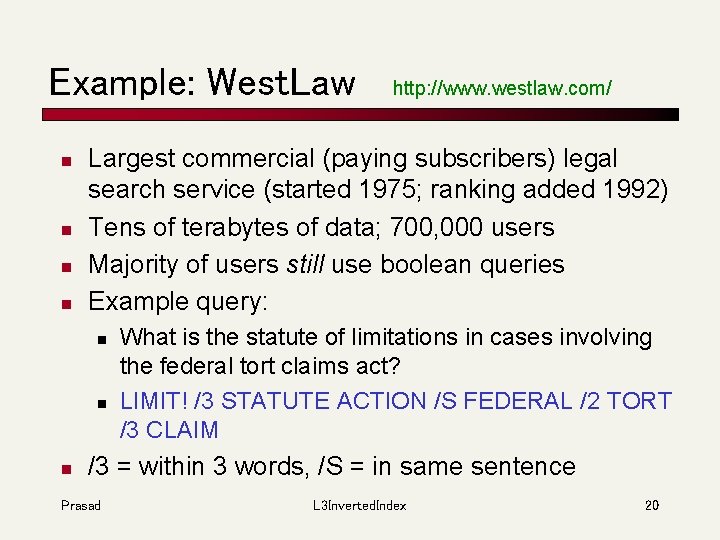
Example: West. Law n n Largest commercial (paying subscribers) legal search service (started 1975; ranking added 1992) Tens of terabytes of data; 700, 000 users Majority of users still use boolean queries Example query: n n n http: //www. westlaw. com/ What is the statute of limitations in cases involving the federal tort claims act? LIMIT! /3 STATUTE ACTION /S FEDERAL /2 TORT /3 CLAIM /3 = within 3 words, /S = in same sentence Prasad L 3 Inverted. Index 20
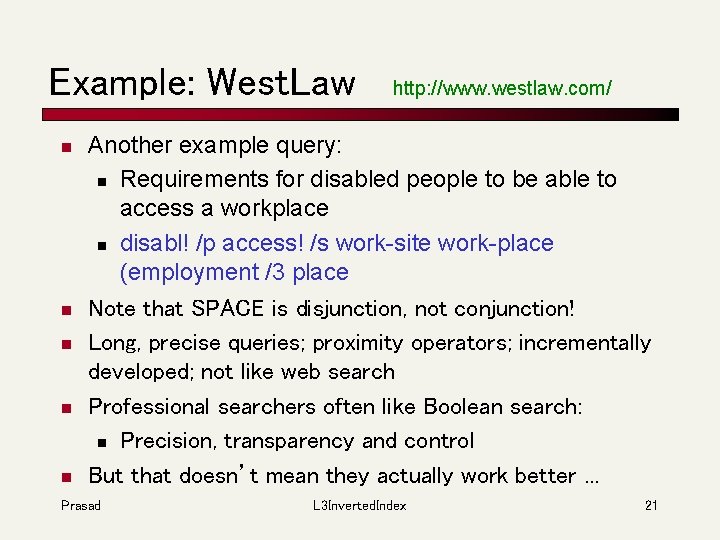
Example: West. Law n n n http: //www. westlaw. com/ Another example query: n Requirements for disabled people to be able to access a workplace n disabl! /p access! /s work-site work-place (employment /3 place Note that SPACE is disjunction, not conjunction! Long, precise queries; proximity operators; incrementally developed; not like web search Professional searchers often like Boolean search: n Precision, transparency and control But that doesn’t mean they actually work better. . . Prasad L 3 Inverted. Index 21
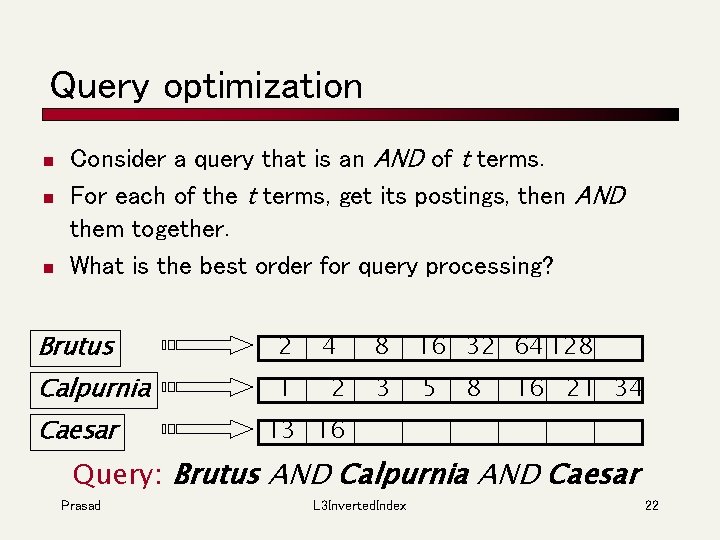
Query optimization n Consider a query that is an AND of t terms. For each of the t terms, get its postings, then AND them together. What is the best order for query processing? Brutus 2 Calpurnia 1 Caesar 4 2 8 16 32 64 128 3 5 8 16 21 34 13 16 Query: Brutus AND Calpurnia AND Caesar Prasad L 3 Inverted. Index 22
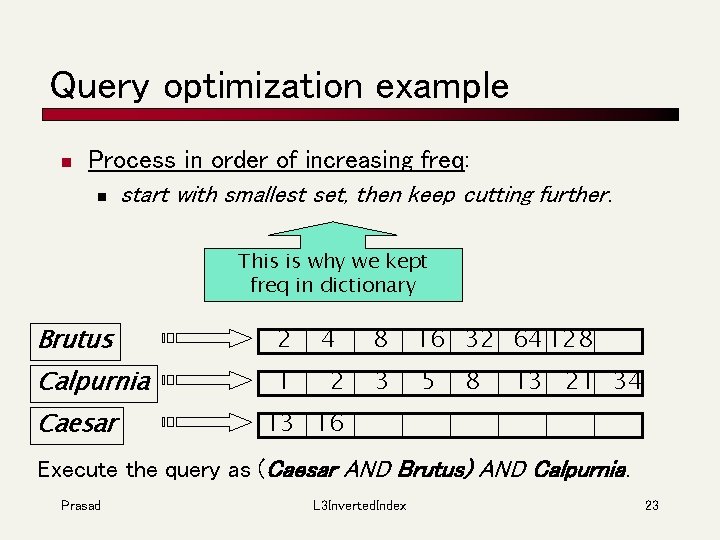
Query optimization example n Process in order of increasing freq: n start with smallest set, then keep cutting further. This is why we kept freq in dictionary Brutus 2 Calpurnia 1 Caesar 4 2 8 16 32 64 128 3 5 8 13 21 34 13 16 Execute the query as (Caesar AND Brutus) AND Calpurnia. Prasad L 3 Inverted. Index 23
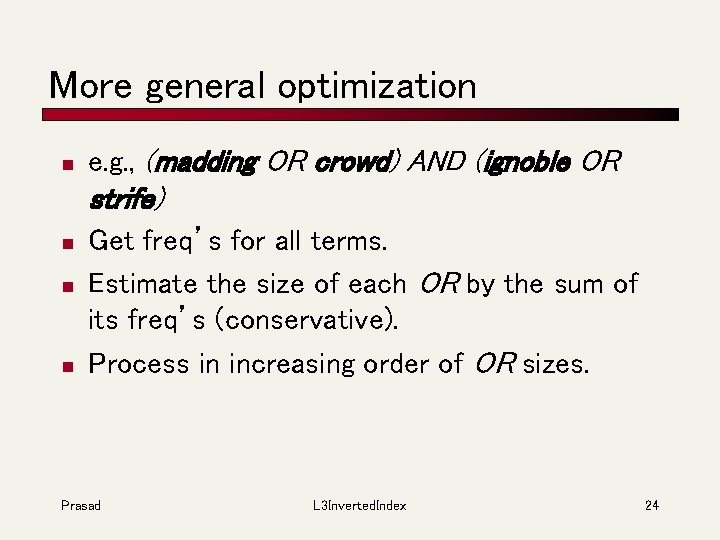
More general optimization n e. g. , (madding OR crowd) AND (ignoble OR strife) n n n Get freq’s for all terms. Estimate the size of each OR by the sum of its freq’s (conservative). Process in increasing order of OR sizes. Prasad L 3 Inverted. Index 24
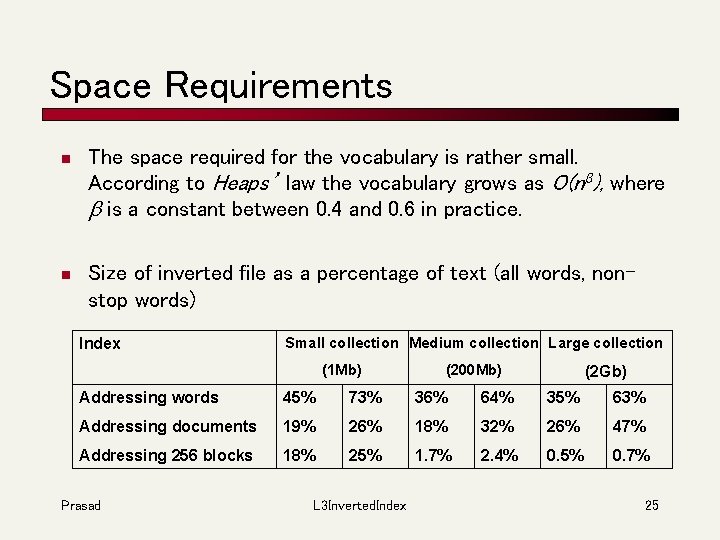
Space Requirements n The space required for the vocabulary is rather small. According to Heaps’ law the vocabulary grows as O(n ), where is a constant between 0. 4 and 0. 6 in practice. n Size of inverted file as a percentage of text (all words, nonstop words) Index Small collection Medium collection Large collection (1 Mb) (200 Mb) (2 Gb) Addressing words 45% 73% 36% 64% 35% 63% Addressing documents 19% 26% 18% 32% 26% 47% Addressing 256 blocks 18% 25% 1. 7% 2. 4% 0. 5% 0. 7% Prasad L 3 Inverted. Index 25
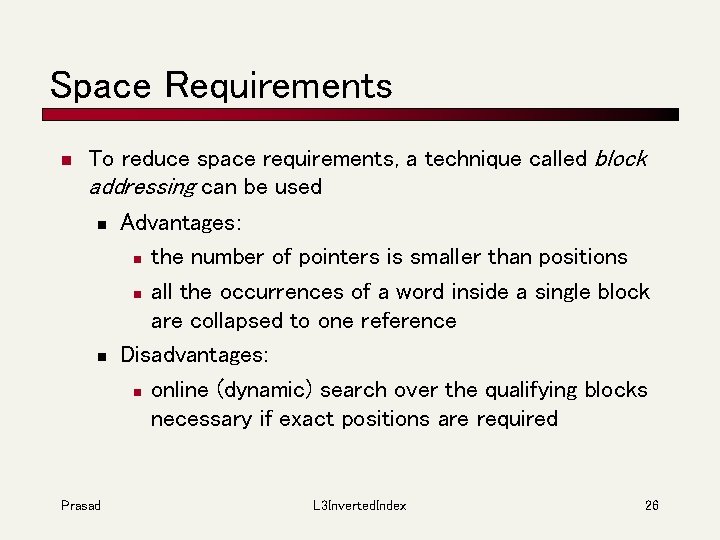
Space Requirements n To reduce space requirements, a technique called block addressing can be used n Advantages: n the number of pointers is smaller than positions n all the occurrences of a word inside a single block are collapsed to one reference n Disadvantages: n online (dynamic) search over the qualifying blocks necessary if exact positions are required Prasad L 3 Inverted. Index 26
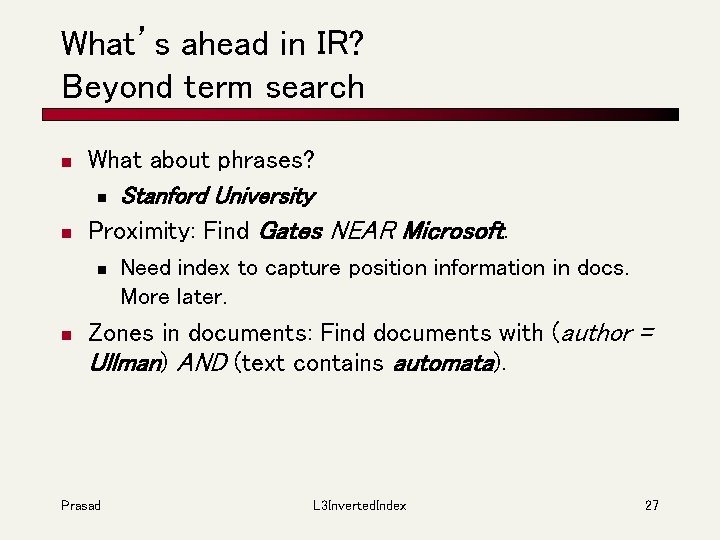
What’s ahead in IR? Beyond term search n n What about phrases? n Stanford University Proximity: Find Gates NEAR Microsoft. n n Need index to capture position information in docs. More later. Zones in documents: Find documents with (author = Ullman) AND (text contains automata). Prasad L 3 Inverted. Index 27
Other Indexing Techniques n Even though Inverted Files is the method of choice, in the face of phrase and proximity queries, the following approaches were also developed: n Suffix arrays n Signature files Prasad L 3 Inverted. Index 28
- Slides: 28