
INVERTEBRATES PROTOSTOMES MORE BEGINS Who lives in a
INVERTEBRATES= PROTOSTOMES + MORE BEGINS Who lives in a pineapple under the sea? Absorbent and yellow and porous is he, If nautical nonsense is something you wish. . .
Hi there and welcome to the invertebrate presentation. There is a lot to learn in this section so I’ll be asking for a little help along the way. We will start with the early development of the first multicellular animals. Protostomes means coelum from cell masses
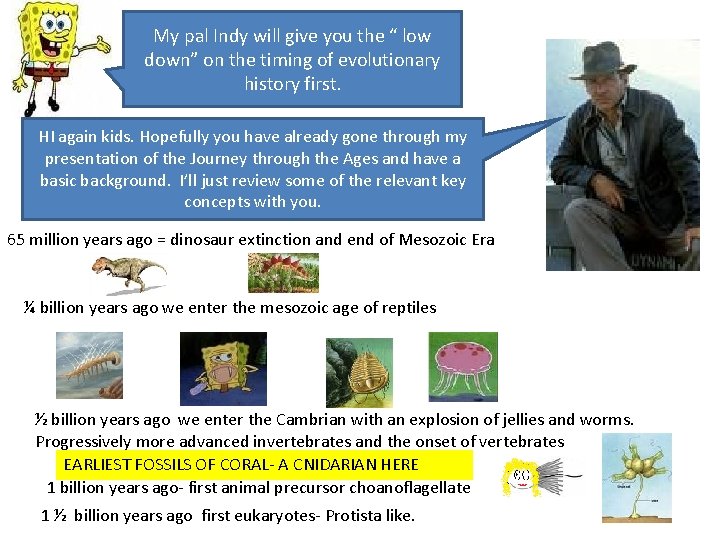
My pal Indy will give you the “ low down” on the timing of evolutionary history first. HI again kids. Hopefully you have already gone through my presentation of the Journey through the Ages and have a basic background. I’ll just review some of the relevant key concepts with you. 65 million years ago = dinosaur extinction and end of Mesozoic Era ¼ billion years ago we enter the mesozoic age of reptiles ½ billion years ago we enter the Cambrian with an explosion of jellies and worms. Progressively more advanced invertebrates and the onset of vertebrates EARLIEST FOSSILS OF CORAL- A CNIDARIAN HERE 1 billion years ago- first animal precursor choanoflagellate 1 ½ billion years ago first eukaryotes- Protista like.
WHAT IS AN ANIMAL ANYWAY? There a lot of different types of animals with many different types of characteristics. Take me for example: in the real world I don’t move, I just sit attached (SESSILE) on the substrate, so some might think I am a plant. So let’s come up with distinguishing features of animals ALL HETEROTROPHIC ALL MOTILE AT SOME LIFE STAGE COMMON ANIMAL ANCESTOR Sexual or asexual reproduction Many invertebrates have larval forms (polymorphic)
HOW DO YOU KNOW IF YOU ARE LOOKING AT AN INVERTEBRATE? All invertebrates lack a backbone. Let me introduce you to my animal friends in Bikini Bottom.
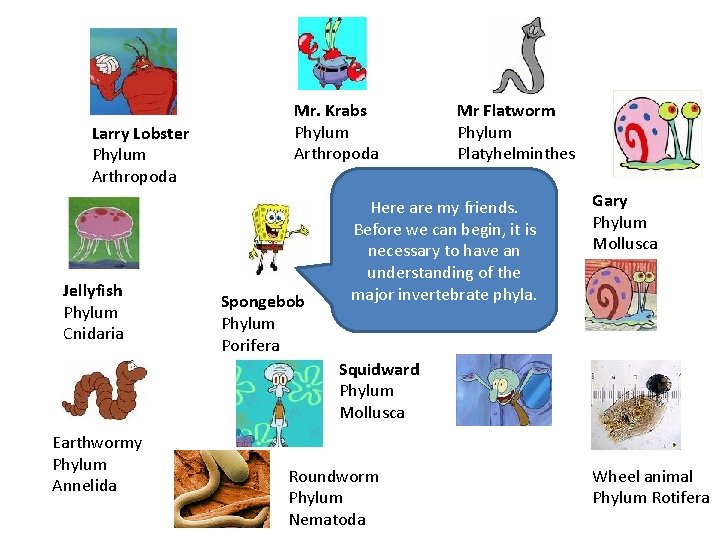
Larry Lobster Phylum Arthropoda Jellyfish Phylum Cnidaria Mr. Krabs Phylum Arthropoda Spongebob Phylum Porifera Mr Flatworm Phylum Platyhelminthes Here are my friends. Before we can begin, it is necessary to have an understanding of the major invertebrate phyla. Gary Phylum Mollusca Squidward Phylum Mollusca Earthwormy Phylum Annelida Roundworm Phylum Nematoda Wheel animal Phylum Rotifera
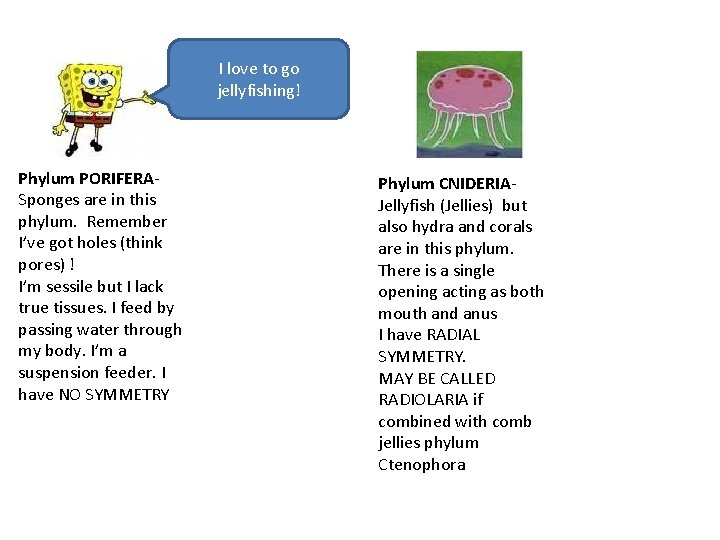
I love to go jellyfishing! Phylum PORIFERASponges are in this phylum. Remember I’ve got holes (think pores) ! I’m sessile but I lack true tissues. I feed by passing water through my body. I’m a suspension feeder. I have NO SYMMETRY Phylum CNIDERIAJellyfish (Jellies) but also hydra and corals are in this phylum. There is a single opening acting as both mouth and anus I have RADIAL SYMMETRY. MAY BE CALLED RADIOLARIA if combined with comb jellies phylum Ctenophora

PROTOSTOMES Phylum MOLLUSCA The squid is a mollusca and is in the class Cephalopoda. It has a mouth and an anus yet is a protostome. I have BILATERAL SYMMETRY. Phylum PLATYHELMINTHES Long thin body organism. No body cavity. Bilateral symmetry Phylum ARTHROPODA Majority of animals are this phylum. Insects, crustaceans, arachnids. All have segmented exoskeleton and jointed appendages Phylum ANNELIDA I’m an Oligochaete. Segmented body with coelum. Freshwater, marine and land varieties. Phylum NEMATODA Non segmented worm pseudocoelomates
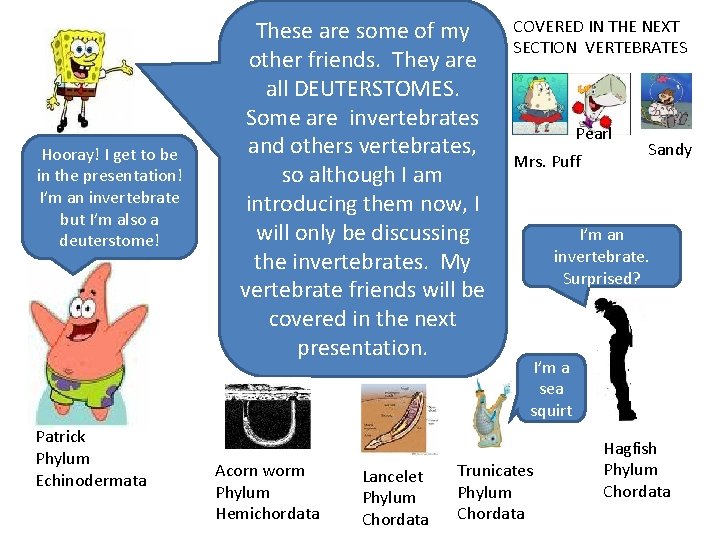
Hooray! I get to be in the presentation! I’m an invertebrate but I’m also a deuterstome! Patrick Phylum Echinodermata These are some of my other friends. They are all DEUTERSTOMES. Some are invertebrates and others vertebrates, so although I am introducing them now, I will only be discussing the invertebrates. My vertebrate friends will be covered in the next presentation. Acorn worm Phylum Hemichordata Lancelet Phylum Chordata COVERED IN THE NEXT SECTION VERTEBRATES Pearl Mrs. Puff Sandy I’m an invertebrate. Surprised? I’m a sea squirt Trunicates Phylum Chordata Hagfish Phylum Chordata
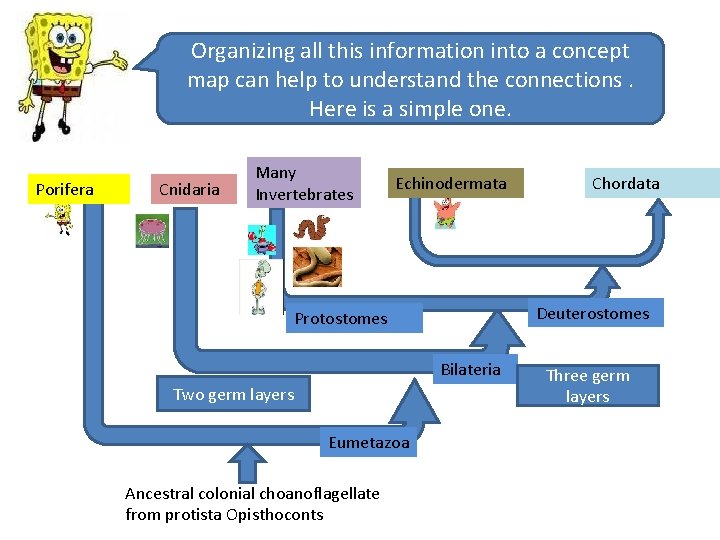
Organizing all this information into a concept map can help to understand the connections. Here is a simple one. Porifera Cnidaria Many Invertebrates Echinodermata Deuterostomes Protostomes Bilateria Two germ layers Eumetazoa Ancestral colonial choanoflagellate from protista Opisthoconts Chordata Three germ layers
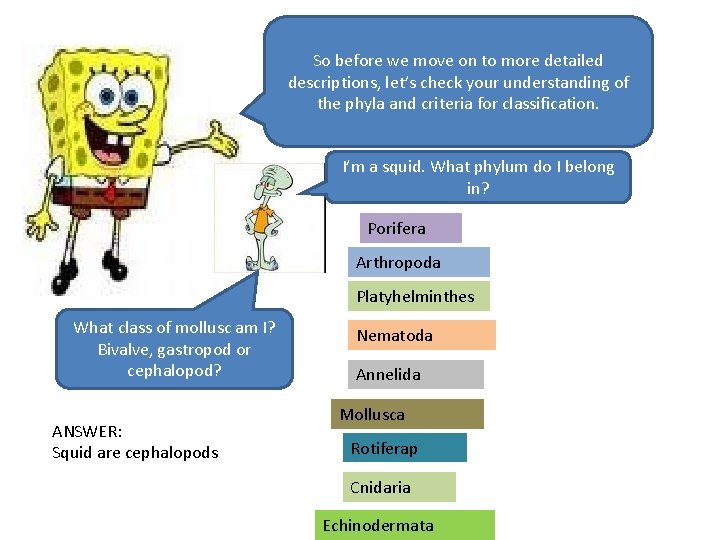
So before we move on to more detailed descriptions, let’s check your understanding of the phyla and criteria for classification. I’m a squid. What phylum do I belong in? Porifera Arthropoda Platyhelminthes What class of mollusc am I? Bivalve, gastropod or cephalopod? ANSWER: Squid are cephalopods Nematoda Annelida Mollusca Rotiferap Cnidaria Echinodermata
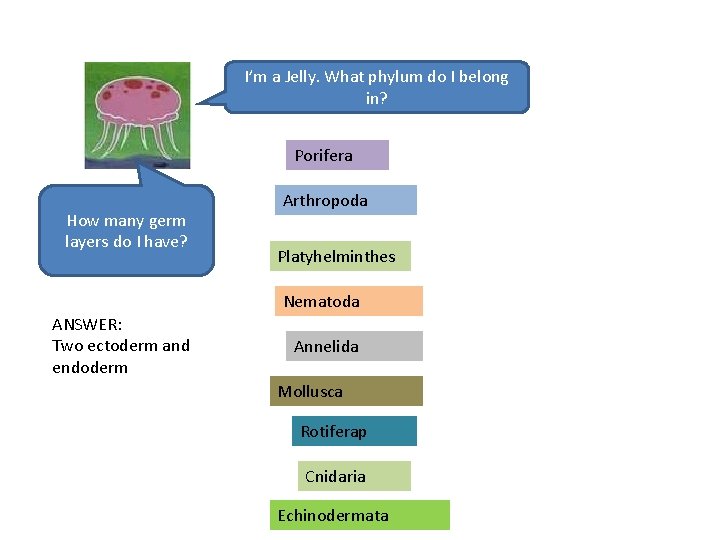
I’m a Jelly. What phylum do I belong in? Porifera How many germ layers do I have? Arthropoda Platyhelminthes Nematoda ANSWER: Two ectoderm and endoderm Annelida Mollusca Rotiferap Cnidaria Echinodermata
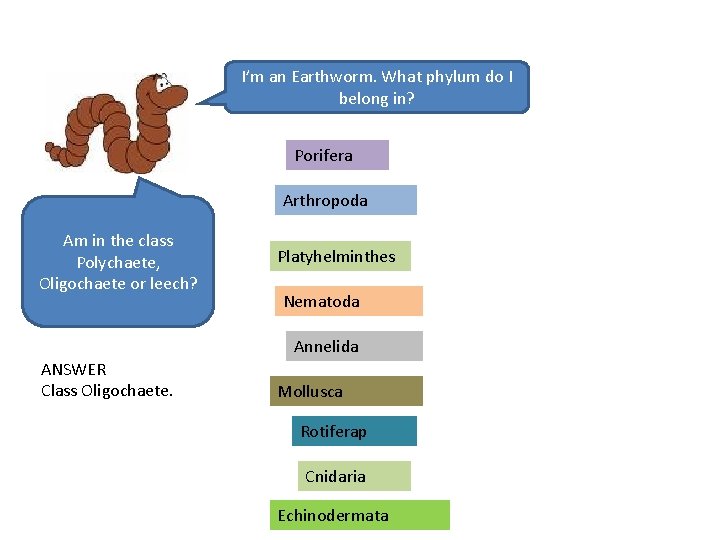
I’m an Earthworm. What phylum do I belong in? Porifera Arthropoda Am in the class Polychaete, Oligochaete or leech? Platyhelminthes Nematoda Annelida ANSWER Class Oligochaete. Mollusca Rotiferap Cnidaria Echinodermata
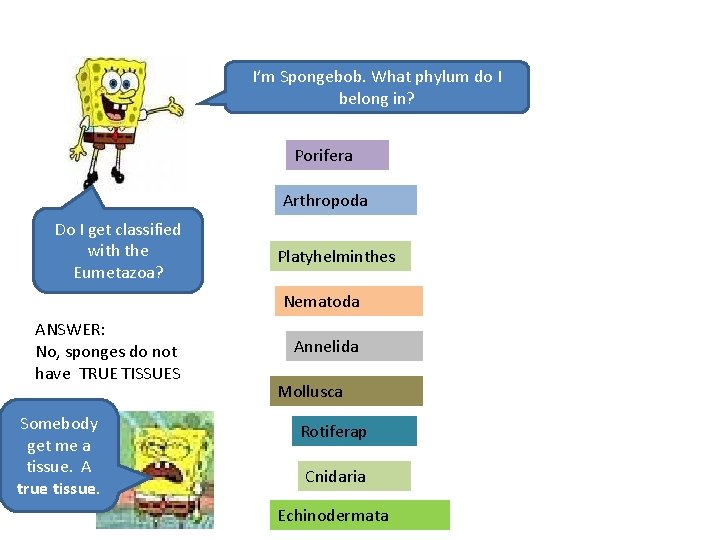
I’m Spongebob. What phylum do I belong in? Porifera Arthropoda Do I get classified with the Eumetazoa? Platyhelminthes Nematoda ANSWER: No, sponges do not have TRUE TISSUES Somebody get me a tissue. A true tissue. Annelida Mollusca Rotiferap Cnidaria Echinodermata
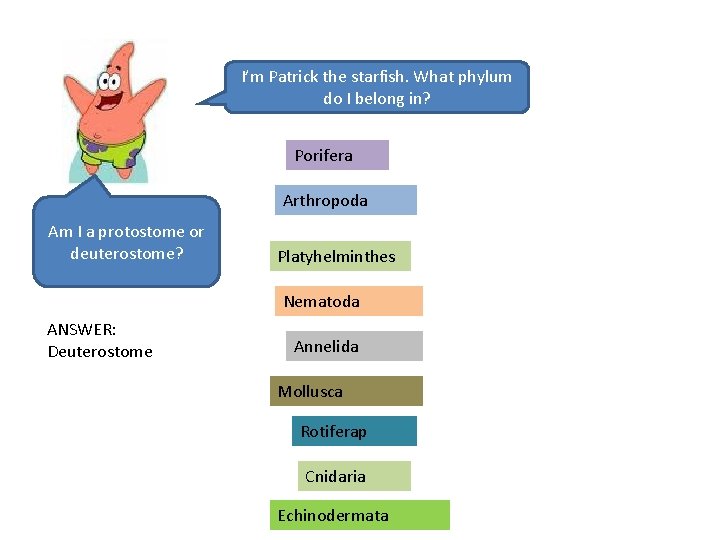
I’m Patrick the starfish. What phylum do I belong in? Porifera Arthropoda Am I a protostome or deuterostome? Platyhelminthes Nematoda ANSWER: Deuterostome Annelida Mollusca Rotiferap Cnidaria Echinodermata
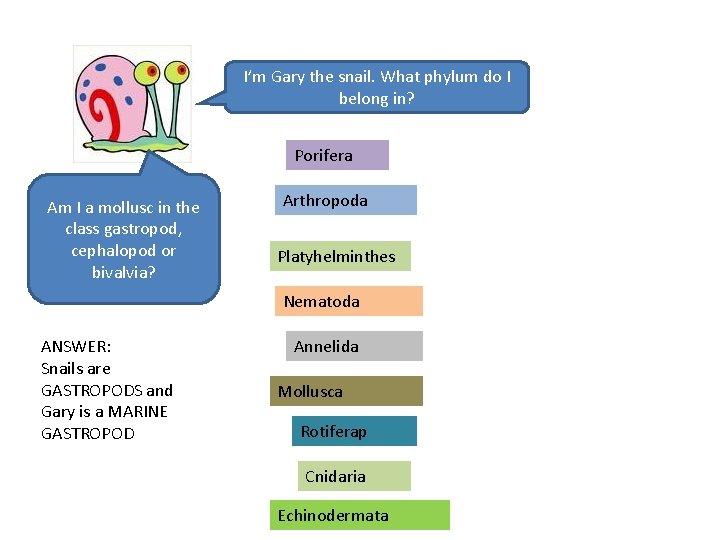
I’m Gary the snail. What phylum do I belong in? Porifera Am I a mollusc in the class gastropod, cephalopod or bivalvia? Arthropoda Platyhelminthes Nematoda ANSWER: Snails are GASTROPODS and Gary is a MARINE GASTROPOD Annelida Mollusca Rotiferap Cnidaria Echinodermata
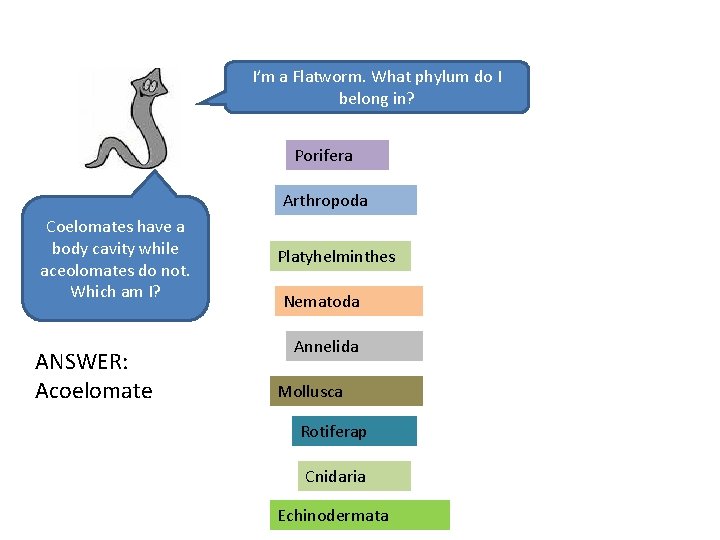
I’m a Flatworm. What phylum do I belong in? Porifera Arthropoda Coelomates have a body cavity while aceolomates do not. Which am I? ANSWER: Acoelomate Platyhelminthes Nematoda Annelida Mollusca Rotiferap Cnidaria Echinodermata
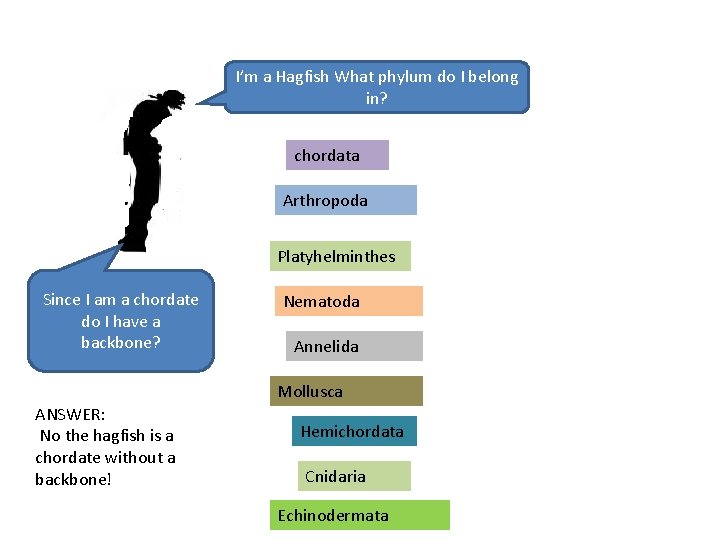
I’m a Hagfish What phylum do I belong in? chordata Arthropoda Platyhelminthes Since I am a chordate do I have a backbone? Nematoda Annelida Mollusca ANSWER: No the hagfish is a chordate without a backbone! Hemichordata Cnidaria Echinodermata
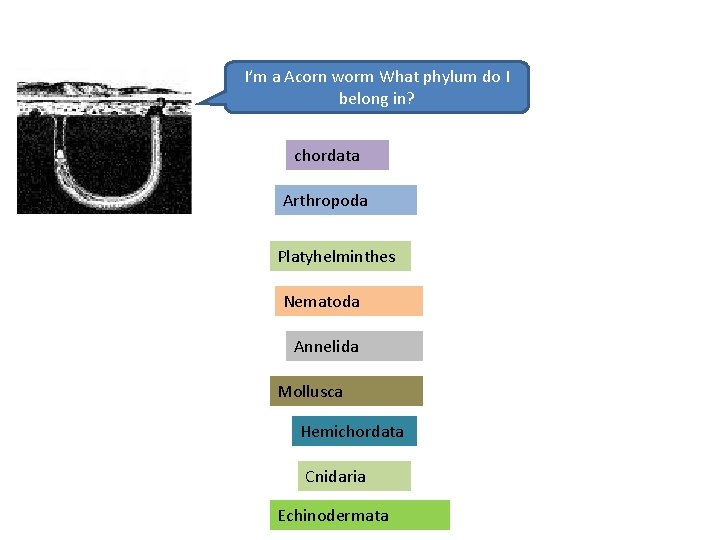
I’m a Acorn worm What phylum do I belong in? chordata Arthropoda Platyhelminthes Nematoda Annelida Mollusca Hemichordata Cnidaria Echinodermata
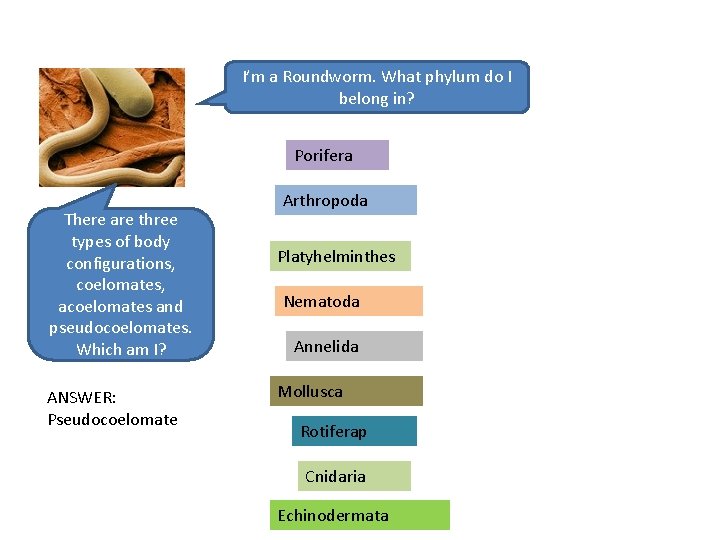
I’m a Roundworm. What phylum do I belong in? Porifera There are three types of body configurations, coelomates, acoelomates and pseudocoelomates. Which am I? ANSWER: Pseudocoelomate Arthropoda Platyhelminthes Nematoda Annelida Mollusca Rotiferap Cnidaria Echinodermata
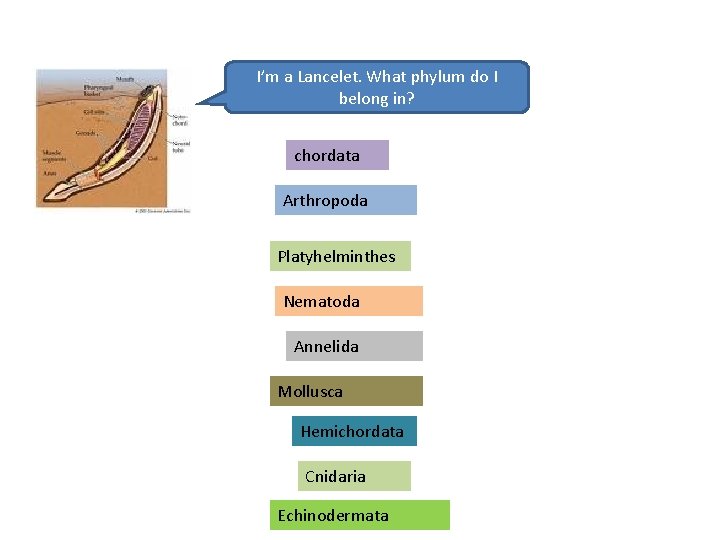
I’m a Lancelet. What phylum do I belong in? chordata Arthropoda Platyhelminthes Nematoda Annelida Mollusca Hemichordata Cnidaria Echinodermata
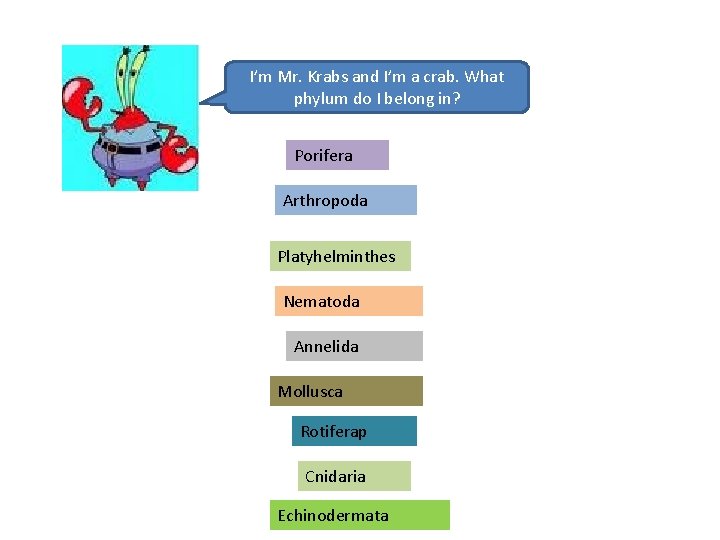
I’m Mr. Krabs and I’m a crab. What phylum do I belong in? Porifera Arthropoda Platyhelminthes Nematoda Annelida Mollusca Rotiferap Cnidaria Echinodermata
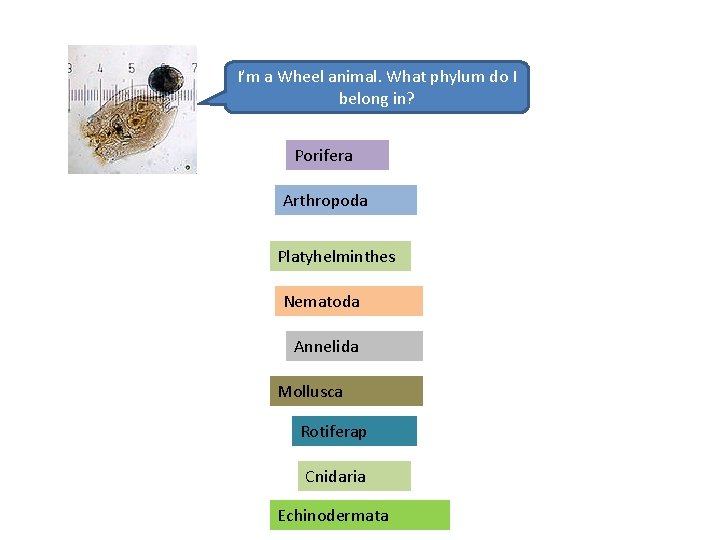
I’m a Wheel animal. What phylum do I belong in? Porifera Arthropoda Platyhelminthes Nematoda Annelida Mollusca Rotiferap Cnidaria Echinodermata
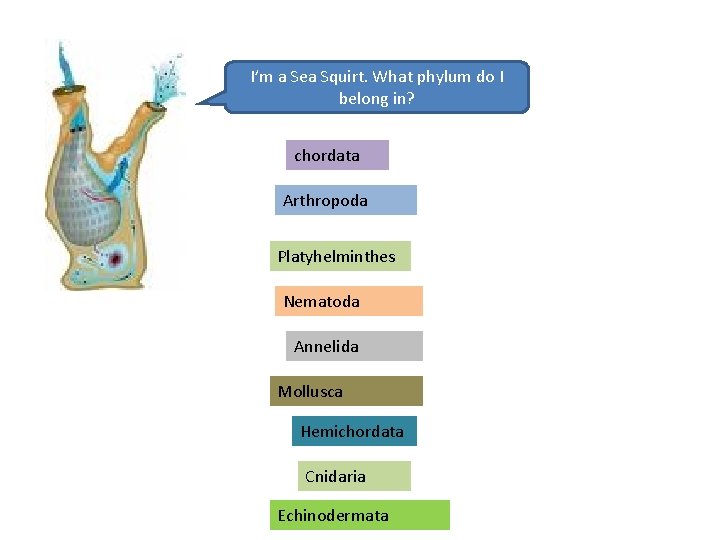
I’m a Sea Squirt. What phylum do I belong in? chordata Arthropoda Platyhelminthes Nematoda Annelida Mollusca Hemichordata Cnidaria Echinodermata
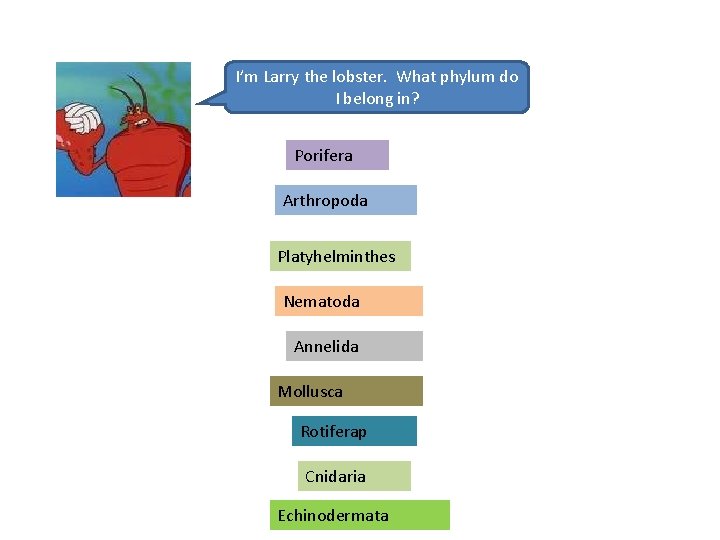
I’m Larry the lobster. What phylum do I belong in? Porifera Arthropoda Platyhelminthes Nematoda Annelida Mollusca Rotiferap Cnidaria Echinodermata
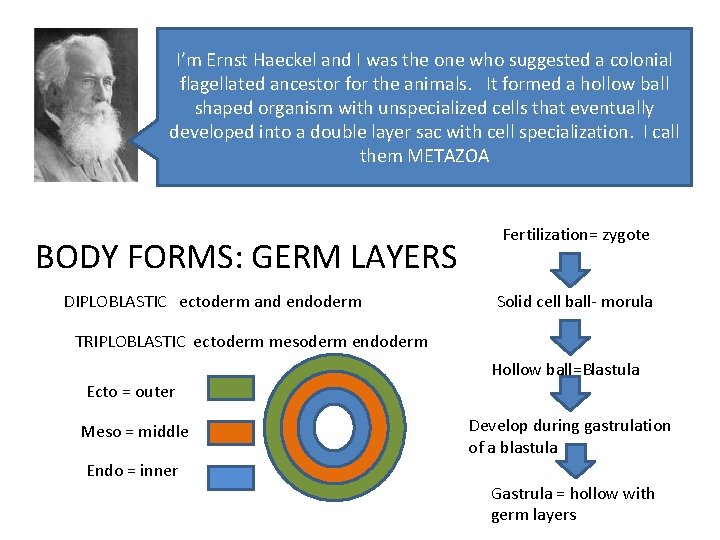
I’m Ernst Haeckel and I was the one who suggested a colonial flagellated ancestor for the animals. It formed a hollow ball shaped organism with unspecialized cells that eventually developed into a double layer sac with cell specialization. I call them METAZOA BODY FORMS: GERM LAYERS DIPLOBLASTIC ectoderm and endoderm Fertilization= zygote Solid cell ball- morula TRIPLOBLASTIC ectoderm mesoderm endoderm Hollow ball=Blastula Ecto = outer Meso = middle Develop during gastrulation of a blastula Endo = inner Gastrula = hollow with germ layers
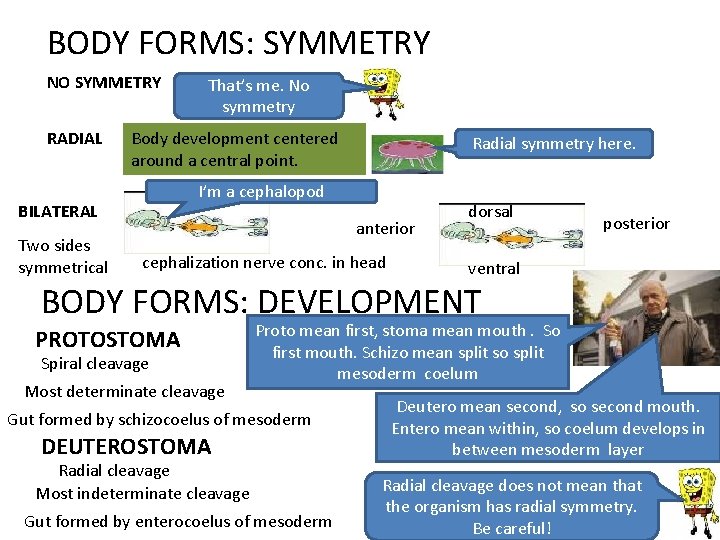
BODY FORMS: SYMMETRY NO SYMMETRY RADIAL Body development centered around a central point. Radial symmetry here. I’m a cephalopod BILATERAL Two sides symmetrical That’s me. No symmetry anterior cephalization nerve conc. in head dorsal posterior ventral BODY FORMS: DEVELOPMENT PROTOSTOMA Spiral cleavage Most determinate cleavage Proto mean first, stoma mean mouth. So first mouth. Schizo mean split so split mesoderm coelum Gut formed by schizocoelus of mesoderm DEUTEROSTOMA Radial cleavage Most indeterminate cleavage Gut formed by enterocoelus of mesoderm Deutero mean second, so second mouth. Entero mean within, so coelum develops in between mesoderm layer Radial cleavage does not mean that the organism has radial symmetry. Be careful!
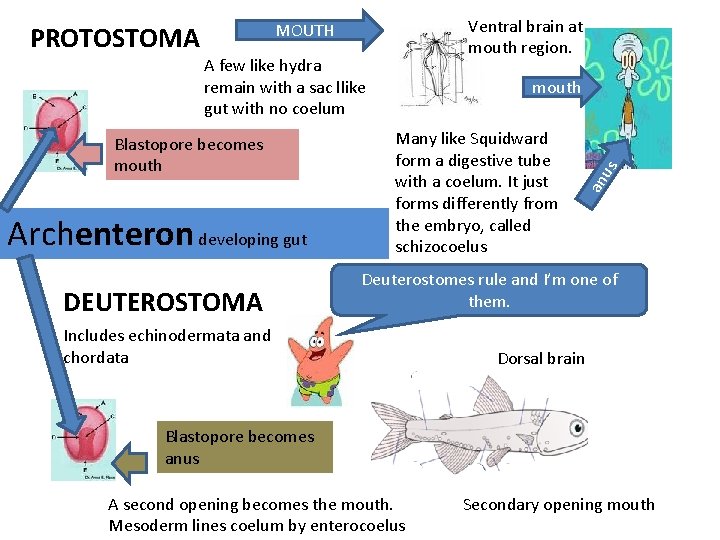
A few like hydra remain with a sac llike gut with no coelum Archenteron developing gut DEUTEROSTOMA Many like Squidward form a digestive tube with a coelum. It just forms differently from the embryo, called schizocoelus us Blastopore becomes mouth an PROTOSTOMA Ventral brain at mouth region. MOUTH Deuterostomes rule and I’m one of them. Includes echinodermata and chordata Dorsal brain Blastopore becomes anus A second opening becomes the mouth. Mesoderm lines coelum by enterocoelus Secondary opening mouth
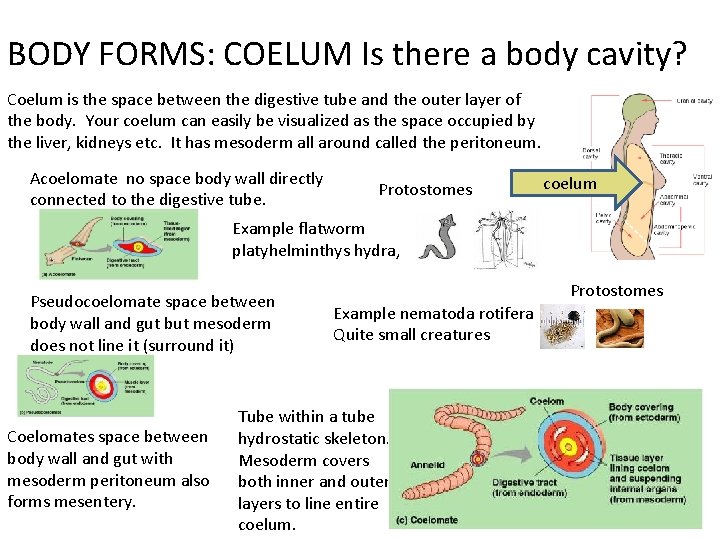
BODY FORMS: COELUM Is there a body cavity? Coelum is the space between the digestive tube and the outer layer of the body. Your coelum can easily be visualized as the space occupied by the liver, kidneys etc. It has mesoderm all around called the peritoneum. Acoelomate no space body wall directly connected to the digestive tube. Protostomes coelum Example flatworm platyhelminthys hydra, Pseudocoelomate space between body wall and gut but mesoderm does not line it (surround it) Coelomates space between body wall and gut with mesoderm peritoneum also forms mesentery. Protostomes Example nematoda rotifera Quite small creatures Tube within a tube hydrostatic skeleton. Mesoderm covers both inner and outer layers to line entire coelum.
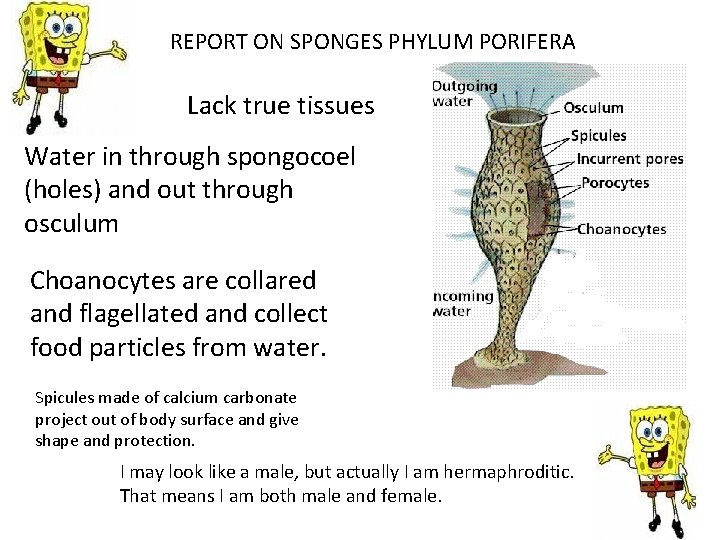
REPORT ON SPONGES PHYLUM PORIFERA Lack true tissues Water in through spongocoel (holes) and out through osculum Choanocytes are collared and flagellated and collect food particles from water. Spicules made of calcium carbonate project out of body surface and give shape and protection. I may look like a male, but actually I am hermaphroditic. That means I am both male and female.
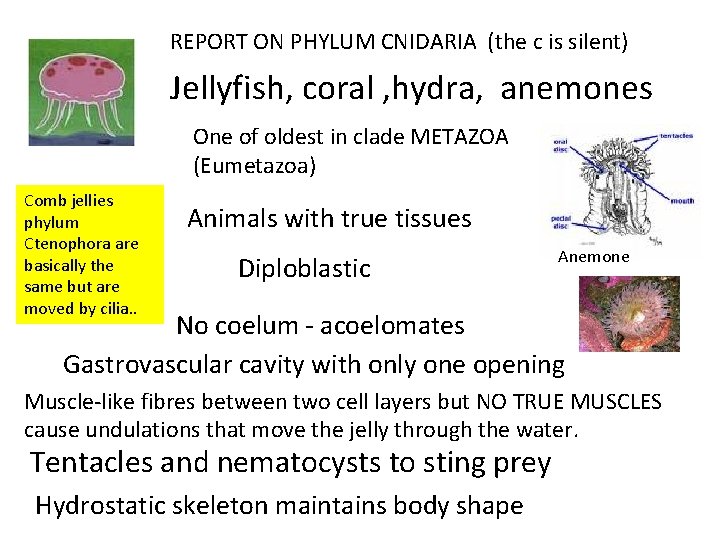
REPORT ON PHYLUM CNIDARIA (the c is silent) Jellyfish, coral , hydra, anemones One of oldest in clade METAZOA (Eumetazoa) Comb jellies phylum Ctenophora are basically the same but are moved by cilia. . Animals with true tissues Diploblastic Anemone No coelum - acoelomates Gastrovascular cavity with only one opening Muscle-like fibres between two cell layers but NO TRUE MUSCLES cause undulations that move the jelly through the water. Tentacles and nematocysts to sting prey Hydrostatic skeleton maintains body shape
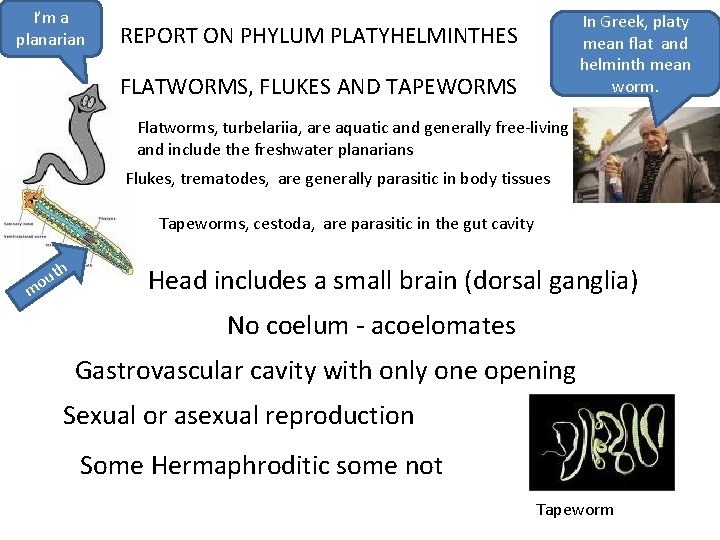
I’m a planarian In Greek, platy mean flat and helminth mean worm. REPORT ON PHYLUM PLATYHELMINTHES FLATWORMS, FLUKES AND TAPEWORMS Flatworms, turbelariia, are aquatic and generally free-living and include the freshwater planarians Flukes, trematodes, are generally parasitic in body tissues Tapeworms, cestoda, are parasitic in the gut cavity th u mo Head includes a small brain (dorsal ganglia) No coelum - acoelomates Gastrovascular cavity with only one opening Sexual or asexual reproduction Some Hermaphroditic some not Tapeworm
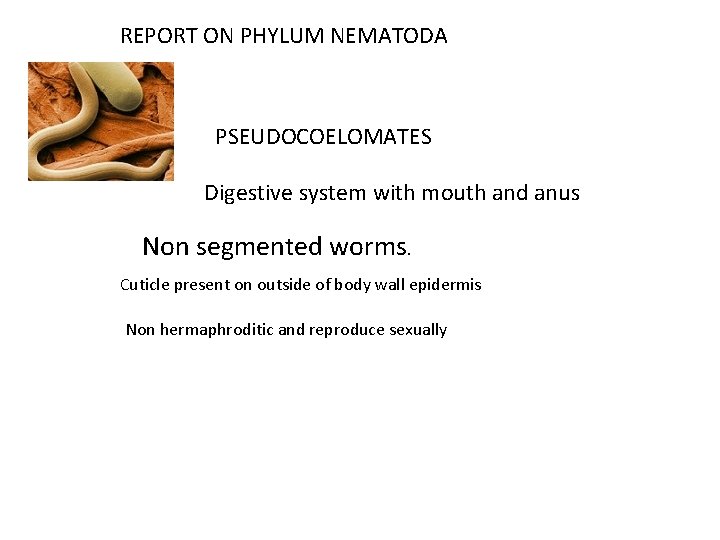
REPORT ON PHYLUM NEMATODA PSEUDOCOELOMATES Digestive system with mouth and anus Non segmented worms. Cuticle present on outside of body wall epidermis Non hermaphroditic and reproduce sexually
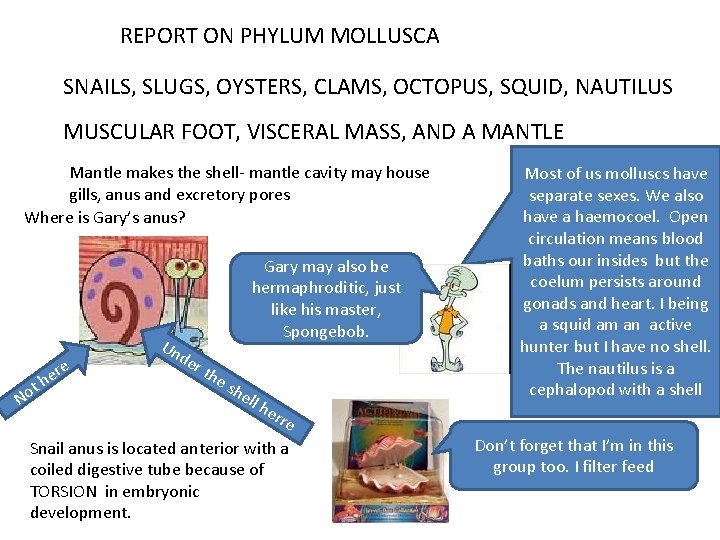
REPORT ON PHYLUM MOLLUSCA SNAILS, SLUGS, OYSTERS, CLAMS, OCTOPUS, SQUID, NAUTILUS MUSCULAR FOOT, VISCERAL MASS, AND A MANTLE Mantle makes the shell- mantle cavity may house gills, anus and excretory pores Where is Gary’s anus? t No h ere Un Gary may also be hermaphroditic, just like his master, Spongebob. de r th es he ll h err e Snail anus is located anterior with a coiled digestive tube because of TORSION in embryonic development. Most of us molluscs have separate sexes. We also have a haemocoel. Open circulation means blood baths our insides but the coelum persists around gonads and heart. I being a squid am an active hunter but I have no shell. The nautilus is a cephalopod with a shell Don’t forget that I’m in this group too. I filter feed
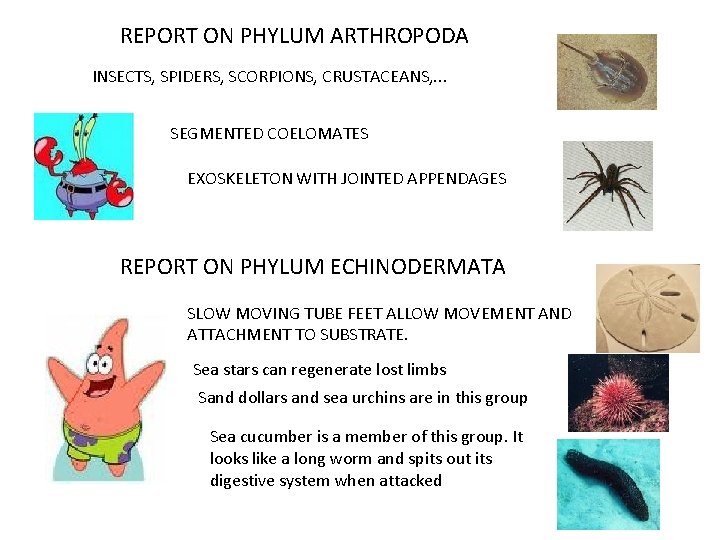
REPORT ON PHYLUM ARTHROPODA INSECTS, SPIDERS, SCORPIONS, CRUSTACEANS, . . . SEGMENTED COELOMATES EXOSKELETON WITH JOINTED APPENDAGES REPORT ON PHYLUM ECHINODERMATA SLOW MOVING TUBE FEET ALLOW MOVEMENT AND ATTACHMENT TO SUBSTRATE. Sea stars can regenerate lost limbs Sand dollars and sea urchins are in this group Sea cucumber is a member of this group. It looks like a long worm and spits out its digestive system when attacked
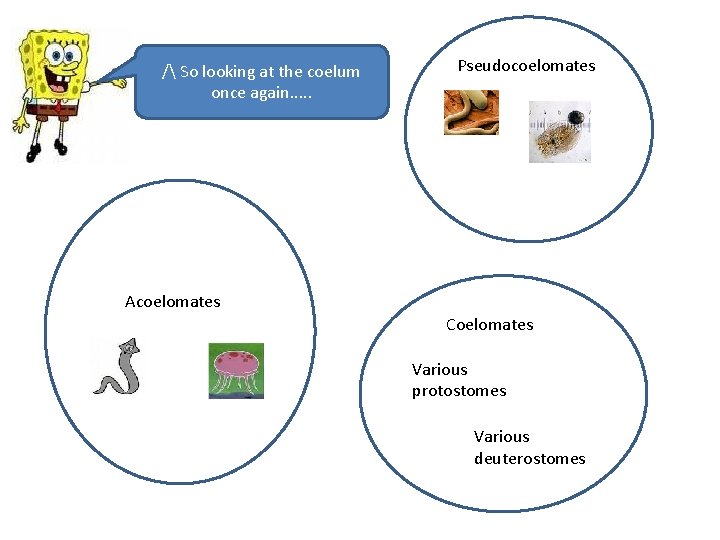
/ So looking at the coelum once again. . . Pseudocoelomates Acoelomates Coelomates Various protostomes Various deuterostomes
Bye for now. Hey I’ll bet you learned something. How come you learn something when watching the Spongebob cartoon? INVERTEBRATES Ends Stephen Hillenburg, the creator of Spongebob, is an artist, animator and former marine biologist. You can tell because of the terms used in the show.

- Slides: 38