
Invertebrates Flatworms Platyhelminthes planarians Sub Groups Cestoda tapeworms
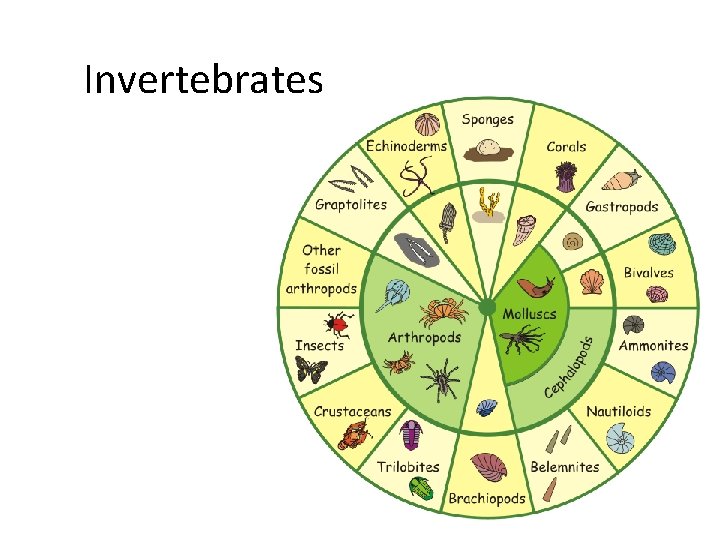
Invertebrates
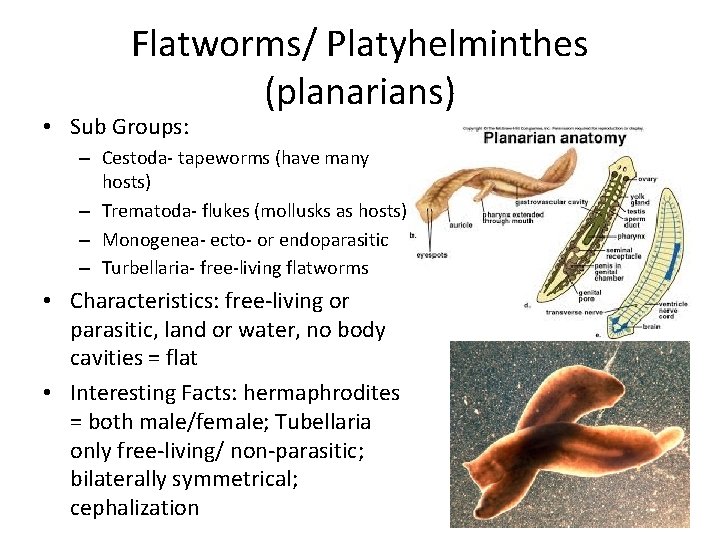
Flatworms/ Platyhelminthes (planarians) • Sub Groups: – Cestoda- tapeworms (have many hosts) – Trematoda- flukes (mollusks as hosts) – Monogenea- ecto- or endoparasitic – Turbellaria- free-living flatworms • Characteristics: free-living or parasitic, land or water, no body cavities = flat • Interesting Facts: hermaphrodites = both male/female; Tubellaria only free-living/ non-parasitic; bilaterally symmetrical; cephalization
Roundworms (nematodes) • Sub Groups: – Adenophorea – Secementea • Characteristics: Live in soil/FW/Saltwater, tube digestion system, hydorstatic skeleton, parasitic • Interesting Facts: all look similar except for tail structure • Examples: Trichinella spiralis, hookworms, Ascaris
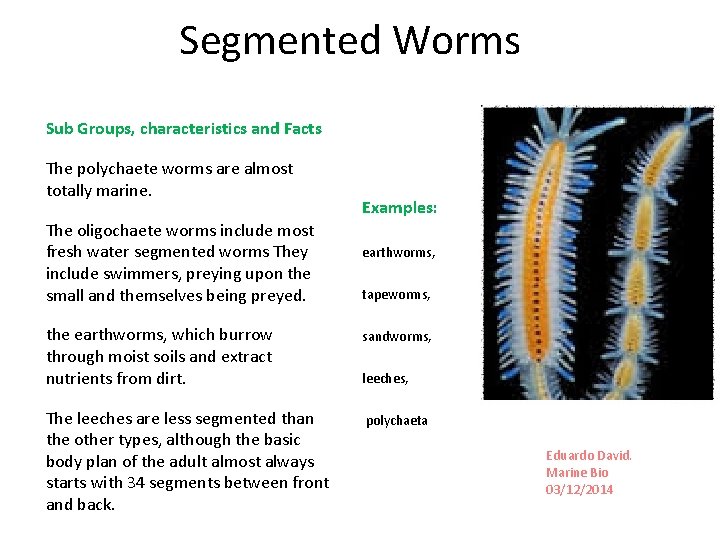
Segmented Worms Sub Groups, characteristics and Facts The polychaete worms are almost totally marine. The oligochaete worms include most fresh water segmented worms They include swimmers, preying upon the small and themselves being preyed. Examples: earthworms, tapeworms, the earthworms, which burrow through moist soils and extract nutrients from dirt. sandworms, The leeches are less segmented than the other types, although the basic body plan of the adult almost always starts with 34 segments between front and back. polychaeta leeches, Eduardo David. Marine Bio 03/12/2014
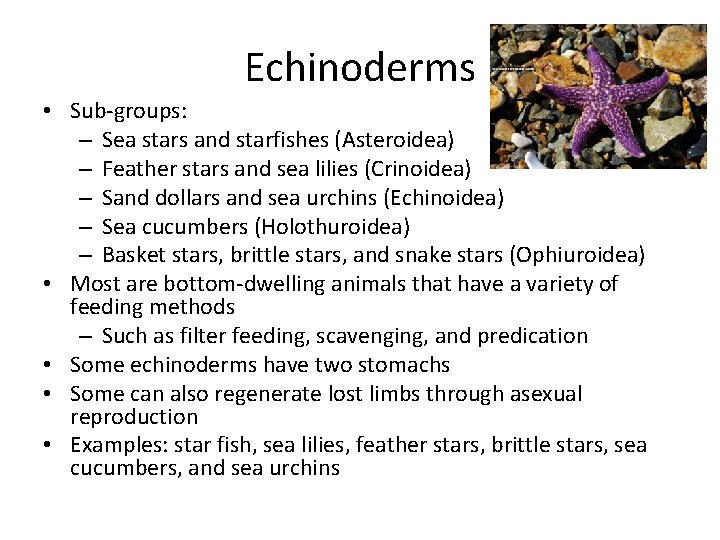
Echinoderms • Sub-groups: – Sea stars and starfishes (Asteroidea) – Feather stars and sea lilies (Crinoidea) – Sand dollars and sea urchins (Echinoidea) – Sea cucumbers (Holothuroidea) – Basket stars, brittle stars, and snake stars (Ophiuroidea) • Most are bottom-dwelling animals that have a variety of feeding methods – Such as filter feeding, scavenging, and predication • Some echinoderms have two stomachs • Some can also regenerate lost limbs through asexual reproduction • Examples: star fish, sea lilies, feather stars, brittle stars, sea cucumbers, and sea urchins
Mollusks Subgroups- cephalopods, gastropods, and bivalves. Characteristics- There characteristics are that they are all soft, they have unsegmented bodies and are invertebrates. Some have shells, and some don’t. Interesting facts- There are 8 groups of mollusks alive today. Mollusks come in all different shapes, sizes, and forms. Example- Squid, octopus, and snails.
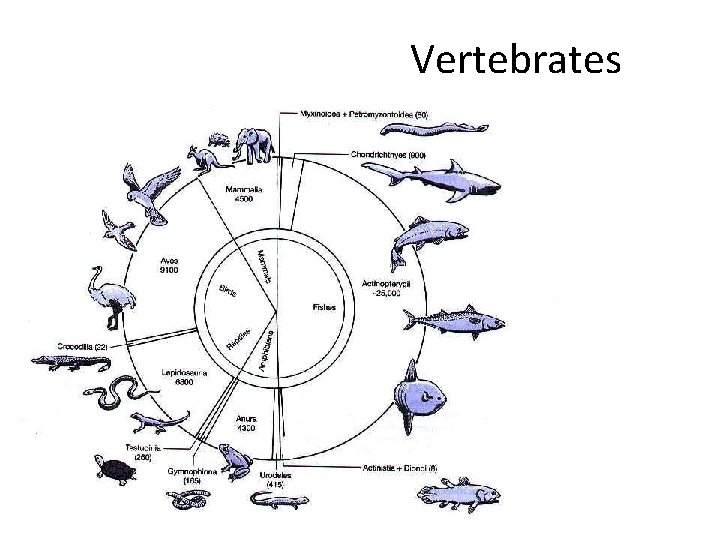
Vertebrates

Bony fishes(Osteichthyes) Sub-Groups: Actinopterygii(The ray-finned fishes) Sarcopterygii(The lobe-finned bony fishes) Characteristics: are a taxonomic group of fish that have bone, as opposed to cartilaginous, skeletons. The vast majority of fish are osteichthyes, which is an extremely diverse and abundant group consisting of 45 orders, and over 435 families and 28, 000 species. Interesting Facts: 1. They have teeth that are fixed onto the upper jaw. 2. Bony fish do not have to swim to breathe. 3. They also are able to see in color, unlike most other fish. Examples: Chinese Sturgeon Salmon
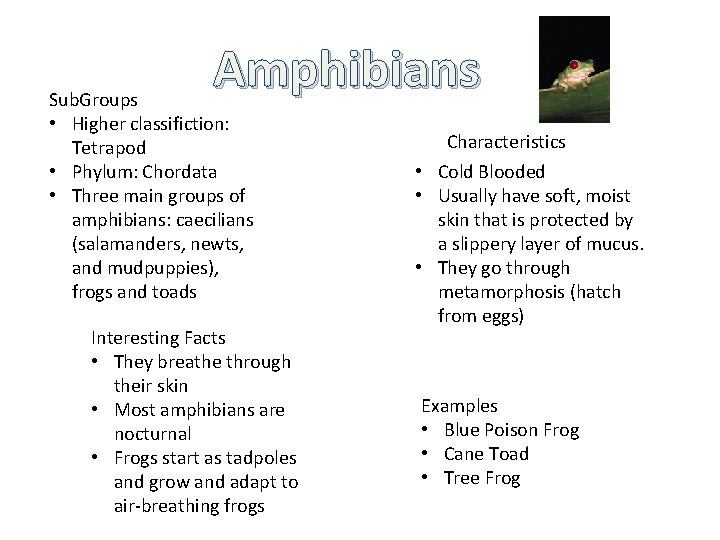
Amphibians Sub. Groups • Higher classifiction: Subgroups Tetrapod • Phylum: Chordata • Three main groups of amphibians: caecilians (salamanders, newts, and mudpuppies), frogs and toads Interesting Facts • They breathe through Interesting Facts their skin • Most amphibians are nocturnal • Frogs start as tadpoles and grow and adapt to air-breathing frogs Characteristics • Cold Blooded • Usually have soft, moist skin that is protected by a slippery layer of mucus. • They go through metamorphosis (hatch from eggs) Examples • Blue Poison Frog • Cane Toad • Tree Frog
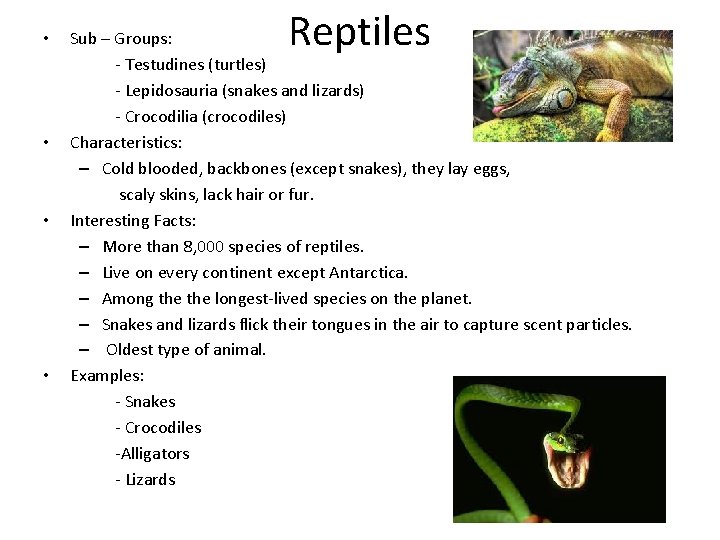
• • Reptiles Sub – Groups: - Testudines (turtles) - Lepidosauria (snakes and lizards) - Crocodilia (crocodiles) Characteristics: – Cold blooded, backbones (except snakes), they lay eggs, scaly skins, lack hair or fur. Interesting Facts: – More than 8, 000 species of reptiles. – Live on every continent except Antarctica. – Among the longest-lived species on the planet. – Snakes and lizards flick their tongues in the air to capture scent particles. – Oldest type of animal. Examples: - Snakes - Crocodiles -Alligators - Lizards
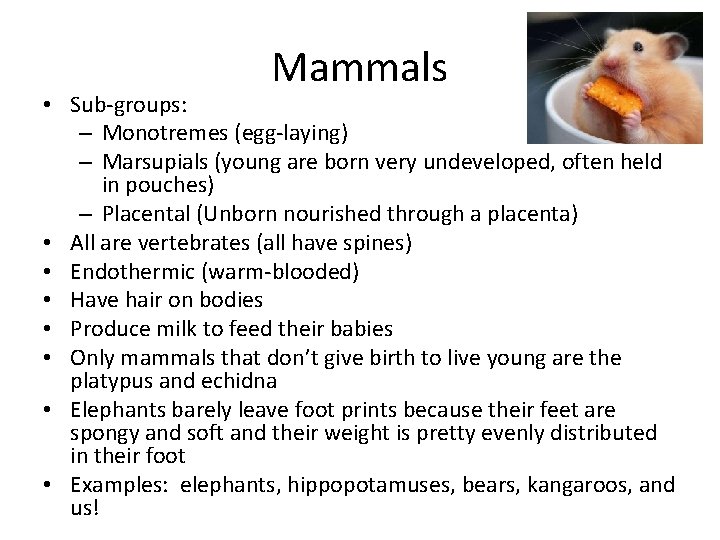
Mammals • Sub-groups: – Monotremes (egg-laying) – Marsupials (young are born very undeveloped, often held in pouches) – Placental (Unborn nourished through a placenta) • All are vertebrates (all have spines) • Endothermic (warm-blooded) • Have hair on bodies • Produce milk to feed their babies • Only mammals that don’t give birth to live young are the platypus and echidna • Elephants barely leave foot prints because their feet are spongy and soft and their weight is pretty evenly distributed in their foot • Examples: elephants, hippopotamuses, bears, kangaroos, and us!
- Slides: 11