
Invertebrates 4 Phylum Mollusca Phylum Mollusca The softbodied
Invertebrates 4 Phylum Mollusca

Phylum Mollusca: The “soft-bodied” animals

Evolutionary relationships and HOX genes

Molluscan body plan Hypothetical ancestral mollusc (HAM) § § § § Shell Mantle cavity Ctenidia Visceral mass Head and assocated sensory structures Radula Foot and epipodial tentacles

Molluscan body plan (HAM) § Digestive system § § § complete note position of anus Circulation/Respiration § § ctenidium open circulatory system § § coelom=pericardial cavity. § § Except which class? True coelom, but reduced. Water/ion balance and ammonia excretion § Has paired nephridia: kidney-like in function

Molluscan body plan (HAM) § Nervous system § § Brain Paired ventral nerve cords. Ganglia at key locations Several sensory structures (already presented)
Major Molluscan Classes § LEARN!: § How are the features of HAM modified for each of the major classes? § how are these modifications adaptive? ?

Class Polyplacophora: “many plates” § The chitons § Differences from HAM § 8 shell plates § Mantle cavity expanded around foot § Multiple ctenidia § Mantle grows over shell, thickened (new functions? ) § Reduced head; no sensory structures
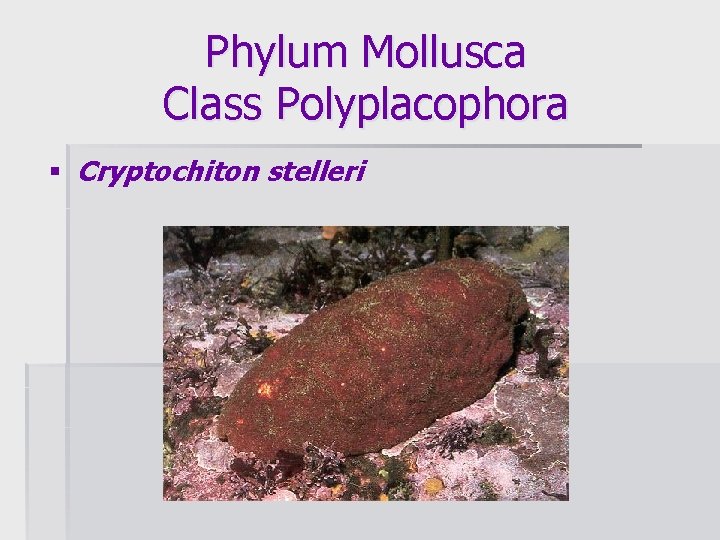
Phylum Mollusca Class Polyplacophora § Cryptochiton stelleri

Class Gastropoda: “stomachfoot” § Representative members: Snails, limpets, abalone, nudibranchs, sea and land slugs § Differences from HAM § Undergo torsion (sketch) § What is torsion? § Advantages of torsion § Disadvantages of torsion § Be sure you understand how torsion makes Gastropods different from HAM!
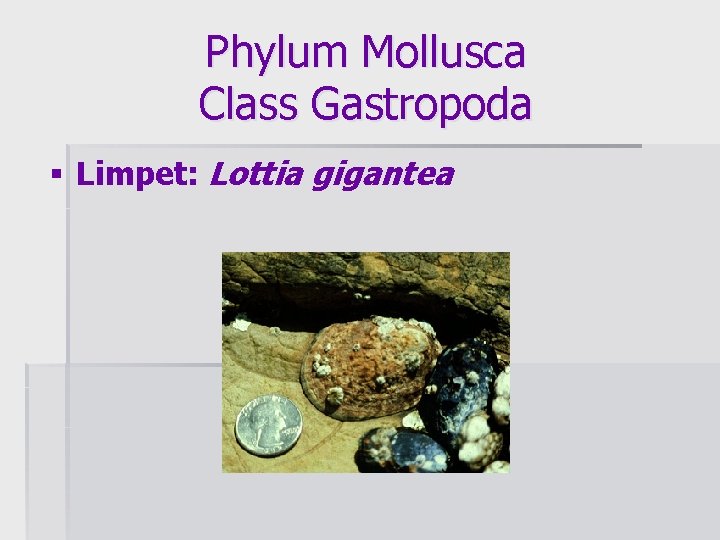
Phylum Mollusca Class Gastropoda § Limpet: Lottia gigantea

Phylum Mollusca Class Gastropoda § Dogwinkle: Nucella sp.

Phylum Mollusca Class Gastropoda § Opisthobranchs: “rear gill” § Discodoris (Dialula sandiegensis)

Phylum Mollusca Class Gastropoda § Opisthobranchs: “rear gill” § Hermissenda (Phidiana) crassicornis
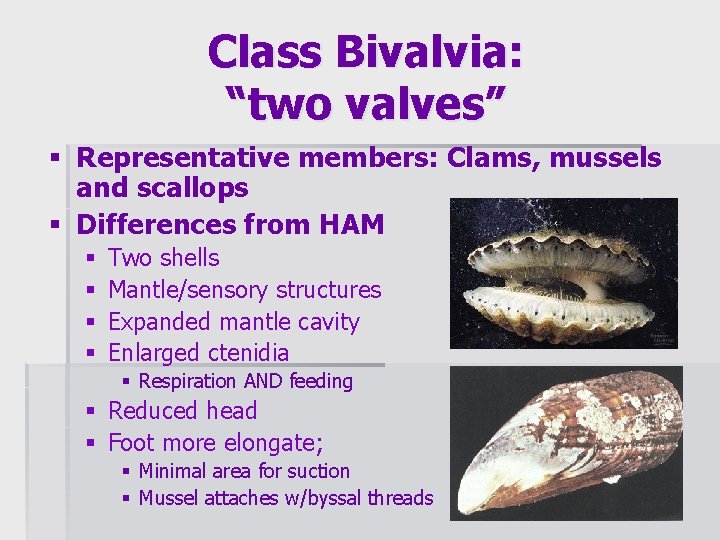
Class Bivalvia: “two valves” § Representative members: Clams, mussels and scallops § Differences from HAM § § Two shells Mantle/sensory structures Expanded mantle cavity Enlarged ctenidia § Respiration AND feeding § Reduced head § Foot more elongate; § Minimal area for suction § Mussel attaches w/byssal threads
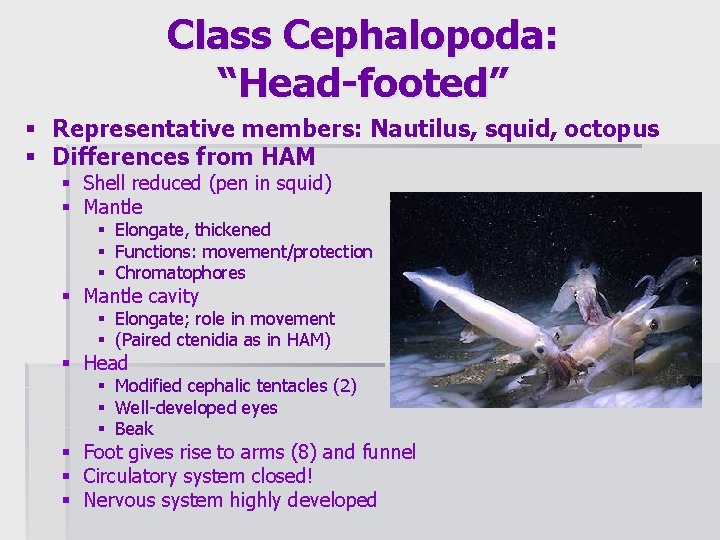
Class Cephalopoda: “Head-footed” § Representative members: Nautilus, squid, octopus § Differences from HAM § Shell reduced (pen in squid) § Mantle § Elongate, thickened § Functions: movement/protection § Chromatophores § Mantle cavity § Elongate; role in movement § (Paired ctenidia as in HAM) § Head § Modified cephalic tentacles (2) § Well-developed eyes § Beak § Foot gives rise to arms (8) and funnel § Circulatory system closed! § Nervous system highly developed
- Slides: 16