
Invertebrate Zoology Lecture 5 Phylum Porifera Lecture outline
Invertebrate Zoology Lecture 5: Phylum Porifera
Lecture outline § Phylum Porifera «Overview «Body structure and the aquiferous “system” «Nutrition, excretion and gas exchange «Activity and Sensitivity «Reproduction «Reaggregation «Protection «Sponges as habitat «Sponges and Humans
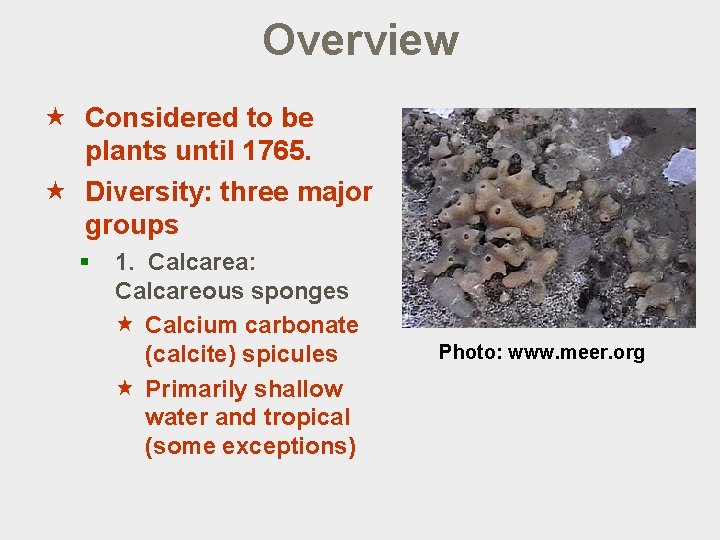
Overview « Considered to be plants until 1765. « Diversity: three major groups § 1. Calcarea: Calcareous sponges « Calcium carbonate (calcite) spicules « Primarily shallow water and tropical (some exceptions) Photo: www. meer. org
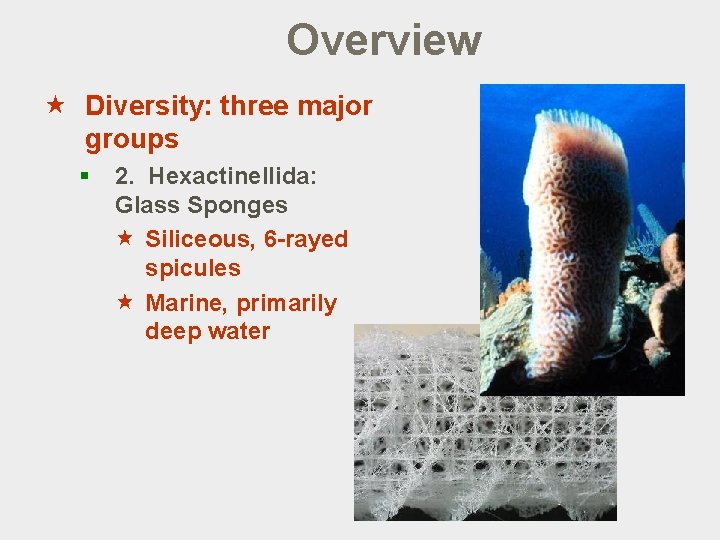
Overview « Diversity: three major groups § 2. Hexactinellida: Glass Sponges « Siliceous, 6 -rayed spicules « Marine, primarily deep water
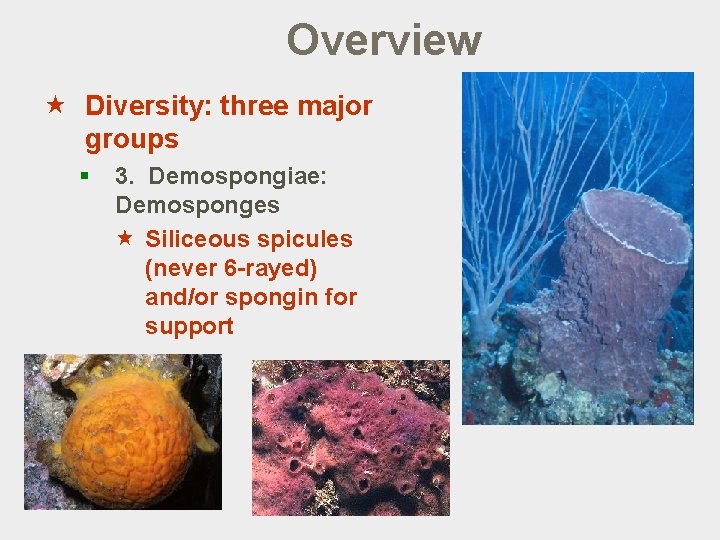
Overview « Diversity: three major groups § 3. Demospongiae: Demosponges « Siliceous spicules (never 6 -rayed) and/or spongin for support
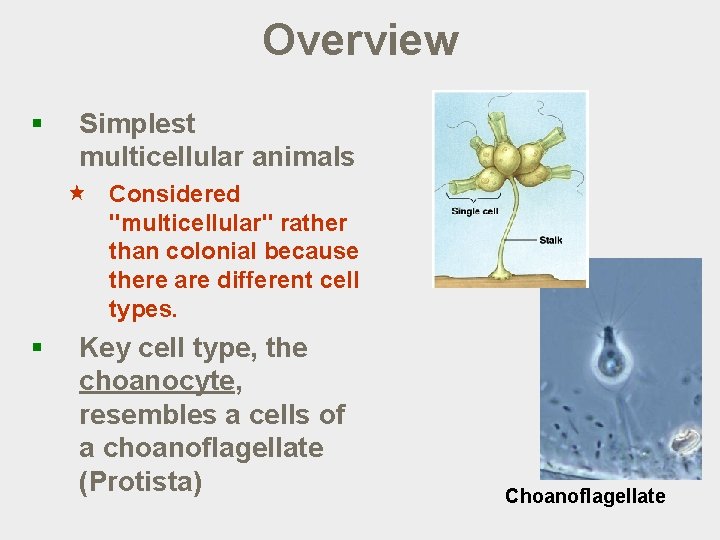
Overview § Simplest multicellular animals « Considered "multicellular" rather than colonial because there are different cell types. § Key cell type, the choanocyte, resembles a cells of a choanoflagellate (Protista) Choanoflagellate
Overview § Key characteristics (see Box 6 A) « Metazoa § No true tissues or body systems of any type « Not much, if any. coordination among cells « Layers lack basement membrane « Adults are asymmetrical or superficially radially symmetrical « Totipotent cells: like stem cells! « Choanocytes drive water through the various canals and chambers: “aquiferous system”
Overview § Key characteristics (cont. ) « Almost all species are sessile suspension feeders « Larvae are motile, usually lecithotrophic (dispersed, not brooded; carry significant yolk supply; non-feeding) « Mesohyle (middle “layer”) includes motile cells plus supporting material (i. e. spicules, spongin) « Skeletal elements composed of calcium carbonate, silicon dioxide and/or collagen
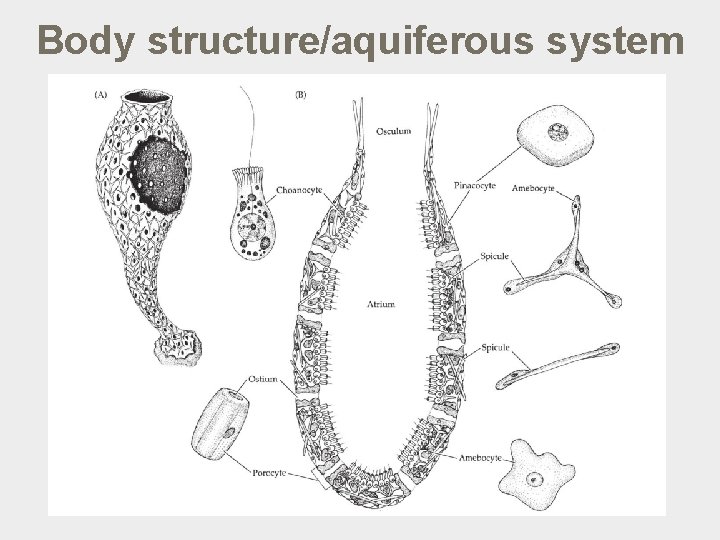
Body structure/aquiferous system
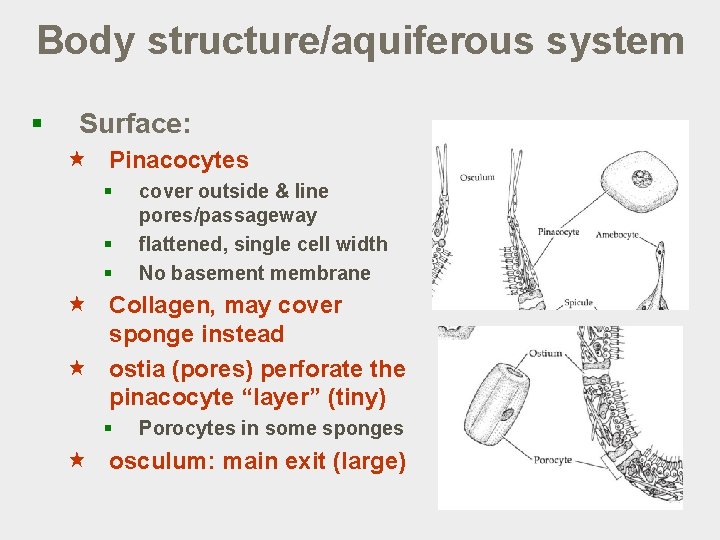
Body structure/aquiferous system § Surface: « Pinacocytes § § § cover outside & line pores/passageway flattened, single cell width No basement membrane « Collagen, may cover sponge instead « ostia (pores) perforate the pinacocyte “layer” (tiny) § Porocytes in some sponges « osculum: main exit (large)
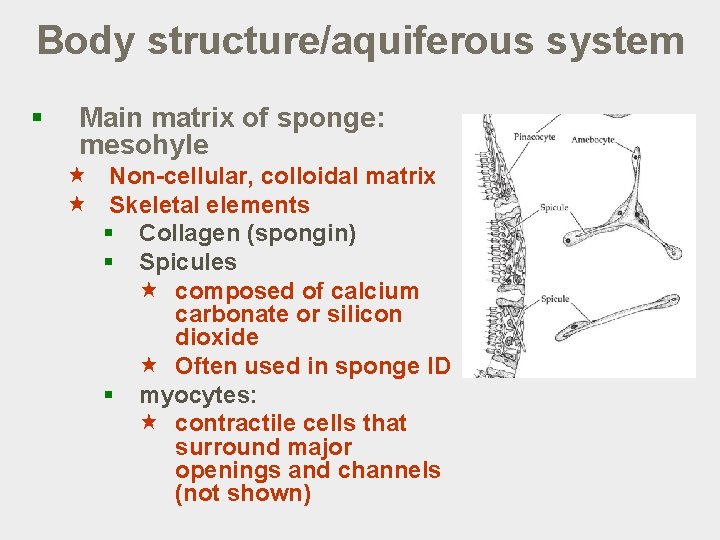
Body structure/aquiferous system § Main matrix of sponge: mesohyle « Non-cellular, colloidal matrix « Skeletal elements § Collagen (spongin) § Spicules « composed of calcium carbonate or silicon dioxide « Often used in sponge ID § myocytes: « contractile cells that surround major openings and channels (not shown)
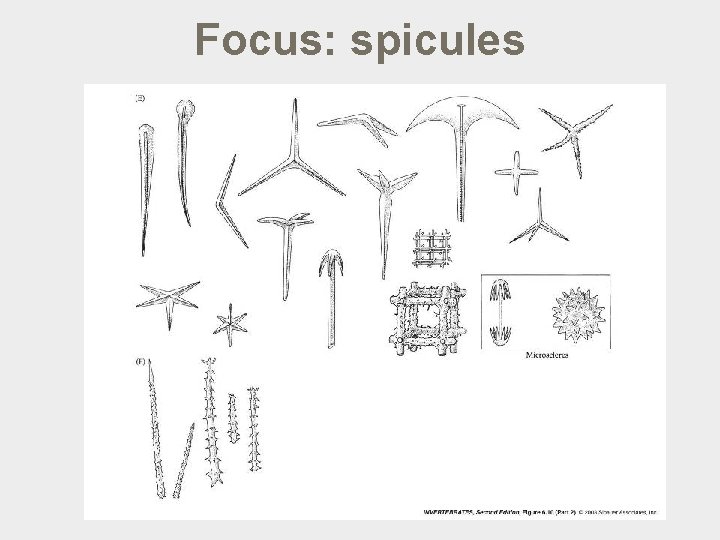
Focus: spicules
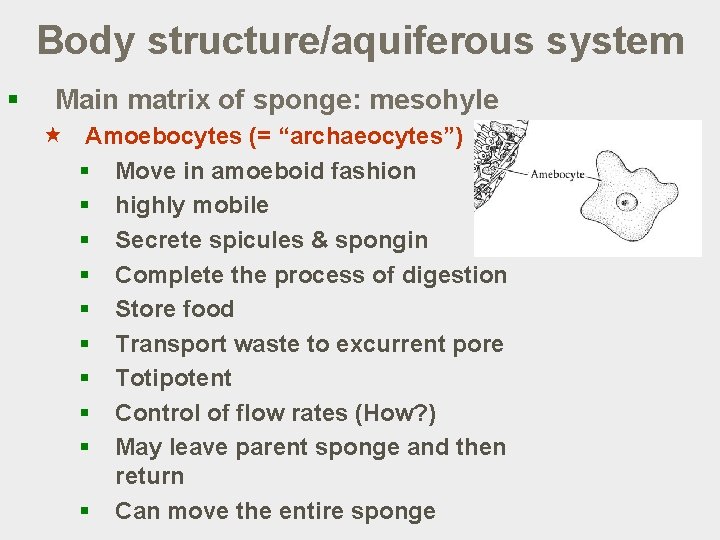
Body structure/aquiferous system § Main matrix of sponge: mesohyle « Amoebocytes (= “archaeocytes”) § Move in amoeboid fashion § highly mobile § Secrete spicules & spongin § Complete the process of digestion § Store food § Transport waste to excurrent pore § Totipotent § Control of flow rates (How? ) § May leave parent sponge and then return § Can move the entire sponge
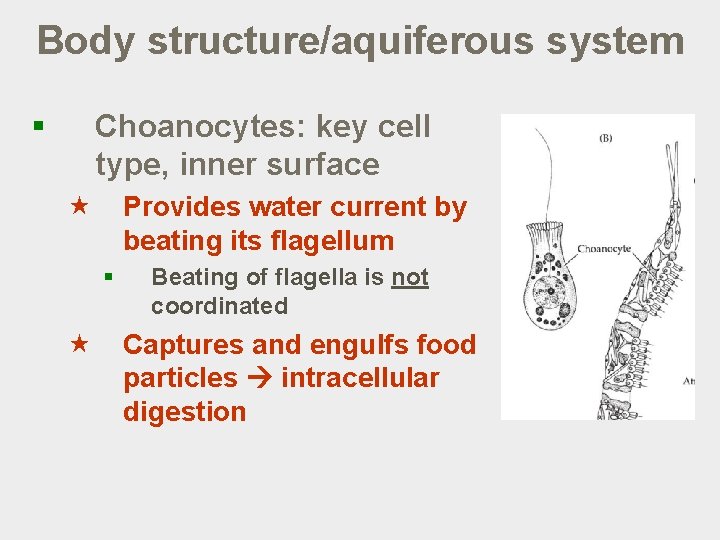
Body structure/aquiferous system § Choanocytes: key cell type, inner surface « Provides water current by beating its flagellum § « Beating of flagella is not coordinated Captures and engulfs food particles intracellular digestion
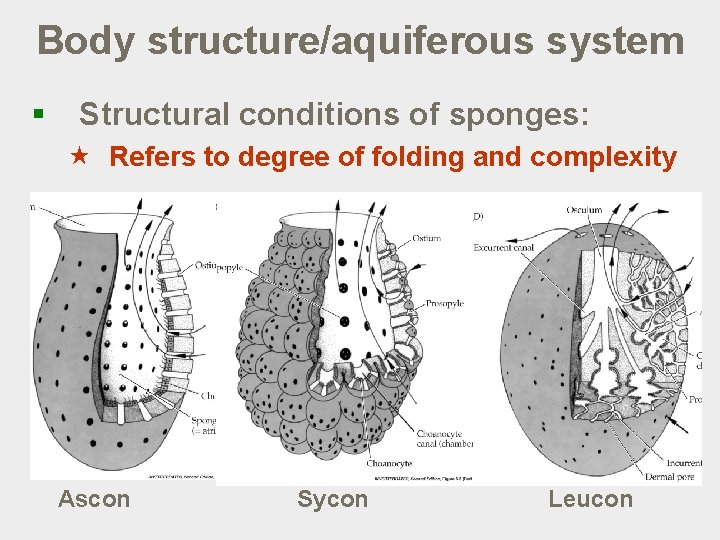
Body structure/aquiferous system § Structural conditions of sponges: « Refers to degree of folding and complexity Ascon Sycon Leucon
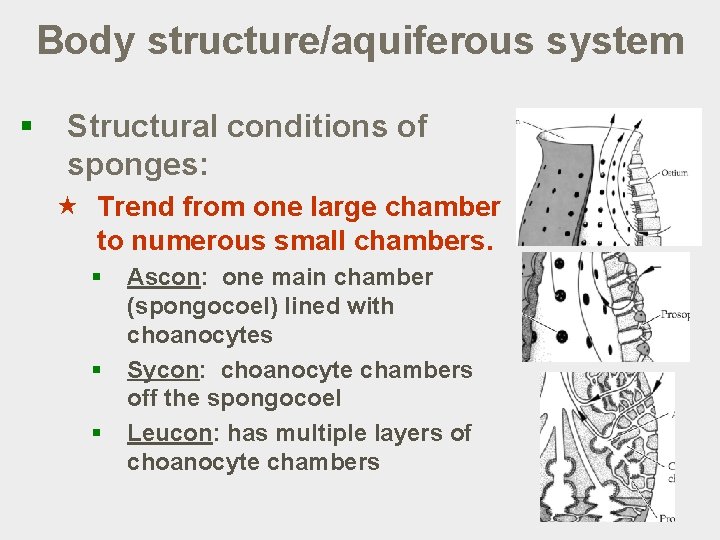
Body structure/aquiferous system § Structural conditions of sponges: « Trend from one large chamber to numerous small chambers. § § § Ascon: one main chamber (spongocoel) lined with choanocytes Sycon: choanocyte chambers off the spongocoel Leucon: has multiple layers of choanocyte chambers
Body structure/aquiferous system § Consequences of increased complexity « More surface area for…? « Higher flow rates (overall) § Causes? « Advantages of higher flow rates? « Potential problems of flow? § § Where in sponge must flow rates drop and why? What causes this slowing? « NOTE: Water current adds to internal current created by flagella
Nutrition § § Water flow brings in food Size selectivity at several levels « Ostia, ~5 -50 µm = small phytoplankton, bacteria, detritus « Ameobocytes, ~2 -5 µm (smaller phytoplankton, bacteria, detritus) « Choanocyte collar: ~0. 5 – 1. 5 µm (bacteria, viruses, larger organic molecules)
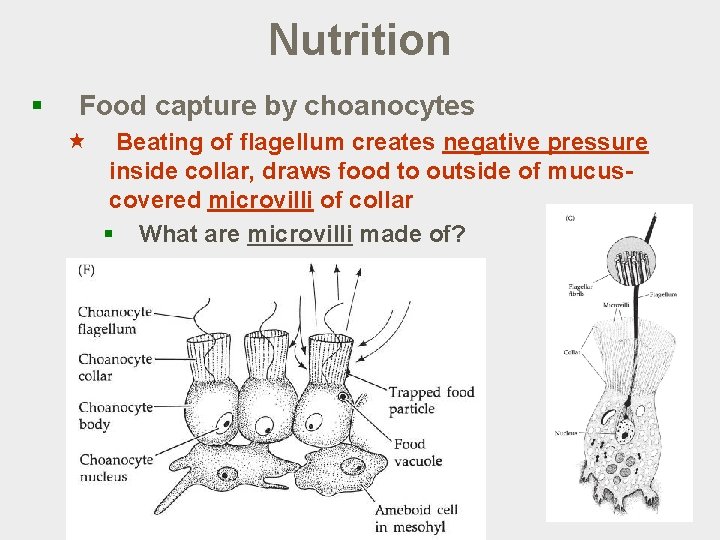
Nutrition § Food capture by choanocytes « Beating of flagellum creates negative pressure inside collar, draws food to outside of mucuscovered microvilli of collar § What are microvilli made of?
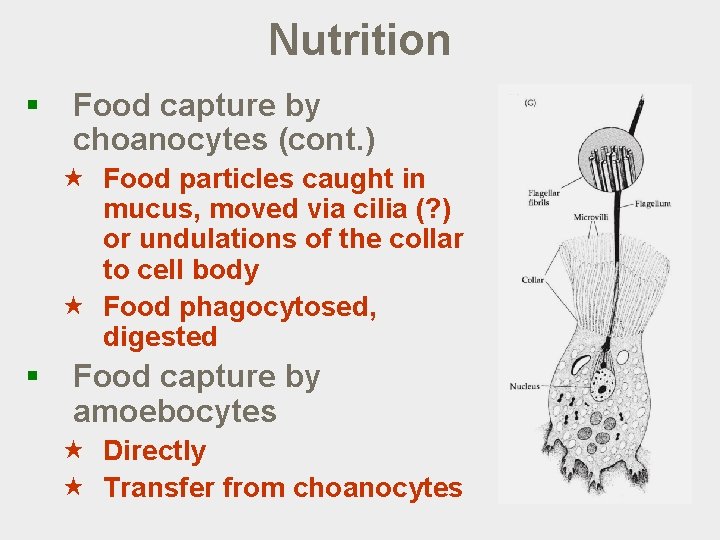
Nutrition § Food capture by choanocytes (cont. ) « Food particles caught in mucus, moved via cilia (? ) or undulations of the collar to cell body « Food phagocytosed, digested § Food capture by amoebocytes « Directly « Transfer from choanocytes
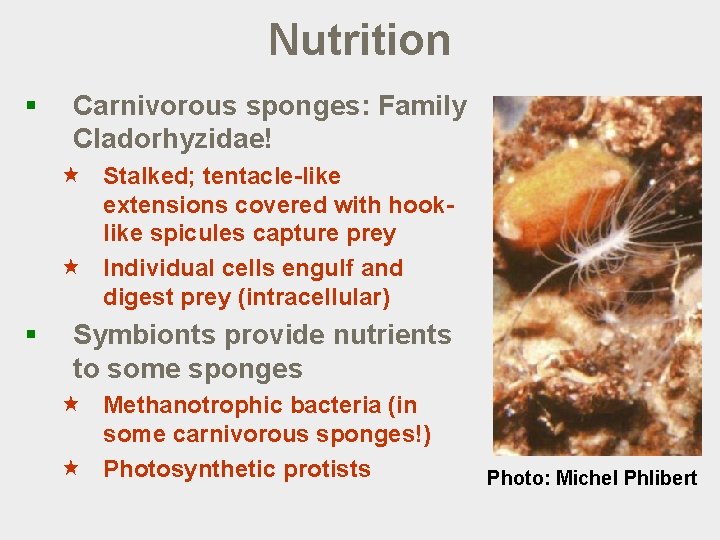
Nutrition § Carnivorous sponges: Family Cladorhyzidae! « Stalked; tentacle-like extensions covered with hooklike spicules capture prey « Individual cells engulf and digest prey (intracellular) § Symbionts provide nutrients to some sponges « Methanotrophic bacteria (in some carnivorous sponges!) « Photosynthetic protists Photo: Michel Phlibert
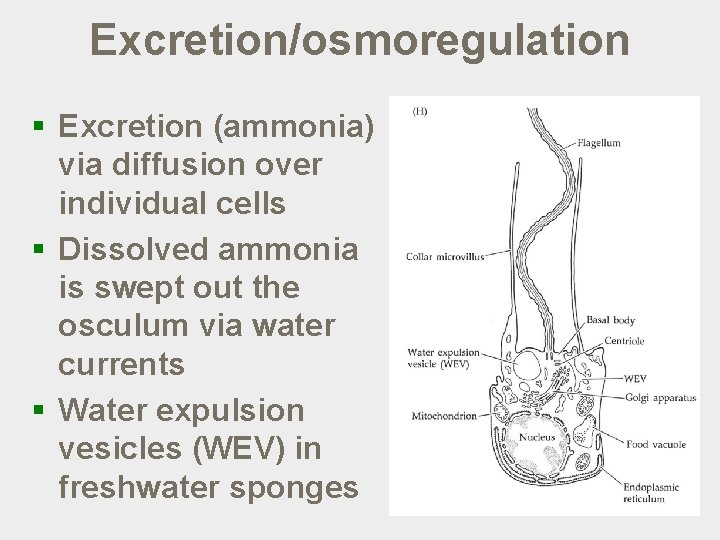
Excretion/osmoregulation § Excretion (ammonia) via diffusion over individual cells § Dissolved ammonia is swept out the osculum via water currents § Water expulsion vesicles (WEV) in freshwater sponges
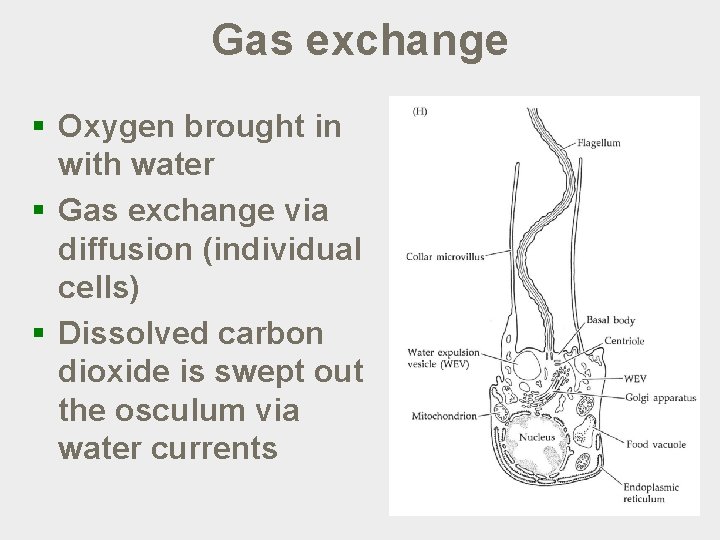
Gas exchange § Oxygen brought in with water § Gas exchange via diffusion (individual cells) § Dissolved carbon dioxide is swept out the osculum via water currents
Activity and Sensitivity § § § No nervous system or discrete sense organs Respond to touch (some will close off ostia/osculum) Respond to excessively high particle concentration « Close off ostia (via myocytes); flagellar beating Some have endogenous rhythmicity « Takes a few minutes for the entire sponge to change rates « Cells communicate mechanically and chemically current generation: reorganization or reproduction Class Hexactinellida have a syncytium which can conduct electrical signals along its membrane « Much slower than true neurons. « Apparently controls water flow into the sponge
Activity and Sensitivity § Movement « Most species are sessile as adults § § Cells frequently move and rearrange themselves Amoebocytes are highly mobile « One species, Tethya seychellensis, Red Sea, has sticky, filamentous extensions § Filaments contract and pull sponge along.
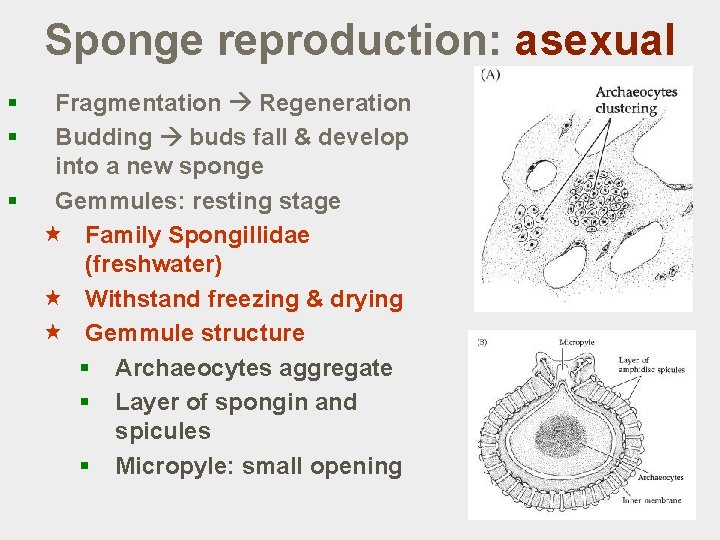
Sponge reproduction: asexual § § § Fragmentation Regeneration Budding buds fall & develop into a new sponge Gemmules: resting stage « Family Spongillidae (freshwater) « Withstand freezing & drying « Gemmule structure § Archaeocytes aggregate § Layer of spongin and spicules § Micropyle: small opening
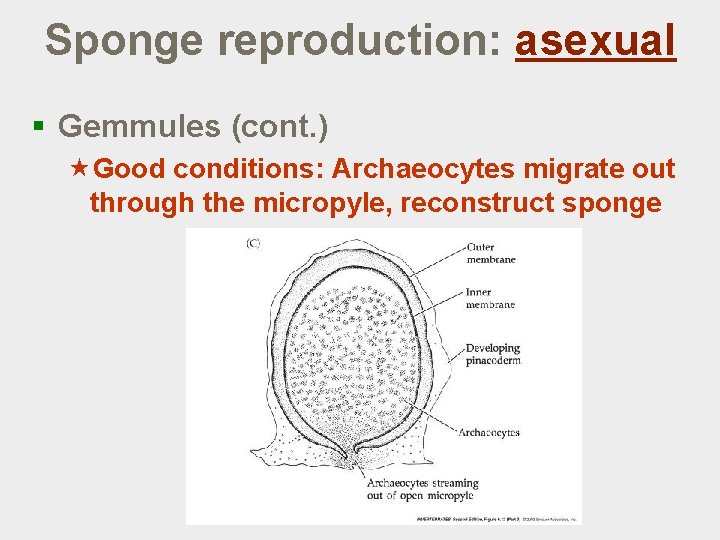
Sponge reproduction: asexual § Gemmules (cont. ) «Good conditions: Archaeocytes migrate out through the micropyle, reconstruct sponge

Sponge reproduction: sexual § Overview « Most sponges are protandrous or protogynous hermaphrodites § § A few are gonochoristic Some species have both hermaphroditic and gonochoristic individuals in the same population « No gonads « Sperm production: choanocytes transform into spermatogonia (in choanocyte chambers or after migrating into the mesohyle. « Egg production: choanocytes or amoebocytes transform into oocytes
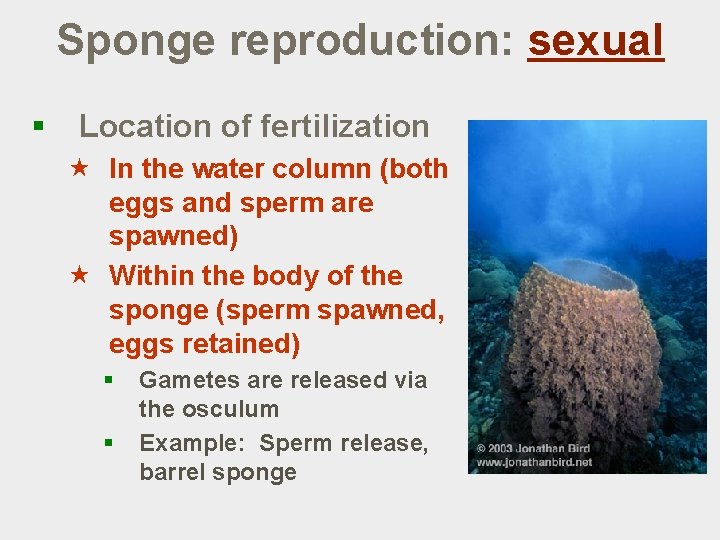
Sponge reproduction: sexual § Location of fertilization « In the water column (both eggs and sperm are spawned) « Within the body of the sponge (sperm spawned, eggs retained) § § Gametes are released via the osculum Example: Sperm release, barrel sponge
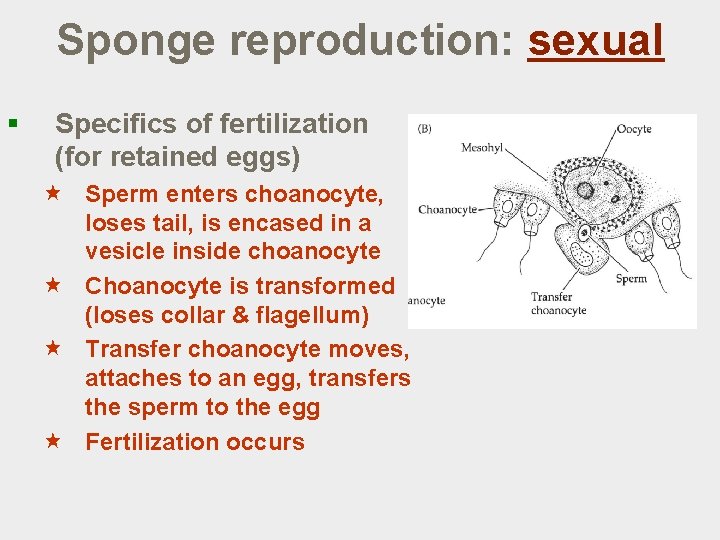
Sponge reproduction: sexual § Specifics of fertilization (for retained eggs) « Sperm enters choanocyte, loses tail, is encased in a vesicle inside choanocyte « Choanocyte is transformed (loses collar & flagellum) « Transfer choanocyte moves, attaches to an egg, transfers the sperm to the egg « Fertilization occurs
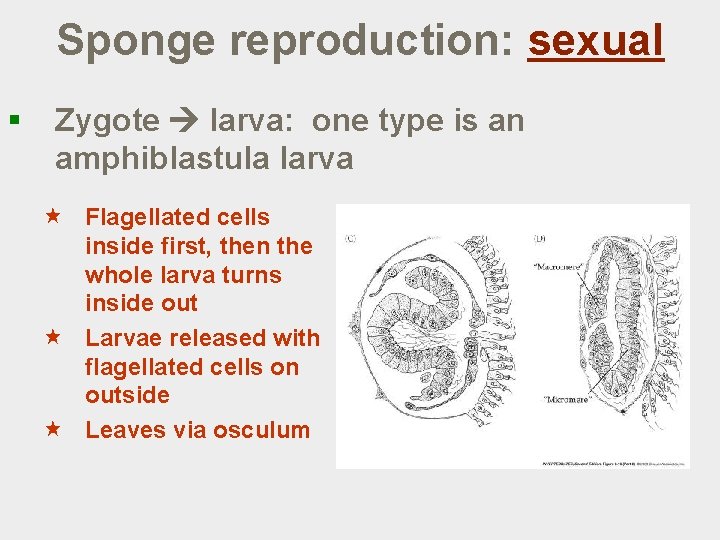
Sponge reproduction: sexual § Zygote larva: one type is an amphiblastula larva « Flagellated cells inside first, then the whole larva turns inside out « Larvae released with flagellated cells on outside « Leaves via osculum
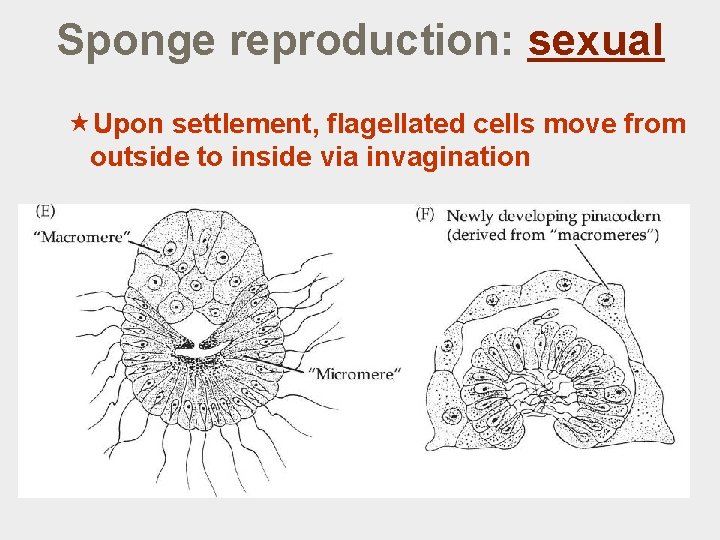
Sponge reproduction: sexual «Upon settlement, flagellated cells move from outside to inside via invagination
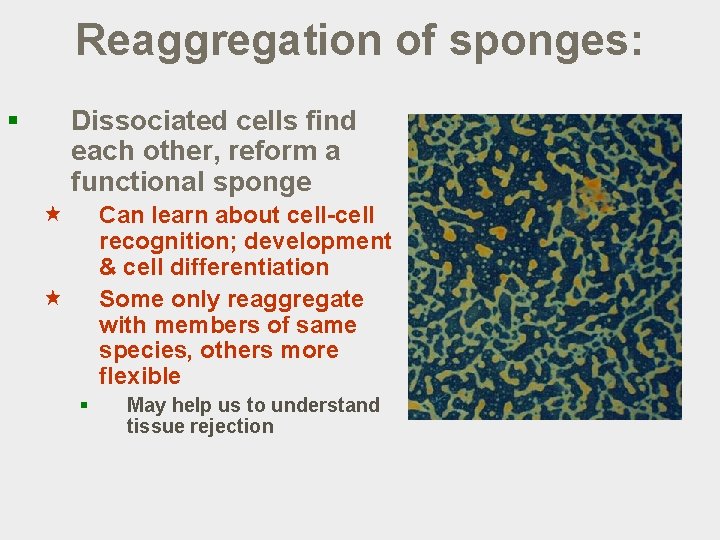
Reaggregation of sponges: § Dissociated cells find each other, reform a functional sponge « Can learn about cell-cell recognition; development & cell differentiation Some only reaggregate with members of same species, others more flexible « § May help us to understand tissue rejection
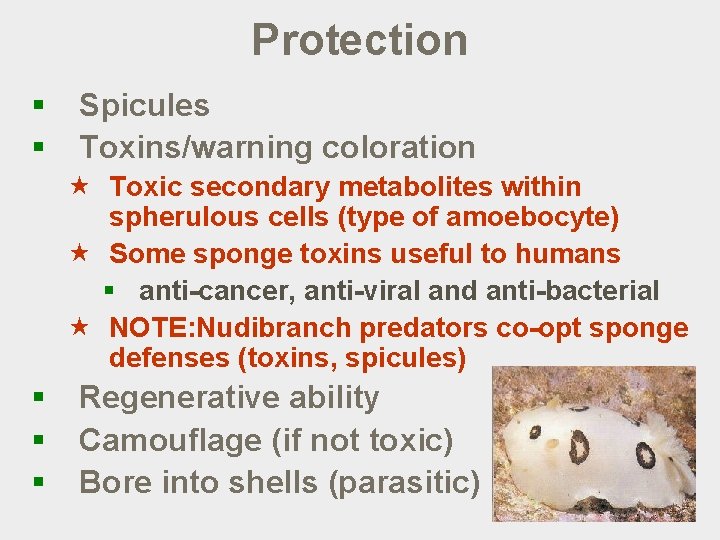
Protection § § Spicules Toxins/warning coloration « Toxic secondary metabolites within spherulous cells (type of amoebocyte) « Some sponge toxins useful to humans § anti-cancer, anti-viral and anti-bacterial « NOTE: Nudibranch predators co-opt sponge defenses (toxins, spicules) § § § Regenerative ability Camouflage (if not toxic) Bore into shells (parasitic)
Sponges and humans § § § Medical uses (just mentioned) Bath sponges Sponge farms in some regions Sponges over-harvested in Greece, Bahamas Declines due to fungal and viral diseases in some regions.
- Slides: 35