
Invertebrate community composition enables to predict compliance to
Invertebrate community composition enables to predict compliance to microbial pathogen related standards of rivers Rubén Jerves-Cobo, I. Nopens, P. Goethals Ruben. Jerves. Cobo@UGent. Be Laboratory of Environmental Toxicology and Aquatic Ecology BIG DATA AND DATA MINING 2016, London, England, Date (26/09/2016) Laboratory of Environmental Toxicology and Aquatic Ecology, Research Group Aquatic Ecology (AECO) Ruben. Jerves. Cobo@UGent. be
OUTLINE Background and objective Materials and methods Results Conclusion BIG DATA AND DATA MINING 2016, London, England, Date (26/09/2016) Laboratory of Environmental Toxicology and Aquatic Ecology, Research Group Aquatic Ecology (AECO) Ruben. Jerves. Cobo@UGent. be
1 -BACKGROUND AND OBJECTIVE (I) • The quality of the water must accomplish standards. • drinking water, recreational purpose, Irrigation • The indicators used to verify microbial contamination of water are: • total coliforms and fecal coliforms and/or Escherichia coli BIG DATA AND DATA MINING 2016, London, England, Date (26/09/2016) Laboratory of Environmental Toxicology and Aquatic Ecology, Research Group Aquatic Ecology (AECO) Ruben. Jerves. Cobo@UGent. be
1 -BACKGROUND AND OBJECTIVE (II) • Checking the fulfillment requires expensive and highly trained personnel in laboratories • Biota works as a permanent monitor of water • biological samples can : • reflect an increase in pollution. • predict average values of chemical parameters BIG DATA AND DATA MINING 2016, London, England, Date (26/09/2016) Laboratory of Environmental Toxicology and Aquatic Ecology, Research Group Aquatic Ecology (AECO) Ruben. Jerves. Cobo@UGent. be
Objective - Introduce a quick way of checking the fulfillment of fecal coliforms standards using macro-benthos. - Analyzes the requirement to include biology and hydro-morphology aspects in Ecuadorian regulations to assess river ecosystem health. BIG DATA AND DATA MINING 2016, London, England, Date (26/09/2016) Laboratory of Environmental Toxicology and Aquatic Ecology, Research Group Aquatic Ecology (AECO) Ruben. Jerves. Cobo@UGent. be
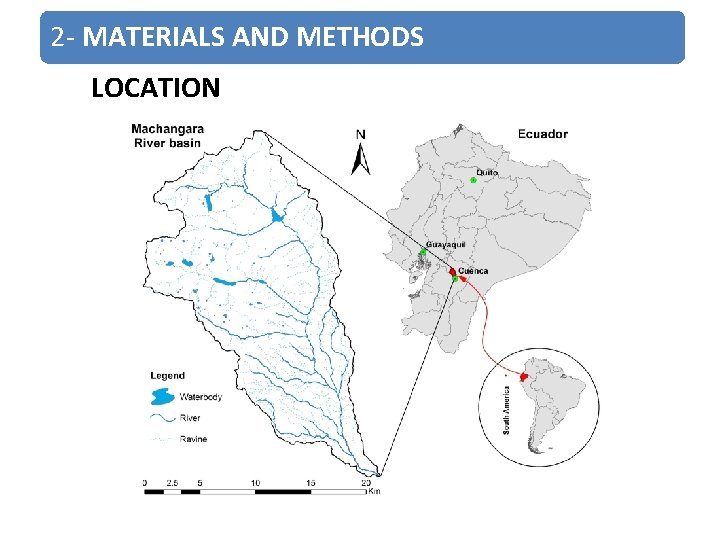
2 - MATERIALS AND METHODS LOCATION
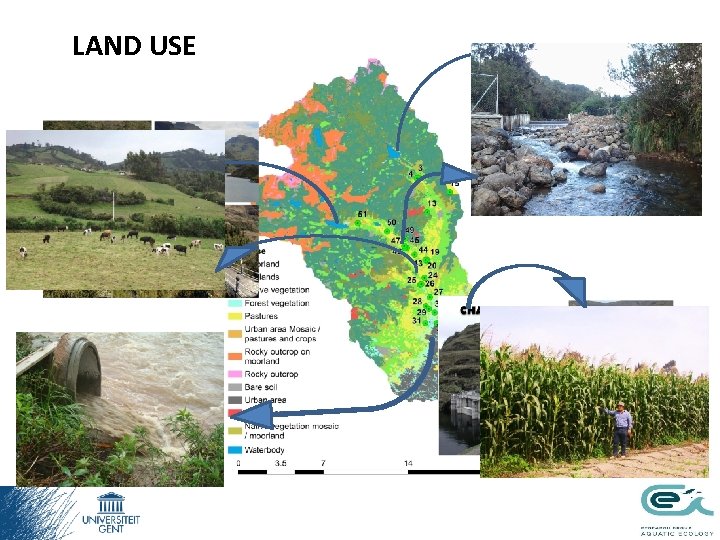
LAND USE
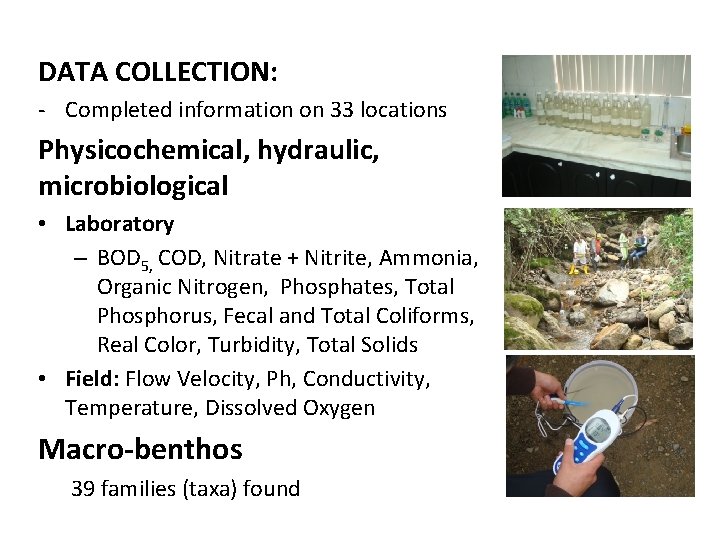
DATA COLLECTION: - Completed information on 33 locations Physicochemical, hydraulic, microbiological • Laboratory – BOD 5, COD, Nitrate + Nitrite, Ammonia, Organic Nitrogen, Phosphates, Total Phosphorus, Fecal and Total Coliforms, Real Color, Turbidity, Total Solids • Field: Flow Velocity, Ph, Conductivity, Temperature, Dissolved Oxygen Macro-benthos 39 families (taxa) found
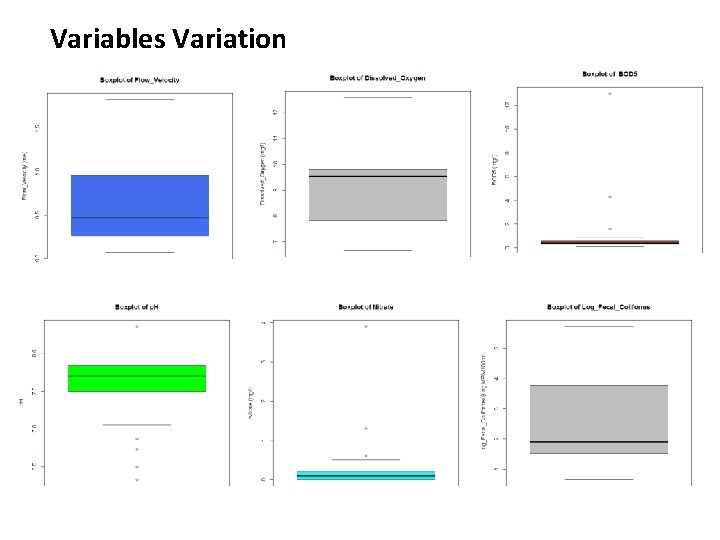
Variables Variation
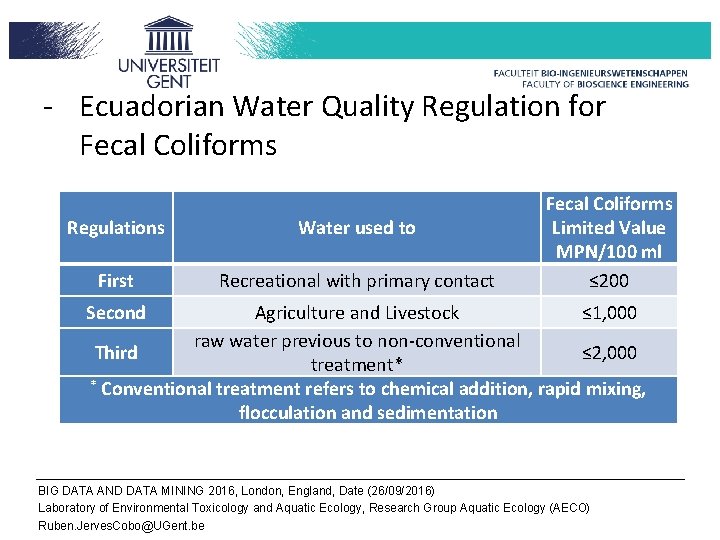
- Ecuadorian Water Quality Regulation for Fecal Coliforms Regulations Water used to First Recreational with primary contact Fecal Coliforms Limited Value MPN/100 ml ≤ 200 Second Agriculture and Livestock ≤ 1, 000 raw water previous to non-conventional Third ≤ 2, 000 treatment* * Conventional treatment refers to chemical addition, rapid mixing, flocculation and sedimentation BIG DATA AND DATA MINING 2016, London, England, Date (26/09/2016) Laboratory of Environmental Toxicology and Aquatic Ecology, Research Group Aquatic Ecology (AECO) Ruben. Jerves. Cobo@UGent. be
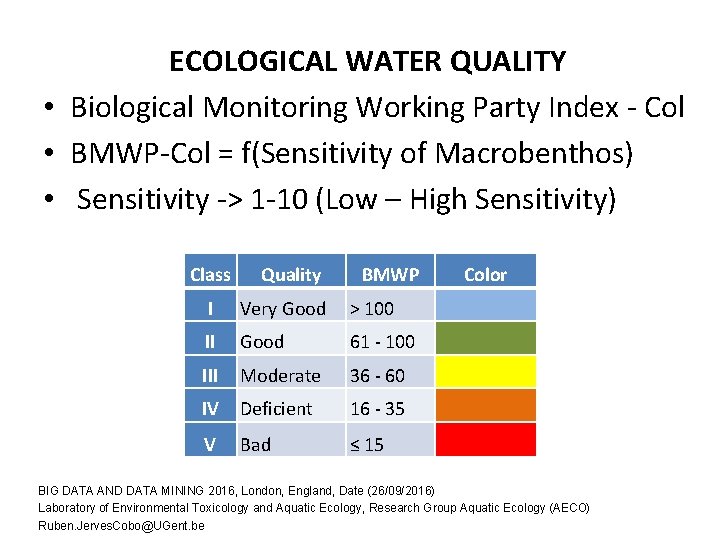
ECOLOGICAL WATER QUALITY • Biological Monitoring Working Party Index - Col • BMWP-Col = f(Sensitivity of Macrobenthos) • Sensitivity -> 1 -10 (Low – High Sensitivity) Class Quality BMWP I Very Good > 100 II Good 61 - 100 III Moderate 36 - 60 IV Deficient 16 - 35 V Bad ≤ 15 Color BIG DATA AND DATA MINING 2016, London, England, Date (26/09/2016) Laboratory of Environmental Toxicology and Aquatic Ecology, Research Group Aquatic Ecology (AECO) Ruben. Jerves. Cobo@UGent. be
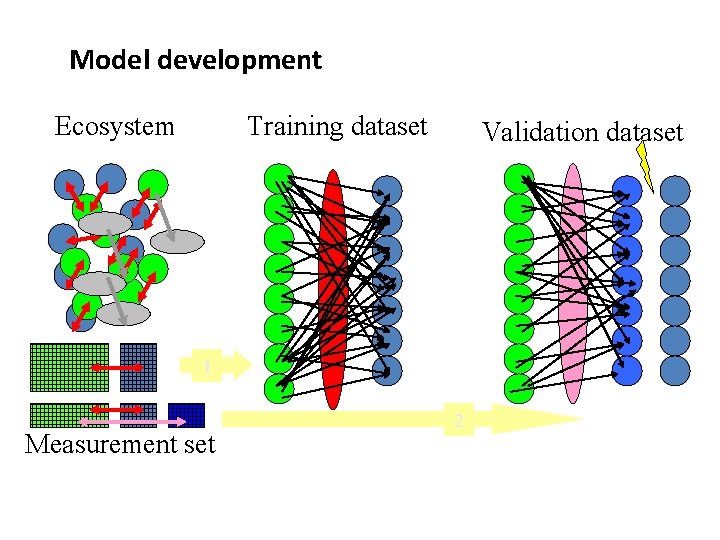
Model development Ecosystem Training dataset Validation dataset 1 Measurement set 2
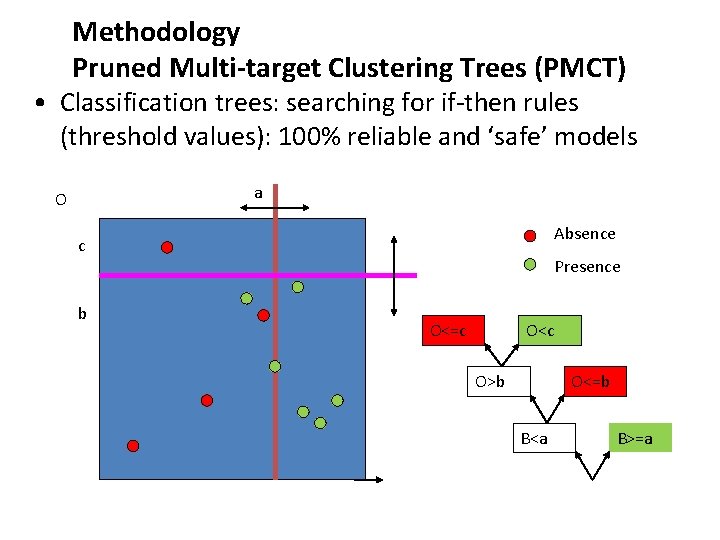
Methodology Pruned Multi-target Clustering Trees (PMCT) • Classification trees: searching for if-then rules (threshold values): 100% reliable and ‘safe’ models a O Absence c b Presence O<=c O<c O>b O<=b B<a B>=a
Model Performance - Models must be evaluated based on statistical and ecological criteria. - Models must be as clear and simple as possible. Settings - Machine learning software: Waikato Environment for Knowledge Analysis (WEKA) - Three, five, ten-fold cross validation (k fcv) - Pruning process • Pruning confidence factors (PCF): 0. 25, 0. 10 BIG DATA AND DATA MINING 2016, London, England, Date (26/09/2016) Laboratory of Environmental Toxicology and Aquatic Ecology, Research Group Aquatic Ecology (AECO) Ruben. Jerves. Cobo@UGent. be
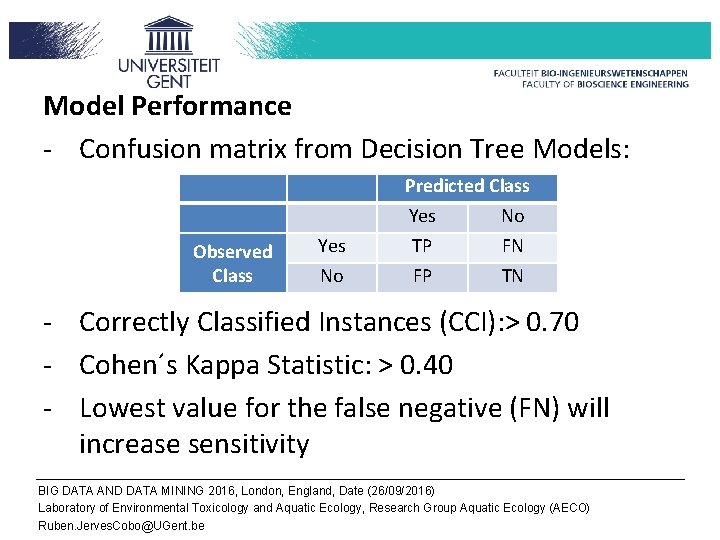
Model Performance - Confusion matrix from Decision Tree Models: Observed Class Yes No Predicted Class Yes No TP FN FP TN - Correctly Classified Instances (CCI): > 0. 70 - Cohen´s Kappa Statistic: > 0. 40 - Lowest value for the false negative (FN) will increase sensitivity BIG DATA AND DATA MINING 2016, London, England, Date (26/09/2016) Laboratory of Environmental Toxicology and Aquatic Ecology, Research Group Aquatic Ecology (AECO) Ruben. Jerves. Cobo@UGent. be
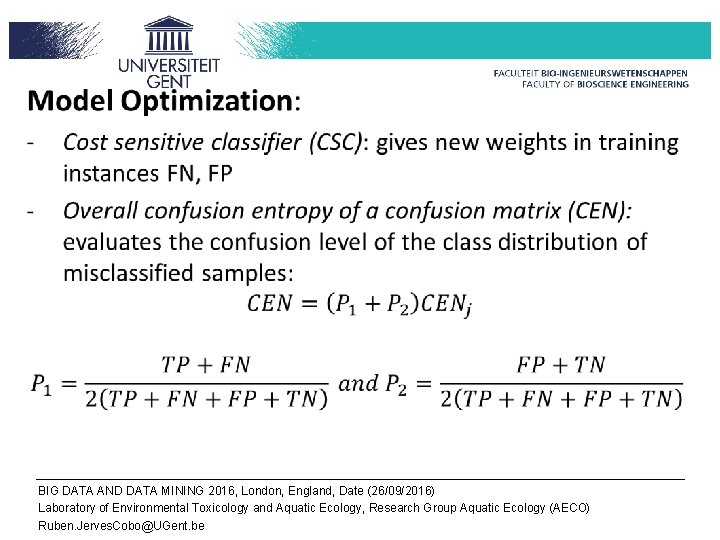
BIG DATA AND DATA MINING 2016, London, England, Date (26/09/2016) Laboratory of Environmental Toxicology and Aquatic Ecology, Research Group Aquatic Ecology (AECO) Ruben. Jerves. Cobo@UGent. be
BIG DATA AND DATA MINING 2016, London, England, Date (26/09/2016) Laboratory of Environmental Toxicology and Aquatic Ecology, Research Group Aquatic Ecology (AECO) Ruben. Jerves. Cobo@UGent. be
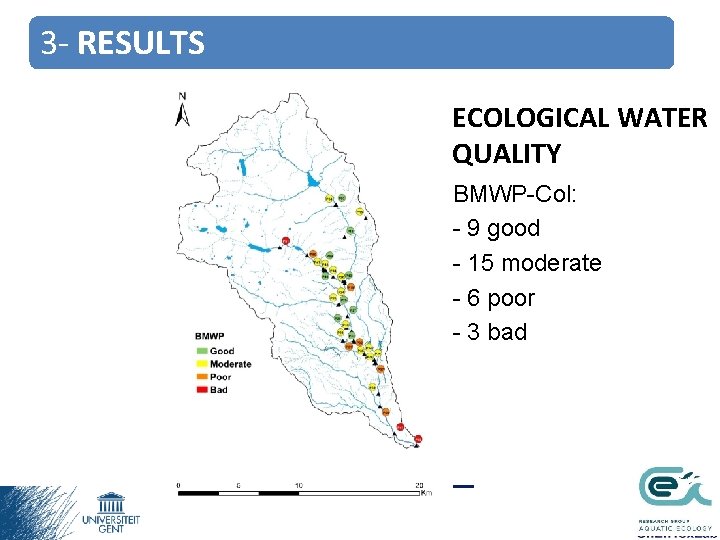
3 - RESULTS ECOLOGICAL WATER QUALITY BMWP-Col: - 9 good - 15 moderate - 6 poor - 3 bad
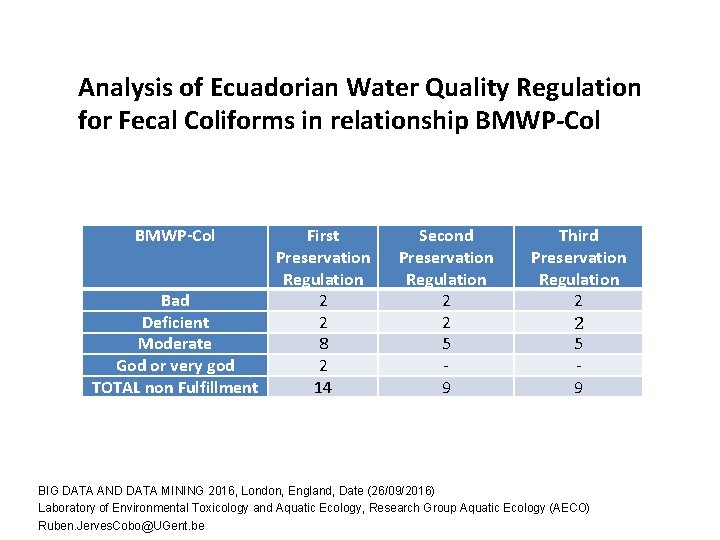
Analysis of Ecuadorian Water Quality Regulation for Fecal Coliforms in relationship BMWP-Col First Preservation Regulation Bad 2 Deficient 2 Moderate 8 God or very god 2 TOTAL non Fulfillment 14 Second Preservation Regulation 2 2 5 9 Third Preservation Regulation 2 2 5 9 BIG DATA AND DATA MINING 2016, London, England, Date (26/09/2016) Laboratory of Environmental Toxicology and Aquatic Ecology, Research Group Aquatic Ecology (AECO) Ruben. Jerves. Cobo@UGent. be
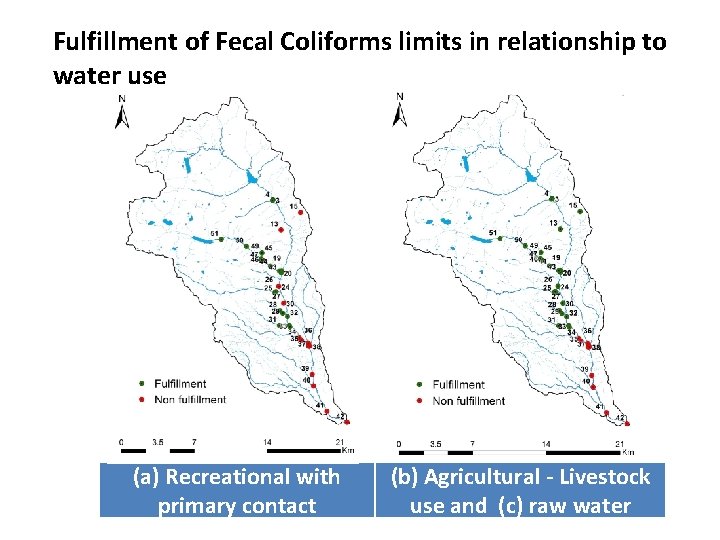
Fulfillment of Fecal Coliforms limits in relationship to water use (a) Recreational with primary contact (b) Agricultural - Livestock use and (c) raw water
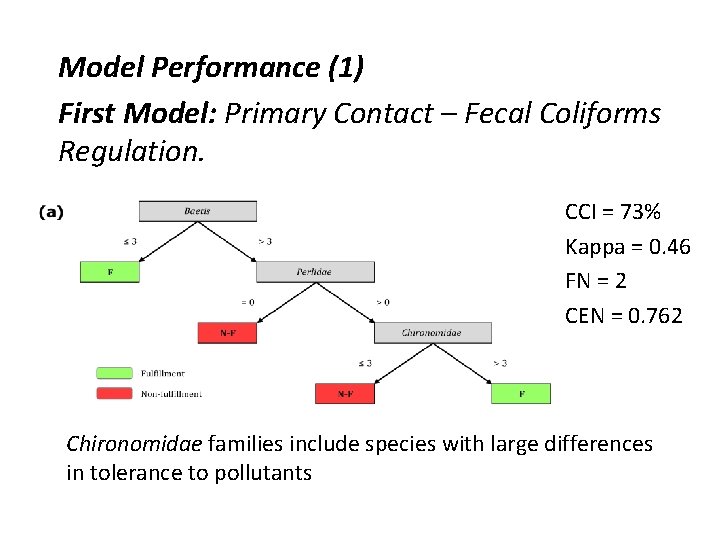
Model Performance (1) First Model: Primary Contact – Fecal Coliforms Regulation. CCI = 73% Kappa = 0. 46 FN = 2 CEN = 0. 762 Chironomidae families include species with large differences in tolerance to pollutants
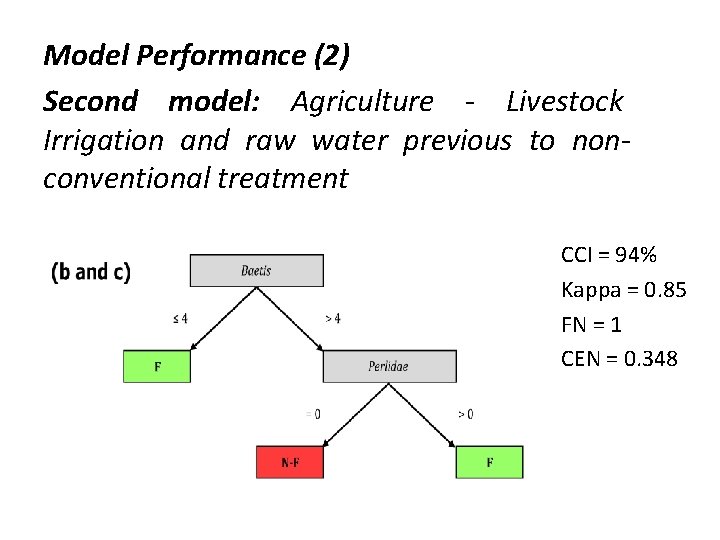
Model Performance (2) Second model: Agriculture - Livestock Irrigation and raw water previous to nonconventional treatment CCI = 94% Kappa = 0. 85 FN = 1 CEN = 0. 348
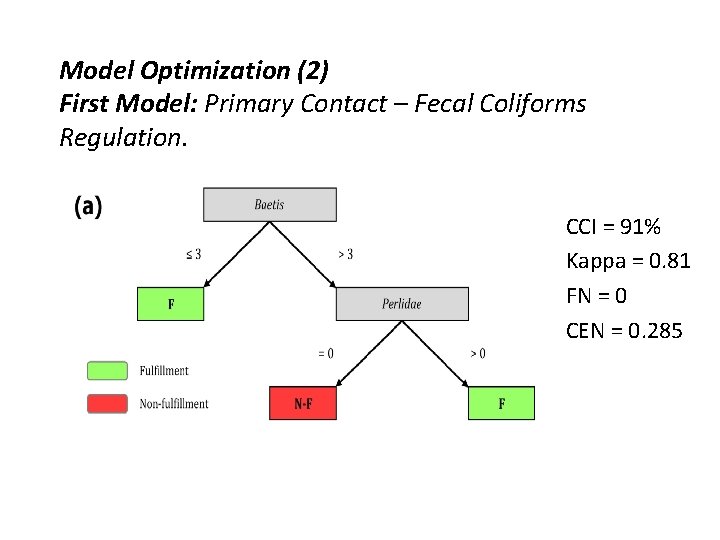
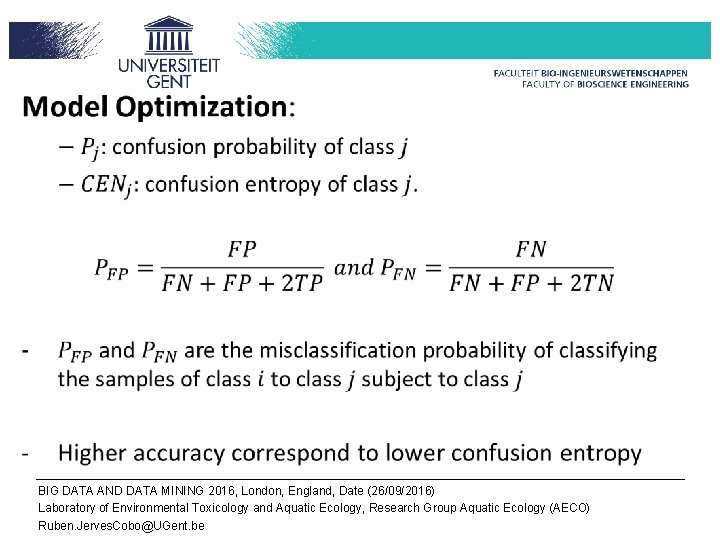
Model Optimization (2) First Model: Primary Contact – Fecal Coliforms Regulation. CCI = 91% Kappa = 0. 81 FN = 0 CEN = 0. 285
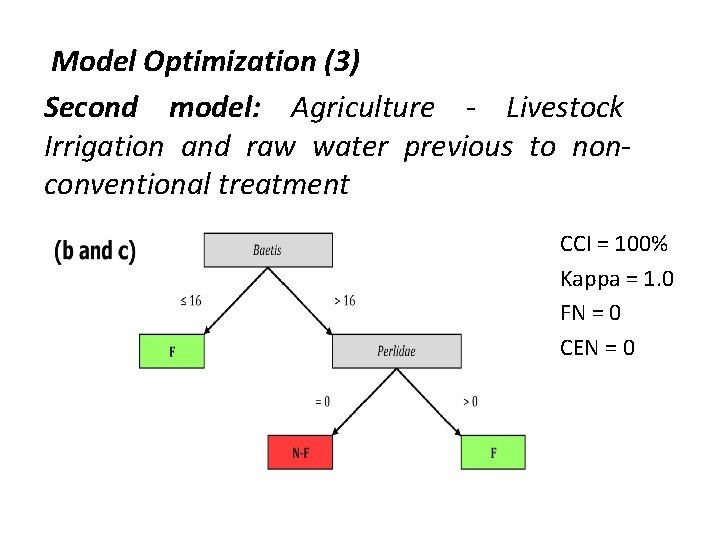
Model Optimization (3) Second model: Agriculture - Livestock Irrigation and raw water previous to nonconventional treatment CCI = 100% Kappa = 1. 0 FN = 0 CEN = 0
4 - CONCLUSION - Four models were selected. • Two Models: fecal coliforms threshold in recreational with primary contact water use. • Two Models: fecal coliforms limits in agricultural - livestock water use, or raw water for drinking water treated with non-conventional processes. - The cost-sensitive classifier (CSC) in the Weka can reduce false negatives (FN) in the confusion matrix, improved the reliability of the resulting models. - Confusion entropy of a confusion matrix (CEN) was lower when the confusion matrix had lower FN values.
Acknowledgement - VLIR-UOS IUC Programme - University of Cuenca - VLIR Ecuador Biodiversity Network Project - Council of the Machangara River Basin BIG DATA AND DATA MINING 2016, London, England, Date (26/09/2016) Laboratory of Environmental Toxicology and Aquatic Ecology, Research Group Aquatic Ecology (AECO) Ruben. Jerves. Cobo@UGent. be
Thank you ? BIG DATA AND DATA MINING 2016, London, England, Date (26/09/2016) Laboratory of Environmental Toxicology and Aquatic Ecology, Research Group Aquatic Ecology (AECO) Ruben. Jerves. Cobo@UGent. be
Bibliography: - - - D'Heygere, T. , P. L. M. Goethals, and N. De Pauw. 2003. Use of Genetic Algorithms to Select Input Variables in Decision Tree Models for the Prediction of Benthic Macroinvertebrates. Ecological Modelling 160: 291300 Maimon, O. , and L. Rokach. 2005. Data Mining and Knowledge Discovery Handbook. Springer. Roldán Pérez, G. 1999. Los Macroinvertebrados y Su Valor Como Indicadores de la Calidad del Agua. Academia Colombiana de Ciencia 23: 375 -387. Ting, K. M. 2002. An instance-weighting method to induce cost-sensitive trees. Ieee Transactions on Knowledge and Data Engineering 14: 659 -665. Wei, J. -M. , X. -J. Yuan, Q. -H. Hu, and S. -Q. Wang. 2010. A novel measure for evaluating classifiers. Expert Systems with Applications 37: 3799 -3809 BIG DATA AND DATA MINING 2016, London, England, Date (26/09/2016) Laboratory of Environmental Toxicology and Aquatic Ecology, Research Group Aquatic Ecology (AECO) Ruben. Jerves. Cobo@UGent. be
- Slides: 28