
Invertebrate Animals Ch 29 745 758 Zany Zoology
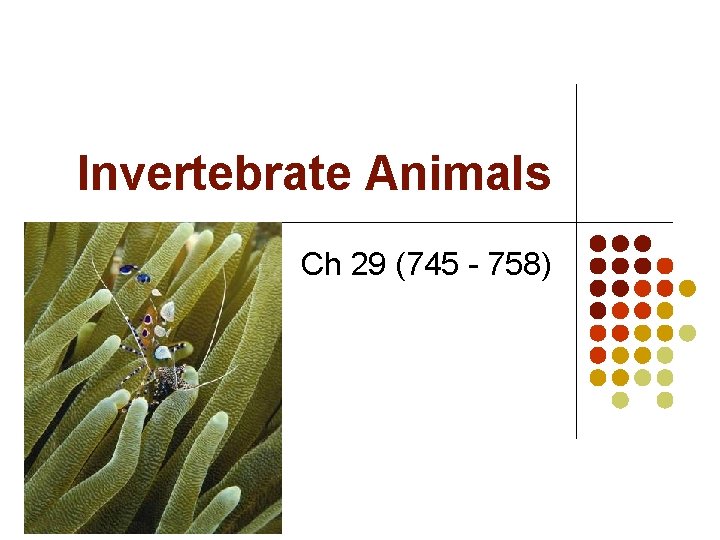
Invertebrate Animals Ch 29 (745 - 758)
Zany Zoology! l l Welcome to the wild world of animals! Think of an animal l l Most likely listed vertebrates l l List on board <5% of animal species are verts This chapter introduces the invertebrates, most of which do not resemble us much…
Intro to Animals (26 -1) l Today’s Learning Objectives: l l l Explain how animals are different than other life forms. List the trends in animal evolution. Memorize the nine phyla of animals that we are studying.
Intro to Animals Kingdom Animalia l About 40 phyla: 9 phyla in this text 1 million species documented, many more exist l l Two major divisions l Invertebrates – 1. l Animals lacking a backbone Vertebrates – 2. l Animals with a backbone
Intro to Animals Animal characteristics l l l Multicellular Heterotrophic Lack cell walls Sexual reproduction Movement (usually)
Intro to Animals Trends in Animal evolution: l 1. 2. 3. 4. Increased cell specialization Body symmetry Cephalization Coelom development
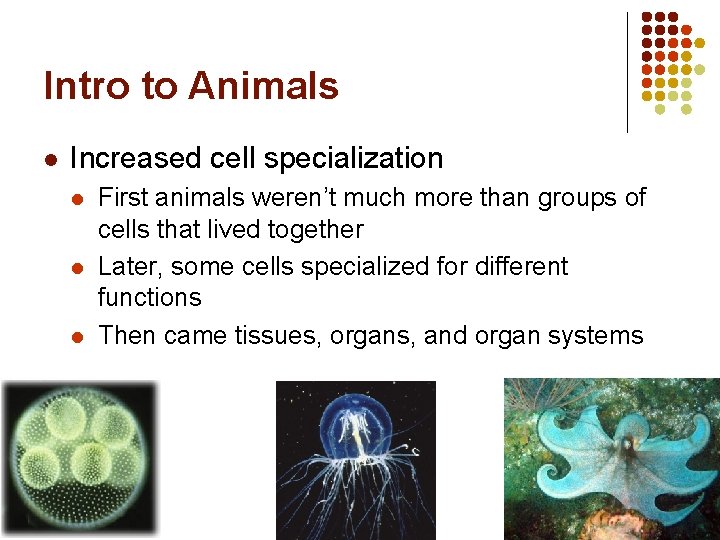
Intro to Animals l Increased cell specialization l l l First animals weren’t much more than groups of cells that lived together Later, some cells specialized for different functions Then came tissues, organs, and organ systems
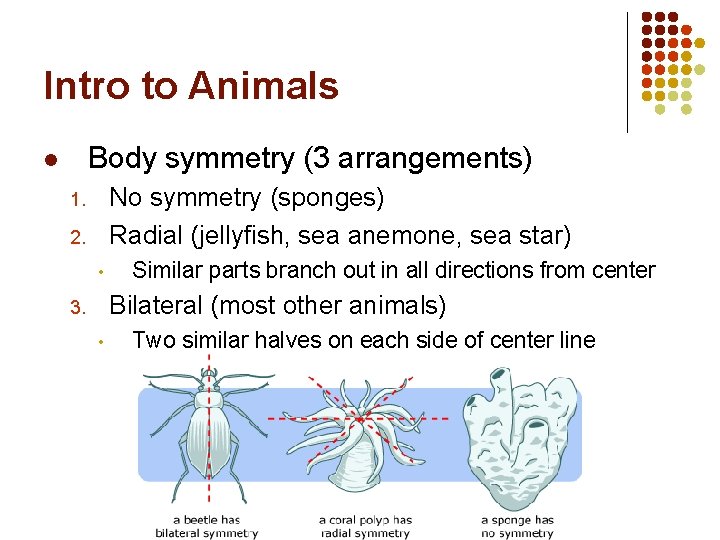
Intro to Animals Body symmetry (3 arrangements) l No symmetry (sponges) Radial (jellyfish, sea anemone, sea star) 1. 2. • Similar parts branch out in all directions from center Bilateral (most other animals) 3. • Two similar halves on each side of center line
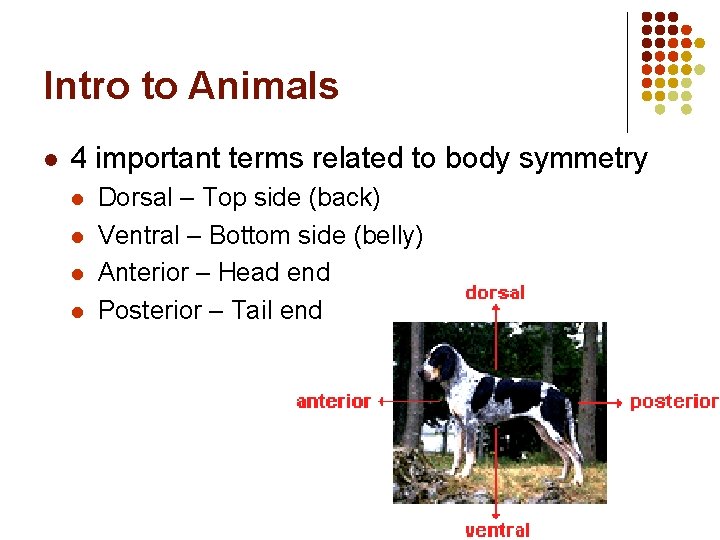
Intro to Animals l 4 important terms related to body symmetry l l Dorsal – Top side (back) Ventral – Bottom side (belly) Anterior – Head end Posterior – Tail end
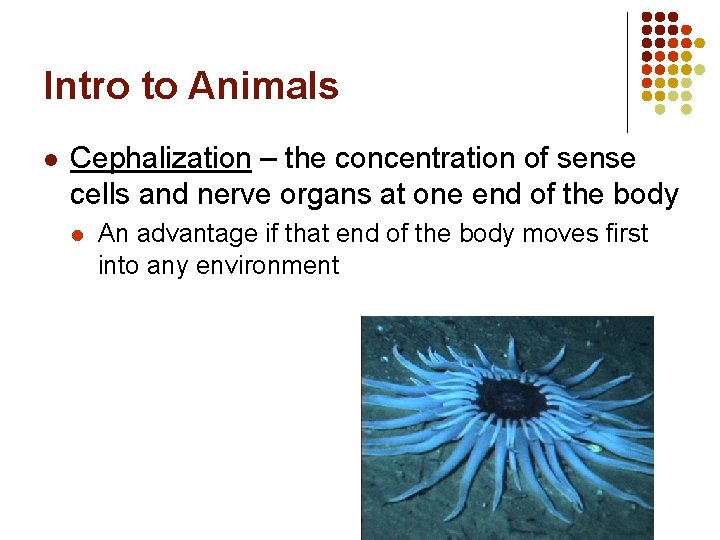
Intro to Animals l Cephalization – the concentration of sense cells and nerve organs at one end of the body l An advantage if that end of the body moves first into any environment
Intro to Animals l Coelom development l Coelom (AKA body cavities) – fluid filled spaces in body that lie between the digestive tract and body wall l Provides location for organs that is not bothered by body movements
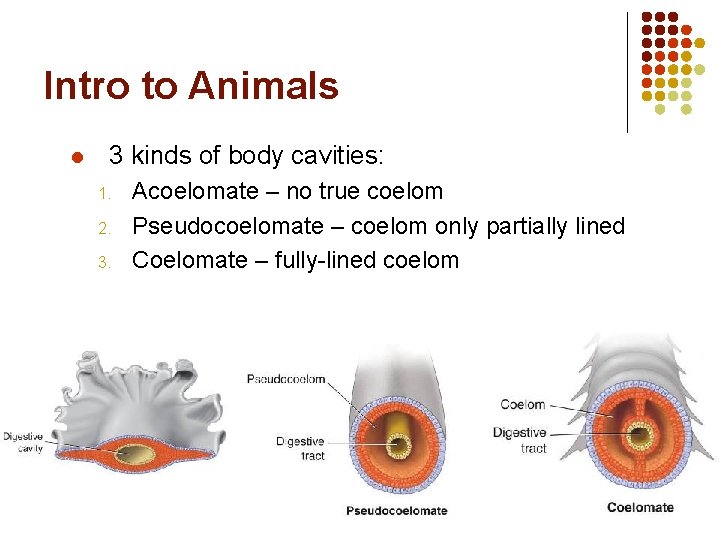
Intro to Animals l 3 kinds of body cavities: 1. 2. 3. Acoelomate – no true coelom Pseudocoelomate – coelom only partially lined Coelomate – fully-lined coelom
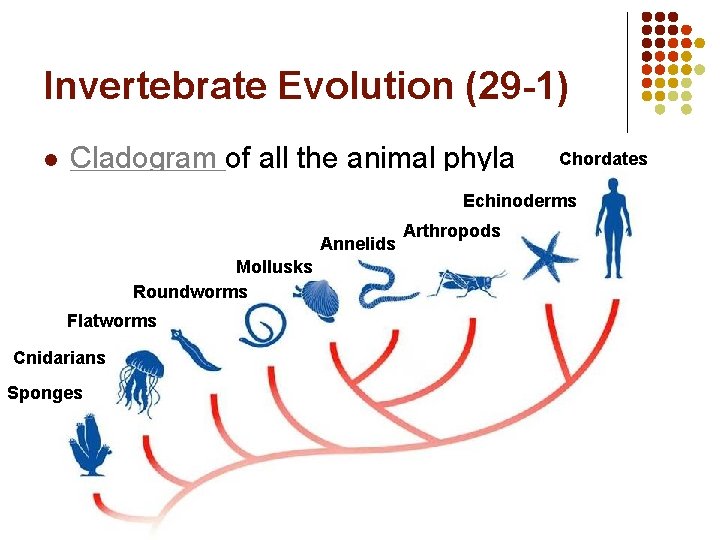
Invertebrate Evolution (29 -1) l Cladogram of all the animal phyla Chordates Echinoderms Annelids Mollusks Roundworms Flatworms Cnidarians Sponges Arthropods
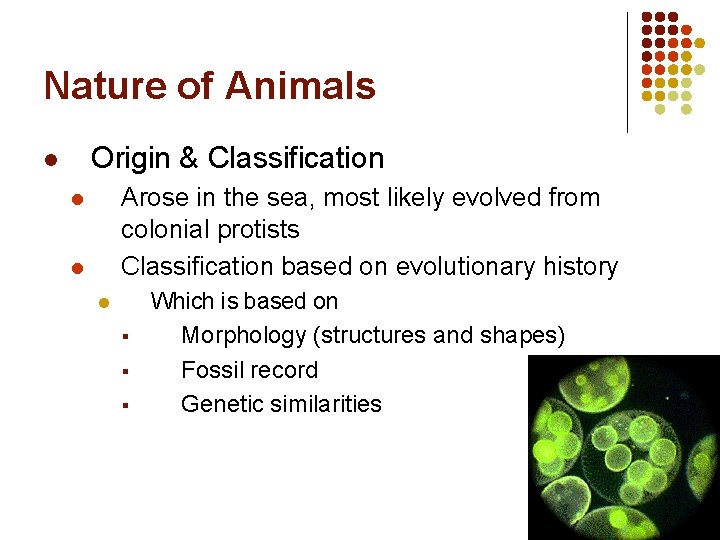
Nature of Animals Origin & Classification l Arose in the sea, most likely evolved from colonial protists Classification based on evolutionary history l l l Which is based on § Morphology (structures and shapes) § § Fossil record Genetic similarities
9 Animal Phyla to know (quiz) 1. 2. 3. 4. 5. 6. 7. 8. 9. Porifera (sponges) Cnidaria (jellyfish, sea anemone) Platyhelminthes (flatworms, flukes) Nematoda (roundworms) Annelida (segmented worms) Mollusca (snails, mussels, octopus, squid) Arthropoda (insects, crustaceans, spiders) Echinodermata (sea stars, sea cucumbers) Chordata (vertebrates and near-vertebrates)
Form & Function in Invertebrates (29 -2) l Today’s Learning Objective: l Know and provide examples of how invertebrates meet the seven tasks of species survival.
Form & Function in Invertebrates Seven tasks of species survival l 1. 2. 3. 4. 5. 6. 7. Feeding & digestion Respiration Circulation Excretion Response to environment Movement & support Reproduction
Form & Function in Invertebrates Feeding & Digestion l l Techniques for feeding are incredibly diverse – probably too much to discuss here l Digestion: two categories 1. 2. Intracellular digestion – food is digested inside cells Extracellular digestion – food is digested in digestive cavities (between cells)
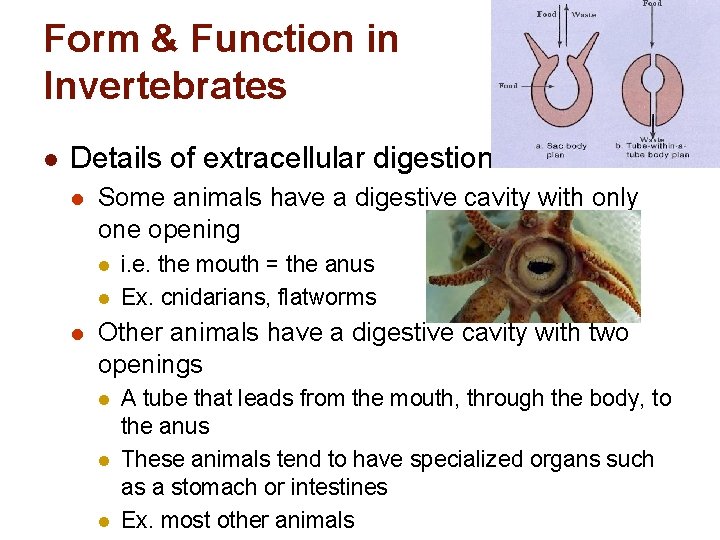
Form & Function in Invertebrates l Details of extracellular digestion l Some animals have a digestive cavity with only one opening l l l i. e. the mouth = the anus Ex. cnidarians, flatworms Other animals have a digestive cavity with two openings l l l A tube that leads from the mouth, through the body, to the anus These animals tend to have specialized organs such as a stomach or intestines Ex. most other animals
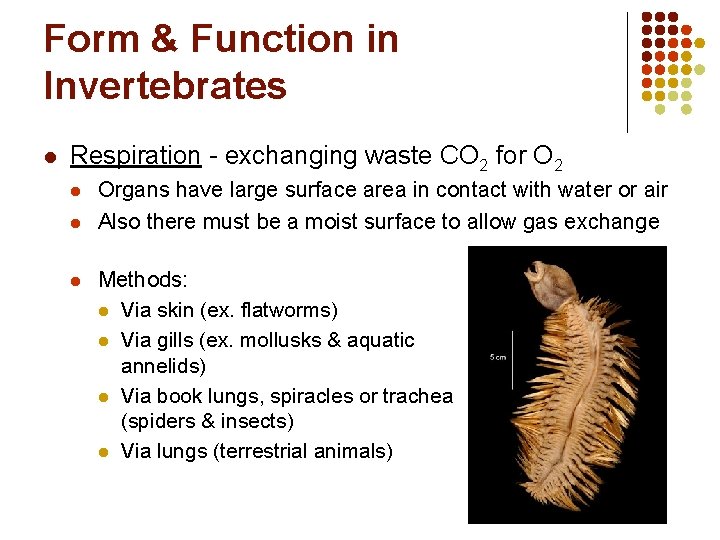
Form & Function in Invertebrates l Respiration - exchanging waste CO 2 for O 2 l l l Organs have large surface area in contact with water or air Also there must be a moist surface to allow gas exchange Methods: l Via skin (ex. flatworms) l Via gills (ex. mollusks & aquatic annelids) l Via book lungs, spiracles or trachea (spiders & insects) l Via lungs (terrestrial animals)
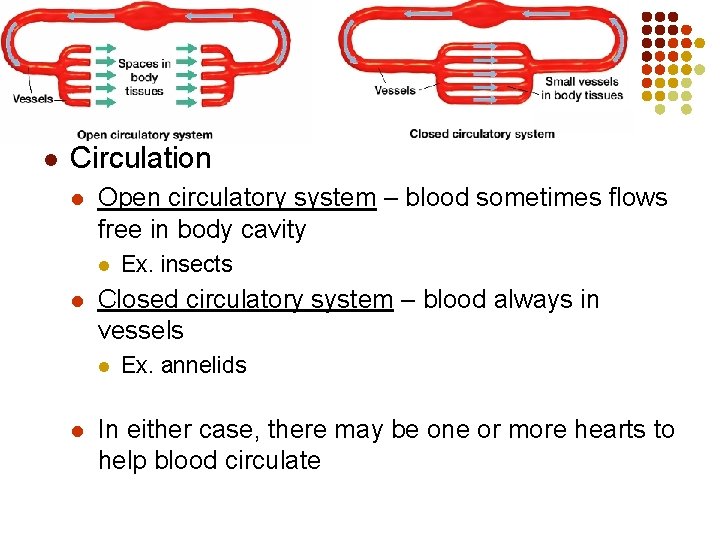
Form & Function in Invertebrates l Circulation l Open circulatory system – blood sometimes flows free in body cavity l l Closed circulatory system – blood always in vessels l l Ex. insects Ex. annelids In either case, there may be one or more hearts to help blood circulate
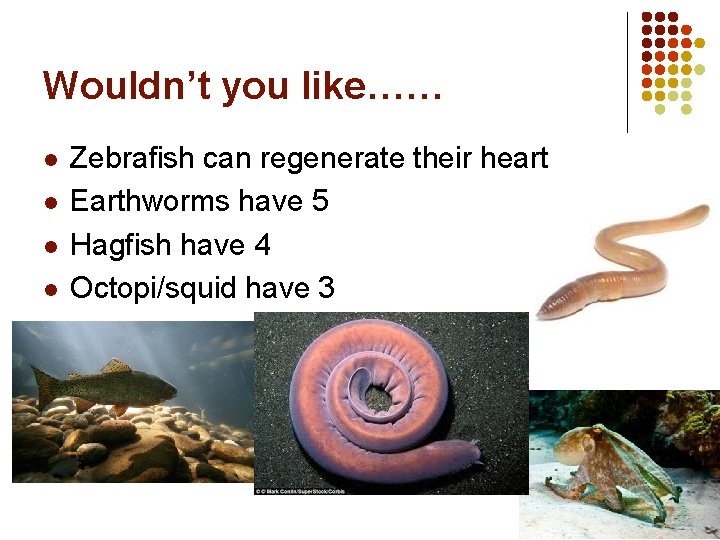
Wouldn’t you like…… l l Zebrafish can regenerate their heart Earthworms have 5 Hagfish have 4 Octopi/squid have 3
Form & Function in Invertebrates l Excretion – eliminating liquid wastes while controlling water balance in body l Ammonia is created as a waste product in cells Ammonia is toxic to our cells l Techniques for removing: l l l If aquatic, dilute with water and let it go If terrestrial, convert to urea (less toxic) to make urine, or to uric acid (some animals combine this with their feces, instead of urinating)
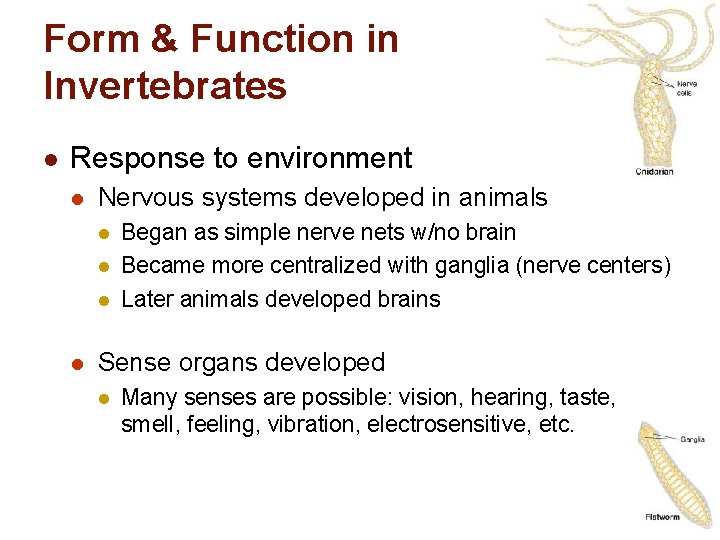
Form & Function in Invertebrates l Response to environment l Nervous systems developed in animals l l Began as simple nerve nets w/no brain Became more centralized with ganglia (nerve centers) Later animals developed brains Sense organs developed l Many senses are possible: vision, hearing, taste, smell, feeling, vibration, electrosensitive, etc.
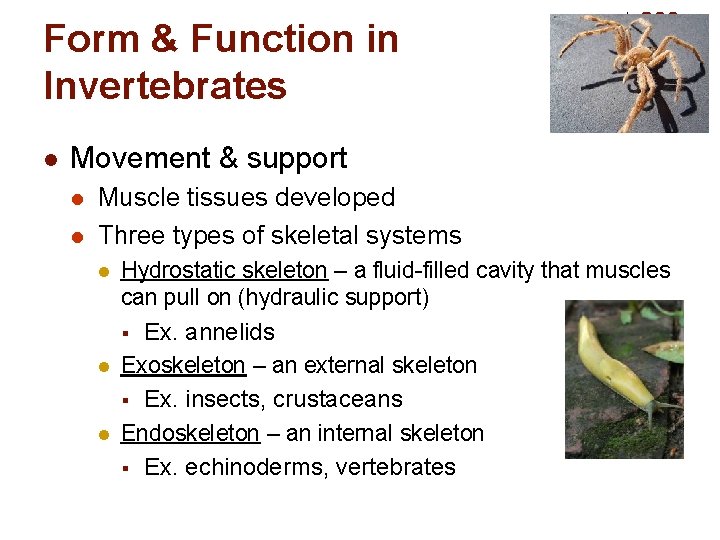
Form & Function in Invertebrates l Movement & support l l Muscle tissues developed Three types of skeletal systems l l l Hydrostatic skeleton – a fluid-filled cavity that muscles can pull on (hydraulic support) § Ex. annelids Exoskeleton – an external skeleton § Ex. insects, crustaceans Endoskeleton – an internal skeleton § Ex. echinoderms, vertebrates
Form & Function in Invertebrates l Reproduction l Asexual reproduction less common in animals l l l Budding (sponges) Parthenogenesis – when an egg can develop into a new individual w/o being fertilized § Ex. water fleas, aphids, lizards, salamanders, some fish, and even turkeys Sexual reproduction is the usual method l l External fertilization – eggs fertilized outside the body Internal fertilization – eggs fertilized inside the body
- Slides: 26