
Inverse Trig Functions I Properties of Inverse Functions


- Slides: 5
Inverse Trig Functions I. Properties of Inverse Functions. A) Inverse function: swap the x & y values. 1) (x , y) (y , x) 2) y = mx + b x = my + b. B) They reflect across the line y = x (45° angle line) C) Symbol for inverse is f – 1(x). D) To be an inverse function, both the original [ f(x) ] and its inverse [ f – 1(x) ] must be functions. 1) They must both pass the vertical line test. 2) Shortcut: f(x) must pass vertical & horizontal line test. 3) If they are both functions, they are called one-to-one.
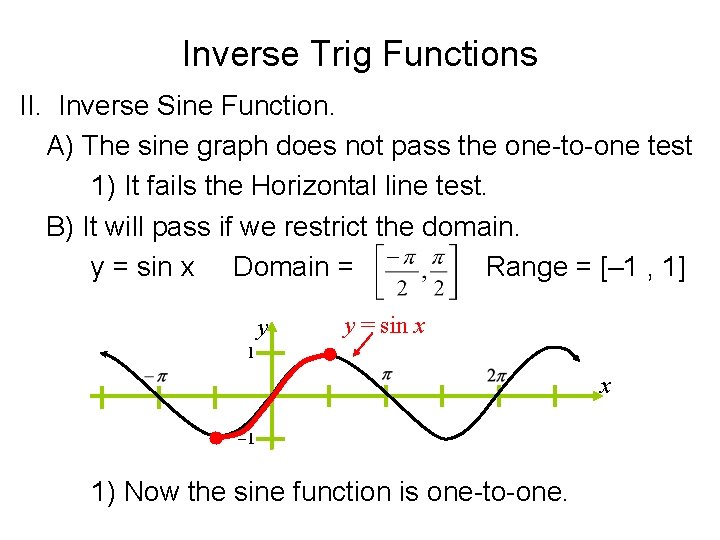
Inverse Trig Functions II. Inverse Sine Function. A) The sine graph does not pass the one-to-one test 1) It fails the Horizontal line test. B) It will pass if we restrict the domain. y = sin x Domain = Range = [– 1 , 1] y y = sin x x 1) Now the sine function is one-to-one.
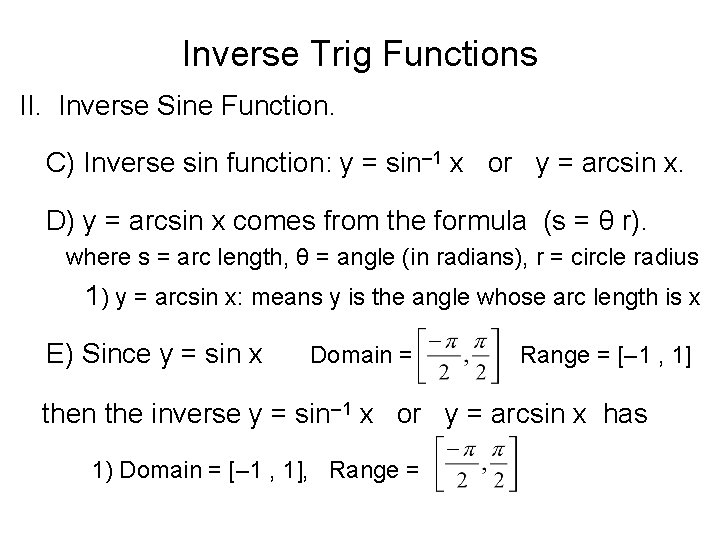
Inverse Trig Functions II. Inverse Sine Function. C) Inverse sin function: y = sin– 1 x or y = arcsin x. D) y = arcsin x comes from the formula (s = θ r). where s = arc length, θ = angle (in radians), r = circle radius 1) y = arcsin x: means y is the angle whose arc length is x E) Since y = sin x Domain = Range = [– 1 , 1] then the inverse y = sin– 1 x or y = arcsin x has 1) Domain = [– 1 , 1], Range =
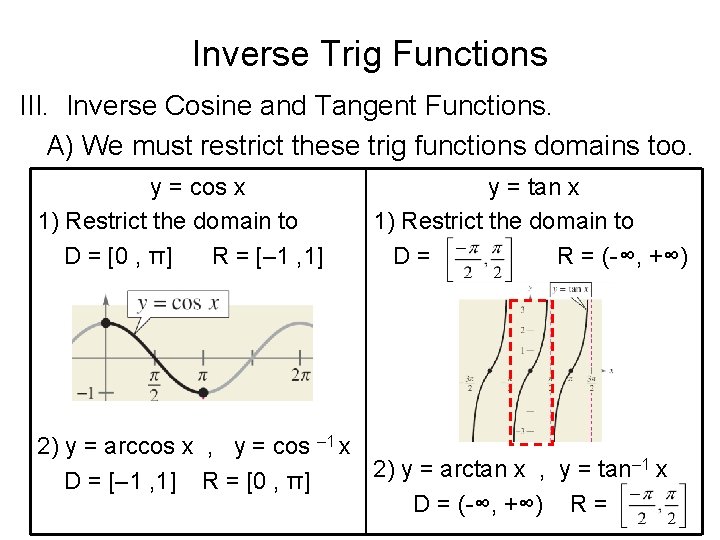
Inverse Trig Functions III. Inverse Cosine and Tangent Functions. A) We must restrict these trig functions domains too. y = cos x 1) Restrict the domain to D = [0 , π] R = [– 1 , 1] y = tan x 1) Restrict the domain to D= R = (-∞, +∞) 2) y = arccos x , y = cos – 1 x 2) y = arctan x , y = tan D = [– 1 , 1] R = [0 , π] D = (-∞, +∞) R =
Inverse Trig Functions IV. Evaluating Trig Inverse Functions. A) For 30°, 45°, 60°, 90° angles, use the Unit Circle’s (x , y) values to find what angle [ θ ] gives you that arctrig value. 1) sin = y values, cos = x values, tan = y/x values. B) Remember to stay within the arctrig’s domain. 1) You might have to go in the -θ° direction. a) = 2) You can subtract 2π from the angle to get a -θ°. a) 3) Some arctrig values are undefined (have no θ answer).