
Inverse Normal Inverse Normal This is where you
- Slides: 12
Inverse Normal
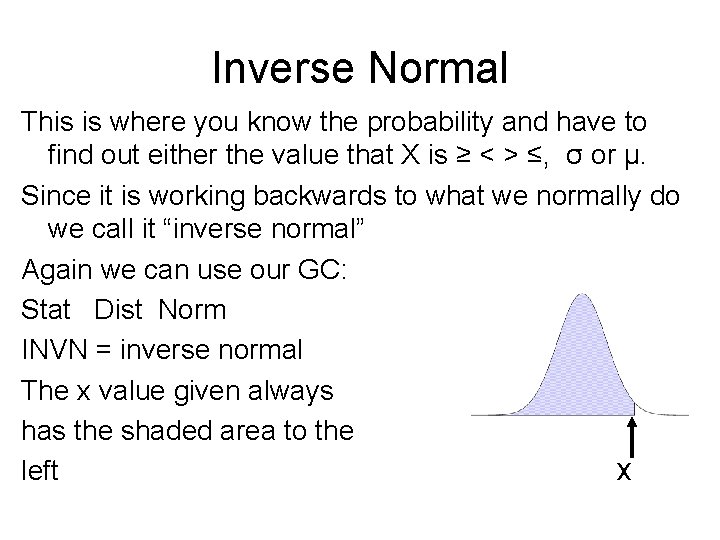
Inverse Normal This is where you know the probability and have to find out either the value that X is ≥ < > ≤, σ or µ. Since it is working backwards to what we normally do we call it “inverse normal” Again we can use our GC: Stat Dist Norm INVN = inverse normal The x value given always has the shaded area to the left x
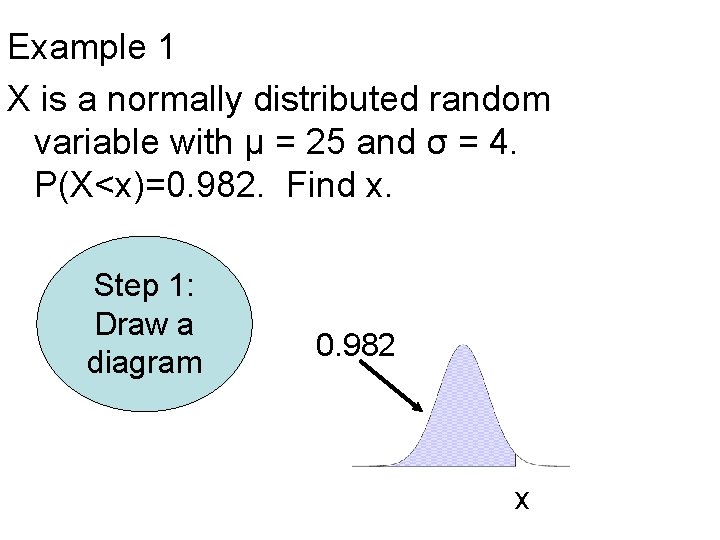
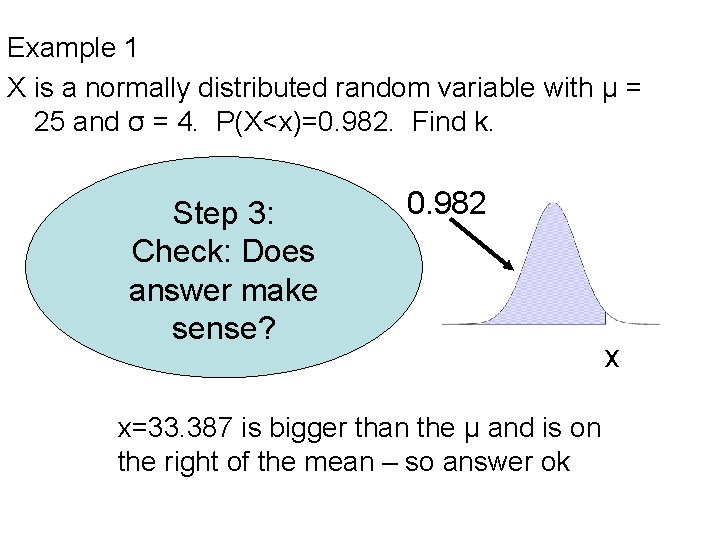
Example 1 X is a normally distributed random variable with µ = 25 and σ = 4. P(X<x)=0. 982. Find x. Step 1: Draw a diagram 0. 982 x
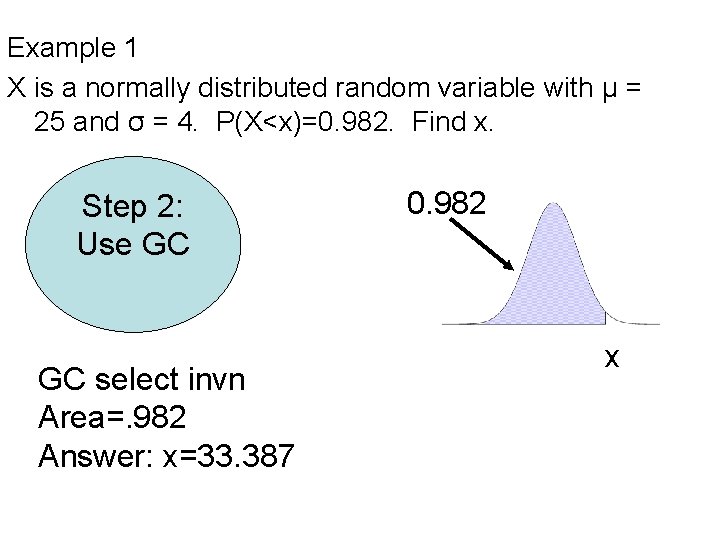
Example 1 X is a normally distributed random variable with µ = 25 and σ = 4. P(X<x)=0. 982. Find x. Step 2: Use GC GC select invn Area=. 982 Answer: x=33. 387 0. 982 x
Example 1 X is a normally distributed random variable with µ = 25 and σ = 4. P(X<x)=0. 982. Find k. Step 3: Check: Does answer make sense? 0. 982 x=33. 387 is bigger than the µ and is on the right of the mean – so answer ok x
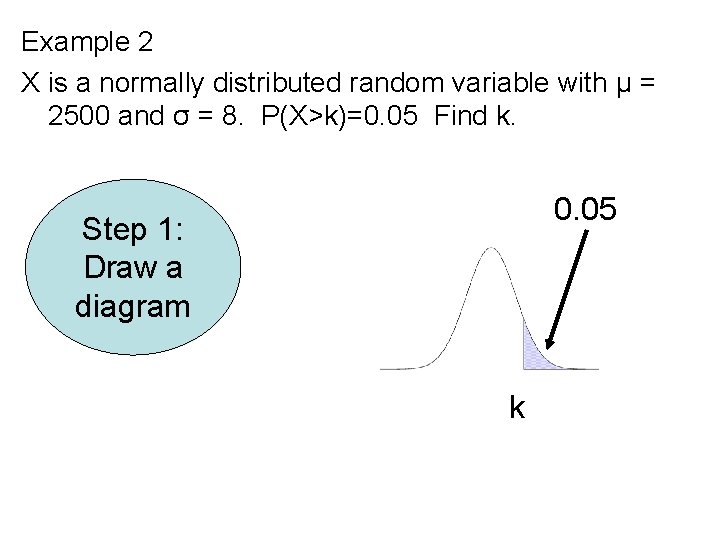
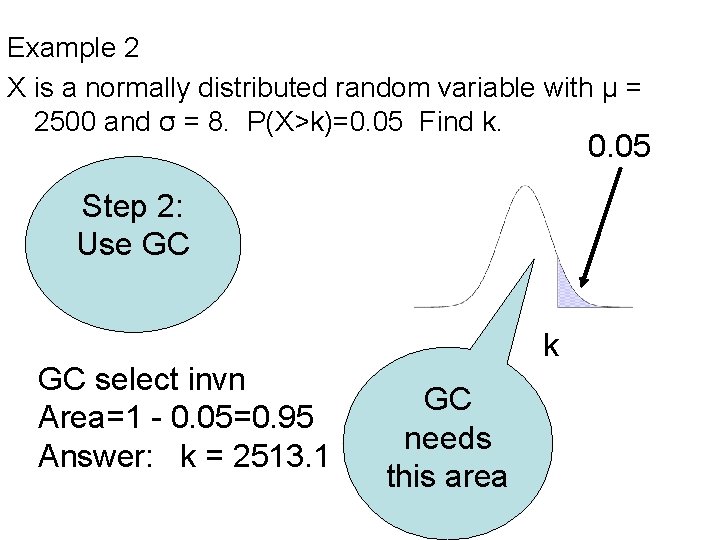
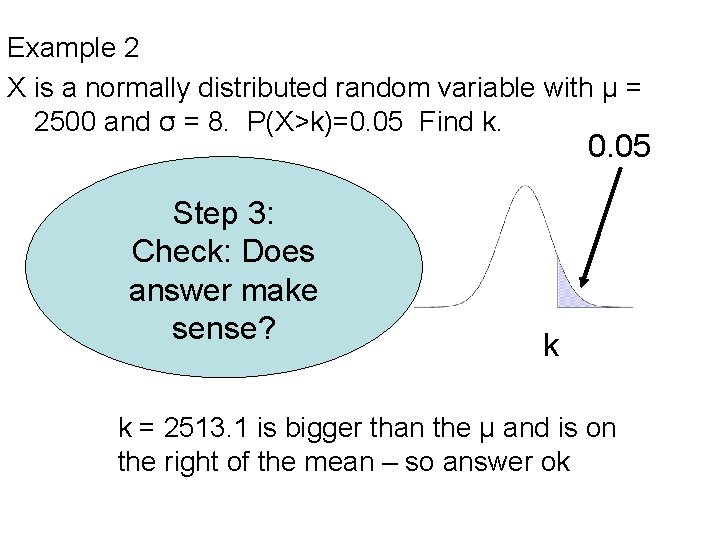
Example 2 X is a normally distributed random variable with µ = 2500 and σ = 8. P(X>k)=0. 05 Find k. 0. 05 Step 1: Draw a diagram k
Example 2 X is a normally distributed random variable with µ = 2500 and σ = 8. P(X>k)=0. 05 Find k. 0. 05 Step 2: Use GC GC select invn Area=1 - 0. 05=0. 95 Answer: k = 2513. 1 k GC needs this area
Example 2 X is a normally distributed random variable with µ = 2500 and σ = 8. P(X>k)=0. 05 Find k. 0. 05 Step 3: Check: Does answer make sense? k k = 2513. 1 is bigger than the µ and is on the right of the mean – so answer ok
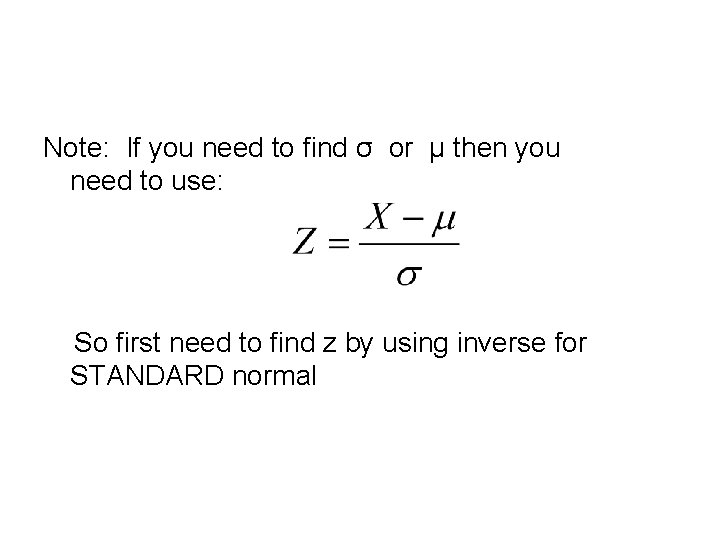
Note: If you need to find σ or µ then you need to use: So first need to find z by using inverse for STANDARD normal
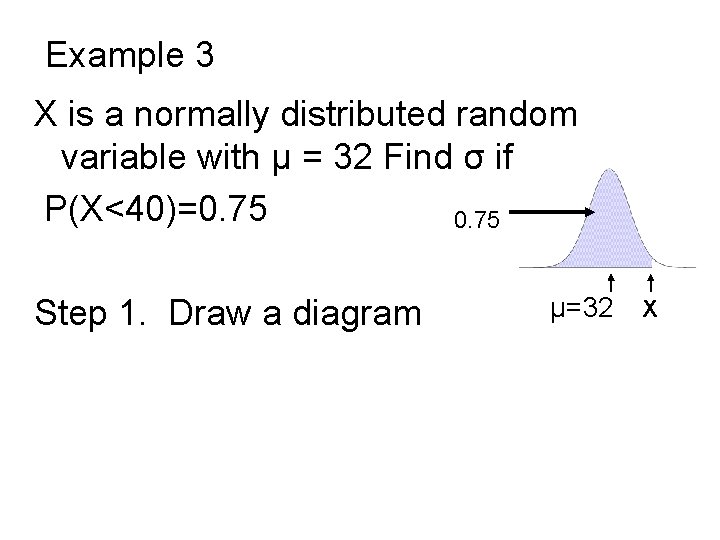
Example 3 X is a normally distributed random variable with µ = 32 Find σ if P(X<40)=0. 75 Step 1. Draw a diagram µ=32 X
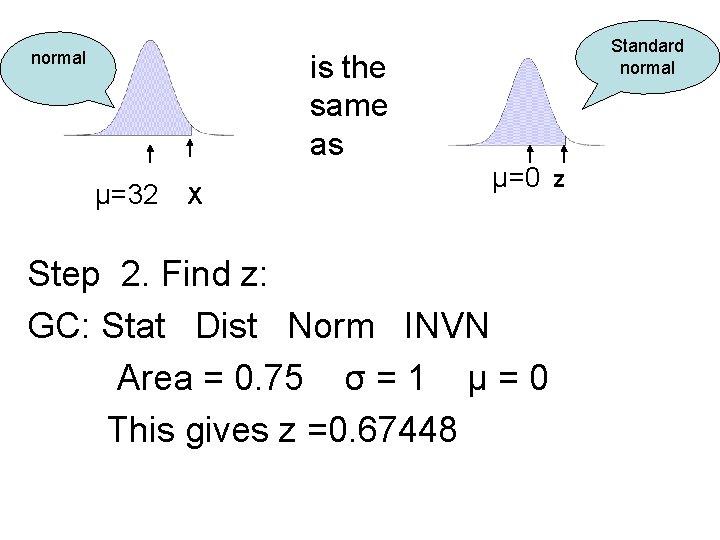
normal Standard normal is the same as µ=32 X µ=0 z Step 2. Find z: GC: Stat Dist Norm INVN Area = 0. 75 σ = 1 µ = 0 This gives z =0. 67448
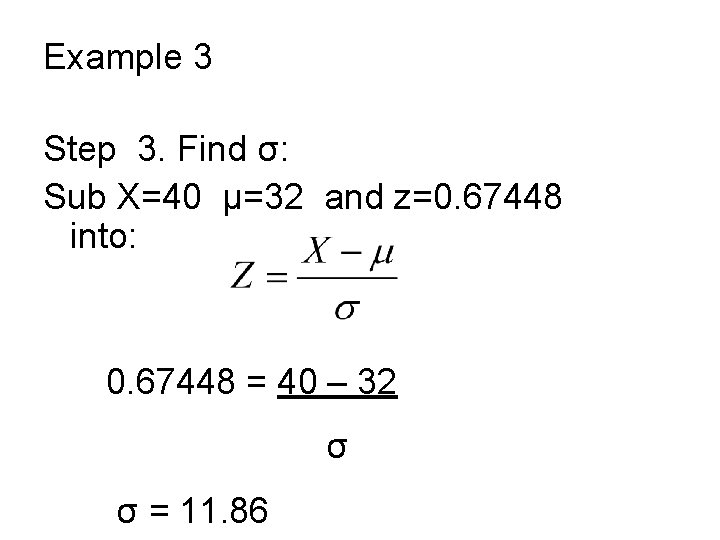
Example 3 Step 3. Find σ: Sub X=40 µ=32 and z=0. 67448 into: 0. 67448 = 40 – 32 σ σ = 11. 86