
Inverse Modeling of Hydrologic Parameters using Surface Flux
- Slides: 1
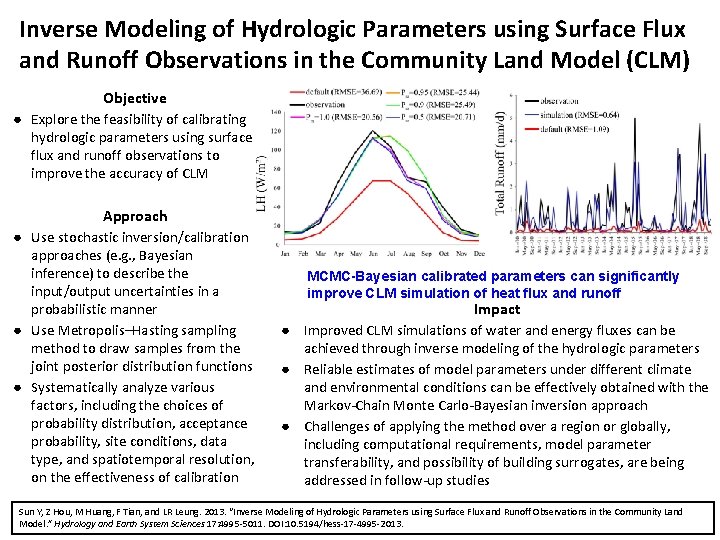
Inverse Modeling of Hydrologic Parameters using Surface Flux and Runoff Observations in the Community Land Model (CLM) Objective ● Explore the feasibility of calibrating hydrologic parameters using surface flux and runoff observations to improve the accuracy of CLM Approach ● Use stochastic inversion/calibration approaches (e. g. , Bayesian inference) to describe the input/output uncertainties in a probabilistic manner ● Use Metropolis–Hasting sampling method to draw samples from the joint posterior distribution functions ● Systematically analyze various factors, including the choices of probability distribution, acceptance probability, site conditions, data type, and spatiotemporal resolution, on the effectiveness of calibration MCMC-Bayesian calibrated parameters can significantly improve CLM simulation of heat flux and runoff Impact ● Improved CLM simulations of water and energy fluxes can be achieved through inverse modeling of the hydrologic parameters ● Reliable estimates of model parameters under different climate and environmental conditions can be effectively obtained with the Markov-Chain Monte Carlo-Bayesian inversion approach ● Challenges of applying the method over a region or globally, including computational requirements, model parameter transferability, and possibility of building surrogates, are being addressed in follow-up studies Sun Y, Z Hou, M Huang, F Tian, and LR Leung. 2013. “Inverse Modeling of Hydrologic Parameters using Surface Flux and Runoff Observations in the Community Land Model. ” Hydrology and Earth System Sciences 17: 4995 -5011. DOI: 10. 5194/hess-17 -4995 -2013.