
INVERSE MANIPULATOR KINEMATICS OSMAN PARLAKTUNA OSMANGAZI UNIVERSITY ESKISEHIR
- Slides: 41
INVERSE MANIPULATOR KINEMATICS OSMAN PARLAKTUNA OSMANGAZI UNIVERSITY ESKISEHIR, TURKEY www. ogu. edu. tr/~oparlak
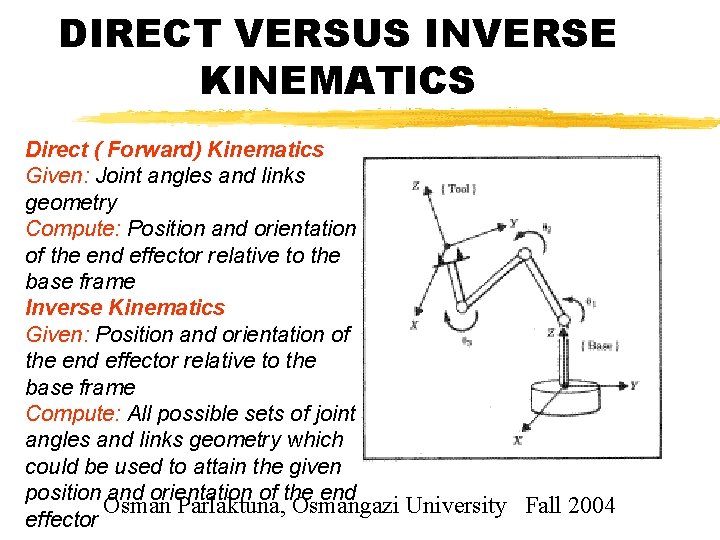
DIRECT VERSUS INVERSE KINEMATICS Direct ( Forward) Kinematics Given: Joint angles and links geometry Compute: Position and orientation of the end effector relative to the base frame Inverse Kinematics Given: Position and orientation of the end effector relative to the base frame Compute: All possible sets of joint angles and links geometry which could be used to attain the given position and orientation of the end Osman Parlaktuna, Osmangazi University Fall 2004 effector
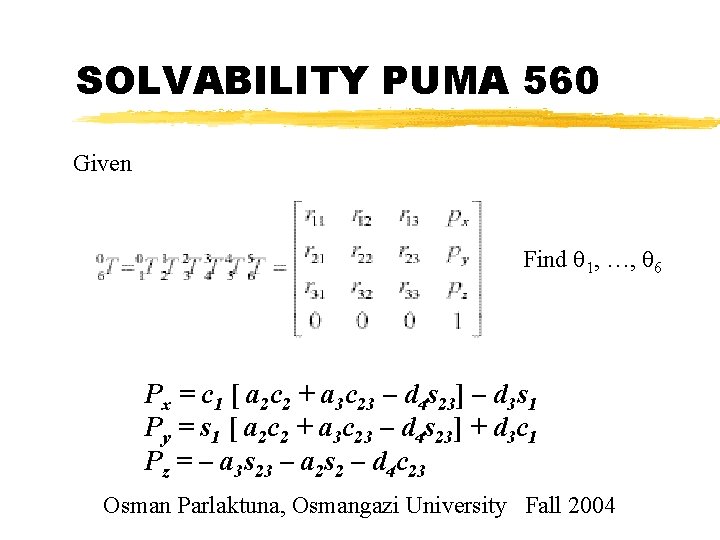
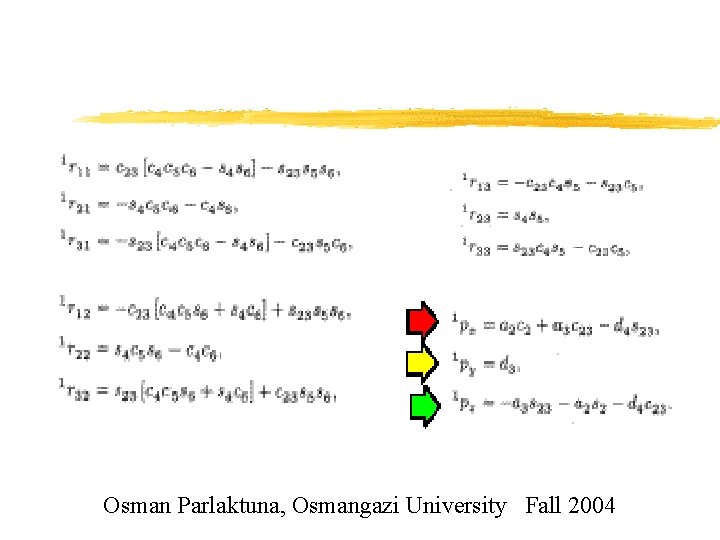
SOLVABILITY PUMA 560 Given Find 1, …, 6 Px = c 1 [ a 2 c 2 + a 3 c 23 – d 4 s 23] – d 3 s 1 Py = s 1 [ a 2 c 2 + a 3 c 23 – d 4 s 23] + d 3 c 1 Pz = – a 3 s 23 – a 2 s 2 – d 4 c 23 Osman Parlaktuna, Osmangazi University Fall 2004
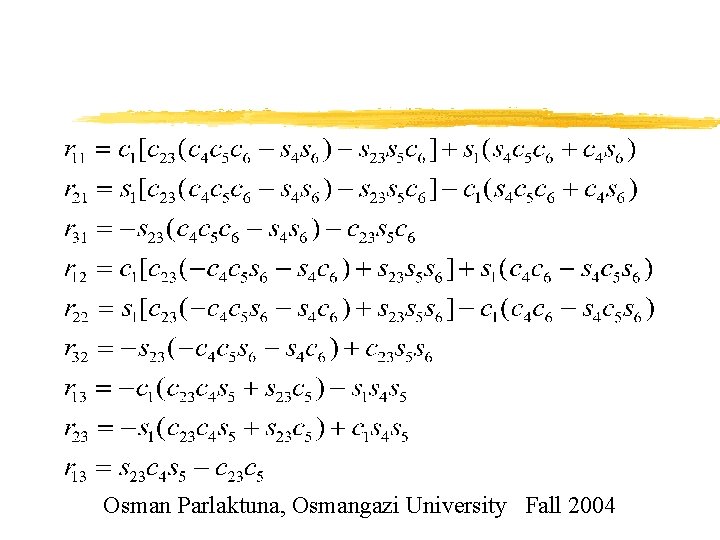
Osman Parlaktuna, Osmangazi University Fall 2004
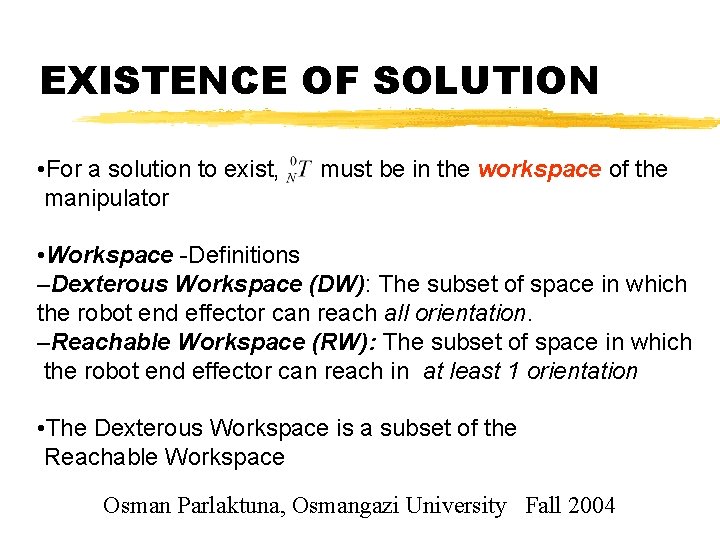
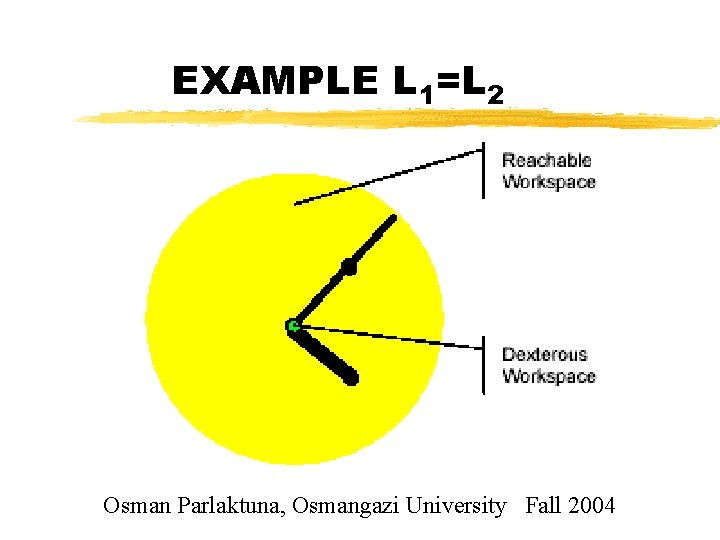
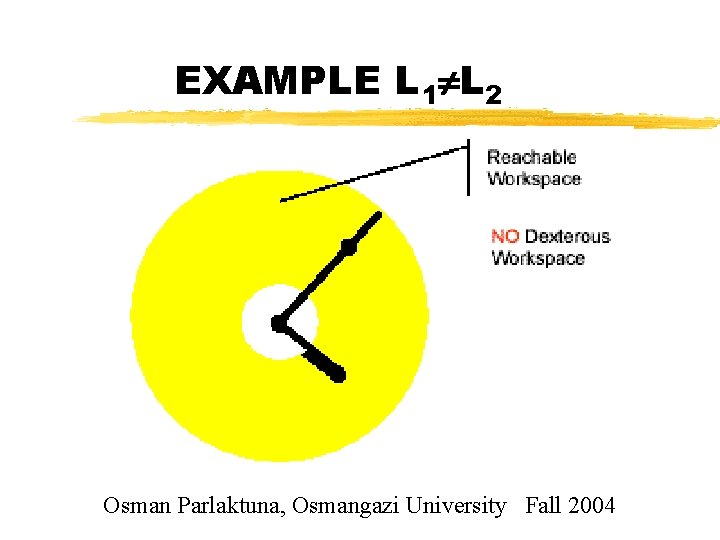
EXISTENCE OF SOLUTION • For a solution to exist, manipulator must be in the workspace of the • Workspace -Definitions –Dexterous Workspace (DW): The subset of space in which the robot end effector can reach all orientation. –Reachable Workspace (RW): The subset of space in which the robot end effector can reach in at least 1 orientation • The Dexterous Workspace is a subset of the Reachable Workspace Osman Parlaktuna, Osmangazi University Fall 2004
EXAMPLE L 1=L 2 Osman Parlaktuna, Osmangazi University Fall 2004
EXAMPLE L 1 L 2 Osman Parlaktuna, Osmangazi University Fall 2004
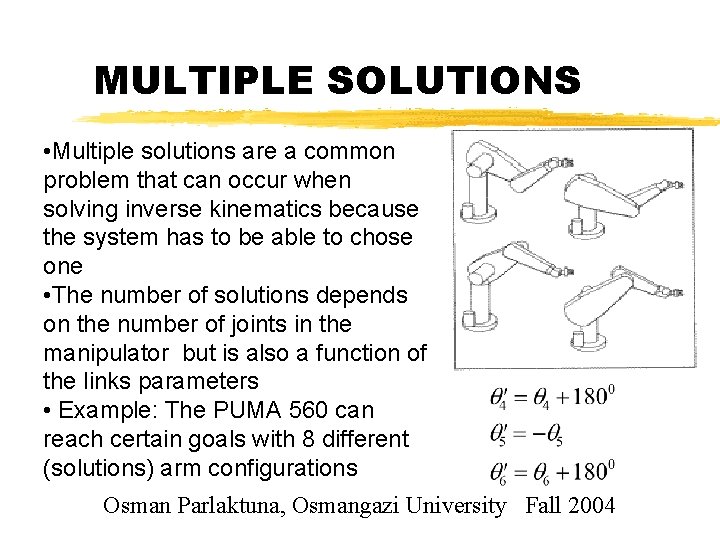
MULTIPLE SOLUTIONS • Multiple solutions are a common problem that can occur when solving inverse kinematics because the system has to be able to chose one • The number of solutions depends on the number of joints in the manipulator but is also a function of the links parameters • Example: The PUMA 560 can reach certain goals with 8 different (solutions) arm configurations Osman Parlaktuna, Osmangazi University Fall 2004
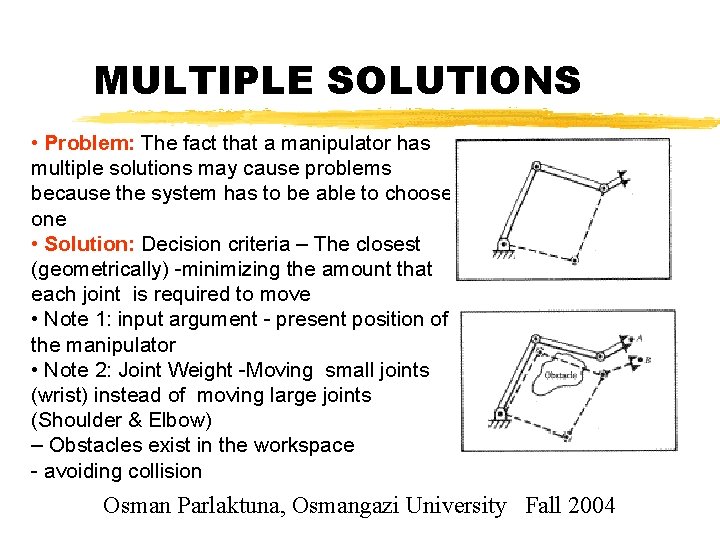
MULTIPLE SOLUTIONS • Problem: The fact that a manipulator has multiple solutions may cause problems because the system has to be able to choose one • Solution: Decision criteria – The closest (geometrically) -minimizing the amount that each joint is required to move • Note 1: input argument - present position of the manipulator • Note 2: Joint Weight -Moving small joints (wrist) instead of moving large joints (Shoulder & Elbow) – Obstacles exist in the workspace - avoiding collision Osman Parlaktuna, Osmangazi University Fall 2004
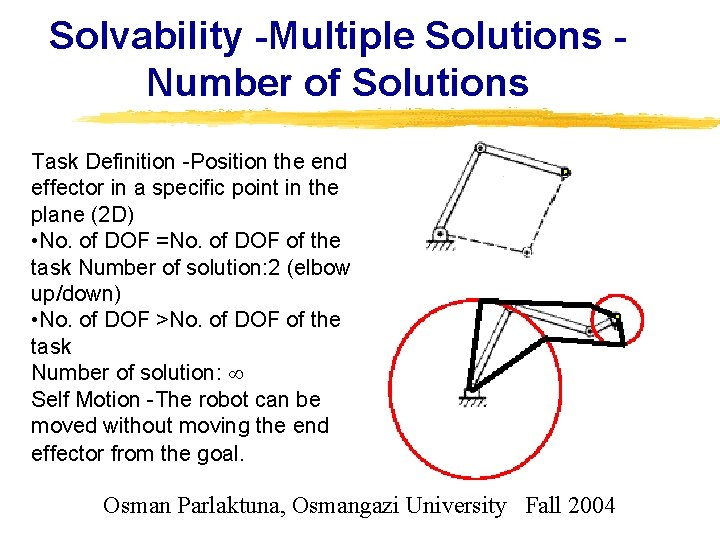
Solvability -Multiple Solutions Number of Solutions Task Definition -Position the end effector in a specific point in the plane (2 D) • No. of DOF =No. of DOF of the task Number of solution: 2 (elbow up/down) • No. of DOF >No. of DOF of the task Number of solution: Self Motion -The robot can be moved without moving the end effector from the goal. Osman Parlaktuna, Osmangazi University Fall 2004
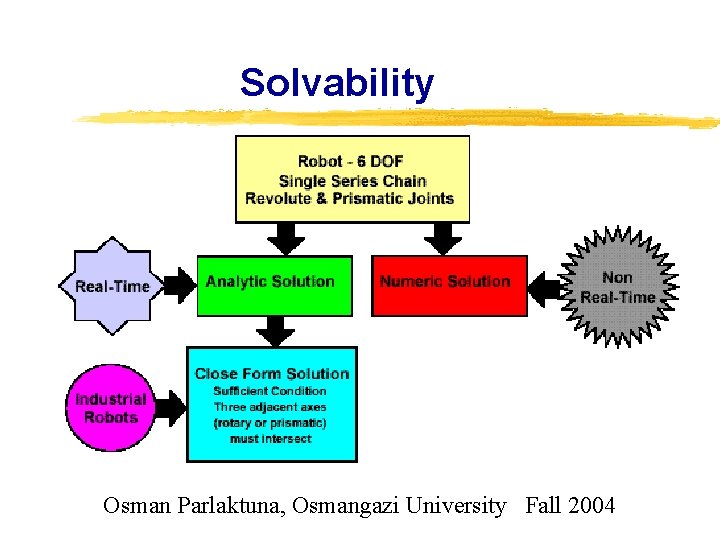
Solvability - Methods of Solutions • Solution (Inverse Kinematics)- A “solution” is the set of joint variables associated with an end effector’s desired position and orientation. • No general algorithms that lead to the solution of inverse kinematic equations. • Solution Strategies – Closed form Solutions - An analytic expression includes all solution sets. • Algebraic Solution - Trigonometric (Nonlinear) equations • Geometric Solution - Reduces the larger problem to a series of plane geometry problems. – Numerical Solutions - Iterative solutions will not be considered in this course. Osman Parlaktuna, Osmangazi University Fall 2004
Solvability Osman Parlaktuna, Osmangazi University Fall 2004
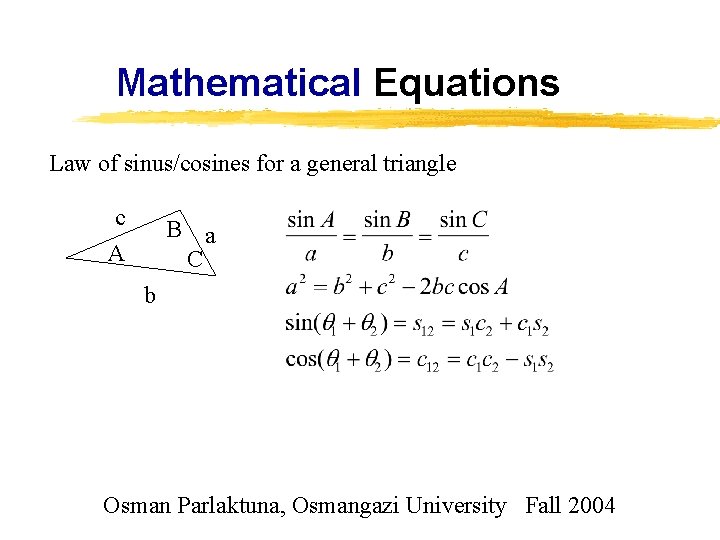
Mathematical Equations Law of sinus/cosines for a general triangle c A B a C b Osman Parlaktuna, Osmangazi University Fall 2004
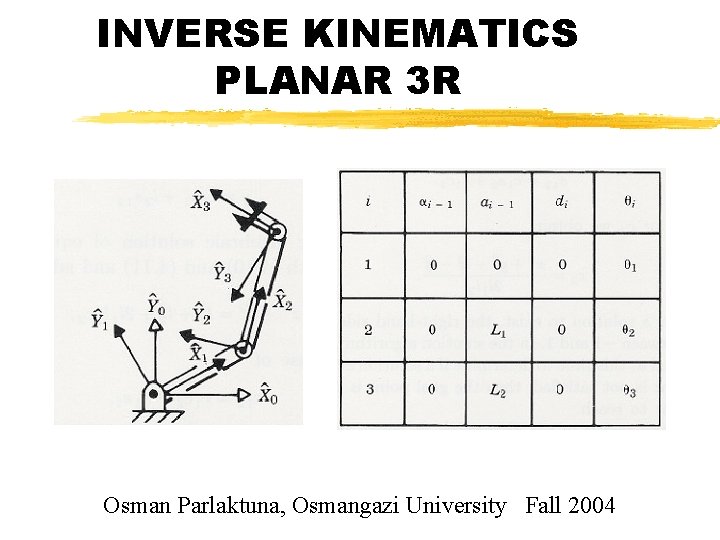
INVERSE KINEMATICS PLANAR 3 R Osman Parlaktuna, Osmangazi University Fall 2004
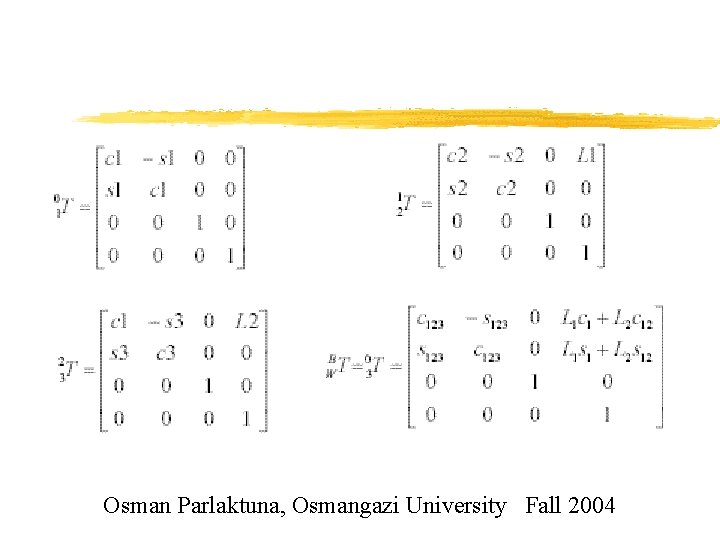
Osman Parlaktuna, Osmangazi University Fall 2004
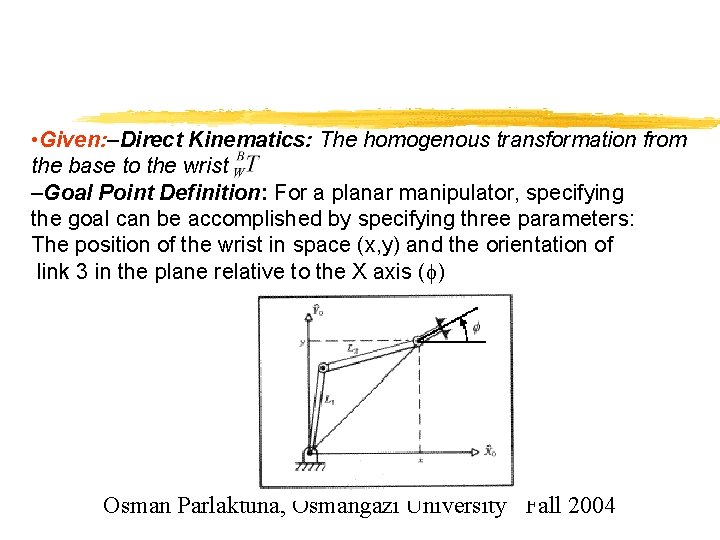
• Given: –Direct Kinematics: The homogenous transformation from the base to the wrist –Goal Point Definition: For a planar manipulator, specifying the goal can be accomplished by specifying three parameters: The position of the wrist in space (x, y) and the orientation of link 3 in the plane relative to the X axis ( ) Osman Parlaktuna, Osmangazi University Fall 2004
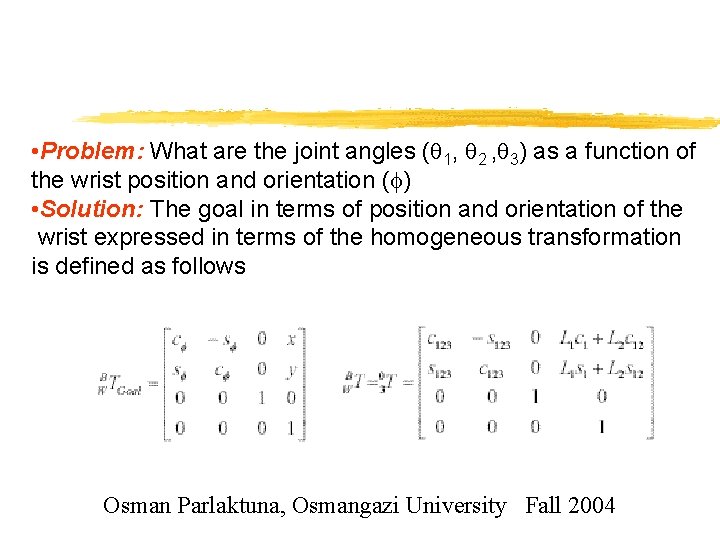
• Problem: What are the joint angles ( 1, 2 , 3) as a function of the wrist position and orientation ( ) • Solution: The goal in terms of position and orientation of the wrist expressed in terms of the homogeneous transformation is defined as follows Osman Parlaktuna, Osmangazi University Fall 2004
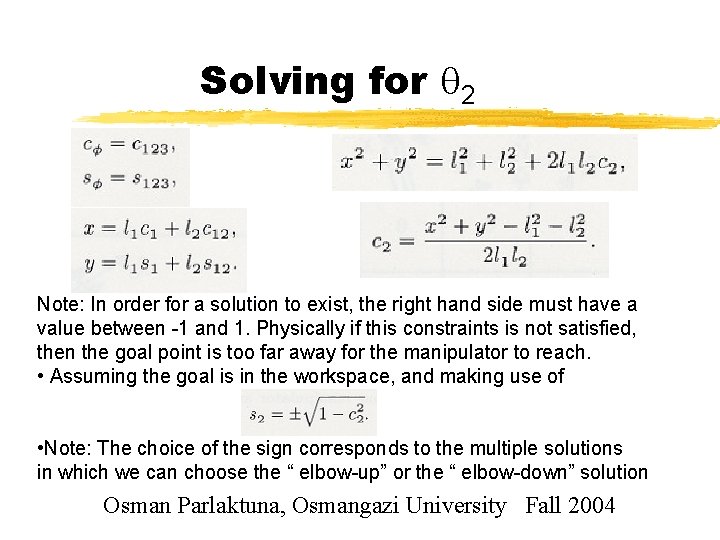
Solving for 2 Note: In order for a solution to exist, the right hand side must have a value between -1 and 1. Physically if this constraints is not satisfied, then the goal point is too far away for the manipulator to reach. • Assuming the goal is in the workspace, and making use of • Note: The choice of the sign corresponds to the multiple solutions in which we can choose the “ elbow-up” or the “ elbow-down” solution Osman Parlaktuna, Osmangazi University Fall 2004
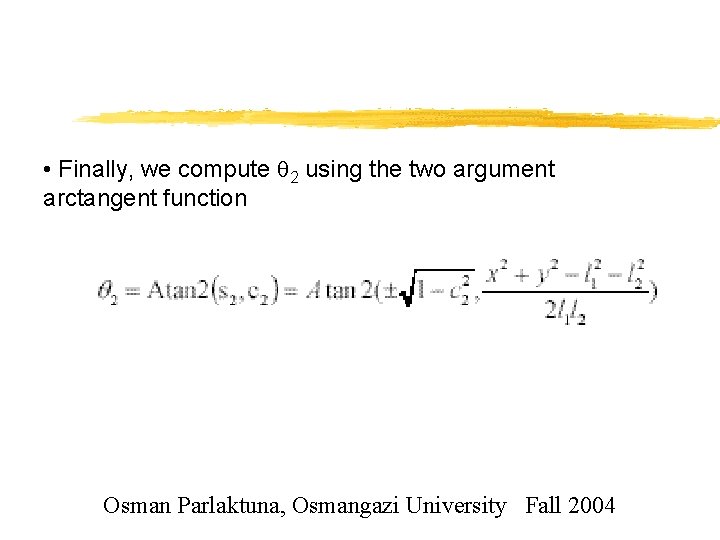
• Finally, we compute 2 using the two argument arctangent function Osman Parlaktuna, Osmangazi University Fall 2004
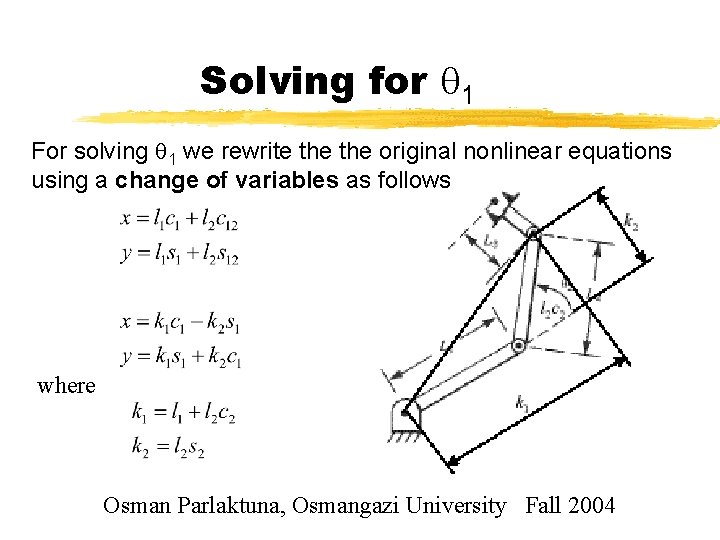
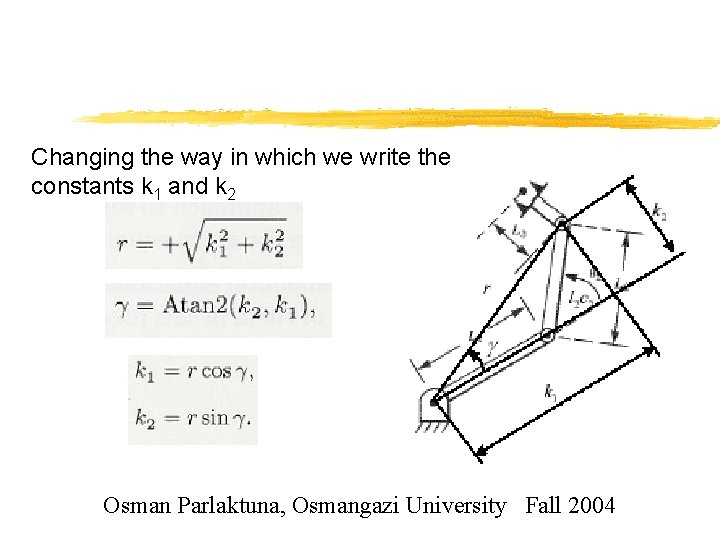
Solving for 1 For solving 1 we rewrite the original nonlinear equations using a change of variables as follows where Osman Parlaktuna, Osmangazi University Fall 2004
Changing the way in which we write the constants k 1 and k 2 Osman Parlaktuna, Osmangazi University Fall 2004
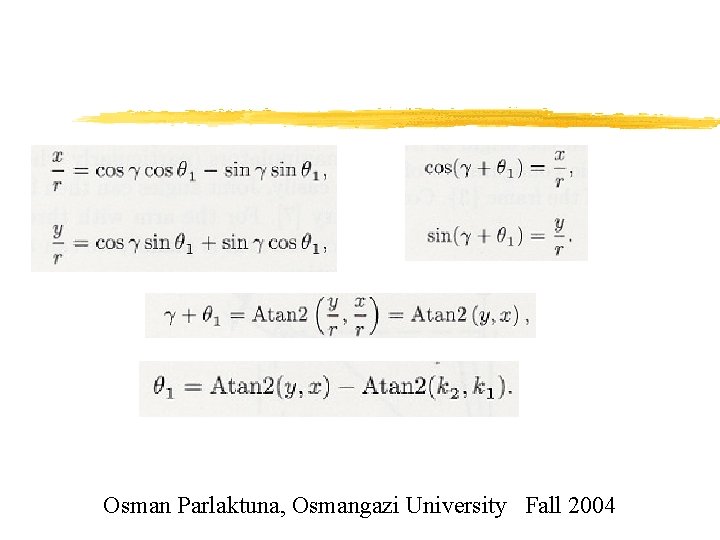
Osman Parlaktuna, Osmangazi University Fall 2004
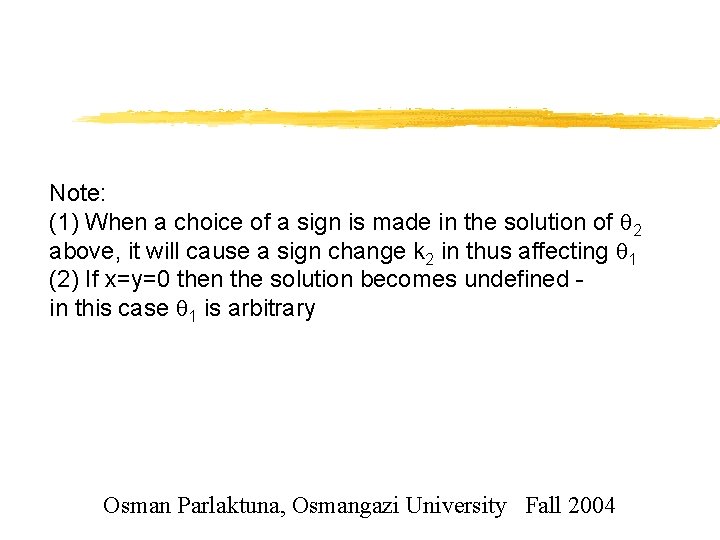
Note: (1) When a choice of a sign is made in the solution of 2 above, it will cause a sign change k 2 in thus affecting 1 (2) If x=y=0 then the solution becomes undefined in this case 1 is arbitrary Osman Parlaktuna, Osmangazi University Fall 2004
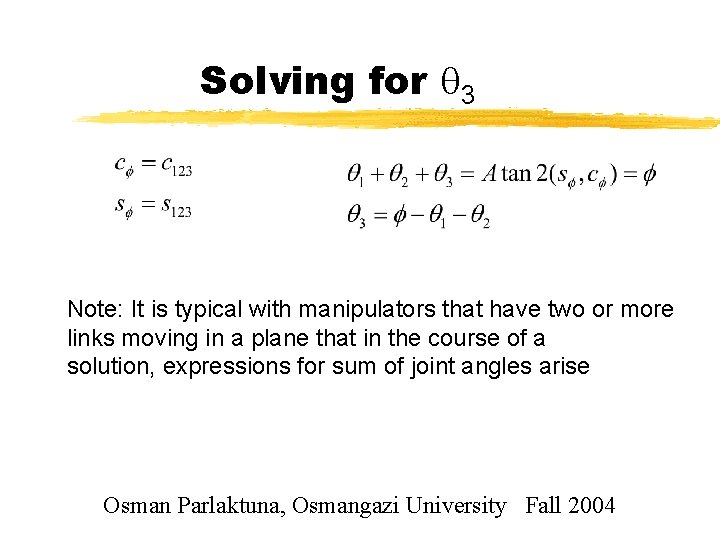
Solving for 3 Note: It is typical with manipulators that have two or more links moving in a plane that in the course of a solution, expressions for sum of joint angles arise Osman Parlaktuna, Osmangazi University Fall 2004
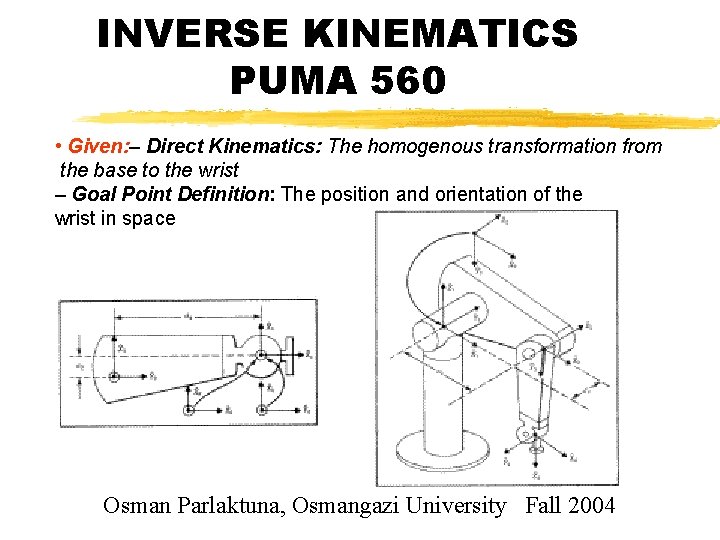
INVERSE KINEMATICS PUMA 560 • Given: – Direct Kinematics: The homogenous transformation from the base to the wrist – Goal Point Definition: The position and orientation of the wrist in space Osman Parlaktuna, Osmangazi University Fall 2004
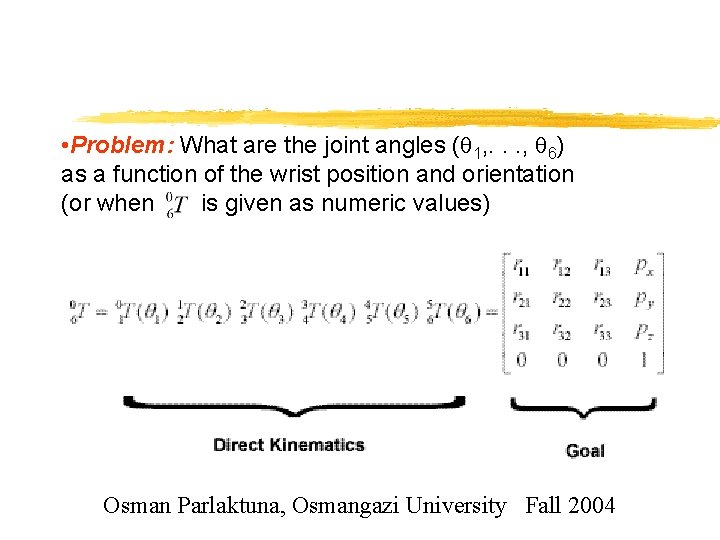
• Problem: What are the joint angles ( 1, . . . , 6) as a function of the wrist position and orientation (or when is given as numeric values) Osman Parlaktuna, Osmangazi University Fall 2004
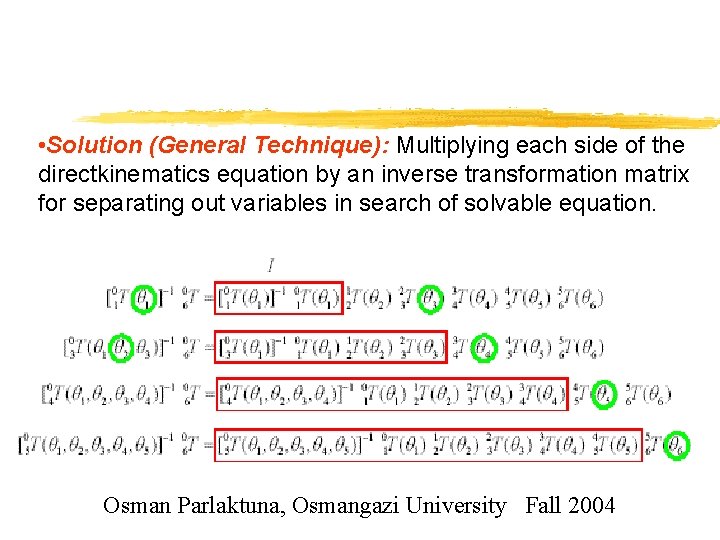
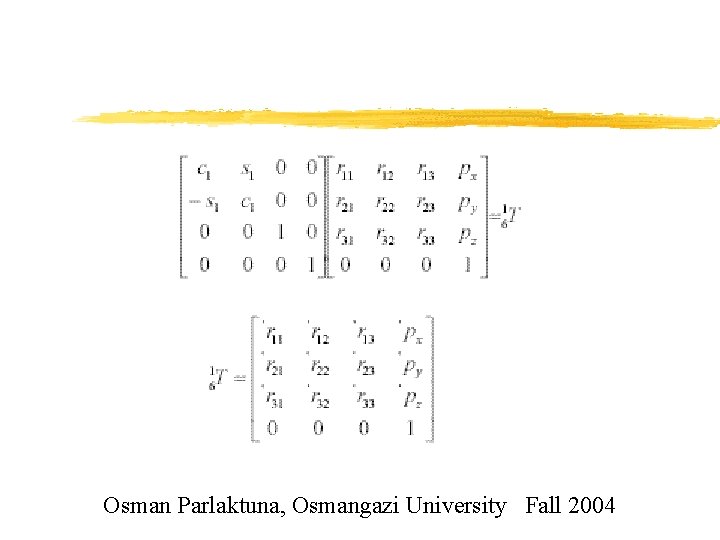
• Solution (General Technique): Multiplying each side of the directkinematics equation by an inverse transformation matrix for separating out variables in search of solvable equation. Osman Parlaktuna, Osmangazi University Fall 2004
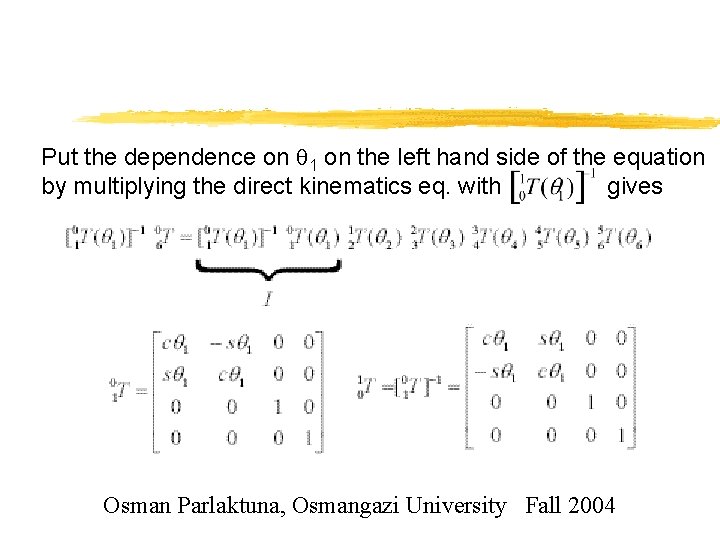
Put the dependence on 1 on the left hand side of the equation by multiplying the direct kinematics eq. with gives Osman Parlaktuna, Osmangazi University Fall 2004
Osman Parlaktuna, Osmangazi University Fall 2004
Osman Parlaktuna, Osmangazi University Fall 2004
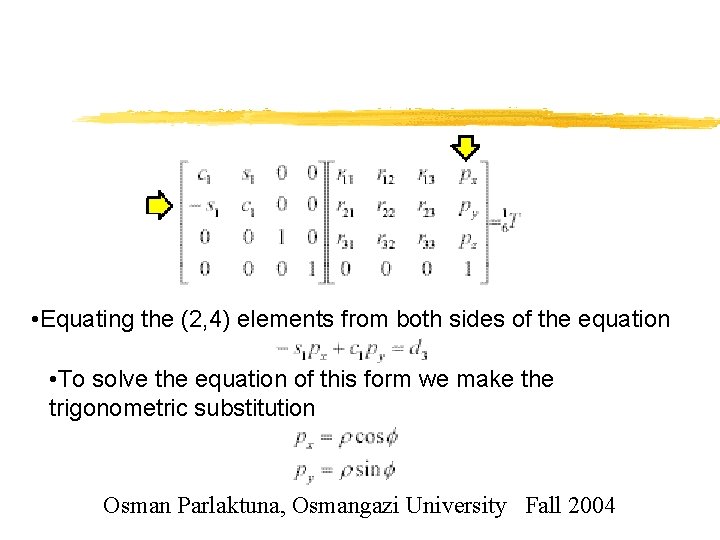
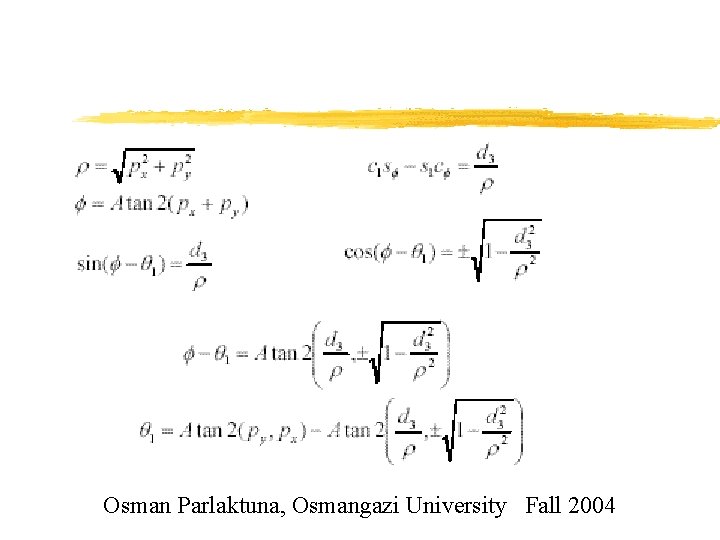
• Equating the (2, 4) elements from both sides of the equation • To solve the equation of this form we make the trigonometric substitution Osman Parlaktuna, Osmangazi University Fall 2004
Osman Parlaktuna, Osmangazi University Fall 2004
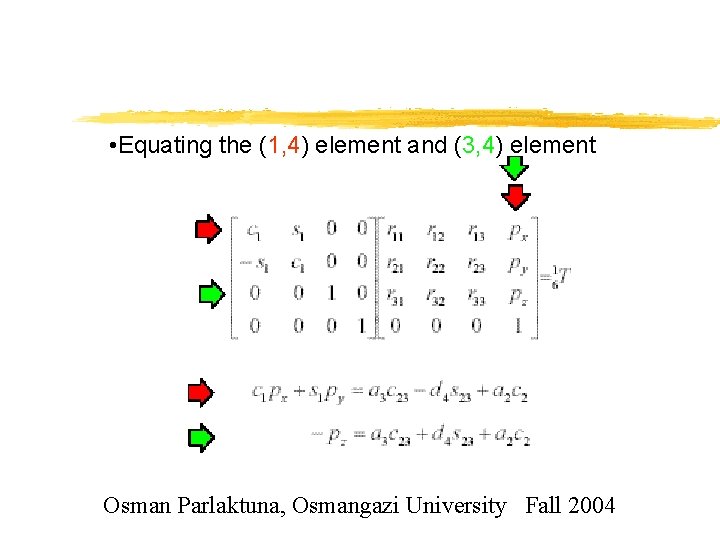
• Equating the (1, 4) element and (3, 4) element Osman Parlaktuna, Osmangazi University Fall 2004
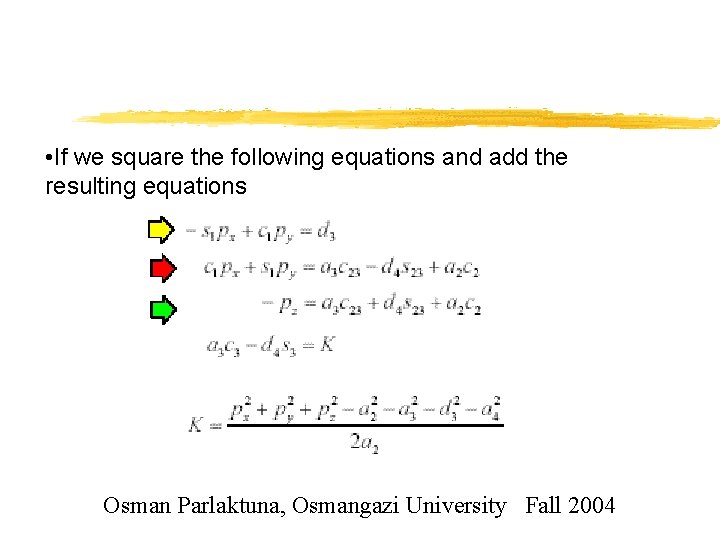
• If we square the following equations and add the resulting equations Osman Parlaktuna, Osmangazi University Fall 2004
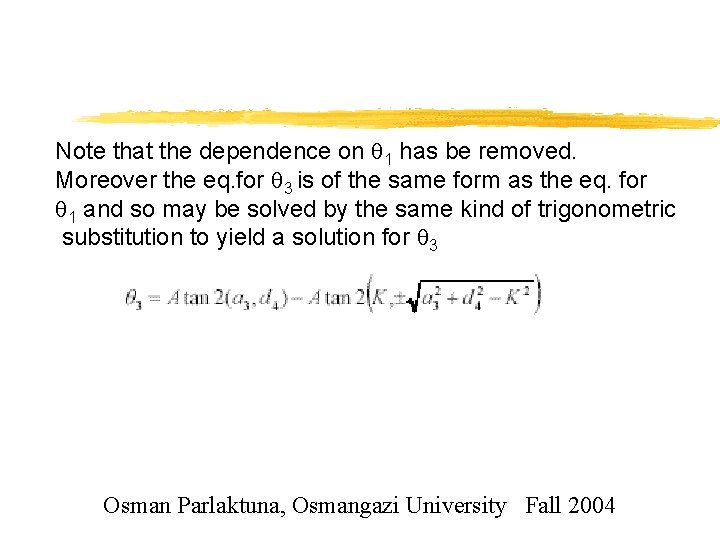
Note that the dependence on 1 has be removed. Moreover the eq. for 3 is of the same form as the eq. for 1 and so may be solved by the same kind of trigonometric substitution to yield a solution for 3 Osman Parlaktuna, Osmangazi University Fall 2004
Osman Parlaktuna, Osmangazi University Fall 2004
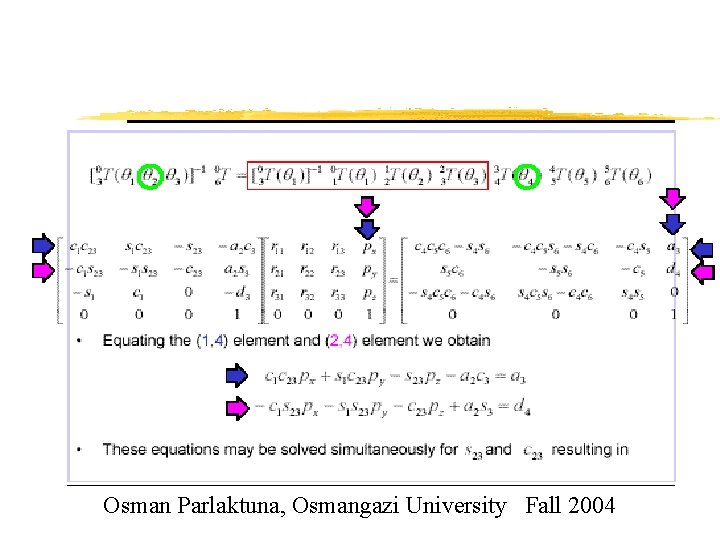
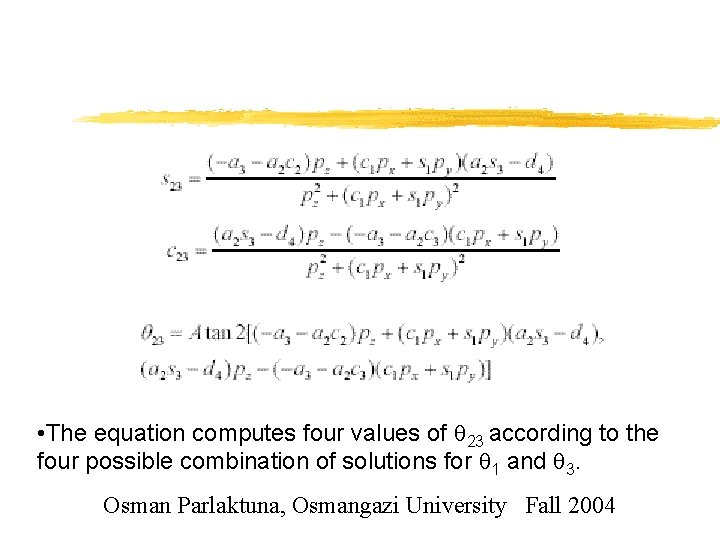
• The equation computes four values of 23 according to the four possible combination of solutions for 1 and 3. Osman Parlaktuna, Osmangazi University Fall 2004
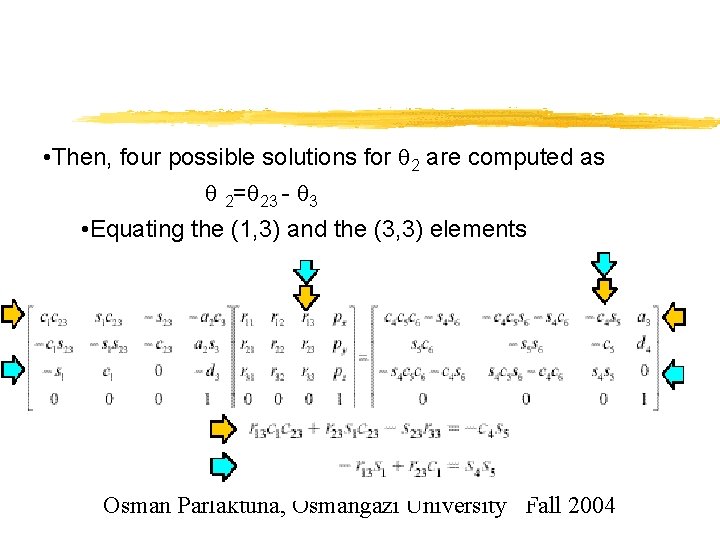
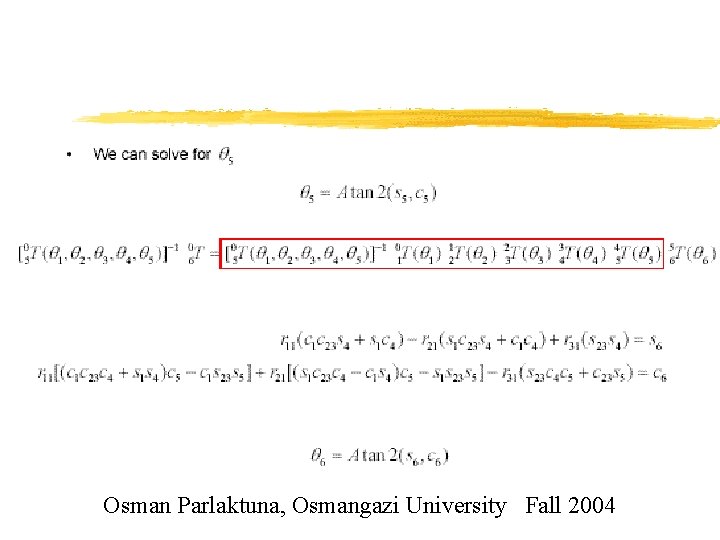
• Then, four possible solutions for 2 are computed as 2= 23 - 3 • Equating the (1, 3) and the (3, 3) elements Osman Parlaktuna, Osmangazi University Fall 2004
Osman Parlaktuna, Osmangazi University Fall 2004
Osman Parlaktuna, Osmangazi University Fall 2004
Osman Parlaktuna, Osmangazi University Fall 2004