
Inverse Barometer correction comparison for Envisat mission between
Inverse Barometer correction comparison for Envisat mission between Corrections based on JRA-55 and ERA-Interim atmospheric reanalyses The JRA-55 correction is referred to as JRA 55 in the following study The ERA-Interim correction is referred to as ERA Lionel Zawadzki, Michael Ablain (CLS)
Inverse Barometer correction comparison for Envisat mission Introduction: • We will observe and analyse the impact of the Inverse Barometer correction computed from the JRA 55 atmospheric reanalysis for climate applications on the Envisat period • We will compare this correction with the Inverse Barometer correction computed from the ERA-Interim atmospheric reanalysis. It will be referred to as “ERA”. • In order to determine the impact of this alternative Inverse Barometer correction in terms of climate applications and temporal scales, we will try in this study to indicate for each impact detected if it’s a positive (+) or a negative (-) impact : Low impact Significant impact No impact detected
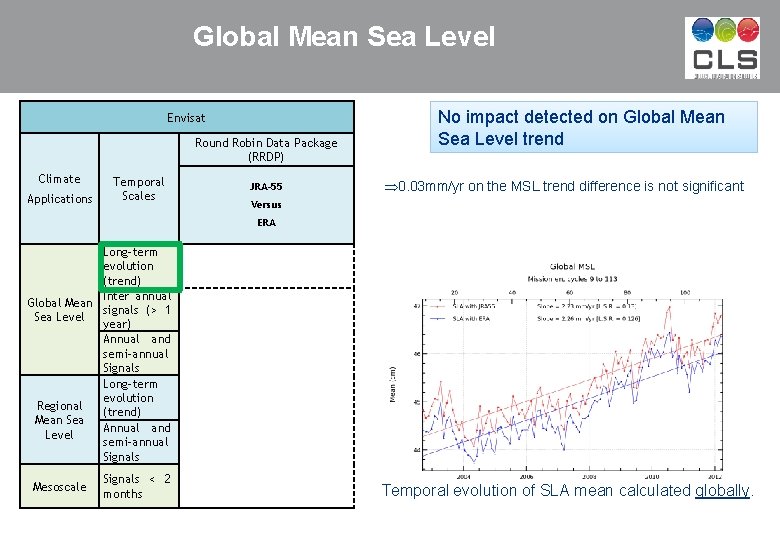
Global Mean Sea Level Envisat Round Robin Data Package (RRDP) Climate Applications Temporal Scales JRA-55 No impact detected on Global Mean Sea Level trend Þ 0. 03 mm/yr on the MSL trend difference is not significant Versus ERA Long-term evolution (trend) Inter annual Global Mean signals (> 1 Sea Level year) Annual and semi-annual Signals Long-term evolution Regional (trend) Mean Sea Annual and Level semi-annual Signals Mesoscale Signals < 2 months Temporal evolution of SLA mean calculated globally.
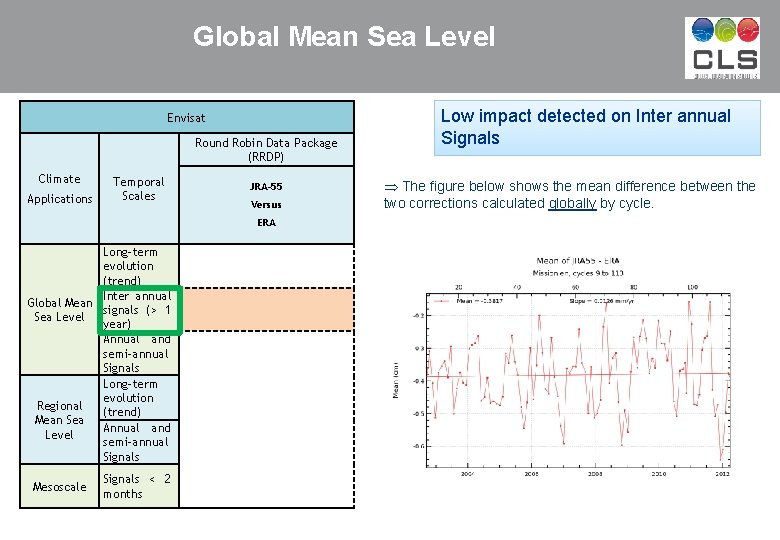
Global Mean Sea Level Envisat Round Robin Data Package (RRDP) Climate Applications Temporal Scales JRA-55 Versus ERA Long-term evolution (trend) Inter annual Global Mean signals (> 1 Sea Level year) Annual and semi-annual Signals Long-term evolution Regional (trend) Mean Sea Annual and Level semi-annual Signals Mesoscale Signals < 2 months Low impact detected on Inter annual Signals Þ The figure below shows the mean difference between the two corrections calculated globally by cycle.
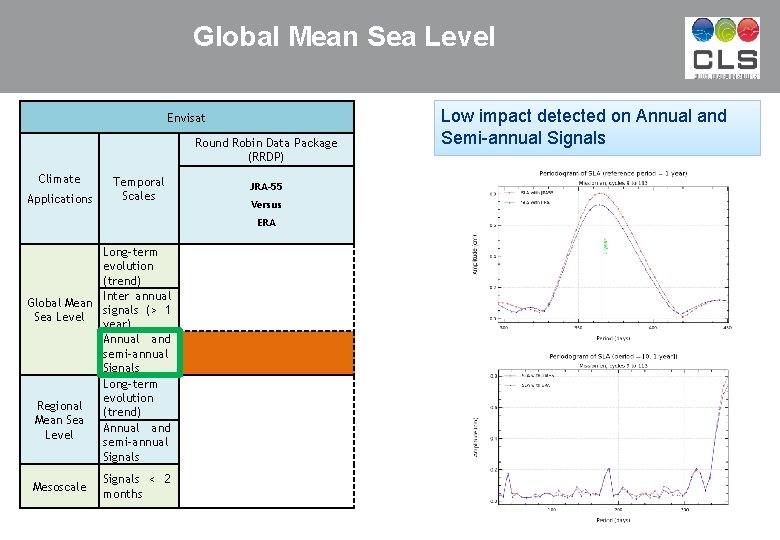
Global Mean Sea Level Envisat Round Robin Data Package (RRDP) Climate Applications Temporal Scales JRA-55 Versus ERA Long-term evolution (trend) Inter annual Global Mean signals (> 1 Sea Level year) Annual and semi-annual Signals Long-term evolution Regional (trend) Mean Sea Annual and Level semi-annual Signals Mesoscale Signals < 2 months Low impact detected on Annual and Semi-annual Signals
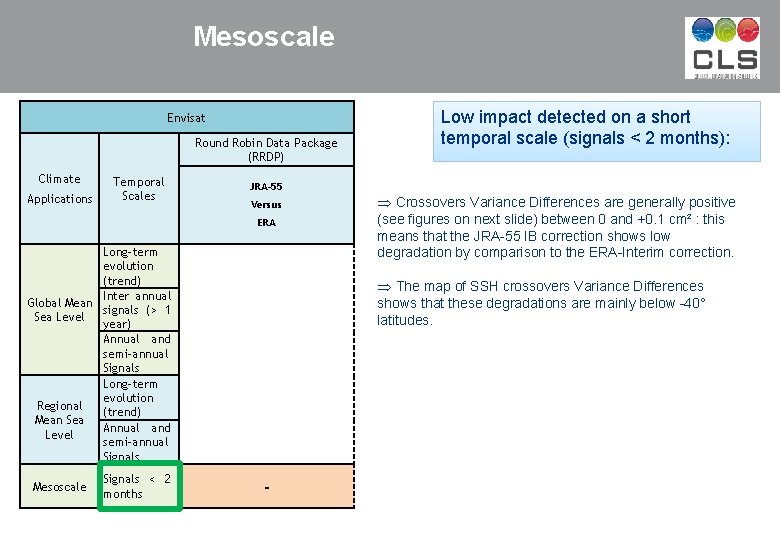
Mesoscale Envisat Round Robin Data Package (RRDP) Climate Applications Temporal Scales JRA-55 Versus ERA Long-term evolution (trend) Inter annual Global Mean signals (> 1 Sea Level year) Annual and semi-annual Signals Long-term evolution Regional (trend) Mean Sea Annual and Level semi-annual Signals Mesoscale Signals < 2 months Low impact detected on a short temporal scale (signals < 2 months): Þ Crossovers Variance Differences are generally positive (see figures on next slide) between 0 and +0. 1 cm² : this means that the JRA-55 IB correction shows low degradation by comparison to the ERA-Interim correction. Þ The map of SSH crossovers Variance Differences shows that these degradations are mainly below -40° latitudes. -
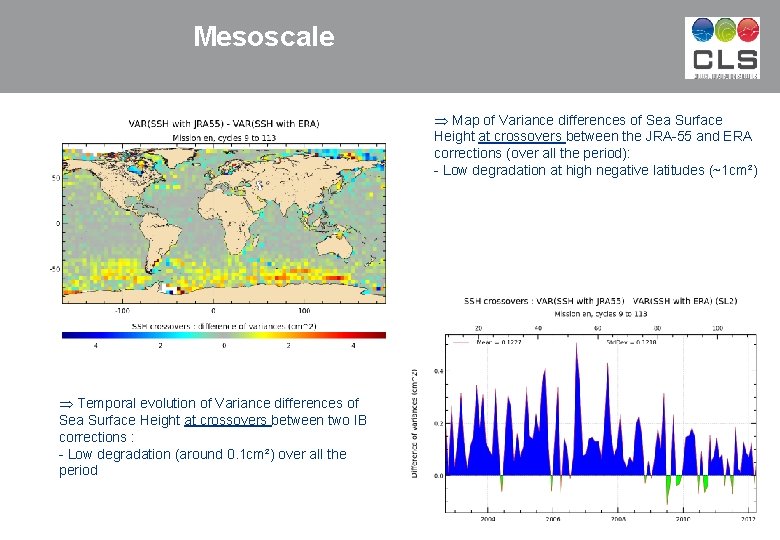
Mesoscale Þ Map of Variance differences of Sea Surface Height at crossovers between the JRA-55 and ERA corrections (over all the period): - Low degradation at high negative latitudes (~1 cm²) Þ Temporal evolution of Variance differences of Sea Surface Height at crossovers between two IB corrections : - Low degradation (around 0. 1 cm²) over all the period
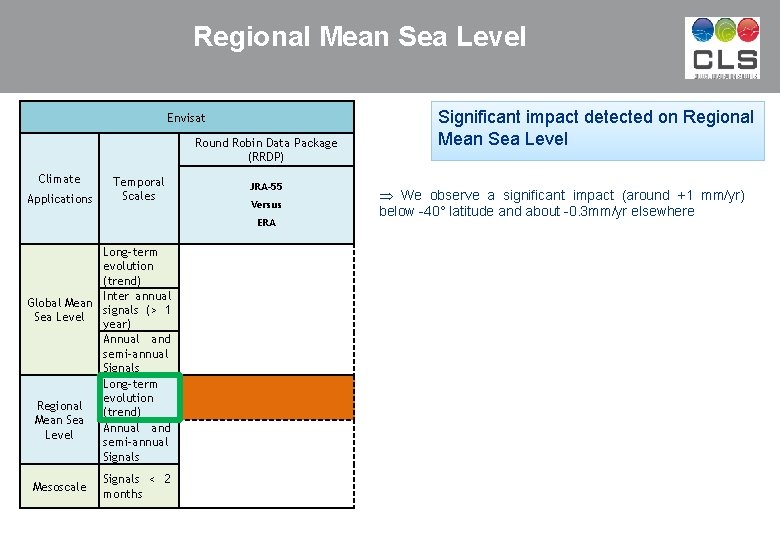
Regional Mean Sea Level Envisat Round Robin Data Package (RRDP) Climate Applications Temporal Scales JRA-55 Versus ERA Long-term evolution (trend) Inter annual Global Mean signals (> 1 Sea Level year) Annual and semi-annual Signals Long-term evolution Regional (trend) Mean Sea Annual and Level semi-annual Signals Mesoscale Signals < 2 months Significant impact detected on Regional Mean Sea Level Þ We observe a significant impact (around +1 mm/yr) below -40° latitude and about -0. 3 mm/yr elsewhere
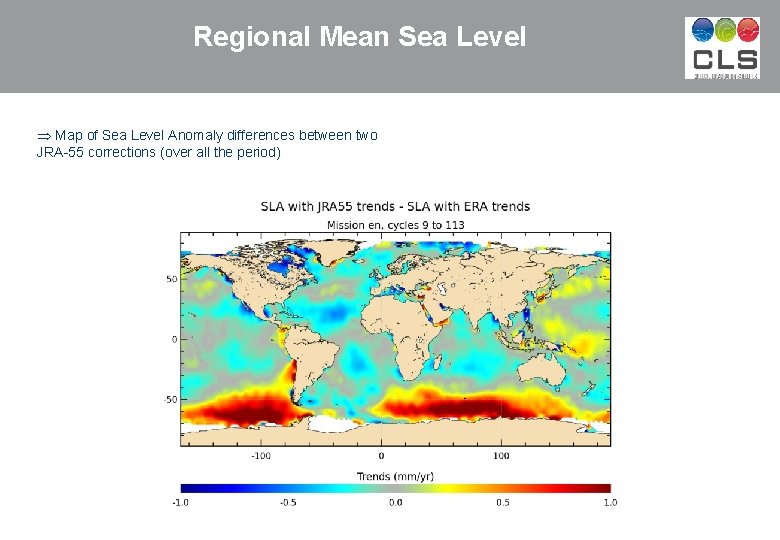
Regional Mean Sea Level Þ Map of Sea Level Anomaly differences between two JRA-55 corrections (over all the period)
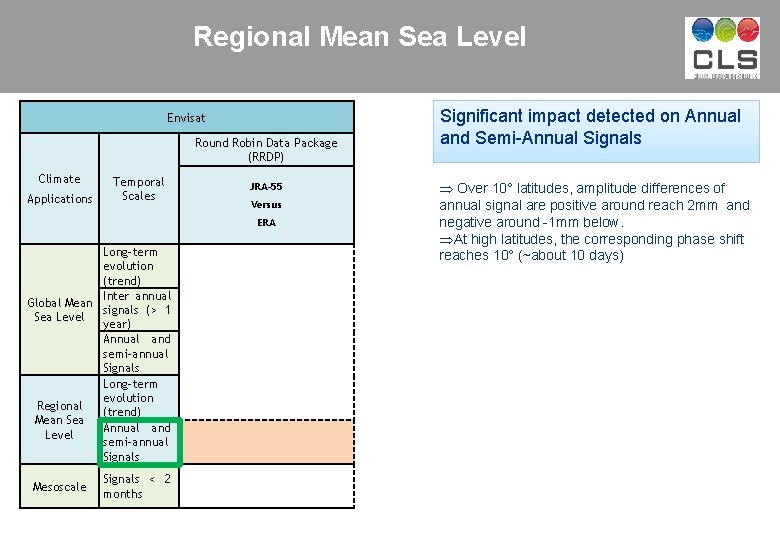
Regional Mean Sea Level Envisat Round Robin Data Package (RRDP) Climate Applications Temporal Scales JRA-55 Versus ERA Long-term evolution (trend) Inter annual Global Mean signals (> 1 Sea Level year) Annual and semi-annual Signals Long-term evolution Regional (trend) Mean Sea Annual and Level semi-annual Signals Mesoscale Signals < 2 months Significant impact detected on Annual and Semi-Annual Signals Þ Over 10° latitudes, amplitude differences of annual signal are positive around reach 2 mm and negative around -1 mm below. ÞAt high latitudes, the corresponding phase shift reaches 10° (~about 10 days)
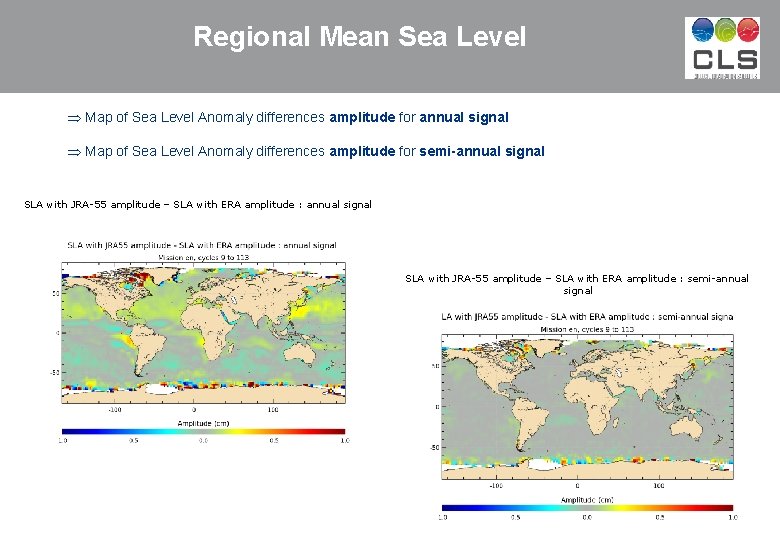
Regional Mean Sea Level Þ Map of Sea Level Anomaly differences amplitude for annual signal Þ Map of Sea Level Anomaly differences amplitude for semi-annual signal SLA with JRA-55 amplitude – SLA with ERA amplitude : semi-annual signal
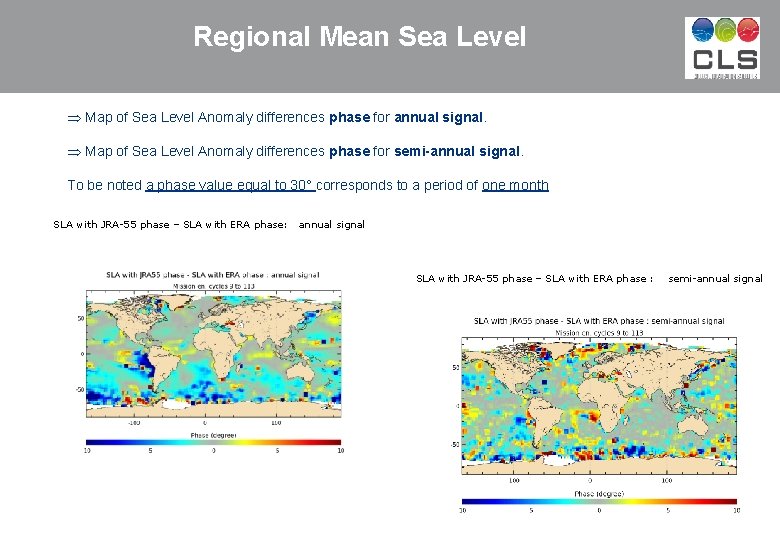
Regional Mean Sea Level Þ Map of Sea Level Anomaly differences phase for annual signal. Þ Map of Sea Level Anomaly differences phase for semi-annual signal. To be noted a phase value equal to 30° corresponds to a period of one month SLA with JRA-55 phase – SLA with ERA phase: annual signal SLA with JRA-55 phase – SLA with ERA phase : semi-annual signal
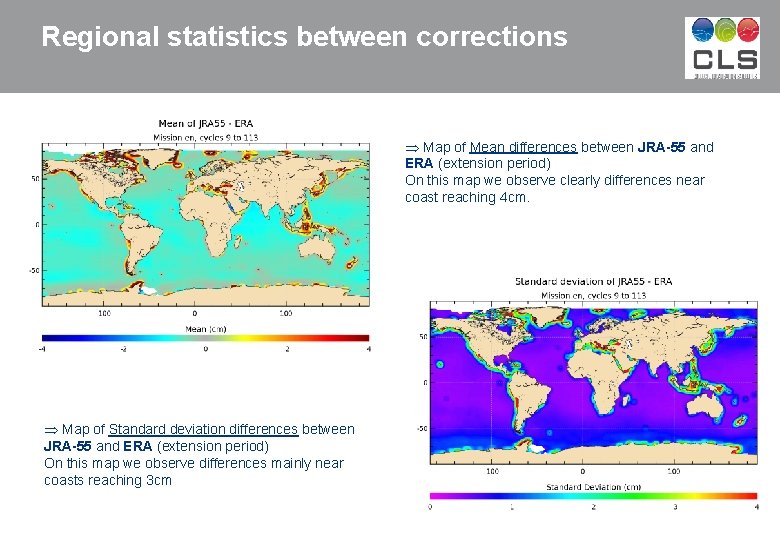
Regional statistics between corrections Þ Map of Mean differences between JRA-55 and ERA (extension period) On this map we observe clearly differences near coast reaching 4 cm. Þ Map of Standard deviation differences between JRA-55 and ERA (extension period) On this map we observe differences mainly near coasts reaching 3 cm
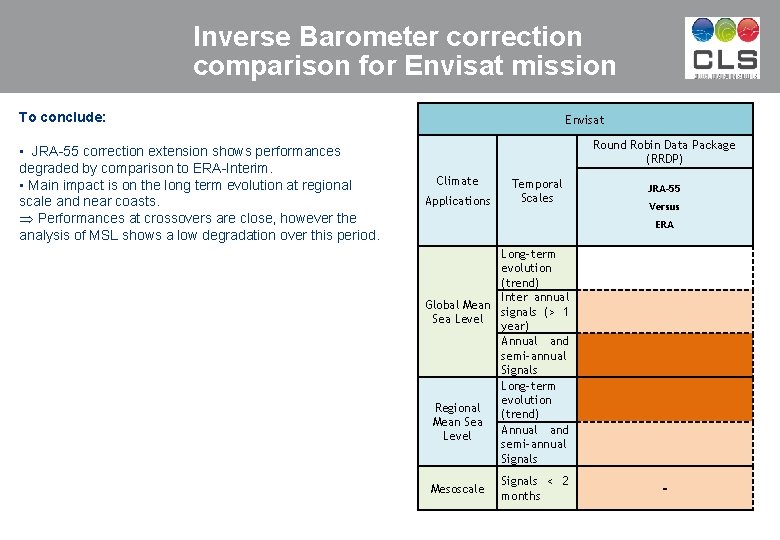
Inverse Barometer correction comparison for Envisat mission To conclude: • JRA-55 correction extension shows performances degraded by comparison to ERA-Interim. • Main impact is on the long term evolution at regional scale and near coasts. Þ Performances at crossovers are close, however the analysis of MSL shows a low degradation over this period. Envisat Round Robin Data Package (RRDP) Climate Applications Temporal Scales JRA-55 Versus ERA Long-term evolution (trend) Inter annual Global Mean signals (> 1 Sea Level year) Annual and semi-annual Signals Long-term evolution Regional (trend) Mean Sea Annual and Level semi-annual Signals Mesoscale Signals < 2 months -
- Slides: 14