
Inventory Valuation Physical inventory flow Prepared by Anees
Inventory Valuation & Physical inventory flow Prepared by Anees Abu Hashem 1
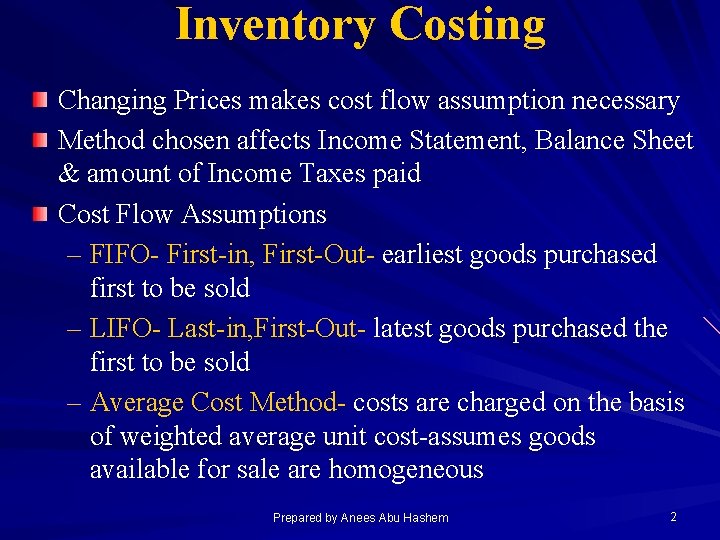
Inventory Costing Changing Prices makes cost flow assumption necessary Method chosen affects Income Statement, Balance Sheet & amount of Income Taxes paid Cost Flow Assumptions – FIFO- First-in, First-Out- earliest goods purchased first to be sold – LIFO- Last-in, First-Out- latest goods purchased the first to be sold – Average Cost Method- costs are charged on the basis of weighted average unit cost-assumes goods available for sale are homogeneous Prepared by Anees Abu Hashem 2
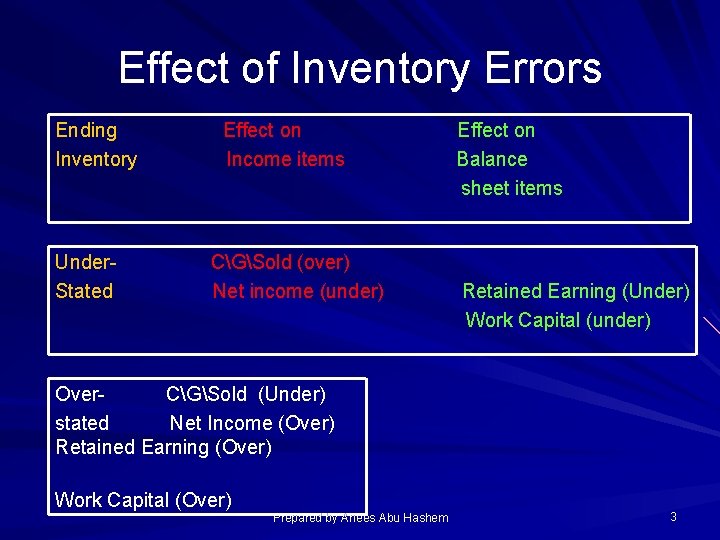
Effect of Inventory Errors Ending Inventory Under. Stated Effect on Income items CGSold (over) Net income (under) Effect on Balance sheet items Retained Earning (Under) Work Capital (under) Over. CGSold (Under) stated Net Income (Over) Retained Earning (Over) Work Capital (Over) Prepared by Anees Abu Hashem 3
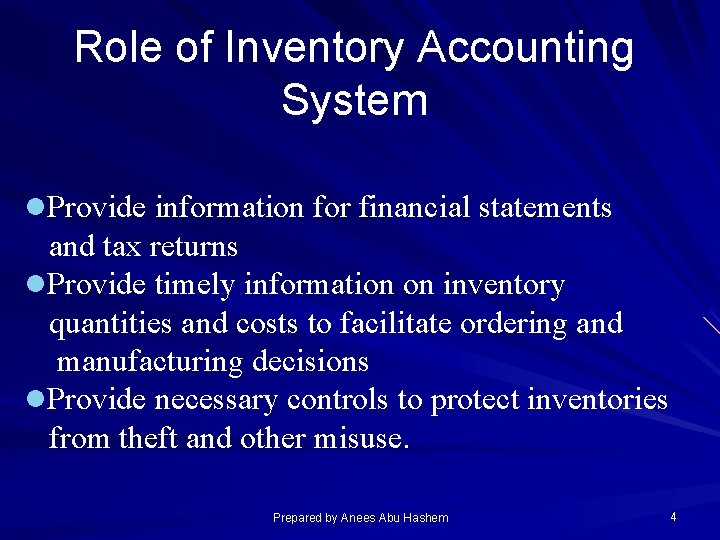
Role of Inventory Accounting System l. Provide information for financial statements and tax returns l. Provide timely information on inventory quantities and costs to facilitate ordering and manufacturing decisions l. Provide necessary controls to protect inventories from theft and other misuse. Prepared by Anees Abu Hashem 4
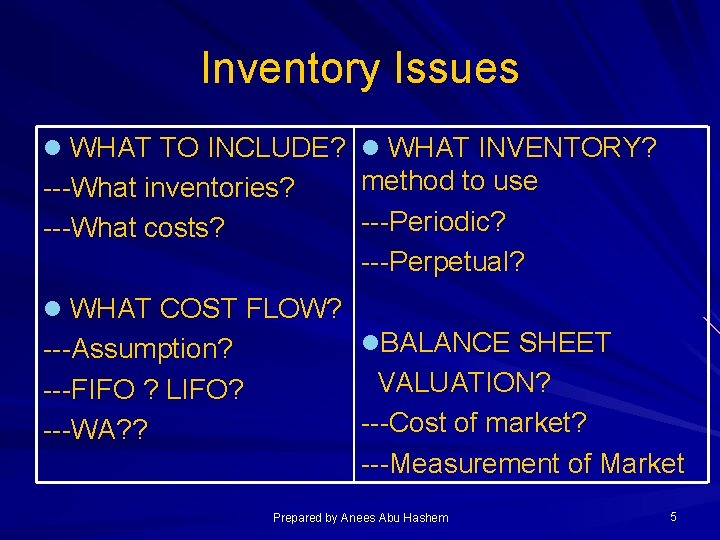
Inventory Issues l WHAT TO INCLUDE? l WHAT INVENTORY? ---What inventories? ---What costs? method to use ---Periodic? ---Perpetual? l WHAT COST FLOW? ---Assumption? ---FIFO ? LIFO? ---WA? ? l. BALANCE SHEET VALUATION? ---Cost of market? ---Measurement of Market Prepared by Anees Abu Hashem 5
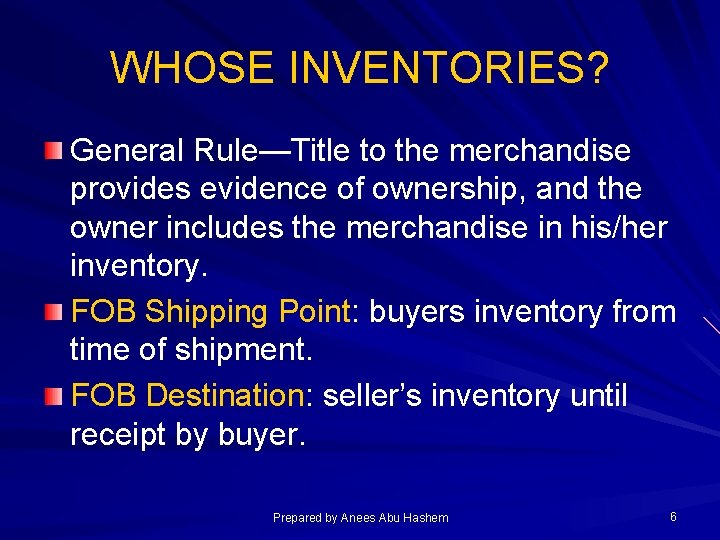
WHOSE INVENTORIES? General Rule—Title to the merchandise provides evidence of ownership, and the owner includes the merchandise in his/her inventory. FOB Shipping Point: buyers inventory from time of shipment. FOB Destination: seller’s inventory until receipt by buyer. Prepared by Anees Abu Hashem 6
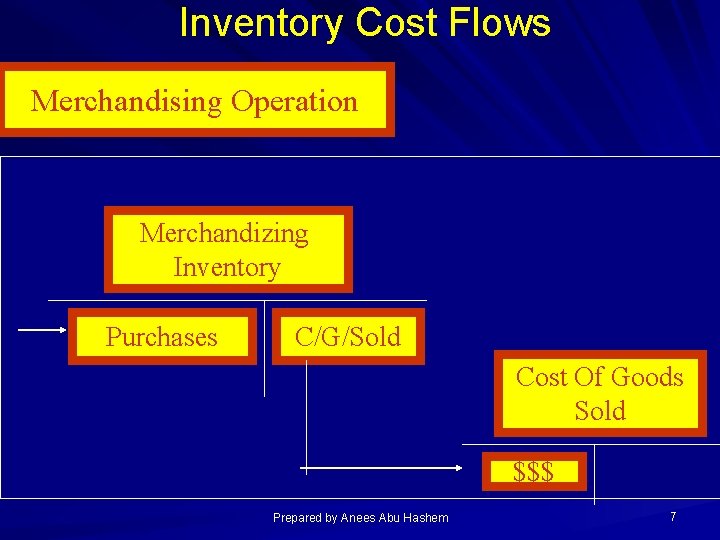
Inventory Cost Flows Merchandising Operation Merchandizing Inventory Purchases C/G/Sold Cost Of Goods Sold $$$ Prepared by Anees Abu Hashem 7

Inventory Cost Flows Manufacturing Operation Raw Material Labor Work in Progress Inventory $$$ C/G/Mfd Finished goods $$$ Cost of Goods Sold Manual Overhead $$$ Prepared by Anees Abu Hashem 8
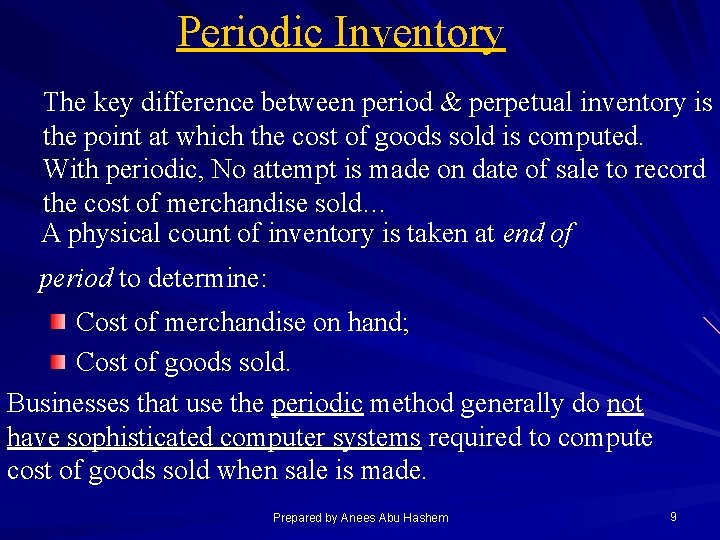
Periodic Inventory The key difference between period & perpetual inventory is the point at which the cost of goods sold is computed. With periodic, No attempt is made on date of sale to record the cost of merchandise sold… A physical count of inventory is taken at end of period to determine: Cost of merchandise on hand; Cost of goods sold. Businesses that use the periodic method generally do not have sophisticated computer systems required to compute cost of goods sold when sale is made. Prepared by Anees Abu Hashem 9

Inventory at the Commercial Companies Physical inventory count at the end of Prd. Beginning Inventory balance and the purchase transactions together show the goods which is available for sale. Inventory cost per unit depends on the way of physical flow, LIFO? FIFO? WA? Prepared by Anees Abu Hashem 10

Ex. Based on Periodic Inventory Cost/u Beg. Balance Amount in units 18 u $10 Total cost $180 Purch Oct. 11 10 u $10. 50 $105 Purch Oct. 25 12 u $11 $132 Purch Oct. 30 10 u $120 Total 50 units Prepared by Anees Abu Hashem $537 11
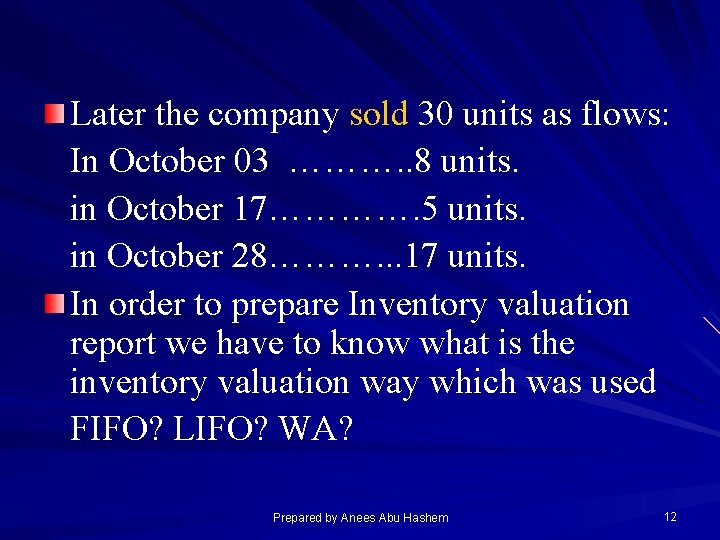
Later the company sold 30 units as flows: In October 03 ………. . 8 units. in October 17…………. 5 units. in October 28………. . . 17 units. In order to prepare Inventory valuation report we have to know what is the inventory valuation way which was used FIFO? LIFO? WA? Prepared by Anees Abu Hashem 12
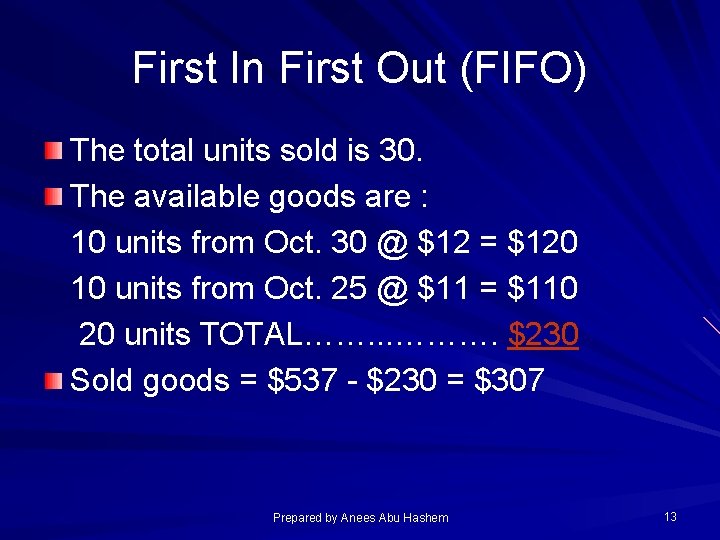
First In First Out (FIFO) The total units sold is 30. The available goods are : 10 units from Oct. 30 @ $12 = $120 10 units from Oct. 25 @ $11 = $110 20 units TOTAL……. . . ………. $230 Sold goods = $537 - $230 = $307 Prepared by Anees Abu Hashem 13
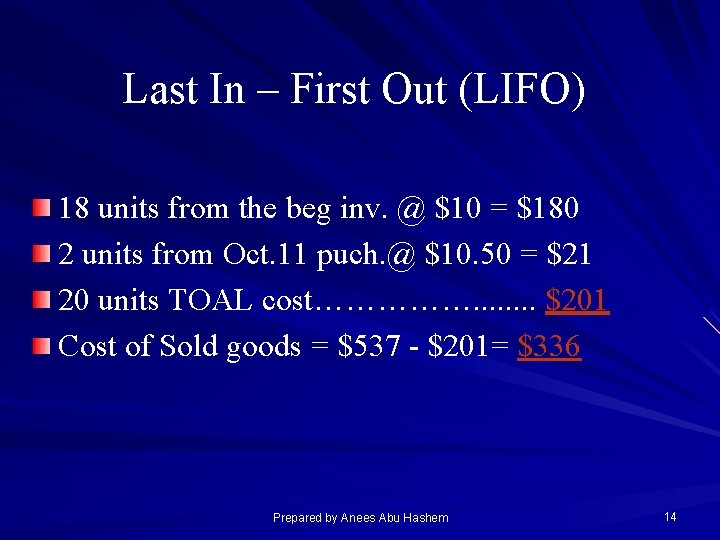
Last In – First Out (LIFO) 18 units from the beg inv. @ $10 = $180 2 units from Oct. 11 puch. @ $10. 50 = $21 20 units TOAL cost……………. . . . $201 Cost of Sold goods = $537 - $201= $336 Prepared by Anees Abu Hashem 14
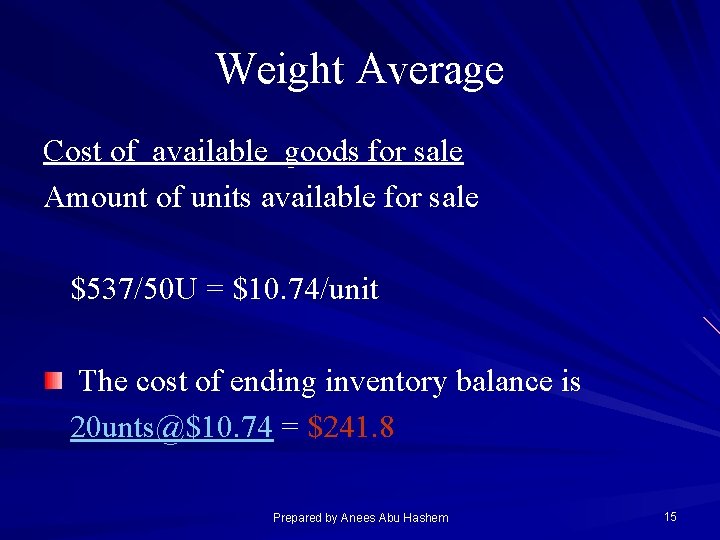
Weight Average Cost of available goods for sale Amount of units available for sale $537/50 U = $10. 74/unit The cost of ending inventory balance is 20 unts@$10. 74 = $241. 8 Prepared by Anees Abu Hashem 15

Valuation of Perpetual Inventories It is a continuous inventory count for every single operation and its costs. it is widely used in the industrial firms, because the costs of inventory can be distributed over all the operations cost during the manufacturing and the production process. It is continuous. The cost flow of the row materials can be changed as soon as the inventory enter the production process. Prepared by Anees Abu Hashem 16
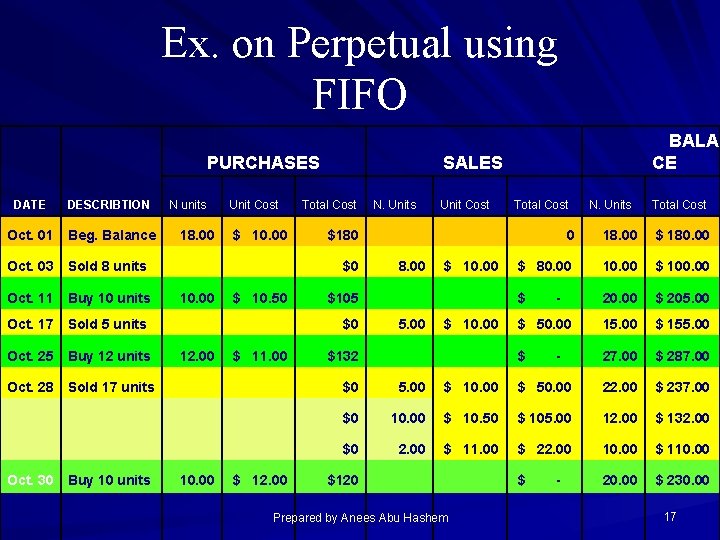
Ex. on Perpetual using FIFO PURCHASES DATE DESCRIBTION Oct. 01 Beg. Balance N units 18. 00 Unit Cost $ 10. 00 Oct. 03 Sold 8 units Oct. 11 Buy 10 units $ 10. 50 Oct. 17 Sold 5 units Oct. 25 Buy 12 units Total Cost 12. 00 $ 11. 00 10. 00 $ 12. 00 N. Units Unit Cost Total Cost $180 8. 00 $ 10. 00 $105 $0 Oct. 28 Sold 17 units Oct. 30 Buy 10 units SALES $0 10. 00 BALAN CE 5. 00 $ 10. 00 $132 N. Units Total Cost 0 18. 00 $ 180. 00 $ 80. 00 10. 00 $ 100. 00 $ 205. 00 $ 50. 00 15. 00 $ 155. 00 $ 27. 00 $ 287. 00 - - $0 5. 00 $ 10. 00 $ 50. 00 22. 00 $ 237. 00 $0 10. 00 $ 10. 50 $ 105. 00 12. 00 $ 132. 00 $0 2. 00 $ 11. 00 $ 22. 00 10. 00 $ 110. 00 $ 230. 00 $120 Prepared by Anees Abu Hashem - 17
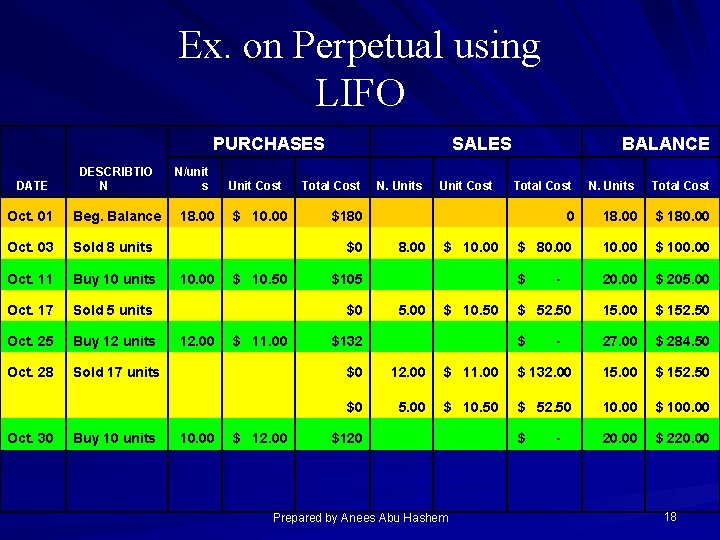
Ex. on Perpetual using LIFO PURCHASES DATE DESCRIBTIO N Oct. 01 Beg. Balance Oct. 03 Sold 8 units Oct. 11 Buy 10 units Oct. 17 Sold 5 units Oct. 25 Buy 12 units Oct. 28 Sold 17 units Oct. 30 Buy 10 units N/unit s 18. 00 Unit Cost $ 10. 00 SALES Total Cost $ 10. 50 10. 00 $ 11. 00 $ 12. 00 8. 00 $ 10. 00 $105 $0 12. 00 Unit Cost Total Cost N. Units Total Cost 0 18. 00 $ 180. 00 $ 80. 00 10. 00 $ 100. 00 $ 205. 00 $ 52. 50 15. 00 $ 152. 50 $ 27. 00 $ 284. 50 $180 $0 10. 00 N. Units BALANCE 5. 00 $ 10. 50 $132 - - $0 12. 00 $ 11. 00 $ 132. 00 15. 00 $ 152. 50 $0 5. 00 $ 10. 50 $ 52. 50 10. 00 $ 100. 00 $ 220. 00 $120 Prepared by Anees Abu Hashem - 18
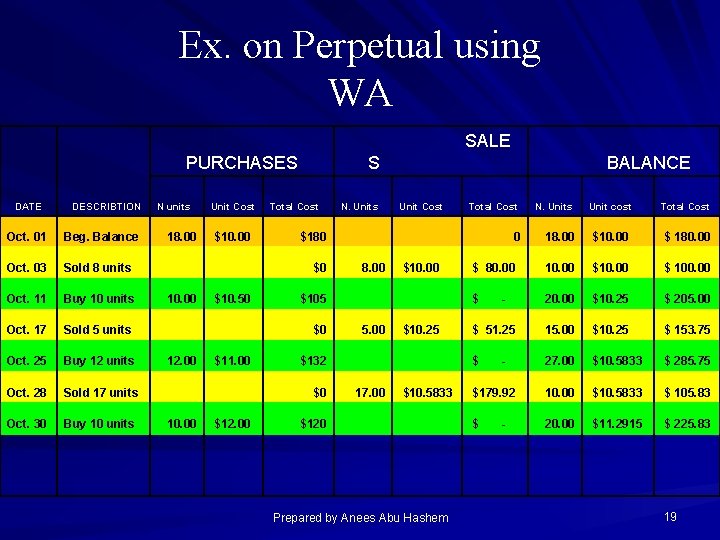
Ex. on Perpetual using WA SALE PURCHASES DATE DESCRIBTION Oct. 01 Beg. Balance Oct. 03 Sold 8 units Oct. 11 Buy 10 units Oct. 17 Sold 5 units Oct. 25 Buy 12 units Oct. 28 Sold 17 units Oct. 30 Buy 10 units N units 18. 00 Unit Cost $10. 00 S Total Cost $10. 50 $11. 00 $12. 00 8. 00 $10. 00 5. 00 $10. 25 $132 $0 10. 00 Total Cost N. Units Unit cost Total Cost 18. 00 $10. 00 $ 180. 00 $ 80. 00 10. 00 $ 100. 00 $ 20. 00 $10. 25 $ 205. 00 $ 51. 25 15. 00 $10. 25 $ 153. 75 $ 27. 00 $10. 5833 $ 285. 75 $179. 92 10. 00 $10. 5833 $ 105. 83 $ 20. 00 $11. 2915 $ 225. 83 0 $105 $0 12. 00 Unit Cost $180 $0 10. 00 N. Units BALANCE 17. 00 $10. 5833 $120 Prepared by Anees Abu Hashem - - - 19
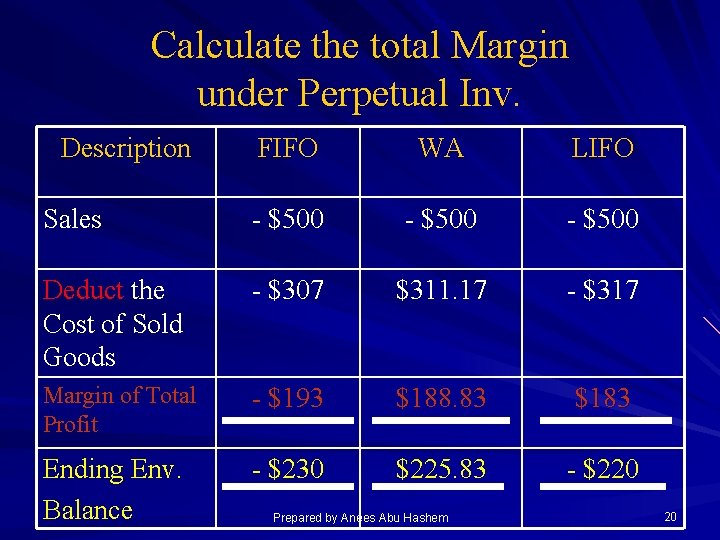
Calculate the total Margin under Perpetual Inv. Description FIFO WA LIFO Sales - $500 Deduct the Cost of Sold Goods - $307 $311. 17 - $317 Margin of Total Profit - $193 $188. 83 $183 Ending Env. Balance - $230 $225. 83 - $220 Prepared by Anees Abu Hashem 20
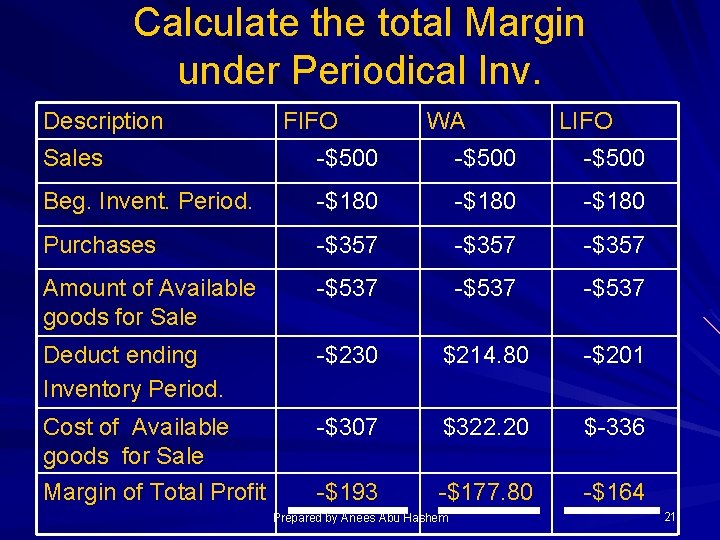
Calculate the total Margin under Periodical Inv. Description Sales FIFO -$500 WA -$500 LIFO -$500 Beg. Invent. Period. -$180 Purchases -$357 Amount of Available goods for Sale -$537 Deduct ending Inventory Period. -$230 $214. 80 -$201 Cost of Available goods for Sale Margin of Total Profit -$307 $322. 20 $-336 -$193 -$177. 80 -$164 Prepared by Anees Abu Hashem 21
Sales Revenues Under a Periodic System are recorded when earned-revenue recognition principle must be supported by a business documentwritten evidence ONLY 1 entry is made for each sale – one to record sale Prepared by Anees Abu Hashem 22

Companies that use periodic inventory take a physical count to. . . Compute the amount of goods sold Determine ending inventory. Companies that use perpetual inventory must take a physical count in order to check accuracy of “Book Inventory” to actual inventory. Prepared by Anees Abu Hashem 23

Determining inventory quantities by counting, weighting or measuring each type of inventory. Determining ownership of goods, including goods in transit, consigned goods. Quantity of each kind of inventory is listed on inventory summary sheets where unit costs are applied. Do all goods in count belong to company? Does the company own goods not included in the count (in transit? ) Prepared by Anees Abu Hashem 24
Income Statement Presentation company is the same whether a periodic or perpetual inventory system is used, except for the cost of goods sold section. The income statement for a merchandising Prepared by Anees Abu Hashem 25
Comparison of Methods Sales $5, 00 (all methods) Cost of goods available for sale $537 (all methods) Prepared by Anees Abu Hashem 26
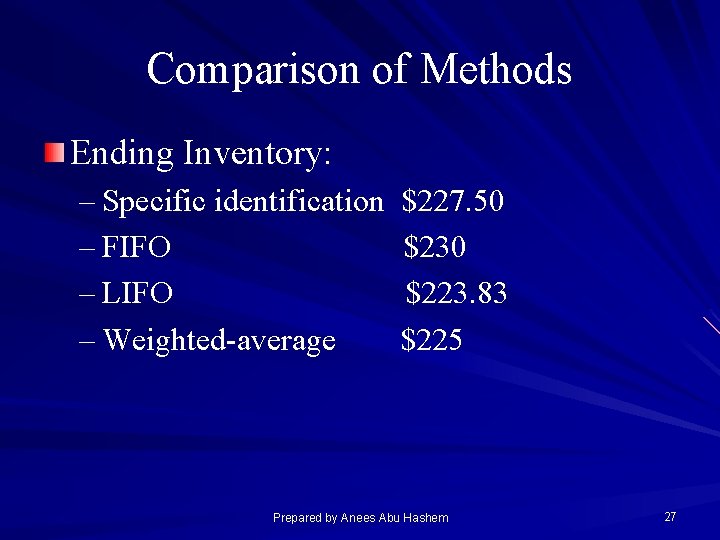
Comparison of Methods Ending Inventory: – Specific identification – FIFO – LIFO – Weighted-average $227. 50 $230 $223. 83 $225 Prepared by Anees Abu Hashem 27
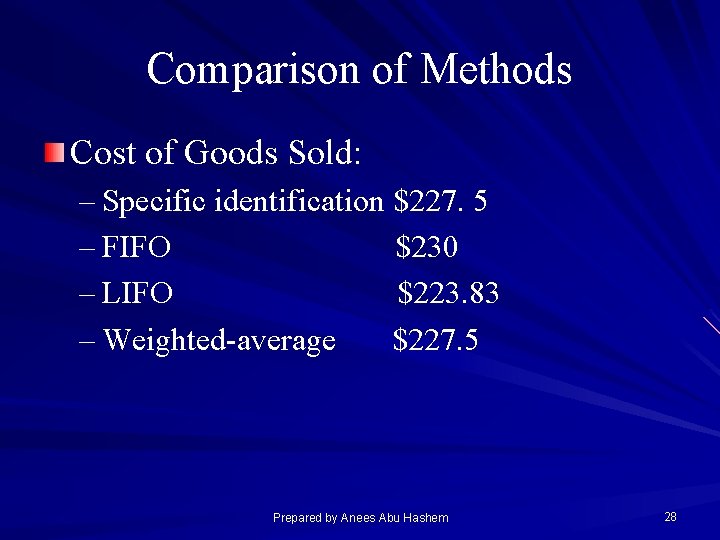
Comparison of Methods Cost of Goods Sold: – Specific identification $227. 5 – FIFO $230 – LIFO $223. 83 – Weighted-average $227. 5 Prepared by Anees Abu Hashem 28
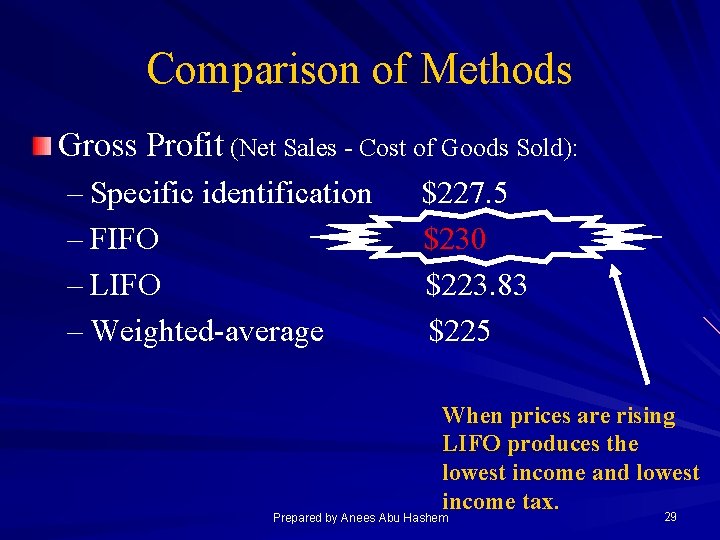
Comparison of Methods Gross Profit (Net Sales - Cost of Goods Sold): – Specific identification $227. 5 – FIFO $230 – LIFO $223. 83 – Weighted-average $225 When prices are rising LIFO produces the lowest income and lowest income tax. Prepared by Anees Abu Hashem 29
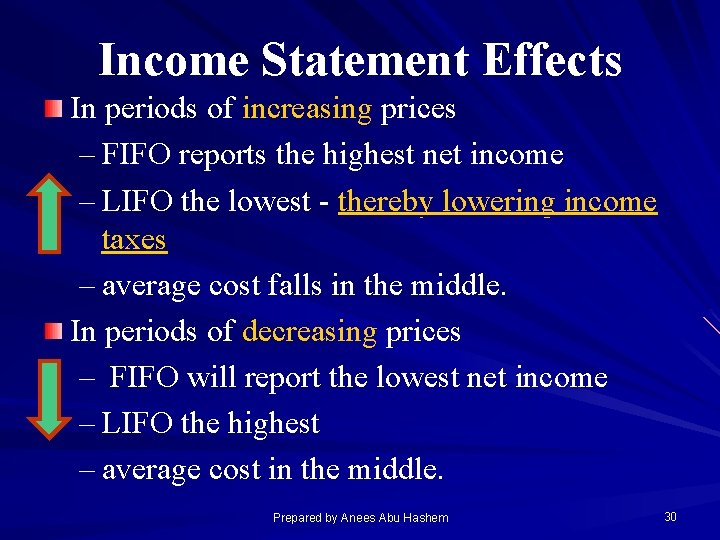
Income Statement Effects In periods of increasing prices – FIFO reports the highest net income – LIFO the lowest - thereby lowering income taxes – average cost falls in the middle. In periods of decreasing prices – FIFO will report the lowest net income – LIFO the highest – average cost in the middle. Prepared by Anees Abu Hashem 30
Balance Sheet Effects In a period of increasing prices costs allocated to ending inventory using: FIFO will approximate current costs LIFO will be understated Prepared by Anees Abu Hashem 31
The Lower of Cost or Market Basis of Accounting for Inventories When the value of inventory is lower than its cost, the inventory is written down to its market value by valuing the inventory at the lower of cost or market (LCM) in the period in which the price decline occurs. (“Market” is current replacement cost) departure from cost principle follows conservatism concept can be used only after one of the cost flow methods ( Specific Identification FIFO, LIFO, or Average Cost) Prepared by Anees Abu Hashem 32
LIFO Reserve And Its Importance For Comparing Results Of Different Companies Accounting standards require firms using LIFO to report the amount by which inventory would be increased (or on occasion decreased) if the firm had instead been using FIFO. Prepared by Anees Abu Hashem 25 33
This amount is referred to as the LIFO reserve. Reporting the LIFO reserve enables analysts to make adjustments to compare companies that use different cost flow methods. Prepared by Anees Abu Hashem 34
- Slides: 34