
INVENTORY STRATEGY l l Inventory decision high risk
- Slides: 5
INVENTORY STRATEGY l l Inventory decision : high risk and impact The improper inventory arrangement : lost of sales, decreased customer’s satisfaction, delayed production line, higher costs and poor quality. The principles : significant cost center, capital investment, potential for obsolescence and damaged/total loss, no added value, the ideal make-to-order operation. The functionality : geographical specialization (increasing operation efficiency at a single location, decoupling (increase operation efficiency at multiple locations), balancing, buffer uncertainties.
COST OF INVENTORY l Ô Ô l l l Carrying costs : capital cost taxes insurance obsolescence Ordering costs Shortage Costs see the Inventory topic in POM class
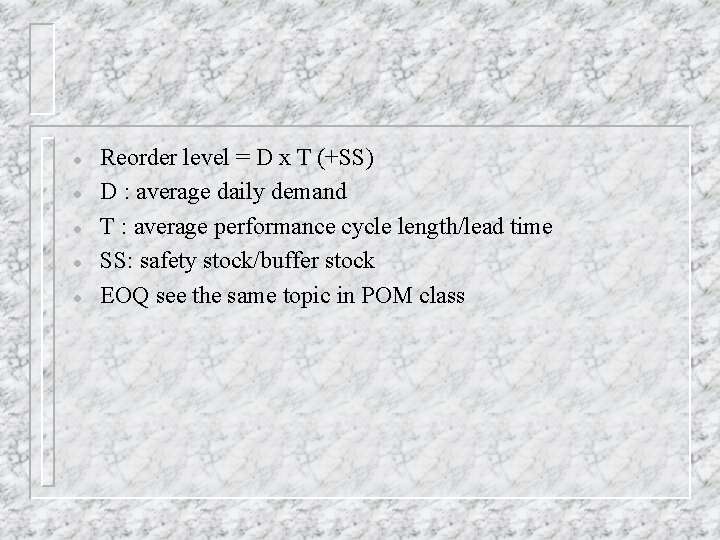
l l l Reorder level = D x T (+SS) D : average daily demand T : average performance cycle length/lead time SS: safety stock/buffer stock EOQ see the same topic in POM class
INVENTORY MANAGEMENT l l l A planning that proactively schedules products movement and allocation through the channel according to forecasted demand product availability. Inventory control : perpetual review, periodic review, modified control system (TGT - upper limit for replenishment) Planning Method : to coordinate inventory requirement across multiple locations or stages or channel partners in the value added chain. Fair Share Allocation : a common sources/plant warehouse provides each distribution facility with an equitable or fair share of available inventory
l Distribution Requirement Planning : the extension of Manufacturing/Material Requirement Planning (see figure 9 -3).