
Inventory Management Control Introduction Inventory everywhere My desk

- Slides: 47
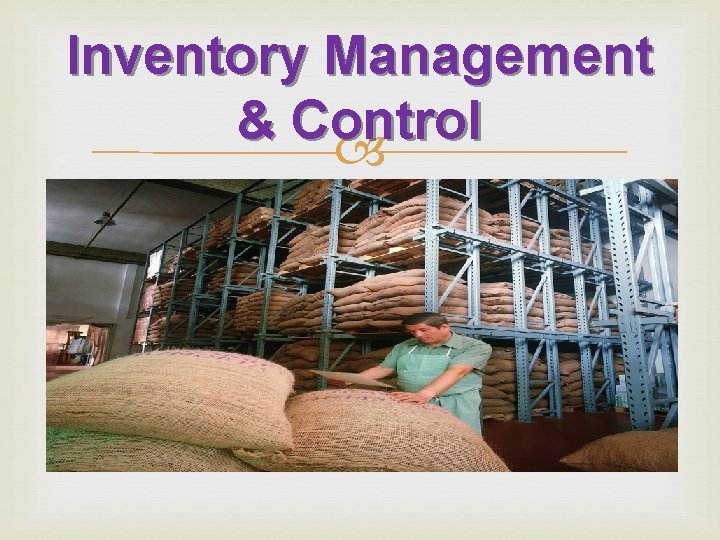
Inventory Management & Control
Introduction Inventory everywhere: My desk drawer Piles of material in any plant Supply room, retail stores Vast global network of industry Inventories in transit Inventories in the service industries Kitchen at home Introduction 1 - 2
Inventory It means stocking adequate number and kind of stores, so that the materials are available whenever required and wherever required. Scientific inventory control results in optimal balance 3
Inventory Investment in inventories constitute the most significant part of working capital in most of the undertakings. 4
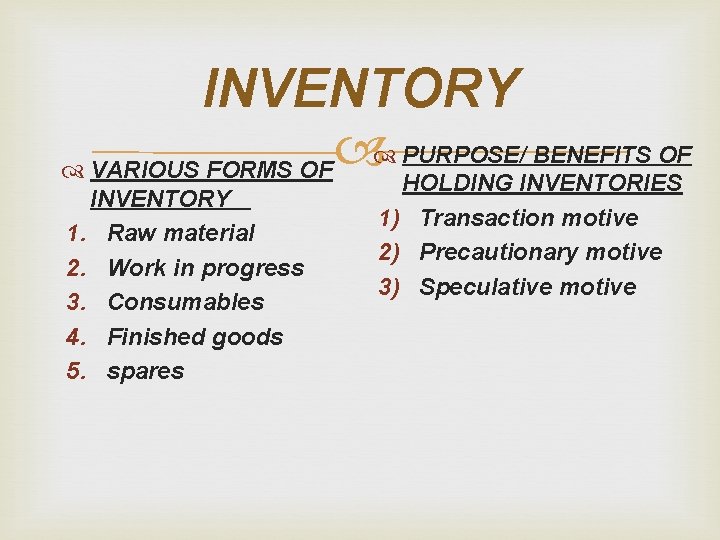
INVENTORY PURPOSE/ BENEFITS OF VARIOUS FORMS OF HOLDING INVENTORIES INVENTORY 1. Raw material 2. Work in progress 3. Consumables 4. Finished goods 5. spares 1) Transaction motive 2) Precautionary motive 3) Speculative motive
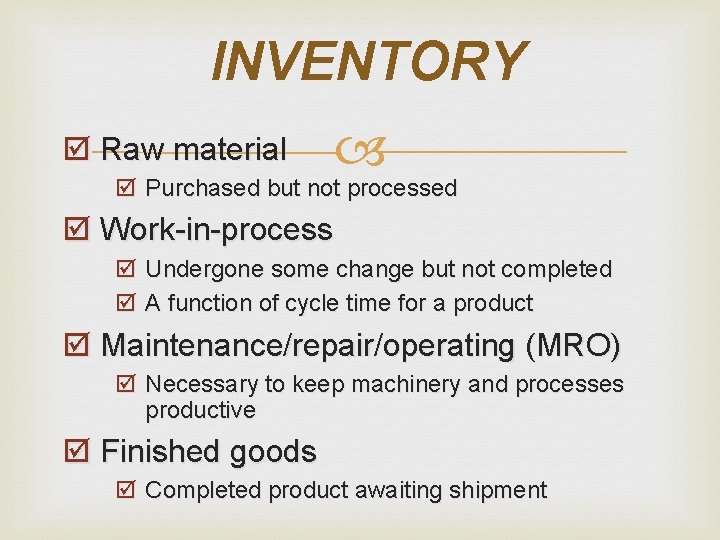
INVENTORY þ Raw material þ Purchased but not processed þ Work-in-process þ Undergone some change but not completed þ A function of cycle time for a product þ Maintenance/repair/operating (MRO) þ Necessary to keep machinery and processes productive þ Finished goods þ Completed product awaiting shipment
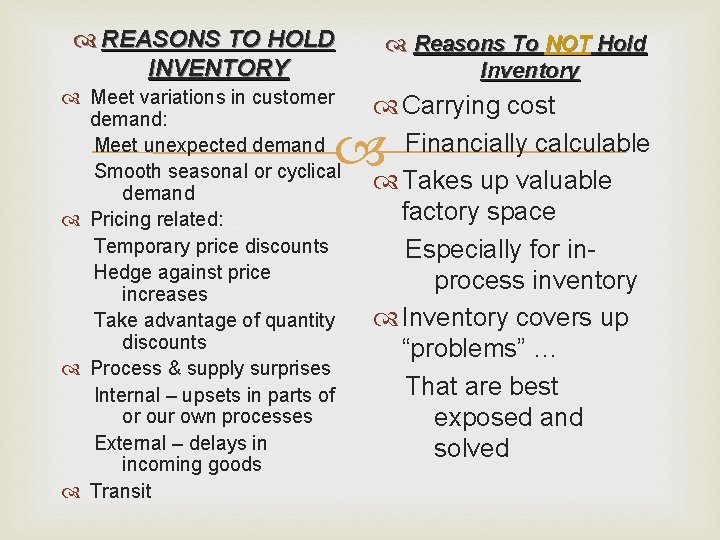
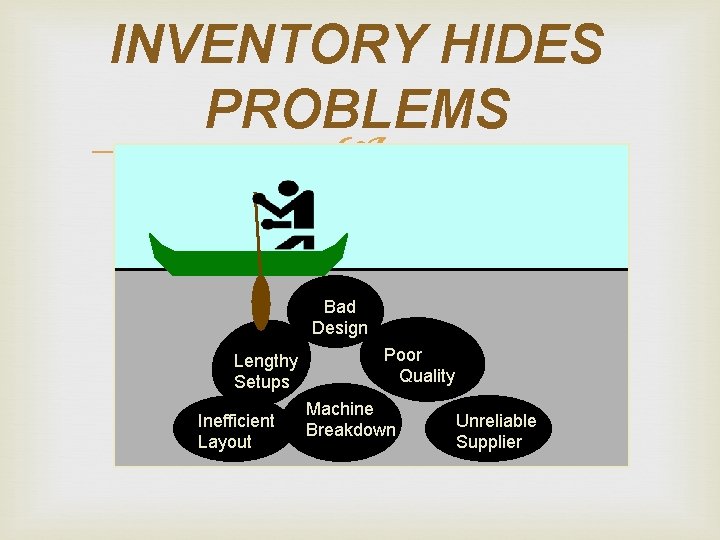
REASONS TO HOLD INVENTORY Reasons To NOT Hold Inventory Meet variations in customer demand: Meet unexpected demand Smooth seasonal or cyclical demand Pricing related: Temporary price discounts Hedge against price increases Take advantage of quantity discounts Process & supply surprises Internal – upsets in parts of or our own processes External – delays in incoming goods Transit Carrying cost Financially calculable Takes up valuable factory space Especially for inprocess inventory Inventory covers up “problems” … That are best exposed and solved
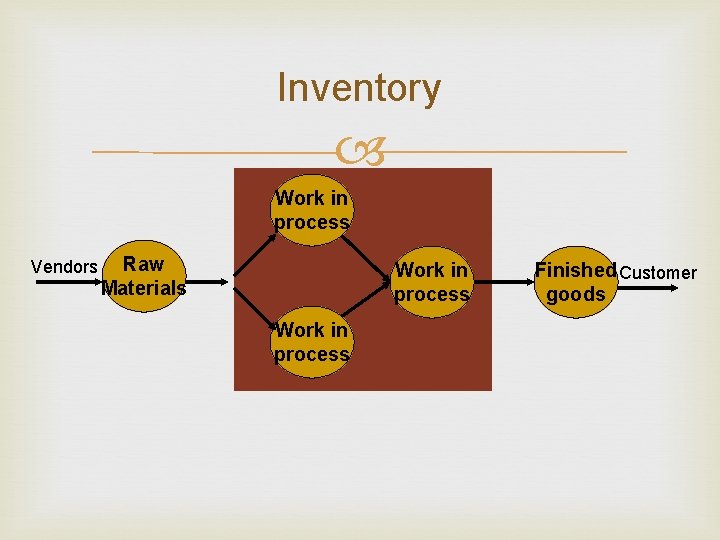
Inventory Work in process Vendors Raw Materials Work in process Finished Customer goods
Functions of inventory • To provide maximum supply service, consistent with maximum efficiency & optimum investment. • To provide cushion between forecasted & actual demand for a material • buying in large quantities allows spreading of fixed costs such as ordering costs and obtaining quantity discounts. • stocking of seasonal items allow production smoothing or work-load balancing. 9
FUNCTIONS OF INVENTORY v To decouple or separate various parts of the production process v To decouple the firm from fluctuations in demand provide a stock of goods that will provide a selection for customers v To take advantage of quantity discounts v To hedge against inflation
INVENTORY MANAGEMENT The dictionary meaning of inventory is “stock of goods, or a list of goods” consisting of various forms. It serves the link between production & distribution processes. It provides cushion for future price fluctuations. One of the most expensive assets of many Companies inventory system representing as much as 50% of total invested capital. Operations managers must balance inventory investment and customer service.
Inventory Management History 1915 F. W. Harris (Westinghouse) Lot size formula (EOQ model); independently developed by Wilson and sold to many companies as an integral part of an inventory control scheme. 1931 F. E. Raymond (MIT) Wrote the first full length book. 1950’s Computer made it possible to handle large data requirement Of the inventory models, Within published a book on stochastic inventory models in 1953. Introduction 1 - 12
Inventory Management 1958 Arrow, Karlin and Scarf published their now classical book, which is a definitive work on inventory theory, inspired a great deal of research for next decade. Mid Material requirement planning (MRP) 1970’s Books by Orlicky, Wight in 1974 Introduction 1 - 13
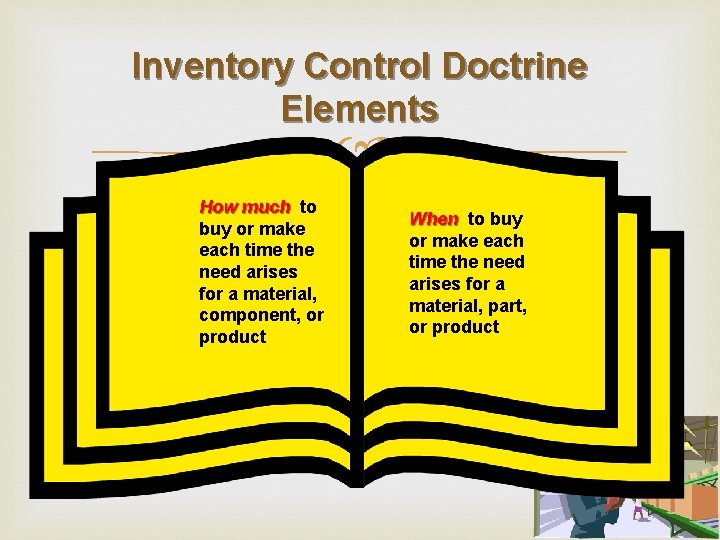
Inventory Control Doctrine Elements How much to buy or make each time the need arises for a material, component, or product When to buy or make each time the need arises for a material, part, or product
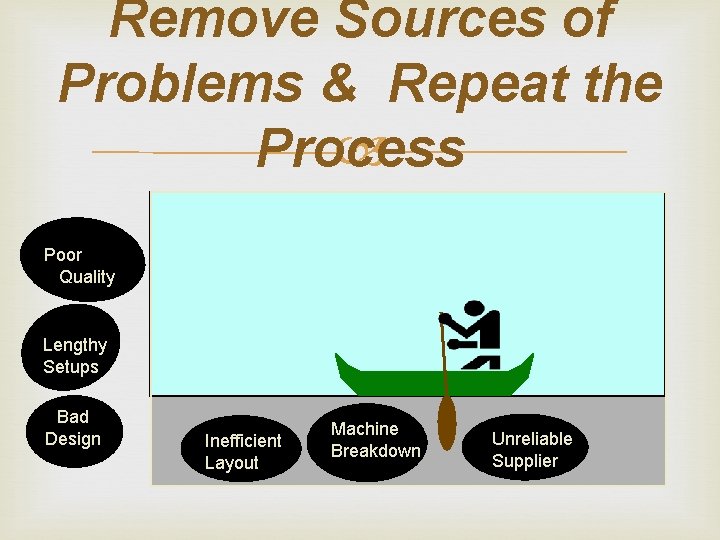
INVENTORY HIDES PROBLEMS Bad Design Lengthy Setups Inefficient Layout Poor Quality Machine Breakdown Unreliable Supplier
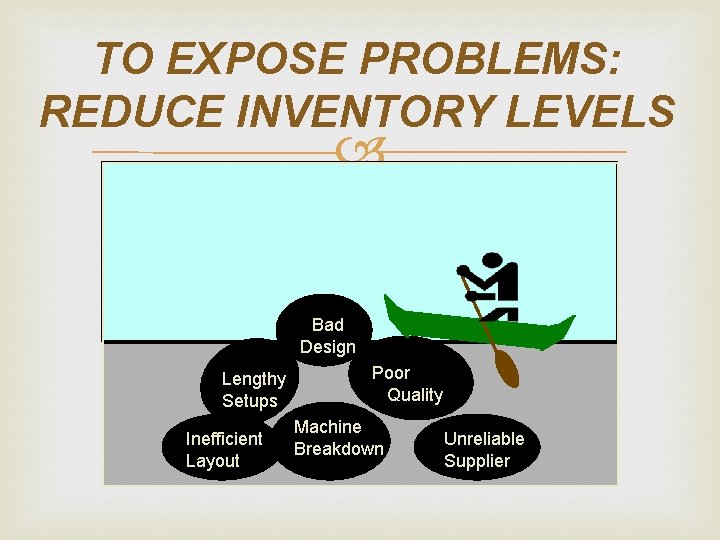
TO EXPOSE PROBLEMS: REDUCE INVENTORY LEVELS Bad Design Lengthy Setups Inefficient Layout Poor Quality Machine Breakdown Unreliable Supplier
Remove Sources of Problems & Repeat the Process Poor Quality Lengthy Setups Bad Design Inefficient Layout Machine Breakdown Unreliable Supplier
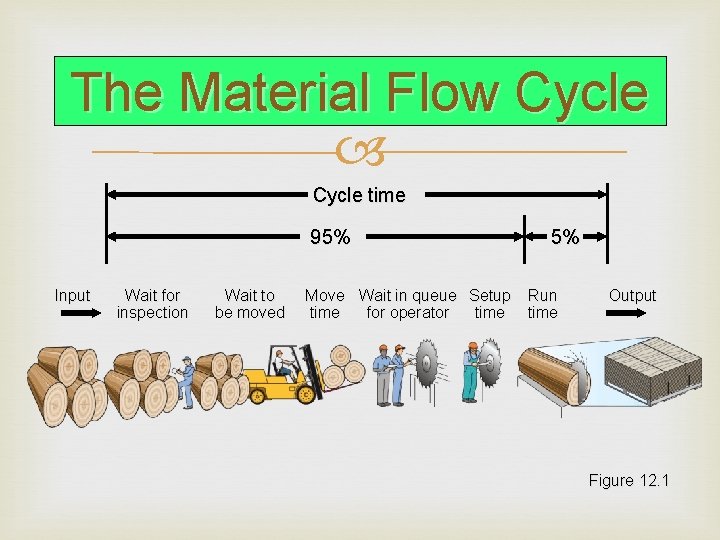
The Material Flow Cycle time 95% Input Wait for inspection Wait to be moved Move Wait in queue Setup time for operator time 5% Run time Output Figure 12. 1
RISK & COSTS OF HOLDING INVENTORIES CAPITAL COSTS STORAGE & HANDLING COSTS RISK OF PRICE DECLINE RISK OF OBSOLESCENCE RISK OF DETERIORATION IN QUALITY
Nature of Inventory: Adding Value through Inventory Quality - inventory can be a “buffer” against poor quality; conversely, low inventory levels may force high quality Speed - location of inventory has gigantic effect on speed Flexibility - location, level of anticipatory inventory both have effects Cost - direct: purchasing, delivery, manufacturing indirect: holding, stock out.
INVENTORY MANAGENENT Ø To ensure continuous supply Ø To avoid over stocking & under stocking Ø Maintain investment in inventories Ø To keep material cost under control Ø To eliminate duplication in ordering stocks Ø To minimize the losses Ø To design proper organization for inventory management Ø To ensures perpetual inventory control Ø To ensure right quality goods at reasonable prices Ø To facilitate furnishing of data for short-term & long term.
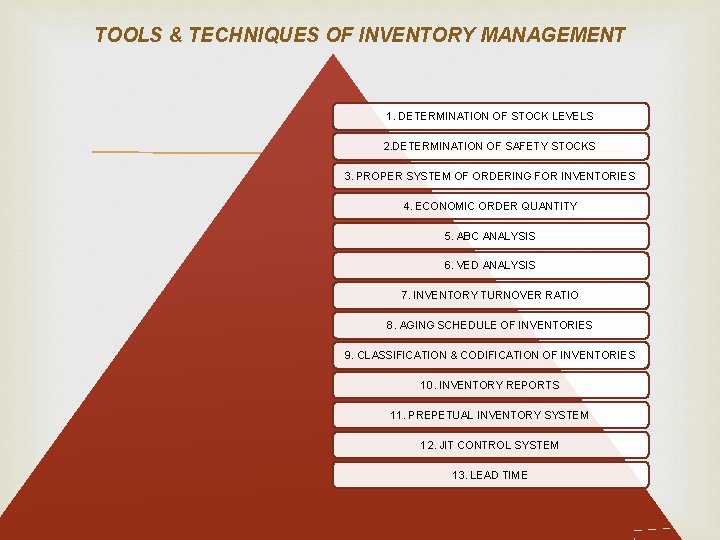
TOOLS & TECHNIQUES OF INVENTORY MANAGEMENT 1. DETERMINATION OF STOCK LEVELS 2. DETERMINATION OF SAFETY STOCKS 3. PROPER SYSTEM OF ORDERING FOR INVENTORIES 4. ECONOMIC ORDER QUANTITY 5. ABC ANALYSIS 6. VED ANALYSIS 7. INVENTORY TURNOVER RATIO 8. AGING SCHEDULE OF INVENTORIES 9. CLASSIFICATION & CODIFICATION OF INVENTORIES 10. INVENTORY REPORTS 11. PREPETUAL INVENTORY SYSTEM 12. JIT CONTROL SYSTEM 13. LEAD TIME
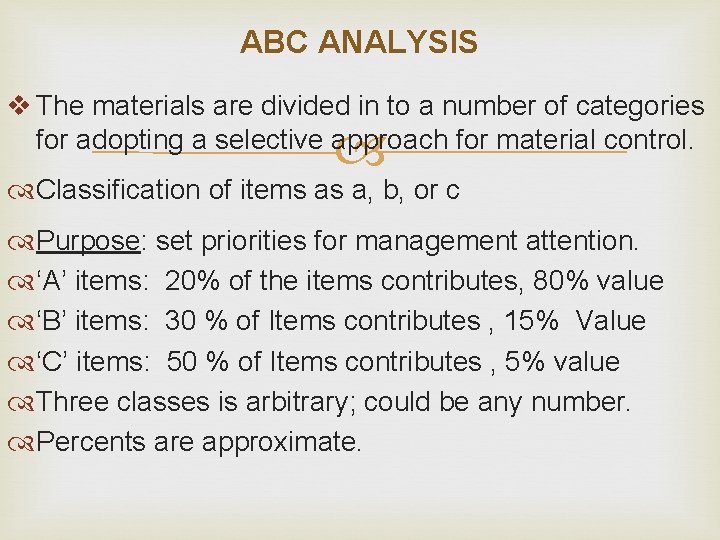
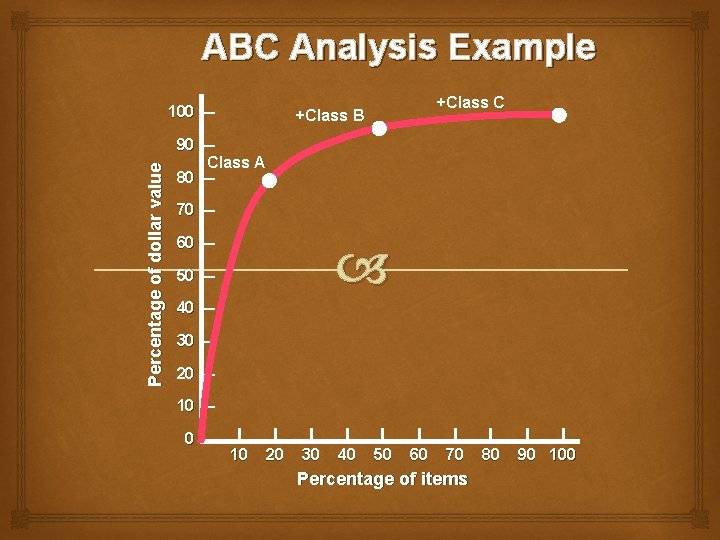
ABC ANALYSIS v The materials are divided in to a number of categories for adopting a selective approach for material control. Classification of items as a, b, or c Purpose: set priorities for management attention. ‘A’ items: 20% of the items contributes, 80% value ‘B’ items: 30 % of Items contributes , 15% Value ‘C’ items: 50 % of Items contributes , 5% value Three classes is arbitrary; could be any number. Percents are approximate.
ABC Analysis Example Percentage of dollar value 100 — +Class C +Class B 90 — Class A 80 — 70 — 60 — 50 — 40 — 30 — 20 — 10 — 0— 10 20 30 40 50 60 70 Percentage of items 80 90 100
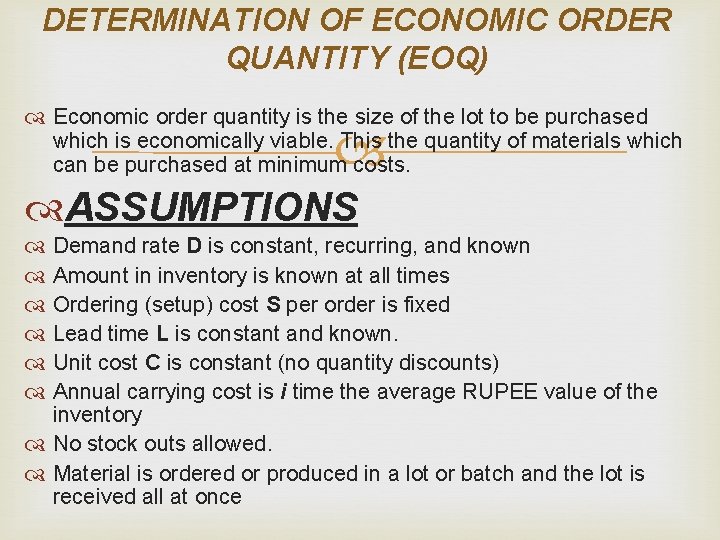
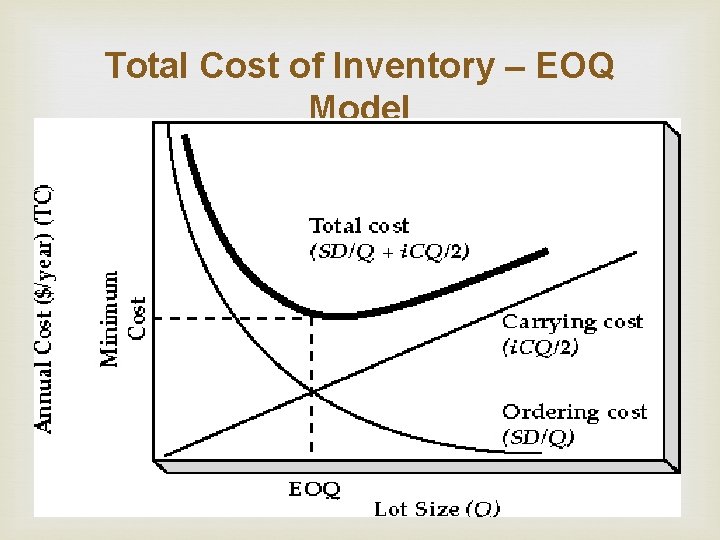
DETERMINATION OF ECONOMIC ORDER QUANTITY (EOQ) Economic order quantity is the size of the lot to be purchased which is economically viable. This the quantity of materials which can be purchased at minimum costs. ASSUMPTIONS Demand rate D is constant, recurring, and known Amount in inventory is known at all times Ordering (setup) cost S per order is fixed Lead time L is constant and known. Unit cost C is constant (no quantity discounts) Annual carrying cost is i time the average RUPEE value of the inventory No stock outs allowed. Material is ordered or produced in a lot or batch and the lot is received all at once
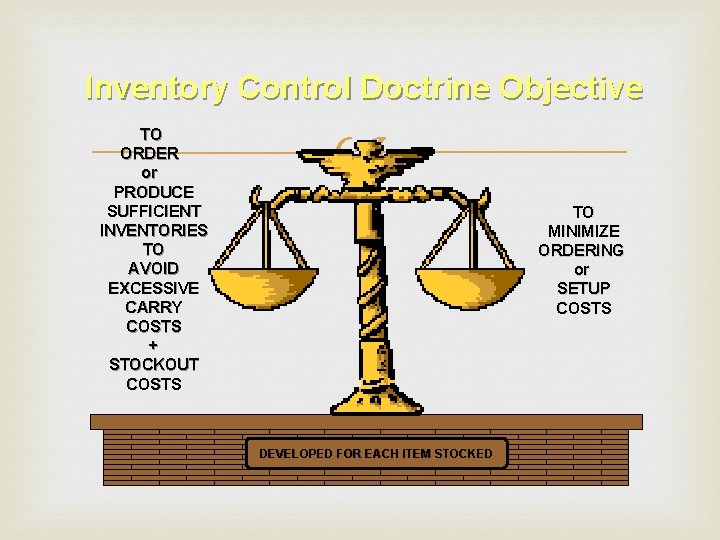
Inventory Control Doctrine Objective TO ORDER or PRODUCE SUFFICIENT INVENTORIES TO AVOID EXCESSIVE CARRY COSTS + STOCKOUT COSTS TO MINIMIZE ORDERING or SETUP COSTS DEVELOPED FOR EACH ITEM STOCKED
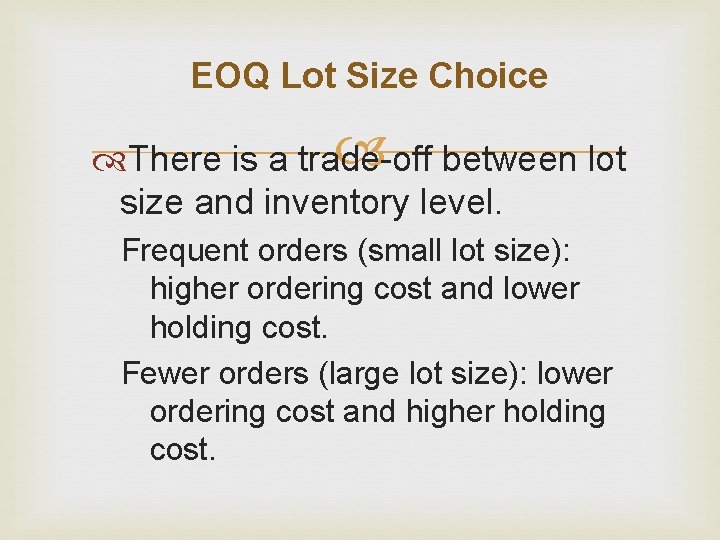
EOQ Lot Size Choice between lot There is a trade-off size and inventory level. Frequent orders (small lot size): higher ordering cost and lower holding cost. Fewer orders (large lot size): lower ordering cost and higher holding cost.
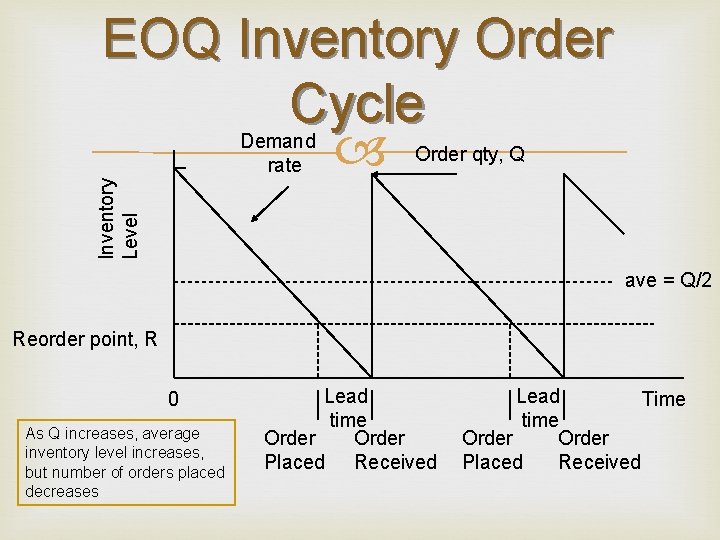
EOQ Inventory Order Cycle Order qty, Q Inventory Level Demand rate ave = Q/2 Reorder point, R 0 As Q increases, average inventory level increases, but number of orders placed decreases Lead time Order Placed Received Lead Time time Order Placed Received
Total Cost of Inventory – EOQ Model
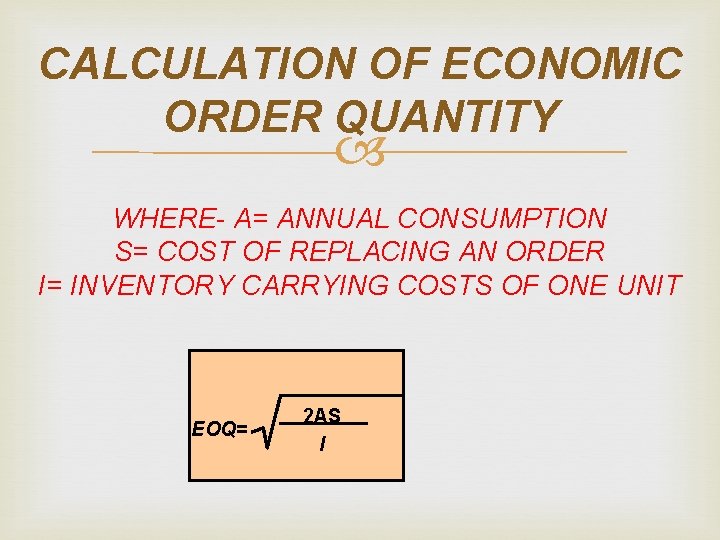
CALCULATION OF ECONOMIC ORDER QUANTITY WHERE- A= ANNUAL CONSUMPTION S= COST OF REPLACING AN ORDER I= INVENTORY CARRYING COSTS OF ONE UNIT EOQ= 2 AS I
Holding, Ordering, and Setup Costs þ Holding costs - the costs of holding or “carrying” inventory over time þ Ordering costs - the costs of placing an order and receiving goods þ Setup costs - cost to prepare a machine or process for manufacturing an order
ECONOMIC ORDER QUANTITY ORDERING COSTS A. Cost of staff B. Transportation expenses C. Inspection costs D. Cost of stationary, typing, postage etc. CARRYING COSTS a) Cost of capital invested b) Cost of storage c) Cost of loss of material due to natural factors d) Insurance cost e) Cost of spoilage in handling of material
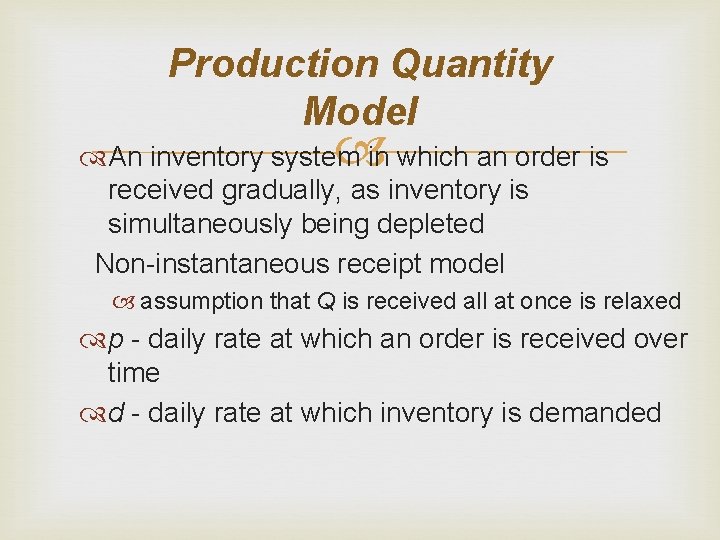
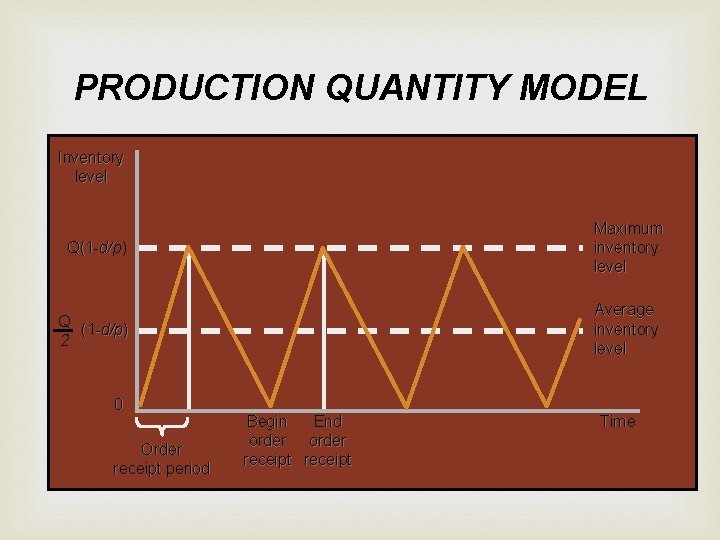
Production Quantity Model An inventory system in which an order is received gradually, as inventory is simultaneously being depleted Non-instantaneous receipt model assumption that Q is received all at once is relaxed p - daily rate at which an order is received over time d - daily rate at which inventory is demanded
Inventory Terms Lead time: time interval between ordering and receiving the order Holding (carrying) costs: cost to carry an item in inventory for a length of time, usually a year Ordering costs: costs of ordering and receiving inventory Shortage costs: costs when demand exceeds supply 12 -34
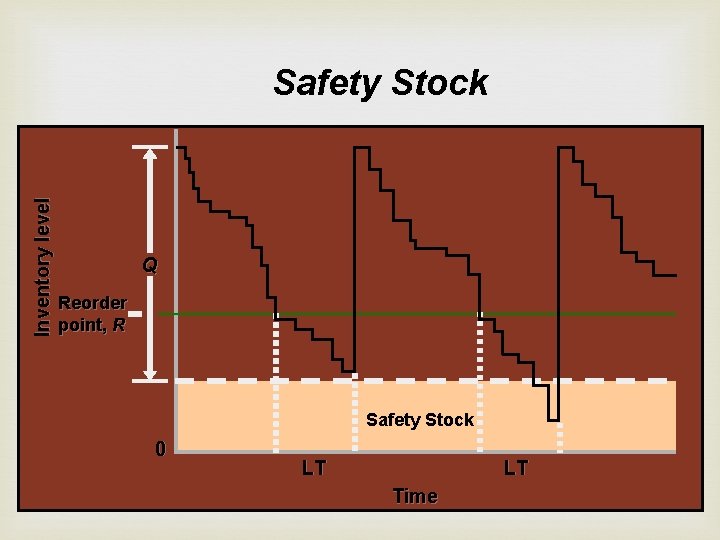
When to Reorder with EOQ Ordering Reorder Point - When the quantity on hand of an item drops to this amount, the item is reordered Safety Stock - Stock that is held in excess of expected demand due to variable demand rate and/or lead time. Service Level - Probability that demand will not exceed supply during lead time. 12 -35
PRODUCTION QUANTITY MODEL Inventory level Q(1 -d/p) Maximum inventory level Q (1 -d/p) 2 Average inventory level 0 Order receipt period Begin End order receipt Time
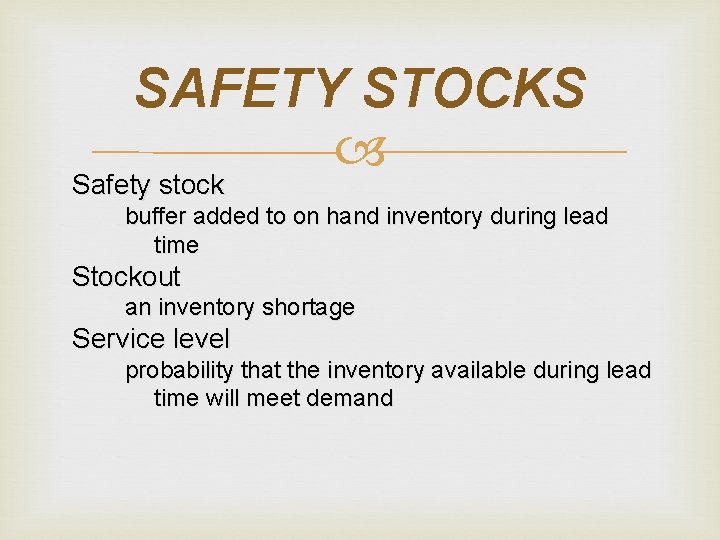
SAFETY STOCKS Safety stock buffer added to on hand inventory during lead time Stockout an inventory shortage Service level probability that the inventory available during lead time will meet demand
Safety Stock Inventory level Q Reorder point, R Safety Stock 0 LT LT Time
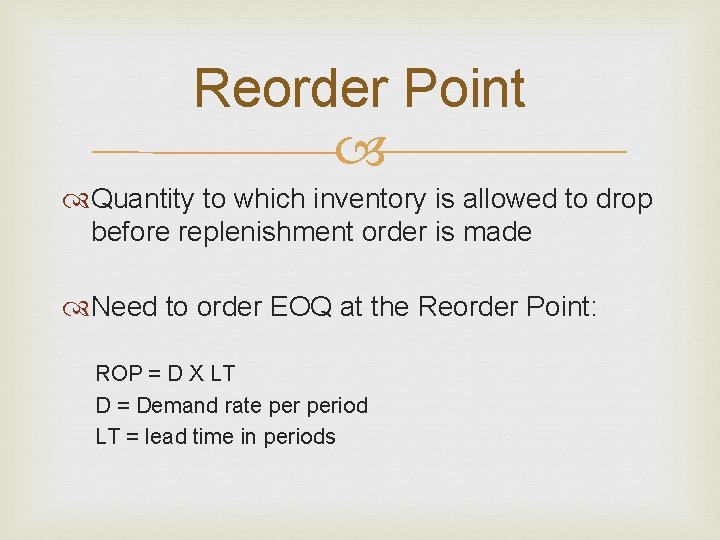
Reorder Point Quantity to which inventory is allowed to drop before replenishment order is made Need to order EOQ at the Reorder Point: ROP = D X LT D = Demand rate period LT = lead time in periods
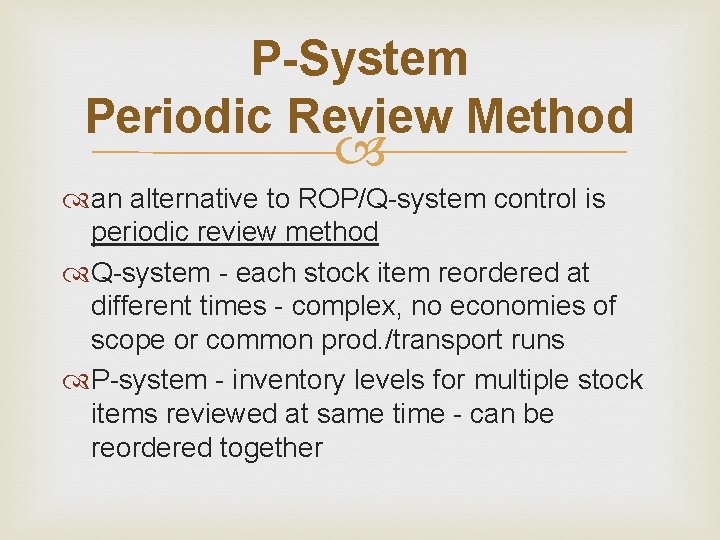
P-System Periodic Review Method an alternative to ROP/Q-system control is periodic review method Q-system - each stock item reordered at different times - complex, no economies of scope or common prod. /transport runs P-system - inventory levels for multiple stock items reviewed at same time - can be reordered together
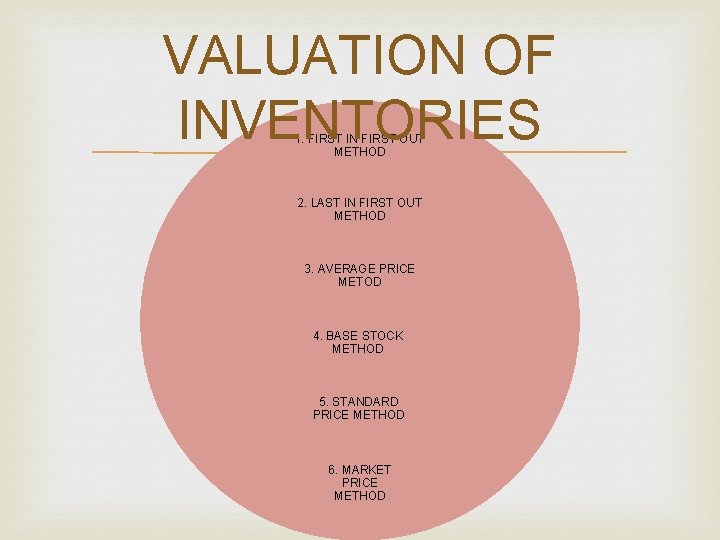
VALUATION OF INVENTORIES 1. FIRST IN FIRST OUT METHOD 2. LAST IN FIRST OUT METHOD 3. AVERAGE PRICE METOD 4. BASE STOCK METHOD 5. STANDARD PRICE METHOD 6. MARKET PRICE METHOD
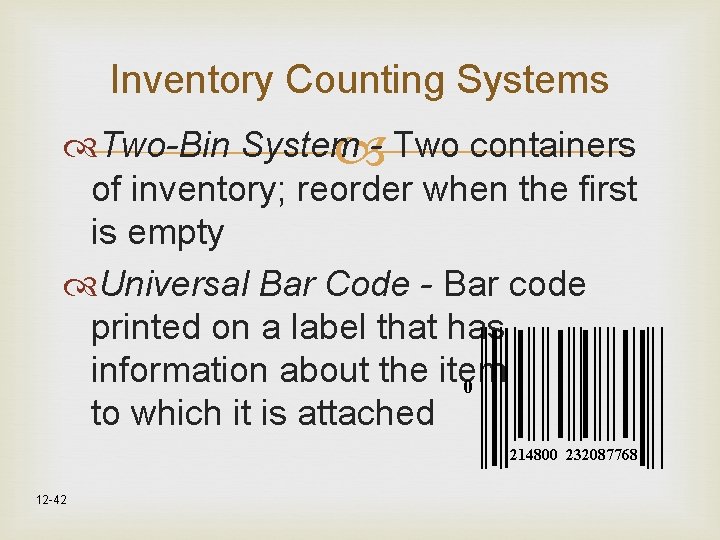
Inventory Counting Systems Two-Bin System - Two containers of inventory; reorder when the first is empty Universal Bar Code - Bar code printed on a label that has information about the item 0 to which it is attached 214800 232087768 12 -42
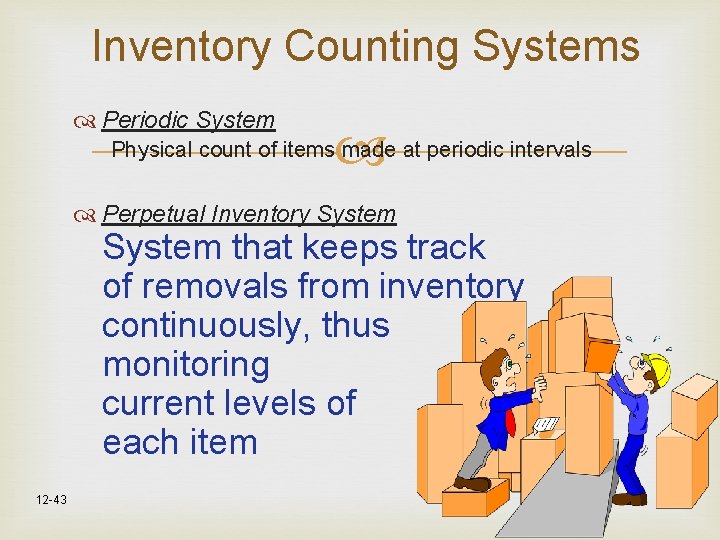
Inventory Counting Systems Periodic System Physical count of items made at periodic intervals Perpetual Inventory System that keeps track of removals from inventory continuously, thus monitoring current levels of each item 12 -43
Single Period Model Single period model: model for ordering of perishables and other items with limited useful lives Shortage cost: generally the unrealized profits per unit Excess cost: difference between purchase cost and salvage value of items left over at the end of a period 12 -44
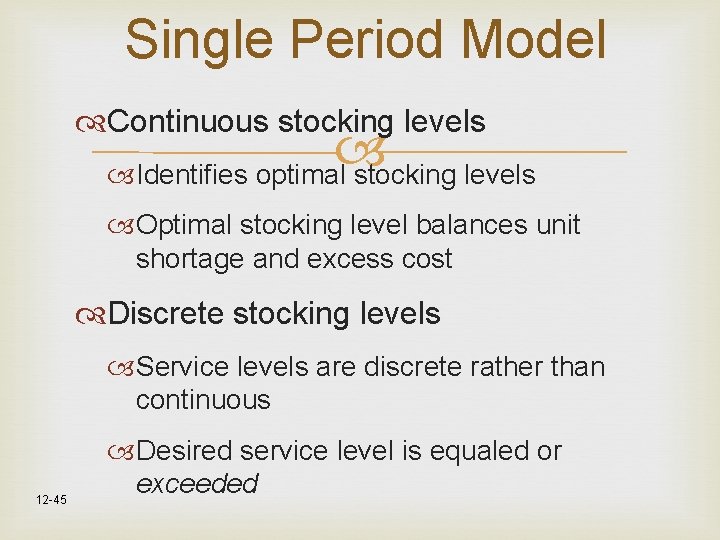
Single Period Model Continuous stocking levels Identifies optimal stocking levels Optimal stocking level balances unit shortage and excess cost Discrete stocking levels Service levels are discrete rather than continuous 12 -45 Desired service level is equaled or exceeded
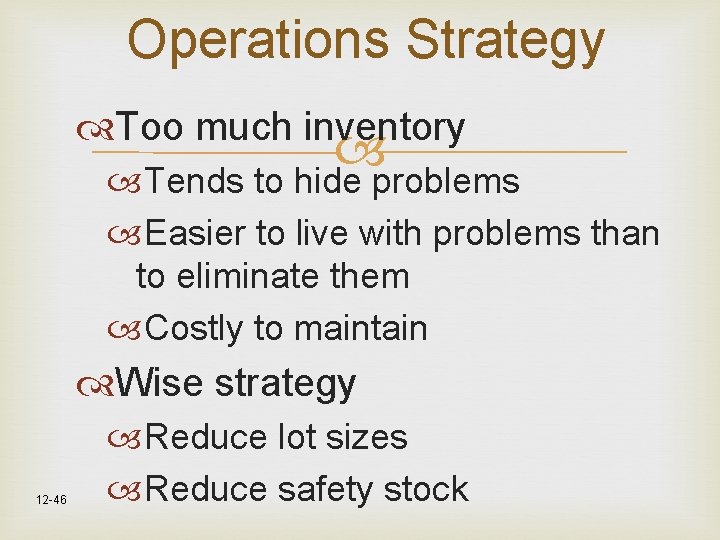
Operations Strategy Too much inventory Tends to hide problems Easier to live with problems than to eliminate them Costly to maintain Wise strategy 12 -46 Reduce lot sizes Reduce safety stock
THANK YOU