
INVENTORY AND TURNOVER Course Code and Title DBA
INVENTORY AND TURNOVER Course Code and Title: DBA 151 Business Mathematics Lead Lecturer: Abdul Samed Muntaka
OUTLINE DEFINITION OF INVENTORY CONTROL METHODS FOR COMPUTING INVENTORY Average inventory and Inventory turnover Perpetual inventory & universal product codes Specific identification method Average Cost/Weighted Average method FIFO method LIFO method The Gross Profit method The retail method The of cost or market (LCM) Inventory Value COMPUTING INVENTORY TURNOVER
DEFINITION OF INVENTORY CONTROL The inventory of a business is the amount of goods it has on hand at any particular time. Retailers and wholesalers usually have only one type of inventory – merchandise, which is the goods they sell. In a mercantile business, inventory is merchandise that is held for resale. As such, it will ordinarily be converted into cash in less than a year and is thus a current asset. In a manufacturing business, there will usually be inventories of raw materials and goods in process in addition to an inventory of finished goods. At least once a year, business undertake a physical inventory (i. e. actual counting) of merchandise on hand. If inventory is kept at a minimum level, less capital is needed to operate the business and the of selling inventory is increased. Also, the risk of having old and expired or unsalable merchandise is reduced.
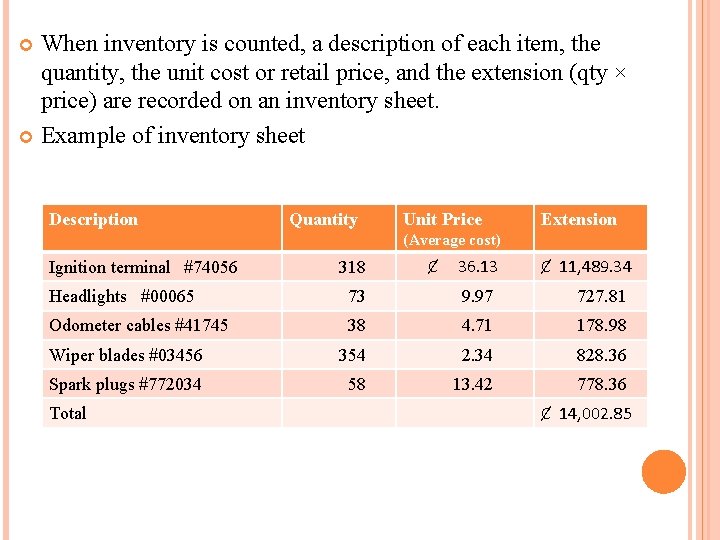
When inventory is counted, a description of each item, the quantity, the unit cost or retail price, and the extension (qty × price) are recorded on an inventory sheet. Example of inventory sheet Description Quantity Unit Price Extension (Average cost) Ignition terminal #74056 318 Ȼ 36. 13 Ȼ 11, 489. 34 Headlights #00065 73 9. 97 727. 81 Odometer cables #41745 38 4. 71 178. 98 Wiper blades #03456 354 2. 34 828. 36 Spark plugs #772034 58 13. 42 778. 36 Total Ȼ 14, 002. 85
INVENTORY VALUATION Inventory valuation is the act of placing a value on the merchandise a firm has in stock. It is not easy to place this value on each of the items and so many large companies keep a perpetual inventory by using a computer. When new items are received, the quantity, size, cost etc. of each item are placed in computer. Sales clerks enter product codes into the cash register (or uniform product codes are entered automatically with an optical scanner) and the computer processes the information. The result is an up-to-the-moment, or perpetual, or inventory value.

USING UNIVERSAL PRODUCT CODES (UPC) UPCs are stripes (also known as bar codes) that appear on many items sold in stores. They usually range from 6 -13 digits depending on the country of origin. The UPCs help businesses greatly in keeping tract of inventory especially on the computer. Businesses that cannot afford the computer take count of merchandise in stock (physical inventory) monthly, quarterly, semi-annually, and or annually. When inventory is taken weekly, monthly, quarterly, and semiannually, it is termed as periodic inventory. Periodic inventory is useful in detecting loss resulting from theft early.
USING SPECIFIC IDENTIFICATION METHOD (SIM) This is an inventory control method that involves the use of numbers or letters or both to categorize the items, indicate their cost, or any other control that a business seeks to introduce into its inventory control system. Within this method, each item is cost coded, and/or identified. For example a store could use the code to represent cost; noting that all cost are to two decimal places: S MARTFELD 1 2 34 5 678 9 An item bearing the code MAT would have a cost of Ȼ 2. 35 If it is used for identification of the sections in the warehouse, then the item bearing MAT could be in section 2, shelf #3 and slot 5. NB: The coding system has to be clear and know to all employees.
THE WEIGHTED/AVERAGE COST METHOD This method values the items in an inventory at the average cost of buying them. Steps: 1. Find the total cost of all the items purchased in the period. 2. Compute average cost by dividing the total cost by the total number of items. 3. Multiply the average cost by the number of items in inventory at the time of the valuation to obtain the inventory value.
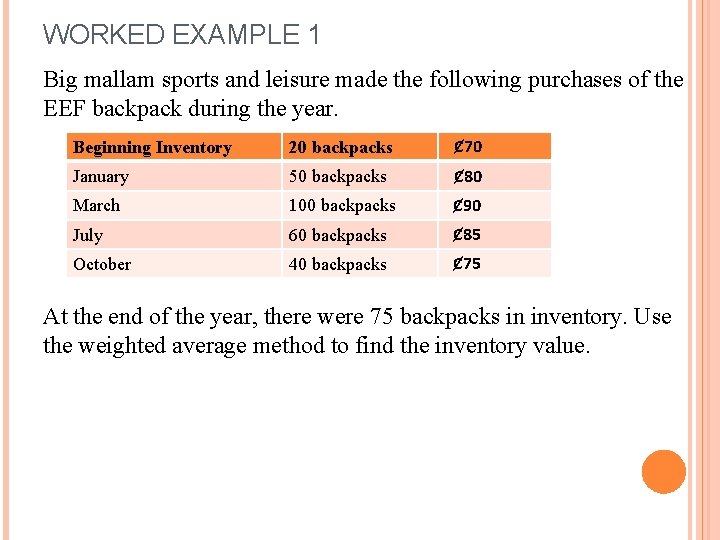
WORKED EXAMPLE 1 Big mallam sports and leisure made the following purchases of the EEF backpack during the year. Beginning Inventory 20 backpacks Ȼ 70 January 50 backpacks Ȼ 80 March 100 backpacks Ȼ 90 July 60 backpacks Ȼ 85 October 40 backpacks Ȼ 75 At the end of the year, there were 75 backpacks in inventory. Use the weighted average method to find the inventory value.
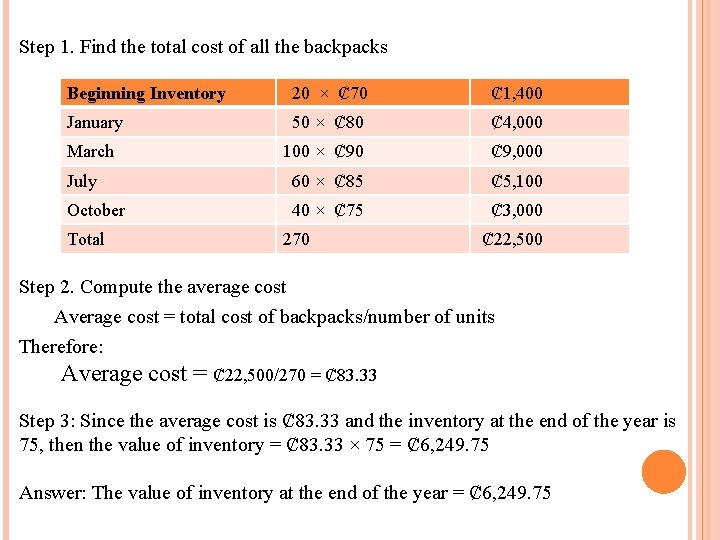
Step 1. Find the total cost of all the backpacks Beginning Inventory 20 × Ȼ 70 Ȼ 1, 400 January 50 × Ȼ 80 Ȼ 4, 000 March 100 × Ȼ 90 Ȼ 9, 000 July 60 × Ȼ 85 Ȼ 5, 100 October 40 × Ȼ 75 Ȼ 3, 000 Total 270 Ȼ 22, 500 Step 2. Compute the average cost Average cost = total cost of backpacks/number of units Therefore: Average cost = Ȼ 22, 500/270 = Ȼ 83. 33 Step 3: Since the average cost is Ȼ 83. 33 and the inventory at the end of the year is 75, then the value of inventory = Ȼ 83. 33 × 75 = Ȼ 6, 249. 75 Answer: The value of inventory at the end of the year = Ȼ 6, 249. 75
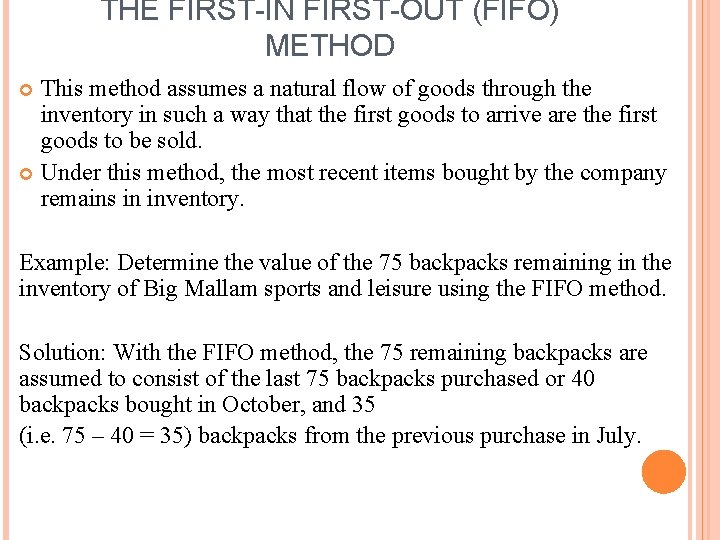
THE FIRST-IN FIRST-OUT (FIFO) METHOD This method assumes a natural flow of goods through the inventory in such a way that the first goods to arrive are the first goods to be sold. Under this method, the most recent items bought by the company remains in inventory. Example: Determine the value of the 75 backpacks remaining in the inventory of Big Mallam sports and leisure using the FIFO method. Solution: With the FIFO method, the 75 remaining backpacks are assumed to consist of the last 75 backpacks purchased or 40 backpacks bought in October, and 35 (i. e. 75 – 40 = 35) backpacks from the previous purchase in July.
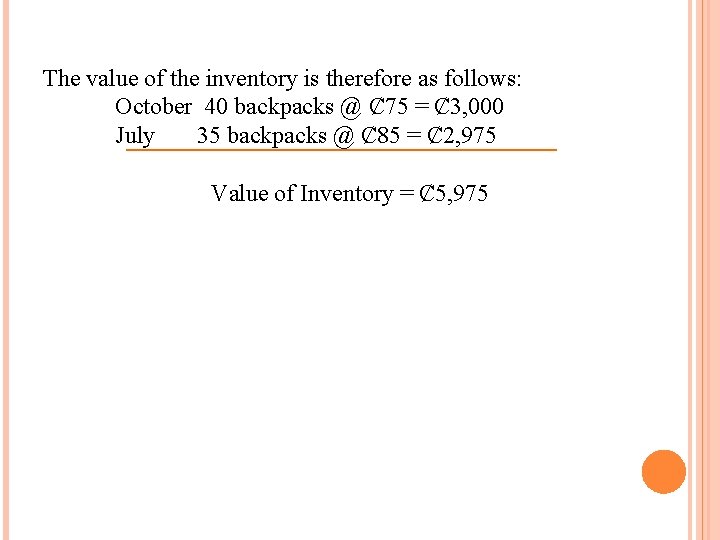
The value of the inventory is therefore as follows: October 40 backpacks @ Ȼ 75 = Ȼ 3, 000 July 35 backpacks @ Ȼ 85 = Ȼ 2, 975 Value of Inventory = Ȼ 5, 975
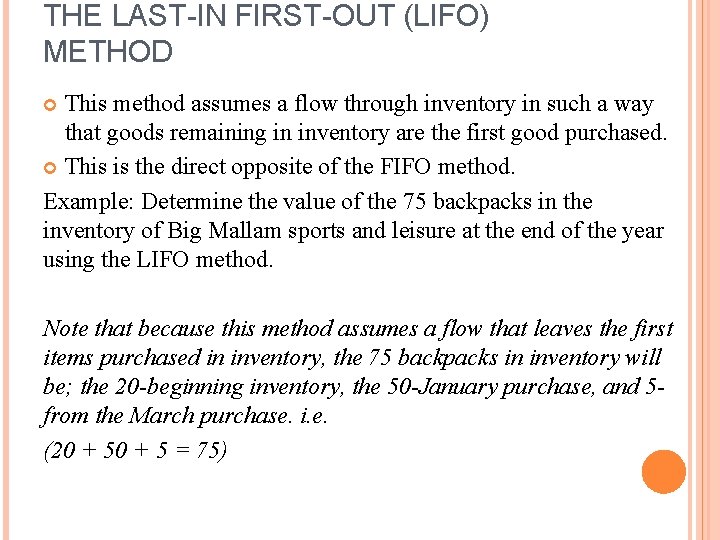
THE LAST-IN FIRST-OUT (LIFO) METHOD This method assumes a flow through inventory in such a way that goods remaining in inventory are the first good purchased. This is the direct opposite of the FIFO method. Example: Determine the value of the 75 backpacks in the inventory of Big Mallam sports and leisure at the end of the year using the LIFO method. Note that because this method assumes a flow that leaves the first items purchased in inventory, the 75 backpacks in inventory will be; the 20 -beginning inventory, the 50 -January purchase, and 5 from the March purchase. i. e. (20 + 5 = 75)
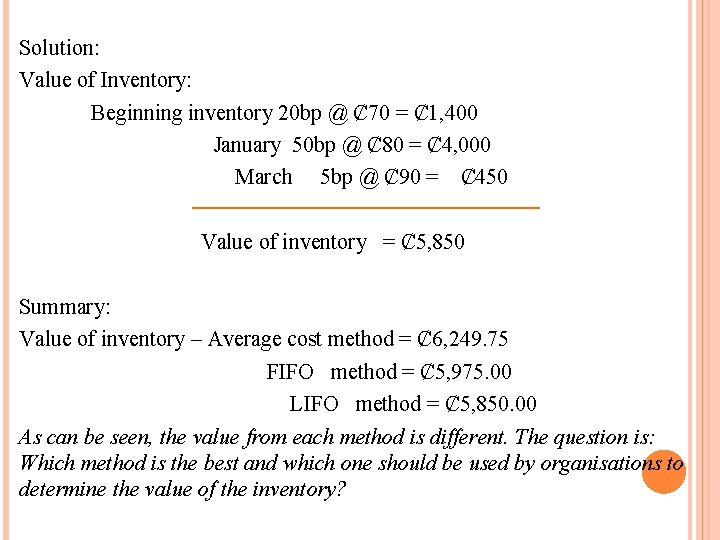
Solution: Value of Inventory: Beginning inventory 20 bp @ Ȼ 70 = Ȼ 1, 400 January 50 bp @ Ȼ 80 = Ȼ 4, 000 March 5 bp @ Ȼ 90 = Ȼ 450 Value of inventory = Ȼ 5, 850 Summary: Value of inventory – Average cost method = Ȼ 6, 249. 75 FIFO method = Ȼ 5, 975. 00 LIFO method = Ȼ 5, 850. 00 As can be seen, the value from each method is different. The question is: Which method is the best and which one should be used by organisations to determine the value of the inventory?
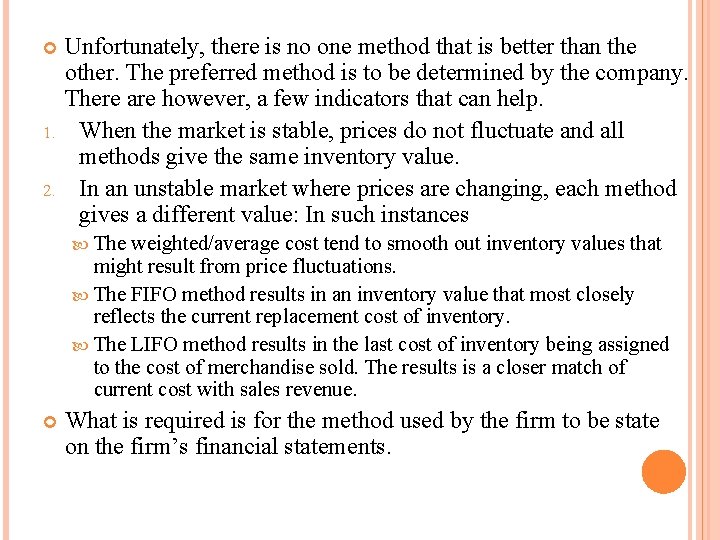
1. 2. Unfortunately, there is no one method that is better than the other. The preferred method is to be determined by the company. There are however, a few indicators that can help. When the market is stable, prices do not fluctuate and all methods give the same inventory value. In an unstable market where prices are changing, each method gives a different value: In such instances The weighted/average cost tend to smooth out inventory values that might result from price fluctuations. The FIFO method results in an inventory value that most closely reflects the current replacement cost of inventory. The LIFO method results in the last cost of inventory being assigned to the cost of merchandise sold. The results is a closer match of current cost with sales revenue. What is required is for the method used by the firm to be state on the firm’s financial statements.
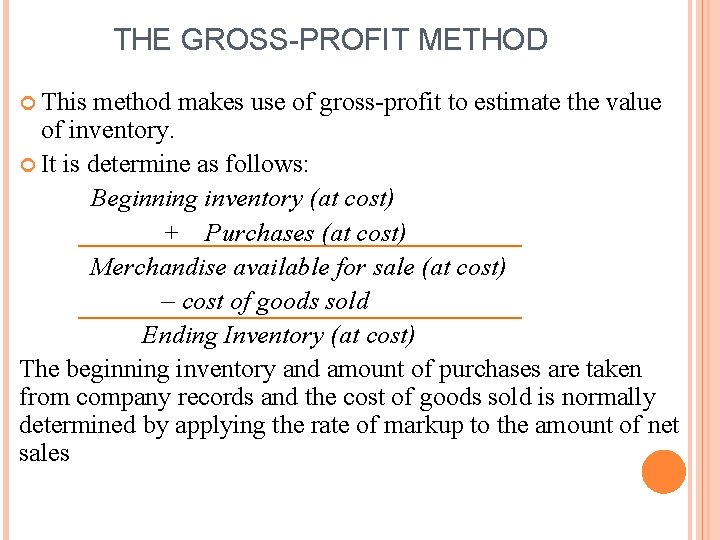
THE GROSS-PROFIT METHOD This method makes use of gross-profit to estimate the value of inventory. It is determine as follows: Beginning inventory (at cost) + Purchases (at cost) Merchandise available for sale (at cost) – cost of goods sold Ending Inventory (at cost) The beginning inventory and amount of purchases are taken from company records and the cost of goods sold is normally determined by applying the rate of markup to the amount of net sales
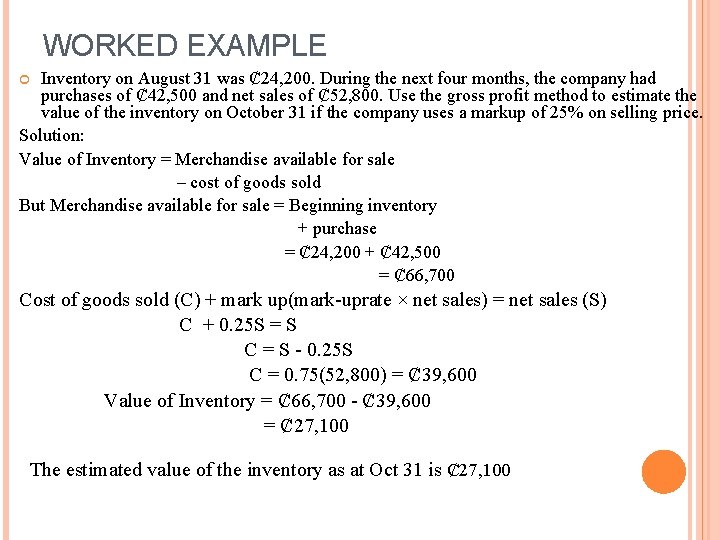
WORKED EXAMPLE Inventory on August 31 was Ȼ 24, 200. During the next four months, the company had purchases of Ȼ 42, 500 and net sales of Ȼ 52, 800. Use the gross profit method to estimate the value of the inventory on October 31 if the company uses a markup of 25% on selling price. Solution: Value of Inventory = Merchandise available for sale – cost of goods sold But Merchandise available for sale = Beginning inventory + purchase = Ȼ 24, 200 + Ȼ 42, 500 = Ȼ 66, 700 Cost of goods sold (C) + mark up(mark-uprate × net sales) = net sales (S) C + 0. 25 S = S C = S - 0. 25 S C = 0. 75(52, 800) = Ȼ 39, 600 Value of Inventory = Ȼ 66, 700 - Ȼ 39, 600 = Ȼ 27, 100 The estimated value of the inventory as at Oct 31 is Ȼ 27, 100
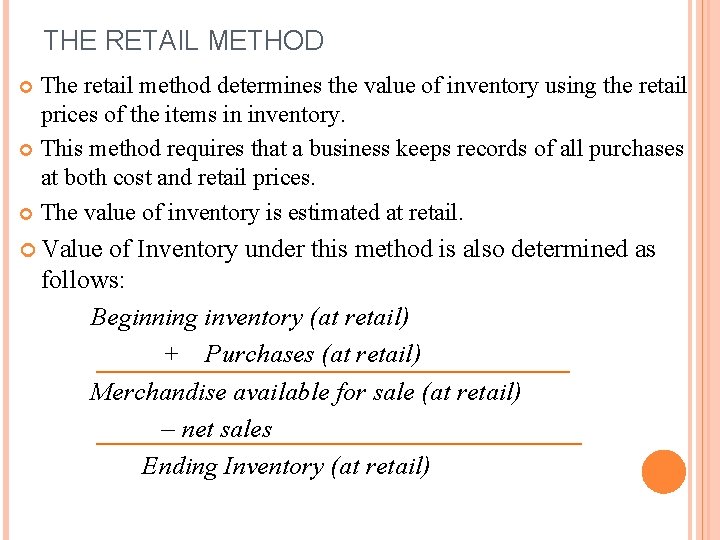
THE RETAIL METHOD The retail method determines the value of inventory using the retail prices of the items in inventory. This method requires that a business keeps records of all purchases at both cost and retail prices. The value of inventory is estimated at retail. Value of Inventory under this method is also determined as follows: Beginning inventory (at retail) + Purchases (at retail) Merchandise available for sale (at retail) – net sales Ending Inventory (at retail)
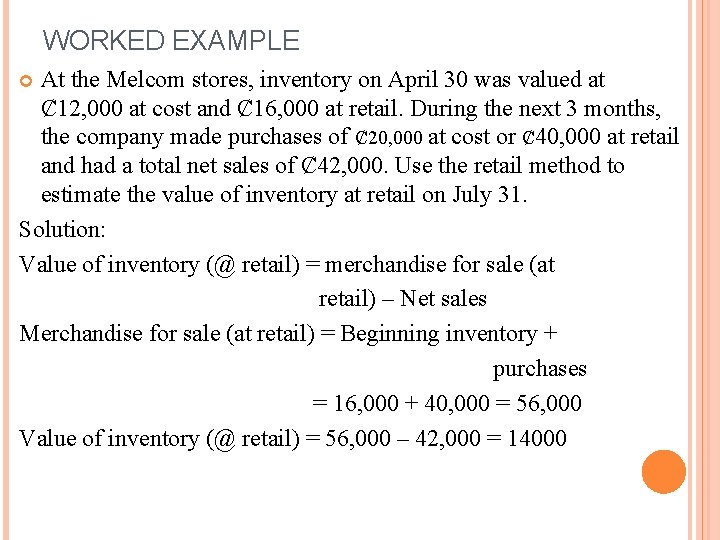
WORKED EXAMPLE At the Melcom stores, inventory on April 30 was valued at Ȼ 12, 000 at cost and Ȼ 16, 000 at retail. During the next 3 months, the company made purchases of Ȼ 20, 000 at cost or Ȼ 40, 000 at retail and had a total net sales of Ȼ 42, 000. Use the retail method to estimate the value of inventory at retail on July 31. Solution: Value of inventory (@ retail) = merchandise for sale (at retail) – Net sales Merchandise for sale (at retail) = Beginning inventory + purchases = 16, 000 + 40, 000 = 56, 000 Value of inventory (@ retail) = 56, 000 – 42, 000 = 14000
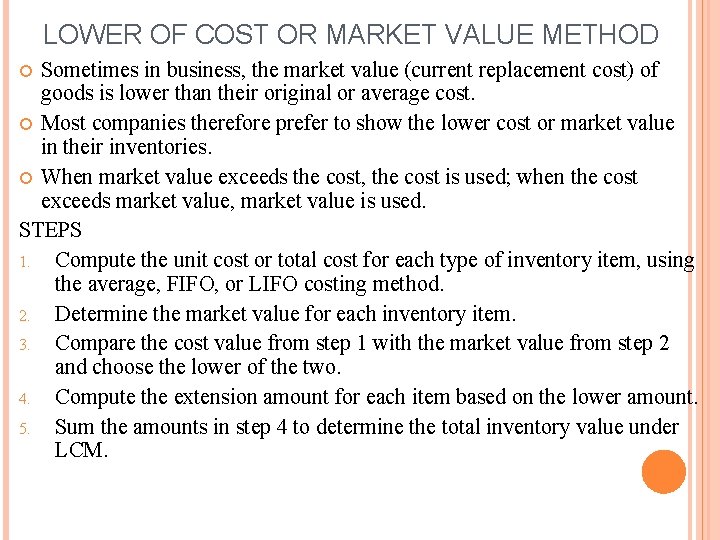
LOWER OF COST OR MARKET VALUE METHOD Sometimes in business, the market value (current replacement cost) of goods is lower than their original or average cost. Most companies therefore prefer to show the lower cost or market value in their inventories. When market value exceeds the cost, the cost is used; when the cost exceeds market value, market value is used. STEPS 1. Compute the unit cost or total cost for each type of inventory item, using the average, FIFO, or LIFO costing method. 2. Determine the market value for each inventory item. 3. Compare the cost value from step 1 with the market value from step 2 and choose the lower of the two. 4. Compute the extension amount for each item based on the lower amount. 5. Sum the amounts in step 4 to determine the total inventory value under LCM.
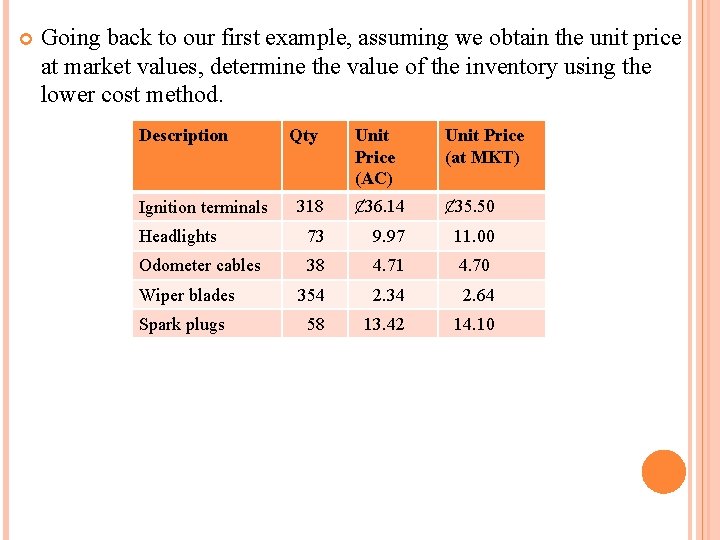
Going back to our first example, assuming we obtain the unit price at market values, determine the value of the inventory using the lower cost method. Description Unit Price (AC) Unit Price (at MKT) 318 Ȼ 36. 14 Ȼ 35. 50 Headlights 73 9. 97 11. 00 Odometer cables 38 4. 71 4. 70 Wiper blades 354 2. 34 2. 64 Spark plugs 58 13. 42 14. 10 Ignition terminals Qty
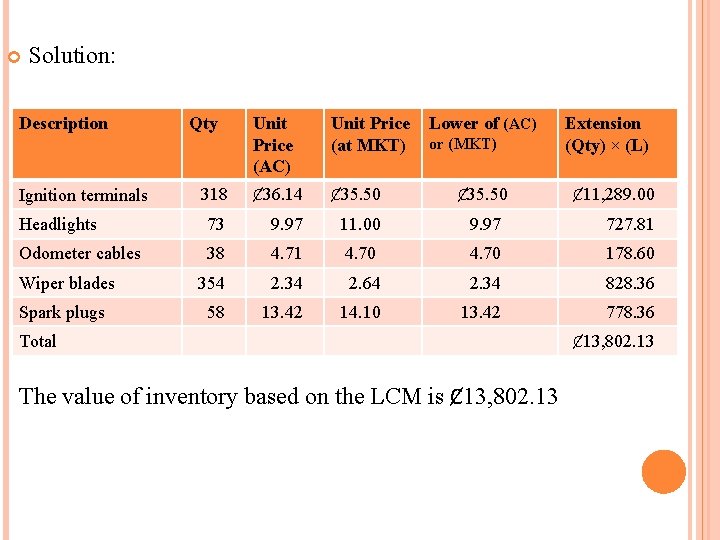
Solution: Description Unit Price (AC) Unit Price (at MKT) 318 Ȼ 36. 14 Ȼ 35. 50 Headlights 73 9. 97 11. 00 9. 97 727. 81 Odometer cables 38 4. 71 4. 70 178. 60 Wiper blades 354 2. 34 2. 64 2. 34 828. 36 Spark plugs 58 13. 42 14. 10 13. 42 778. 36 Ignition terminals Qty Lower of (AC) or (MKT) Total The value of inventory based on the LCM is Ȼ 13, 802. 13 Extension (Qty) × (L) Ȼ 11, 289. 00 Ȼ 13, 802. 13
COMPUTING INVENTORY TURNOVER
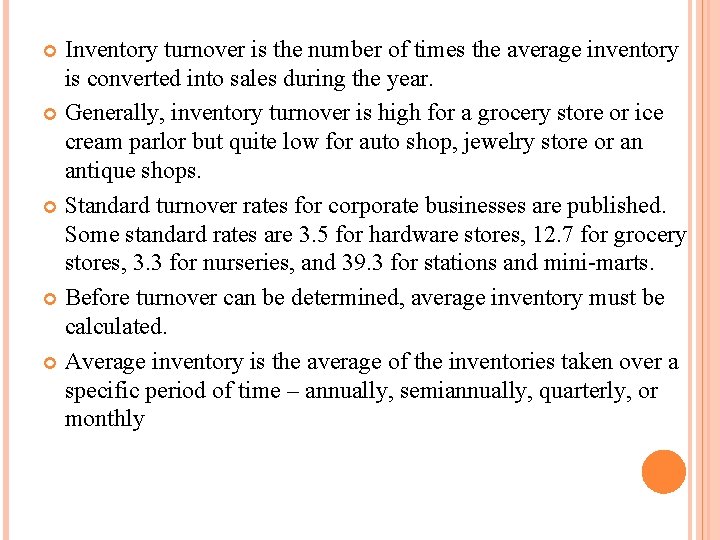
Inventory turnover is the number of times the average inventory is converted into sales during the year. Generally, inventory turnover is high for a grocery store or ice cream parlor but quite low for auto shop, jewelry store or an antique shops. Standard turnover rates for corporate businesses are published. Some standard rates are 3. 5 for hardware stores, 12. 7 for grocery stores, 3. 3 for nurseries, and 39. 3 for stations and mini-marts. Before turnover can be determined, average inventory must be calculated. Average inventory is the average of the inventories taken over a specific period of time – annually, semiannually, quarterly, or monthly
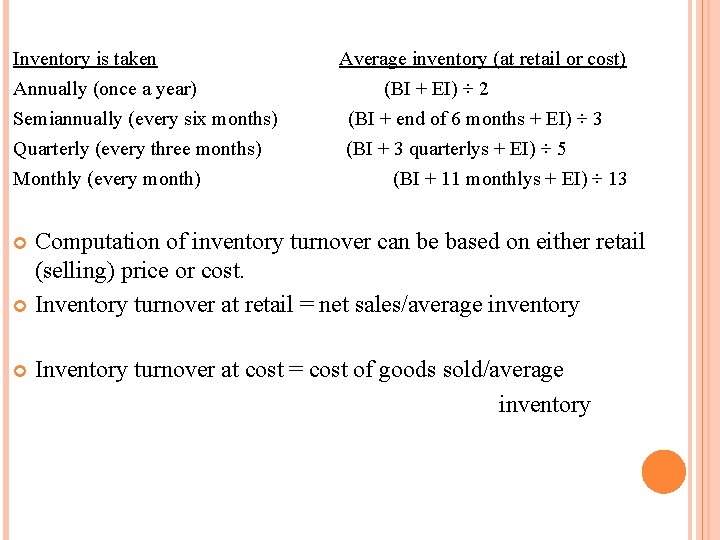
Inventory is taken Annually (once a year) Semiannually (every six months) Quarterly (every three months) Monthly (every month) Average inventory (at retail or cost) (BI + EI) ÷ 2 (BI + end of 6 months + EI) ÷ 3 (BI + 3 quarterlys + EI) ÷ 5 (BI + 11 monthlys + EI) ÷ 13 Computation of inventory turnover can be based on either retail (selling) price or cost. Inventory turnover at retail = net sales/average inventory Inventory turnover at cost = cost of goods sold/average inventory
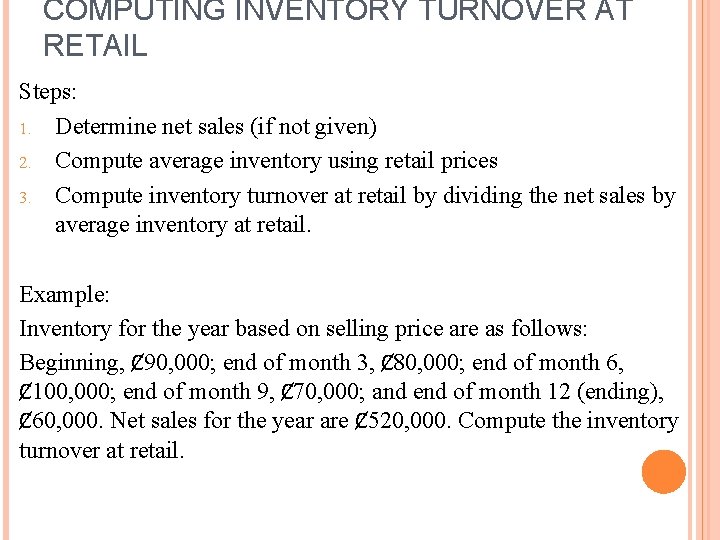
COMPUTING INVENTORY TURNOVER AT RETAIL Steps: 1. Determine net sales (if not given) 2. Compute average inventory using retail prices 3. Compute inventory turnover at retail by dividing the net sales by average inventory at retail. Example: Inventory for the year based on selling price are as follows: Beginning, Ȼ 90, 000; end of month 3, Ȼ 80, 000; end of month 6, Ȼ 100, 000; end of month 9, Ȼ 70, 000; and end of month 12 (ending), Ȼ 60, 000. Net sales for the year are Ȼ 520, 000. Compute the inventory turnover at retail.
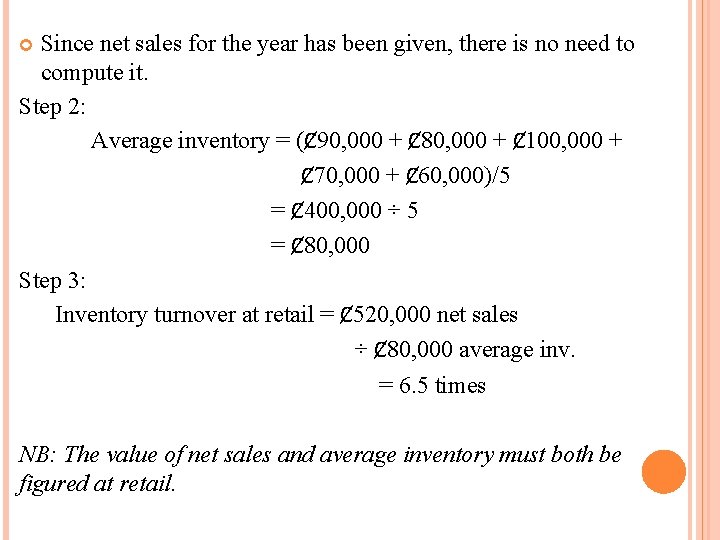
Since net sales for the year has been given, there is no need to compute it. Step 2: Average inventory = (Ȼ 90, 000 + Ȼ 80, 000 + Ȼ 100, 000 + Ȼ 70, 000 + Ȼ 60, 000)/5 = Ȼ 400, 000 ÷ 5 = Ȼ 80, 000 Step 3: Inventory turnover at retail = Ȼ 520, 000 net sales ÷ Ȼ 80, 000 average inv. = 6. 5 times NB: The value of net sales and average inventory must both be figured at retail.
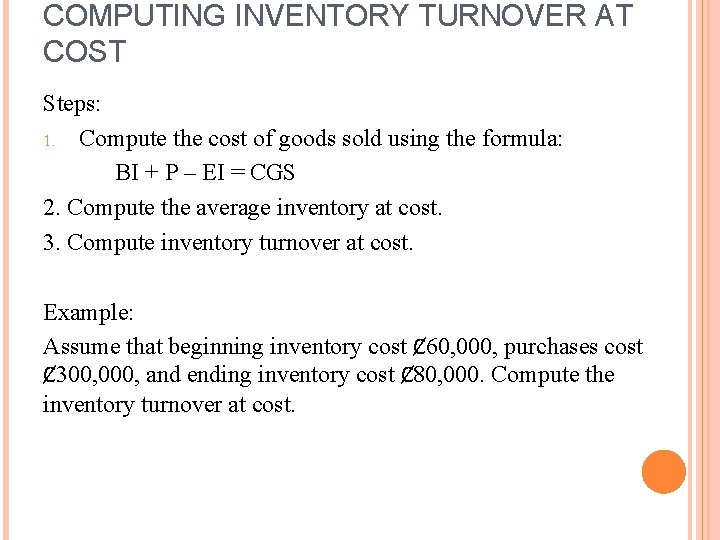
COMPUTING INVENTORY TURNOVER AT COST Steps: 1. Compute the cost of goods sold using the formula: BI + P – EI = CGS 2. Compute the average inventory at cost. 3. Compute inventory turnover at cost. Example: Assume that beginning inventory cost Ȼ 60, 000, purchases cost Ȼ 300, 000, and ending inventory cost Ȼ 80, 000. Compute the inventory turnover at cost.
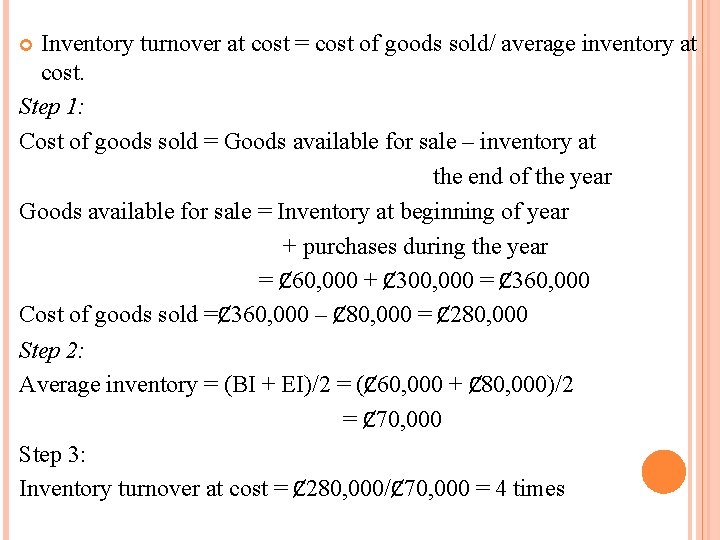
Inventory turnover at cost = cost of goods sold/ average inventory at cost. Step 1: Cost of goods sold = Goods available for sale – inventory at the end of the year Goods available for sale = Inventory at beginning of year + purchases during the year = Ȼ 60, 000 + Ȼ 300, 000 = Ȼ 360, 000 Cost of goods sold =Ȼ 360, 000 – Ȼ 80, 000 = Ȼ 280, 000 Step 2: Average inventory = (BI + EI)/2 = (Ȼ 60, 000 + Ȼ 80, 000)/2 = Ȼ 70, 000 Step 3: Inventory turnover at cost = Ȼ 280, 000/Ȼ 70, 000 = 4 times
- Slides: 29