
Inventories Chapter 25 Glencoe Accounting Unit 5 Chapter



- Slides: 32
Inventories Chapter 25 Glencoe Accounting Unit 5 Chapter 25 Copyright © by The Mc. Graw-Hill Companies, Inc. All rights reserved. 0
Chapter 25, Section 1 Determining the Quantity of Inventories What methods have you seen being used to take inventory in retail stores? Glencoe Accounting Unit 5 Chapter 25 Copyright © by The Mc. Graw-Hill Companies, Inc. All rights reserved. 1
SECTION 25. 1 Determining the Quantity of Inventories Merchandise Inventory To maintain control over inventory, a business establishes a system of inventory-tracking procedures. The Merchandise Inventory account shows the cost of goods purchased for resale and is the only account reported on both the balance sheet and the income statement. Glencoe Accounting Unit 5 Chapter 25 Copyright © by The Mc. Graw-Hill Companies, Inc. All rights reserved. 2
SECTION 25. 1 Determining the Quantity of Inventories Merchandise Inventory By tracking merchandise, a business knows: - How much merchandise is sold - Which items are selling well - Which items, when sold, should not be replaced Glencoe Accounting Unit 5 Chapter 25 Copyright © by The Mc. Graw-Hill Companies, Inc. All rights reserved. 3
SECTION 25. 1 Determining the Quantity of Inventories Methods of Tracking Inventory There are two methods to track merchandise: § the perpetual inventory system § Used by most large businesses and those with automated systems § the periodic inventory system § Used by small businesses with manual systems Glencoe Accounting Unit 5 Chapter 25 Copyright © by The Mc. Graw-Hill Companies, Inc. All rights reserved. 4
SECTION 25. 1 Determining the Quantity of Inventories Perpetual Inventory System The perpetual inventory system allows management to obtain real-time inventory information. Constant, up-to-date, record of merchandise on hand. Every time a purchase or sale is made, Merchandise Inventory is updated. Glencoe Accounting Unit 5 Chapter 25 Copyright © by The Mc. Graw-Hill Companies, Inc. All rights reserved. 5
SECTION 25. 1 Determining the Quantity of Inventories Perpetual Inventory System Computers update a perpetual inventory system through electronic cash registers, or point-of-sale terminals, that are online (linked to a central computer system). Companies that haven’t automated their businesses can use a stock card. (see page 681) Glencoe Accounting Unit 5 Chapter 25 Copyright © by The Mc. Graw-Hill Companies, Inc. All rights reserved. 6
SECTION 25. 1 Determining the Quantity of Inventories Periodic Inventory System The periodic inventory system is one in which inventory records are updated only after a physical count of merchandise on hand is made. Glencoe Accounting Unit 5 Chapter 25 Copyright © by The Mc. Graw-Hill Companies, Inc. All rights reserved. 7
SECTION 25. 1 Determining the Quantity of Inventories Periodic Inventory System Physical Inventory Count A business takes a physical count of its merchandise at least once a year on an inventory sheet. (see pg 682) This is a time consuming process and is usually done at the end of a peak selling period. Why? - When inventory is at its lowest level - To determine what sold well and what didn’t Glencoe Accounting Unit 5 Chapter 25 Copyright © by The Mc. Graw-Hill Companies, Inc. All rights reserved. 8
Determining the Quantity of Inventories SECTION 25. 1 Why is it important to have accurate inventory records? – Internal controls • Theft • Etc – Reporting • Net income/net loss • Accurate financial statements Glencoe Accounting Unit 5 Chapter 25 Copyright © by The Mc. Graw-Hill Companies, Inc. All rights reserved. 9
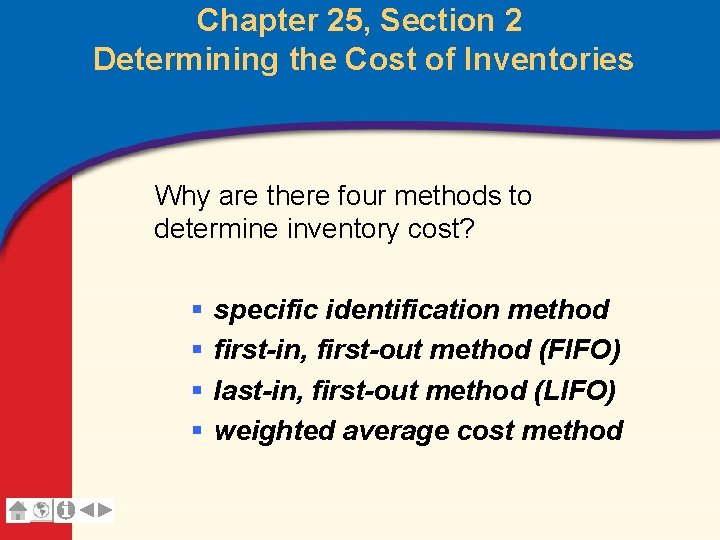
Chapter 25, Section 2 Determining the Cost of Inventories Why are there four methods to determine inventory cost? § § specific identification method first-in, first-out method (FIFO) last-in, first-out method (LIFO) weighted average cost method Glencoe Accounting Unit 5 Chapter 25 Copyright © by The Mc. Graw-Hill Companies, Inc. All rights reserved. 10
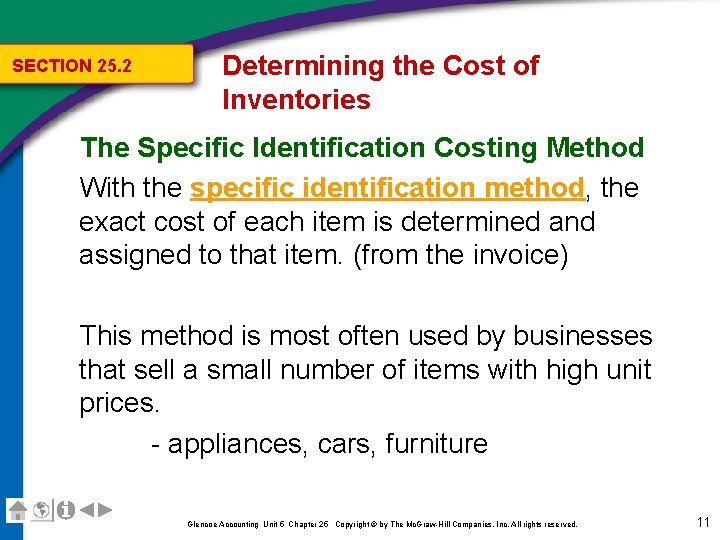
SECTION 25. 2 Determining the Cost of Inventories The Specific Identification Costing Method With the specific identification method, the exact cost of each item is determined and assigned to that item. (from the invoice) This method is most often used by businesses that sell a small number of items with high unit prices. - appliances, cars, furniture Glencoe Accounting Unit 5 Chapter 25 Copyright © by The Mc. Graw-Hill Companies, Inc. All rights reserved. 11
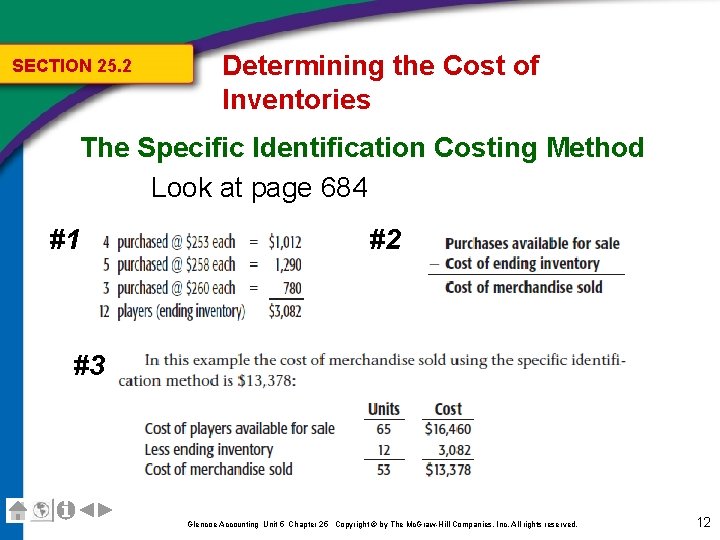
SECTION 25. 2 Determining the Cost of Inventories The Specific Identification Costing Method Look at page 684 #1 #2 #3 Glencoe Accounting Unit 5 Chapter 25 Copyright © by The Mc. Graw-Hill Companies, Inc. All rights reserved. 12
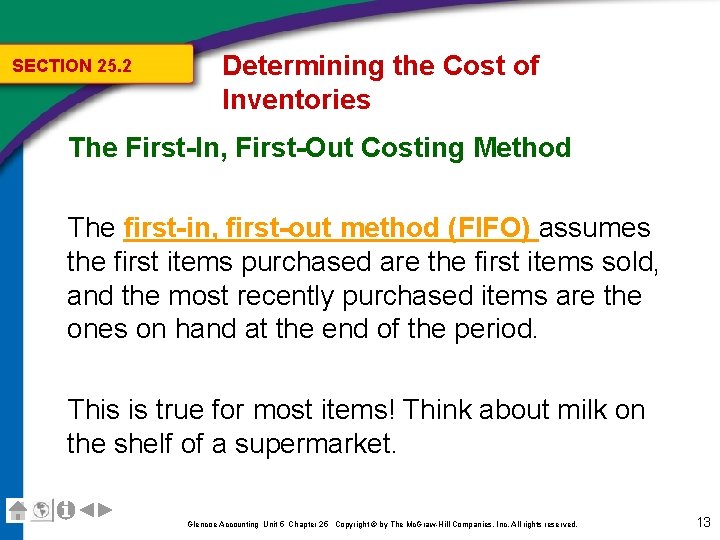
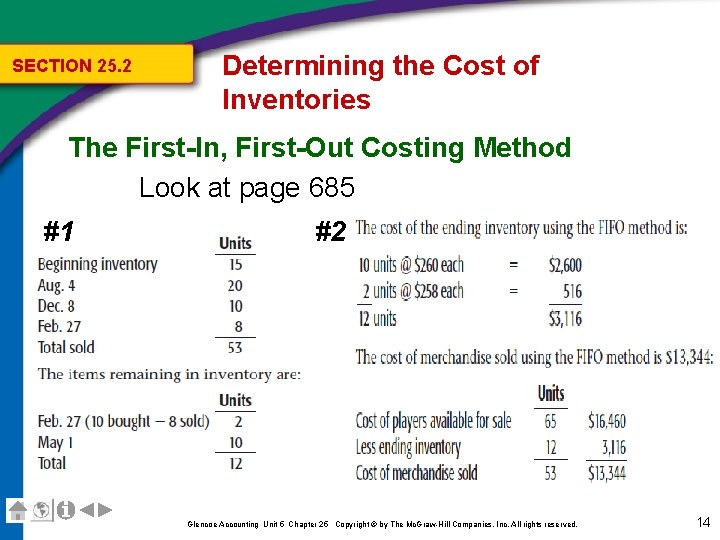
SECTION 25. 2 Determining the Cost of Inventories The First-In, First-Out Costing Method The first-in, first-out method (FIFO) assumes the first items purchased are the first items sold, and the most recently purchased items are the ones on hand at the end of the period. This is true for most items! Think about milk on the shelf of a supermarket. Glencoe Accounting Unit 5 Chapter 25 Copyright © by The Mc. Graw-Hill Companies, Inc. All rights reserved. 13
SECTION 25. 2 Determining the Cost of Inventories The First-In, First-Out Costing Method Look at page 685 #1 #2 Glencoe Accounting Unit 5 Chapter 25 Copyright © by The Mc. Graw-Hill Companies, Inc. All rights reserved. 14
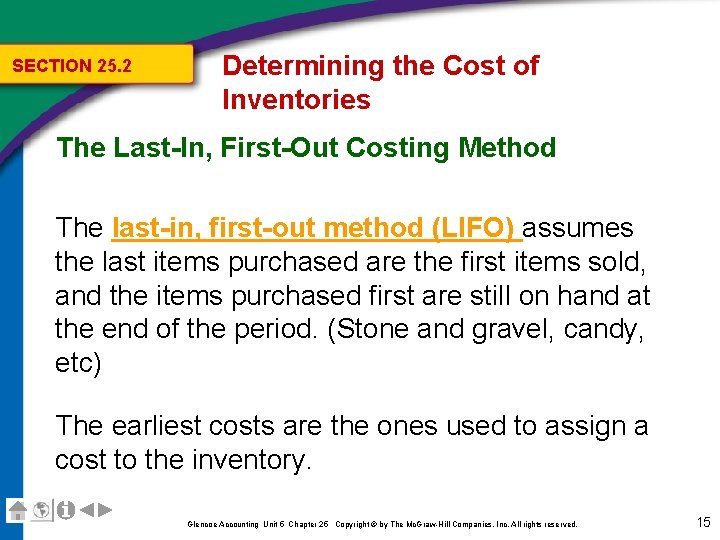
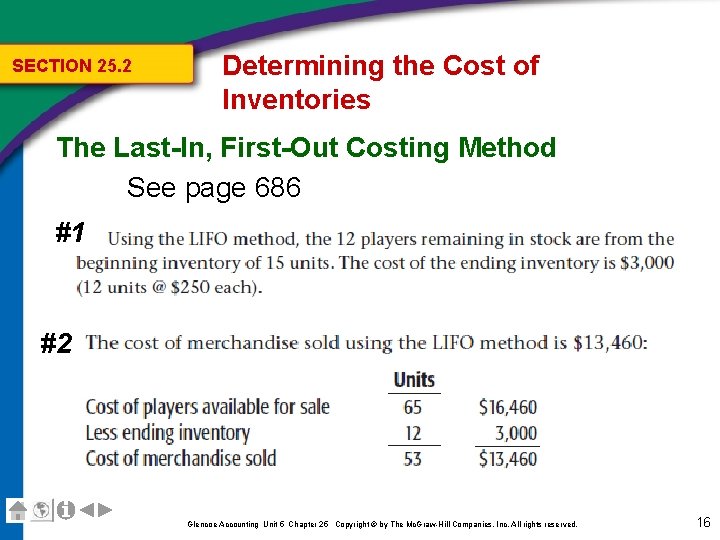
SECTION 25. 2 Determining the Cost of Inventories The Last-In, First-Out Costing Method The last-in, first-out method (LIFO) assumes the last items purchased are the first items sold, and the items purchased first are still on hand at the end of the period. (Stone and gravel, candy, etc) The earliest costs are the ones used to assign a cost to the inventory. Glencoe Accounting Unit 5 Chapter 25 Copyright © by The Mc. Graw-Hill Companies, Inc. All rights reserved. 15
SECTION 25. 2 Determining the Cost of Inventories The Last-In, First-Out Costing Method See page 686 #1 #2 Glencoe Accounting Unit 5 Chapter 25 Copyright © by The Mc. Graw-Hill Companies, Inc. All rights reserved. 16
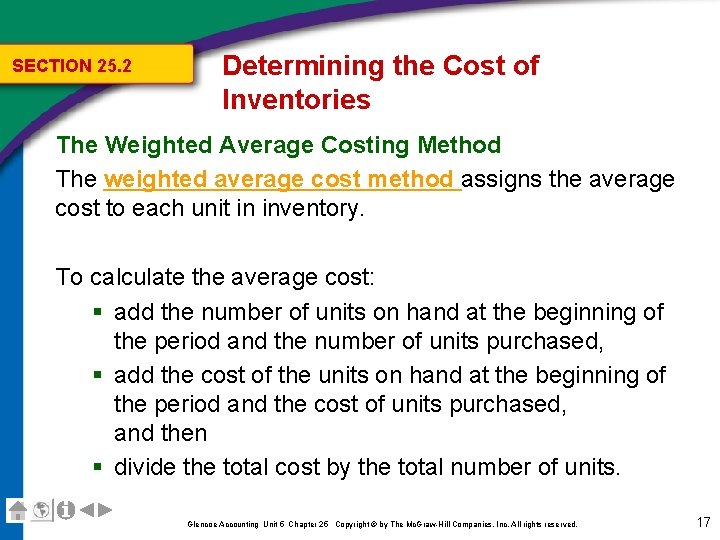
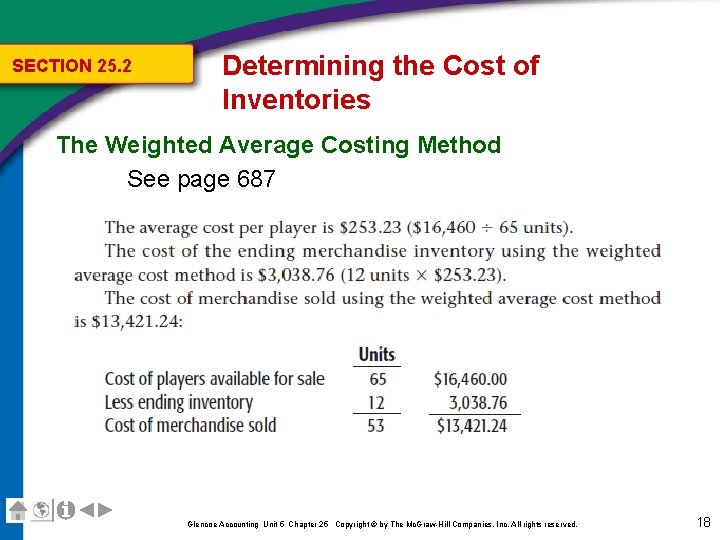
SECTION 25. 2 Determining the Cost of Inventories The Weighted Average Costing Method The weighted average cost method assigns the average cost to each unit in inventory. To calculate the average cost: § add the number of units on hand at the beginning of the period and the number of units purchased, § add the cost of the units on hand at the beginning of the period and the cost of units purchased, and then § divide the total cost by the total number of units. Glencoe Accounting Unit 5 Chapter 25 Copyright © by The Mc. Graw-Hill Companies, Inc. All rights reserved. 17
SECTION 25. 2 Determining the Cost of Inventories The Weighted Average Costing Method See page 687 Glencoe Accounting Unit 5 Chapter 25 Copyright © by The Mc. Graw-Hill Companies, Inc. All rights reserved. 18
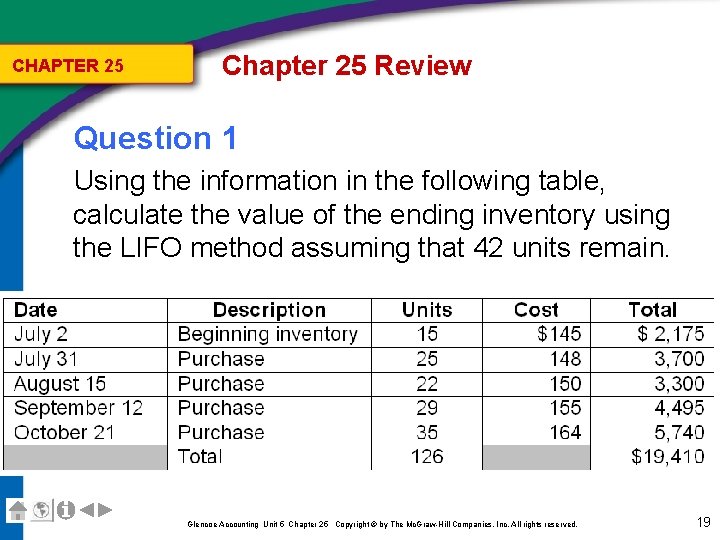
CHAPTER 25 Chapter 25 Review Question 1 Using the information in the following table, calculate the value of the ending inventory using the LIFO method assuming that 42 units remain. Glencoe Accounting Unit 5 Chapter 25 Copyright © by The Mc. Graw-Hill Companies, Inc. All rights reserved. 19
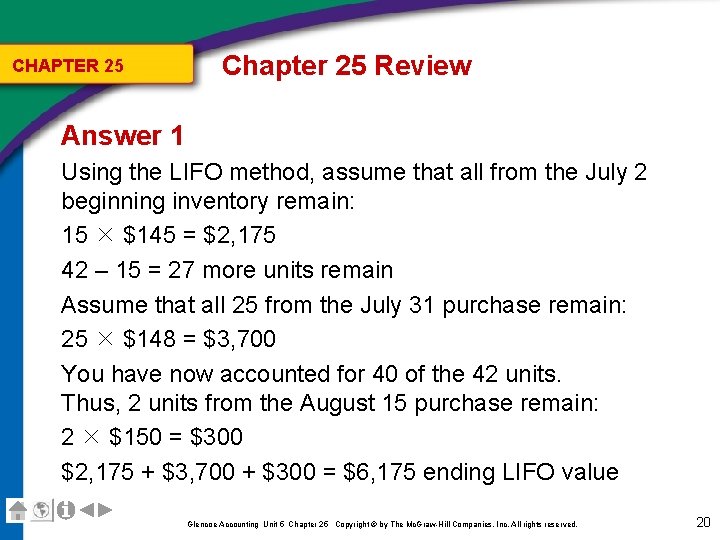
CHAPTER 25 Chapter 25 Review Answer 1 Using the LIFO method, assume that all from the July 2 beginning inventory remain: 15 $145 = $2, 175 42 – 15 = 27 more units remain Assume that all 25 from the July 31 purchase remain: 25 $148 = $3, 700 You have now accounted for 40 of the 42 units. Thus, 2 units from the August 15 purchase remain: 2 $150 = $300 $2, 175 + $3, 700 + $300 = $6, 175 ending LIFO value Glencoe Accounting Unit 5 Chapter 25 Copyright © by The Mc. Graw-Hill Companies, Inc. All rights reserved. 20
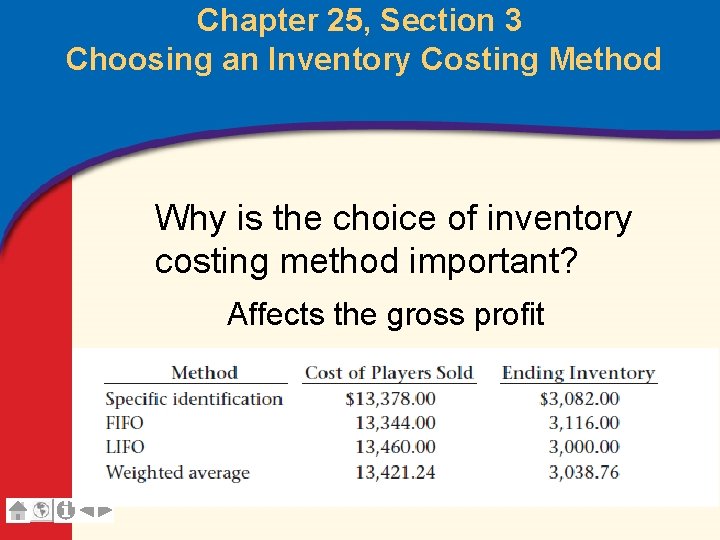
Chapter 25, Section 3 Choosing an Inventory Costing Method Why is the choice of inventory costing method important? Affects the gross profit Glencoe Accounting Unit 5 Chapter 25 Copyright © by The Mc. Graw-Hill Companies, Inc. All rights reserved. 21
SECTION 25. 3 Choosing an Inventory Costing Method Consistency and Inventory Costing When a business applies the same accounting methods in the same way from one period to the next, the GAAP consistency principle is being applied. Glencoe Accounting Unit 5 Chapter 25 Copyright © by The Mc. Graw-Hill Companies, Inc. All rights reserved. 22
SECTION 25. 3 Choosing an Inventory Costing Method Consistency and Inventory Costing The costing methods can be changed, but must be declared: - Reason for change - How the change will affect the financial statements - Must get permission from the IRS Glencoe Accounting Unit 5 Chapter 25 Copyright © by The Mc. Graw-Hill Companies, Inc. All rights reserved. 23
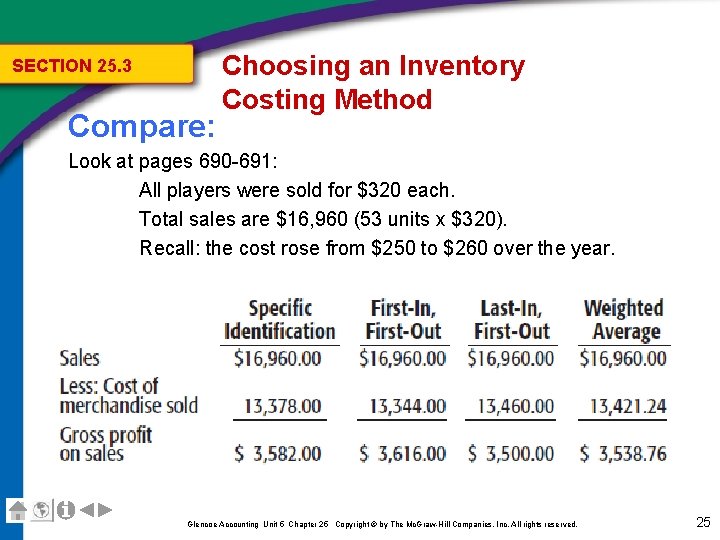
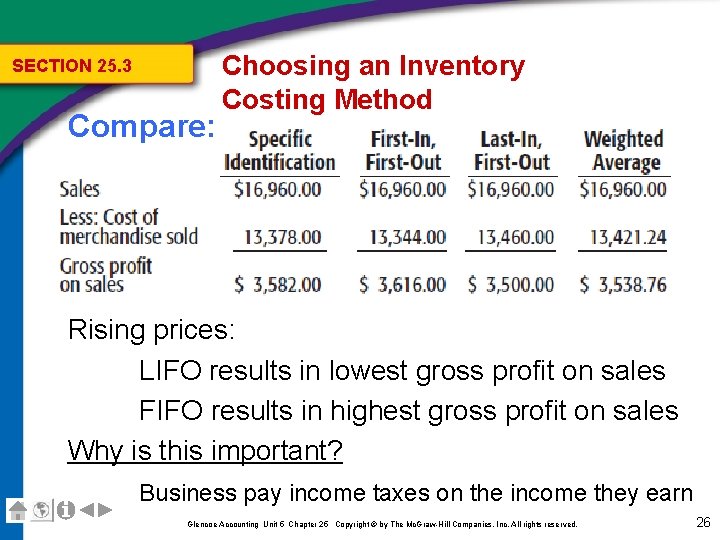
SECTION 25. 3 Choosing an Inventory Costing Method Comparison of the Four Inventory Costing Methods The cost of ending inventory affects the cost of merchandise sold, which in turn affects the income or loss reported on the income statement. Glencoe Accounting Unit 5 Chapter 25 Copyright © by The Mc. Graw-Hill Companies, Inc. All rights reserved. 24
SECTION 25. 3 Compare: Choosing an Inventory Costing Method Look at pages 690 -691: All players were sold for $320 each. Total sales are $16, 960 (53 units x $320). Recall: the cost rose from $250 to $260 over the year. Glencoe Accounting Unit 5 Chapter 25 Copyright © by The Mc. Graw-Hill Companies, Inc. All rights reserved. 25
SECTION 25. 3 Compare: Choosing an Inventory Costing Method Rising prices: LIFO results in lowest gross profit on sales FIFO results in highest gross profit on sales Why is this important? Business pay income taxes on the income they earn Glencoe Accounting Unit 5 Chapter 25 Copyright © by The Mc. Graw-Hill Companies, Inc. All rights reserved. 26
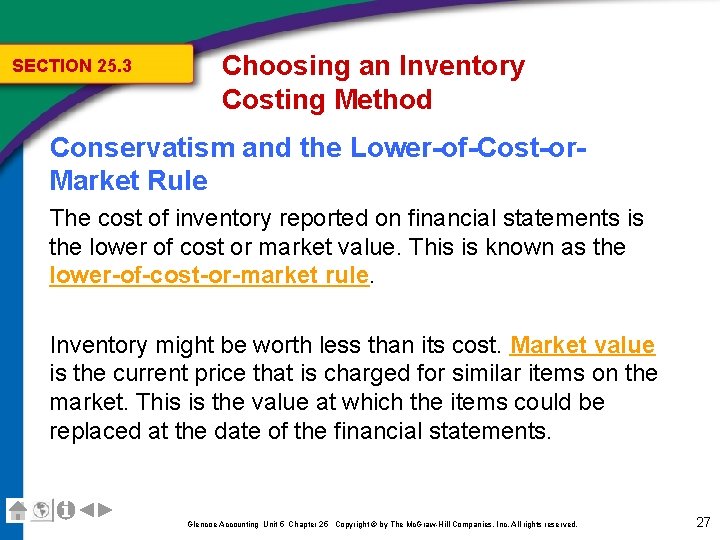
SECTION 25. 3 Choosing an Inventory Costing Method Conservatism and the Lower-of-Cost-or. Market Rule The cost of inventory reported on financial statements is the lower of cost or market value. This is known as the lower-of-cost-or-market rule. Inventory might be worth less than its cost. Market value is the current price that is charged for similar items on the market. This is the value at which the items could be replaced at the date of the financial statements. Glencoe Accounting Unit 5 Chapter 25 Copyright © by The Mc. Graw-Hill Companies, Inc. All rights reserved. 27
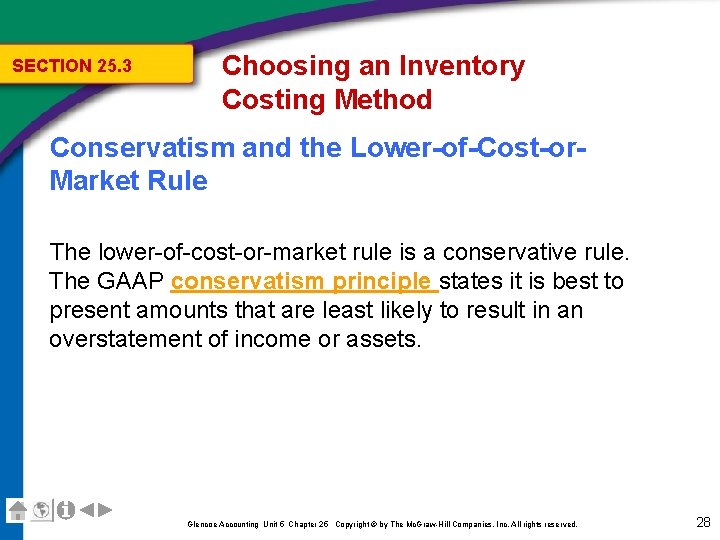
SECTION 25. 3 Choosing an Inventory Costing Method Conservatism and the Lower-of-Cost-or. Market Rule The lower-of-cost-or-market rule is a conservative rule. The GAAP conservatism principle states it is best to present amounts that are least likely to result in an overstatement of income or assets. Glencoe Accounting Unit 5 Chapter 25 Copyright © by The Mc. Graw-Hill Companies, Inc. All rights reserved. 28
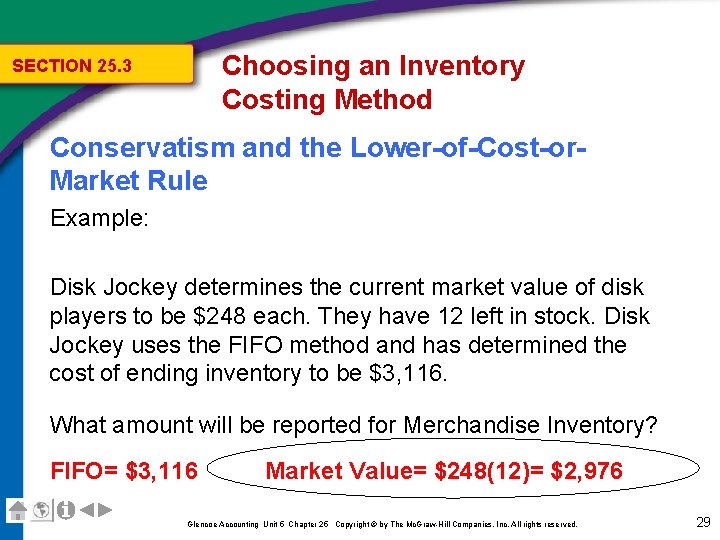
Choosing an Inventory Costing Method SECTION 25. 3 Conservatism and the Lower-of-Cost-or. Market Rule Example: Disk Jockey determines the current market value of disk players to be $248 each. They have 12 left in stock. Disk Jockey uses the FIFO method and has determined the cost of ending inventory to be $3, 116. What amount will be reported for Merchandise Inventory? FIFO= $3, 116 Market Value= $248(12)= $2, 976 Glencoe Accounting Unit 5 Chapter 25 Copyright © by The Mc. Graw-Hill Companies, Inc. All rights reserved. 29
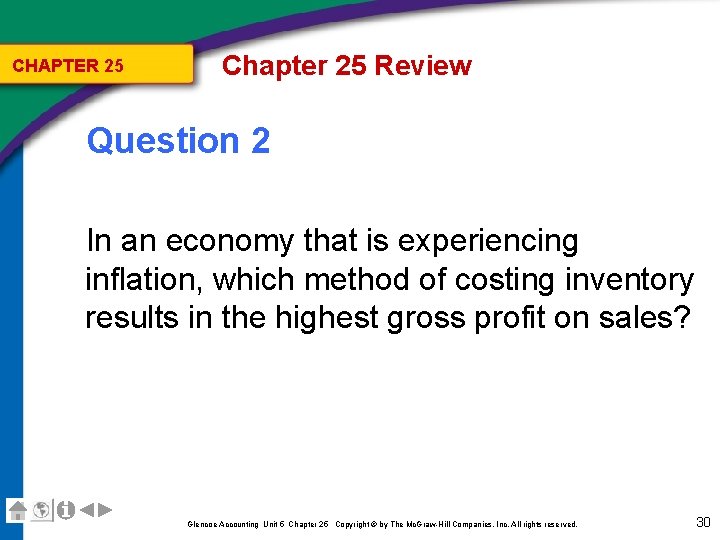
CHAPTER 25 Chapter 25 Review Question 2 In an economy that is experiencing inflation, which method of costing inventory results in the highest gross profit on sales? Glencoe Accounting Unit 5 Chapter 25 Copyright © by The Mc. Graw-Hill Companies, Inc. All rights reserved. 30
Chapter 25 Review CHAPTER 25 Answer 2 FIFO. If costs are rising, the FIFO method assumes that the merchandise sold represents the oldest, or least expensive, units. If this method is used, the business will report the lowest cost of merchandise sold and, thus, the result will be the highest gross profit on sales. Glencoe Accounting Unit 5 Chapter 25 Copyright © by The Mc. Graw-Hill Companies, Inc. All rights reserved. 31