
Inventories and Restructuring Charges ACCOUNTG 245 Introduction to
- Slides: 28
Inventories and Restructuring Charges ACCOUNTG 245: Introduction to Financial Accounting
Learning Objectives � Importance of inventories � Some basics about inventory � Ratios � Terminology � Physical and accounting flows � Methods of accounting for inventory – the basics � Discuss Gardner Denver Case � Accounting implications of restructuring charges 2 Session 4
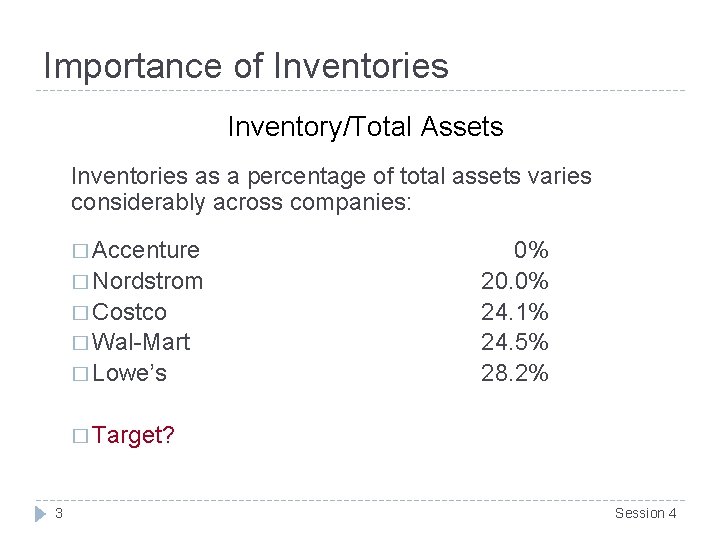
Importance of Inventories Inventory/Total Assets Inventories as a percentage of total assets varies considerably across companies: � Accenture � Nordstrom � Costco � Wal-Mart � Lowe’s 0% 20. 0% 24. 1% 24. 5% 28. 2% � Target? 3 Session 4
GAAP for Inventory � Valuing inventory on the balance sheet � Effect of inventory on the income statement � What if the value of inventory declines? 4 Session 4
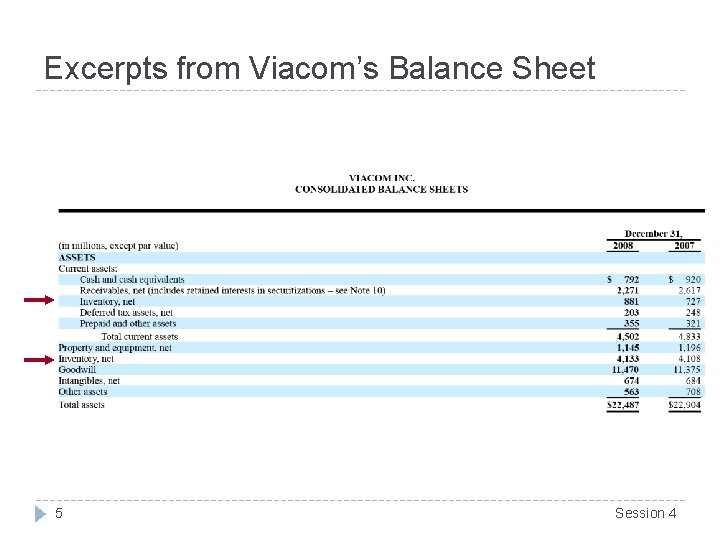
Excerpts from Viacom’s Balance Sheet 5 Session 4
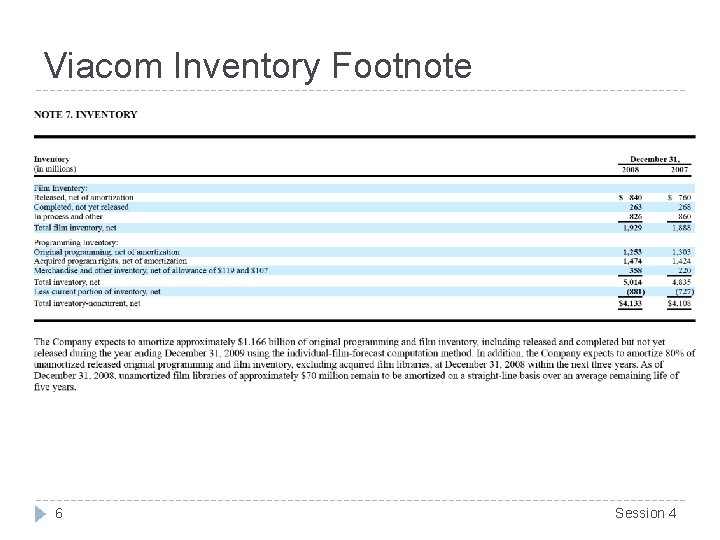
Viacom Inventory Footnote 6 Session 4
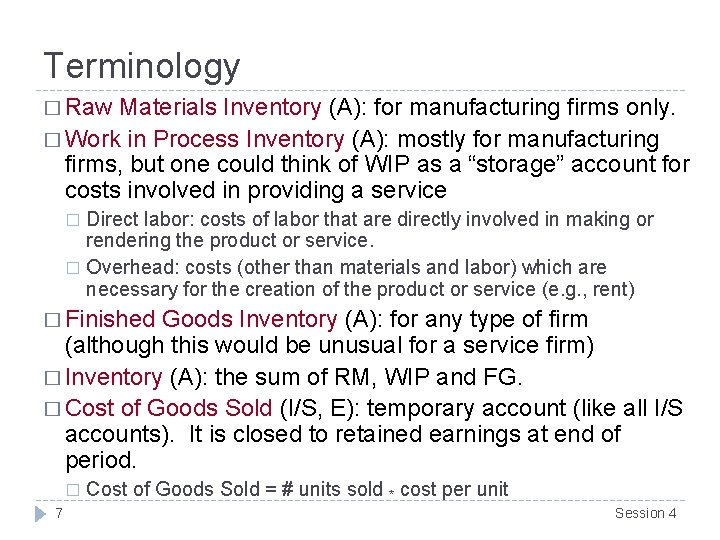
Terminology � Raw Materials Inventory (A): for manufacturing firms only. � Work in Process Inventory (A): mostly for manufacturing firms, but one could think of WIP as a “storage” account for costs involved in providing a service Direct labor: costs of labor that are directly involved in making or rendering the product or service. � Overhead: costs (other than materials and labor) which are necessary for the creation of the product or service (e. g. , rent) � � Finished Goods Inventory (A): for any type of firm (although this would be unusual for a service firm) � Inventory (A): the sum of RM, WIP and FG. � Cost of Goods Sold (I/S, E): temporary account (like all I/S accounts). It is closed to retained earnings at end of period. � 7 Cost of Goods Sold = # units sold * cost per unit Session 4
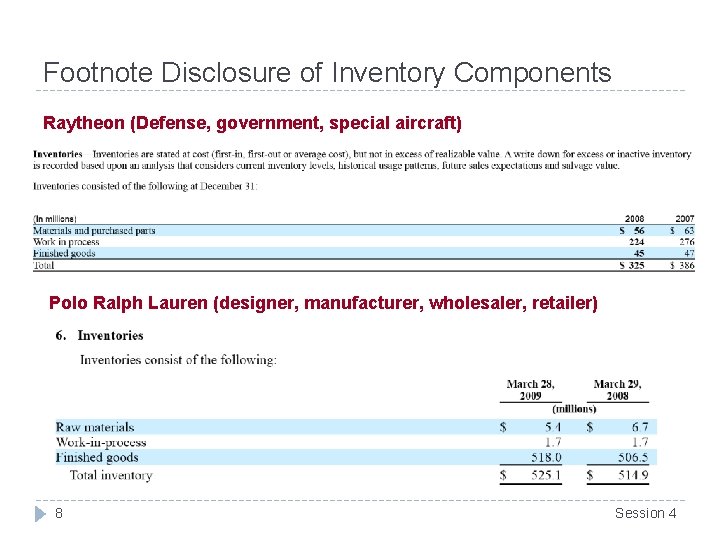
Footnote Disclosure of Inventory Components Raytheon (Defense, government, special aircraft) Polo Ralph Lauren (designer, manufacturer, wholesaler, retailer) 8 Session 4
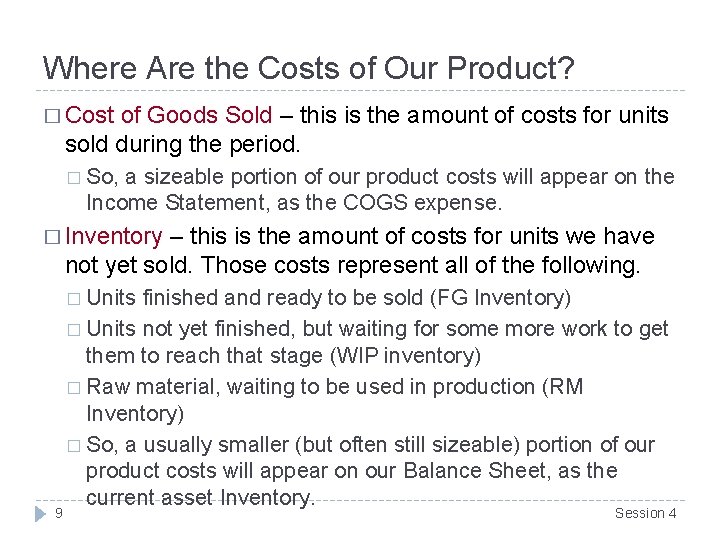
Where Are the Costs of Our Product? � Cost of Goods Sold – this is the amount of costs for units sold during the period. � So, a sizeable portion of our product costs will appear on the Income Statement, as the COGS expense. � Inventory – this is the amount of costs for units we have not yet sold. Those costs represent all of the following. � Units 9 finished and ready to be sold (FG Inventory) � Units not yet finished, but waiting for some more work to get them to reach that stage (WIP inventory) � Raw material, waiting to be used in production (RM Inventory) � So, a usually smaller (but often still sizeable) portion of our product costs will appear on our Balance Sheet, as the current asset Inventory. Session 4
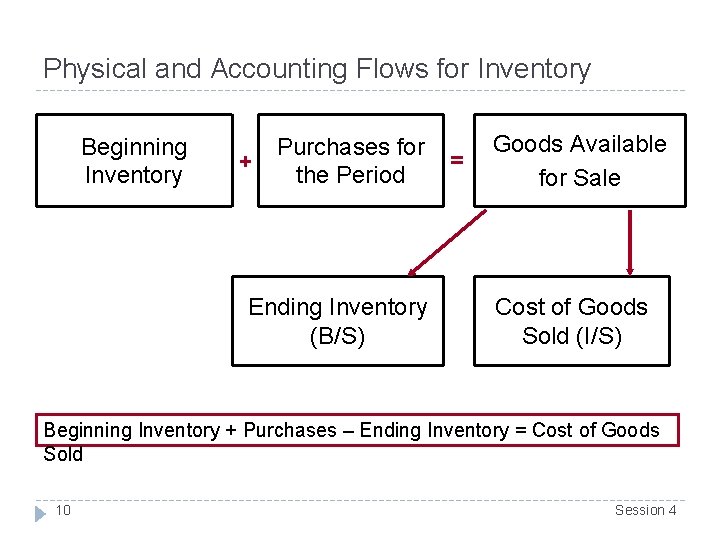
Physical and Accounting Flows for Inventory Beginning Inventory Purchases for + the Period Ending Inventory (B/S) = Goods Available for Sale Cost of Goods Sold (I/S) Beginning Inventory + Purchases – Ending Inventory = Cost of Goods Sold 10 Session 4
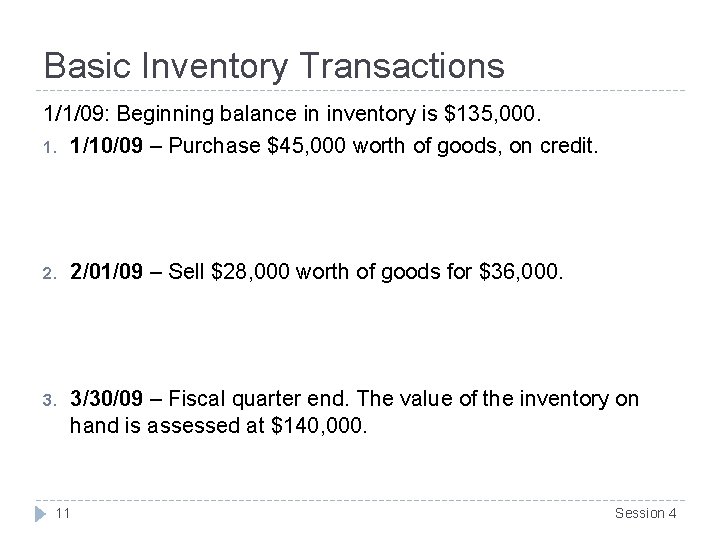
Basic Inventory Transactions 1/1/09: Beginning balance in inventory is $135, 000. 1. 1/10/09 – Purchase $45, 000 worth of goods, on credit. 2/01/09 – Sell $28, 000 worth of goods for $36, 000. 3/30/09 – Fiscal quarter end. The value of the inventory on hand is assessed at $140, 000. 11 Session 4
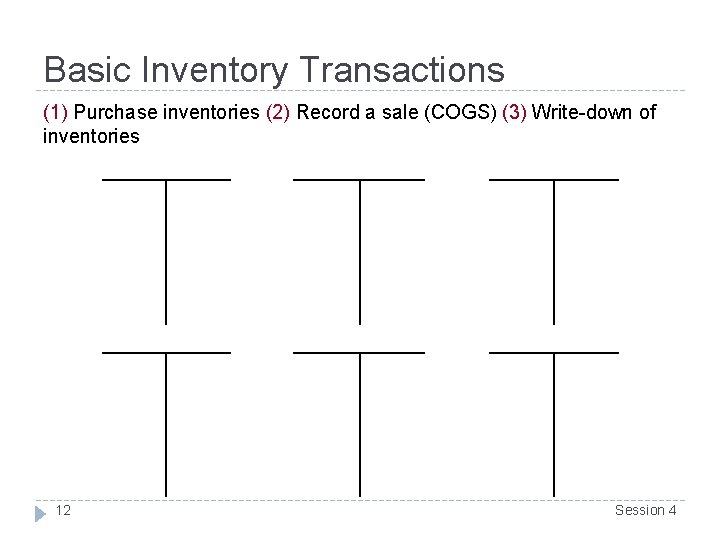
Basic Inventory Transactions (1) Purchase inventories (2) Record a sale (COGS) (3) Write-down of inventories 12 Session 4
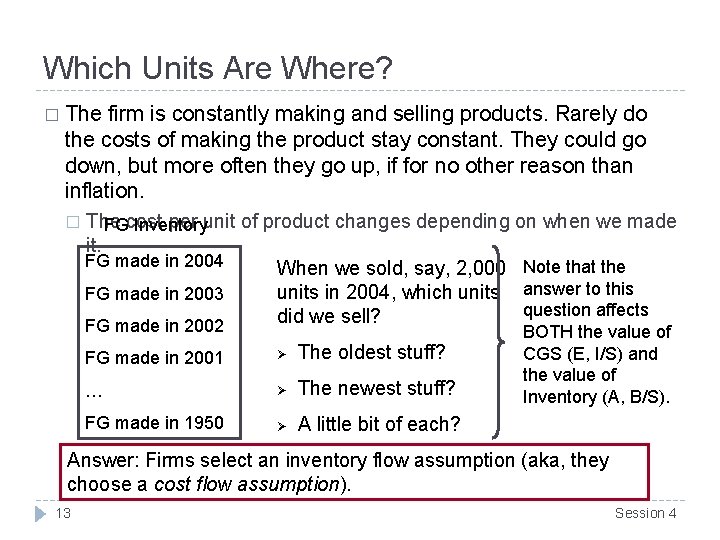
Which Units Are Where? � The firm is constantly making and selling products. Rarely do the costs of making the product stay constant. They could go down, but more often they go up, if for no other reason than inflation. � The per unit of product changes depending on when we made FGcost Inventory it. FG made in 2004 When we sold, say, 2, 000 Note that the units in 2004, which units answer to this FG made in 2003 question affects did we sell? FG made in 2002 FG made in 2001 Ø The oldest stuff? … Ø The newest stuff? FG made in 1950 Ø A little bit of each? BOTH the value of CGS (E, I/S) and the value of Inventory (A, B/S). Answer: Firms select an inventory flow assumption (aka, they choose a cost flow assumption). 13 Session 4
Which Units Did We Sell? � Because firms often make more units than they sell in some period, inventory layers get created. � Each layer of cost could, in theory (and in practice, usually does), have a different unit cost. � So, when we sell the product (and trigger the release of costs from inventory and onto the income statement), we must make an assumption about which units actually get sold each period: new units, old units, a mixture? � Q � This is one of the few situations where the assumption made for financial reporting purposes has tax implications. 14 Session 4
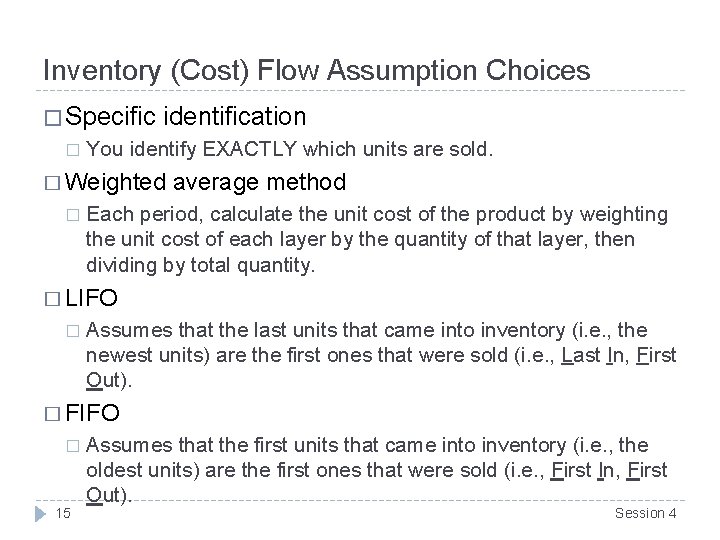
Inventory (Cost) Flow Assumption Choices � Specific � identification You identify EXACTLY which units are sold. � Weighted � average method Each period, calculate the unit cost of the product by weighting the unit cost of each layer by the quantity of that layer, then dividing by total quantity. � LIFO � Assumes that the last units that came into inventory (i. e. , the newest units) are the first ones that were sold (i. e. , Last In, First Out). � FIFO � 15 Assumes that the first units that came into inventory (i. e. , the oldest units) are the first ones that were sold (i. e. , First In, First Out). Session 4
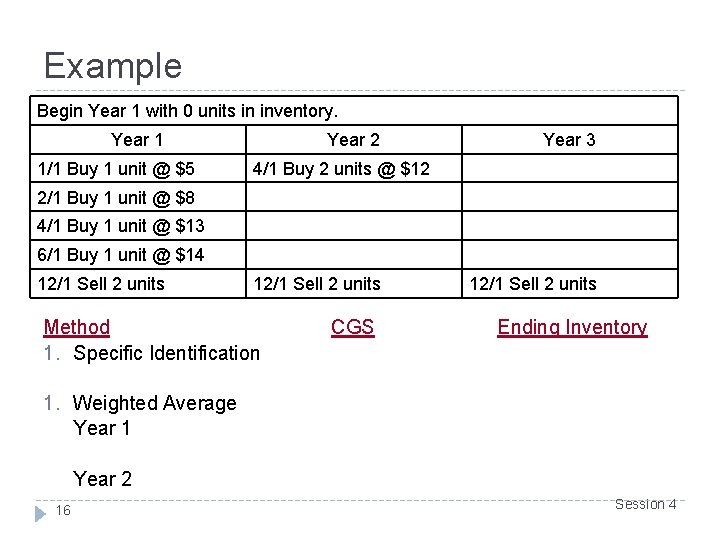
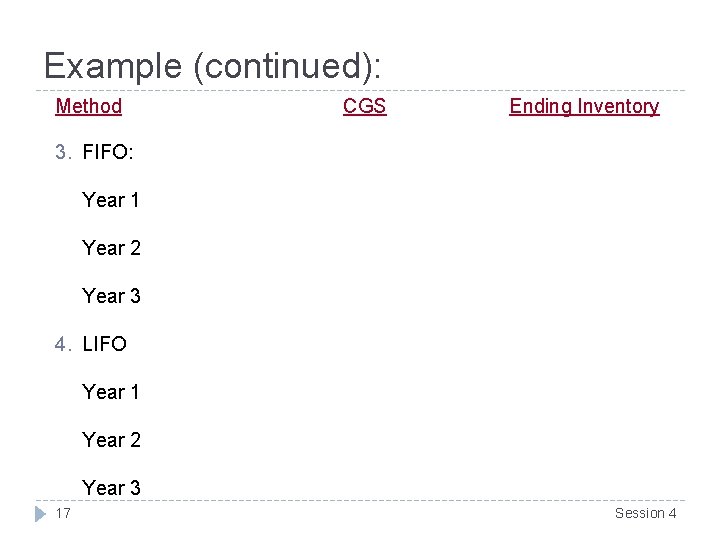
Example Begin Year 1 with 0 units in inventory. Year 1 1/1 Buy 1 unit @ $5 Year 2 Year 3 4/1 Buy 2 units @ $12 2/1 Buy 1 unit @ $8 4/1 Buy 1 unit @ $13 6/1 Buy 1 unit @ $14 12/1 Sell 2 units Method 1. Specific Identification CGS 12/1 Sell 2 units Ending Inventory 1. Weighted Average Year 1 Year 2 16 Session 4
Example (continued): Method CGS Ending Inventory 3. FIFO: Year 1 Year 2 Year 3 4. LIFO Year 1 Year 2 Year 3 17 Session 4
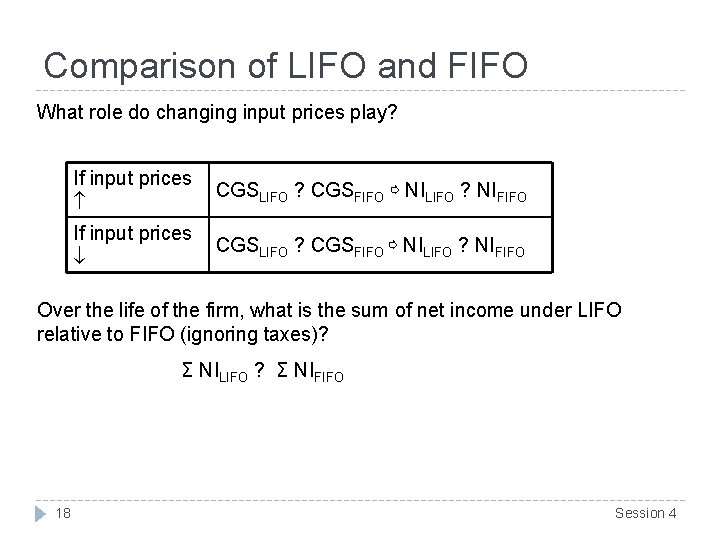
Comparison of LIFO and FIFO What role do changing input prices play? If input prices CGSLIFO ? CGSFIFO ⇨ NILIFO ? NIFIFO Over the life of the firm, what is the sum of net income under LIFO relative to FIFO (ignoring taxes)? Σ NILIFO ? Σ NIFIFO 18 Session 4
Comparison of LIFO and FIFO LIFO 19 FIFO Session 4
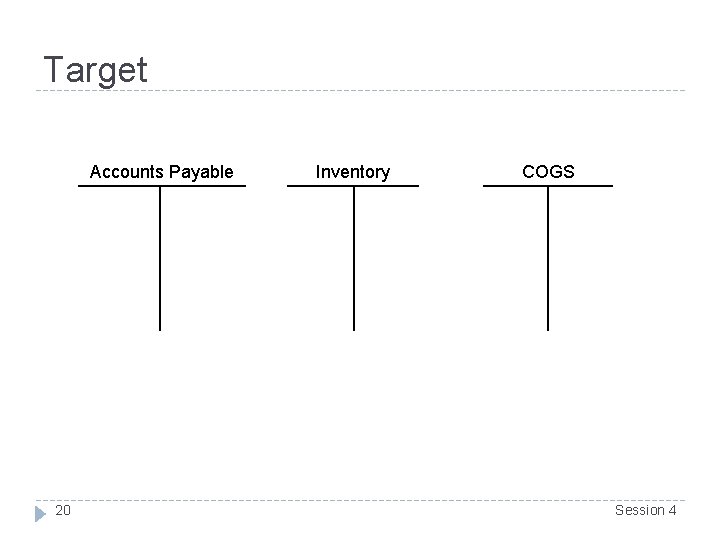
Target Accounts Payable 20 Inventory COGS Session 4
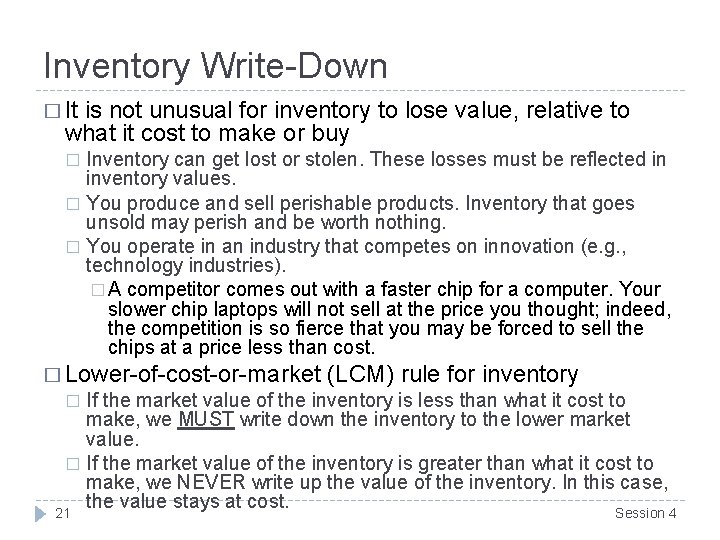
Inventory Write-Down � It is not unusual for inventory to lose value, relative to what it cost to make or buy Inventory can get lost or stolen. These losses must be reflected in inventory values. � You produce and sell perishable products. Inventory that goes unsold may perish and be worth nothing. � You operate in an industry that competes on innovation (e. g. , technology industries). � A competitor comes out with a faster chip for a computer. Your slower chip laptops will not sell at the price you thought; indeed, the competition is so fierce that you may be forced to sell the chips at a price less than cost. � � Lower-of-cost-or-market (LCM) rule for inventory If the market value of the inventory is less than what it cost to make, we MUST write down the inventory to the lower market value. � If the market value of the inventory is greater than what it cost to make, we NEVER write up the value of the inventory. In this case, the value stays at cost. 21 Session 4 �
Gardner Denver � What inventory cost flow assumptions does Gardner Denver use? � What factors does management consider when evaluating whether inventory write downs are necessary? 22 Session 4
Gardner Denver � What is the carrying value of total inventory as of 12/31/2005? � What is the carrying value of total inventory for each of the cost flow assumptions used by Gardner Denver? 23 Session 4
Gardner Denver � If all inventory was accounting for on a FIFO basis, what would have been the inventory value at 12/31/2005? � What amount of cost of goods sold did Gardner Denver report for fiscal year 2005? 24 Session 4
Gardner Denver � What amount of cost of goods sold would Gardner Denver have reported for fiscal year 2005 if all inventory was accounted for on a FIFO basis? � Quantify the effect LIFO liquidations had on reported net income in fiscal year 2004. 25 Session 4
Restructuring Charges � Corporate restructuring refers to shifts in corporate strategy to become more competitive and efficient. � Restructuring can include Closing down of plants � Employee severance � Selling off non-core business units � Consolidating operations � � Restructuring charges are Estimated future costs firms expect to incur in order to successfully carry out the restructuring � Recognized on the income statement as one line item in continuing operations � Discussed in detail in the footnotes � 26 Session 4
Reporting Issues Associated with Restructuring Charges � What are the reporting incentives with respect to restructuring charges? 27 Session 4
Next Session � Long-Term � Case 28 Assets: Tangible and Intangible Assets discussion: Delta Airlines & Singapore Airlines (A) Session 4