
Invasive Whitefly Pests of Florida Photos H Glenn
- Slides: 45
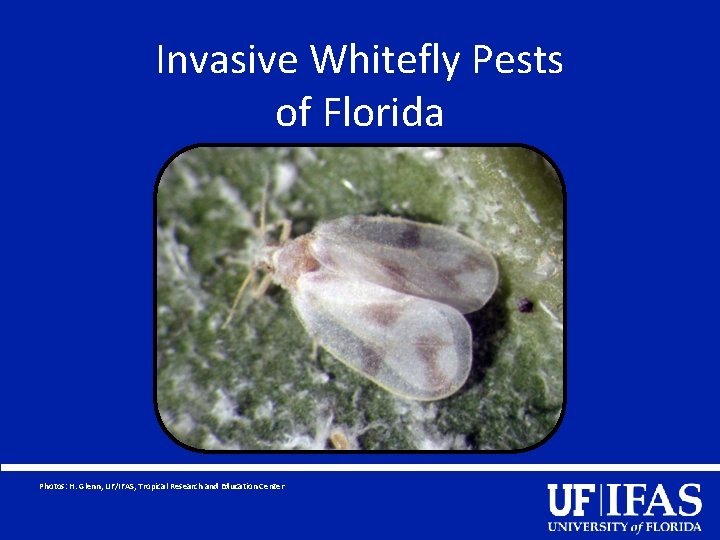
Invasive Whitefly Pests of Florida Photos: H. Glenn, UF/IFAS, Tropical Research and Education Center
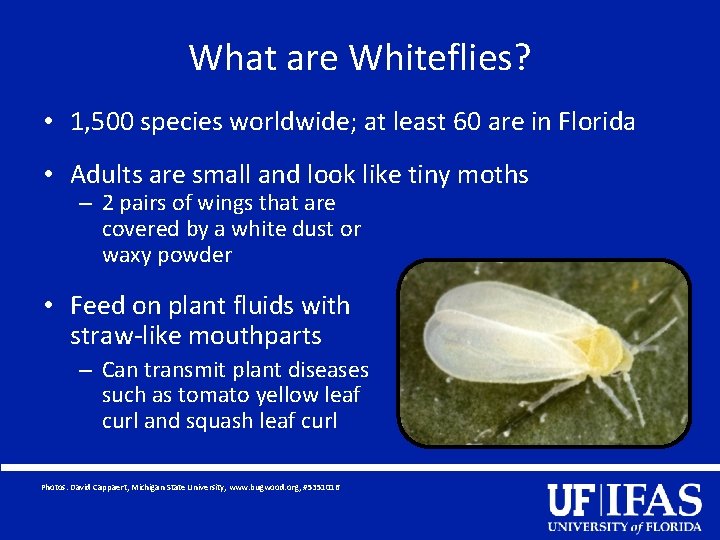
What are Whiteflies? • 1, 500 species worldwide; at least 60 are in Florida • Adults are small and look like tiny moths – 2 pairs of wings that are covered by a white dust or waxy powder • Feed on plant fluids with straw-like mouthparts – Can transmit plant diseases such as tomato yellow leaf curl and squash leaf curl Photos: David Cappaert, Michigan State University, www. bugwood. org, #5351016
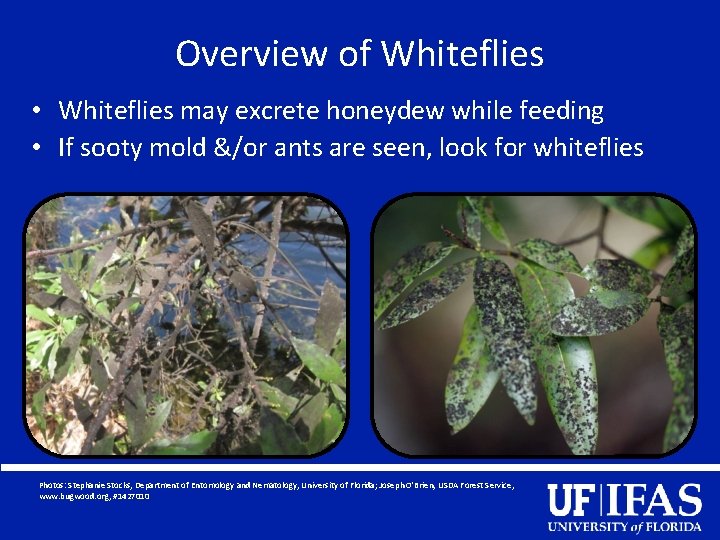
Overview of Whiteflies • Whiteflies may excrete honeydew while feeding • If sooty mold &/or ants are seen, look for whiteflies Photos: Stephanie Stocks, Department of Entomology and Nematology, University of Florida; Joseph O'Brien, USDA Forest Service, www. bugwood. org, #1427010
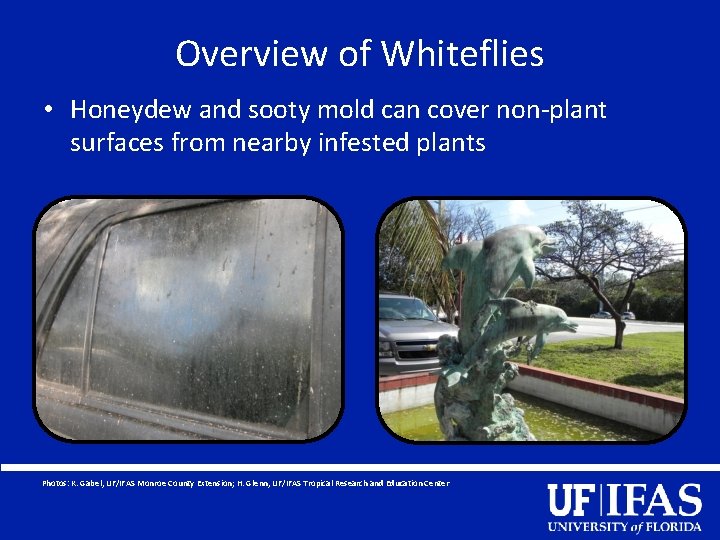
Overview of Whiteflies • Honeydew and sooty mold can cover non-plant surfaces from nearby infested plants Photos: K. Gabel, UF/IFAS Monroe County Extension; H. Glenn, UF/IFAS Tropical Research and Education Center
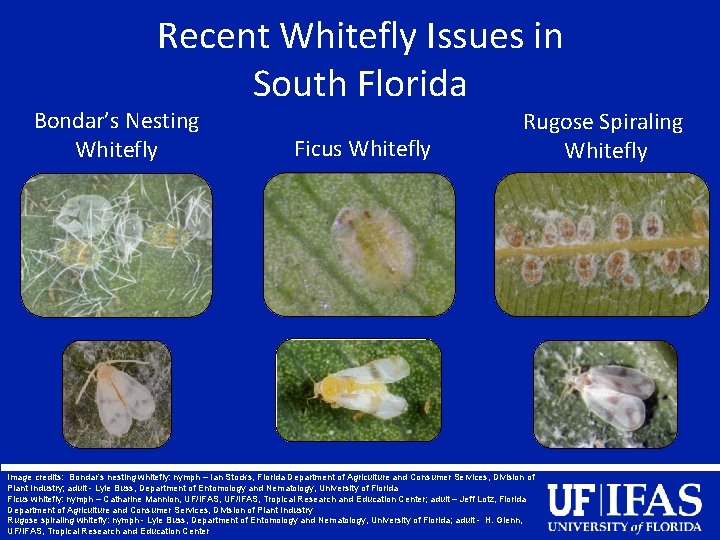
Recent Whitefly Issues in South Florida Bondar’s Nesting Whitefly Ficus Whitefly Rugose Spiraling Whitefly Image credits: Bondar’s nesting whitefly: nymph – Ian Stocks, Florida Department of Agriculture and Consumer Services, Division of Plant Industry; adult - Lyle Buss, Department of Entomology and Nematology, University of Florida Ficus whitefly: nymph – Catharine Mannion, UF/IFAS, Tropical Research and Education Center; adult – Jeff Lotz, Florida Department of Agriculture and Consumer Services, Division of Plant Industry Rugose spiraling whitefly: nymph - Lyle Buss, Department of Entomology and Nematology, University of Florida; adult - H. Glenn, UF/IFAS, Tropical Research and Education Center
Bondar’s Nesting Whitefly Paraleyrodes bondari • Native to South America and the Caribbean • Also detected in Madeira, Comoros, Mauritius, Reunion, Taiwan, Hawaii, Portugal • Found in Florida in 2011 • Not much is known about its biology or life cycle.
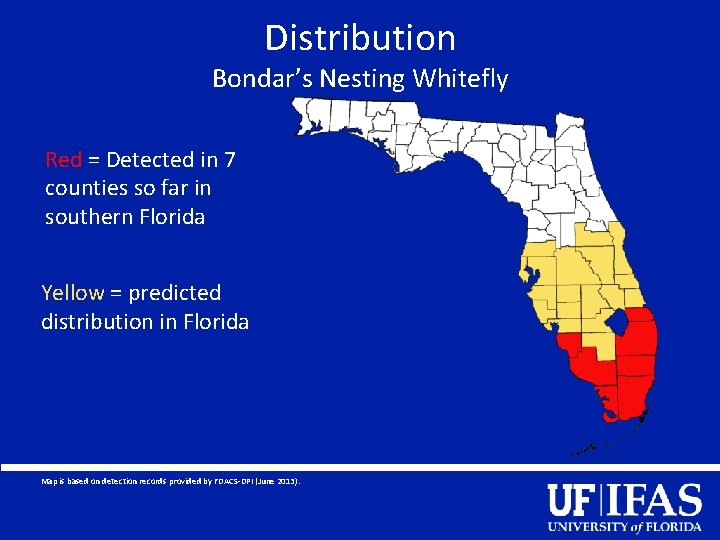
Distribution Bondar’s Nesting Whitefly Red = Detected in 7 counties so far in southern Florida Yellow = predicted distribution in Florida Map is based on detection records provided by FDACS-DPI (June 2013).
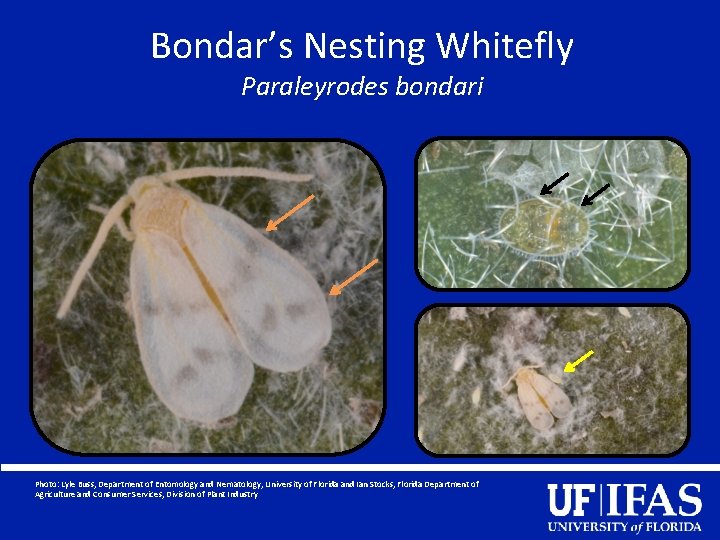
Bondar’s Nesting Whitefly Paraleyrodes bondari Adult in nest Photo: Lyle Buss, Department of Entomology and Nematology, University of Florida and Ian Stocks, Florida Department of Agriculture and Consumer Services, Division of Plant Industry Nymph
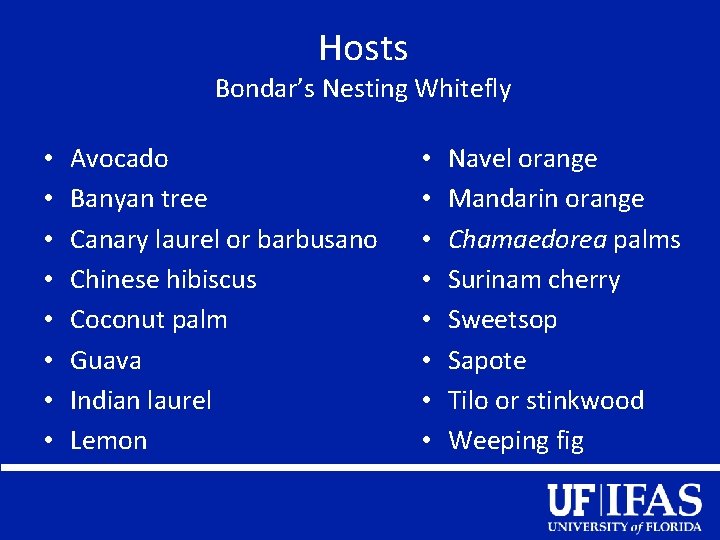
Hosts Bondar’s Nesting Whitefly • • Avocado Banyan tree Canary laurel or barbusano Chinese hibiscus Coconut palm Guava Indian laurel Lemon • • Navel orange Mandarin orange Chamaedorea palms Surinam cherry Sweetsop Sapote Tilo or stinkwood Weeping fig
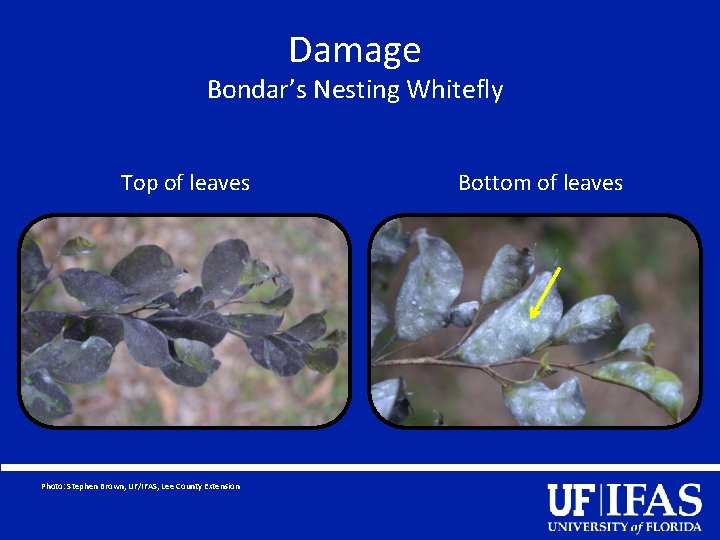
Damage Bondar’s Nesting Whitefly Top of leaves Photo: Stephen Brown, UF/IFAS, Lee County Extension Bottom of leaves
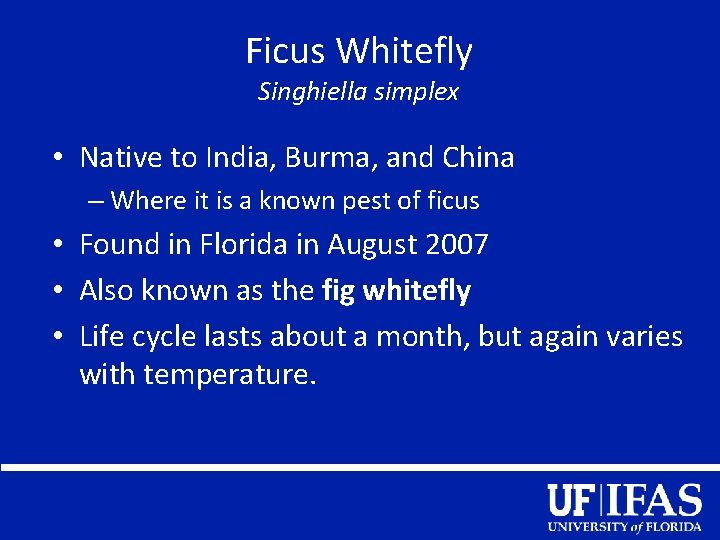
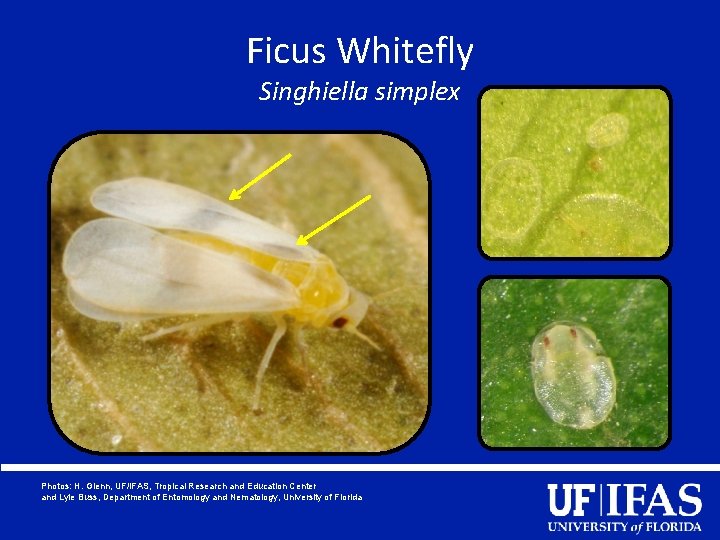
Ficus Whitefly Singhiella simplex • Native to India, Burma, and China – Where it is a known pest of ficus • Found in Florida in August 2007 • Also known as the fig whitefly • Life cycle lasts about a month, but again varies with temperature.
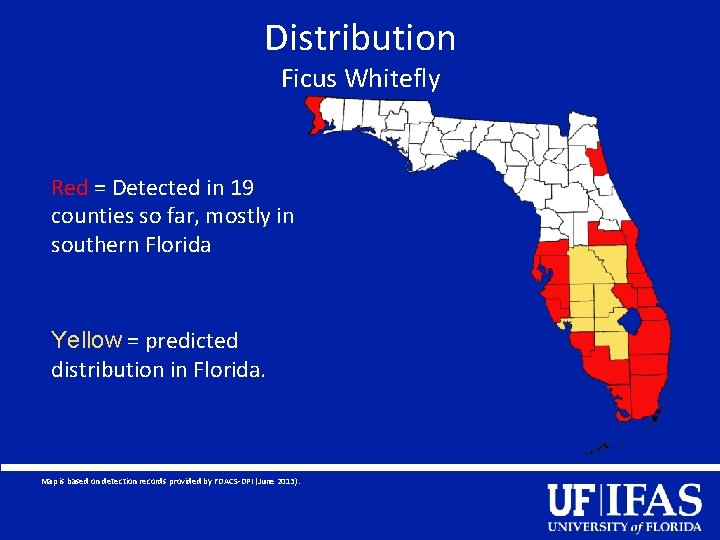
Distribution Ficus Whitefly Red = Detected in 19 counties so far, mostly in southern Florida Yellow = predicted distribution in Florida. Map is based on detection records provided by FDACS-DPI (June 2013).
Ficus Whitefly Singhiella simplex Photos: H. Glenn, UF/IFAS, Tropical Research and Education Center and Lyle Buss, Department of Entomology and Nematology, University of Florida
Hosts Ficus Whitefly • • Weeping fig False banyan tree Banyan tree Cuban laurel Strangler fig Indian fig Fiddle leaf fig Banana leaf fig • Other figs may be susceptible • Still others, such as Green Island fig, does not seem to be susceptible
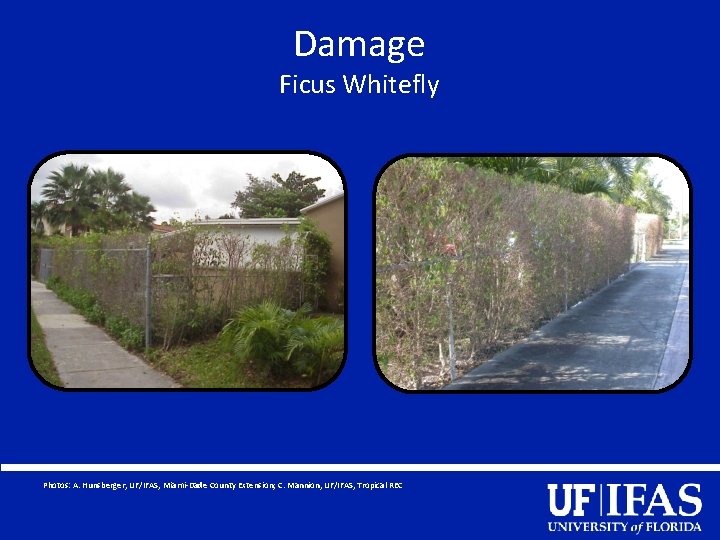
Damage Ficus Whitefly Photos: A. Hunsberger, UF/IFAS, Miami-Dade County Extension; C. Mannion, UF/IFAS, Tropical REC
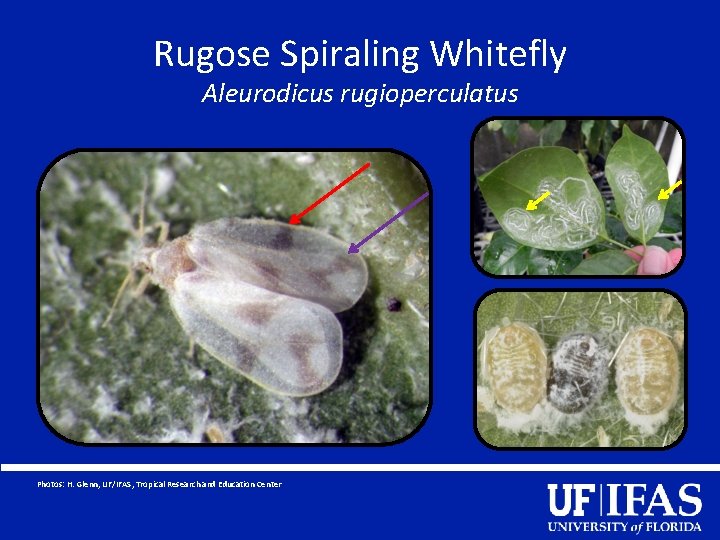
Rugose Spiraling Whitefly Aleurodicus rugioperculatus • Native to Central America • Detected in Florida in 2009 in Miami-Dade County • Has also been referred to as the gumbo limbo spiraling whitefly • Life cycle takes about a month, but is also temperature dependent
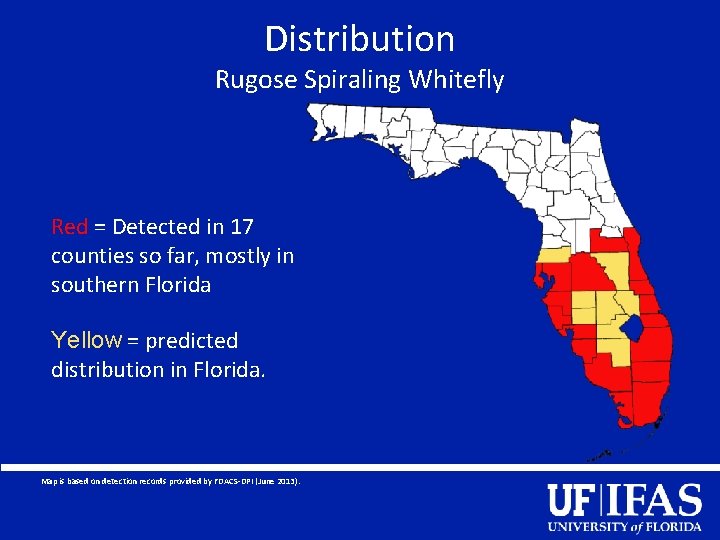
Distribution Rugose Spiraling Whitefly Red = Detected in 17 counties so far, mostly in southern Florida Yellow = predicted distribution in Florida. Map is based on detection records provided by FDACS-DPI (June 2013).
Rugose Spiraling Whitefly Aleurodicus rugioperculatus Eggs Photos: H. Glenn, UF/IFAS, Tropical Research and Education Center
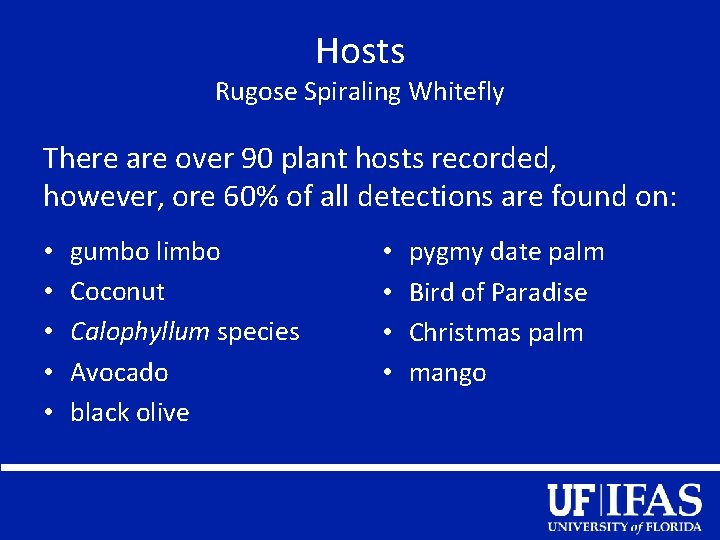
Hosts Rugose Spiraling Whitefly There are over 90 plant hosts recorded, however, ore 60% of all detections are found on: • • • gumbo limbo Coconut Calophyllum species Avocado black olive • • pygmy date palm Bird of Paradise Christmas palm mango
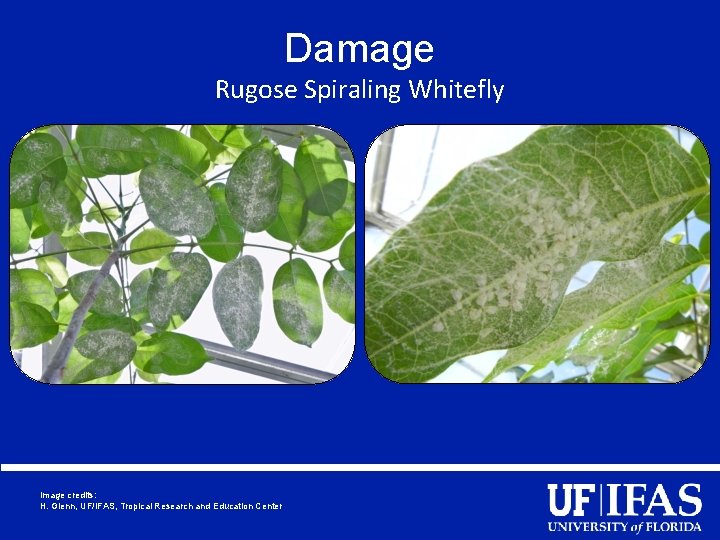
Damage Rugose Spiraling Whitefly Image credits: H. Glenn, UF/IFAS, Tropical Research and Education Center
Monitoring Whiteflies • Scouting - it is very important to “keep an eye” on your plants (especially if an infestation is nearby) • Early detection - allows for the best management decisions – Ficus whitefly – look for the remains of the pupal skin – Rugose spiraling whitefly – look for the spiraling egg patterns – Bondar’s nesting whitefly – look for the waxy nests on the leaves
Removing Honeydew & Sooty Mold • Control pest problem • Wash off as soon as possible – Particularly for cars • Pressure washing • Soaps and oils can potentially remove and reduce build up of sooty mold – Be careful of plant damage • Mold remover products – unknown how effective – Be especially careful about use on plants
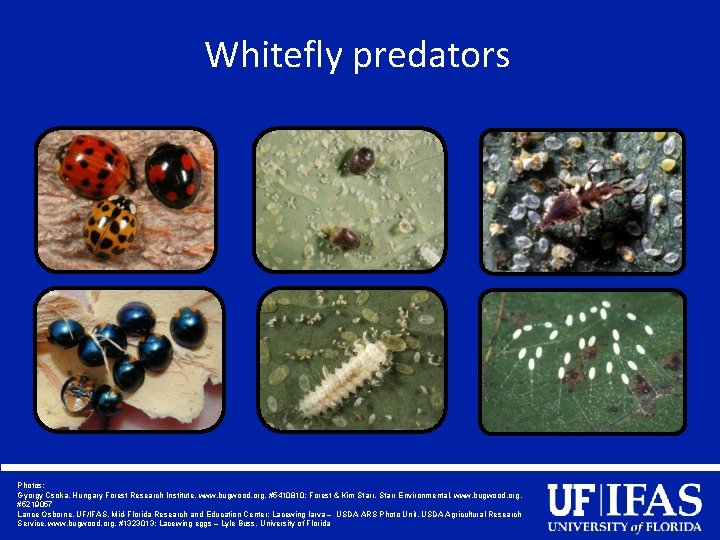
Whitefly Management: Biological Control • What are natural enemies or biocontrol agents? – Important for long term management of pests • Predators versus parasites or parasitoids – Buying and releasing natural enemies
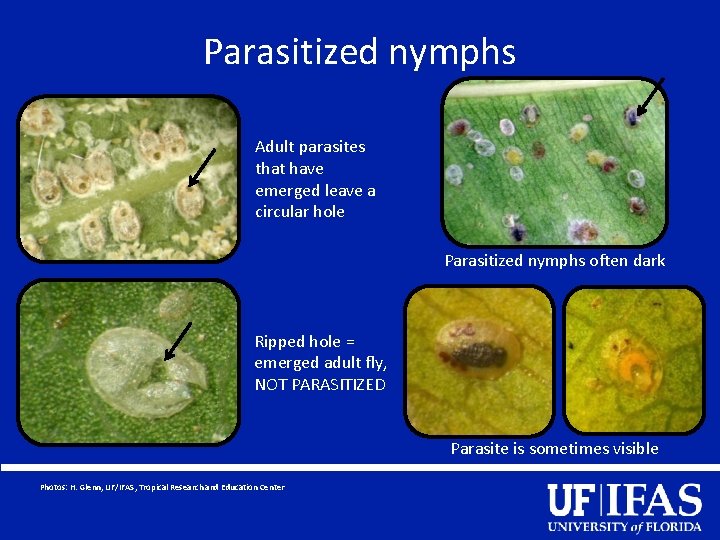
Parasitized nymphs Adult parasites that have emerged leave a circular hole Parasitized nymphs often dark Ripped hole = emerged adult fly, NOT PARASITIZED Parasite is sometimes visible Photos: H. Glenn, UF/IFAS, Tropical Research and Education Center
Whitefly predators Photos: Gyorgy Csoka, Hungary Forest Research Institute, www. bugwood. org, #5410810; Forest & Kim Starr, Starr Environmental, www. bugwood. org, #5219057 Lance Osborne, UF/IFAS, Mid-Florida Research and Education Center; Lacewing larva – USDA ARS Photo Unit, USDA Agricultural Research Service, www. bugwood. org, #1323013; Lacewing eggs – Lyle Buss, University of Florida
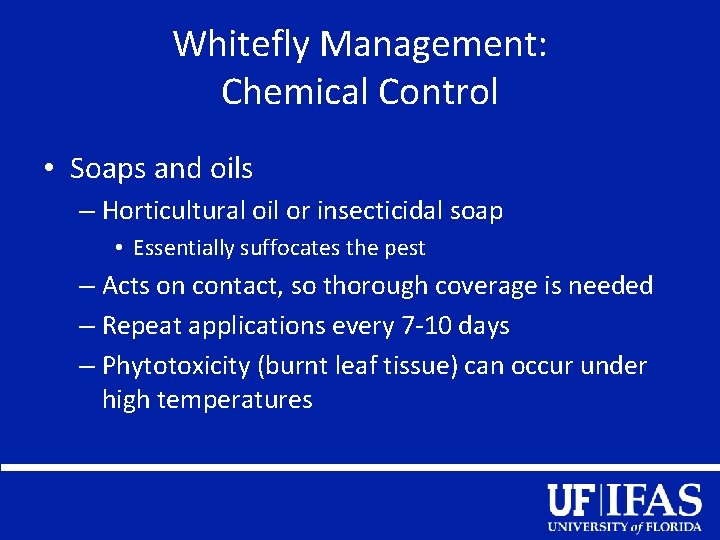
Whitefly Management: Chemical Control • Soaps and oils – Horticultural oil or insecticidal soap • Essentially suffocates the pest – Acts on contact, so thorough coverage is needed – Repeat applications every 7 -10 days – Phytotoxicity (burnt leaf tissue) can occur under high temperatures
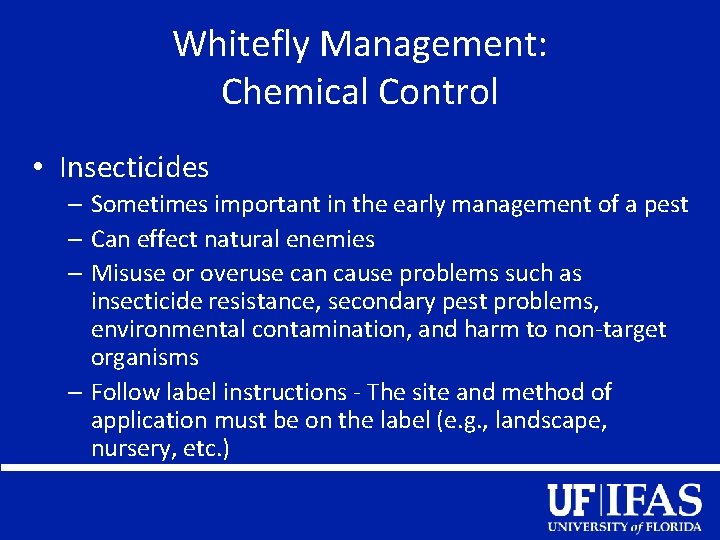
Whitefly Management: Chemical Control • Insecticides – Sometimes important in the early management of a pest – Can effect natural enemies – Misuse or overuse can cause problems such as insecticide resistance, secondary pest problems, environmental contamination, and harm to non-target organisms – Follow label instructions - The site and method of application must be on the label (e. g. , landscape, nursery, etc. )
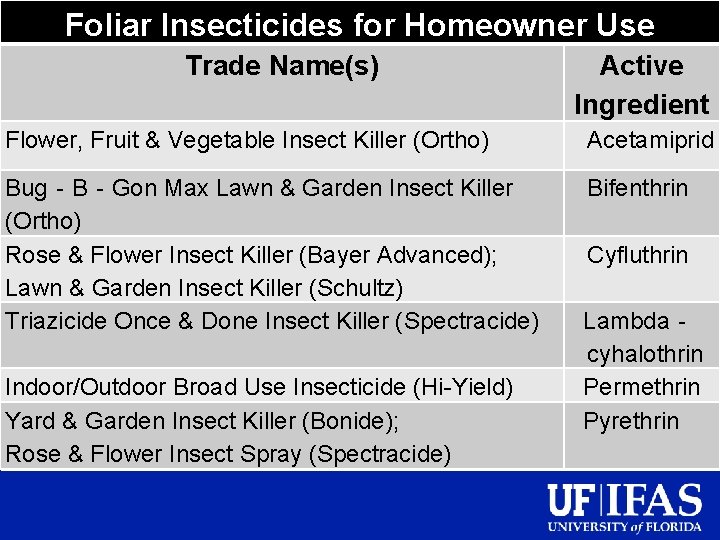
Foliar Insecticides for Homeowner Use Trade Name(s) Active Ingredient Flower, Fruit & Vegetable Insect Killer (Ortho) Acetamiprid Bug‐B‐Gon Max Lawn & Garden Insect Killer (Ortho) Rose & Flower Insect Killer (Bayer Advanced); Lawn & Garden Insect Killer (Schultz) Triazicide Once & Done Insect Killer (Spectracide) Bifenthrin Indoor/Outdoor Broad Use Insecticide (Hi-Yield) Yard & Garden Insect Killer (Bonide); Rose & Flower Insect Spray (Spectracide) Cyfluthrin Lambda‐ cyhalothrin Permethrin Pyrethrin
Conditions that Affect Whitefly Management • Rugose spiraling whitefly and Bondar’s nesting whitefly – Less rain makes the infestations appear worse – Large host range makes them difficult to manage – Excessive wax can affect contact between the insect and the insecticide • Ficus whitefly – Be patient while the leaves comes back and check the health of your ficus often – Try not to prune during recovery
How to Help Whitefly-Damaged Plants to Recover • Proper fertilization and watering – However, over-fertilizing will actually help the pests and lead to run-off issues • Beware: Nothing changes overnight and it sometimes takes time for plant recovery
Whitefly Management: Cultural Control • Use alternative or non-host plants when possible • If moving infested plant material, bag it or cover it! • Be sure not to spread the infestation • Wash plants with water
Content Contributors • Catharine Mannion, Ph. D, UF/IFAS Tropical Research and Education Center Lance Osborne, Ph. D, UF/IFAS Mid Florida Research and Education Center Eileen Buss , Ph. D, Department of Entomology and Nematology, University of Florida John L. Capinera, Ph. D, Department of Entomology and Nematology, University of Florida Jennifer Gillett-Kaufman, Ph. D. , Department of Entomology and Nematology, University of Florida Amanda Hodges, Ph. D, Department of Entomology and Nematology, University of Florida Greg Hodges, Ph. D, Florida Department of Agriculture and Consumer Services, Division of Plant Industry Bill Schall, Commercial Horticultural Extension Agent, Palm Beach County Faculty Ian Stocks, Ph. D, Florida Department of Agriculture and Consumer Services, Division of Plant Industry Stephanie Stocks, MS, Department of Entomology and Nematology, University of Florida • Published: July 2013 • • •
Educational Disclaimer and Citation • This presentation can be used for educational purposes for NON-PROFIT workshops, trainings, etc. • Citation: • Mannion, C. , L. Osborne, E. Buss, J. L. Capinera, J. Gillett-Kaufman, A. Hodges, G. Hodges, B. Schall, I. Stocks, and S. Stocks. 2013. Invasive Whitefly Pests of Florida. accessed (add the date), www. flwhitefly. org.
Partnering Agencies • Florida Department of Agriculture and Consumer Services, Division of Plant Industry • University of Florida, Department of Entomology and Nematology • Pest Management University • IPM Florida • IFAS Extension – Broward County • IFAS Extension – Lee County • IFAS Extension – Miami-Dade County • IFAS Extension – Palm Beach County • Southern Plant Diagnostic Network
References • Bohmfalk, G. T. , R. E. Frisbie, W. L. Sterling, R. B. Metzer, and A. E. Knutson. 2011. Identification, biology, and sampling of cotton insects. Texas Agri. Life Extension. accessed 3/19/2012 – – http: //www. soilcropandmore. info/crops/Cotton. Information/insect/B-933/b-933. htm • Borrer, D. J. and R. E. White. 1970. Peterson Field Guide to Insects. Houghton Mifflin Co. , New York. • Borrer, D. J. , C. A. Triplehorn, N. F. Johnson. 1989. An Introduction to Insects. Sixth Edition. Saunders College Publishing. New York. • Buss, E. A. and S. G. Park-Brown. 2009. Natural products for insect pest management. EDIS. accessed 3/23/2012 – – http: //edis. ifas. ufl. edu/in 197 • CABI. 2012. Bemisia tabaci. Invasive Species Compendium (beta). accessed 2/27/2012 – – http: //www. cabi. org/isc/? compid=5&dsid=8927&loadmodule=datasheet&page=481&si te=144
References • CABI. 2012. Dialeurodes citri (citrus whitefly). Invasive Species Compendium (beta). accessed 2/28/2012 – – http: //www. cabi. org/isc/? compid=5&dsid=18698&loadmodule=datasheet&page=481& site=144 • CABI. 2012. Paraleyrodes bondari. Invasive Species Compendium (beta). accessed 2/25/2012 – – http: //www. cabi. org/isc/? compid=5&dsid=116127&loadmodule=datasheet&page=481 &site=144 • CSIRO. 2001. Encarsia protransvena Viggiani. Encarsia of Australia Online. accessed 2/26/2012 – – http: //www. ces. csiro. au/science/encarsia/pro_ss. htm • De. Bach, P. and D. Rosen. 1991. Biological Control by Natural Enemies. Cambridge University Press.
References • Drost, Y. C. , Y. T. Qiu, C. J. A. M. Posthuma-Doodeman and J. C. van Lenteren. 1999. “Life-history and oviposition behaviour of Amitus bennetti, a parasitoid of Bemisia argentifolii”. Entomologia Experimentalis et Applicata, volume 90, pp. 183 -189. • EPPO Global Database. accessed 2/25/2012 – – http: //gd 2. eppo. org/organism. php/ALEDDU/distribution • Evans, G. A. 2008. The Whiteflies (Hemiptera: Aleyrodidae) of the World and Their Host Plants and Natural Enemies. USDA-APHIS. accessed 2/26/2012 – – http: //www. sel. barc. usda. gov: 8080/1 WF/World-Whitefly-Catalog. pdf • Fasulo, T. R. and H. V. Weems. 2010. Citrus whitefly. UF Featured Creatures. accessed 2/28/2012 – – http: //entnemdept. ufl. edu/creatures/citrus_whitefly. htm
References • Global Invasive Species Database. Harmonia axyridis. accessed 2/26/2012 – http: //www. issg. org/database/species/ecology. asp? fr=1&si=668 • Gordon, R. D. 1985. “The Coccinellidae (Coleoptera) of America North of Mexico”. Journal of the New York Entomological Society, vol. 93, no. 1, pp. 1 -912. • Henn, T. , R. Weinzierl and P. G. Koehler. 2009. Beneficial insects and mites. EDIS. Accessed 3/23/2012 – – http: //edis. ifas. ufl. edu/in 078 • Hodges, G. 1996. Bemisia tabaci (Gennadius) (biotype ‘Q’): A potential new biotype for Florida’s vegetable and ornamental crops. (Hemiptera: Aleyrodidae). FDCAS-DPI pest Alert. accessed 2/27/2012 – – http: //www. freshfromflorida. com/pi/pest-alerts/bemisia-tabaci. html
References • Hodges, G. S. 1997. Giant whitefly, Aleurodicus dugesii Cockerell, in Florida. FDACS-DPI Pest Alert. accessed 2/25/2012 – – http: //www. freshfromflorida. com/pi/pest-alerts/aleurodicus-dugesii. html • Hodges. G. S. and G. A. Evans. 2005. “An identification guide to the whiteflies (Hemiptera: Aleyrodidae) of the southeastern United States”. Florida Entomologist, Volume 88, issue 4, pp. 518 -534. • Hodges, G. S. 2007. The fig whitefly Singhiella simplex (Singh) (Hemiptera: Aleyrodidae): a new exotic whitefly found on ficus species in South Florida. FDACS-DPI Pest Alert. accessed 2/25/2012– http: //www. freshfromflorida. com/pi/pest-alerts/singhiella-simplex. html • IPM Florida, Solutions for your Life. Natural enemies. accessed 3/23/2012 – – http: //ipm. ifas. ufl. edu/resources/grants_showcase/people_and_communities/natenem y. shtml
References • Legaspi, J. C. , C. Mannion, D. Amalin, and B. C. Legaspi, Jr. 2011. “Life table analysis and development of Singhiella simplex (Hemiptera: Aleyrodidae) under different constant temperatures”. Annals of the Entomological Society of America, vol. 104, issue 3, pp. 451 -458. • Leppla, N. C. and K. L. Johnson. 2011. Guidelines for purchasing and using commercial natural enemies and biopesticide in Florida and other states. EDIS. accessed 3/23/2012 – – http: //edis. ifas. ufl. edu/in 849 • Liu, T. -X. , and P. A. Stansly. 1996. “Morphology of Nephaspis oculatus and Delphastus pusillus (Coleoptera: Coccinellidae), predators of Bemisia argentifolii (Homoptera: Aleyrodidae)”. Proc. Entomol. Soc. Wash. vol. 98: pp. 292 -300.
References • Liu, Tong-Xian, Philip A. Stansly, Kim A. Hoelmer, and Lance Osborne. 1997. “Life history of Nephaspis oculatus (Coleoptera: Coccinellidae) a predator of Bemisia argentifolii (Homoptera: Aleyrodidae)”. Ann. Entomol. Soc. Am. 90(6): 776 -781. • Mac. Leod, E. G. and L. A. Stange. 2011. Brown lacewings of Florida (Insecta: Neuroptera: Hemerobiidae). EDIS. Accessed 3/23/2012 – – http: //edis. ifas. ufl. edu/in 382 • Mannion, C. 2010. Ficus whitefly – management in the landscape. Accessed 3/8/2012 – – http: //trec. ifas. ufl. edu/mannion/pdfs/Ficus%20 Whitefly%20(Feb 2010)%20 Fact%20 Shee t. pdf • Martin, J. H. 1996. “Neotropical whiteflies of the subfamily Aleurodicinae established in the western Palearctic (Homoptera: Aleyrodidae)”. Journal of Natural History 30: 1849– 1859.
References • Mayer, H. , J. Mc. Laughlin, A. Hunsberger, L. Vasquez, T. Olcyzk and C. Mannion. 2010. Common questions about the gumbo limbo spiraling whitefly (Aleurodicus rugioperculatus). accessed 2/26/2012 – – http: //monroe. ifas. ufl. edu/pdf/Hort/Gumbo. Limbo. Spiraling. Whitefly. Questions. pdf • Mc. Auslane, H. 2009. Sweetpotato whitefly Bemisia tabaci. UF Featured Creatures. accessed 2/28/2012 – – http: //entnemdept. ufl. edu/creatures/veg/leaf/silverleaf_whitefly. htm • National Bureau of Agriculturally Important Insects (NBAII). Encarsia guadeloupae Viggiani. accessed 3/23/2012 – – http: //www. nbaii. res. in/Featured%20 insects/encarsia_guadeloupae. htm • National Bureau of Agriculturally Important Insects (NBAII). Chilocorus nigrita (Fabricius). Accessed 3/23/2012 – – http: //www. nbaii. res. in/Featured%20 insects/Chilocorus. htm
References • National Bureau of Agriculturally Important Insects (NBAII). Curinus coeruleus (Mulsant). Accessed 3/23/2012 – – http: //www. nbaii. res. in/Featured%20 insects/Curinus_coeruleus. htm • Natwick, E. T. and F. F. Laemmlen. 1993. “Protection from phytophagous insects and virus vectors in honeydew melons using row covers”. Florida Entomologist, vol. 76, no. 1, pp. 120 -126. accessed 4/2/2012– http: //www. jstor. org/stable/3496020? seq=1 • Nguyen, R. and A. B. Hamon. Bureau of methods development & biological control - biological control of giant whitefly, Aleurodicus dugesii Cockerell, in Florida. accessed 2/25/2012 – – http: //www. freshfromflorida. com/pi/methods/giant-whitefly-bc. html • Scherer, C. W. , P. G. Koehler, D. E. Short and E. A. Buss. 2006. Landscape integrated pest management. EDIS. Accessed 3/22. 2012 – – http: //edis. ifas. ufl. edu/in 109
References • Stocks, I. C. 2012. The Rugose Spiraling Whitefly, Aleurodicus rugioperculatus Martin, a New Exotic Whitefly in South Florida (Hemiptera: Aleyrodidae). FDACS-DPI Pest Alert. accessed 2/25/2012 – – http: //www. freshfromflorida. com/pi/pest-alerts/pdf/aleurodicus-rugioperculatus-pestalert. pdf • Stocks, I. C. 2012. Bondar’s Nesting Whitefly, Paraleyrodes bondari, a Whitefly (Hemiptera: Aleyrodidae) New to Florida Attacking Ficus and Other Hosts. FDACS-DPI Pest Alert. accessed 2/25/2012– http: //www. freshfromflorida. com/pi/pest-alerts/pdf/paraleyrodes-bondari. pdf • Viggiani, G. 1985. “ Notes on a few Aphelinidae, with description of five new species of Encarsia Foerster (Hymenoptera, Chalcidoidea)”. Bollettino del Laboratorio di Entomologia Agraria Filippo Silvestri, Volume 42, pp. 81 -94. accessed 2/26/2012 – – http: //www. nhm. ac. uk/resources/researchcuration/projects/chalcidoids/pdf_X/Viggia 985 d. pdf
References • Viggiani, G. and G. A. Evans. 1992. “Descriptions of three new species of Amitus Haldeman (Hymenoptera: Platygasteridae), parasitoids of known whiteflies from the New World”. Bollettino del Laboratorio di Entomologia Agraria Filippo Silvestri, vol. 49, pp. 189 -194. • http: //www. usautoparts. net/bmw/repairs/detailing/tree_sap. htm