
Invasive Species Lesson The Taro Beetle What are
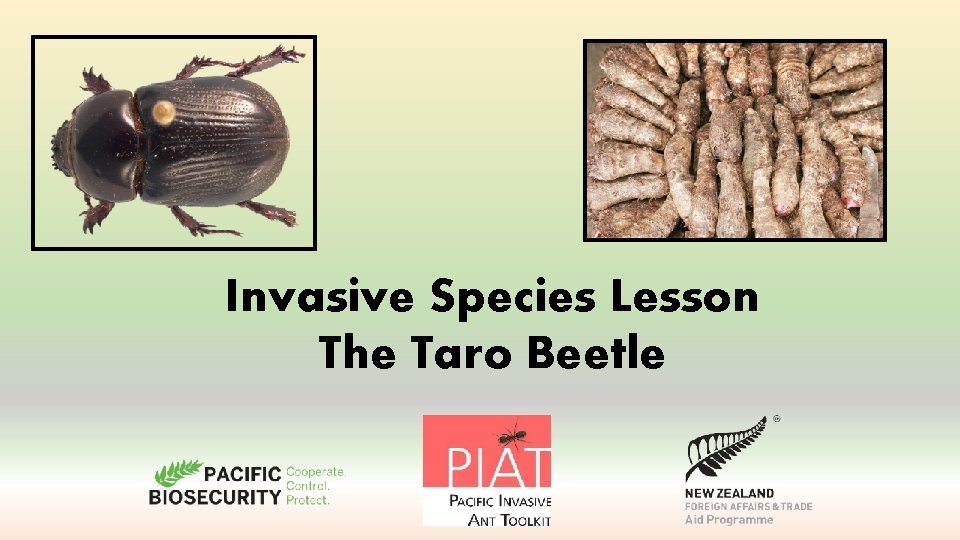
Invasive Species Lesson The Taro Beetle
What are we going to learn today? 1) What are taro beetles. 2) The problems they cause to our people, our agriculture and our natural environment. 3) Where the beetles came from and how they arrived in our country. 4) What can you do to stop them.
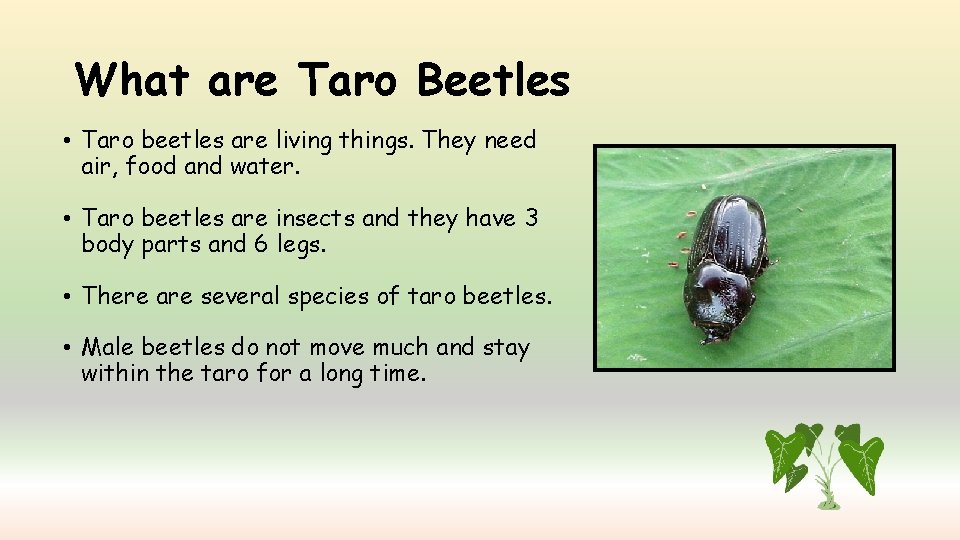
What are Taro Beetles • Taro beetles are living things. They need air, food and water. • Taro beetles are insects and they have 3 body parts and 6 legs. • There are several species of taro beetles. • Male beetles do not move much and stay within the taro for a long time.

Taro Beetle life cycle Taro beetles go through a four-different stages from egg to adult. They have a 4 stage lifecycle just like the butterfly! The entre life-cycle takes about 4 -5 months. Each female lays up to 300 eggs during a lifespan of about 20 months!
Where did the Taro Beetles come from? The origins of the taro beetle in the pacific islands is the island of New Guinea where 14 species occur. There are 2 species in Philippines, 1 in the Moluccas, 1 in northern Australia, 4 in the Solomon Islands, and 2 in Vanuatu. For example, Kiribati and Fiji both have one species each which became established in 1934 and 1984.
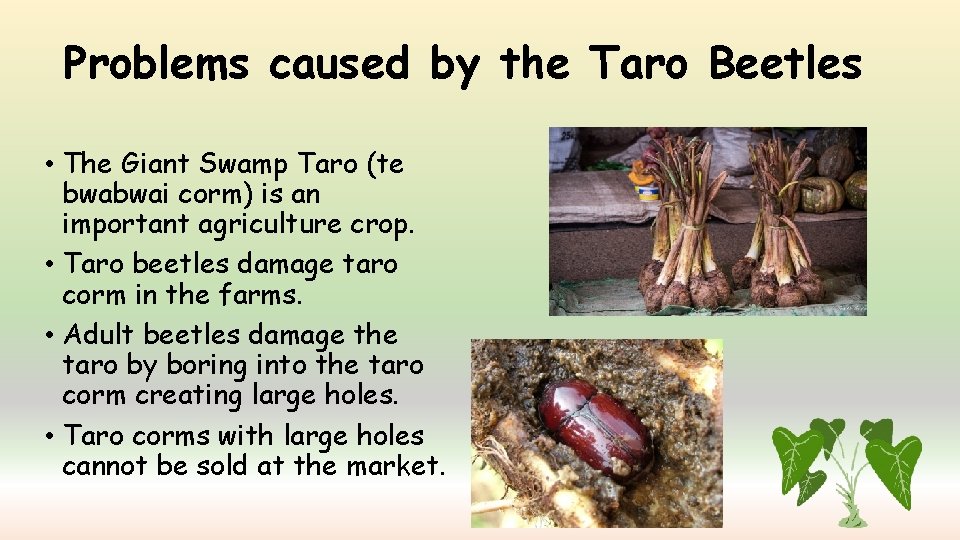
Problems caused by the Taro Beetles • The Giant Swamp Taro (te bwabwai corm) is an important agriculture crop. • Taro beetles damage taro corm in the farms. • Adult beetles damage the taro by boring into the taro corm creating large holes. • Taro corms with large holes cannot be sold at the market.

Problems caused by the Taro Beetles • The damage can be so bad that they can’t even be eaten by the farmers who grow them.
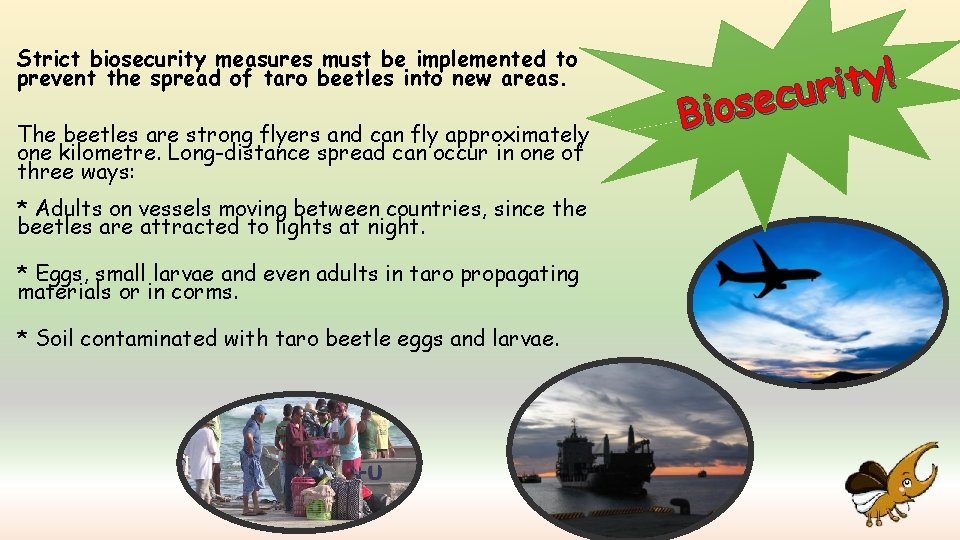
Strict biosecurity measures must be implemented to prevent the spread of taro beetles into new areas. The beetles are strong flyers and can fly approximately one kilometre. Long-distance spread can occur in one of three ways: * Adults on vessels moving between countries, since the beetles are attracted to lights at night. * Eggs, small larvae and even adults in taro propagating materials or in corms. * Soil contaminated with taro beetle eggs and larvae. ! y t i r u c e Bios

2 effective methods to control the taro beetles • Cultural Methods: Cultural control measures include—crop rotation, clean planting material (i. e. free from soil) and destruction of breeding sites near farms. • Chemical Methods: Spraying of taro plants with two insecticides, Imidacloprid and Bifenthrin, used in combination or separately has been found to effectively control the beetle and reduce damage to taro plants. Make c proble ommunitie s Comm ms taro be aware of t e unity h memb tles can ca e use. lookou ers can b e t for them. on the
Activity Time! We are going to have a group discussion!
Shape-it Discussion • Students will be grouped into groups of 4. • Each student will select a shape from the square and write their name on it. • The student will ask the question next to their selected shape and lead the discussion. • Students can record their discussion on the shapes.
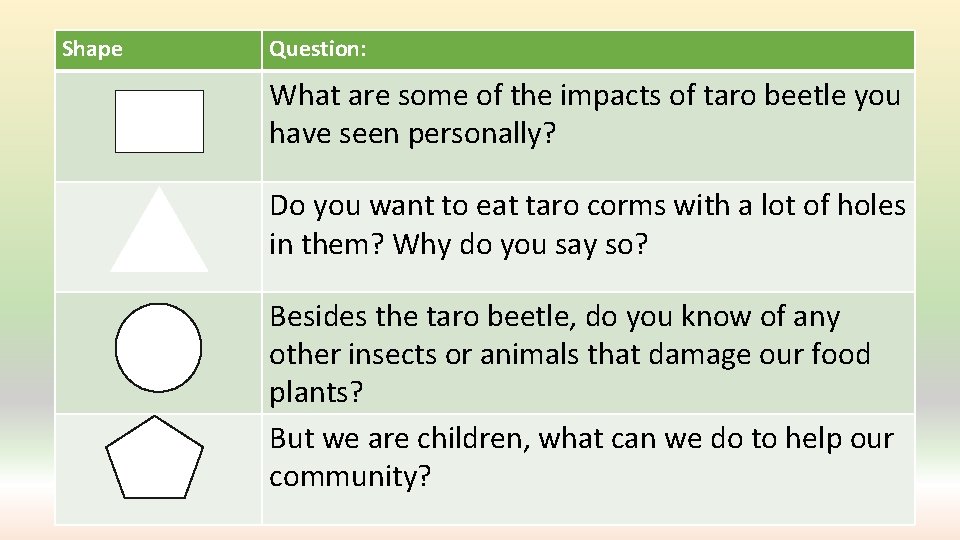
Shape Question: What are some of the impacts of taro beetle you have seen personally? Do you want to eat taro corms with a lot of holes in them? Why do you say so? Besides the taro beetle, do you know of any other insects or animals that damage our food plants? But we are children, what can we do to help our community?
Activity Time! Shape-it Discussion Tool
What we have learnt today • Taro beetles are insects. They have 3 body parts and 6 legs. • The taro beetle has a 4 -stage life cycle. • The adult taro beetle damages taro corms by boring holes in them. • The taro corms that are damaged cannot be sold or eaten. • We can help control the spread of taro beetles into areas that do not have them yet.

See you next time!
References • Aloali’i, I. , Masamdu, R. , Theunis, W. and Thistleton, B. M. , 1993. Prospects for the biological control of taro beetles, Papuana spp. (Coleoptera: Scarabaeidae) in the South Pacific. In: Proceedings of the Sustainable Taro Culture for the Pacific Conference, September 24– 25 1992. Hawaii Institute of Tropical Agriculture and Human Resources Research Extension Series 140, University of Hawaii, 66– 67. • Lal Sada N. 2008. Taro Beetle Management in Papua New Guinea and Fiji: Final Project Report. SPC. • FAO Report on Root Crop – Module 4 • Fiji Leaflet: http: //www. agriculture. gov. fj/images/docs/publications/farmersleaflets/prevention-and-control-of-dalo-beetle. pdf • Pacific Pests and Pathogens - Fact Sheets: Taro Beetle (2017)

Image Credits Slide 1: Adult Taro Beetle image courtesy of Pest and Diseases Image Library, Bugwood. org, ( Free for use under the Creative Commons Attribution 3. 0 Australia License), Taro image courtesy of David Castillo Dominici at Free. Digital. Photos. net Slide 2: Image courtesy of AKARAKINGDOMS at Free. Digital. Photos. net retrieved from http: //www. freedigitalphotos. net/images/downloadfree. php? id=175018&key=22319618 Slide 3: Taro Plant Cartoon courtesy of vectorolie at Free. Digital. Photos. net, Photo of adult Taro beetle courtesy of Mr Roy Masamdu. Used with permission of Grahame Jackson of ediblearoids. org, http: //www. ediblearoids. org/Portals/0/Taro. Pest/Lucid. Key/Taro. Pest/Media/Html/Arthropods/Taro. Beetles 6. htm Slide 4: Taro Plant Cartoon courtesy of vectorolie at Free. Digital. Photos. net, Photo of taro beetle lifecycle courtesy of Mr Roy Masamdu. Used with permission of Grahame Jackson of ediblearoids. org, http: //www. ediblearoids. org/Portals/0/Taro. Pest/Lucid. Key/Taro. Pest/Media/Html/Arthropods/Taro. Beetles 6. htm Slide 5: Beetle Images courtesy of AKARAKINGDOMS at Free. Digital. Photos. net, Slide 6: Photo of Taro Corms at the market © Ted Mc. Grath Non. Commercial-Share. Alike 2. 0 Generic (CC BY-NC-SA 2. 0) - https: //www. flickr. com/photos/time-to-look/26904458284/in/photostream/, Taro Plant Cartoon courtesy of vectorolie at Free. Digital. Photos. net, Photo of boring taro beetle courtesy of Amanda Mararuai. Used with permission of Grahame Jackson of ediblearoids. org, http: //www. ediblearoids. org/Portals/0/Taro. Pest/Lucid. Key/Taro. Pest/Media/Html/Arthropods/Taro. Beetles 6. htm Slide 7: Photos of damage tubuers courtesy of Sarlesh Kumar. Used with permission of Grahame Jackson of ediblearoids. org, http: //www. ediblearoids. org/Portals/0/Taro. Pest/Lucid. Key/Taro. Pest/Media/Html/Arthropods/Taro. Beetles 6. htm Slide 8: Photos of ship and harbour © Allan Burne – Pacific Biosecurity, Image of plane courtesy of satit_srihin at Free. Digital. Photos. net, Beetle Image courtesy of AKARAKINGDOMS at Free. Digital. Photos. net Slide 9: Image of villagers © Kirsti Abbott Slide 10: Beetle Images courtesy of AKARAKINGDOMS at Free. Digital. Photos. net, Taro Plant Cartoon courtesy of vectorolie at Free. Digital. Photos. net Slide 11: Beetle Images courtesy of AKARAKINGDOMS at Free. Digital. Photos. net, Slide 13: Beetle Images courtesy of AKARAKINGDOMS at Free. Digital. Photos. net, Taro Plant Cartoon courtesy of vectorolie at Free. Digital. Photos. net Slide 15: Image courtesy of arztsamui at Free. Digital. Photos. net
- Slides: 17