
Invariance Principles in Theoretical Computer Science Ryan O
![Learning Theory Thm: [O-Servedio’ 08] Can learn LTFs f in poly(n) time, just from](https://slidetodoc.com/presentation_image_h2/8513894dceb063af21b33b655080dfc8/image-6.jpg "Learning Theory Thm: [O-Servedio’ 08] Can learn LTFs f in poly(n) time, just from")
![Property Testing [Matulef-O-Rubinfeld-Servedio’ 09] Thm: Can test if is ϵ-close to an LTF with](https://slidetodoc.com/presentation_image_h2/8513894dceb063af21b33b655080dfc8/image-7.jpg "Property Testing [Matulef-O-Rubinfeld-Servedio’ 09] Thm: Can test if is ϵ-close to an LTF with")
![Derandomization Thm: [Meka-Zuckerman’ 10] PRG for LTFs with seed length O(log(n) log(1/ϵ)). Key: even](https://slidetodoc.com/presentation_image_h2/8513894dceb063af21b33b655080dfc8/image-8.jpg "Derandomization Thm: [Meka-Zuckerman’ 10] PRG for LTFs with seed length O(log(n) log(1/ϵ)). Key: even")

![Derandomization+ [Gopalan-O-Wu-Zuckerman’ 10] Thm: PRG for “functions of O(1) LTFs” with seed length O(log(n)](https://slidetodoc.com/presentation_image_h2/8513894dceb063af21b33b655080dfc8/image-10.jpg "Derandomization+ [Gopalan-O-Wu-Zuckerman’ 10] Thm: PRG for “functions of O(1) LTFs” with seed length O(log(n)")
![Property Testing+ [Blais-O’ 10] Thm: Testing if is a Majority of k bits needs](https://slidetodoc.com/presentation_image_h2/8513894dceb063af21b33b655080dfc8/image-11.jpg "Property Testing+ [Blais-O’ 10] Thm: Testing if is a Majority of k bits needs")
![Social Choice, Inapproximability [Mossel-O-Oleszkiewicz’ 05] Thm: a) Among voting schemes where no voter has](https://slidetodoc.com/presentation_image_h2/8513894dceb063af21b33b655080dfc8/image-12.jpg "Social Choice, Inapproximability [Mossel-O-Oleszkiewicz’ 05] Thm: a) Among voting schemes where no voter has")
![Niceness of random variables Say E[X] = 0, stddev[X] = σ. def: (≥ σ).](https://slidetodoc.com/presentation_image_h2/8513894dceb063af21b33b655080dfc8/image-17.jpg "Niceness of random variables Say E[X] = 0, stddev[X] = σ. def: (≥ σ).")
![Niceness of random variables Say E[X] = 0, stddev[X] = σ. def: (≥ σ).](https://slidetodoc.com/presentation_image_h2/8513894dceb063af21b33b655080dfc8/image-18.jpg "Niceness of random variables Say E[X] = 0, stddev[X] = σ. def: (≥ σ).")

- Slides: 41
Invariance Principles in Theoretical Computer Science Ryan O ’Donnell Carnegie Mellon University
Talk Outline 1. Describe some TCS results requiring variants of the Central Limit Theorem. 2. Show a flexible proof of the CLT with error bounds. 3. Open problems and an advertisement.
Talk Outline 1. Describe some TCS results requiring variants of the Central Limit Theorem. 2. Show a flexible proof of the CLT with error bounds. 3. Open problems and an advertisement.
Linear Threshold Functions
Linear Threshold Functions
Learning Theory Thm: [O-Servedio’ 08] Can learn LTFs f in poly(n) time, just from correlations E[f(x)xi]. Key: when all |ci| ≤ ϵ.
Property Testing [Matulef-O-Rubinfeld-Servedio’ 09] Thm: Can test if is ϵ-close to an LTF with poly(1/ϵ) queries. Key: when all |ci| ≤ ϵ.
Derandomization Thm: [Meka-Zuckerman’ 10] PRG for LTFs with seed length O(log(n) log(1/ϵ)). Key: even when xi’s not fully independent.
Multidimensional CLT? For when all small compared to
Derandomization+ [Gopalan-O-Wu-Zuckerman’ 10] Thm: PRG for “functions of O(1) LTFs” with seed length O(log(n) log(1/ϵ)). Key: Derandomized multidimensional CLT.
Property Testing+ [Blais-O’ 10] Thm: Testing if is a Majority of k bits needs kΩ(1) queries. Key: assuming E[Xi] = E[Yi], Var[Xi] = Var[Yi], and some other conditions. (actually, a multidimensional version)
Social Choice, Inapproximability [Mossel-O-Oleszkiewicz’ 05] Thm: a) Among voting schemes where no voter has unduly large influence, Majority is most robust to noise. b) Max-Cut is UG-hard to. 878 -approx. Key: If P is a low-deg. multilin. polynomial, assuming P has “small coeffs. on each coord. ”
Talk Outline 1. Describe some TCS results requiring variants of the Central Limit Theorem. 2. Show a flexible proof of the CLT with error bounds. 3. Open problems and an advertisement.
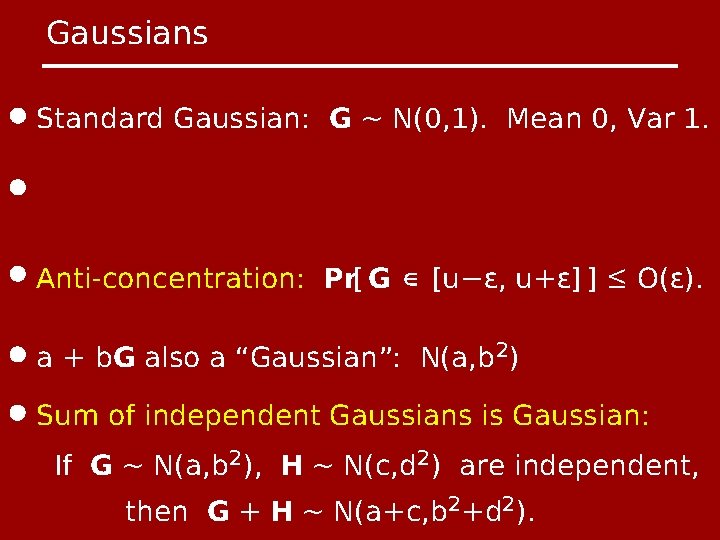
Gaussians Standard Gaussian: G ~ N(0, 1). Mean 0, Var 1. Anti-concentration: Pr[ G ∈ [u−ϵ, u+ϵ] ] ≤ O(ϵ). a + b. G also a “Gaussian”: N(a, b 2) Sum of independent Gaussians is Gaussian: If G ~ N(a, b 2), H ~ N(c, d 2) are independent, then G + H ~ N(a+c, b 2+d 2).
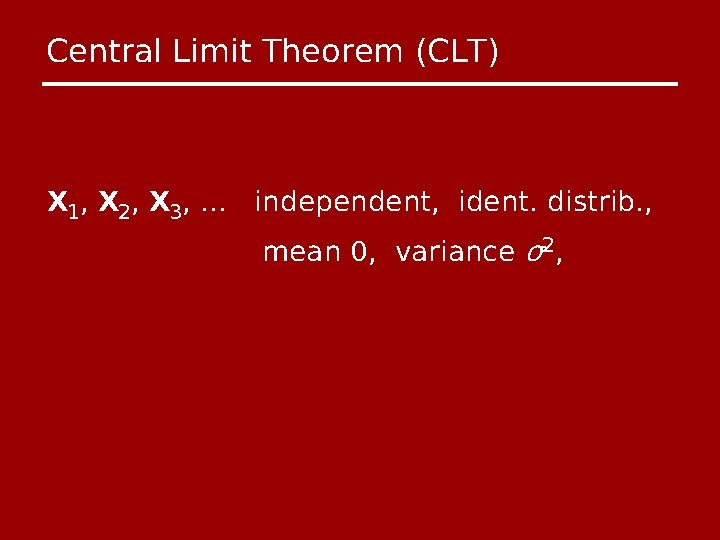
Central Limit Theorem (CLT) X 1, X 2, X 3, … independent, ident. distrib. , mean 0, variance σ2,
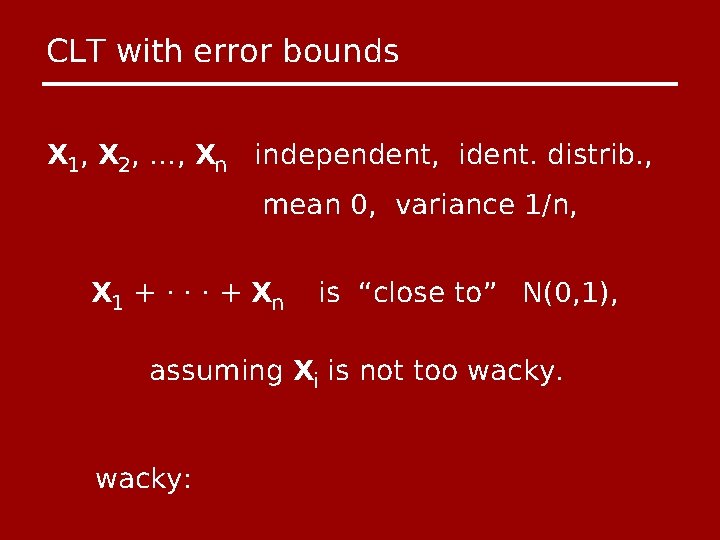
CLT with error bounds X 1, X 2, …, Xn independent, ident. distrib. , mean 0, variance 1/n, X 1 + · · · + Xn is “close to” N(0, 1), assuming Xi is not too wacky:
Niceness of random variables Say E[X] = 0, stddev[X] = σ. def: (≥ σ). “def”: X is “nice” if eg: not nice: ± 1. N(0, 1). Unif on [-a, a].
Niceness of random variables Say E[X] = 0, stddev[X] = σ. def: (≥ σ). def: eg: not nice: X is “C-nice” if ± 1. N(0, 1). Unif on [-a, a].
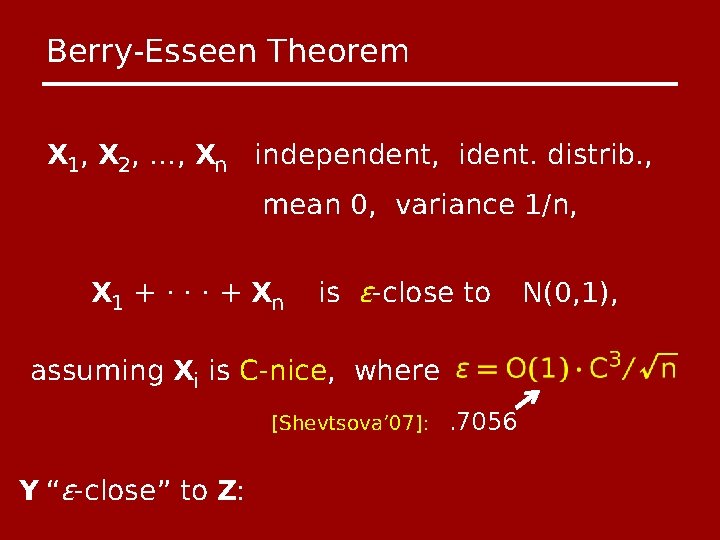
Berry-Esseen Theorem X 1, X 2, …, Xn independent, ident. distrib. , mean 0, variance 1/n, X 1 + · · · + Xn is ϵ-close to assuming Xi is C-nice, where [Shevtsova’ 07]: Y “ϵ-close” to Z: . 7056 N(0, 1),
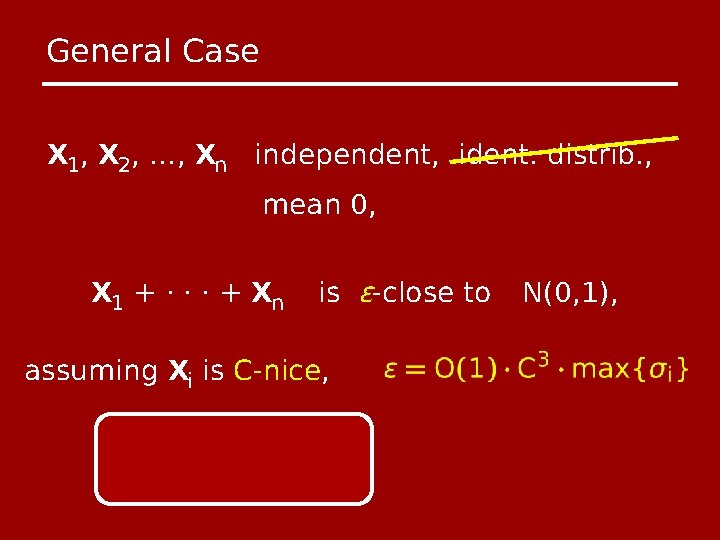
General Case X 1, X 2, …, Xn independent, ident. distrib. , mean 0, X 1 + · · · + Xn is ϵ-close to assuming Xi is C-nice, N(0, 1),
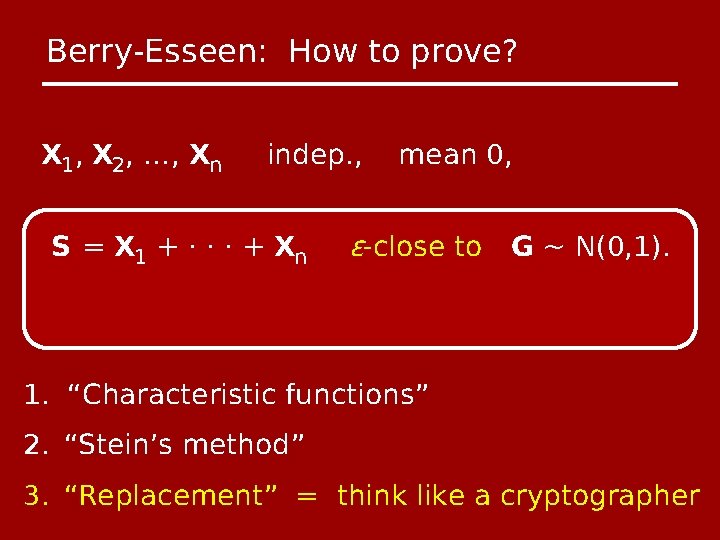
Berry-Esseen: How to prove? X 1, X 2, …, Xn indep. , S = X 1 + · · · + Xn mean 0, ϵ-close to G ~ N(0, 1). 1. “Characteristic functions” 2. “Stein’s method” 3. “Replacement” = think like a cryptographer
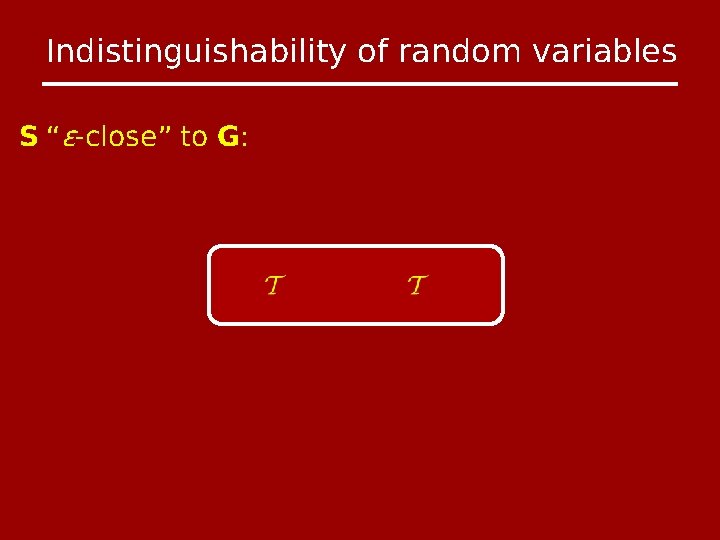
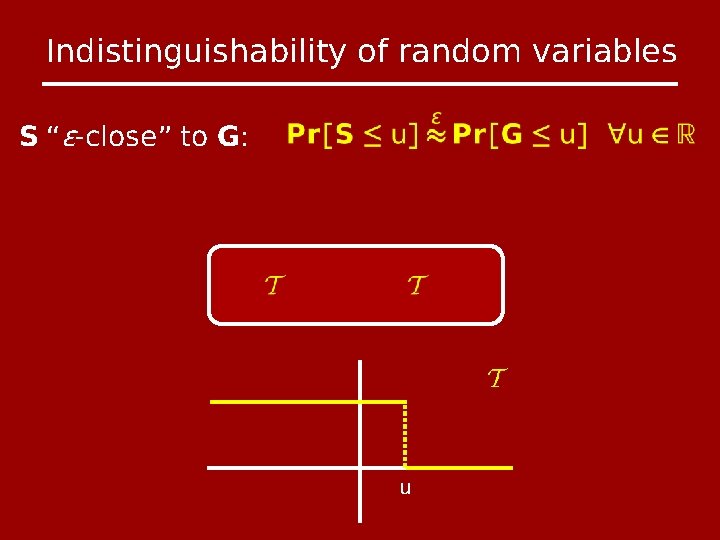
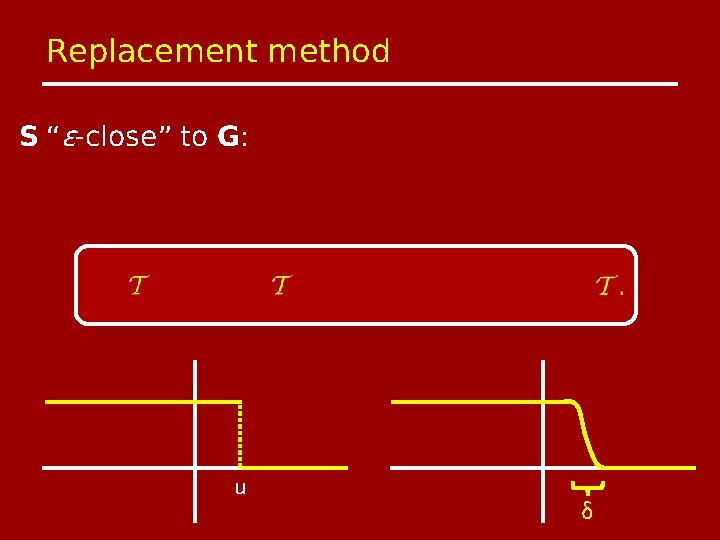
Indistinguishability of random variables S “ϵ-close” to G:
Indistinguishability of random variables S “ϵ-close” to G: u
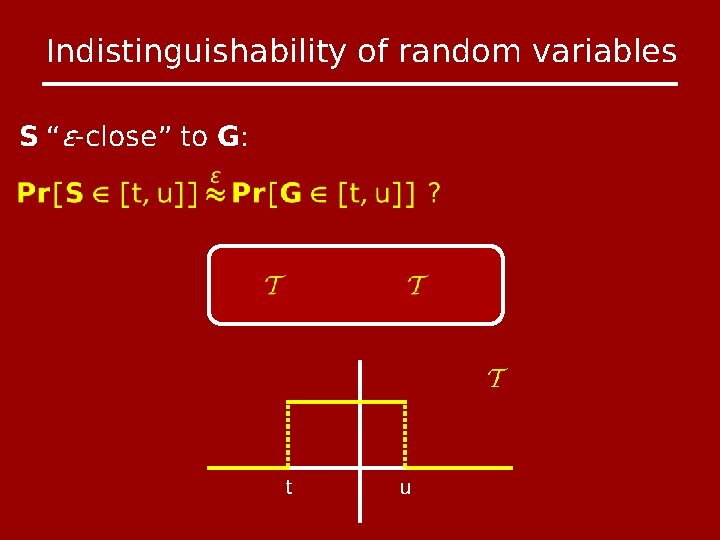
Indistinguishability of random variables S “ϵ-close” to G: t u
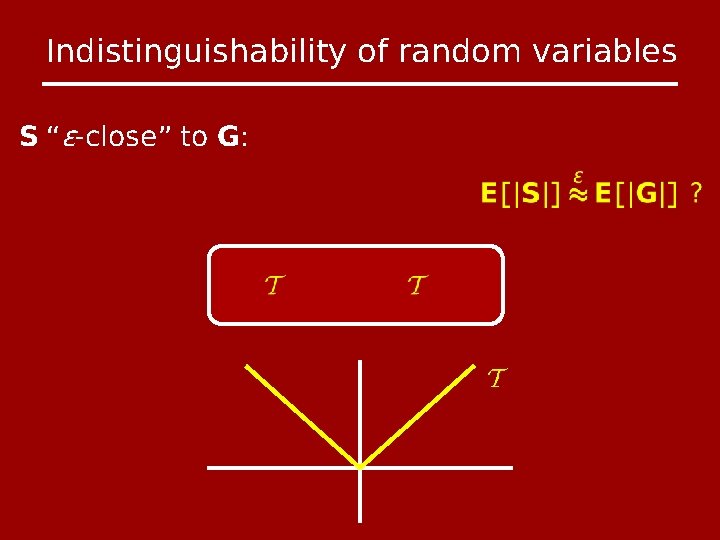
Indistinguishability of random variables S “ϵ-close” to G:
Replacement method S “ϵ-close” to G: u δ
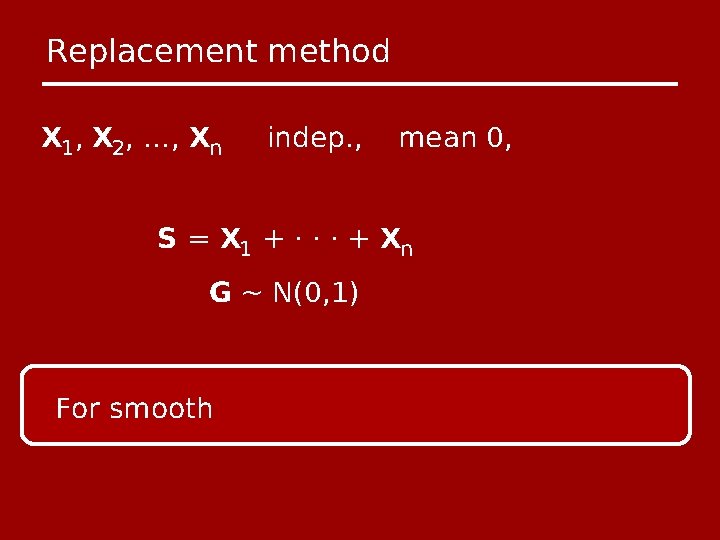
Replacement method X 1, X 2, …, Xn indep. , mean 0, S = X 1 + · · · + Xn G ~ N(0, 1) For smooth
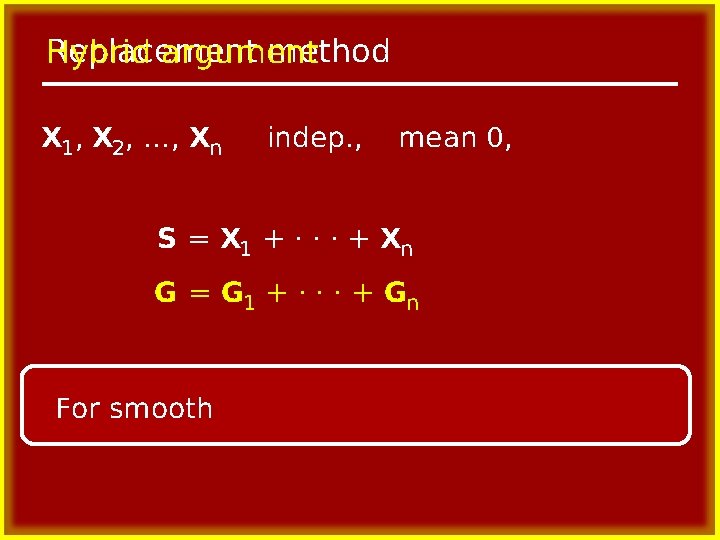
Replacement method Hybrid argument X 1, X 2, …, Xn indep. , mean 0, S = X 1 + · · · + Xn G = G 1 + · · · + Gn For smooth
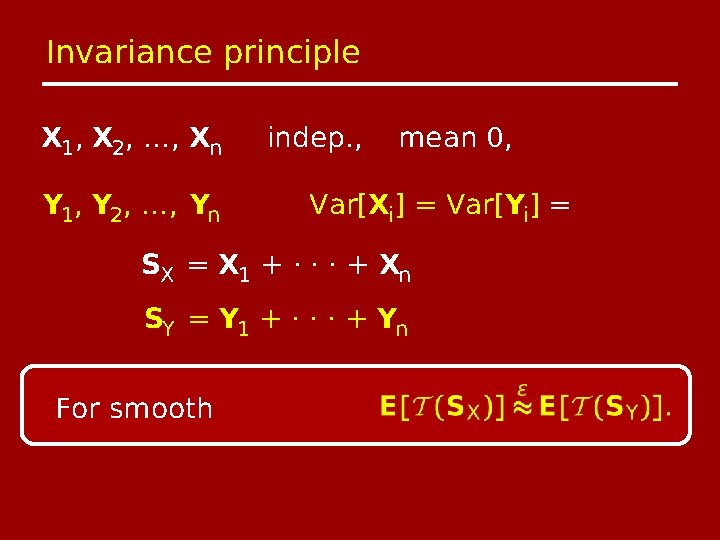
Invariance principle X 1, X 2, …, Xn Y 1, Y 2, …, Yn indep. , mean 0, Var[Xi] = Var[Yi] = SX = X 1 + · · · + Xn SY = Y 1 + · · · + Yn For smooth
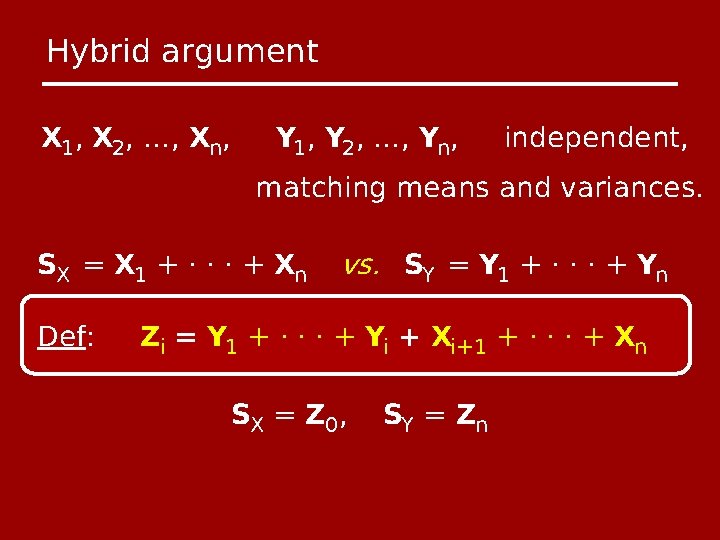
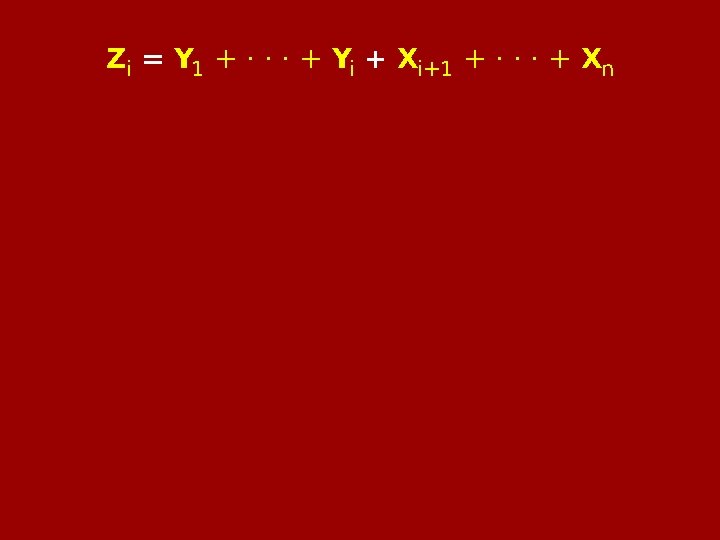
Hybrid argument X 1, X 2, …, Xn, Y 1, Y 2, …, Yn, independent, matching means and variances. SX = X 1 + · · · + Xn Def: vs. SY = Y 1 + · · · + Yn Zi = Y 1 + · · · + Yi + Xi+1 + · · · + Xn SX = Z 0, SY = Zn
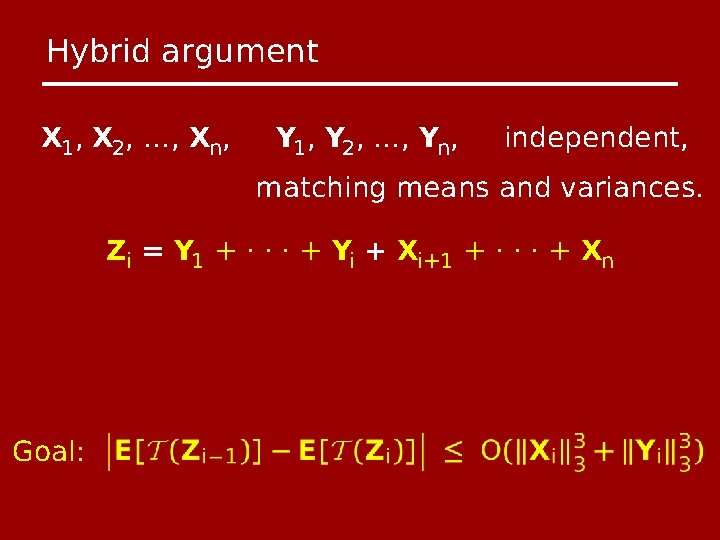
Hybrid argument X 1, X 2, …, Xn, Y 1, Y 2, …, Yn, independent, matching means and variances. Zi = Y 1 + · · · + Yi + Xi+1 + · · · + Xn Goal:
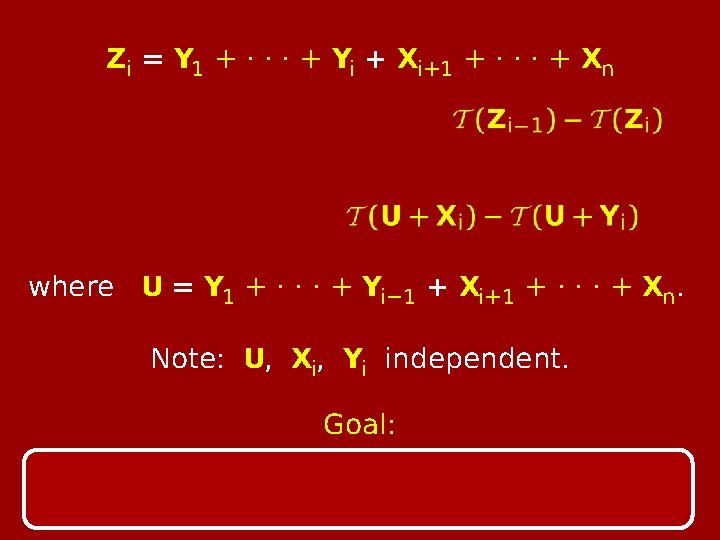
Zi = Y 1 + · · · + Yi + Xi+1 + · · · + Xn where U = Y 1 + · · · + Yi− 1 + Xi+1 + · · · + Xn. Note: U, Xi, Yi independent. Goal:
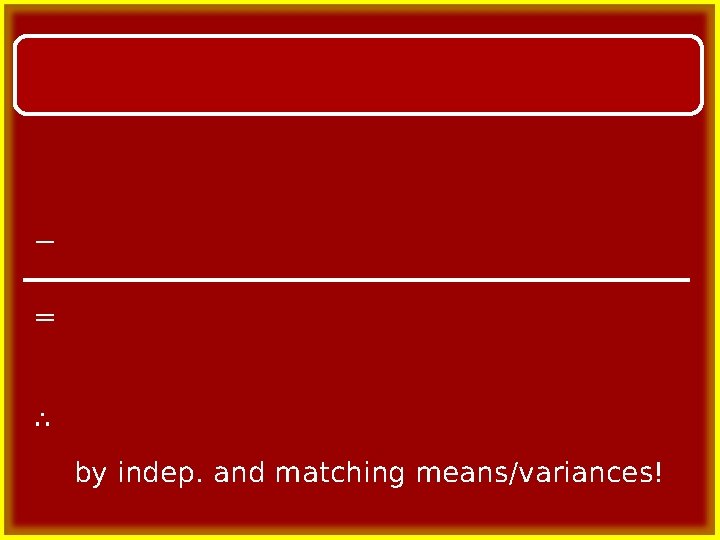
− = ∴ by indep. and matching means/variances!
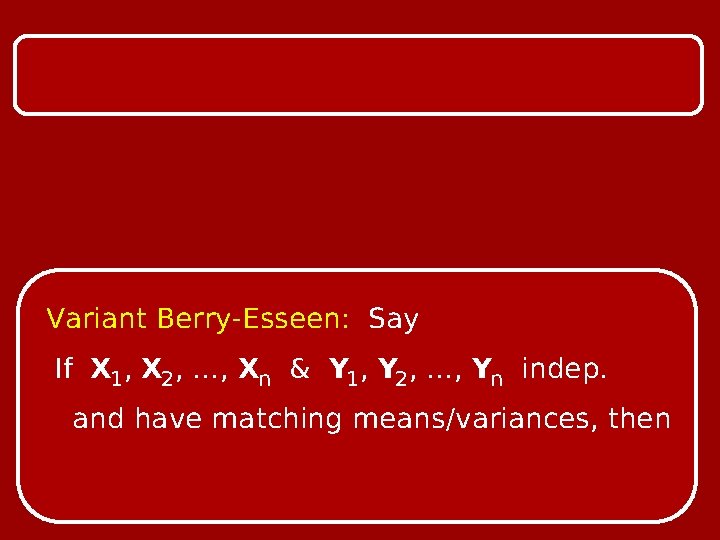
Variant Berry-Esseen: Say If X 1, X 2, …, Xn & Y 1, Y 2, …, Yn indep. and have matching means/variances, then
Usual Berry-Esseen: If X 1, X 2, …, Xn indep. , mean 0, Hack u δ
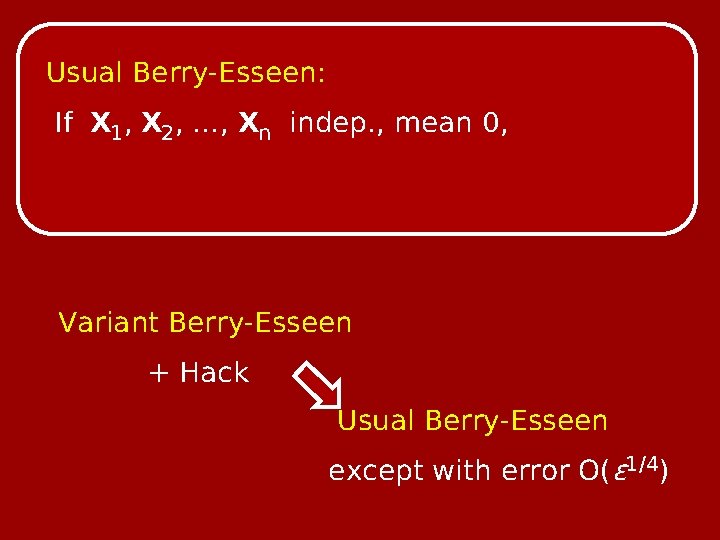
Usual Berry-Esseen: If X 1, X 2, …, Xn indep. , mean 0, Variant Berry-Esseen + Hack Usual Berry-Esseen except with error O(ϵ 1/4)
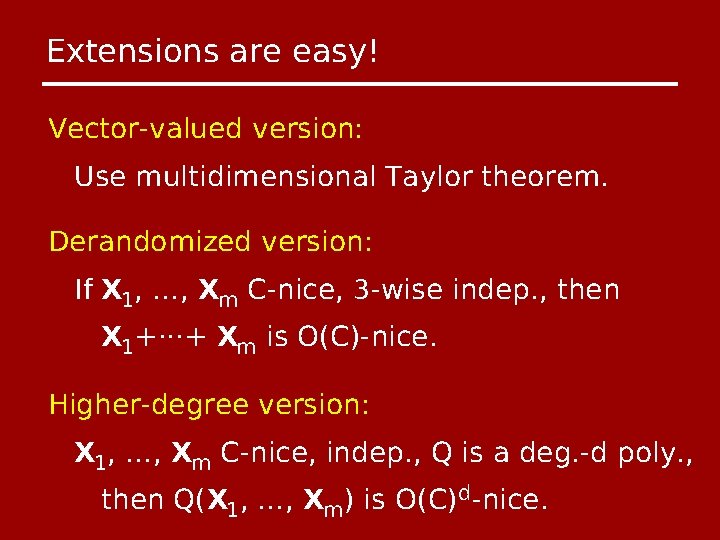
Extensions are easy! Vector-valued version: Use multidimensional Taylor theorem. Derandomized version: If X 1, …, Xm C-nice, 3 -wise indep. , then X 1+···+ Xm is O(C)-nice. Higher-degree version: X 1, …, Xm C-nice, indep. , Q is a deg. -d poly. , then Q(X 1, …, Xm) is O(C)d-nice.
Talk Outline 1. Describe some TCS results requiring variants of the Central Limit Theorem. 2. Show a flexible proof of the CLT with error bounds. 3. Open problems, advertisement, anecdote?
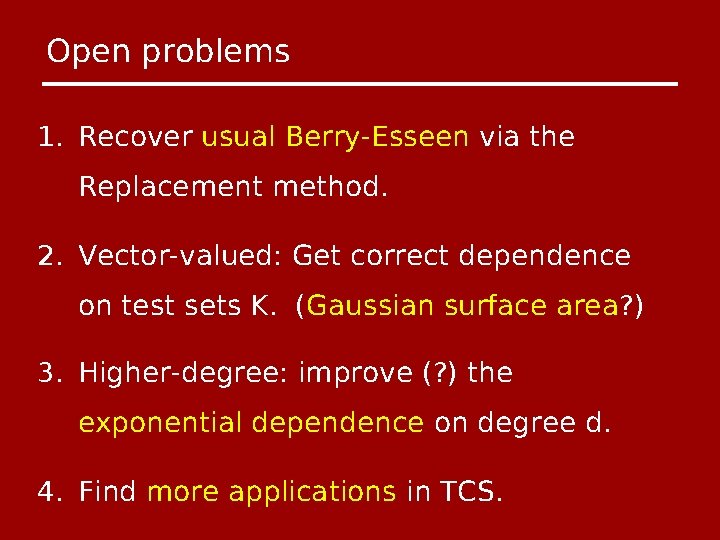
Open problems 1. Recover usual Berry-Esseen via the Replacement method. 2. Vector-valued: Get correct dependence on test sets K. (Gaussian surface area? ) 3. Higher-degree: improve (? ) the exponential dependence on degree d. 4. Find more applications in TCS.
Do you like LTFs and PTFs? Do you like probability and geometry? Oct. 21 -22 (“just before FOCS”) workshop at the Princeton Intractability Center: Analysis and Geometry of Boolean Threshold Functions Diakonikolas! Kane! Meka! Rubinfeld! Servedio! Shpilka! Vempala! And more! http: //intractability. princeton. edu/blog/2010/08/workshop-ltfptf/