
INTUSSUSCEPTION INTUSSUSCEPTION Intussusceptions is one variety of intestinal

- Slides: 13
INTUSSUSCEPTION
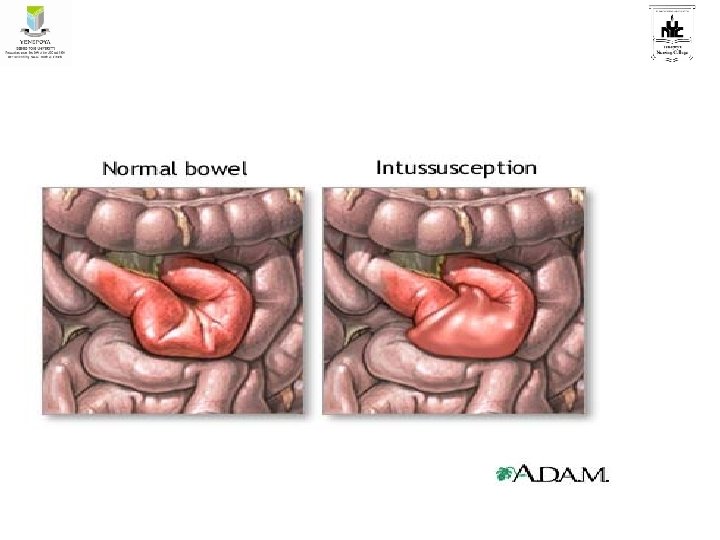
INTUSSUSCEPTION • Intussusceptions is one variety of intestinal obstruction ( partial or complete) where one portion of the intestine( usually the terminal ileum near the ileo – cecal valve) invaginates i. e telescopes in to the distal segment leading to an impairment of blood supply to the involved bowel which may become gangrenous if not relieved promptly.
What causes intussusception? • The causes of intussusception are not fully known. Most cases in young children are idiopathic, (meaning the cause is unknown), although some viral and bacterial infections of the intestine may possibly contribute to intussusception in infancy. • Intussusception is very rare in older children and adults. In this population, the causes are believed to be due to polyps or tumours, which are often referred to as the "lead point" of the intussusception.
Who is at greatest risk for intussusception? • Most cases of intussusception occur in children between 5 months and 1 year of age. Boys develop the condition two times more often than girls. Intussusception can also occur in adults and older children, although it is uncommon.
Types • • Ileo – cecal Ileo- colic Ileo- ileal Colo- colic
PATHOGENESIS • Occurs most often near the ileocecal junction (ileocolic intussusception), Ileo-ileo-colic, jejuno-jejunal, jejuno-ileal, or colo-colic. • The intussusceptum, a proximal segment of bowel, telescopes into the intussuscipiens, a distal segment, dragging the associated mesentery with it. • This leads to the development of venous and lymphatic congestion with resulting intestinal edema, which lead to ischemia, perforation, and peritonitis.
Incidence: • The disease occurs between four months and two years of age (peak incidence 9 -10 months) usually healthy infants during weaning period
Clinical features: • Vomiting • Pain and abdominal colic • Lump • Blood per rectum – ‘red currant jelly’ stool
Diagnostic evaluation • A detailed history • Examination of abdomen • Radiological examination
Management • Treatment is surgical. Non operative method is by injection of barium in to the colon and reduction of the intussusceptions but it may result in incomplete reduction in inexperienced hands
Reference • Hockenberry, Wilson, Judie. Wong’s essentials of pediatric Nursing. South India Edition. Elsevier publication. • Dorothy R Marlow, Barbara A Redding, Raman Kalia. Marlow’s textbook of pediatric Nursing. Harcourt Brace & Company Asia Pte Ltd. • Parul Datta. Pediatric Nursing. 4 th edition. Jaypee Publishers. New Delhi.
THANK YOU