
Intuition for Asymptotic Notation BigOh fn is Ogn
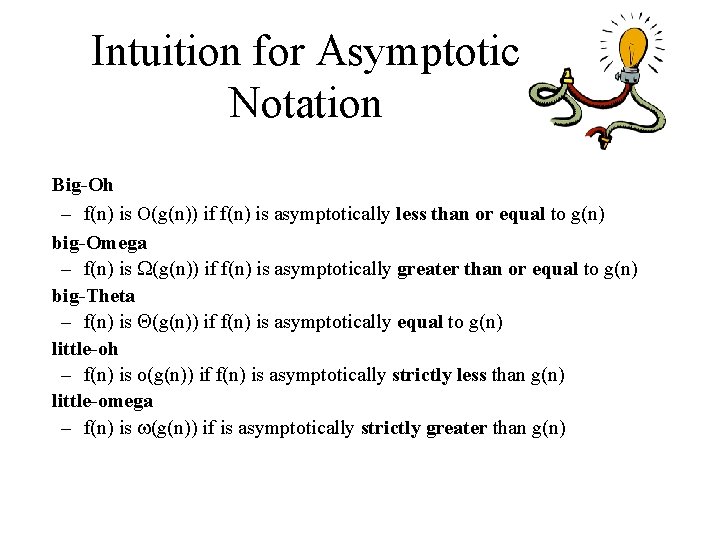
Intuition for Asymptotic Notation Big-Oh – f(n) is O(g(n)) if f(n) is asymptotically less than or equal to g(n) big-Omega – f(n) is (g(n)) if f(n) is asymptotically greater than or equal to g(n) big-Theta – f(n) is (g(n)) if f(n) is asymptotically equal to g(n) little-oh – f(n) is o(g(n)) if f(n) is asymptotically strictly less than g(n) little-omega – f(n) is (g(n)) if is asymptotically strictly greater than g(n)
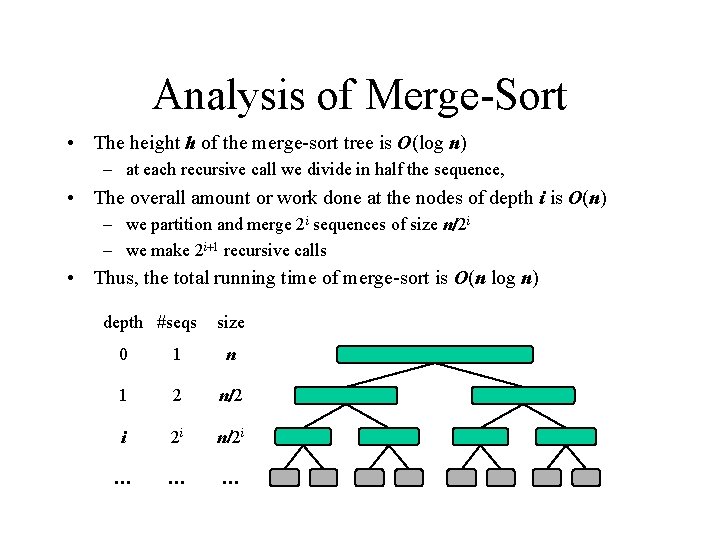
Analysis of Merge-Sort • The height h of the merge-sort tree is O(log n) – at each recursive call we divide in half the sequence, • The overall amount or work done at the nodes of depth i is O(n) – we partition and merge 2 i sequences of size n/2 i – we make 2 i+1 recursive calls • Thus, the total running time of merge-sort is O(n log n) depth #seqs size 0 1 n 1 2 n/2 i 2 i n/2 i … … …
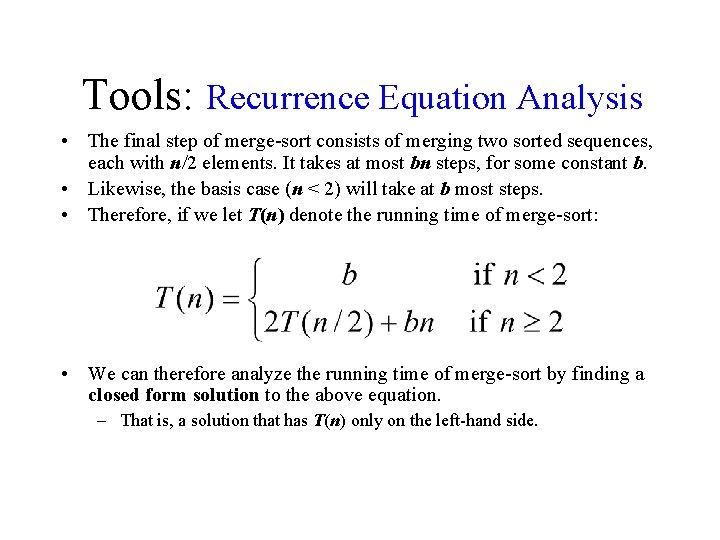
Tools: Recurrence Equation Analysis • The final step of merge-sort consists of merging two sorted sequences, each with n/2 elements. It takes at most bn steps, for some constant b. • Likewise, the basis case (n < 2) will take at b most steps. • Therefore, if we let T(n) denote the running time of merge-sort: • We can therefore analyze the running time of merge-sort by finding a closed form solution to the above equation. – That is, a solution that has T(n) only on the left-hand side.
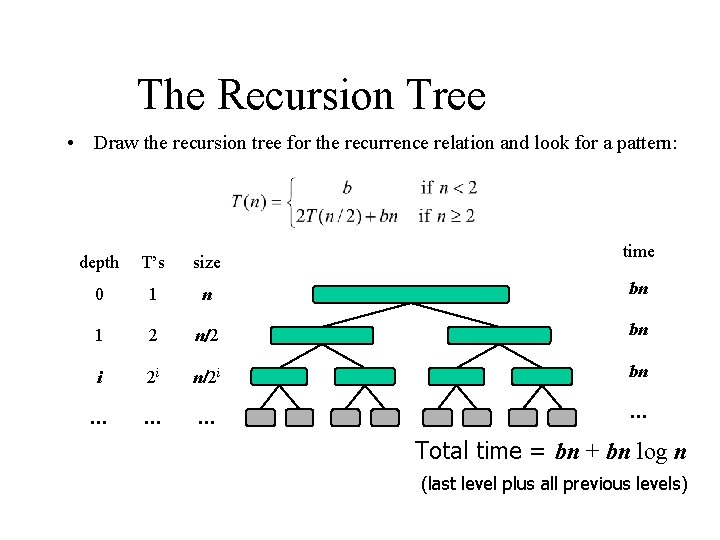
The Recursion Tree • Draw the recursion tree for the recurrence relation and look for a pattern: time depth T’s size 0 1 n bn 1 2 n/2 bn i 2 i n/2 i bn … … Total time = bn + bn log n (last level plus all previous levels)
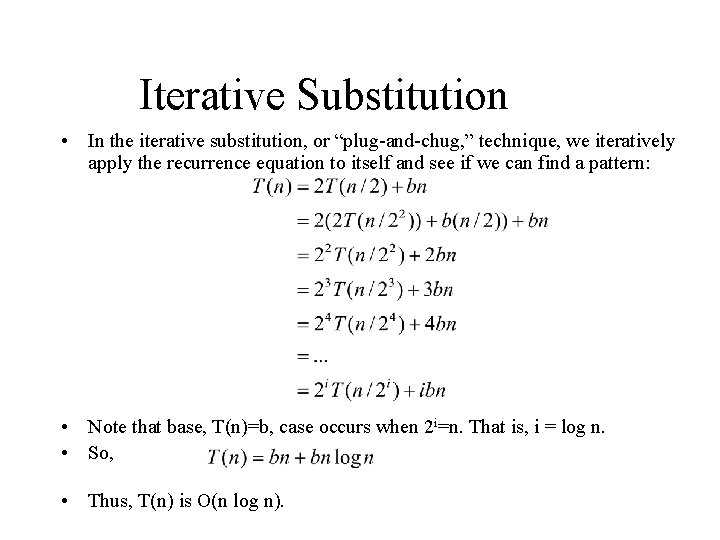
Iterative Substitution • In the iterative substitution, or “plug-and-chug, ” technique, we iteratively apply the recurrence equation to itself and see if we can find a pattern: • Note that base, T(n)=b, case occurs when 2 i=n. That is, i = log n. • So, • Thus, T(n) is O(n log n).
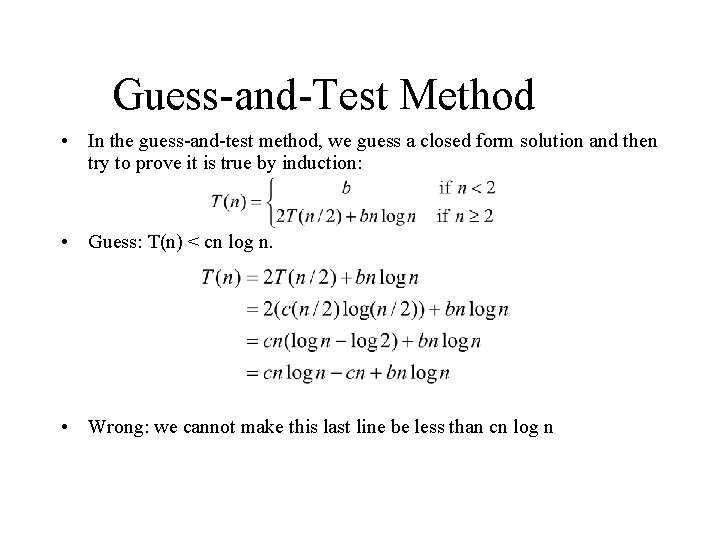
Guess-and-Test Method • In the guess-and-test method, we guess a closed form solution and then try to prove it is true by induction: • Guess: T(n) < cn log n. • Wrong: we cannot make this last line be less than cn log n
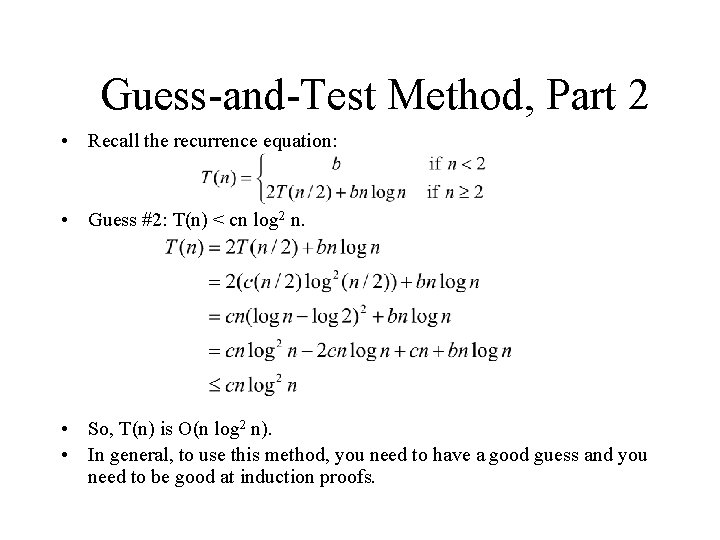
Guess-and-Test Method, Part 2 • Recall the recurrence equation: • Guess #2: T(n) < cn log 2 n. • So, T(n) is O(n log 2 n). • In general, to use this method, you need to have a good guess and you need to be good at induction proofs.
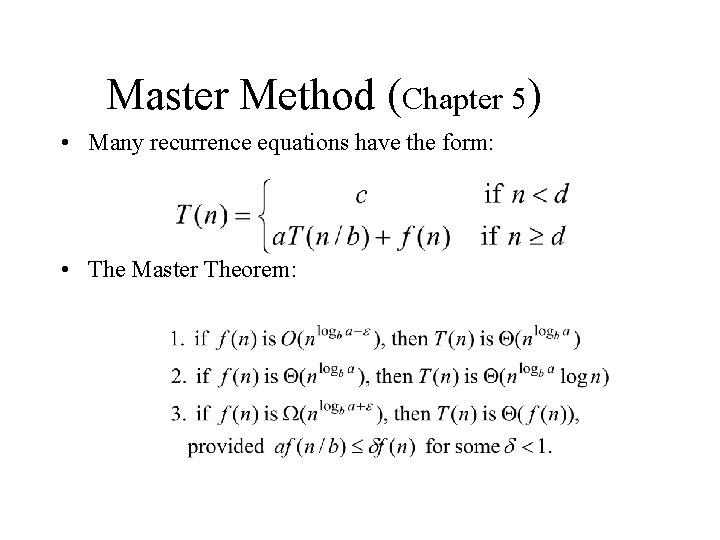
Master Method (Chapter 5) • Many recurrence equations have the form: • The Master Theorem:
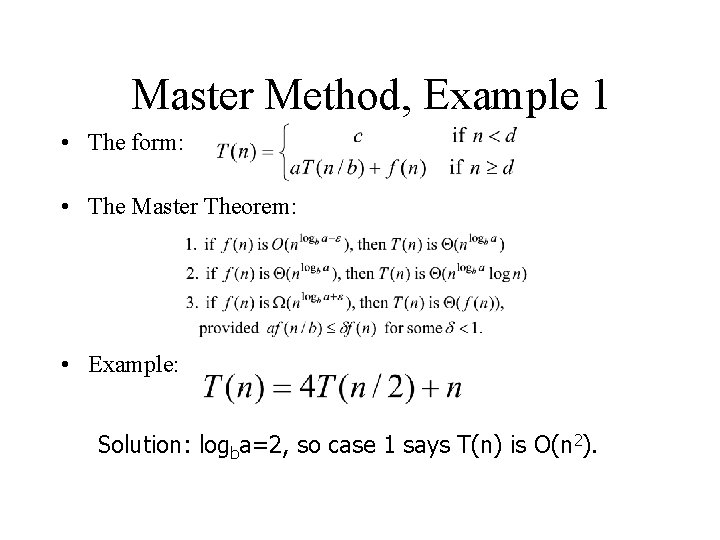
Master Method, Example 1 • The form: • The Master Theorem: • Example: Solution: logba=2, so case 1 says T(n) is O(n 2).
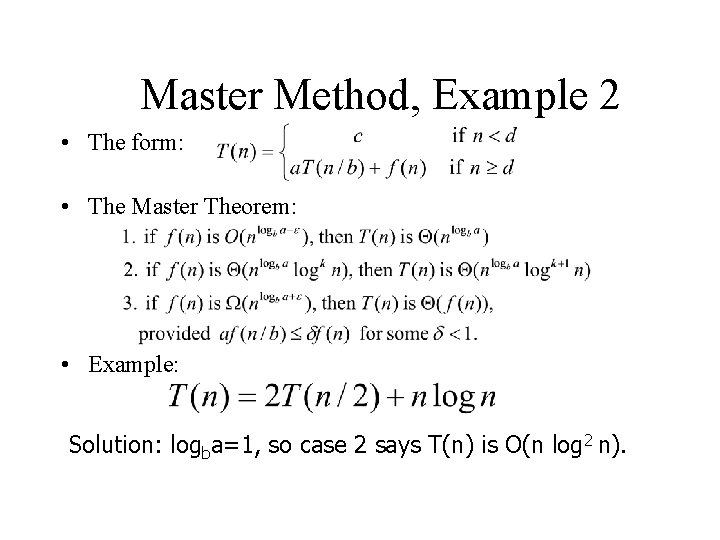
Master Method, Example 2 • The form: • The Master Theorem: • Example: Solution: logba=1, so case 2 says T(n) is O(n log 2 n).
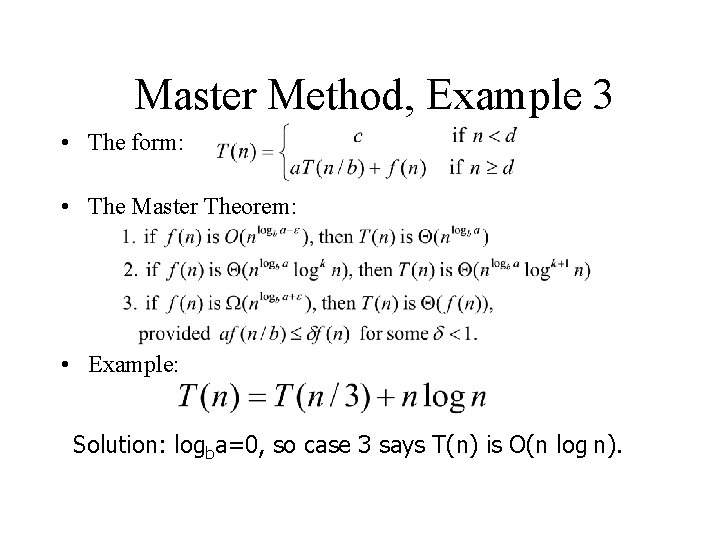
Master Method, Example 3 • The form: • The Master Theorem: • Example: Solution: logba=0, so case 3 says T(n) is O(n log n).
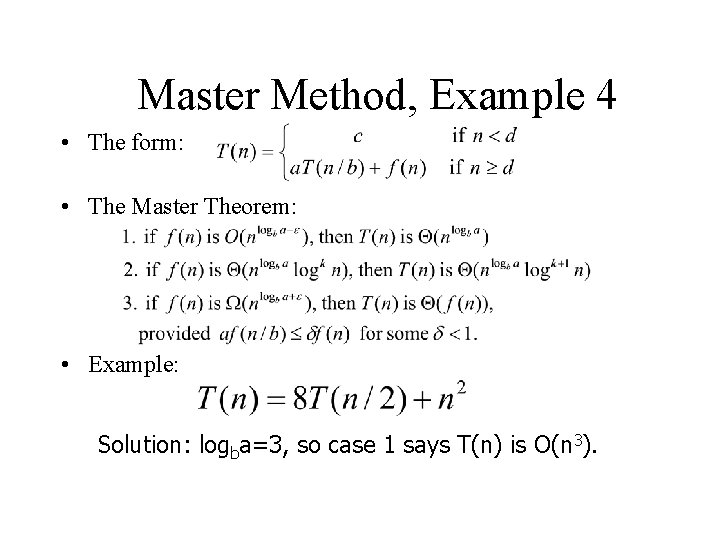
Master Method, Example 4 • The form: • The Master Theorem: • Example: Solution: logba=3, so case 1 says T(n) is O(n 3).
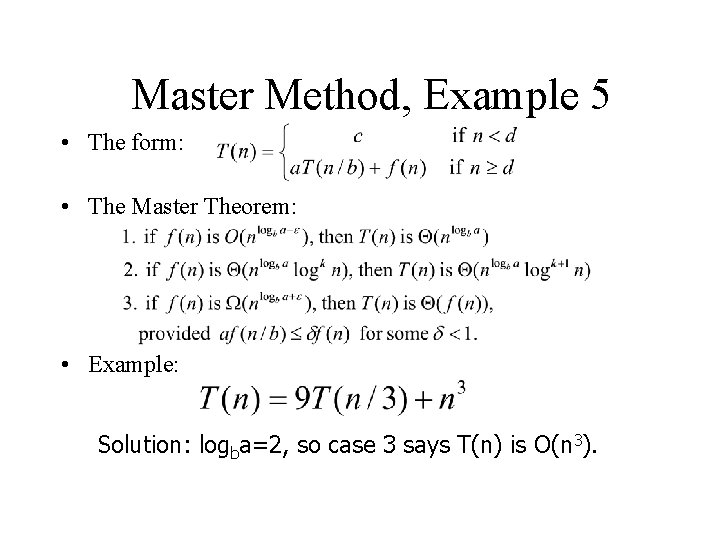
Master Method, Example 5 • The form: • The Master Theorem: • Example: Solution: logba=2, so case 3 says T(n) is O(n 3).
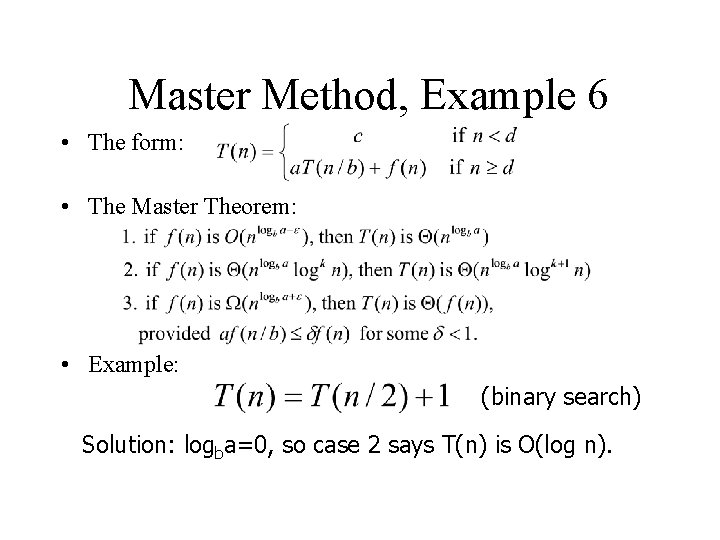
Master Method, Example 6 • The form: • The Master Theorem: • Example: (binary search) Solution: logba=0, so case 2 says T(n) is O(log n).
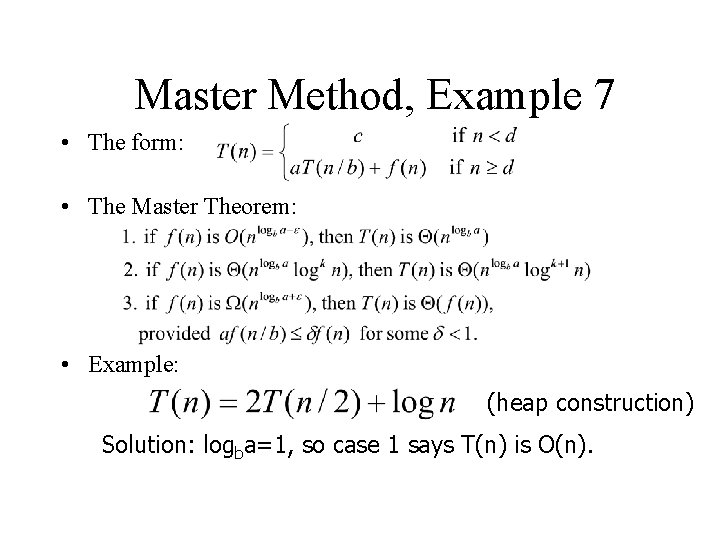
Master Method, Example 7 • The form: • The Master Theorem: • Example: (heap construction) Solution: logba=1, so case 1 says T(n) is O(n).
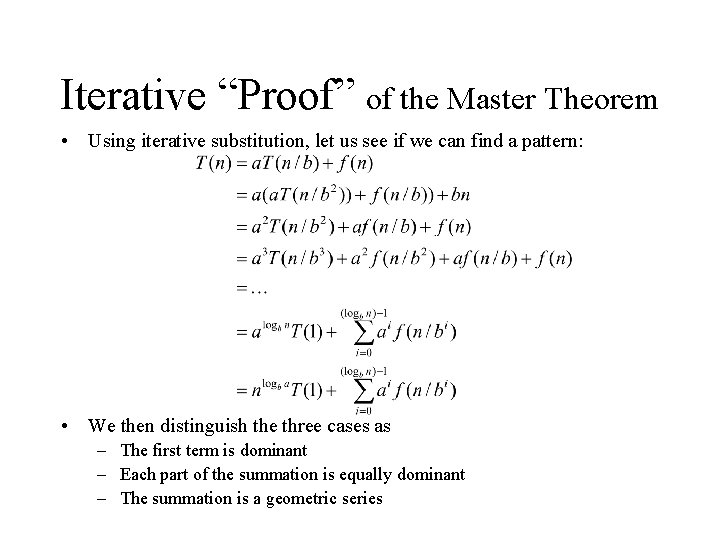
Iterative “Proof” of the Master Theorem • Using iterative substitution, let us see if we can find a pattern: • We then distinguish the three cases as – The first term is dominant – Each part of the summation is equally dominant – The summation is a geometric series

Case Study Priority Queue Sorting
Priority Queue ADT • A priority queue stores a collection of items • An item is a pair (key, element) • Main methods of the Priority Queue ADT – insert. Item(k, e) inserts an item with key k and element e – remove. Min() removes the item with smallest key and returns its element
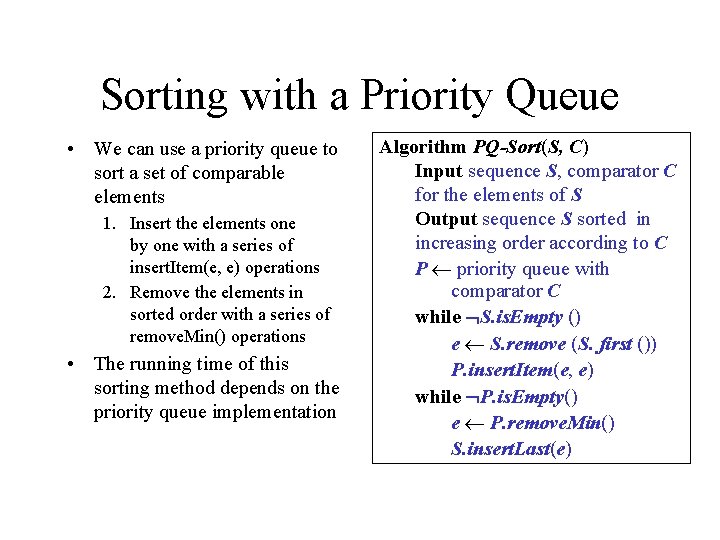
Sorting with a Priority Queue • We can use a priority queue to sort a set of comparable elements 1. Insert the elements one by one with a series of insert. Item(e, e) operations 2. Remove the elements in sorted order with a series of remove. Min() operations • The running time of this sorting method depends on the priority queue implementation Algorithm PQ-Sort(S, C) Input sequence S, comparator C for the elements of S Output sequence S sorted in increasing order according to C P priority queue with comparator C while S. is. Empty () e S. remove (S. first ()) P. insert. Item(e, e) while P. is. Empty() e P. remove. Min() S. insert. Last(e)
Sequence-based Priority Queue • Implementation with an unsorted sequence – Store the items of the priority queue in a list-based sequence, in arbitrary order • Performance: – insert. Item takes O(1) time since we can insert the item at the beginning or end of the sequence – remove. Min, min. Key and min. Element take O(n) time since we have to traverse the entire sequence to find the smallest key
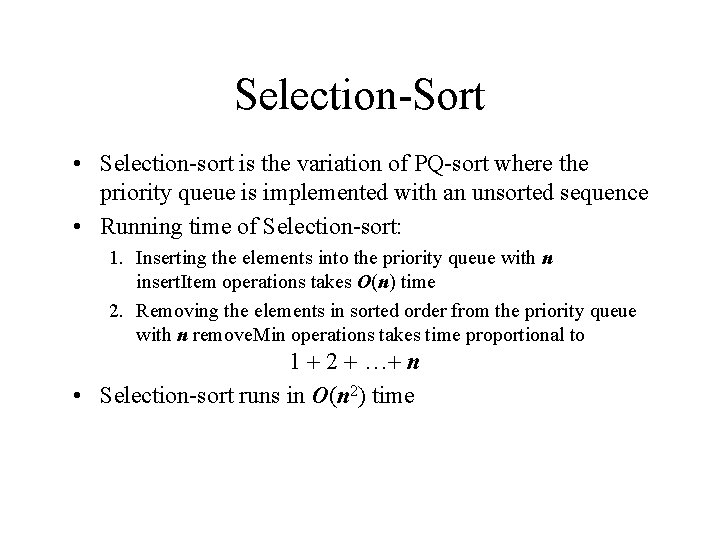
Selection-Sort • Selection-sort is the variation of PQ-sort where the priority queue is implemented with an unsorted sequence • Running time of Selection-sort: 1. Inserting the elements into the priority queue with n insert. Item operations takes O(n) time 2. Removing the elements in sorted order from the priority queue with n remove. Min operations takes time proportional to 1 + 2 + …+ n • Selection-sort runs in O(n 2) time
Sequence-based Priority Queue • Implementation with a sorted sequence – Store the items of the priority queue in a sequence, sorted by key • Performance: – insert. Item takes O(n) time since we have to find the place where to insert the item – remove. Min, min. Key and min. Element take O(1) time since the smallest key is at the beginning of the sequence
Insertion-Sort • • Insertion-sort is the variation of PQ-sort where the priority queue is implemented with a sorted sequence Running time of Insertion-sort: 1. Inserting the elements into the priority queue with n insert. Item operations takes time proportional to 1 + 2 + …+ n 2. • Removing the elements in sorted order from the priority queue with a series of n remove. Min operations takes O(n) time Insertion-sort runs in O(n 2) time
Heaps and Priority Queues 2 5 9 6 7
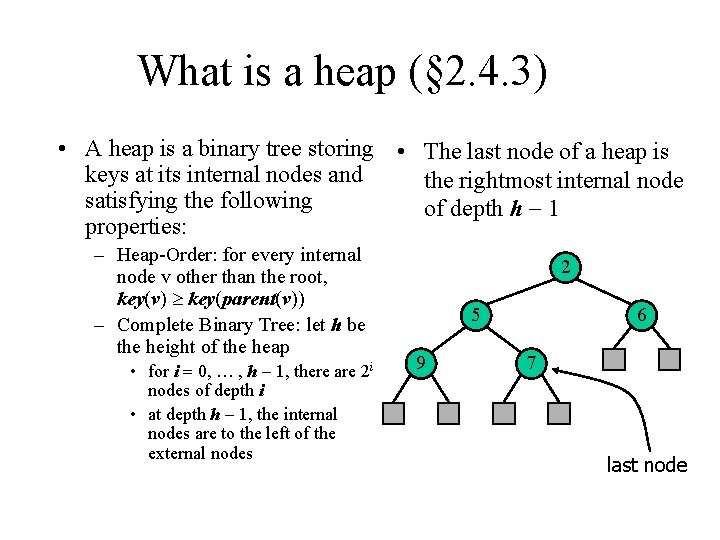
What is a heap (§ 2. 4. 3) • A heap is a binary tree storing • The last node of a heap is keys at its internal nodes and the rightmost internal node satisfying the following of depth h - 1 properties: – Heap-Order: for every internal node v other than the root, key(v) key(parent(v)) – Complete Binary Tree: let h be the height of the heap • for i = 0, … , h - 1, there are 2 i nodes of depth i • at depth h - 1, the internal nodes are to the left of the external nodes 2 5 9 6 7 last node
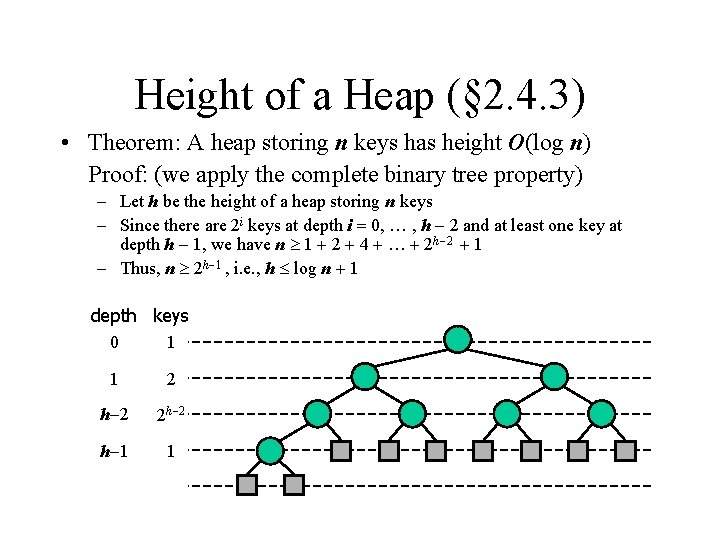
Height of a Heap (§ 2. 4. 3) • Theorem: A heap storing n keys has height O(log n) Proof: (we apply the complete binary tree property) – Let h be the height of a heap storing n keys – Since there are 2 i keys at depth i = 0, … , h - 2 and at least one key at depth h - 1, we have n 1 + 2 + 4 + … + 2 h-2 + 1 – Thus, n 2 h-1 , i. e. , h log n + 1 depth keys 0 1 1 2 h-2 2 h-2 h-1 1
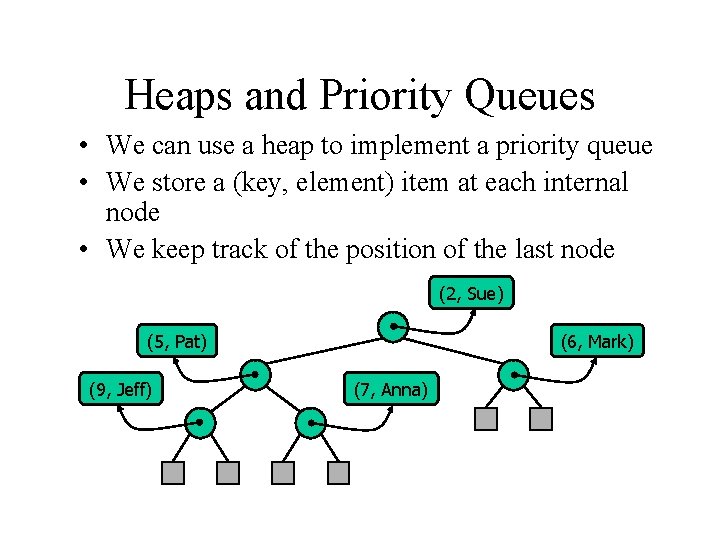
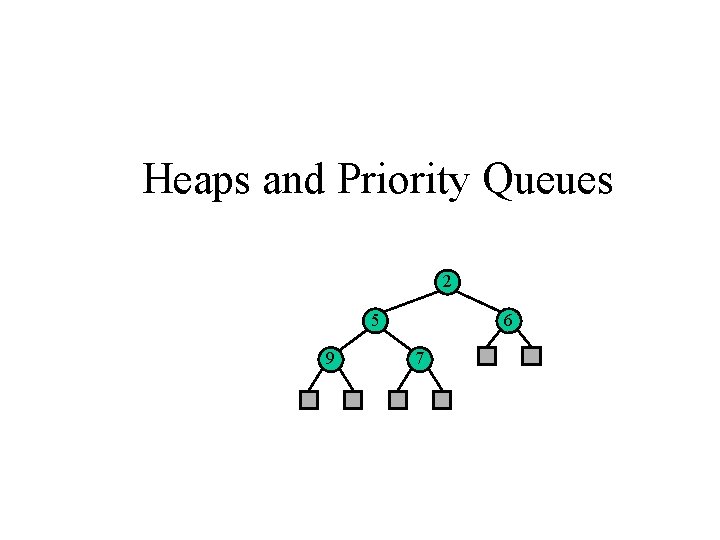
Heaps and Priority Queues • We can use a heap to implement a priority queue • We store a (key, element) item at each internal node • We keep track of the position of the last node (2, Sue) (5, Pat) (9, Jeff) (6, Mark) (7, Anna)
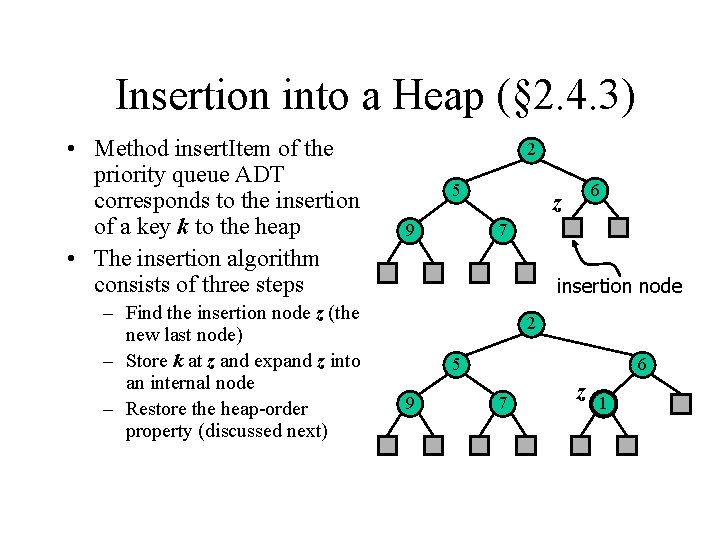
Insertion into a Heap (§ 2. 4. 3) • Method insert. Item of the priority queue ADT corresponds to the insertion of a key k to the heap • The insertion algorithm consists of three steps – Find the insertion node z (the new last node) – Store k at z and expand z into an internal node – Restore the heap-order property (discussed next) 2 5 9 6 z 7 insertion node 2 5 9 6 7 z 1
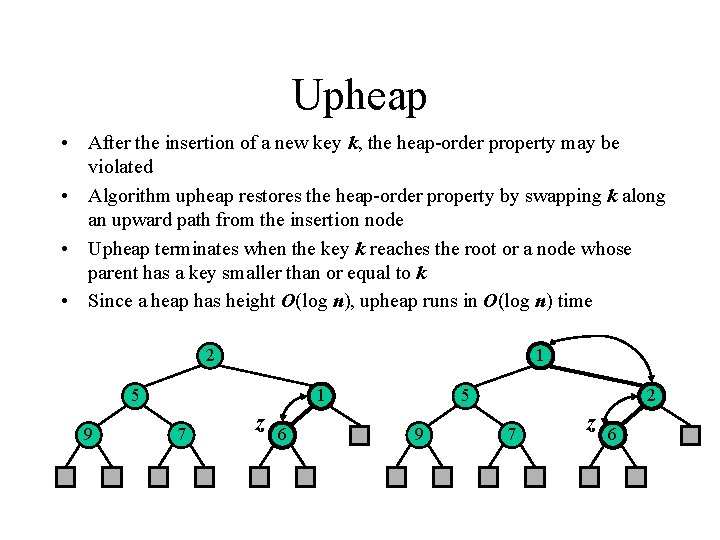
Upheap • After the insertion of a new key k, the heap-order property may be violated • Algorithm upheap restores the heap-order property by swapping k along an upward path from the insertion node • Upheap terminates when the key k reaches the root or a node whose parent has a key smaller than or equal to k • Since a heap has height O(log n), upheap runs in O(log n) time 2 1 5 9 1 7 z 6 5 9 2 7 z 6
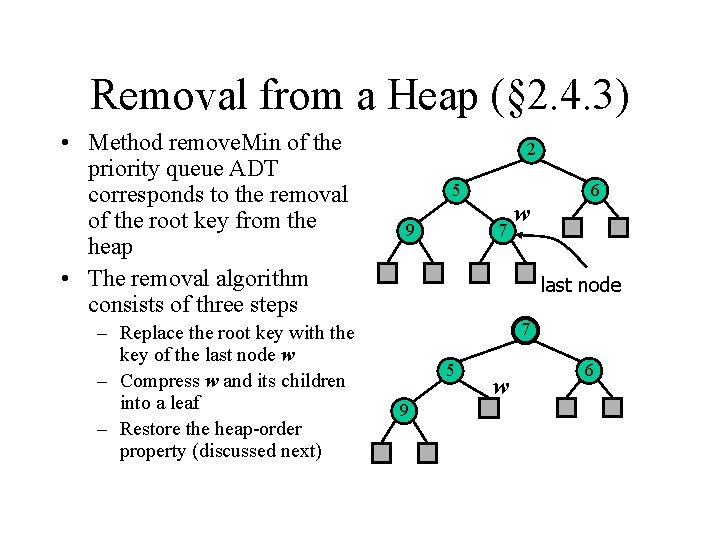
Removal from a Heap (§ 2. 4. 3) • Method remove. Min of the priority queue ADT corresponds to the removal of the root key from the heap • The removal algorithm consists of three steps – Replace the root key with the key of the last node w – Compress w and its children into a leaf – Restore the heap-order property (discussed next) 2 5 9 6 7 w last node 7 5 9 w 6
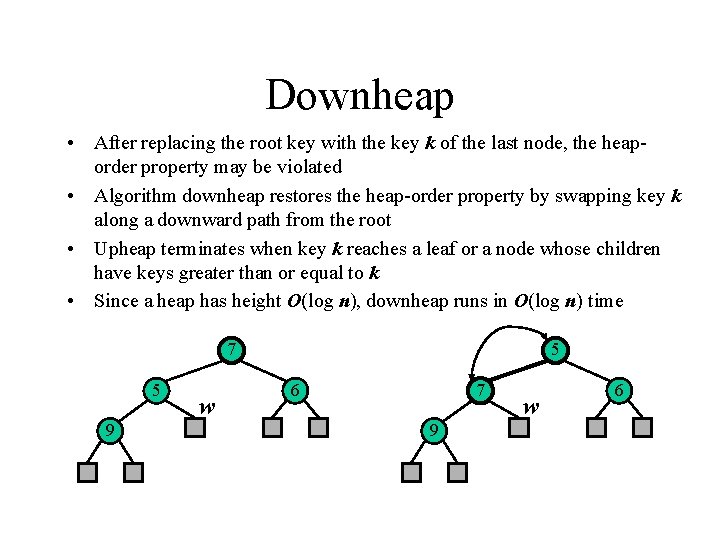
Downheap • After replacing the root key with the key k of the last node, the heaporder property may be violated • Algorithm downheap restores the heap-order property by swapping key k along a downward path from the root • Upheap terminates when key k reaches a leaf or a node whose children have keys greater than or equal to k • Since a heap has height O(log n), downheap runs in O(log n) time 7 5 9 w 5 6 7 9 w 6
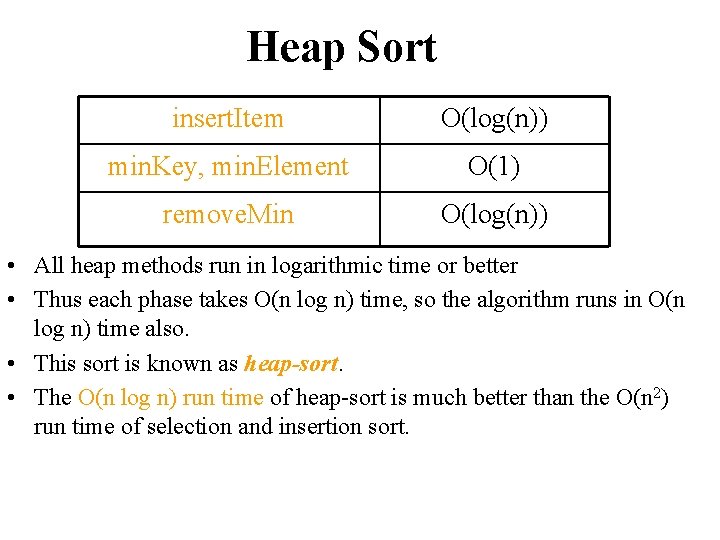
Heap Sort insert. Item O(log(n)) min. Key, min. Element O(1) remove. Min O(log(n)) • All heap methods run in logarithmic time or better • Thus each phase takes O(n log n) time, so the algorithm runs in O(n log n) time also. • This sort is known as heap-sort. • The O(n log n) run time of heap-sort is much better than the O(n 2) run time of selection and insertion sort.
Heap-Sort (§ 2. 4. 4) • Consider a priority queue with n items implemented by means of a heap – the space used is O(n) – methods insert. Item and remove. Min take O(log n) time – methods size, is. Empty, min. Key, and min. Element take time O(1) time • Using a heap-based priority queue, we can sort a sequence of n elements in O(n log n) time • The resulting algorithm is called heap-sort • Heap-sort is much faster than quadratic sorting algorithms, such as insertion-sort and selection -sort
Bottom-Up Heap Construction Algorithm (§ 2. 4. 3) Algorithm Bottom. Up. Heap(S) Input: A sequence S storing n = 2 h-1 keys Output: A heap T storing keys in S if S is empty then return an empty heap Remove the first key, k, from S Split S into 2 sequences, S 1 and S 2, each of size (n-1)/2. T 1 Bottom. Up. Heap(S 1) T 2 Bottom. Up. Heap(S 2) Create binary tree T with root r storing k, left subtree T 1 and right subtree T 2. Perform a down-heap bubbling from root r of T return T
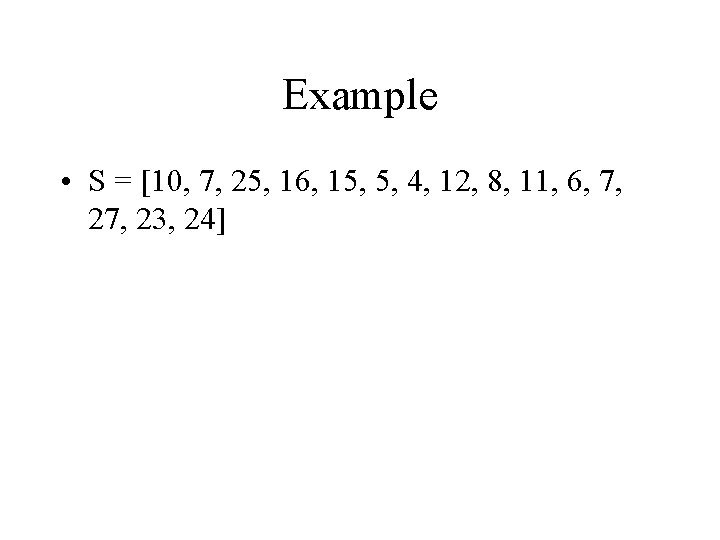
Example • S = [10, 7, 25, 16, 15, 5, 4, 12, 8, 11, 6, 7, 23, 24]
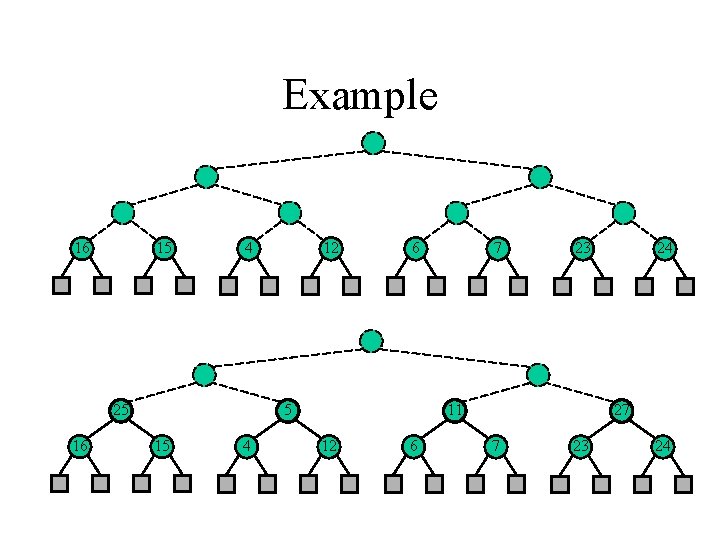
Example 16 15 4 25 16 12 6 5 15 4 7 23 11 12 6 24 27 7 23 24
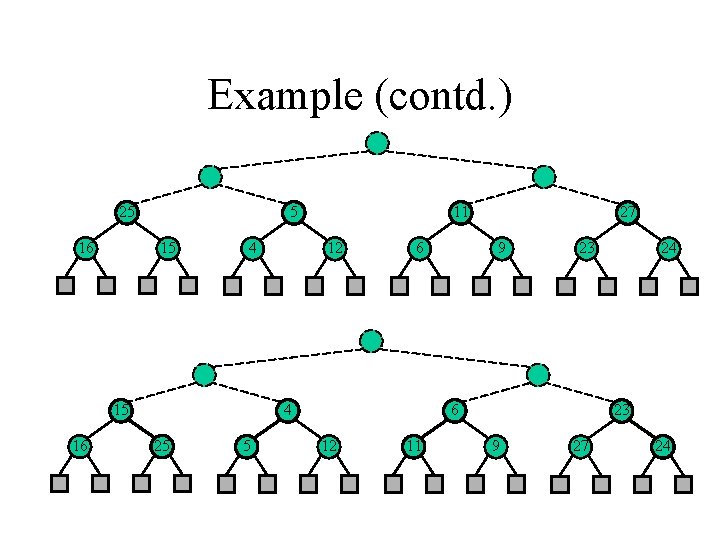
Example (contd. ) 25 16 5 15 4 15 16 11 12 6 4 25 5 27 9 23 6 12 11 24 23 9 27 24
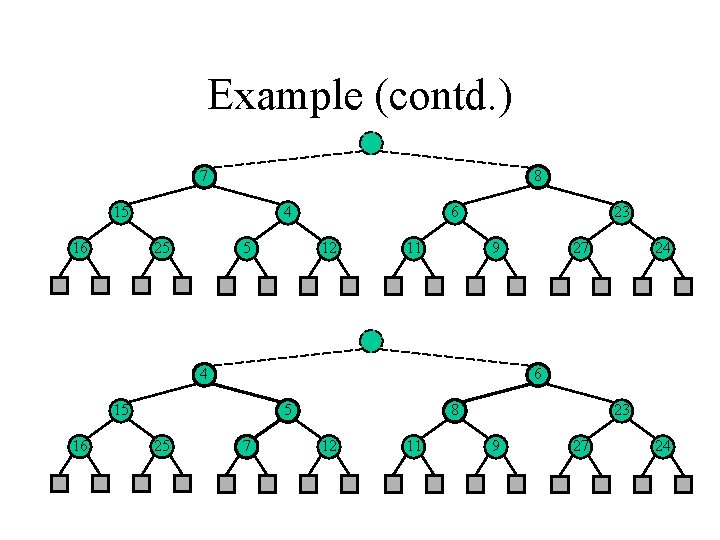
Example (contd. ) 7 8 15 16 4 25 5 6 12 11 23 9 4 5 25 24 6 15 16 27 7 8 12 11 23 9 27 24
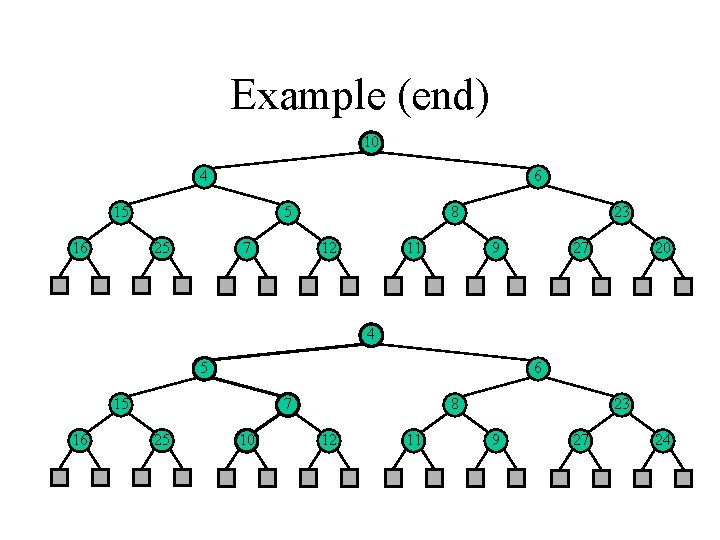
Example (end) 10 4 6 15 16 5 25 7 8 12 11 23 9 27 20 4 5 6 15 16 7 25 10 8 12 11 23 9 27 24
Binary Search Trees < 2 1 6 9 > 4 = 8
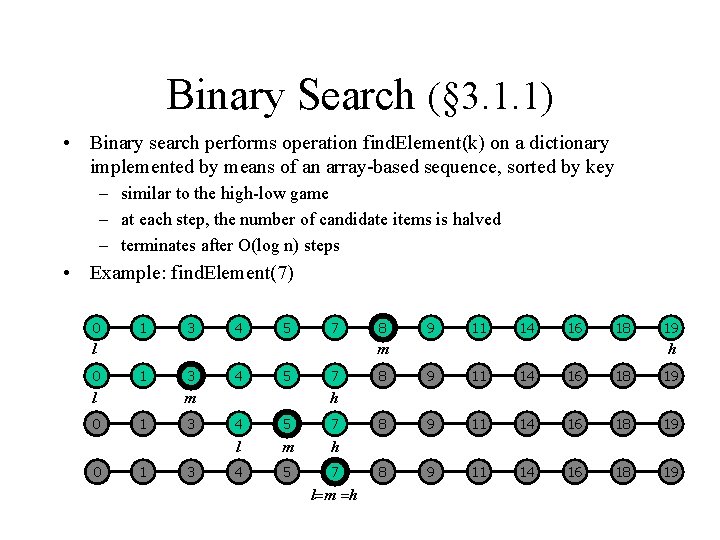
Binary Search (§ 3. 1. 1) • Binary search performs operation find. Element(k) on a dictionary implemented by means of an array-based sequence, sorted by key – similar to the high-low game – at each step, the number of candidate items is halved – terminates after O(log n) steps • Example: find. Element(7) 0 1 3 4 5 7 1 0 3 4 5 m l 0 9 11 14 16 18 m l 0 8 1 1 3 3 7 19 h 8 9 11 14 16 18 19 h 4 5 7 l m h 4 5 7 l=m =h
Lookup Table (§ 3. 1. 1) • A lookup table is a dictionary implemented by means of a sorted sequence – We store the items of the dictionary in an array-based sequence, sorted by key – We use an external comparator for the keys • Performance: – find. Element takes O(log n) time, using binary search – insert. Item takes O(n) time since in the worst case we have to shift n/2 items to make room for the new item – remove. Element take O(n) time since in the worst case we have to shift n/2 items to compact the items after the removal • The lookup table is effective only for dictionaries of small size or for dictionaries on which searches are the most common operations, while insertions and removals are rarely performed (e. g. , credit card authorizations)
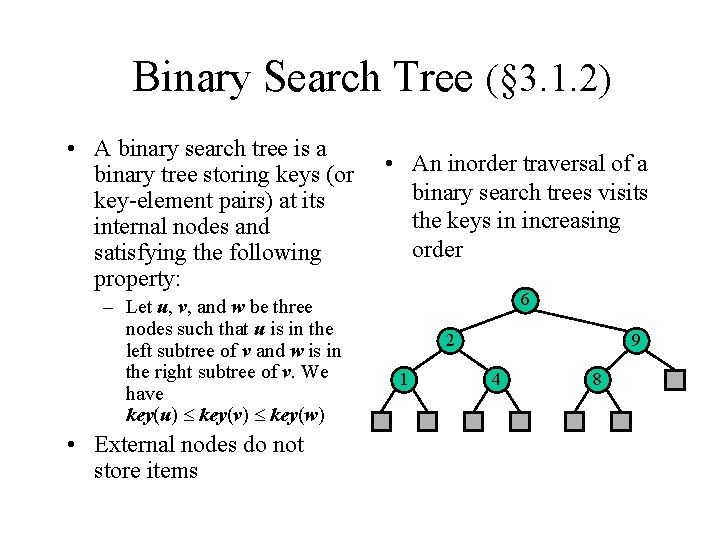
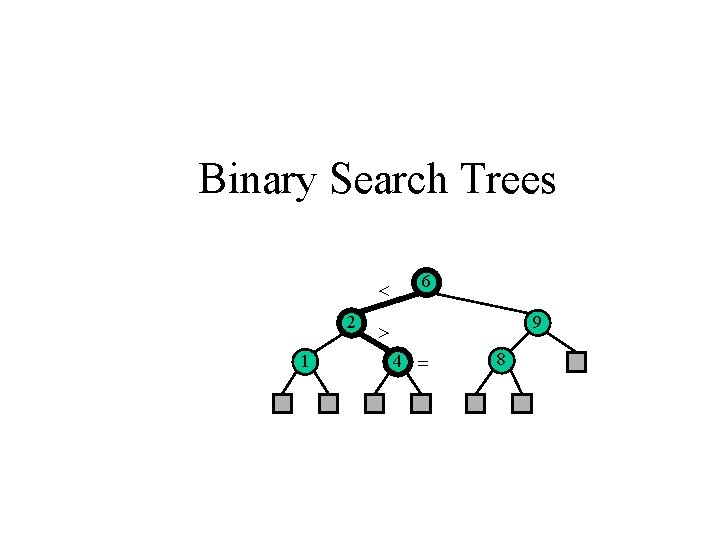
Binary Search Tree (§ 3. 1. 2) • A binary search tree is a binary tree storing keys (or key-element pairs) at its internal nodes and satisfying the following property: – Let u, v, and w be three nodes such that u is in the left subtree of v and w is in the right subtree of v. We have key(u) key(v) key(w) • External nodes do not store items • An inorder traversal of a binary search trees visits the keys in increasing order 6 2 1 9 4 8
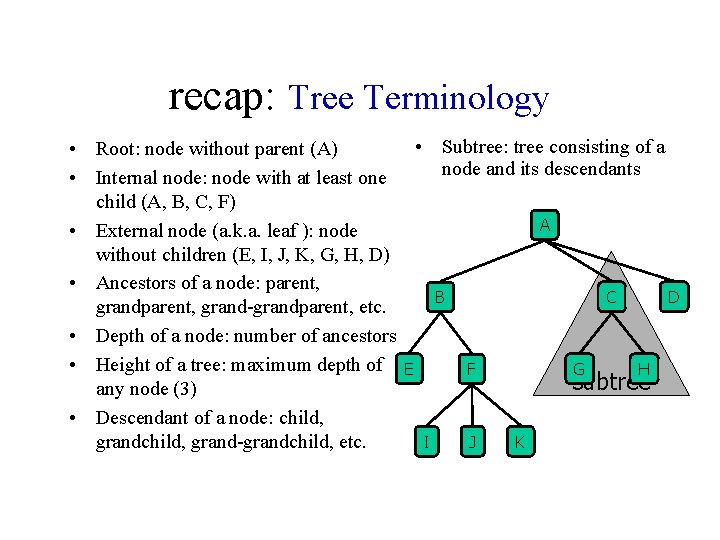
recap: Tree Terminology • Subtree: tree consisting of a • Root: node without parent (A) node and its descendants • Internal node: node with at least one child (A, B, C, F) A • External node (a. k. a. leaf ): node without children (E, I, J, K, G, H, D) • Ancestors of a node: parent, B C D grandparent, grand-grandparent, etc. • Depth of a node: number of ancestors • Height of a tree: maximum depth of E F G H subtree any node (3) • Descendant of a node: child, I J K grandchild, grand-grandchild, etc.
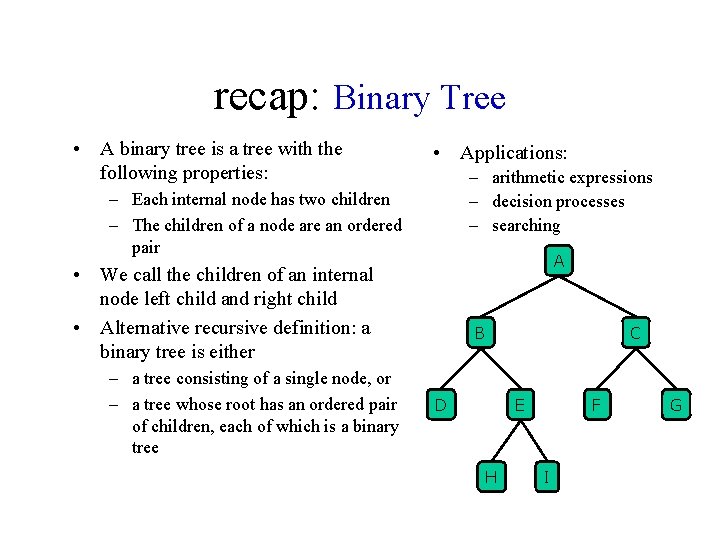
recap: Binary Tree • A binary tree is a tree with the following properties: • Applications: – arithmetic expressions – decision processes – searching – Each internal node has two children – The children of a node are an ordered pair A • We call the children of an internal node left child and right child • Alternative recursive definition: a binary tree is either – a tree consisting of a single node, or – a tree whose root has an ordered pair of children, each of which is a binary tree B C D F E H I G
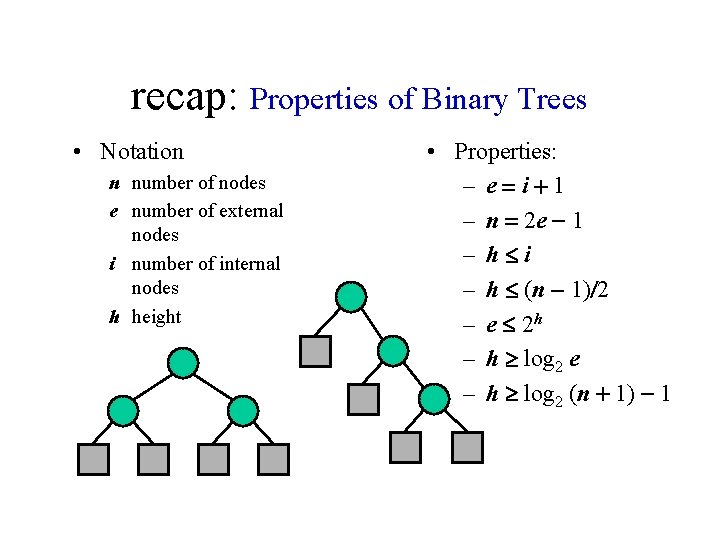
recap: Properties of Binary Trees • Notation n number of nodes e number of external nodes i number of internal nodes h height • Properties: – e=i+1 – n = 2 e - 1 – h i – h (n - 1)/2 – e 2 h – h log 2 e – h log 2 (n + 1) - 1
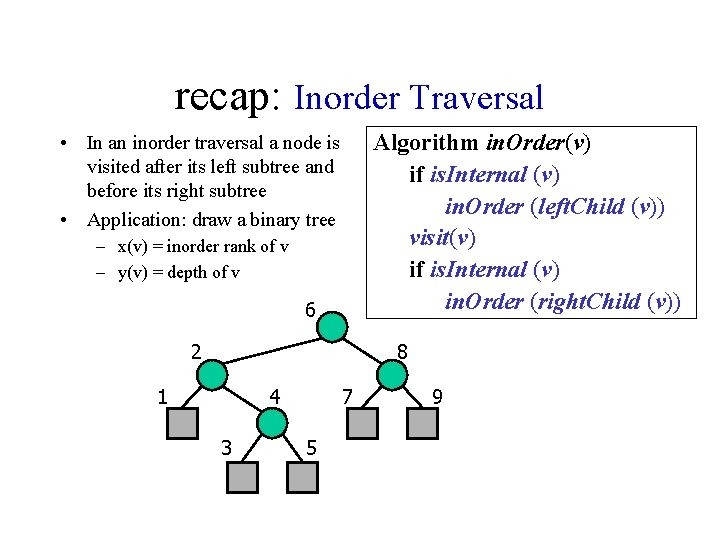
recap: Inorder Traversal Algorithm in. Order(v) if is. Internal (v) in. Order (left. Child (v)) visit(v) if is. Internal (v) in. Order (right. Child (v)) • In an inorder traversal a node is visited after its left subtree and before its right subtree • Application: draw a binary tree – x(v) = inorder rank of v – y(v) = depth of v 6 2 8 1 4 3 7 5 9
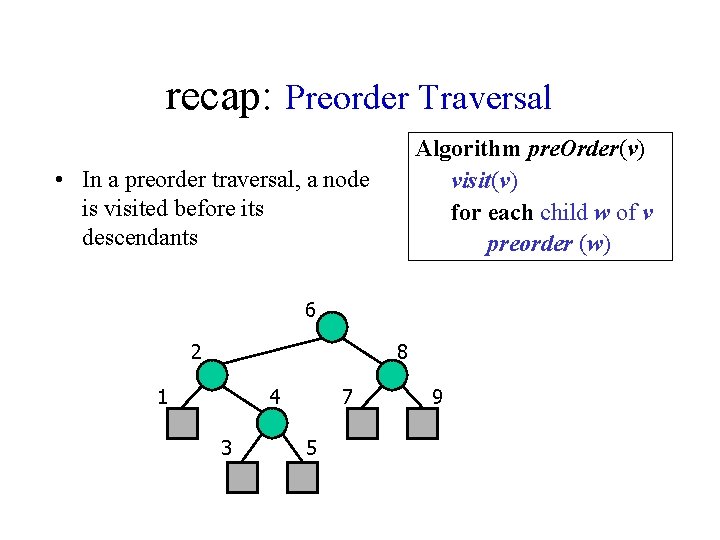
recap: Preorder Traversal Algorithm pre. Order(v) visit(v) for each child w of v preorder (w) • In a preorder traversal, a node is visited before its descendants 6 2 8 1 4 3 7 5 9
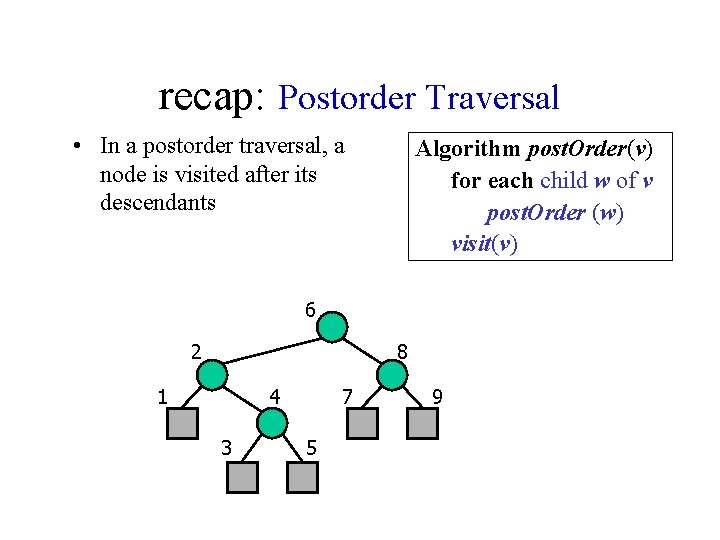
recap: Postorder Traversal • In a postorder traversal, a node is visited after its descendants Algorithm post. Order(v) for each child w of v post. Order (w) visit(v) 6 2 8 1 4 3 7 5 9
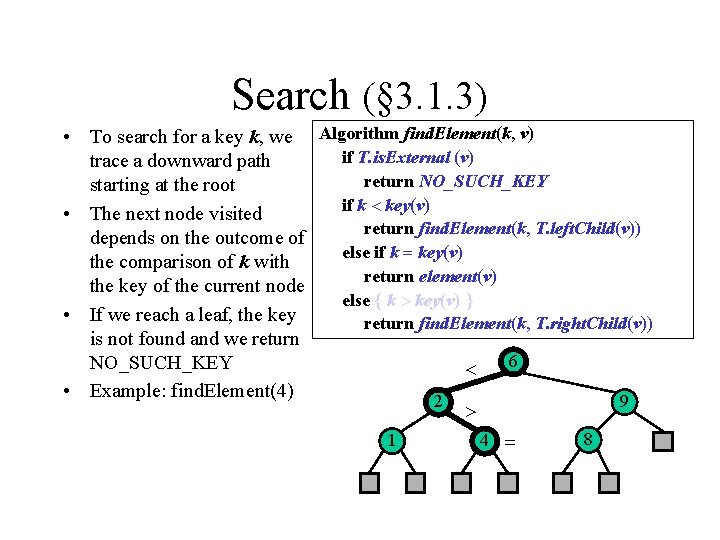
Search (§ 3. 1. 3) • To search for a key k, we Algorithm find. Element(k, v) if T. is. External (v) trace a downward path return NO_SUCH_KEY starting at the root if k < key(v) • The next node visited return find. Element(k, T. left. Child(v)) depends on the outcome of else if k = key(v) the comparison of k with return element(v) the key of the current node else { k > key(v) } • If we reach a leaf, the key return find. Element(k, T. right. Child(v)) is not found and we return 6 NO_SUCH_KEY < • Example: find. Element(4) 2 9 > 1 4 = 8
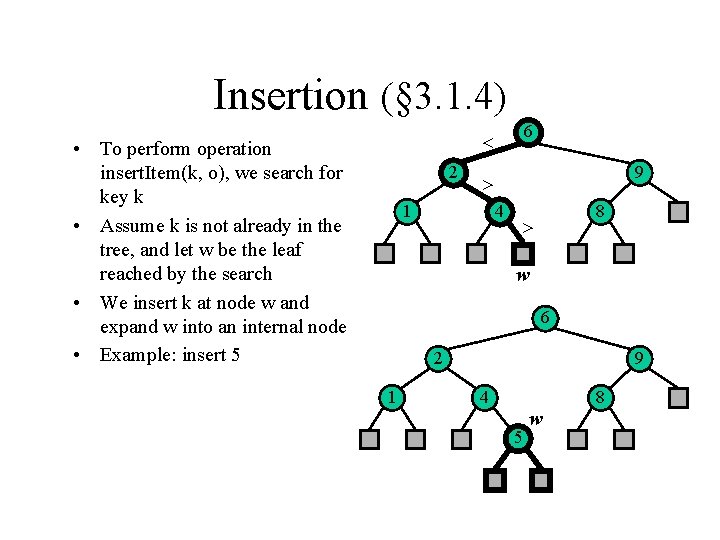
Insertion (§ 3. 1. 4) 6 < • To perform operation insert. Item(k, o), we search for key k • Assume k is not already in the tree, and let w be the leaf reached by the search • We insert k at node w and expand w into an internal node • Example: insert 5 2 9 > 1 4 8 > w 6 2 1 9 4 8 5 w
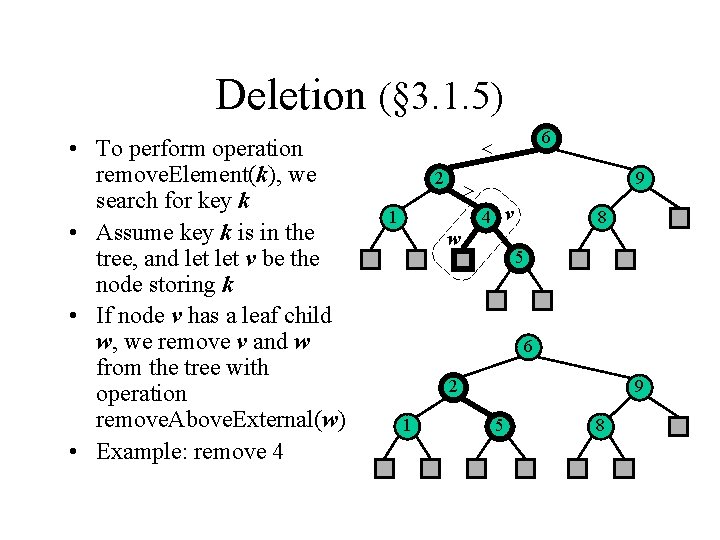
Deletion (§ 3. 1. 5) • To perform operation remove. Element(k), we search for key k • Assume key k is in the tree, and let v be the node storing k • If node v has a leaf child w, we remove v and w from the tree with operation remove. Above. External(w) • Example: remove 4 6 < 2 9 > 4 v 1 w 8 5 6 2 1 9 5 8
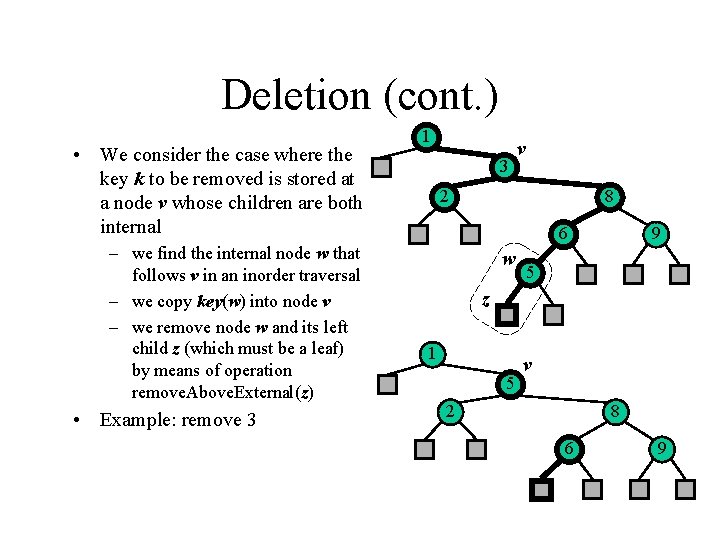
Deletion (cont. ) • We consider the case where the key k to be removed is stored at a node v whose children are both internal – we find the internal node w that follows v in an inorder traversal – we copy key(w) into node v – we remove node w and its left child z (which must be a leaf) by means of operation remove. Above. External(z) • Example: remove 3 1 3 v 2 8 6 w 9 5 z 1 5 v 2 8 6 9
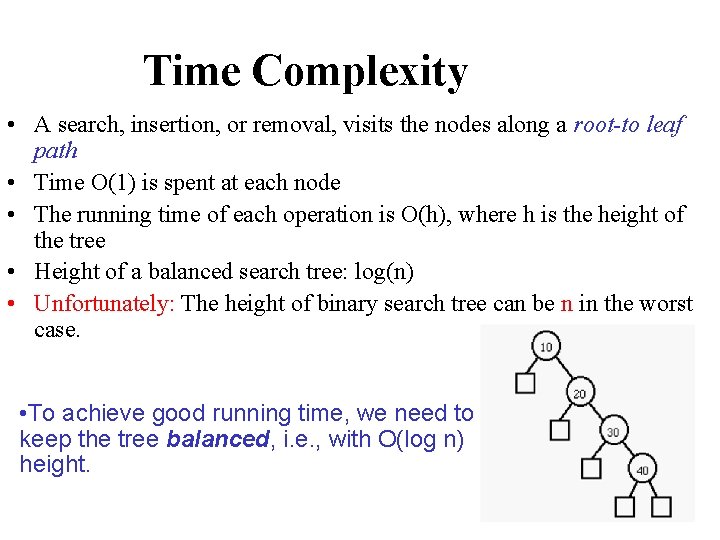
Time Complexity • A search, insertion, or removal, visits the nodes along a root-to leaf path • Time O(1) is spent at each node • The running time of each operation is O(h), where h is the height of the tree • Height of a balanced search tree: log(n) • Unfortunately: The height of binary search tree can be n in the worst case. • To achieve good running time, we need to keep the tree balanced, i. e. , with O(log n) height.
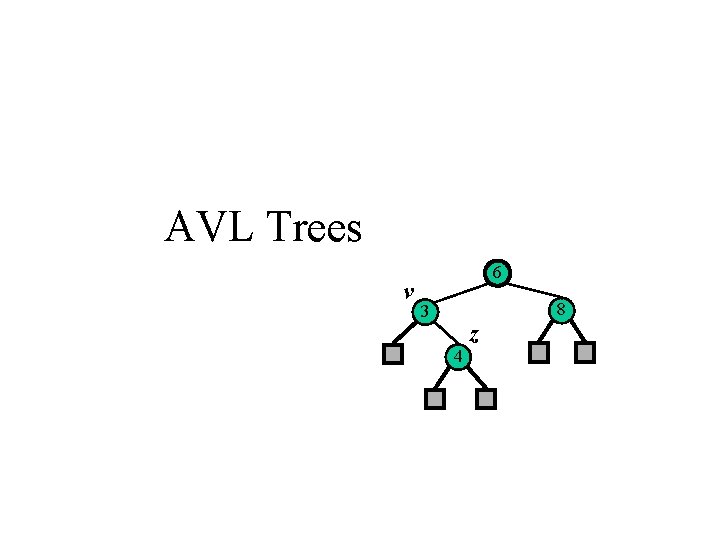
AVL Trees v 6 8 3 4 z
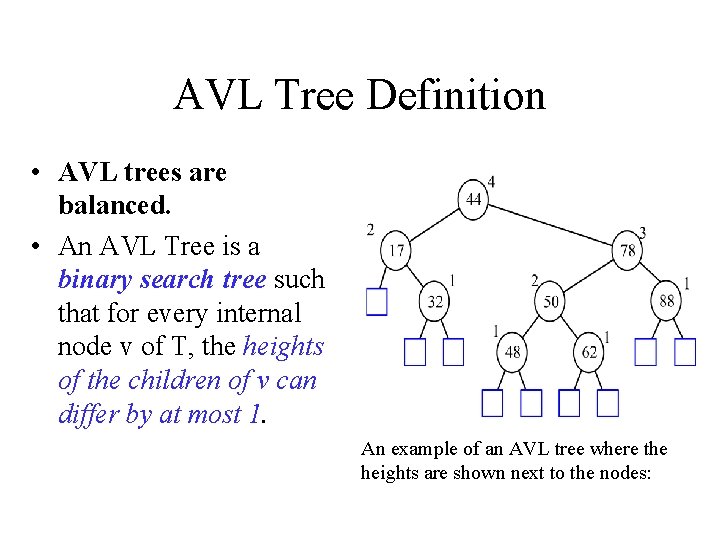
AVL Tree Definition • AVL trees are balanced. • An AVL Tree is a binary search tree such that for every internal node v of T, the heights of the children of v can differ by at most 1. An example of an AVL tree where the heights are shown next to the nodes:
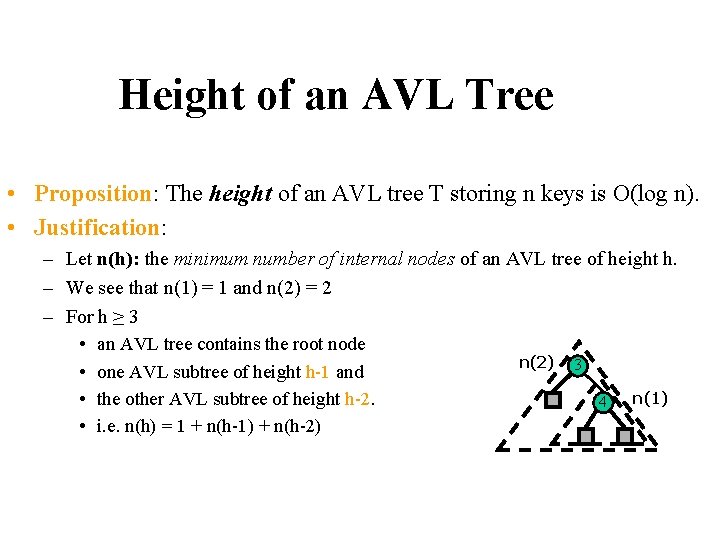
Height of an AVL Tree • Proposition: The height of an AVL tree T storing n keys is O(log n). • Justification: – Let n(h): the minimum number of internal nodes of an AVL tree of height h. – We see that n(1) = 1 and n(2) = 2 – For h ≥ 3 • an AVL tree contains the root node n(2) 3 • one AVL subtree of height h-1 and n(1) • the other AVL subtree of height h-2. 4 • i. e. n(h) = 1 + n(h-1) + n(h-2)
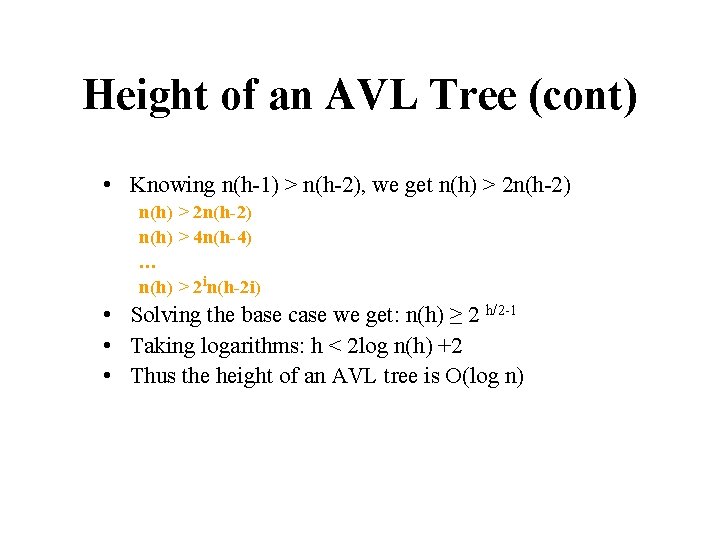
Height of an AVL Tree (cont) • Knowing n(h-1) > n(h-2), we get n(h) > 2 n(h-2) n(h) > 4 n(h-4) … n(h) > 2 in(h-2 i) • Solving the base case we get: n(h) ≥ 2 h/2 -1 • Taking logarithms: h < 2 log n(h) +2 • Thus the height of an AVL tree is O(log n)
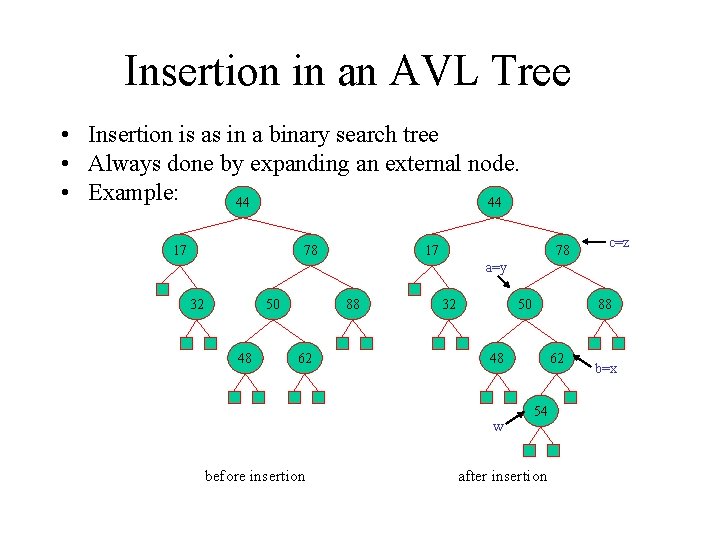
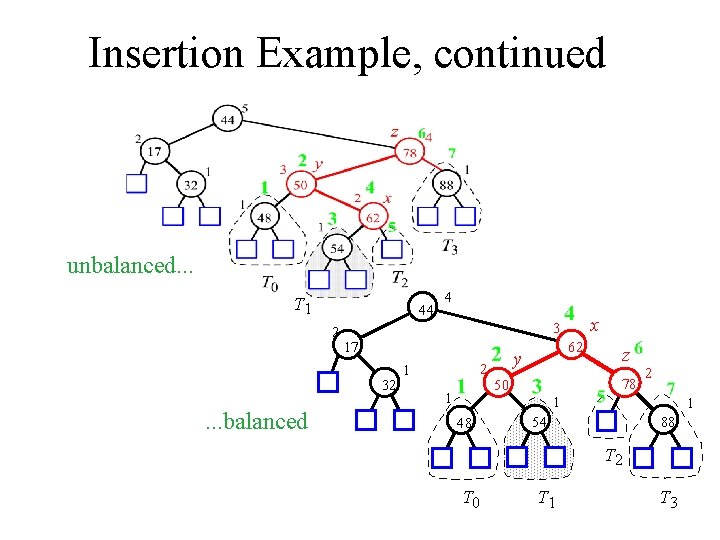
Insertion in an AVL Tree • Insertion is as in a binary search tree • Always done by expanding an external node. • Example: 44 44 17 78 c=z a=y 32 50 48 88 62 32 50 48 w before insertion 88 62 54 after insertion b=x
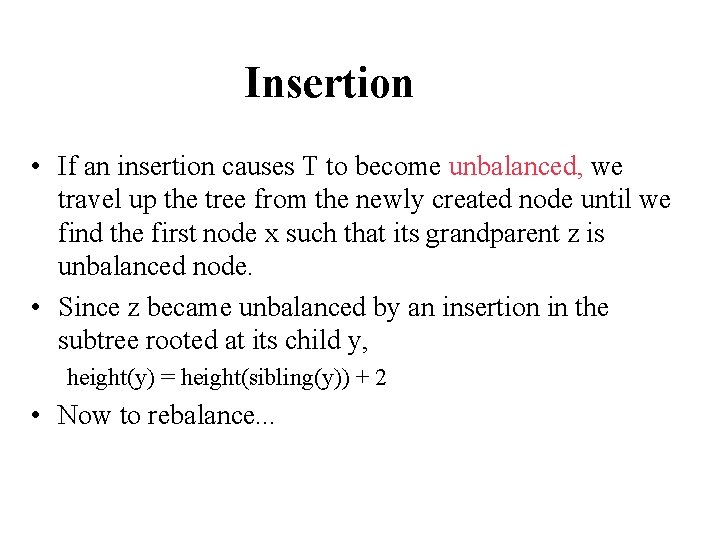
Insertion • If an insertion causes T to become unbalanced, we travel up the tree from the newly created node until we find the first node x such that its grandparent z is unbalanced node. • Since z became unbalanced by an insertion in the subtree rooted at its child y, height(y) = height(sibling(y)) + 2 • Now to rebalance. . .
Insertion: rebalancing • To rebalance the sub-tree rooted at z, we must perform a restructuring
Insertion Example, continued unbalanced. . . T 1 44 2 x 3 17 32 . . . balanced 4 2 1 1 48 62 y z 78 50 2 1 1 54 88 T 2 T 0 T 1 T 3
Restructuring (as Single Rotations) • Single Rotations: c=z single rotation b=y a=x c=z a=x T 0 T 1 T 2 T 3
Restructuring (as Double Rotations) • double rotations: double rotation c=z a=y b=x a=y c=z b=x T 0 T 1 T 3 T 2 T 0 T 1 T 2 T 3
Restructure Algorithm 1. we rename x, y, and z to a, b, and c based on the order of the nodes in an in-order traversal. 2. z is replaced by b, whose children are now a and c whose children, in turn, consist of the four other sub-trees formerly children of x, y, and z.
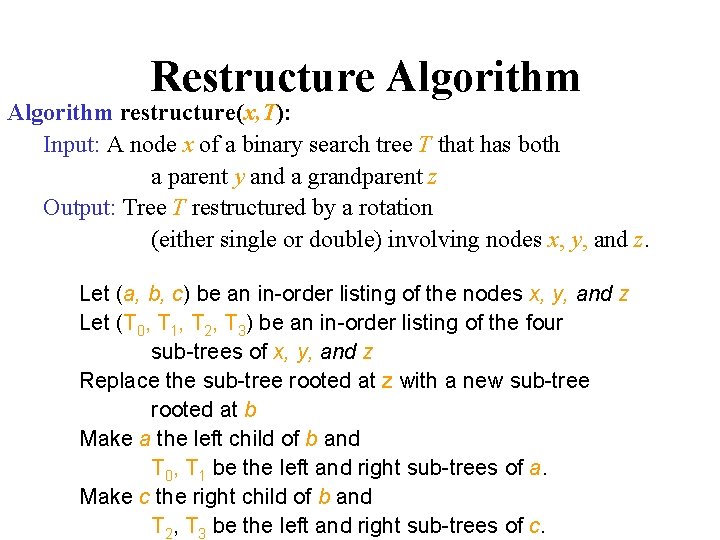
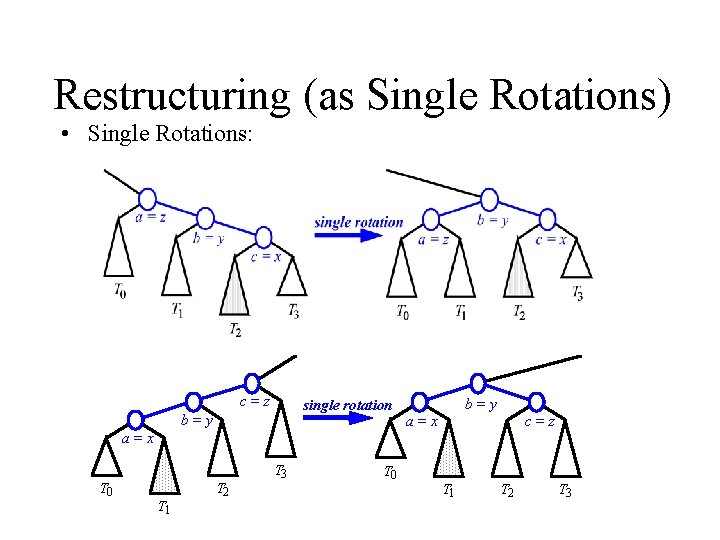
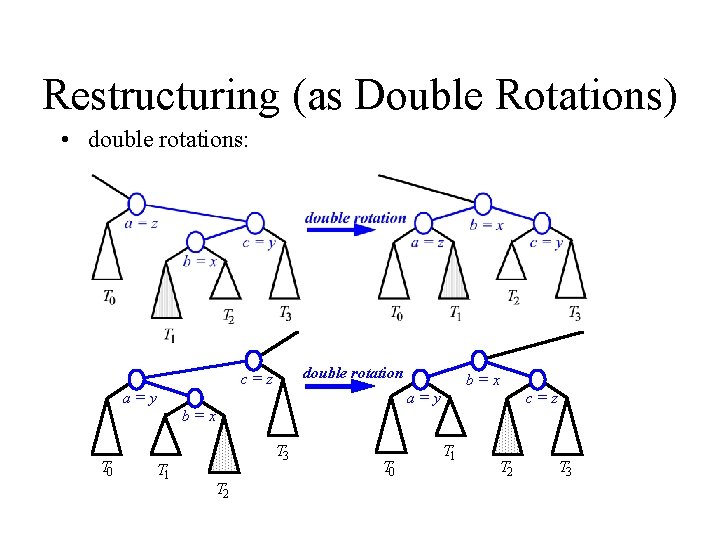
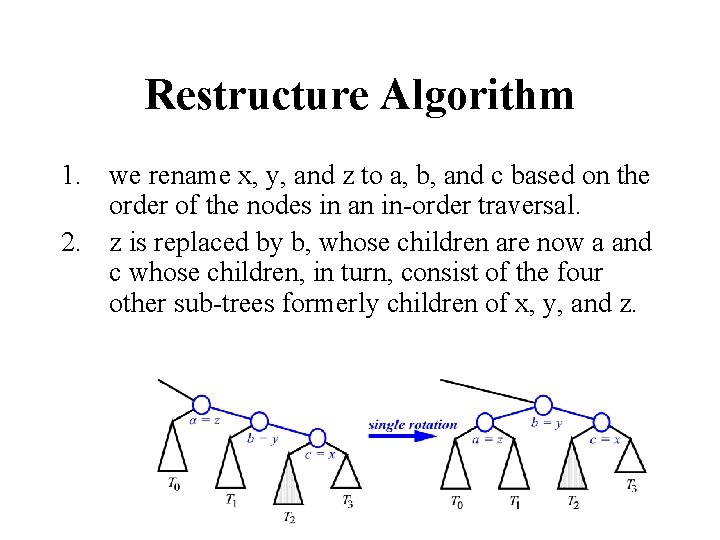
Restructure Algorithm restructure(x, T): Input: A node x of a binary search tree T that has both a parent y and a grandparent z Output: Tree T restructured by a rotation (either single or double) involving nodes x, y, and z. Let (a, b, c) be an in-order listing of the nodes x, y, and z Let (T 0, T 1, T 2, T 3) be an in-order listing of the four sub-trees of x, y, and z Replace the sub-tree rooted at z with a new sub-tree rooted at b Make a the left child of b and T 0, T 1 be the left and right sub-trees of a. Make c the right child of b and T 2, T 3 be the left and right sub-trees of c.
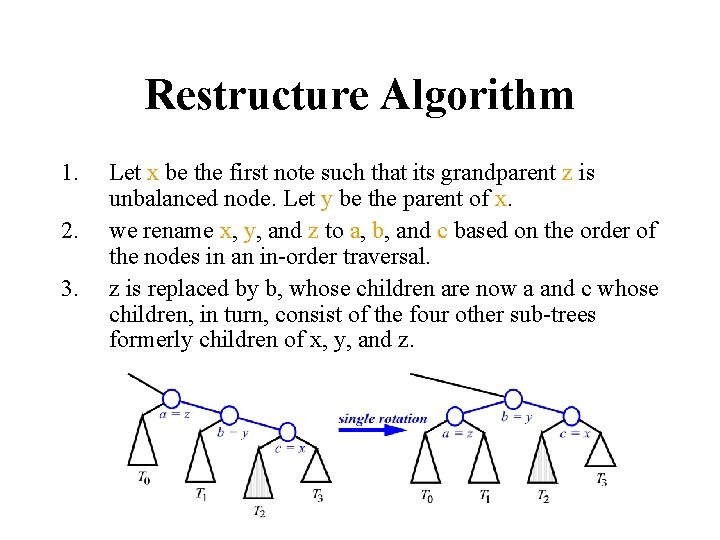
Restructure Algorithm 1. 2. 3. Let x be the first note such that its grandparent z is unbalanced node. Let y be the parent of x. we rename x, y, and z to a, b, and c based on the order of the nodes in an in-order traversal. z is replaced by b, whose children are now a and c whose children, in turn, consist of the four other sub-trees formerly children of x, y, and z.
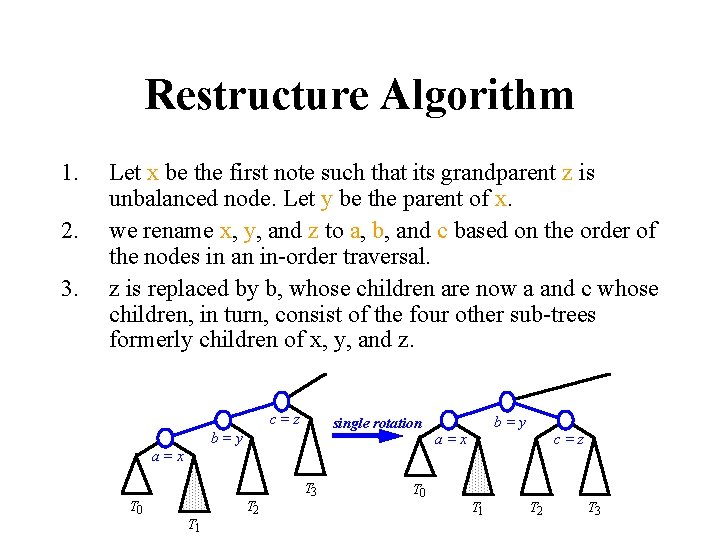
Restructure Algorithm 1. 2. 3. Let x be the first note such that its grandparent z is unbalanced node. Let y be the parent of x. we rename x, y, and z to a, b, and c based on the order of the nodes in an in-order traversal. z is replaced by b, whose children are now a and c whose children, in turn, consist of the four other sub-trees formerly children of x, y, and z. c=z single rotation b=y a=x c=z a=x T 0 T 1 T 2 T 3
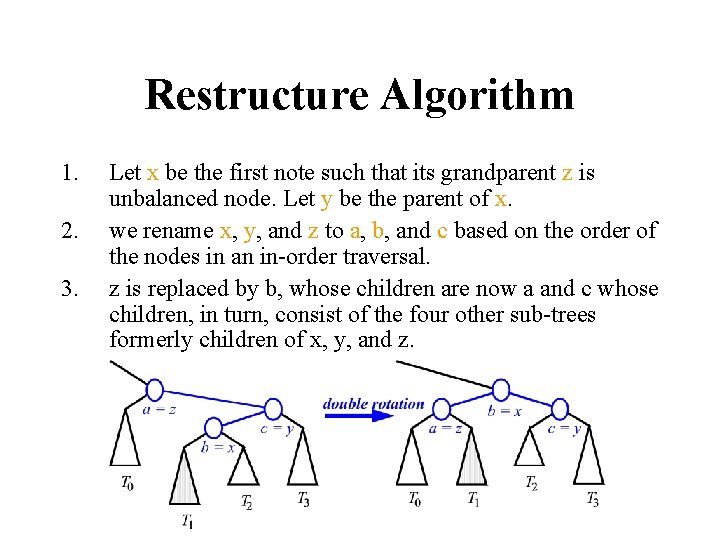
Restructure Algorithm 1. 2. 3. Let x be the first note such that its grandparent z is unbalanced node. Let y be the parent of x. we rename x, y, and z to a, b, and c based on the order of the nodes in an in-order traversal. z is replaced by b, whose children are now a and c whose children, in turn, consist of the four other sub-trees formerly children of x, y, and z.
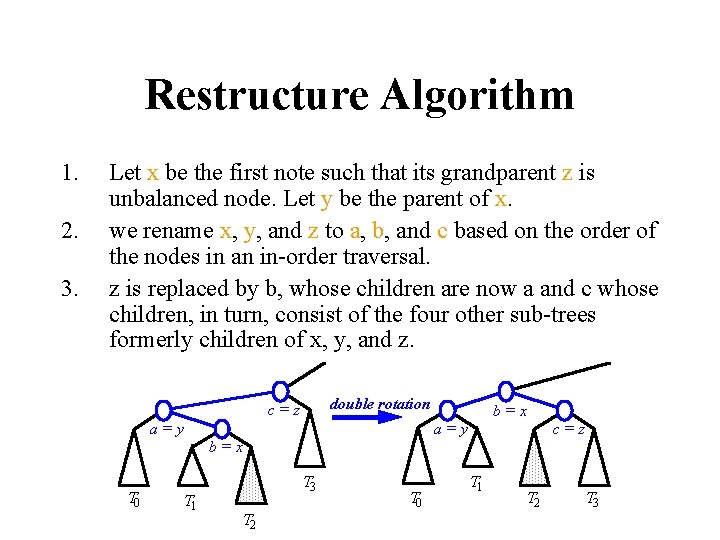
Restructure Algorithm 1. 2. 3. Let x be the first note such that its grandparent z is unbalanced node. Let y be the parent of x. we rename x, y, and z to a, b, and c based on the order of the nodes in an in-order traversal. z is replaced by b, whose children are now a and c whose children, in turn, consist of the four other sub-trees formerly children of x, y, and z. double rotation c=z a=y b=x a=y c=z b=x T 0 T 1 T 3 T 2 T 0 T 1 T 2 T 3
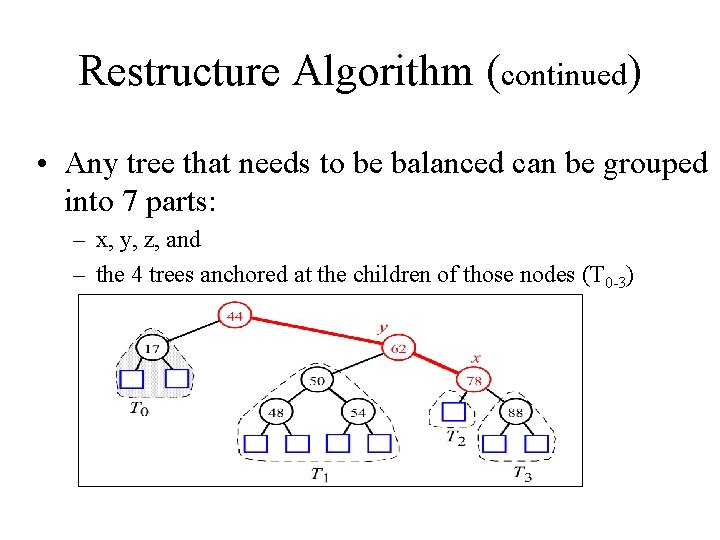
Restructure Algorithm (continued) • Any tree that needs to be balanced can be grouped into 7 parts: – x, y, z, and – the 4 trees anchored at the children of those nodes (T 0 -3)
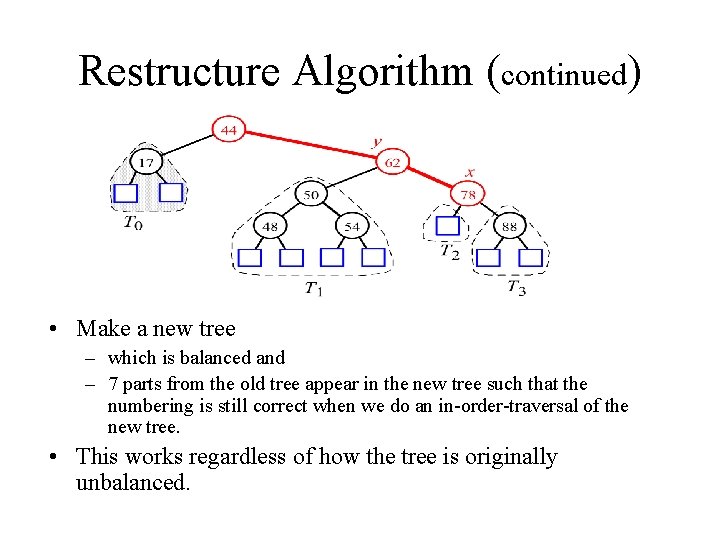
Restructure Algorithm (continued) • Make a new tree – which is balanced and – 7 parts from the old tree appear in the new tree such that the numbering is still correct when we do an in-order-traversal of the new tree. • This works regardless of how the tree is originally unbalanced.
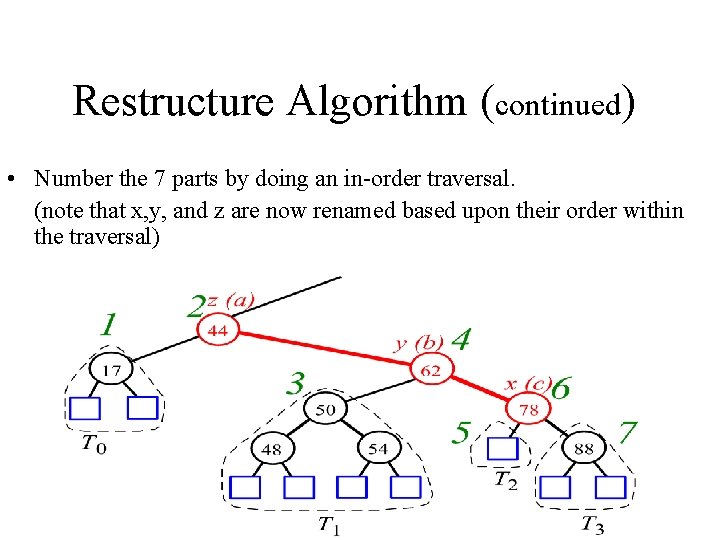
Restructure Algorithm (continued) • Number the 7 parts by doing an in-order traversal. (note that x, y, and z are now renamed based upon their order within the traversal)
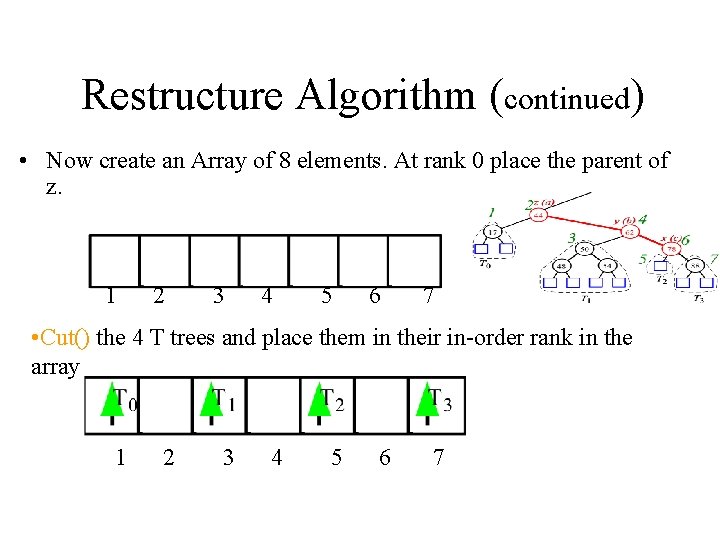
Restructure Algorithm (continued) • Now create an Array of 8 elements. At rank 0 place the parent of z. 1 2 3 4 5 6 7 • Cut() the 4 T trees and place them in their in-order rank in the array 1 2 3 4 5 6 7
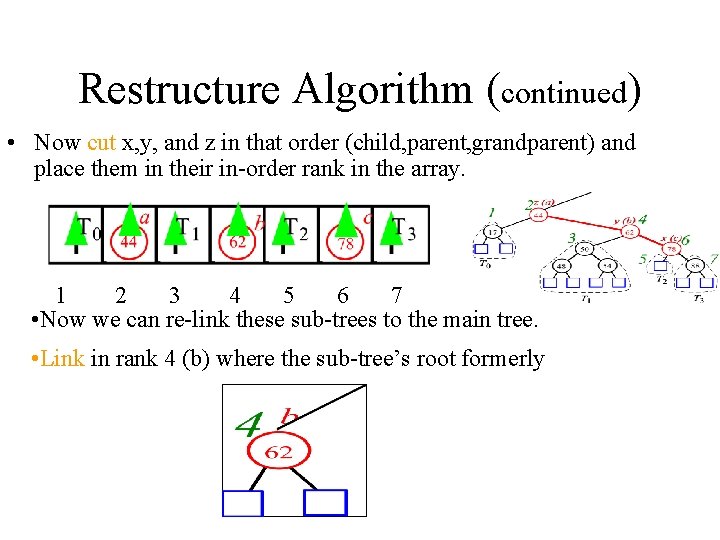
Restructure Algorithm (continued) • Now cut x, y, and z in that order (child, parent, grandparent) and place them in their in-order rank in the array. 1 2 3 4 5 6 7 • Now we can re-link these sub-trees to the main tree. • Link in rank 4 (b) where the sub-tree’s root formerly
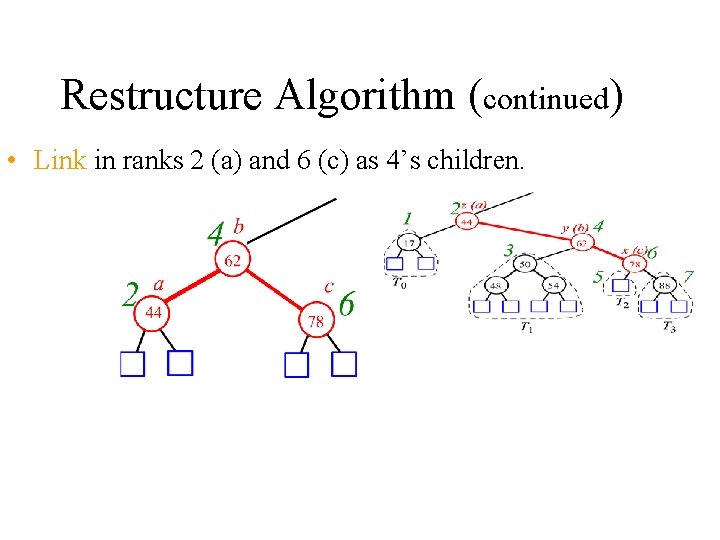
Restructure Algorithm (continued) • Link in ranks 2 (a) and 6 (c) as 4’s children.
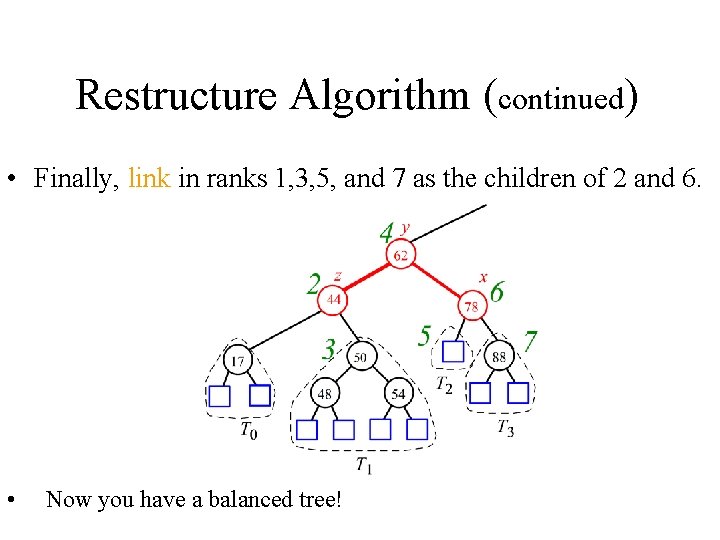
Restructure Algorithm (continued) • Finally, link in ranks 1, 3, 5, and 7 as the children of 2 and 6. • Now you have a balanced tree!
Restructure Algorithm (continued) • NOTE: – This algorithm for restructuring has the exact same effect as using the four rotation cases discussed earlier. – Advantages: no case analysis, more elegant
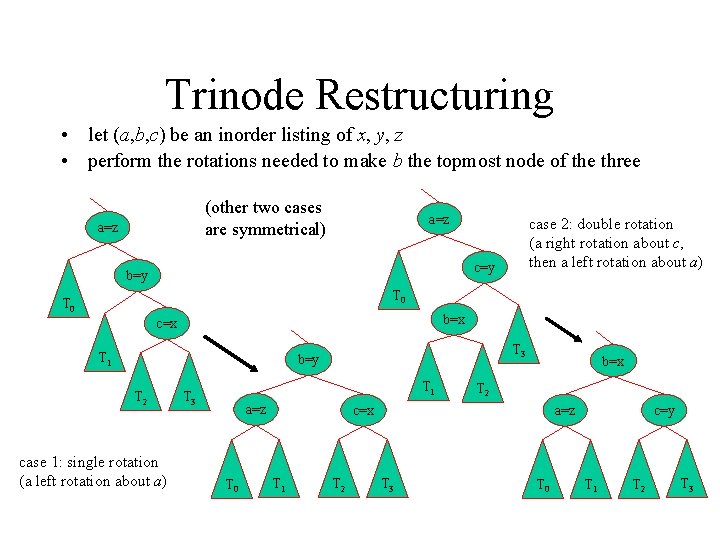
Trinode Restructuring • let (a, b, c) be an inorder listing of x, y, z • perform the rotations needed to make b the topmost node of the three (other two cases are symmetrical) a=z case 2: double rotation (a right rotation about c, then a left rotation about a) c=y b=y T 0 b=x c=x T 1 T 3 b=y T 2 case 1: single rotation (a left rotation about a) T 1 T 3 a=z T 0 b=x T 2 c=x T 1 T 2 a=z T 3 T 0 c=y T 1 T 2 T 3
Removal • We can easily see that performing a remove. Above. External(w) can cause T to become unbalanced. • Let z be the first unbalanced node encountered while traveling up the tree from w. Also, let y be the child of z with the larger height, and let x be the child of y with the larger height. • We can perform operation restructure(x) to restore balance at the sub-tree rooted at z.
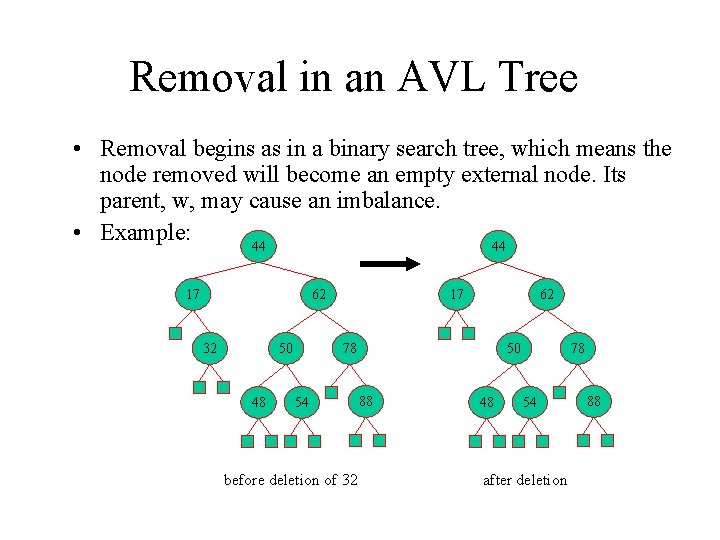
Removal in an AVL Tree • Removal begins as in a binary search tree, which means the node removed will become an empty external node. Its parent, w, may cause an imbalance. • Example: 44 44 17 62 32 50 48 17 62 78 54 before deletion of 32 50 88 48 78 54 after deletion 88
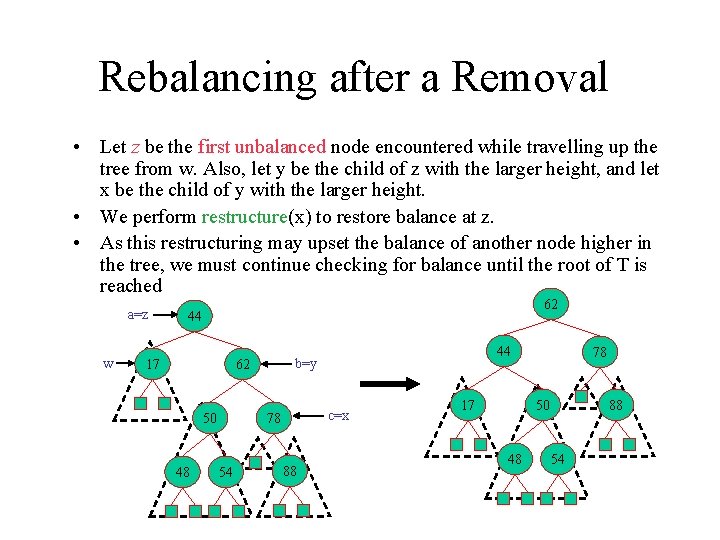
Rebalancing after a Removal • Let z be the first unbalanced node encountered while travelling up the tree from w. Also, let y be the child of z with the larger height, and let x be the child of y with the larger height. • We perform restructure(x) to restore balance at z. • As this restructuring may upset the balance of another node higher in the tree, we must continue checking for balance until the root of T is reached a=z w 62 44 17 b=y 62 50 48 c=x 78 54 44 88 17 78 50 48 88 54
Running Times for AVL Trees • a single restructure is O(1) – using a linked-structure binary tree • find is O(log n) – height of tree is O(log n), no restructures needed • insert is O(log n) – initial find is O(log n) – Restructuring up the tree, maintaining heights is O(log n) • remove is O(log n) – initial find is O(log n) – Restructuring up the tree, maintaining heights is O(log n)
Removal (contd. ) • NOTE: restructuring may upset the balance of another node higher in the tree, we must continue checking for balance until the root of T is reached
Running Times for AVL Trees • a single restructure is O(1) – using a linked-structure binary tree • find is O(log n) – height of tree is O(log n), no restructures needed • insert is O(log n) – initial find is O(log n) – Restructuring up the tree, maintaining heights is O(log n) – One restructuring is sufficient to restore the global height balance property • remove is O(log n) – initial find is O(log n) – Restructuring up the tree, maintaining heights is O(log n) – Single re-structuring is not enough to restore height balance globally. Continue walking up the tree for unbalanced nodes.
- Slides: 85