
Intrusion Detection From the book Computer Security Principles
Intrusion Detection From the book: Computer Security: Principles and Practice by Stalllings and Brown CS 432/532 – Computer and Network Security Sabancı University
Intruders n significant problem of networked systems ¨ hostile/unwanted trespass ¨ from benign to serious n user trespass ¨ unauthorized n software trespass ¨ virus, n logon, privilege abuse worm, or trojan horse classes of intruders: ¨ masquerader, misfeasor, clandestine user
Security Intrusion and Intrusion Detection – Def’ns from RFC 2828 Security Intrusion a security event, or combination of multiple security events, that constitutes a security incident in which an intruder gains, or attempts to gain, access to a system (or system resource) without having authorization to do so. Intrusion Detection a security service that monitors and analyzes system events for the purpose of finding, and providing realtime or near real-time warning of attempts to access system resources in an unauthorized manner.
Examples of Intrusion n n n remote root compromise web server defacement guessing / cracking passwords copying / viewing sensitive data / databases running a packet sniffer to obtain username/passwords impersonating a user to reset/learn password ¨ Mostly n via social engineering using an unattended and logged-in workstation
Intruder Types and Behaviors n Three broad categories ¨ Hackers ¨ Criminals ¨ Insiders
Hackers n motivated by “thrill” and “status/reputation” ¨ hacking community a strong meritocracy ¨ status is determined by level of competence n benign intruders might be tolerable ¨ do consume resources and may slow performance ¨ can’t know in advance whether benign or malign n What to do ¨ IDS (Intrusion Detection Systems), IPS (Intsrusion Prevention System), VPNs can help to counter n Awareness of intruder problems led to establishment of CERTs ¨ Computer Emergency Response Teams ¨ collect / disseminate vulnerability info / responses
Criminals / Criminal Enterprises n n Here the main motivation is to make money Now the common threat is “organized groups of hackers” ¨ May be employed by a corporation / government ¨ Moslty loosely affiliated gangs ¨ Typically young ¨ often from Eastern European, Russian, Southeast n n n Asia common target is financial institutions and credit cards on e-commerce server criminal hackers usually have specific targets once penetrated act quickly and get out IDS may help but less effective due to quick-in-and -out strategy sensitive data needs strong data protection (e. g. credit card numbers)
Insider Attacks n Most difficult to detect and prevent ¨ employees n have access & systems knowledge Attackers are motivated by revenge / entitlement ¨ when employment terminated ¨ taking customer data when move to competitor n IDS/IPS may help but also need extra precautions ¨ least privilege (need to know basis) ¨ monitor logs ¨ Upon termination revoke all rights and network access
Insider Behavior Example 1. 2. 3. 4. 5. 6. create accounts for themselves and their friends access accounts and applications they wouldn't normally use for their daily jobs conduct furtive instant-messaging chats visit web sites that cater to disgruntled employees perform large downloads and file copying access the network during off hours.
Intrusion Detection Systems (IDS) n IDS classification ¨ Host-based IDS: monitor single host activity ¨ Network-based IDS: monitor network traffic n logical components: ¨ Sensors n collect data from various sources such as log files, network packets n sends them to the analyzer ¨ Analyzers n process data from sensors and determine if intrusion has occurred n may also provide actions to take ¨ user interface n view the output and manage the behavior
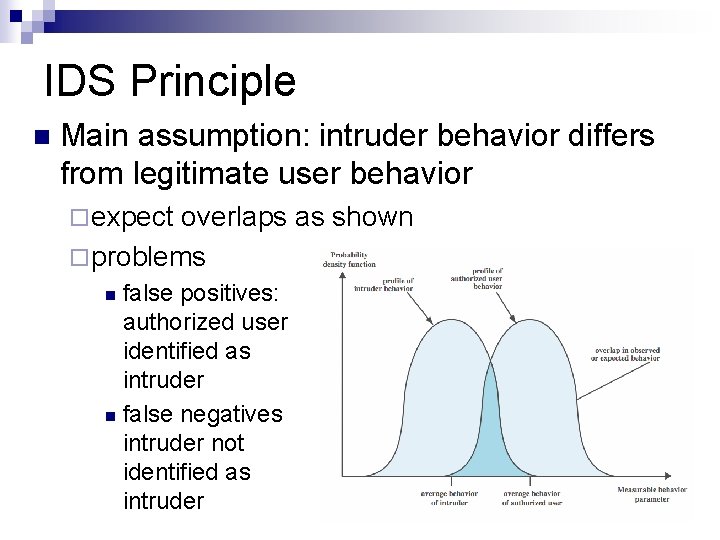
IDS Principle n Main assumption: intruder behavior differs from legitimate user behavior ¨ expect overlaps as shown ¨ problems false positives: authorized user identified as intruder n false negatives intruder not identified as intruder n
IDS Requirements run continually with minimal human supervision n be fault tolerant n resist subversion n minimal overhead on system n scalable n configured according to system security policies n allow dynamic reconfiguration n
Host-Based IDS n specialized software to monitor system activity to detect suspicious behavior ¨ primary purpose is to detect intrusions, log suspicious events, and send alerts ¨ can detect both external and internal intrusions n two approaches, often used in combination: ¨ anomaly detection n collection of data relating to the behavior of legitimate users n Statistical tests are applied to observed behavior ¨ threshold detection – applies to all users ¨ profile based – differs among the users ¨ signature detection n attack patterns are defined and they are used to decide on intrusion
Audit Records A fundamental tool for intrusion detection n Two variants: n ¨ Native n audit records - provided by O/S always available but may not contain enough info ¨ Detection-specific audit records collects information required by IDS n additional overhead but specific to IDS task n
Anomaly Detection n Threshold detection ¨ Checks excessive event occurrences over time ¨ Crude and ineffective intruder detector per se ¨ Creates lots of false positives/negatives due to n n n Variance in time Variance accross users Profile based ¨ Characterize past behavior of users and groups ¨ Then, detect significant deviations ¨ Based on analysis of audit records n example metrics: counter, guage, interval timer, resource utilization n analysis methods: mean and standard deviation, multivariate, markov process, time series (next slide)
Profile based Anomaly Detection - Analysis Methods n Mean and standard deviation ¨ of a particular ¨ Not good (too n parameter crude) Multivariate analysis ¨ Correlations among several parameters (ex. relation between login freq. and session time) n Markov process ¨ Considers n transition probabilities Time series analysis ¨ Analyze time intervals to see sequences of events happening rapidly or slowly n All statistical methods using AI, Mach. Learning and Data Mining techniques.
Signature Detection Observe events on system and applying a set of rules to decide if intruder n Approaches: n ¨ rule-based anomaly detection n analyze historical audit records for expected behavior, then match with current behavior ¨ rule-based penetration identification n rules identify known penetrations or possible penetrations due to known weaknesses n Mostly OS specific n Rules obtained by analyzing attack scripts from Internet ¨ supplemented with rules from security experts
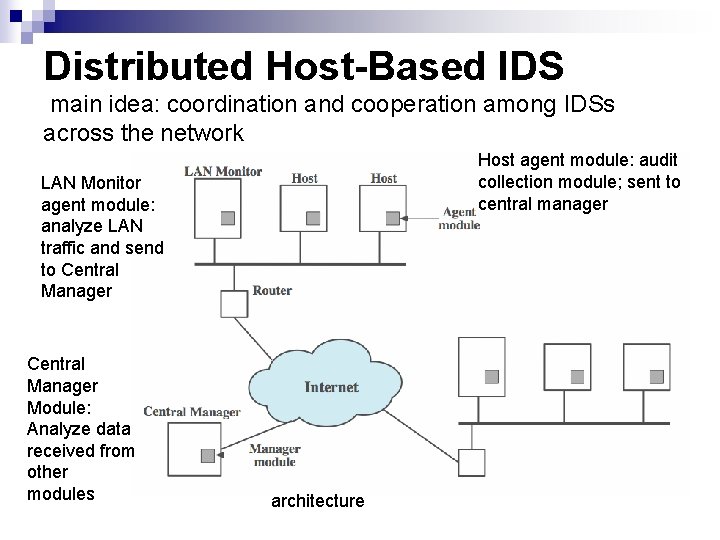
Distributed Host-Based IDS main idea: coordination and cooperation among IDSs across the network Host agent module: audit collection module; sent to central manager LAN Monitor agent module: analyze LAN traffic and send to Central Manager Module: Analyze data received from other modules architecture
Network-Based IDS n network-based IDS (NIDS) ¨ monitor traffic at selected points on a network to detect intrusion patterns n in (near) real-time ¨ may examine network, transport and/or application level protocol activity directed toward the system to be protected n n Only network packets, no software activity examined System components ¨A number of sensors to monitor packet traffic ¨ Management server(s) with console (GUI) n Analysis can be done at sensors, at managements servers or both
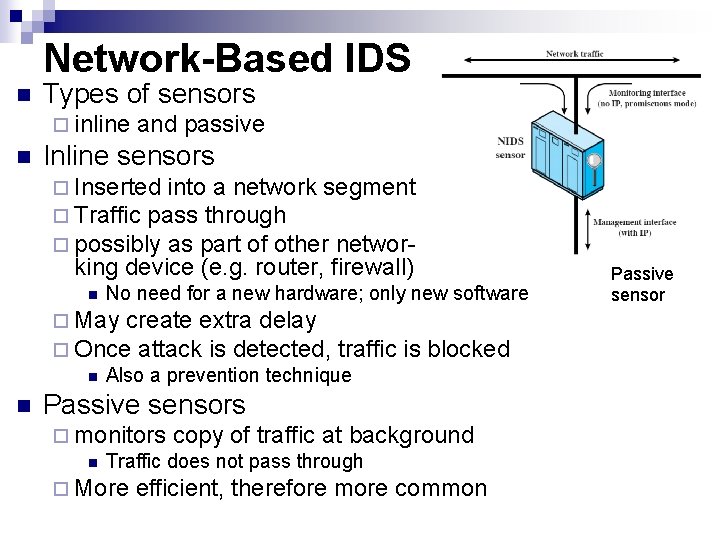
Network-Based IDS n Types of sensors ¨ inline n and passive Inline sensors ¨ Inserted into a network segment ¨ Traffic pass through ¨ possibly as part of other networ- king device (e. g. router, firewall) n No need for a new hardware; only new software ¨ May create extra delay ¨ Once attack is detected, traffic n Also a prevention technique n is blocked Passive sensors ¨ monitors copy of traffic at background n Traffic does not pass through ¨ More efficient, therefore more common Passive sensor
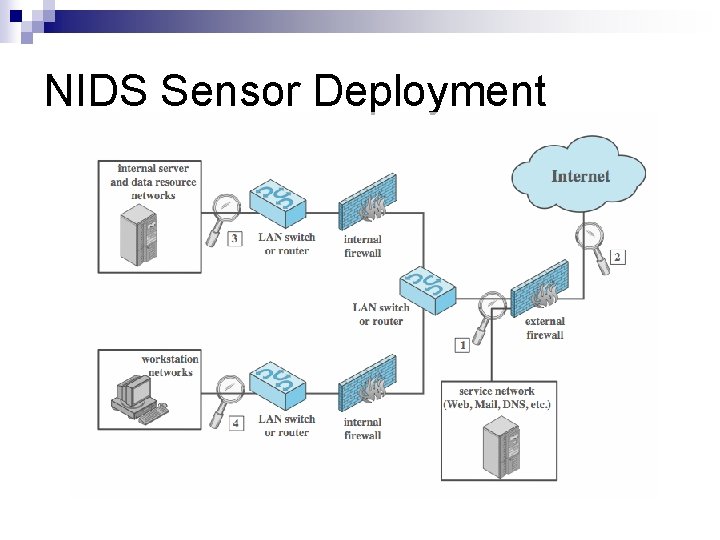
NIDS Sensor Deployment
Intrusion Detection Techniques n signature detection ¨ at application (mostly), transport, and network layers n anomaly detection – attacks that cause abnormal behaviors are detected ¨ denial n of service attacks, scanning attacks when potential violation detected, sensor sends an alert and logs information
Honeypots n Decoy systems ¨ filled n n with fabricated info appers to be the real system with valuable info legitimate users would not access ¨ instrumented with monitors and event loggers ¨ divert and hold attacker to collect activity info ¨ without exposing production systems n If there is somebody in, then there is an attack ¨ benign n or malicious Initially honeypots were single computer ¨ now networks that emulate entire networks
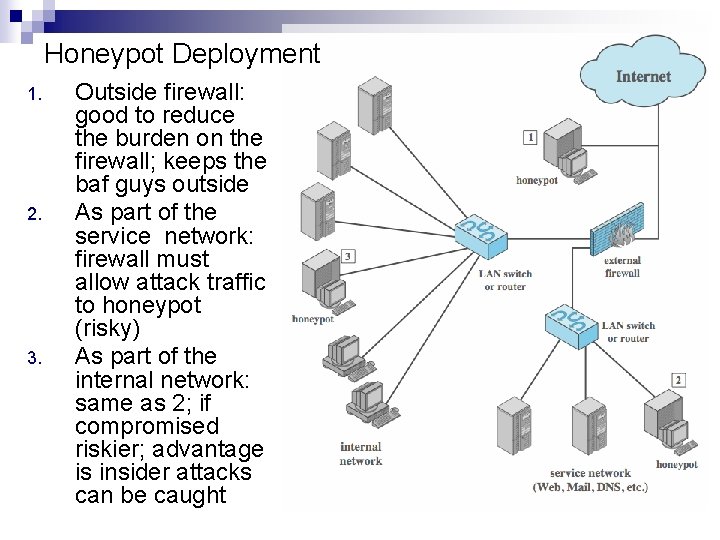
Honeypot Deployment 1. 2. 3. Outside firewall: good to reduce the burden on the firewall; keeps the baf guys outside As part of the service network: firewall must allow attack traffic to honeypot (risky) As part of the internal network: same as 2; if compromised riskier; advantage is insider attacks can be caught
An Example System: Snort n Lightweight IDS ¨ open source ¨ Portable, efficient ¨ easy deployment and configuration ¨ May work in host-based and network-based manner n Snort can perform ¨ real-time packet capture and rule analysis Sensors can be inline or passive n Snort can also be used as IPS n
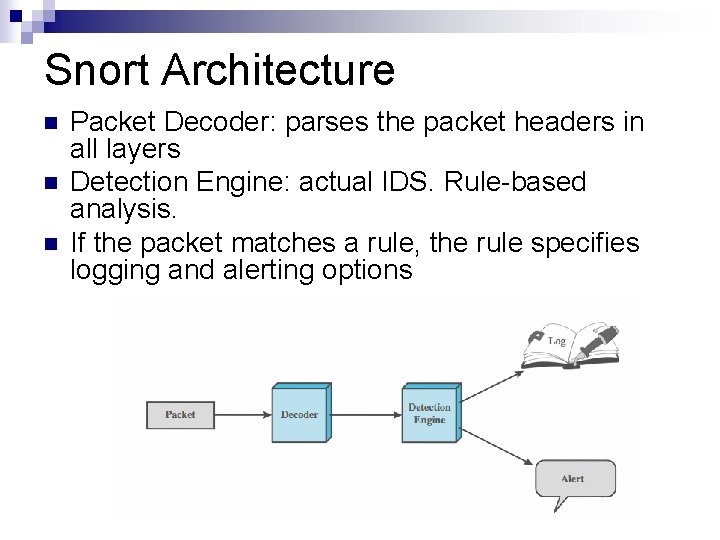
Snort Architecture n n n Packet Decoder: parses the packet headers in all layers Detection Engine: actual IDS. Rule-based analysis. If the packet matches a rule, the rule specifies logging and alerting options
SNORT Rules n Snort use a simple, flexible and effective rule definition language ¨ But n n needs training to be an expert on it Each rule has a fixed header and 0 or more options Header fields ¨ action: what to do if matches – alert, drop, pass, etc. ¨ protocol: analyze further if matches - IP, ICMP, TCP, UDP ¨ source IP: single, list, any, negation ¨ source port: TCP or UDP port; single, list, any, negation ¨ direction: unidirectional (->) or bidirectional (<->). ¨ dest IP, dest port: same format as sources
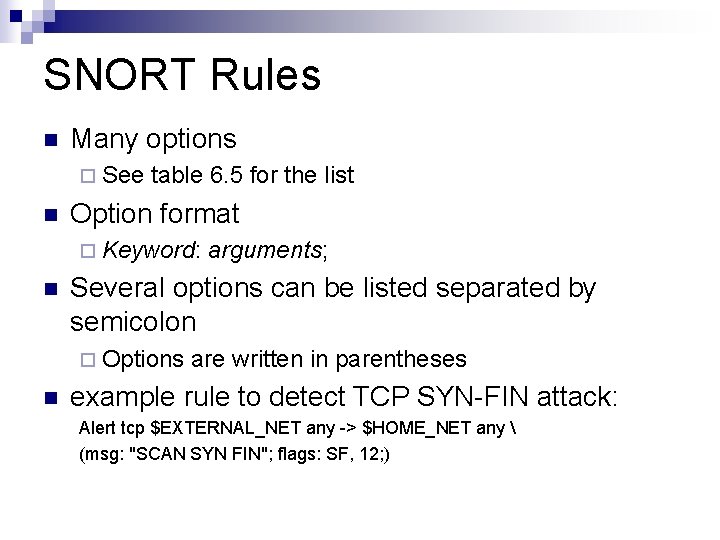
SNORT Rules n Many options ¨ See n table 6. 5 for the list Option format ¨ Keyword: n Several options can be listed separated by semicolon ¨ Options n arguments; are written in parentheses example rule to detect TCP SYN-FIN attack: Alert tcp $EXTERNAL_NET any -> $HOME_NET any (msg: "SCAN SYN FIN"; flags: SF, 12; )
Intrusion Prevention Systems (IPS) (Section 9. 6) n n Recent addition to terminology of security products Two Interpretations of IPS ¨ inline network or host-based IDS that can block traffic ¨ functional n An IPS can block traffic like a firewall, but using IDS algorithms ¨ may n addition IDS capabilities to firewalls be network or host based Inline Snort is actually an IPS
- Slides: 29