
INTRODUCTORY STATISTICS Chapter 3 PROBABILITY TOPICS CHAPTER 3

INTRODUCTORY STATISTICS Chapter 3 PROBABILITY TOPICS
CHAPTER 3: PROBABILITY TOPICS 3. 1 Terminology 3. 2 Independent and Mutually Exclusive Events 3. 3 Two Basic Rules of Probability 3. 4 Contingency Tables 3. 5 Tree and Venn Diagrams
CHAPTER OBJECTIVES By the end of this chapter, the student should be able to: • Understand use the terminology of probability. • Determine whether two events are mutually exclusive and whether two events are independent. • Calculate probabilities using the Addition Rules and Multiplication Rules. • Construct and interpret Contingency Tables. • Construct and interpret Venn Diagrams. • Construct and interpret Tree Diagrams.
1) Raise your hand if you have any change in your pocket or purse. number of raised hands 2) Raise your hand if you bought something from the vending machines in the past month. number of raised hands 3) Raise your hand if you answered "yes" to BOTH of the first two questions. number of raised hands Use the class data as estimates of the following probabilities: a) Find P(change). b) Find P(vending machine). c) Find P(change AND vending machine). d) Find P(change|vending machine). Find the probability that a randomly chosen student has change given that he or she bought from a vending machine in the past month.
3. 1 TERMINOLOGY Probability is a measure that is associated with how certain we are of outcomes of a particular experiment or activity. • An experiment is a planned operation carried out under controlled conditions. If the result is not predetermined, then the experiment is said to be a chance experiment. Flipping one fair coin twice is an example of an experiment. • A result of an experiment is called an outcome. • The sample space of an experiment is the set of all possible outcomes. • Three ways to represent a sample space are: 1) to list the possible outcomes 2) to create a tree diagram 3) to create a Venn diagram. • The uppercase letter S is used to denote the sample space.
MORE TERMINOLOGY • An event is any combination of outcomes. Upper case letters like A and B represent events. For example, if the experiment is to flip one fair coin, event A might be getting at most one head. The probability of an event A is written P(A). • The probability of any outcome is the long-term relative frequency of that outcome. • Probabilities are between zero and one, inclusive (that is, zero and one and all numbers between these values). • P(A) = 0 means the event A can never happen. • P(A) = 1 means the event A always happens. • P(A) = 0. 5 means the event A is equally likely to occur or not to occur. • For example, if you flip one fair coin repeatedly (from 20 to 2, 000 to 20, 000 times) the relative frequency of heads approaches 0. 5 (the probability of heads).
Theoretical probability – the likeliness of an event happening based on all possible outcomes. Sometimes called the expected probability. Empirical probability – the observed probability based on sample data. Sometimes called experimental probability.
EQUALLY LIKELY EVENTS • Equally likely means that each outcome of an experiment occurs with equal probability. Examples: • If you toss a fair, six-sided die, each face (1, 2, 3, 4, 5, or 6) is as likely to occur as any other face. • If you toss a fair coin, a Head (H) and a Tail (T) are equally likely to occur. • If you randomly guess the answer to a true/false question on an exam, you are equally likely to select a correct answer or an incorrect answer.
To calculate the probability of an event A when all outcomes in the sample space are equally likely, count the number of outcomes for event A and divide by the total number of outcomes in the sample space. For example, if you toss a fair dime and a fair nickel, the sample space is {HH, HT, TH, TT} where H = heads and T = tails. The sample space has 4 outcomes. If A = getting one tail, find the P(A). There are two outcomes that meet this condition {HT, TH}, so P(A) = 2/4 = 0. 5.
LAW OF LARGE NUMBERS The law of large numbers states that as the number of repetitions of an experiment is increased, the relative frequency obtained in the experiment tends to become closer and closer to theoretical probability. • Example: Suppose you roll one fair six-sided die, with the numbers {1, 2, 3, 4, 5, 6} on its faces. Let event E = rolling a number that is at least five. There are two outcomes {5, 6} so P(E) = 2/6. If you were to roll the die only a few times, you would not be surprised if your observed results did not match the probability. If you were to roll the die a very large number of times, you would expect that, overall, 2/6 of the rolls would result in an outcome of "at least five". You would not expect exactly 2/6. The long-term relative frequency of obtaining this result would approach theoretical probability of 2/6 as the number of repetitions grows larger and larger.
“OR”, “AND” "OR" Event: • An outcome is in the event A OR B if the outcome is in A or is in B or is in both A and B. For example, let A = {1, 2, 3, 4, 5} and B = {4, 5, 6, 7, 8}. A OR B = {1, 2, 3, 4, 5, 6, 7, 8}. Notice that 4 and 5 are NOT listed twice. "AND" Event: • An outcome is in the event A AND B if the outcome is in both A and B at the same time. For example, let A = {1, 2, 3, 4, 5} and B = {4, 5, 6, 7, 8}, Then A AND B = {4, 5}.
COMPLEMENT The complement of event A is denoted A′ (read "A prime"). A′ consists of all outcomes that are NOT in A. • For example, let S = {1, 2, 3, 4, 5, 6} and let A = all numbers no more than 4. A = {1, 2, 3, 4}. Then, A′ = {5, 6}. P(A) = 4/6, P(A′) = 2/6 P(A) + P(A′) = 4/6+ 2/6 = 1 Notice that P(A) + P(A′) = 1.
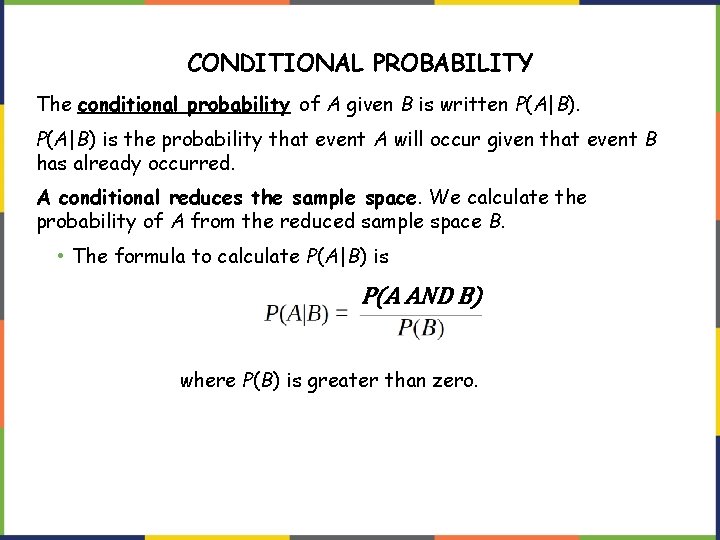
CONDITIONAL PROBABILITY The conditional probability of A given B is written P(A|B) is the probability that event A will occur given that event B has already occurred. A conditional reduces the sample space. We calculate the probability of A from the reduced sample space B. • The formula to calculate P(A|B) is P(A AND B) where P(B) is greater than zero.
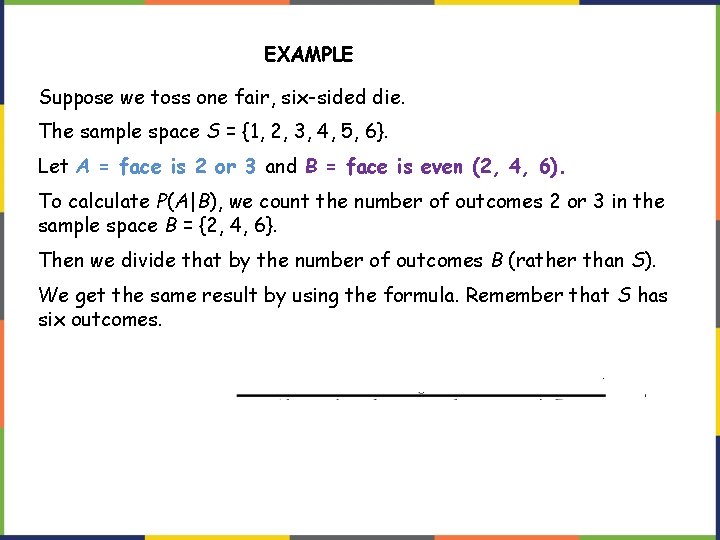
EXAMPLE Suppose we toss one fair, six-sided die. The sample space S = {1, 2, 3, 4, 5, 6}. Let A = face is 2 or 3 and B = face is even (2, 4, 6). To calculate P(A|B), we count the number of outcomes 2 or 3 in the sample space B = {2, 4, 6}. Then we divide that by the number of outcomes B (rather than S). We get the same result by using the formula. Remember that S has six outcomes.
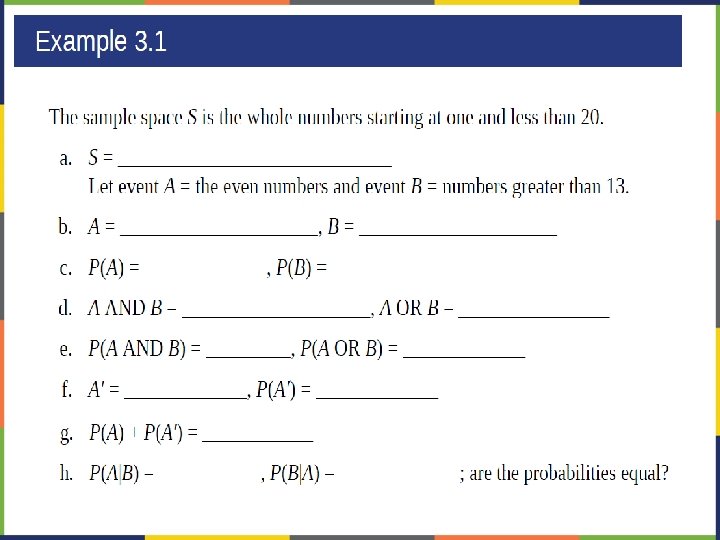
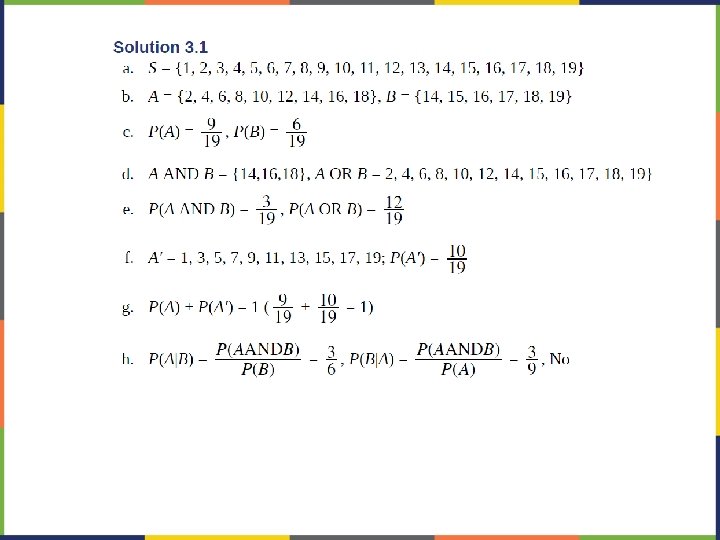
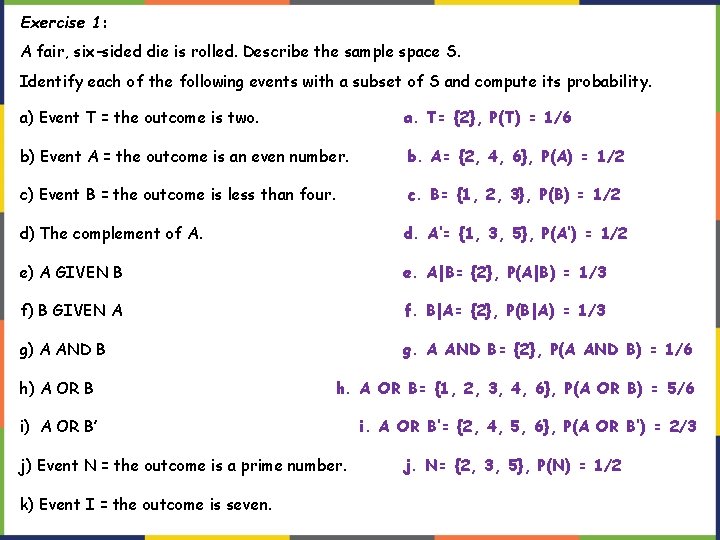
Exercise 1: A fair, six-sided die is rolled. Describe the sample space S. Identify each of the following events with a subset of S and compute its probability. a) Event T = the outcome is two. a. T= {2}, P(T) = 1/6 b) Event A = the outcome is an even number. b. A= {2, 4, 6}, P(A) = 1/2 c) Event B = the outcome is less than four. c. B= {1, 2, 3}, P(B) = 1/2 d) The complement of A. d. A′= {1, 3, 5}, P(A′) = 1/2 e) A GIVEN B e. A|B= {2}, P(A|B) = 1/3 f) B GIVEN A f. B|A= {2}, P(B|A) = 1/3 g) A AND B g. A AND B= {2}, P(A AND B) = 1/6 h) A OR B h. A OR B= {1, 2, 3, 4, 6}, P(A OR B) = 5/6 i) A OR B′ i. A OR B′= {2, 4, 5, 6}, P(A OR B′) = 2/3 j) Event N = the outcome is a prime number. k) Event I = the outcome is seven. j. N= {2, 3, 5}, P(N) = 1/2
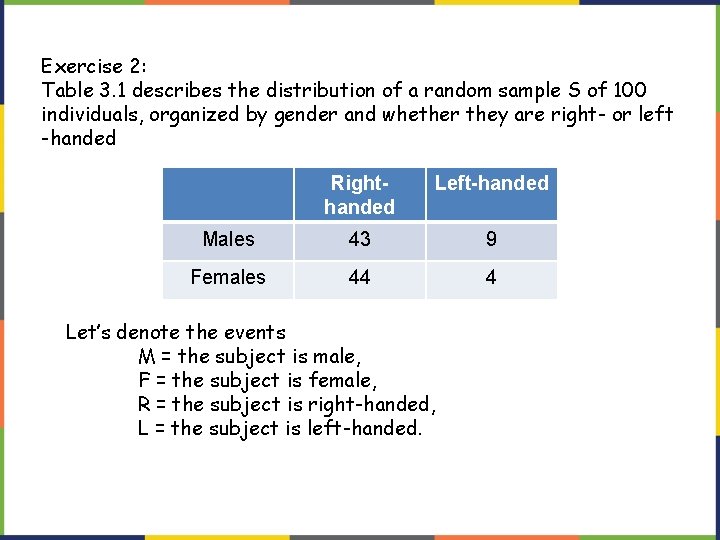
Exercise 2: Table 3. 1 describes the distribution of a random sample S of 100 individuals, organized by gender and whether they are right- or left -handed Righthanded Left-handed Males 43 9 Females 44 4 Let’s denote the events M = the subject is male, F = the subject is female, R = the subject is right-handed, L = the subject is left-handed.

Righthanded Left-handed Males 43 9 Females 44 4 Compute the following probabilities: a. P(M) = 0. 52 b. P(F) = 0. 48 c. P(R) = 0. 87 d. P(L) = 0. 13 e. P(M AND R) = 0. 43 f. P(F AND L) = 0. 04 g. P(M OR F) = 1 h. P(M OR R) = 0. 96 i. P(F OR L) = 0. 57 j. P(M') = 0. 48 k. P(R|M) = 0. 8269 l. P(F|L) = 0. 3077 m. P(L|F) = 0. 0833
3. 1 Practice: Page 213 -214 #2 -5, 19, 21, 22, 23, 25 -39 odd
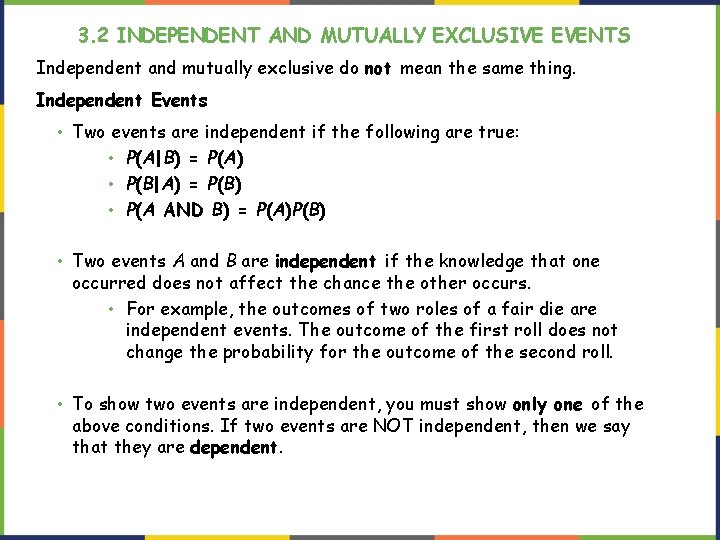
3. 2 INDEPENDENT AND MUTUALLY EXCLUSIVE EVENTS Independent and mutually exclusive do not mean the same thing. Independent Events • Two events are independent if the following are true: • P(A|B) = P(A) • P(B|A) = P(B) • P(A AND B) = P(A)P(B) • Two events A and B are independent if the knowledge that one occurred does not affect the chance the other occurs. • For example, the outcomes of two roles of a fair die are independent events. The outcome of the first roll does not change the probability for the outcome of the second roll. • To show two events are independent, you must show only one of the above conditions. If two events are NOT independent, then we say that they are dependent.
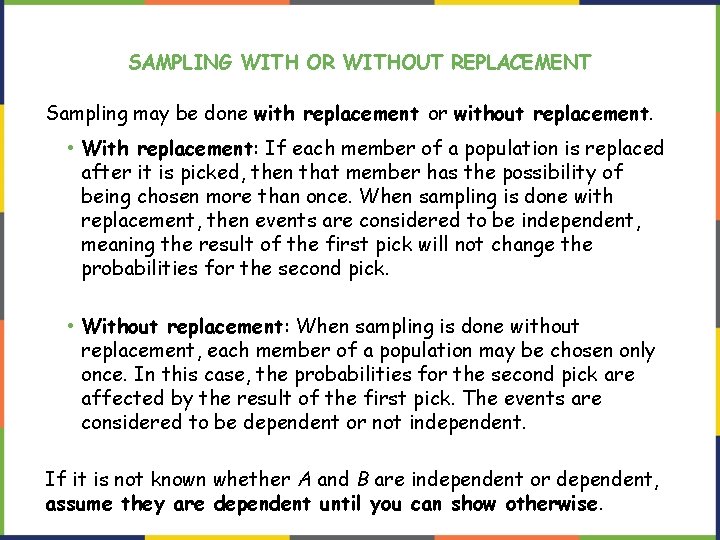
SAMPLING WITH OR WITHOUT REPLACEMENT Sampling may be done with replacement or without replacement. • With replacement: If each member of a population is replaced after it is picked, then that member has the possibility of being chosen more than once. When sampling is done with replacement, then events are considered to be independent, meaning the result of the first pick will not change the probabilities for the second pick. • Without replacement: When sampling is done without replacement, each member of a population may be chosen only once. In this case, the probabilities for the second pick are affected by the result of the first pick. The events are considered to be dependent or not independent. If it is not known whether A and B are independent or dependent, assume they are dependent until you can show otherwise.
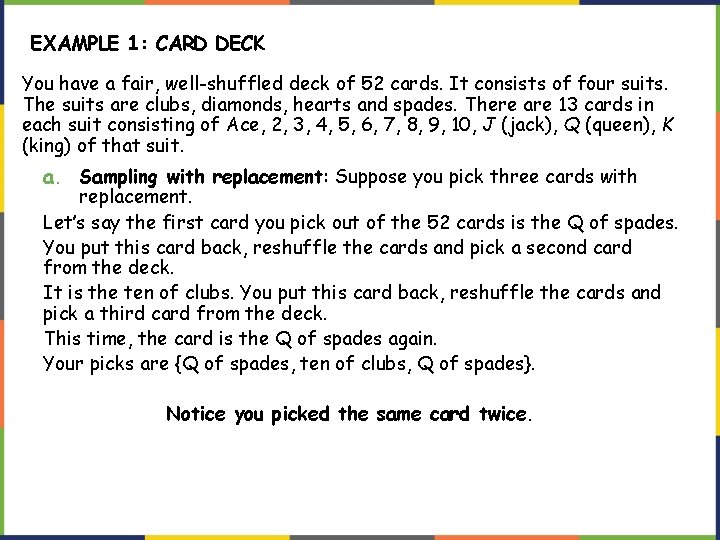
EXAMPLE 1: CARD DECK You have a fair, well-shuffled deck of 52 cards. It consists of four suits. The suits are clubs, diamonds, hearts and spades. There are 13 cards in each suit consisting of Ace, 2, 3, 4, 5, 6, 7, 8, 9, 10, J (jack), Q (queen), K (king) of that suit. a. Sampling with replacement: Suppose you pick three cards with replacement. Let’s say the first card you pick out of the 52 cards is the Q of spades. You put this card back, reshuffle the cards and pick a second card from the deck. It is the ten of clubs. You put this card back, reshuffle the cards and pick a third card from the deck. This time, the card is the Q of spades again. Your picks are {Q of spades, ten of clubs, Q of spades}. Notice you picked the same card twice.
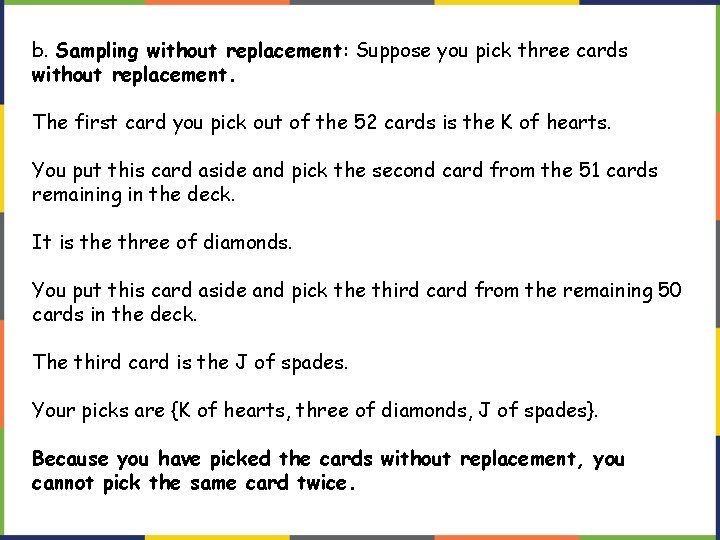
b. Sampling without replacement: Suppose you pick three cards without replacement. The first card you pick out of the 52 cards is the K of hearts. You put this card aside and pick the second card from the 51 cards remaining in the deck. It is the three of diamonds. You put this card aside and pick the third card from the remaining 50 cards in the deck. The third card is the J of spades. Your picks are {K of hearts, three of diamonds, J of spades}. Because you have picked the cards without replacement, you cannot pick the same card twice.
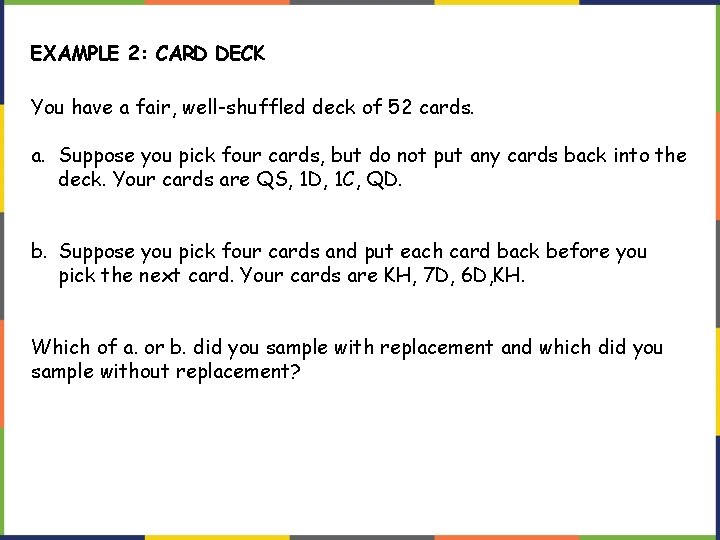
EXAMPLE 2: CARD DECK You have a fair, well-shuffled deck of 52 cards. a. Suppose you pick four cards, but do not put any cards back into the deck. Your cards are QS, 1 D, 1 C, QD. b. Suppose you pick four cards and put each card back before you pick the next card. Your cards are KH, 7 D, 6 D, KH. Which of a. or b. did you sample with replacement and which did you sample without replacement?
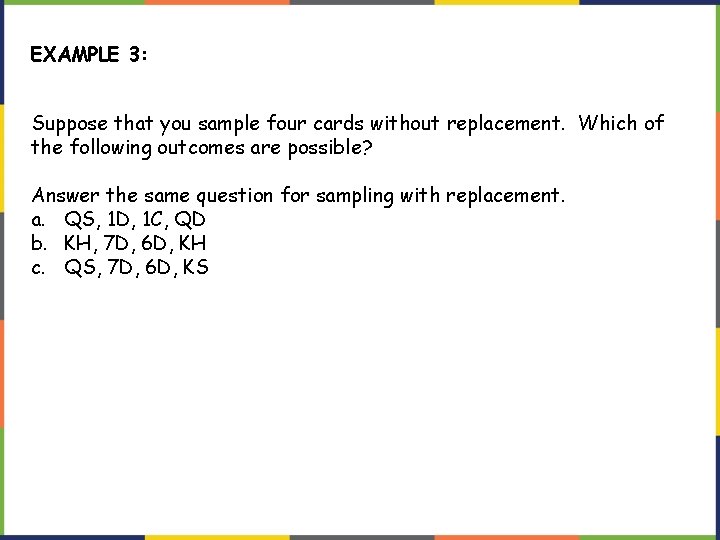
EXAMPLE 3: Suppose that you sample four cards without replacement. Which of the following outcomes are possible? Answer the same question for sampling with replacement. a. QS, 1 D, 1 C, QD b. KH, 7 D, 6 D, KH c. QS, 7 D, 6 D, KS
MUTUALLY EXCLUSIVE EVENTS A and B are mutually exclusive events if they cannot occur at the same time. This means that A and B do not share any outcomes and P(A AND B) = 0. • For example, suppose the sample space S = {1, 2, 3, 4, 5, 6, 7, 8, 9, 10}. Let A = {1, 2, 3, 4, 5}, B = {4, 5, 6, 7, 8}, and C = {7, 9}. • A AND B = {4, 5}. • P(A AND B) = 2/10 and is not equal to zero. • Therefore, A and B are not mutually exclusive. • A and C do not have any numbers in common so P(A AND C) = 0. • Therefore, A and C are mutually exclusive.
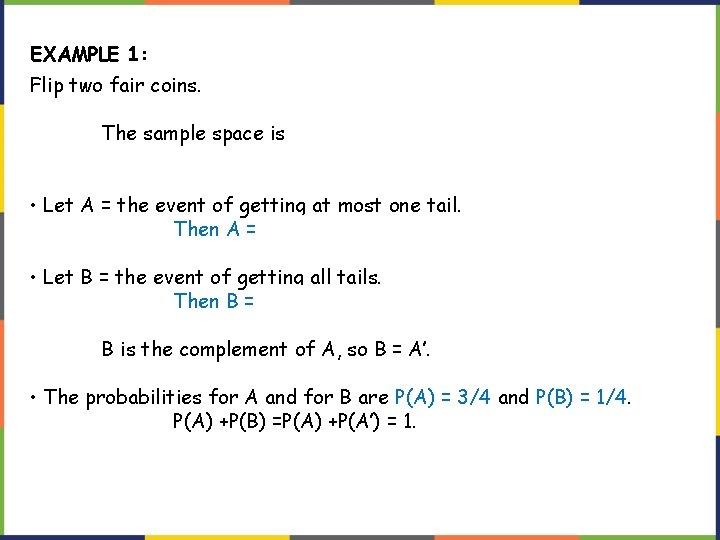
EXAMPLE 1: Flip two fair coins. The sample space is {HH, HT, TH, TT} • Let A = the event of getting at most one tail. Then A = {HH, HT, TH}. • Let B = the event of getting all tails. Then B = {TT}. B is the complement of A, so B = A′. • The probabilities for A and for B are P(A) = 3/4 and P(B) = 1/4. P(A) +P(B) =P(A) +P(A′) = 1.
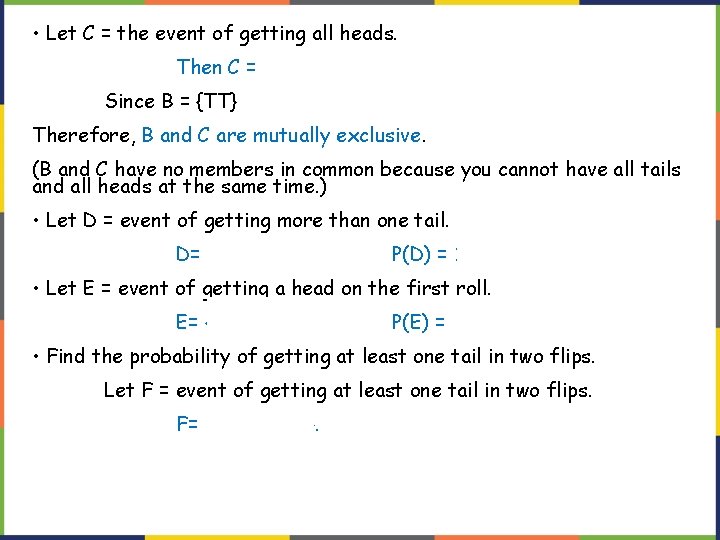
• Let C = the event of getting all heads. Then C = {HH}. Since B = {TT}, P(B AND C) = 0. Therefore, B and C are mutually exclusive. (B and C have no members in common because you cannot have all tails and all heads at the same time. ) • Let D = event of getting more than one tail. D= {TT}. P(D) = 1/4 • Let E = event of getting a head on the first roll. E= {HT, HH}. P(E) = 2/4 • Find the probability of getting at least one tail in two flips. Let F = event of getting at least one tail in two flips. F= {HT, TH, TT}. P(F) = 3/4
EXAMPLE 2: Flip two fair coins. Find the probabilities of the events. a. Let F = the event of getting at most one tail P(F) = 3/4 b. Let G = the event of getting two faces that are the same. P(G) = 2/4 b. Let H = the event of getting a head on the first flip followed by a head or tail on the second flip. P(H) = 2/4 d. Are F and G mutually exclusive? No ~ 2 Heads could occur e. Let J = the event of getting all tails. P(J) = 1/4 f. Are J and H mutually exclusive? Yes ~ can’t be all tails if the first one is heads.
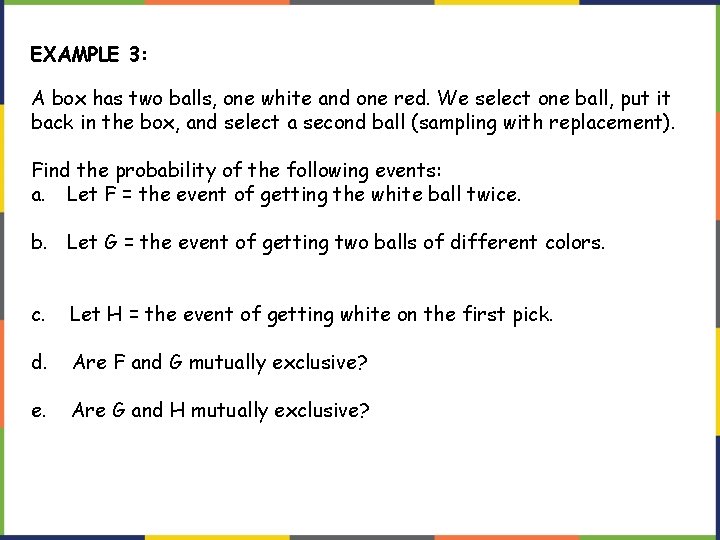
EXAMPLE 3: A box has two balls, one white and one red. We select one ball, put it back in the box, and select a second ball (sampling with replacement). Find the probability of the following events: a. Let F = the event of getting the white ball twice. P(F) = 1/4 b. Let G = the event of getting two balls of different colors. P(G) = 2/4 c. Let H = the event of getting white on the first pick. P(H) = 2/4 d. Are F and G mutually exclusive? Yes e. Are G and H mutually exclusive? No
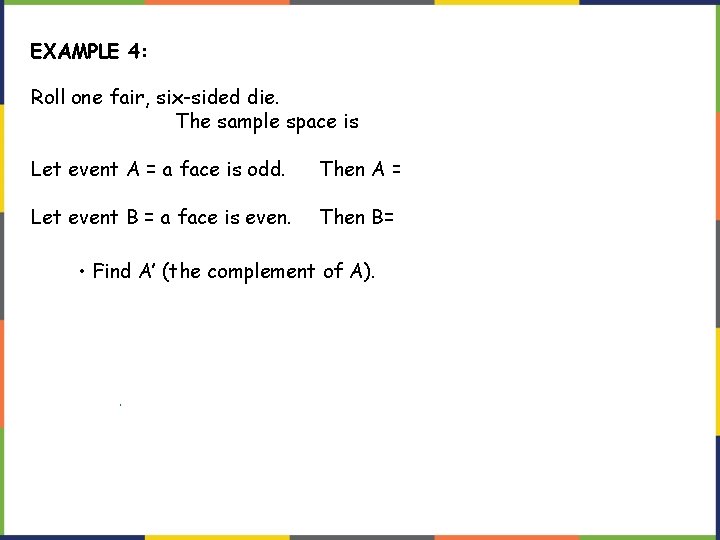
EXAMPLE 4: Roll one fair, six-sided die. The sample space is {1, 2, 3, 4, 5, 6}. Let event A = a face is odd. Then A = {1, 3, 5}. Let event B = a face is even. Then B= {2, 4, 6}. • Find A’ (the complement of A). A′ = {2, 4, 6} which is the same as event B. P(A) +P(B) =P(A) +P(A′) = 1. Also, P(A) = 3/6 and P(B) = 3/6.
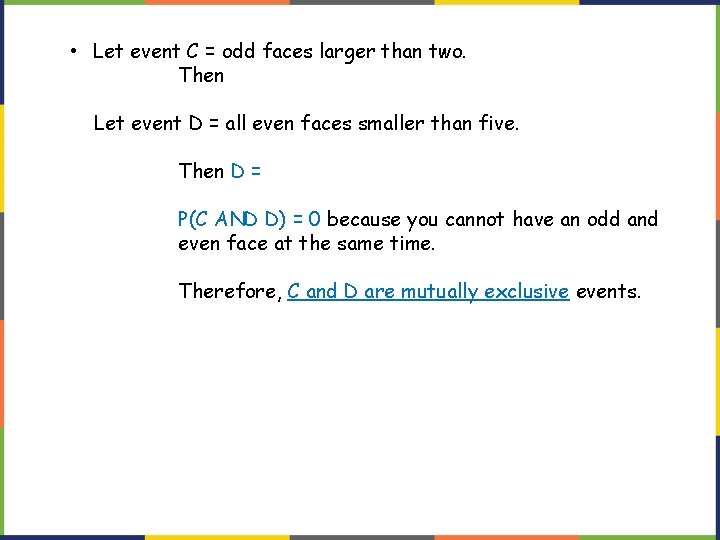
• Let event C = odd faces larger than two. Then C = {3, 5}. Let event D = all even faces smaller than five. Then D = {2, 4}. P(C AND D) = 0 because you cannot have an odd and even face at the same time. Therefore, C and D are mutually exclusive events.
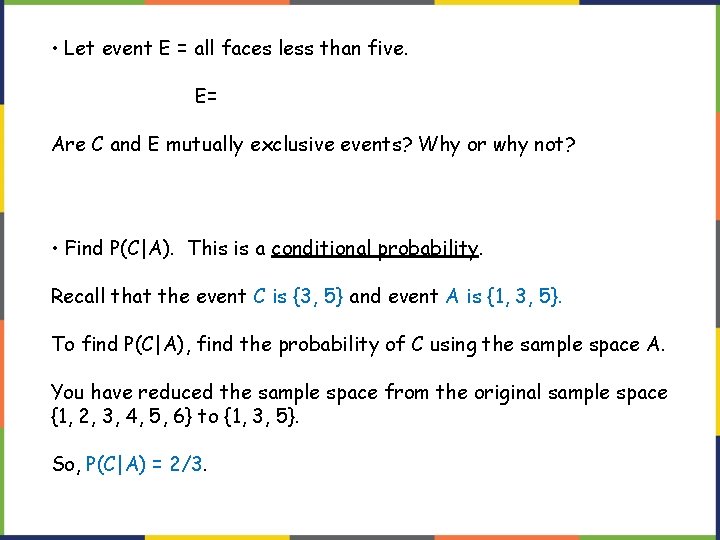
• Let event E = all faces less than five. E= {1, 2, 3, 4}. Are C and E mutually exclusive events? Why or why not? No. C = {3, 5} and E = {1, 2, 3, 4}. P(C AND E) = 1/6. To be mutually exclusive, P(C AND E) must be zero. • Find P(C|A). This is a conditional probability. Recall that the event C is {3, 5} and event A is {1, 3, 5}. To find P(C|A), find the probability of C using the sample space A. You have reduced the sample space from the original sample space {1, 2, 3, 4, 5, 6} to {1, 3, 5}. So, P(C|A) = 2/3.
Complete 3. 2 Practice Worksheet
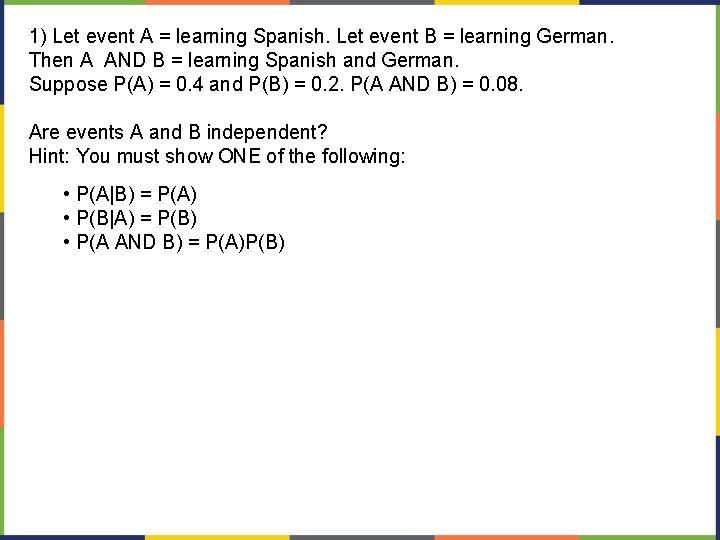
1) Let event A = learning Spanish. Let event B = learning German. Then A AND B = learning Spanish and German. Suppose P(A) = 0. 4 and P(B) = 0. 2. P(A AND B) = 0. 08. Are events A and B independent? Hint: You must show ONE of the following: • P(A|B) = P(A) • P(B|A) = P(B) • P(A AND B) = P(A)P(B)
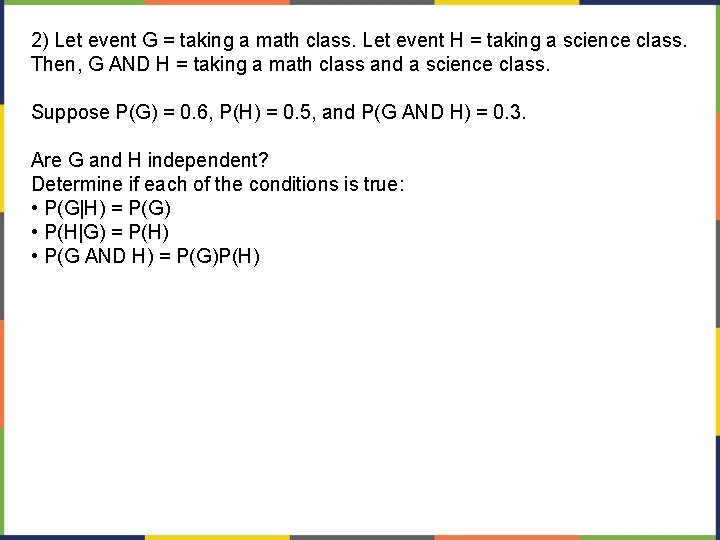
2) Let event G = taking a math class. Let event H = taking a science class. Then, G AND H = taking a math class and a science class. Suppose P(G) = 0. 6, P(H) = 0. 5, and P(G AND H) = 0. 3. Are G and H independent? Determine if each of the conditions is true: • P(G|H) = P(G) • P(H|G) = P(H) • P(G AND H) = P(G)P(H)
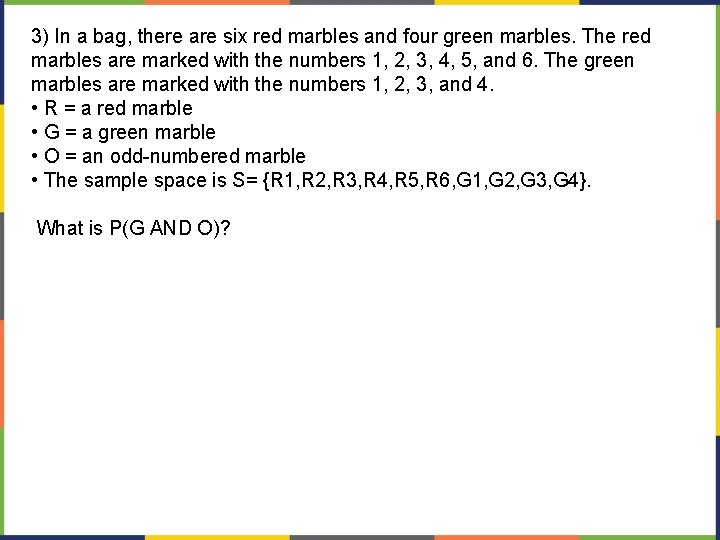
3) In a bag, there are six red marbles and four green marbles. The red marbles are marked with the numbers 1, 2, 3, 4, 5, and 6. The green marbles are marked with the numbers 1, 2, 3, and 4. • R = a red marble • G = a green marble • O = an odd-numbered marble • The sample space is S= {R 1, R 2, R 3, R 4, R 5, R 6, G 1, G 2, G 3, G 4}. What is P(G AND O)?
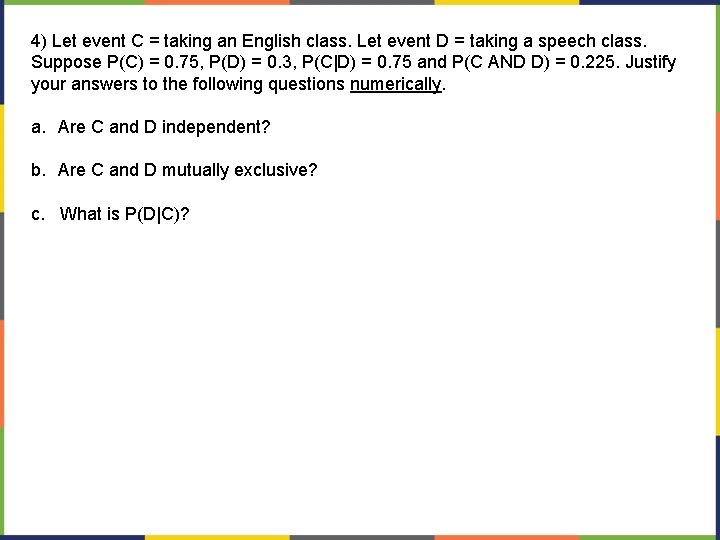
4) Let event C = taking an English class. Let event D = taking a speech class. Suppose P(C) = 0. 75, P(D) = 0. 3, P(C|D) = 0. 75 and P(C AND D) = 0. 225. Justify your answers to the following questions numerically. a. Are C and D independent? b. Are C and D mutually exclusive? c. What is P(D|C)?
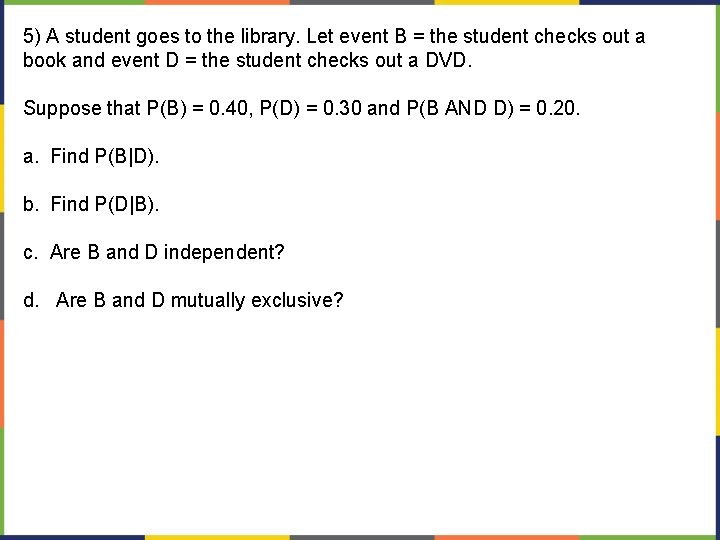
5) A student goes to the library. Let event B = the student checks out a book and event D = the student checks out a DVD. Suppose that P(B) = 0. 40, P(D) = 0. 30 and P(B AND D) = 0. 20. a. Find P(B|D). b. Find P(D|B). c. Are B and D independent? d. Are B and D mutually exclusive?
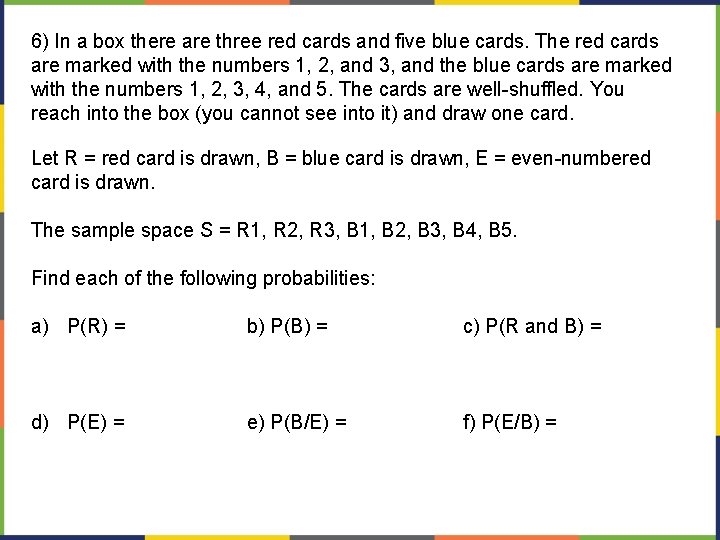
6) In a box there are three red cards and five blue cards. The red cards are marked with the numbers 1, 2, and 3, and the blue cards are marked with the numbers 1, 2, 3, 4, and 5. The cards are well-shuffled. You reach into the box (you cannot see into it) and draw one card. Let R = red card is drawn, B = blue card is drawn, E = even-numbered card is drawn. The sample space S = R 1, R 2, R 3, B 1, B 2, B 3, B 4, B 5. Find each of the following probabilities: a) P(R) = b) P(B) = c) P(R and B) = d) P(E) = e) P(B/E) = f) P(E/B) =
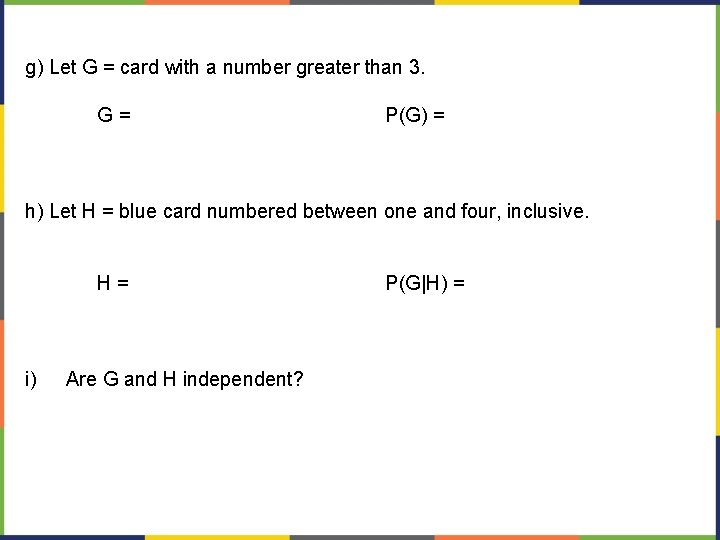
g) Let G = card with a number greater than 3. G= P(G) = h) Let H = blue card numbered between one and four, inclusive. H= i) Are G and H independent? P(G|H) =
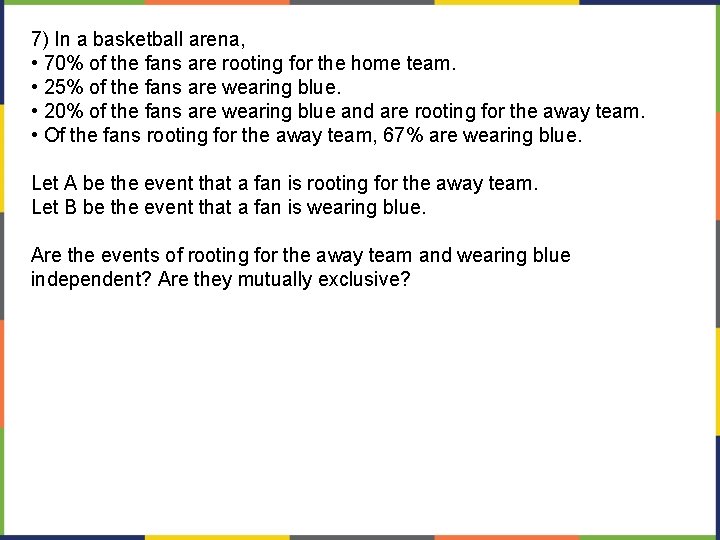
7) In a basketball arena, • 70% of the fans are rooting for the home team. • 25% of the fans are wearing blue. • 20% of the fans are wearing blue and are rooting for the away team. • Of the fans rooting for the away team, 67% are wearing blue. Let A be the event that a fan is rooting for the away team. Let B be the event that a fan is wearing blue. Are the events of rooting for the away team and wearing blue independent? Are they mutually exclusive?
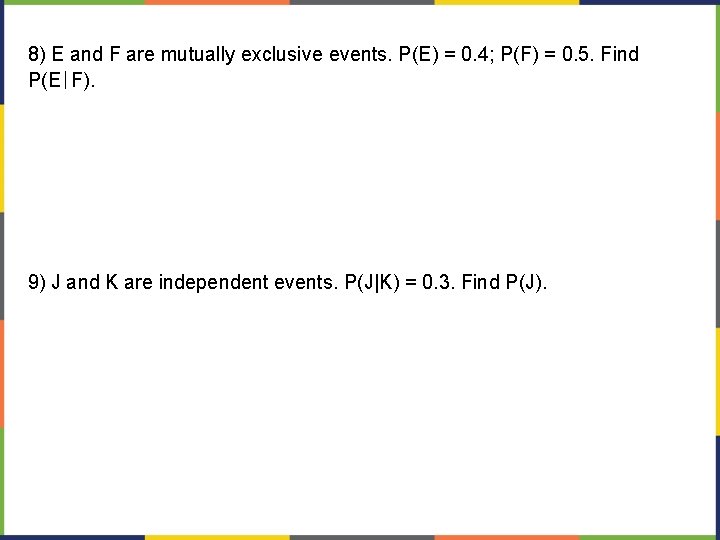
8) E and F are mutually exclusive events. P(E) = 0. 4; P(F) = 0. 5. Find P(E∣F). 9) J and K are independent events. P(J|K) = 0. 3. Find P(J).
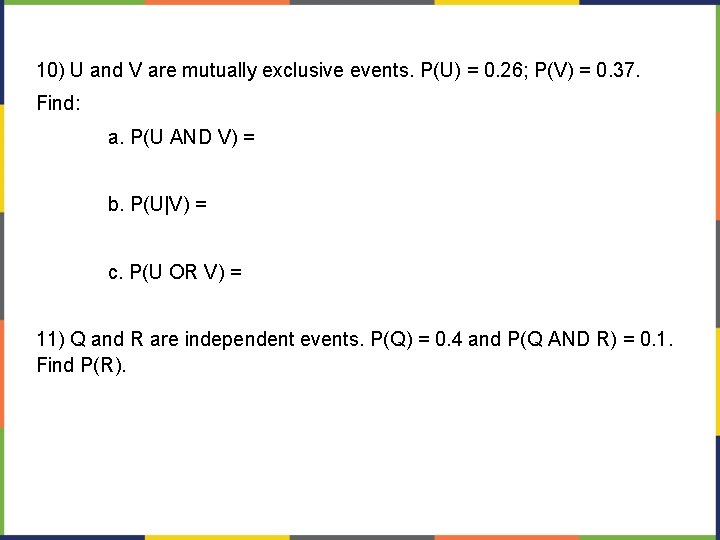
10) U and V are mutually exclusive events. P(U) = 0. 26; P(V) = 0. 37. Find: a. P(U AND V) = b. P(U|V) = c. P(U OR V) = 11) Q and R are independent events. P(Q) = 0. 4 and P(Q AND R) = 0. 1. Find P(R).
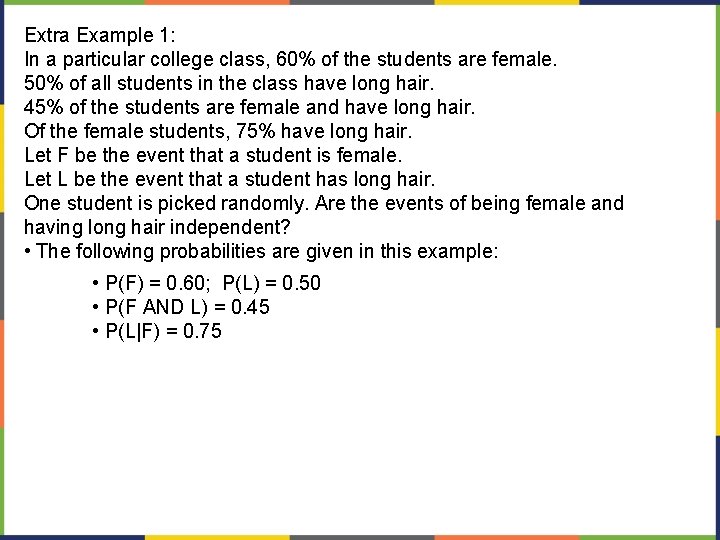
Extra Example 1: In a particular college class, 60% of the students are female. 50% of all students in the class have long hair. 45% of the students are female and have long hair. Of the female students, 75% have long hair. Let F be the event that a student is female. Let L be the event that a student has long hair. One student is picked randomly. Are the events of being female and having long hair independent? • The following probabilities are given in this example: • P(F) = 0. 60; P(L) = 0. 50 • P(F AND L) = 0. 45 • P(L|F) = 0. 75
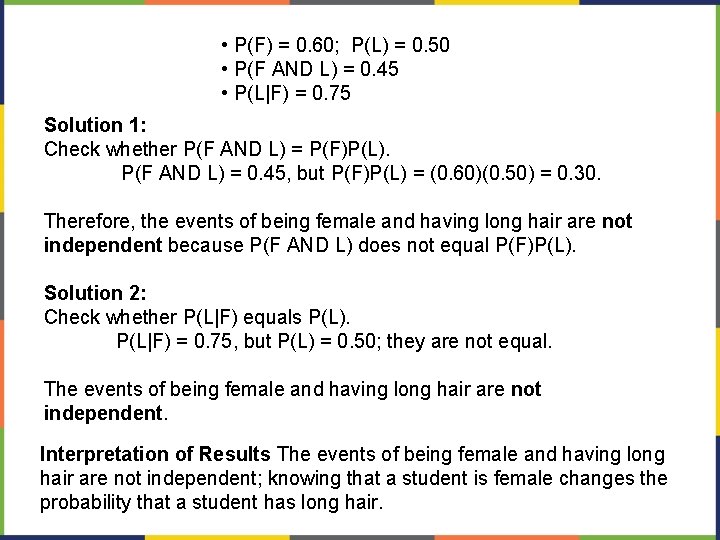
• P(F) = 0. 60; P(L) = 0. 50 • P(F AND L) = 0. 45 • P(L|F) = 0. 75 Solution 1: Check whether P(F AND L) = P(F)P(L). P(F AND L) = 0. 45, but P(F)P(L) = (0. 60)(0. 50) = 0. 30. Therefore, the events of being female and having long hair are not independent because P(F AND L) does not equal P(F)P(L). Solution 2: Check whether P(L|F) equals P(L). P(L|F) = 0. 75, but P(L) = 0. 50; they are not equal. The events of being female and having long hair are not independent. Interpretation of Results The events of being female and having long hair are not independent; knowing that a student is female changes the probability that a student has long hair.
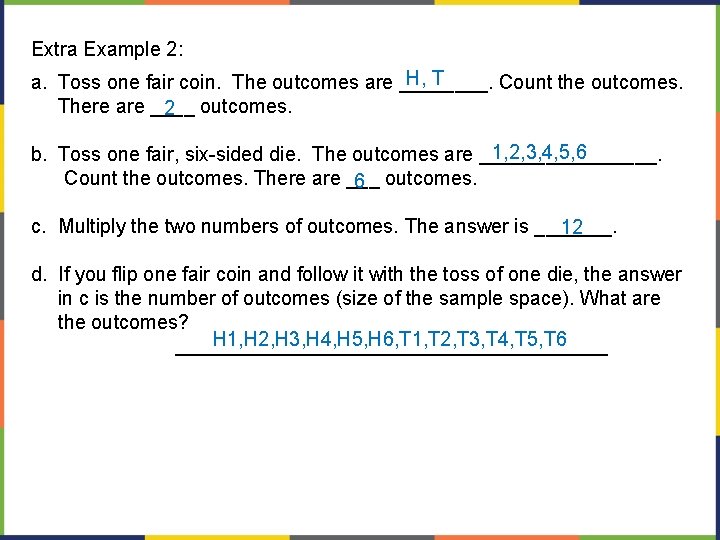
Extra Example 2: H, T a. Toss one fair coin. The outcomes are ____. Count the outcomes. There are ____ 2 outcomes. 1, 2, 3, 4, 5, 6 b. Toss one fair, six-sided die. The outcomes are ________. Count the outcomes. There are ___ 6 outcomes. c. Multiply the two numbers of outcomes. The answer is _______. 12 d. If you flip one fair coin and follow it with the toss of one die, the answer in c is the number of outcomes (size of the sample space). What are the outcomes? H 1, H 2, H 3, H 4, H 5, H 6, T 1, T 2, T 3, T 4, T 5, T 6
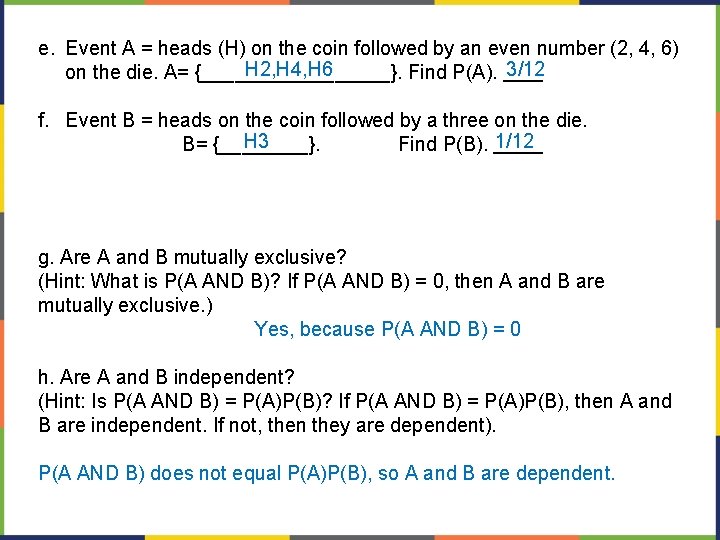
e. Event A = heads (H) on the coin followed by an even number (2, 4, 6) H 2, H 4, H 6 on the die. A= {_________}. Find P(A). 3/12 f. Event B = heads on the coin followed by a three on the die. H 3 B= {____}. Find P(B). 1/12 g. Are A and B mutually exclusive? (Hint: What is P(A AND B)? If P(A AND B) = 0, then A and B are mutually exclusive. ) Yes, because P(A AND B) = 0 h. Are A and B independent? (Hint: Is P(A AND B) = P(A)P(B)? If P(A AND B) = P(A)P(B), then A and B are independent. If not, then they are dependent). P(A AND B) does not equal P(A)P(B), so A and B are dependent.
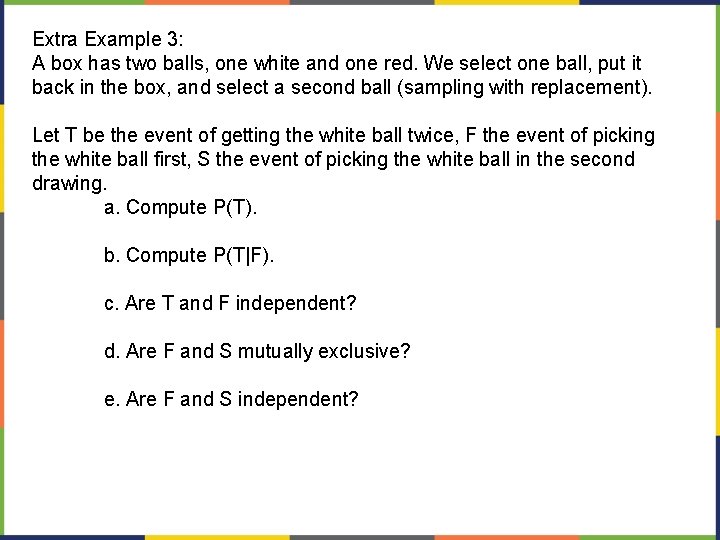
Extra Example 3: A box has two balls, one white and one red. We select one ball, put it back in the box, and select a second ball (sampling with replacement). Let T be the event of getting the white ball twice, F the event of picking the white ball first, S the event of picking the white ball in the second drawing. a. Compute P(T) = 1/4 b. Compute P(T|F). P(T/F) = 1/2 c. Are T and F independent? No ~ P(T) ≠ P(T/F) d. Are F and S mutually exclusive? No ~ P(F AND S) ≠ 0 e. Are F and S independent? Yes ~ P(F AND S) = P(F)P(S) 1/4 = (1/2)
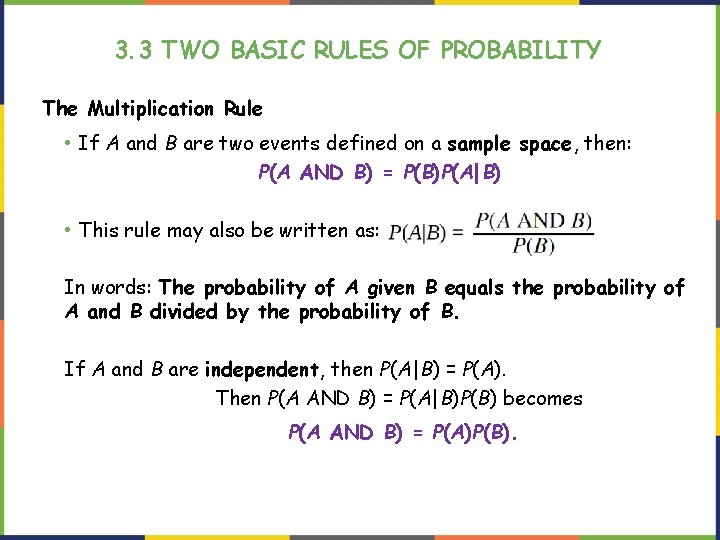
3. 3 TWO BASIC RULES OF PROBABILITY The Multiplication Rule • If A and B are two events defined on a sample space, then: P(A AND B) = P(B)P(A|B) • This rule may also be written as: In words: The probability of A given B equals the probability of A and B divided by the probability of B. If A and B are independent, then P(A|B) = P(A). Then P(A AND B) = P(A|B)P(B) becomes P(A AND B) = P(A)P(B).
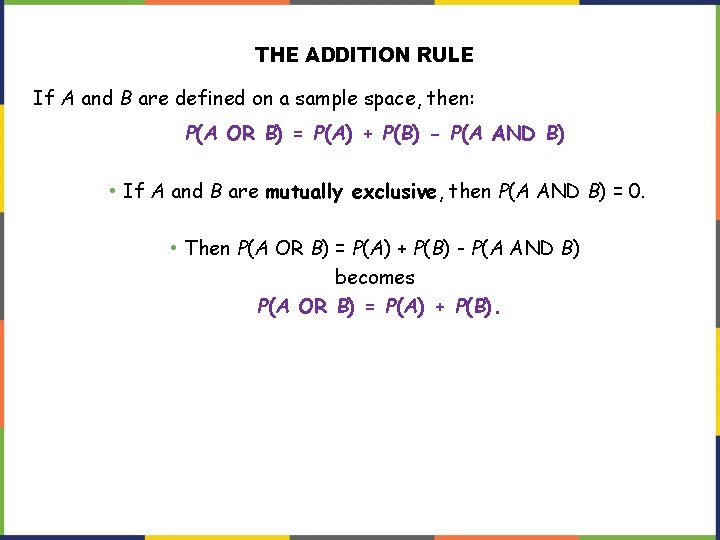
THE ADDITION RULE If A and B are defined on a sample space, then: P(A OR B) = P(A) + P(B) - P(A AND B) • If A and B are mutually exclusive, then P(A AND B) = 0. • Then P(A OR B) = P(A) + P(B) - P(A AND B) becomes P(A OR B) = P(A) + P(B).

Example 1 Kevin is trying to choose where to go on vacation. His two choices are: N = New Zealand A = Alaska • Kevin can only afford one vacation. • The probability that he chooses N is P(N) = 0. 6 and the probability that he chooses A is P(A) = 0. 35. a) What is P(N AND A)? P(N AND A) = 0 because Kevin can only afford to take one vacation. b) Are N and A mutually exclusive? Yes, Kevin can only choose one place. c) Find P(N OR A). Since P(N AND A) = 0 and P(N OR A) = P(N) + P(A) – P(N AND A), we get P(N OR A) = 0. 6 + 0. 35 – 0 = 0. 95. Note that the probability that he does not choose to go anywhere on vacation must be 0. 05.
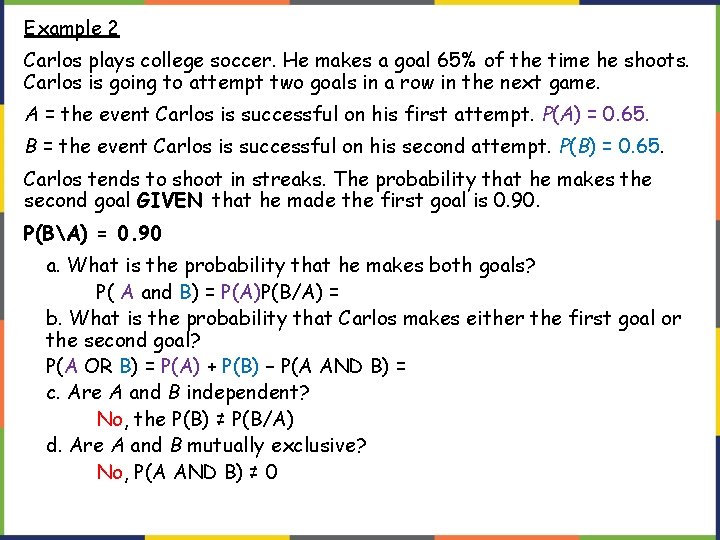
Example 2 Carlos plays college soccer. He makes a goal 65% of the time he shoots. Carlos is going to attempt two goals in a row in the next game. A = the event Carlos is successful on his first attempt. P(A) = 0. 65. B = the event Carlos is successful on his second attempt. P(B) = 0. 65. Carlos tends to shoot in streaks. The probability that he makes the second goal GIVEN that he made the first goal is 0. 90. P(BA) = 0. 90 a. What is the probability that he makes both goals? P( A and B) = P(A)P(B/A) = 0. 65(0. 90) = 0. 585 b. What is the probability that Carlos makes either the first goal or the second goal? P(A OR B) = P(A) + P(B) – P(A AND B) = 0. 65 + 0. 65 – 0. 585 = 0. 715 c. Are A and B independent? No, the P(B) ≠ P(B/A) d. Are A and B mutually exclusive? No, P(A AND B) ≠ 0
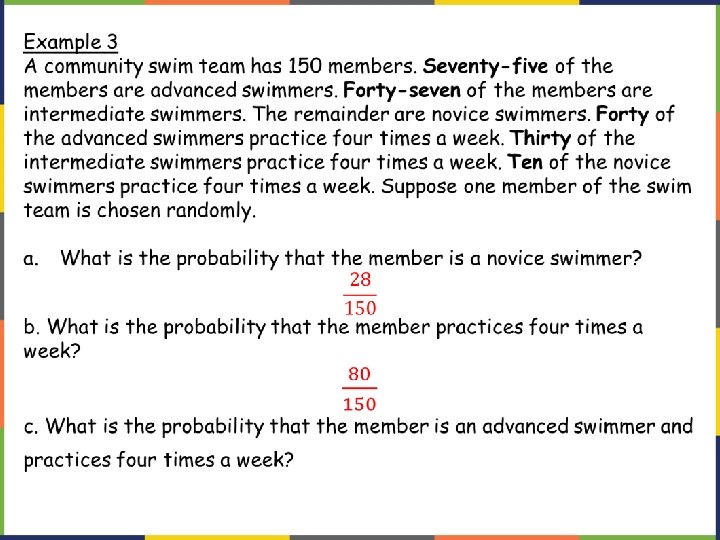
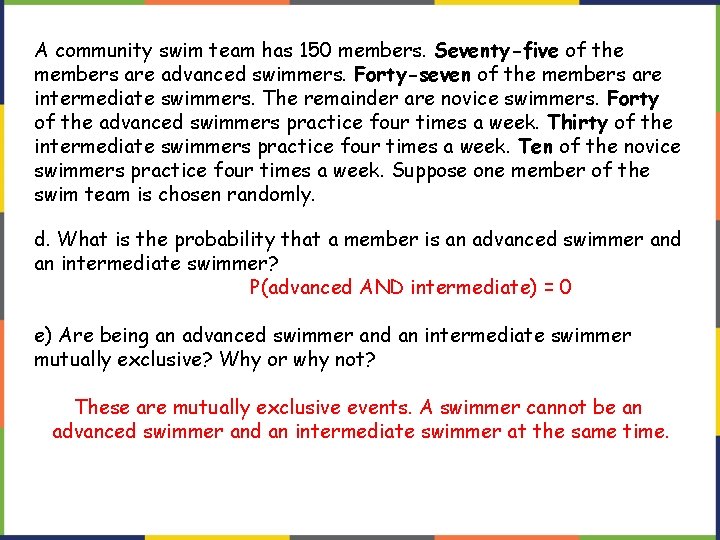
A community swim team has 150 members. Seventy-five of the members are advanced swimmers. Forty-seven of the members are intermediate swimmers. The remainder are novice swimmers. Forty of the advanced swimmers practice four times a week. Thirty of the intermediate swimmers practice four times a week. Ten of the novice swimmers practice four times a week. Suppose one member of the swim team is chosen randomly. d. What is the probability that a member is an advanced swimmer and an intermediate swimmer? P(advanced AND intermediate) = 0 e) Are being an advanced swimmer and an intermediate swimmer mutually exclusive? Why or why not? These are mutually exclusive events. A swimmer cannot be an advanced swimmer and an intermediate swimmer at the same time.
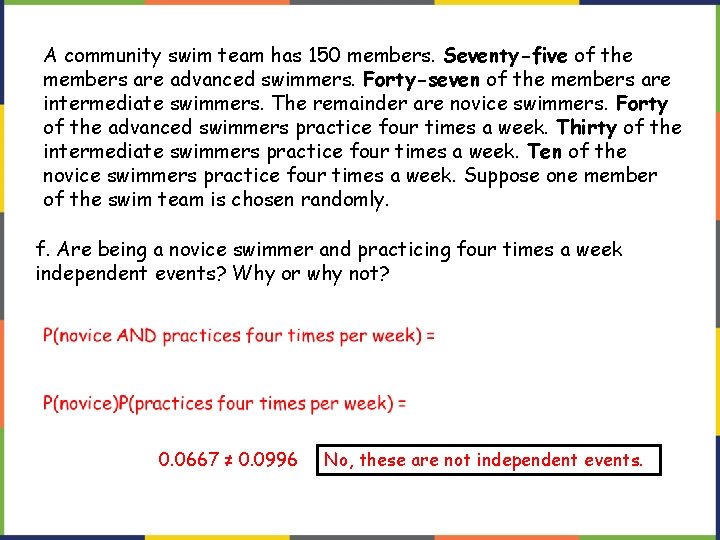
A community swim team has 150 members. Seventy-five of the members are advanced swimmers. Forty-seven of the members are intermediate swimmers. The remainder are novice swimmers. Forty of the advanced swimmers practice four times a week. Thirty of the intermediate swimmers practice four times a week. Ten of the novice swimmers practice four times a week. Suppose one member of the swim team is chosen randomly. f. Are being a novice swimmer and practicing four times a week independent events? Why or why not? 0. 0667 ≠ 0. 0996 No, these are not independent events.

Complete 3. 3 Practice Sheet
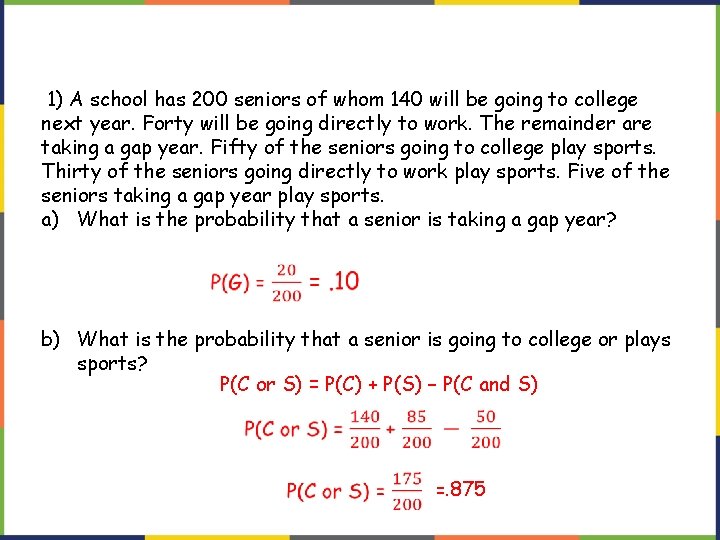
1) A school has 200 seniors of whom 140 will be going to college next year. Forty will be going directly to work. The remainder are taking a gap year. Fifty of the seniors going to college play sports. Thirty of the seniors going directly to work play sports. Five of the seniors taking a gap year play sports. a) What is the probability that a senior is taking a gap year? b) What is the probability that a senior is going to college or plays sports? P(C or S) = P(C) + P(S) – P(C and S) =. 875
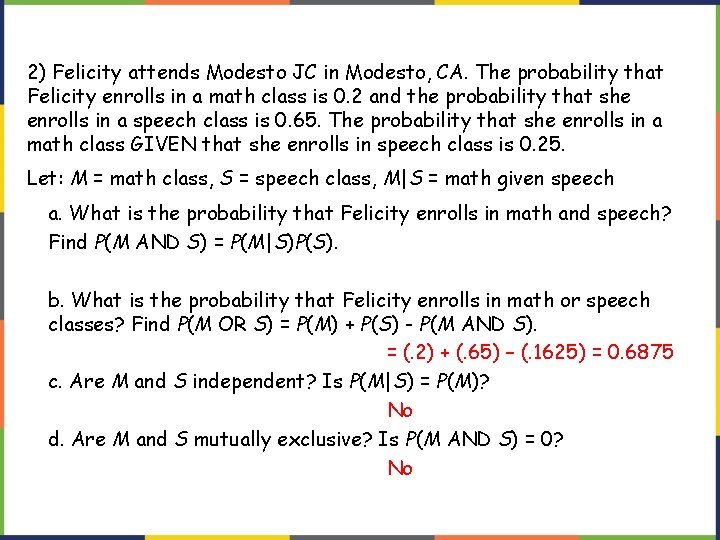
2) Felicity attends Modesto JC in Modesto, CA. The probability that Felicity enrolls in a math class is 0. 2 and the probability that she enrolls in a speech class is 0. 65. The probability that she enrolls in a math class GIVEN that she enrolls in speech class is 0. 25. Let: M = math class, S = speech class, M|S = math given speech a. What is the probability that Felicity enrolls in math and speech? Find P(M AND S) = P(M|S)P(S). = (. 25)(. 65) = 0. 1625 b. What is the probability that Felicity enrolls in math or speech classes? Find P(M OR S) = P(M) + P(S) - P(M AND S). = (. 2) + (. 65) – (. 1625) = 0. 6875 c. Are M and S independent? Is P(M|S) = P(M)? No d. Are M and S mutually exclusive? Is P(M AND S) = 0? No
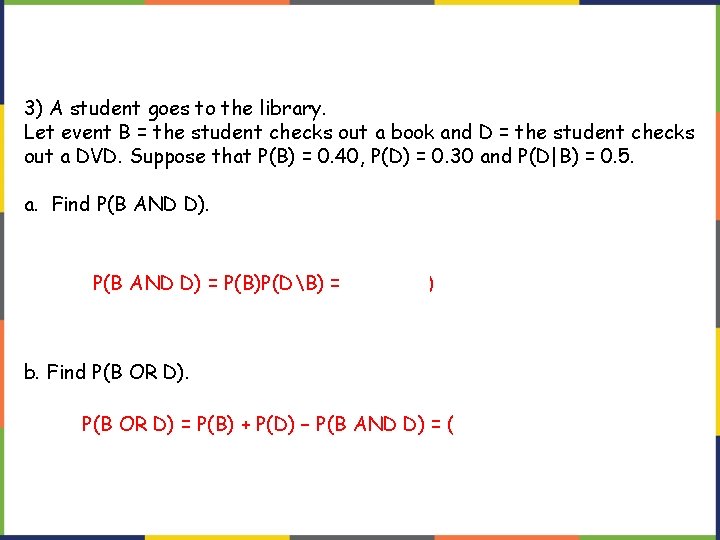
3) A student goes to the library. Let event B = the student checks out a book and D = the student checks out a DVD. Suppose that P(B) = 0. 40, P(D) = 0. 30 and P(D|B) = 0. 5. a. Find P(B AND D) = P(B)P(DB) = (. 40)(0. 5) =. 20 b. Find P(B OR D) = P(B) + P(D) – P(B AND D) = (. 40)+(. 30) – (. 20) =. 50
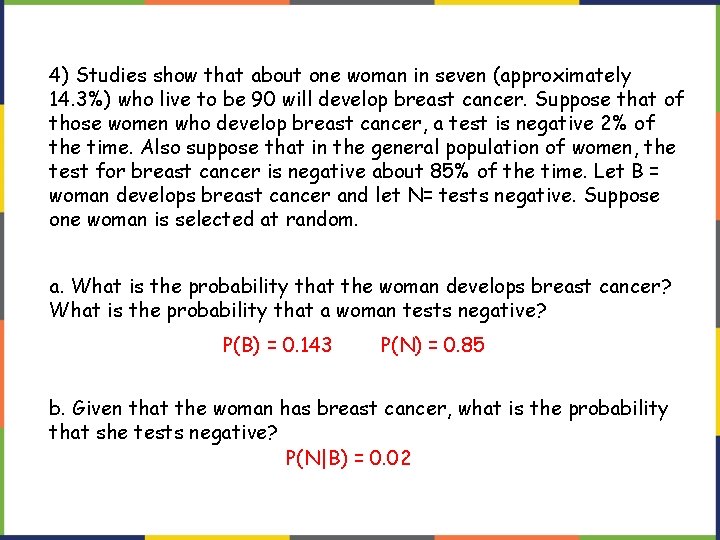
4) Studies show that about one woman in seven (approximately 14. 3%) who live to be 90 will develop breast cancer. Suppose that of those women who develop breast cancer, a test is negative 2% of the time. Also suppose that in the general population of women, the test for breast cancer is negative about 85% of the time. Let B = woman develops breast cancer and let N= tests negative. Suppose one woman is selected at random. a. What is the probability that the woman develops breast cancer? What is the probability that a woman tests negative? P(B) = 0. 143 P(N) = 0. 85 b. Given that the woman has breast cancer, what is the probability that she tests negative? P(N|B) = 0. 02
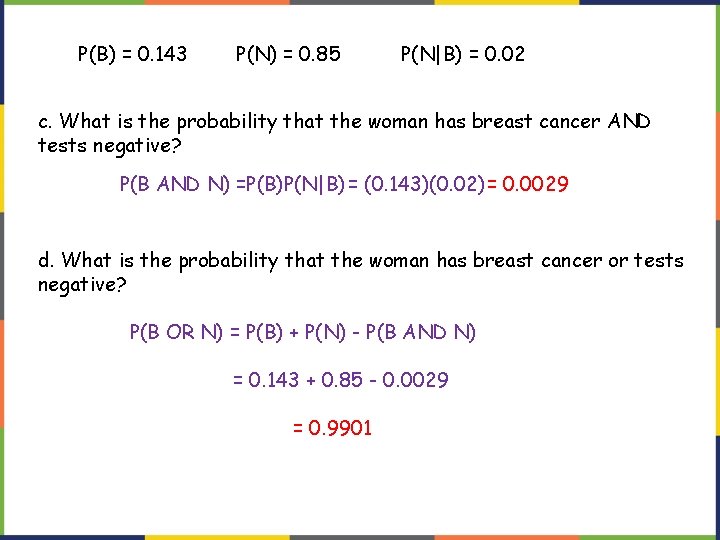
P(B) = 0. 143 P(N) = 0. 85 P(N|B) = 0. 02 c. What is the probability that the woman has breast cancer AND tests negative? P(B AND N) =P(B)P(N|B) = (0. 143)(0. 02) = 0. 0029 d. What is the probability that the woman has breast cancer or tests negative? P(B OR N) = P(B) + P(N) - P(B AND N) = 0. 143 + 0. 85 - 0. 0029 = 0. 9901
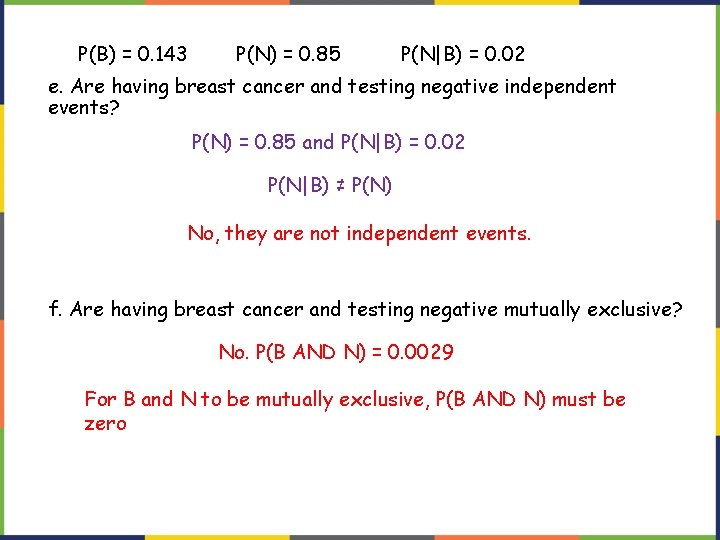
P(B) = 0. 143 P(N) = 0. 85 P(N|B) = 0. 02 e. Are having breast cancer and testing negative independent events? P(N) = 0. 85 and P(N|B) = 0. 02 P(N|B) ≠ P(N) No, they are not independent events. f. Are having breast cancer and testing negative mutually exclusive? No. P(B AND N) = 0. 0029 For B and N to be mutually exclusive, P(B AND N) must be zero
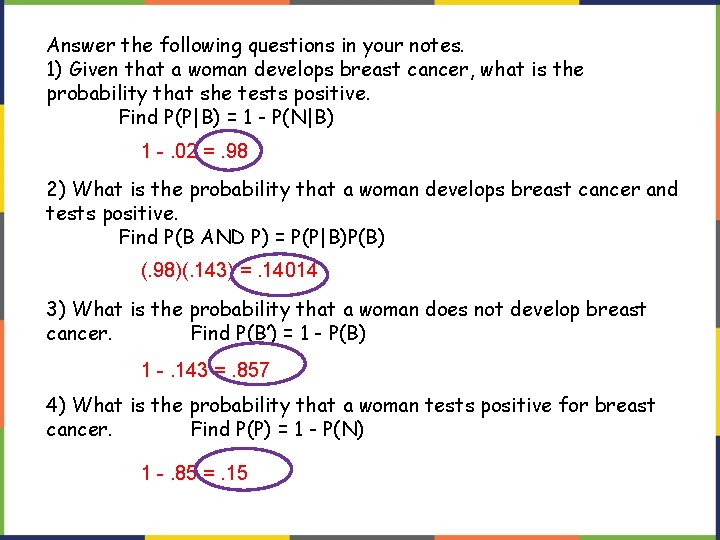
Answer the following questions in your notes. 1) Given that a woman develops breast cancer, what is the probability that she tests positive. Find P(P|B) = 1 - P(N|B) 1 -. 02 =. 98 2) What is the probability that a woman develops breast cancer and tests positive. Find P(B AND P) = P(P|B)P(B) (. 98)(. 143) =. 14014 3) What is the probability that a woman does not develop breast cancer. Find P(B′) = 1 - P(B) 1 -. 143 =. 857 4) What is the probability that a woman tests positive for breast cancer. Find P(P) = 1 - P(N) 1 -. 85 =. 15
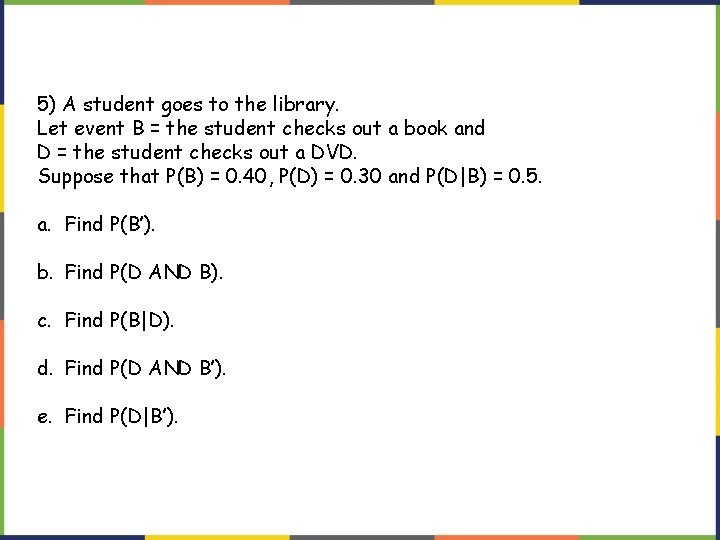
5) A student goes to the library. Let event B = the student checks out a book and D = the student checks out a DVD. Suppose that P(B) = 0. 40, P(D) = 0. 30 and P(D|B) = 0. 5. a. Find P(B′). . 60 b. Find P(D AND B). (. 40)(0. 5) =. 20 c. Find P(B|D). P(B and D)/P(D) =. 20/. 30 =. 67 d. Find P(D AND B′). P(D)P(B’D) = (0. 3)(. 23) =. 069 e. Find P(D|B′). P(D AND B’)/P(B’) =. 069/. 60 =. 115
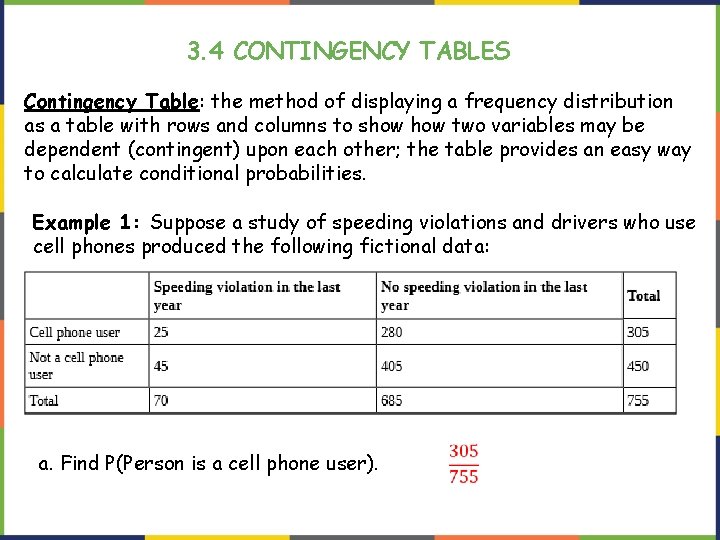
3. 4 CONTINGENCY TABLES Contingency Table: the method of displaying a frequency distribution as a table with rows and columns to show two variables may be dependent (contingent) upon each other; the table provides an easy way to calculate conditional probabilities. Example 1: Suppose a study of speeding violations and drivers who use cell phones produced the following fictional data: a. Find P(Person is a cell phone user).
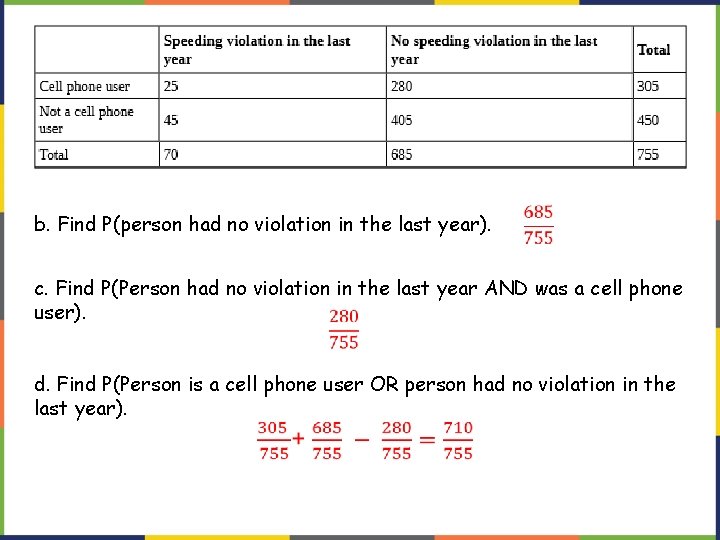
b. Find P(person had no violation in the last year). c. Find P(Person had no violation in the last year AND was a cell phone user). d. Find P(Person is a cell phone user OR person had no violation in the last year).
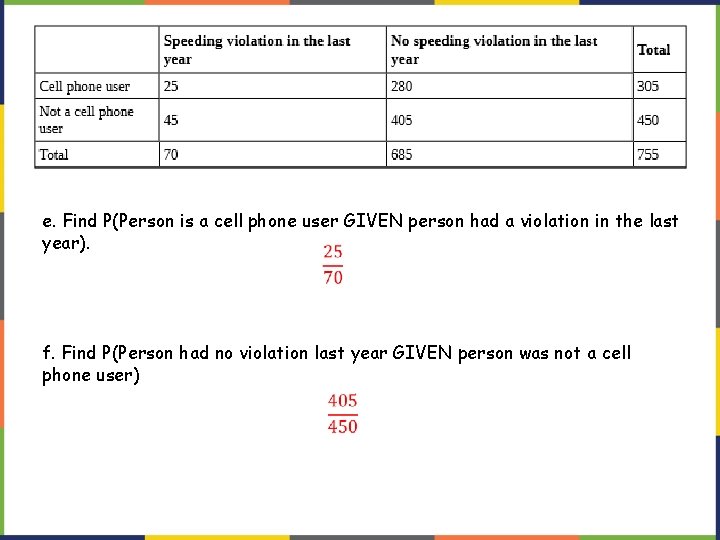
e. Find P(Person is a cell phone user GIVEN person had a violation in the last year). f. Find P(Person had no violation last year GIVEN person was not a cell phone user)
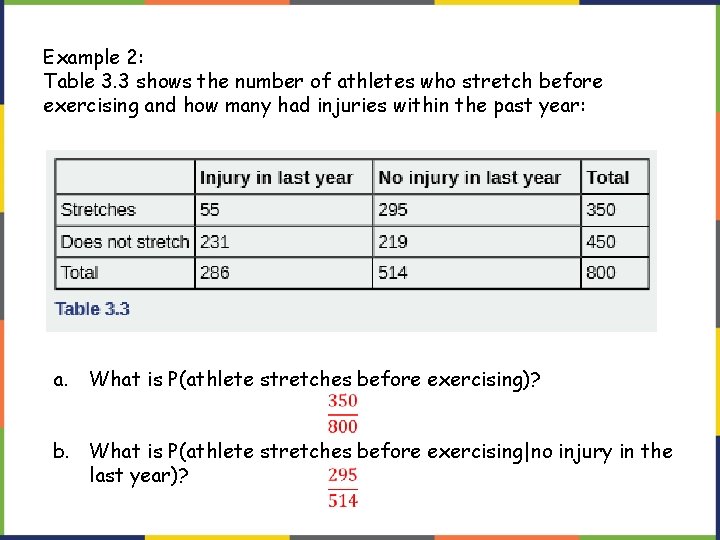
Example 2: Table 3. 3 shows the number of athletes who stretch before exercising and how many had injuries within the past year: a. What is P(athlete stretches before exercising)? b. What is P(athlete stretches before exercising|no injury in the last year)?
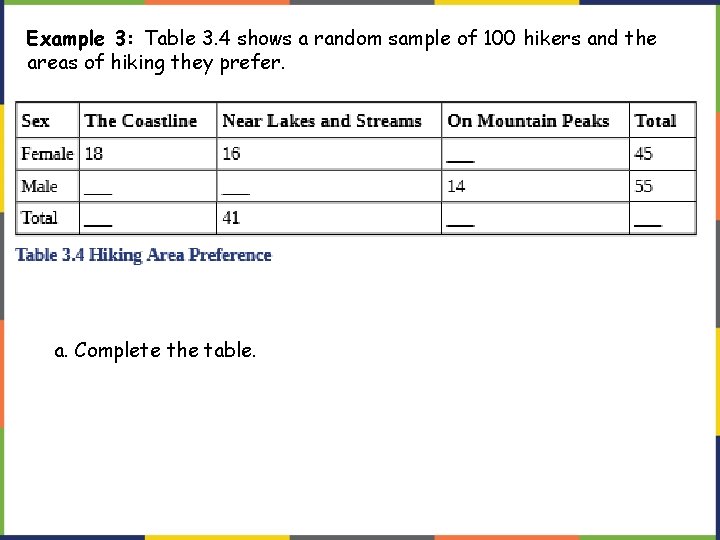
Example 3: Table 3. 4 shows a random sample of 100 hikers and the areas of hiking they prefer. a. Complete the table.
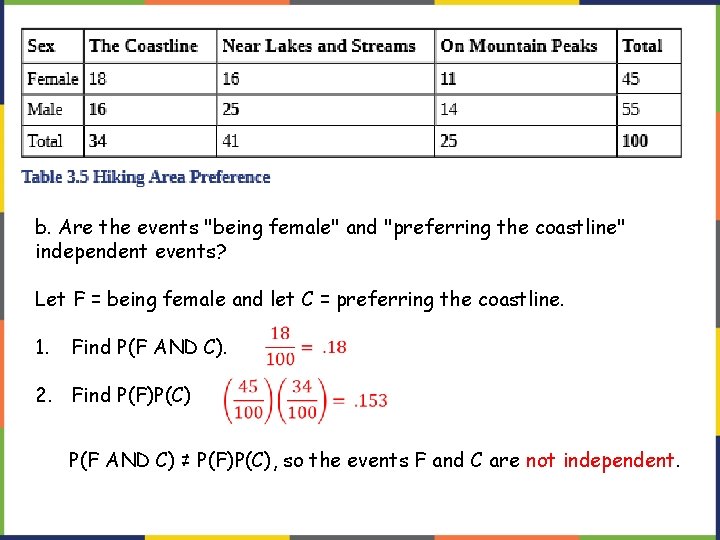
b. Are the events "being female" and "preferring the coastline" independent events? Let F = being female and let C = preferring the coastline. 1. Find P(F AND C). 2. Find P(F)P(C) P(F AND C) ≠ P(F)P(C), so the events F and C are not independent.
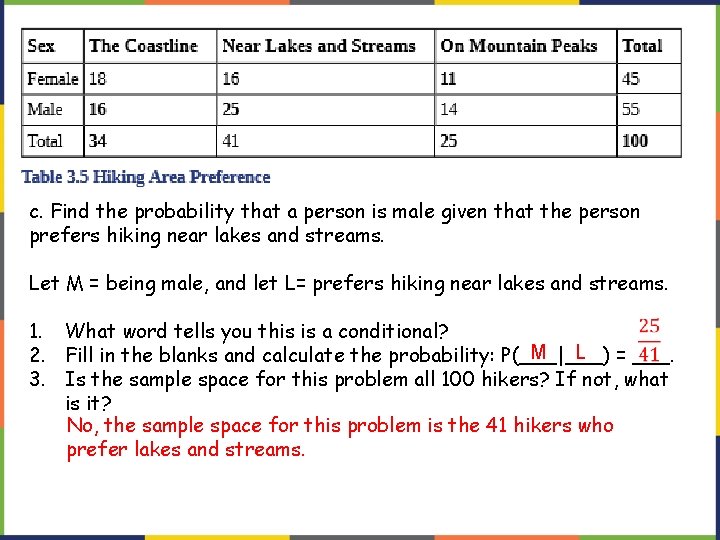
c. Find the probability that a person is male given that the person prefers hiking near lakes and streams. Let M = being male, and let L= prefers hiking near lakes and streams. 1. What word tells you this is a conditional? 'given' M L 2. Fill in the blanks and calculate the probability: P(___|___) = ___. 3. Is the sample space for this problem all 100 hikers? If not, what is it? No, the sample space for this problem is the 41 hikers who prefer lakes and streams.
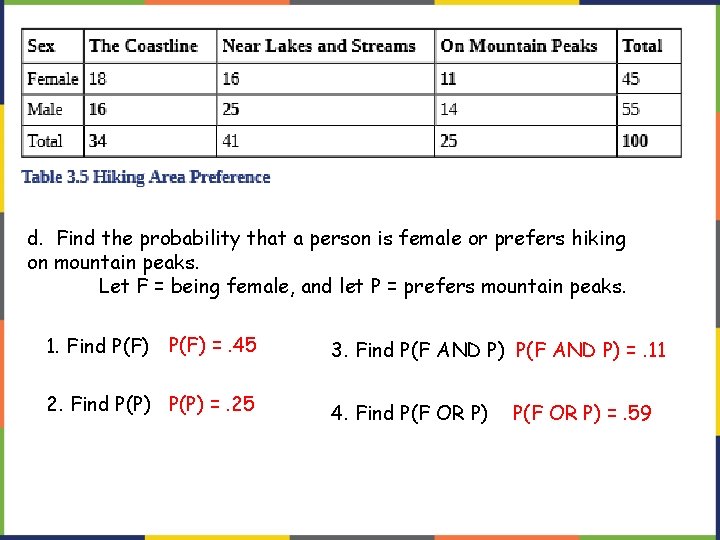
d. Find the probability that a person is female or prefers hiking on mountain peaks. Let F = being female, and let P = prefers mountain peaks. 1. Find P(F) =. 45 3. Find P(F AND P) =. 11 2. Find P(P) =. 25 4. Find P(F OR P) =. 59

1) Complete worksheet 2) Extra Practice: pg. 224 -225/110 -113
3. 5 TREE AND VENN DIAGRAMS Sometimes, when the probability problems are complex, it can be helpful to graph the situation. Tree diagrams and Venn diagrams are two tools that can be used to visualize and solve conditional probabilities. Tree Diagrams • A tree diagram is a special type of graph used to determine the outcomes of an experiment. It consists of "branches" that are labeled with either frequencies or probabilities. Tree diagrams can make some probability problems easier to visualize and solve.
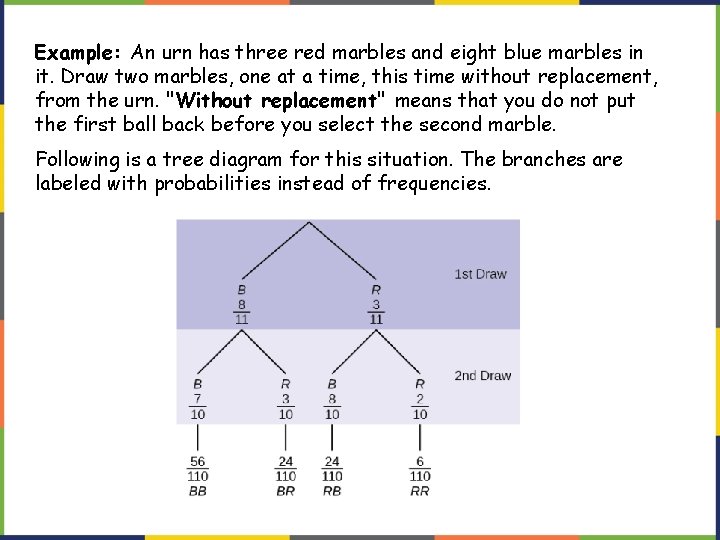
Example: An urn has three red marbles and eight blue marbles in it. Draw two marbles, one at a time, this time without replacement, from the urn. "Without replacement" means that you do not put the first ball back before you select the second marble. Following is a tree diagram for this situation. The branches are labeled with probabilities instead of frequencies.
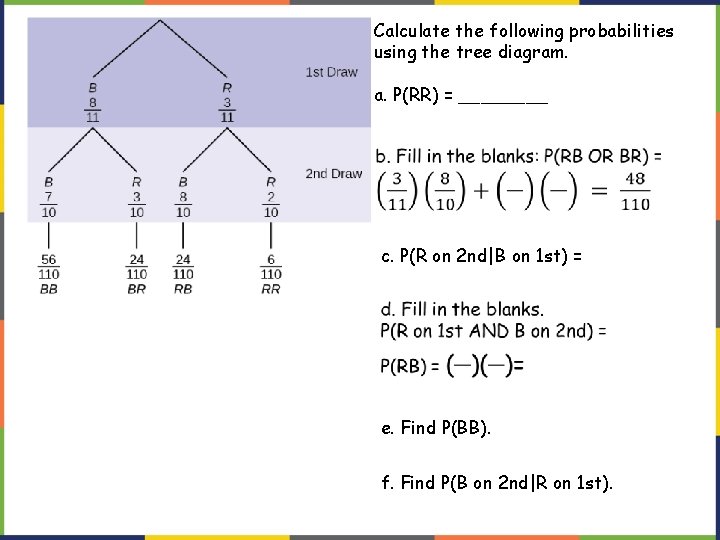
Calculate the following probabilities using the tree diagram. a. P(RR) = ____ c. P(R on 2 nd|B on 1 st) = e. Find P(BB). f. Find P(B on 2 nd|R on 1 st).
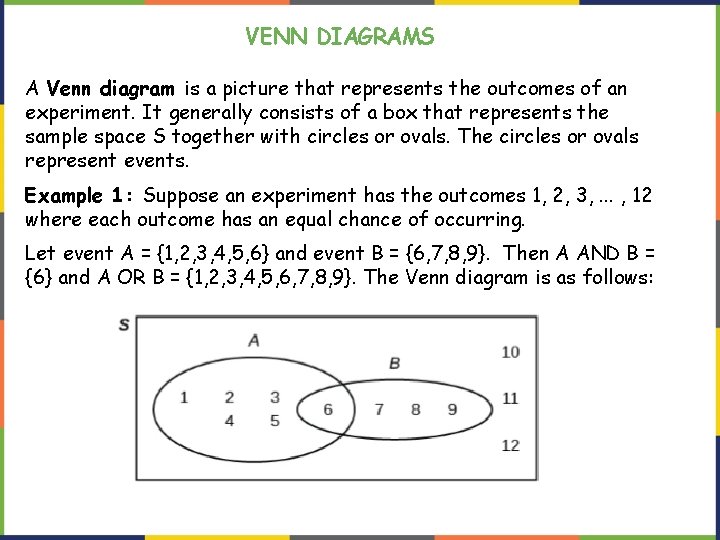
VENN DIAGRAMS A Venn diagram is a picture that represents the outcomes of an experiment. It generally consists of a box that represents the sample space S together with circles or ovals. The circles or ovals represent events. Example 1: Suppose an experiment has the outcomes 1, 2, 3, . . . , 12 where each outcome has an equal chance of occurring. Let event A = {1, 2, 3, 4, 5, 6} and event B = {6, 7, 8, 9}. Then A AND B = {6} and A OR B = {1, 2, 3, 4, 5, 6, 7, 8, 9}. The Venn diagram is as follows:
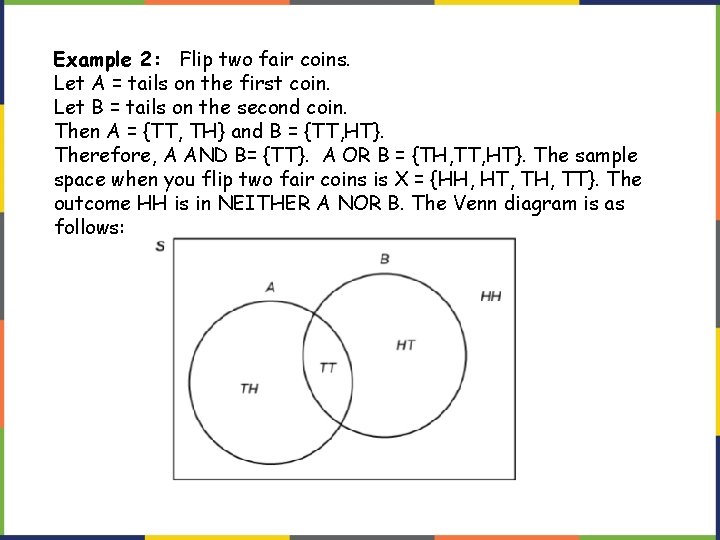
Example 2: Flip two fair coins. Let A = tails on the first coin. Let B = tails on the second coin. Then A = {TT, TH} and B = {TT, HT}. Therefore, A AND B= {TT}. A OR B = {TH, TT, HT}. The sample space when you flip two fair coins is X = {HH, HT, TH, TT}. The outcome HH is in NEITHER A NOR B. The Venn diagram is as follows:
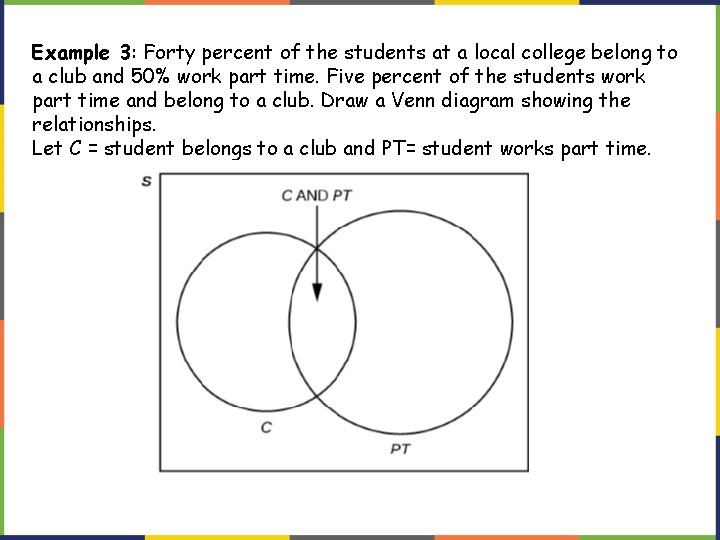
Example 3: Forty percent of the students at a local college belong to a club and 50% work part time. Five percent of the students work part time and belong to a club. Draw a Venn diagram showing the relationships. Let C = student belongs to a club and PT= student works part time.
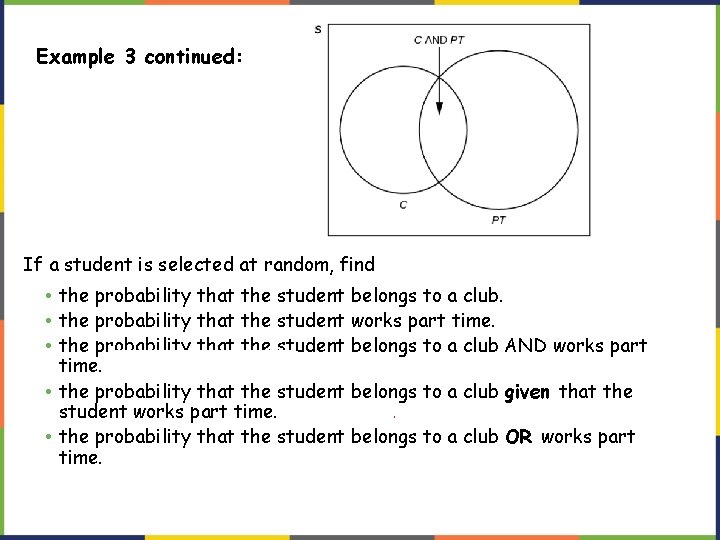
Example 3 continued: If a student is selected at random, find • the probability that the student belongs to a club. P(C) = 0. 40 • the probability that the student works part time. P(PT) = 0. 50 • the probability that the student belongs to a club AND works part time. P(C AND PT) = 0. 05 • the probability that the student belongs to a club given that the student works part time. P(C|PT) = 0. 1 • the probability that the student belongs to a club OR works part time. P(C OR PT) =. 85

Complete 3. 5 Practice Worksheet
- Slides: 83