
Introductory Review of Current Knowledge Organization SystemsStructuresServices KOS


- Slides: 67
Introductory Review of Current Knowledge Organization Systems/Structures/Services (KOS) Marcia Lei Zeng Second International Seminar on Subject Access to Information, Helsinki, Finland, 29 -30 November 2007 M. L. Zeng @ ISSAI, Helsinki, 2007
Purpose of this talk • Introduce different types of knowledge organization systems/structures/services (KOS) • Provide a common terminology and background M. L. Zeng @ ISSAI, Helsinki, 2007 2
1. KOS overview (1) Knowledge organization systems/structures/services (KOS) encompass all types of schemes for organizing information and promoting knowledge management. – (Gail Hodge, 2000) M. L. Zeng @ ISSAI, Helsinki, 2007 3
1. KOS overview (2) These systems • model the underlying semantic structure of a domain, and • provide semantics, navigation, and translation through labels, definitions, typing, relationships, and properties for concepts. – (Hill et al. 2002, Koch and Tudhope 2004). M. L. Zeng @ ISSAI, Helsinki, 2007 4
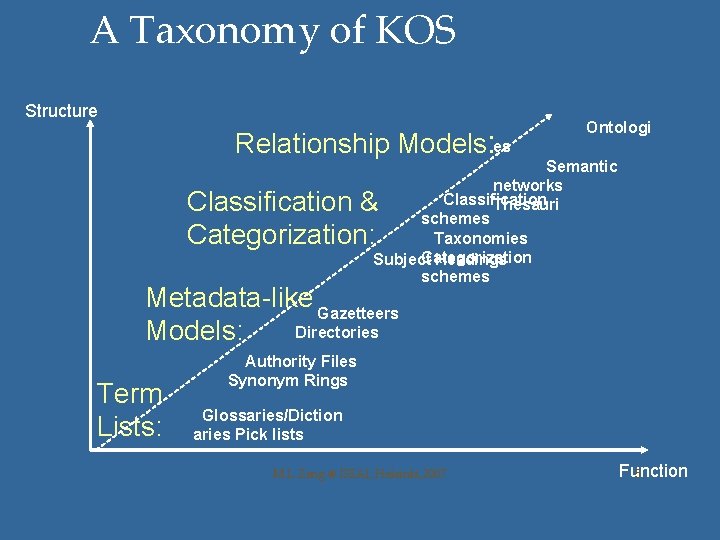
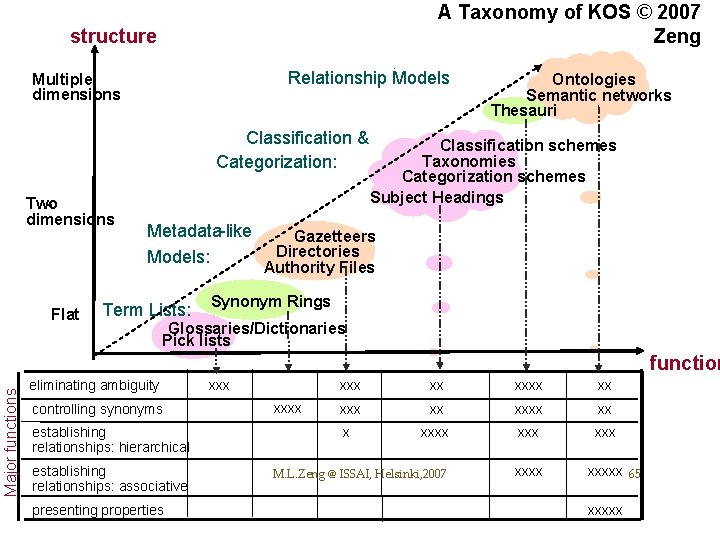
A Taxonomy of KOS Structure Relationship Models: es Ontologi Semantic networks Classification Thesauri schemes Taxonomies Categorization Subject Headings schemes Classification & Categorization: Metadata-like Gazetteers Directories Models: Term Lists: Authority Files Synonym Rings Glossaries/Diction aries Pick lists M. L. Zeng @ ISSAI, Helsinki, 2007 Function 5
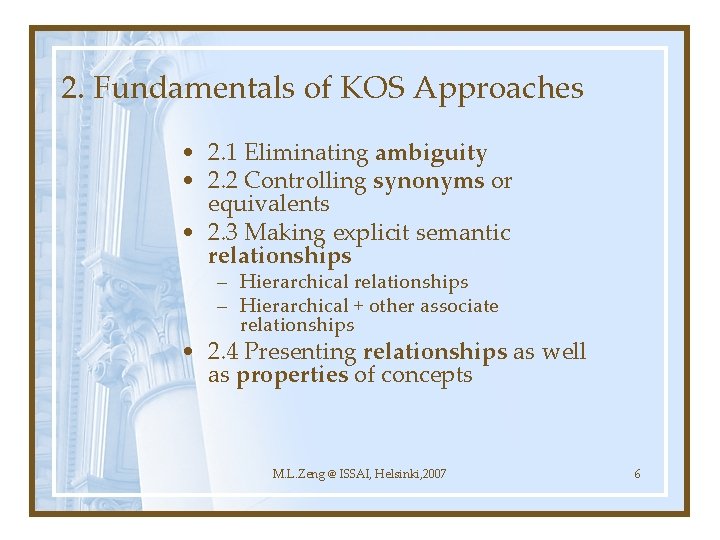
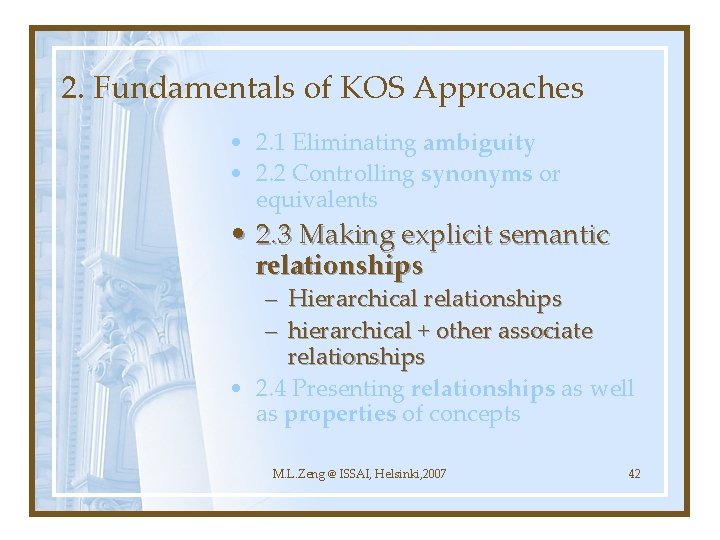
2. Fundamentals of KOS Approaches • 2. 1 Eliminating ambiguity • 2. 2 Controlling synonyms or equivalents • 2. 3 Making explicit semantic relationships – Hierarchical + other associate relationships • 2. 4 Presenting relationships as well as properties of concepts M. L. Zeng @ ISSAI, Helsinki, 2007 6
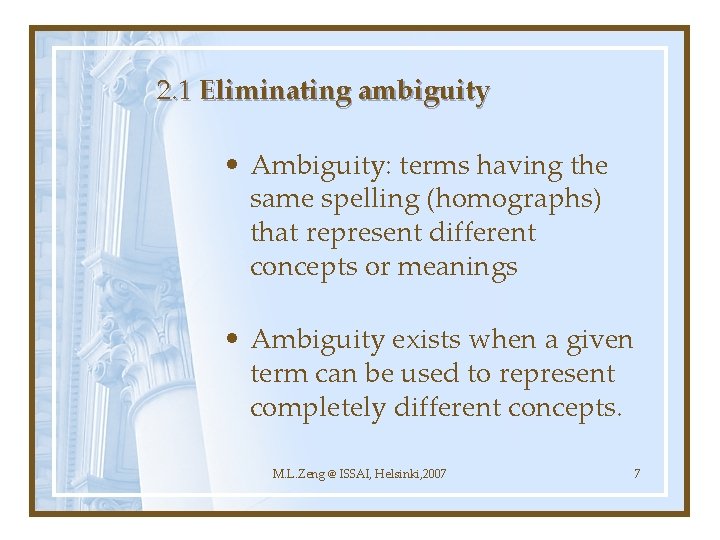
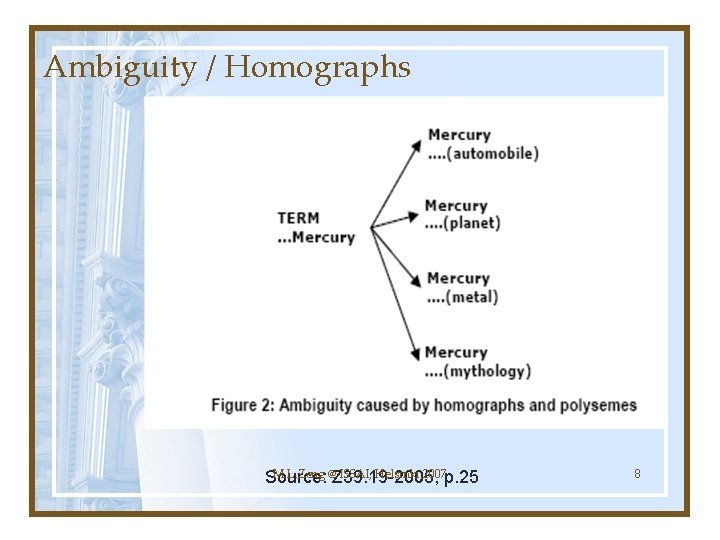
2. 1 Eliminating ambiguity • Ambiguity: terms having the same spelling (homographs) that represent different concepts or meanings • Ambiguity exists when a given term can be used to represent completely different concepts. M. L. Zeng @ ISSAI, Helsinki, 2007 7
Ambiguity / Homographs M. L. Zeng @ ISSAI, Helsinki, 2007 Source: Z 39. 19 -2005, p. 25 8
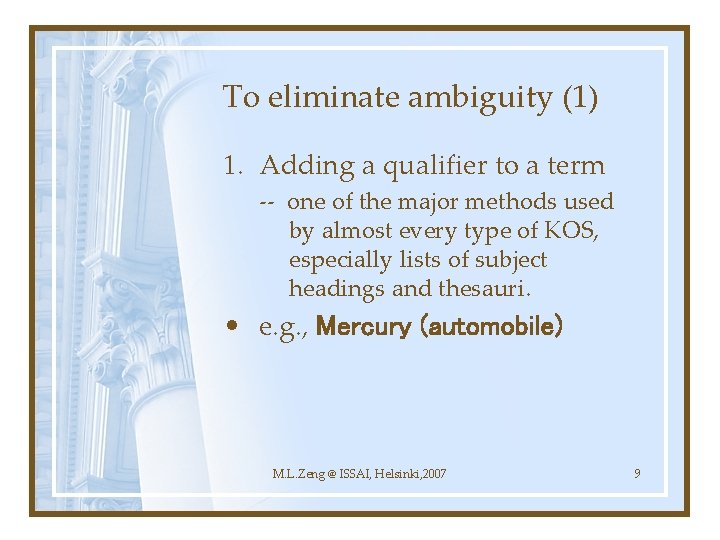
To eliminate ambiguity (1) 1. Adding a qualifier to a term -- one of the major methods used by almost every type of KOS, especially lists of subject headings and thesauri. • e. g. , Mercury (automobile) M. L. Zeng @ ISSAI, Helsinki, 2007 9
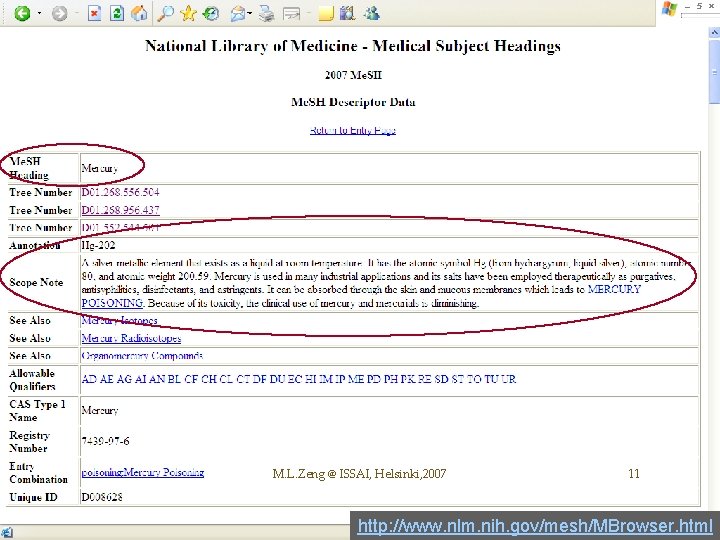
To eliminate ambiguity (2) 2. Providing a scope note -- another major method used by almost every type of KOS, especially lists of subject headings, classifications, and thesauri. Screenshot from Me. SH http: //www. nlm. nih. gov/mesh/MBrowser. html Entry: mercury M. L. Zeng @ ISSAI, Helsinki, 2007 10
M. L. Zeng @ ISSAI, Helsinki, 2007 11 http: //www. nlm. nih. gov/mesh/MBrowser. html
To eliminate ambiguity (3) 3. providing a context of a term M. L. Zeng @ ISSAI, Helsinki, 2007 12
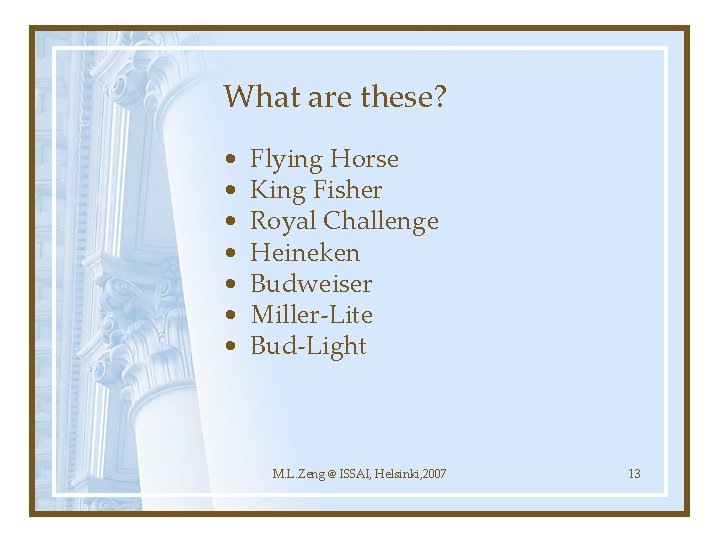
What are these? • • Flying Horse King Fisher Royal Challenge Heineken Budweiser Miller-Lite Bud-Light M. L. Zeng @ ISSAI, Helsinki, 2007 13
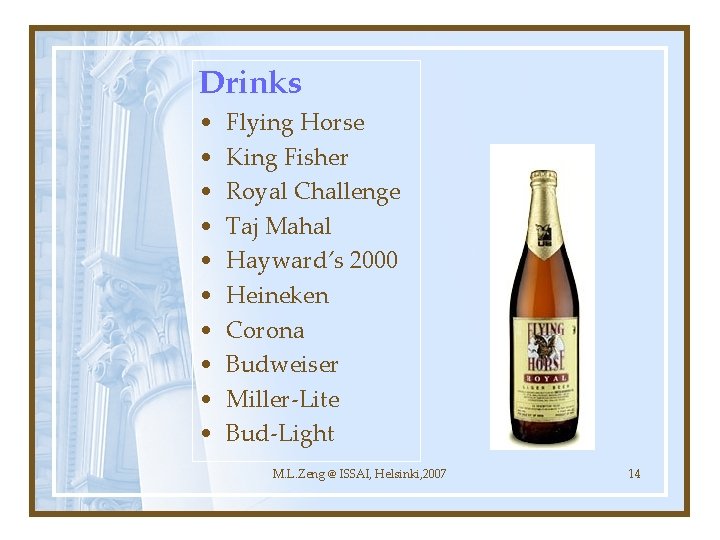
Drinks • • • Flying Horse King Fisher Royal Challenge Taj Mahal Hayward’s 2000 Heineken Corona Budweiser Miller-Lite Bud-Light M. L. Zeng @ ISSAI, Helsinki, 2007 14
Lists (Picklists) A type of controlled vocabulary induced in NISO Z 39. 19 Standard M. L. Zeng @ ISSAI, Helsinki, 2007
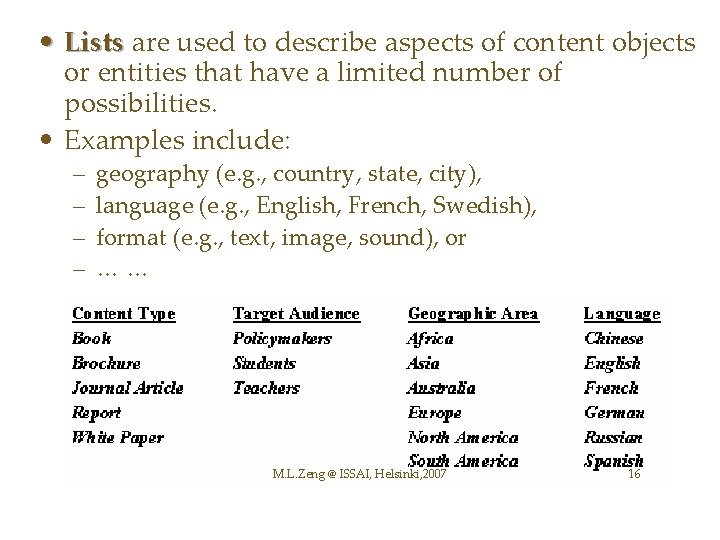
• Lists are used to describe aspects of content objects Lists or entities that have a limited number of possibilities. • Examples include: – – geography (e. g. , country, state, city), language (e. g. , English, French, Swedish), format (e. g. , text, image, sound), or … … M. L. Zeng @ ISSAI, Helsinki, 2007 16
Lists can be used effectively for both browsing and searching. • In browsing, items are directly browsing accessed when the list of terms is reviewed and one term is selected M. L. Zeng @ ISSAI, Helsinki, 2007 17
Source: http: //www. ncbi. nlm. nih. gov/genome/guide/human/resources. shtml M. L. Zeng @ ISSAI, Helsinki, 2007 18
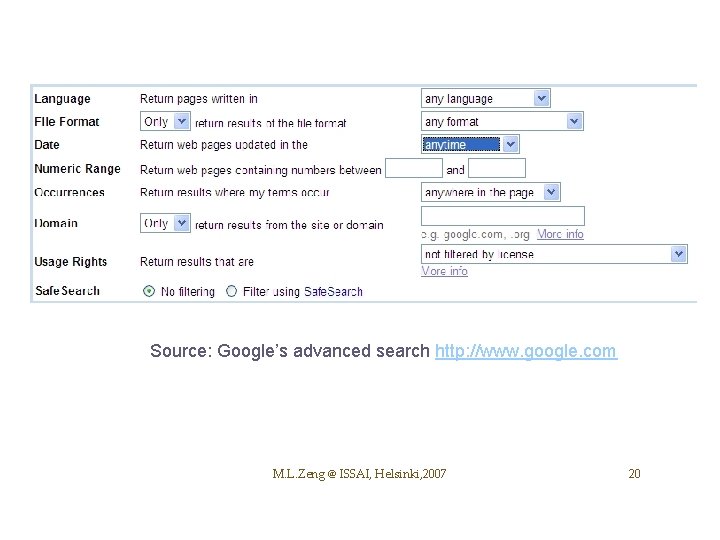
• In searching, a list may be used searching to access content in a single term search, or the terms from the list may be used to limit a retrieved set by another attribute of interest for the user (one or more terms in the search). M. L. Zeng @ ISSAI, Helsinki, 2007 19
Source: Google’s advanced search http: //www. google. com M. L. Zeng @ ISSAI, Helsinki, 2007 20
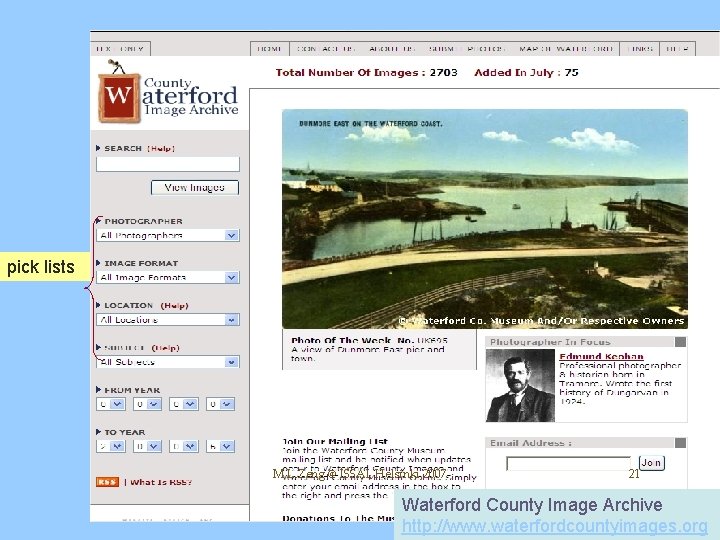
pick lists M. L. Zeng @ ISSAI, Helsinki, 2007 21 Waterford County Image Archive http: //www. waterfordcountyimages. org
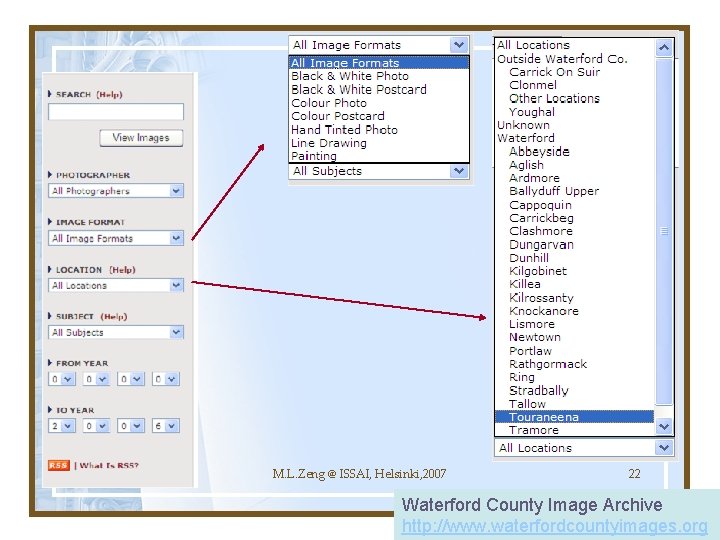
M. L. Zeng @ ISSAI, Helsinki, 2007 22 Waterford County Image Archive http: //www. waterfordcountyimages. org
List - Definition, Purpose, and Uses • A list (also called a pick list) is a limited set of terms arranged as a simple alphabetical list or in some other logically evident way. – A list is a series of terms in some sequential order. – Terms can be ordered alphabetically, chronologically, numerically, etc. M. L. Zeng @ ISSAI, Helsinki, 2007 23
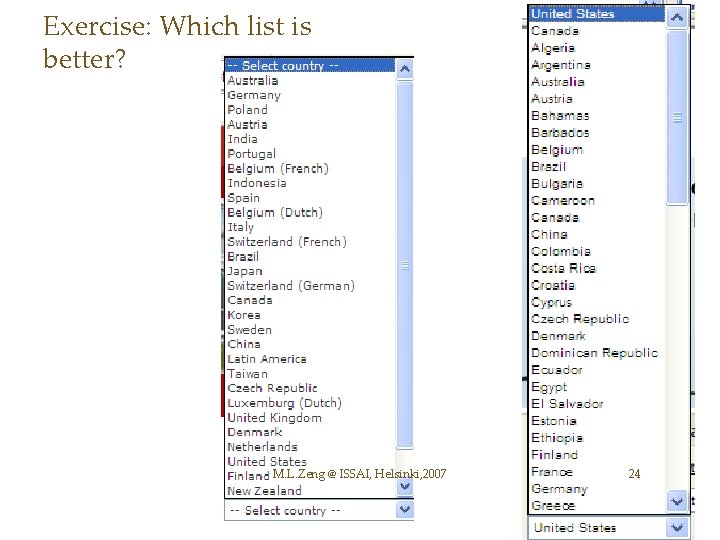
Exercise: Which list is better? M. L. Zeng @ ISSAI, Helsinki, 2007 24
• The defining characteristics of a list are that the terms: · are all members of the same set or class of items (e. g. , countries, products) · are not overlapping in meaning · are equal in terms of specificity (granularity) M. L. Zeng @ ISSAI, Helsinki, 2007 25
Typical applications • Lists are frequently used to display small sets of terms that are to be used for quite narrowly defined purposes such as a web pull-down list or list of menu choices. M. L. Zeng @ ISSAI, Helsinki, 2007 26
2. Fundamentals of KOS Approaches • 2. 1 Eliminating ambiguity • 2. 2 Controlling synonyms or equivalents • 2. 3 Making explicit semantic relationships – Hierarchical relationships – hierarchical + other associate relationships • 2. 4 Presenting relationships as well as properties of concepts M. L. Zeng @ ISSAI, Helsinki, 2007 27
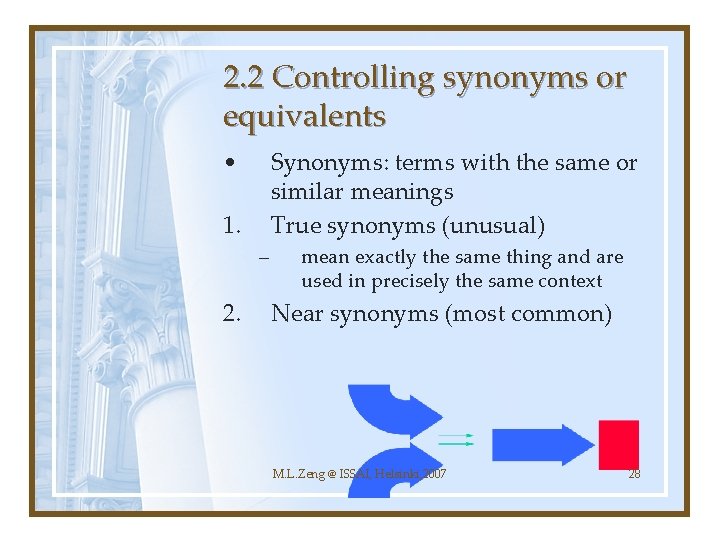
2. 2 Controlling synonyms or equivalents • Synonyms: terms with the same or similar meanings True synonyms (unusual) 1. – 2. mean exactly the same thing and are used in precisely the same context Near synonyms (most common) M. L. Zeng @ ISSAI, Helsinki, 2007 28
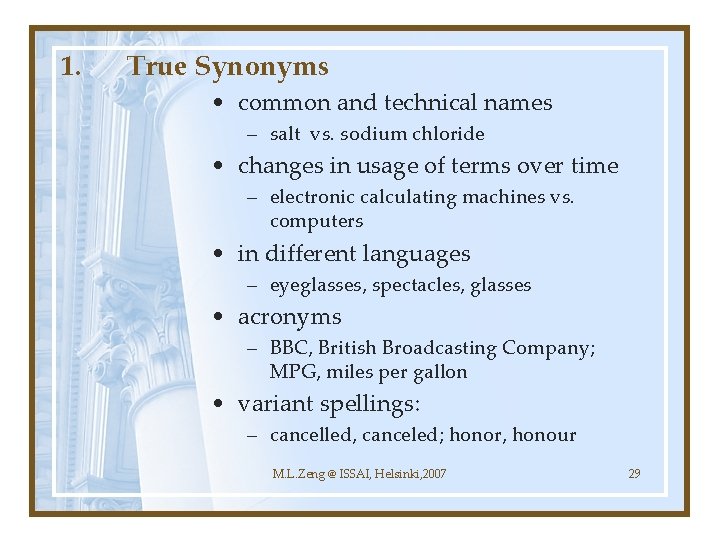
1. True Synonyms • common and technical names – salt vs. sodium chloride • changes in usage of terms over time – electronic calculating machines vs. computers • in different languages – eyeglasses, spectacles, glasses • acronyms – BBC, British Broadcasting Company; MPG, miles per gallon • variant spellings: – cancelled, canceled; honor, honour M. L. Zeng @ ISSAI, Helsinki, 2007 29
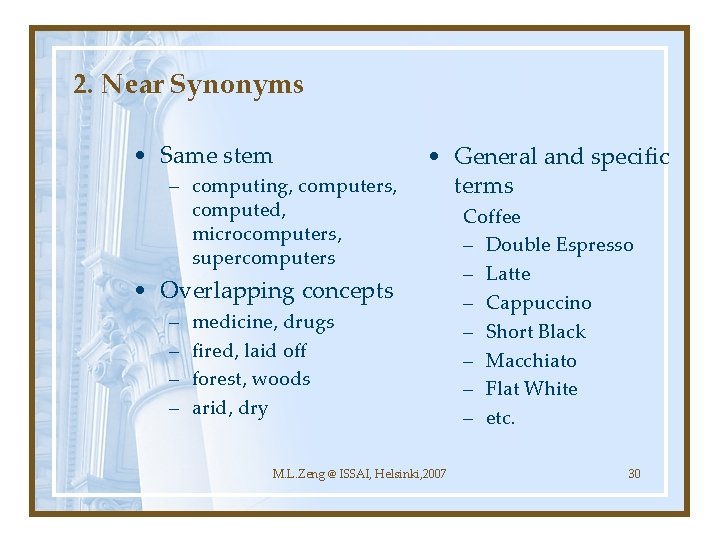
2. Near Synonyms • Same stem – computing, computers, computed, microcomputers, supercomputers • General and specific terms • Overlapping concepts – – medicine, drugs fired, laid off forest, woods arid, dry M. L. Zeng @ ISSAI, Helsinki, 2007 Coffee – Double Espresso – Latte – Cappuccino – Short Black – Macchiato – Flat White – etc. 30
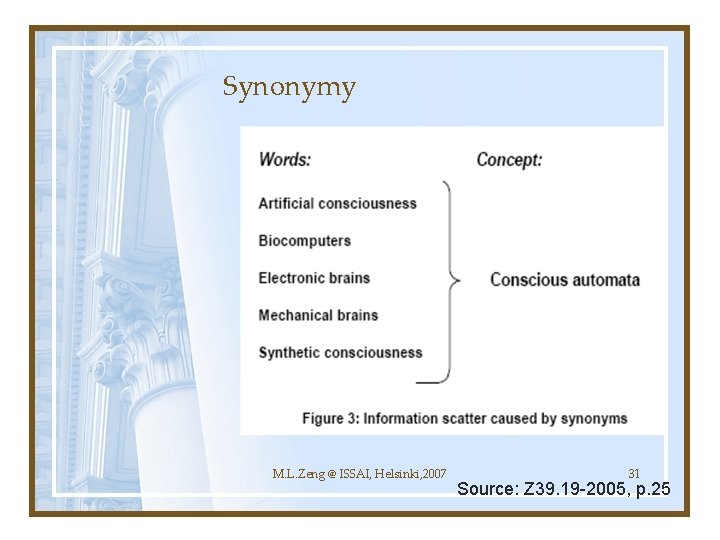
Synonymy M. L. Zeng @ ISSAI, Helsinki, 2007 31 Source: Z 39. 19 -2005, p. 25
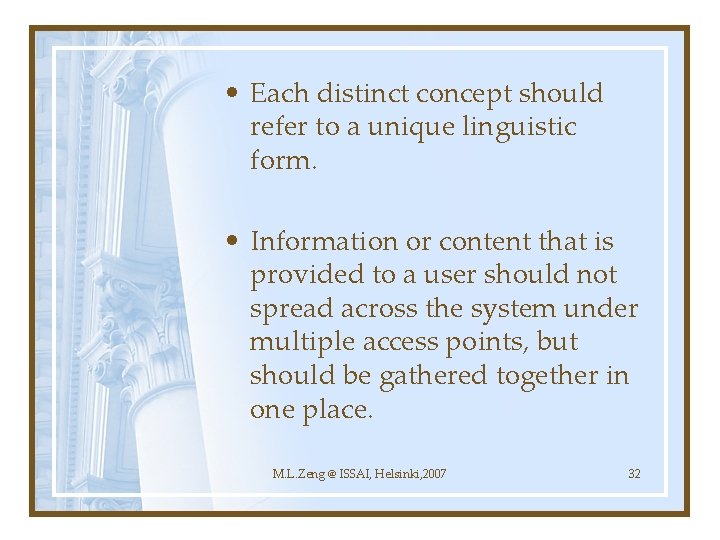
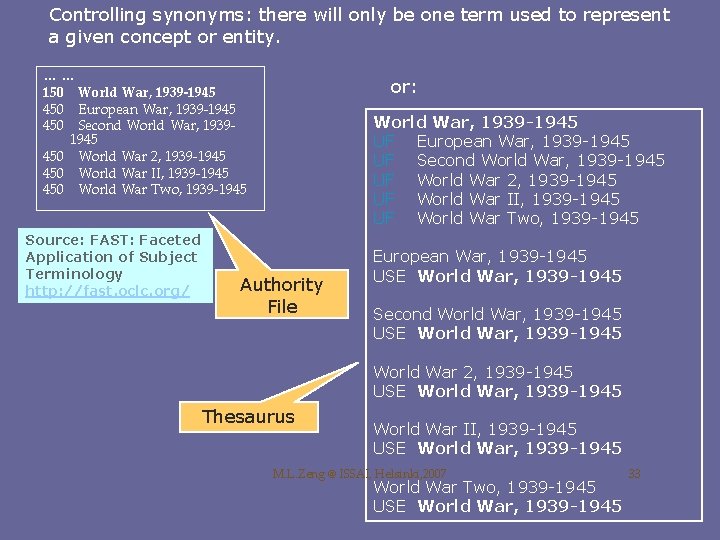
• Each distinct concept should refer to a unique linguistic form. • Information or content that is provided to a user should not spread across the system under multiple access points, but should be gathered together in one place. M. L. Zeng @ ISSAI, Helsinki, 2007 32
Controlling synonyms: there will only be one term used to represent a given concept or entity. … … 150 World War, 1939 -1945 450 European War, 1939 -1945 450 Second World War, 19391945 450 World War 2, 1939 -1945 450 World War II, 1939 -1945 450 World War Two, 1939 -1945 Source: FAST: Faceted Application of Subject Terminology http: //fast. oclc. org/ or: World War, 1939 -1945 UF European War, 1939 -1945 UF Second World War, 1939 -1945 UF World War 2, 1939 -1945 UF World War II, 1939 -1945 UF World War Two, 1939 -1945 Authority File European War, 1939 -1945 USE World War, 1939 -1945 Second World War, 1939 -1945 USE World War, 1939 -1945 World War 2, 1939 -1945 USE World War, 1939 -1945 Thesaurus World War II, 1939 -1945 USE World War, 1939 -1945 M. L. Zeng @ ISSAI, Helsinki, 2007 World War Two, 1939 -1945 USE World War, 1939 -1945 33
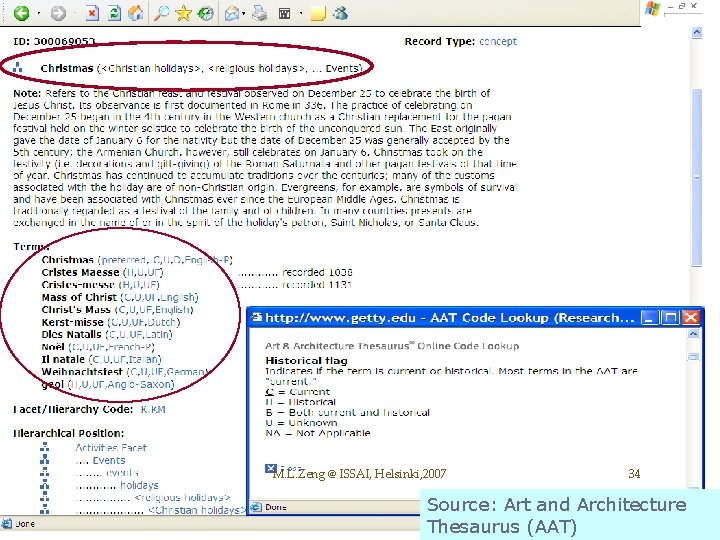
M. L. Zeng @ ISSAI, Helsinki, 2007 34 Source: Art and Architecture Thesaurus (AAT)
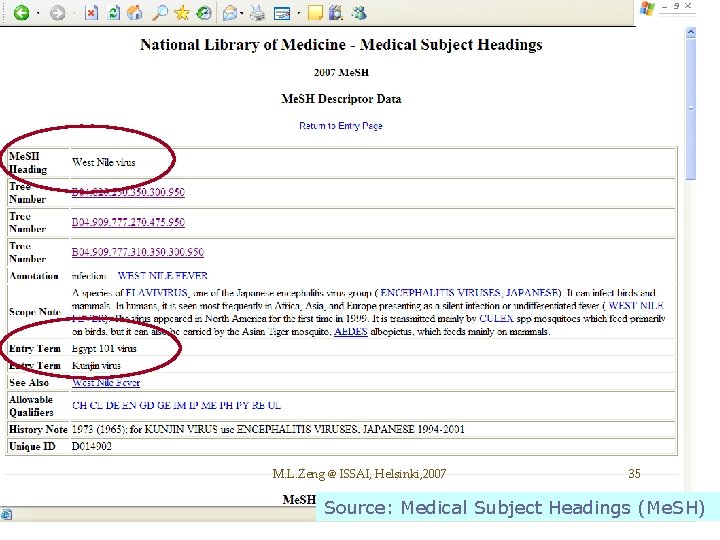
M. L. Zeng @ ISSAI, Helsinki, 2007 35 Source: Medical Subject Headings (Me. SH)
Synonym Rings A type of controlled vocabulary induced in NISO Z 39. 19 Standard M. L. Zeng @ ISSAI, Helsinki, 2007
A synonym ring connects a set of words that are defined as equivalent for retrieval. astronaut spaceman spationaut cosmonaut taikonaut M. L. Zeng @ ISSAI, Helsinki, 2007 37
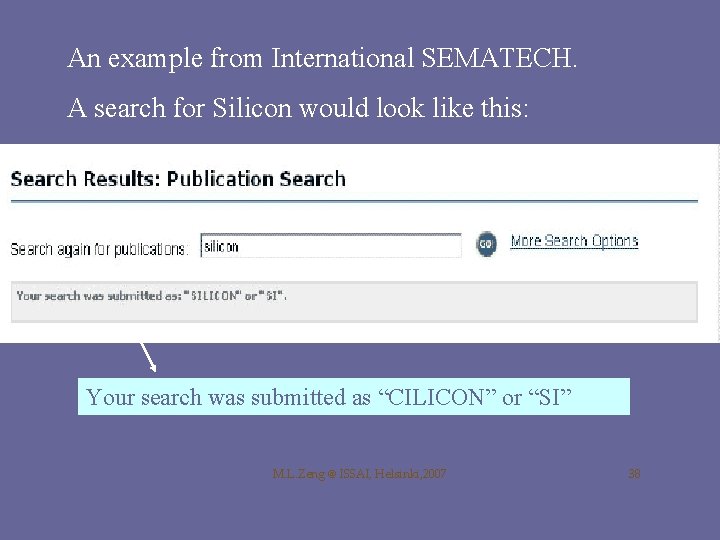
An example from International SEMATECH. A search for Silicon would look like this: Your search was submitted as “CILICON” or “SI” M. L. Zeng @ ISSAI, Helsinki, 2007 38
Synonym Rings are used- • to expand queries for content objects – If a user enters any one of these terms as a query to the system, all items are retrieved that contain any of the terms in the cluster. • in systems where the underlying content objects are left in their unstructured natural language format – The control is achieved through the interface by drawing together similar terms to these clusters. • in conjunction with search engines M. L. Zeng @ ISSAI, Helsinki, 2007 39
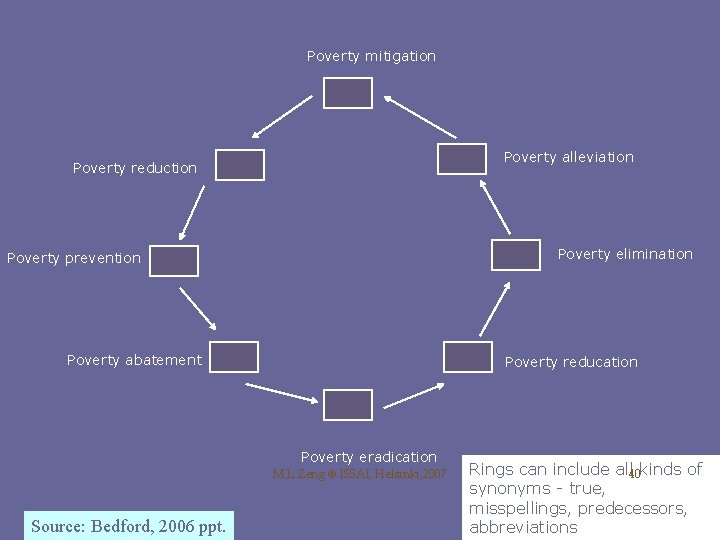
Poverty mitigation Poverty alleviation Poverty reduction Poverty elimination Poverty prevention Poverty abatement Poverty reducation Poverty eradication M. L. Zeng @ ISSAI, Helsinki, 2007 Source: Bedford, 2006 ppt. Rings can include all kinds of 40 synonyms - true, misspellings, predecessors, abbreviations
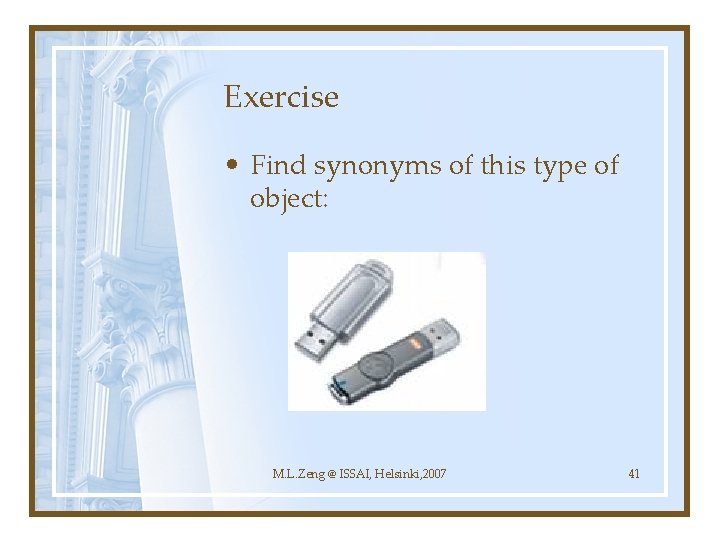
Exercise • Find synonyms of this type of object: M. L. Zeng @ ISSAI, Helsinki, 2007 41
2. Fundamentals of KOS Approaches • 2. 1 Eliminating ambiguity • 2. 2 Controlling synonyms or equivalents • 2. 3 Making explicit semantic relationships – Hierarchical relationships – hierarchical + other associate relationships • 2. 4 Presenting relationships as well as properties of concepts M. L. Zeng @ ISSAI, Helsinki, 2007 42
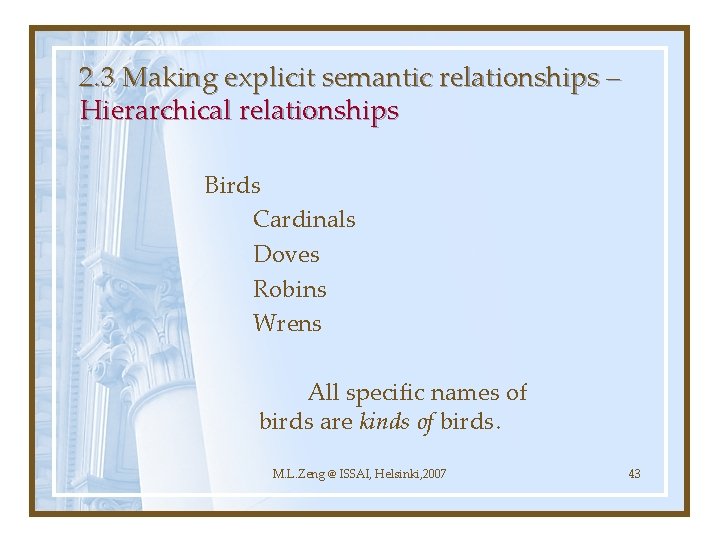
2. 3 Making explicit semantic relationships – Hierarchical relationships Birds Cardinals Doves Robins Wrens All specific names of birds are kinds of birds. M. L. Zeng @ ISSAI, Helsinki, 2007 43
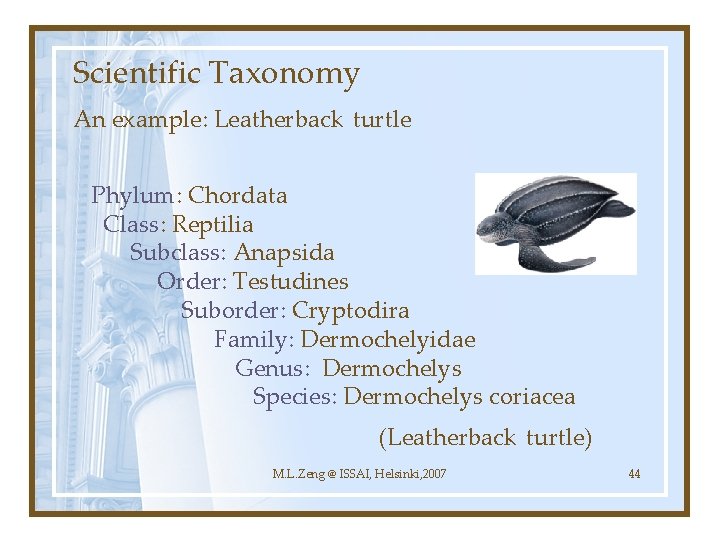
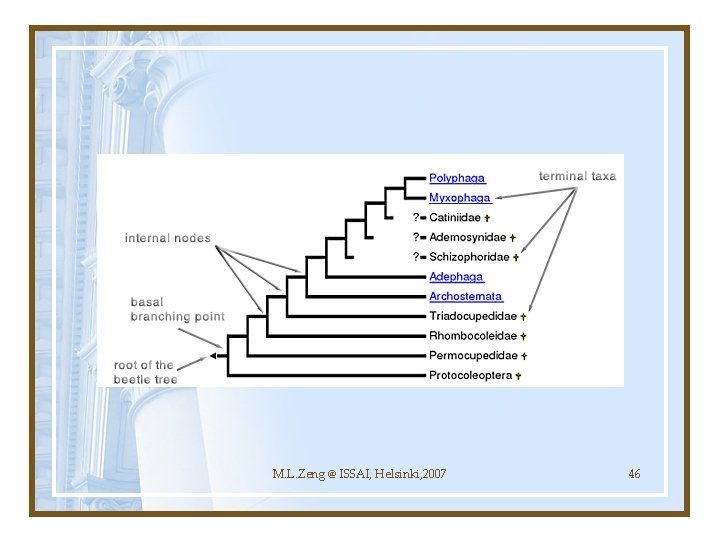
Scientific Taxonomy An example: Leatherback turtle Phylum: Chordata Class: Reptilia Subclass: Anapsida Order: Testudines Suborder: Cryptodira Family: Dermochelyidae Genus: Dermochelys Species: Dermochelys coriacea (Leatherback turtle) M. L. Zeng @ ISSAI, Helsinki, 2007 44
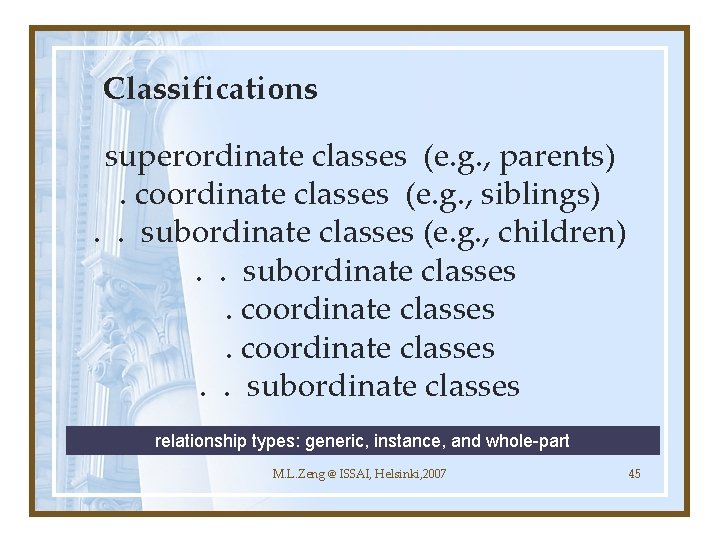
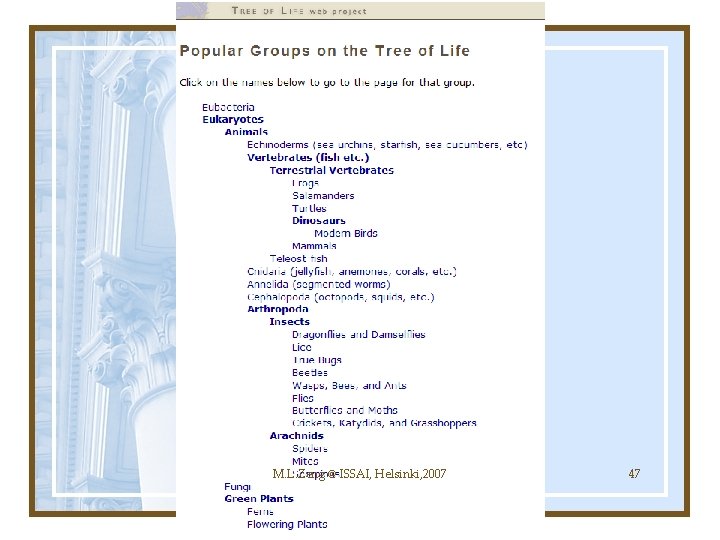
Classifications superordinate classes (e. g. , parents). coordinate classes (e. g. , siblings). . subordinate classes (e. g. , children). . subordinate classes . coordinate classes . . subordinate classes relationship types: generic, instance, and whole-part M. L. Zeng @ ISSAI, Helsinki, 2007 45
M. L. Zeng @ ISSAI, Helsinki, 2007 46
M. L. Zeng @ ISSAI, Helsinki, 2007 47
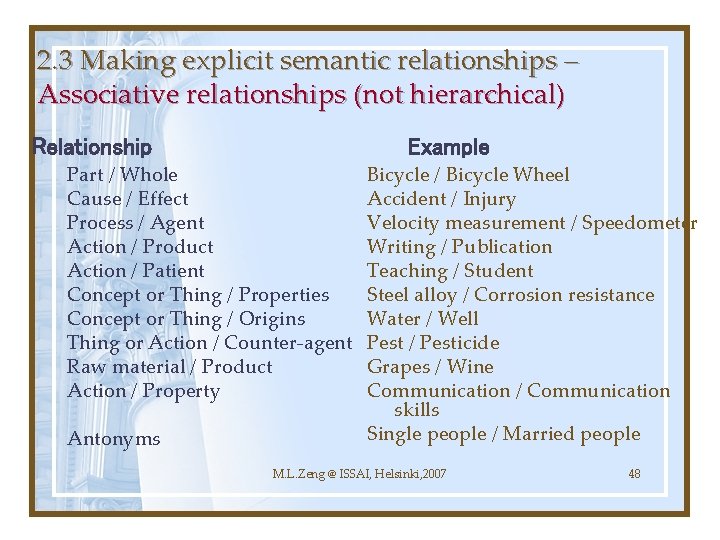
2. 3 Making explicit semantic relationships – Associative relationships (not hierarchical) Relationship Example Part / Whole Cause / Effect Process / Agent Action / Product Action / Patient Concept or Thing / Properties Concept or Thing / Origins Thing or Action / Counter-agent Raw material / Product Action / Property Antonyms Bicycle / Bicycle Wheel Accident / Injury Velocity measurement / Speedometer Writing / Publication Teaching / Student Steel alloy / Corrosion resistance Water / Well Pest / Pesticide Grapes / Wine Communication / Communication skills Single people / Married people M. L. Zeng @ ISSAI, Helsinki, 2007 48
M. L. Zeng @ ISSAI, Helsinki, 2007 49
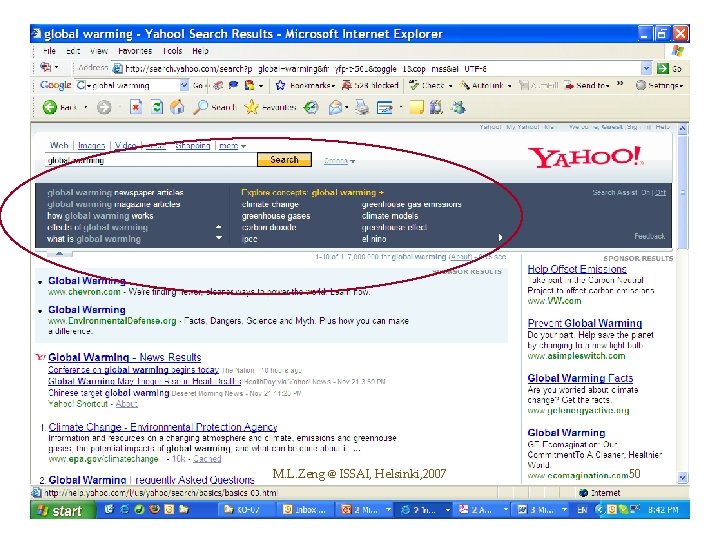
M. L. Zeng @ ISSAI, Helsinki, 2007 50
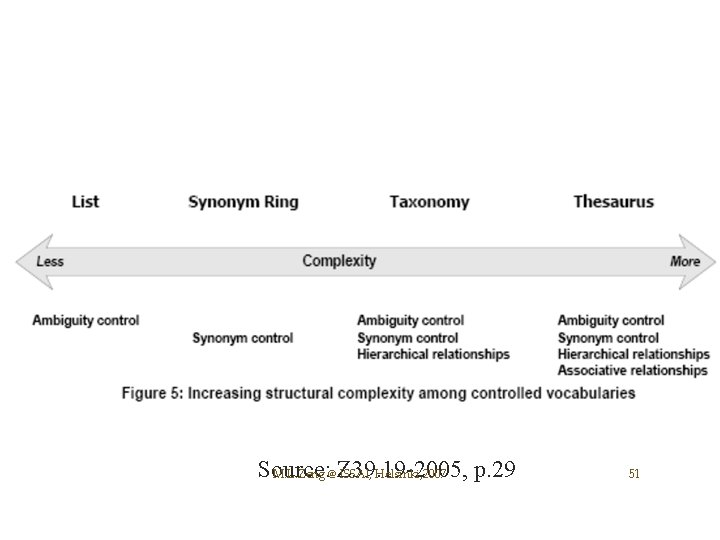
Source: Z 39. 19 -2005, p. 29 M. L. Zeng @ ISSAI, Helsinki, 2007 51
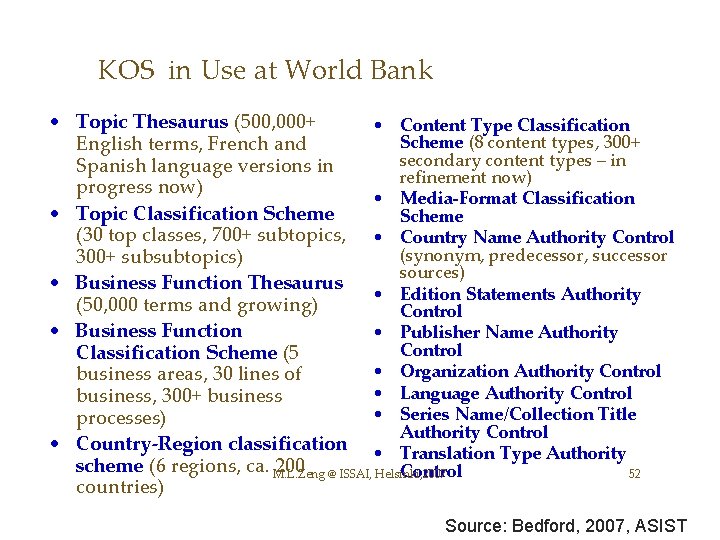
KOS in Use at World Bank • Topic Thesaurus (500, 000+ • Content Type Classification Scheme (8 content types, 300+ English terms, French and secondary content types – in Spanish language versions in refinement now) progress now) • Media-Format Classification • Topic Classification Scheme (30 top classes, 700+ subtopics, • Country Name Authority Control (synonym, predecessor, successor 300+ subsubtopics) sources) • Business Function Thesaurus • Edition Statements Authority (50, 000 terms and growing) Control • Business Function • Publisher Name Authority Control Classification Scheme (5 • Organization Authority Control business areas, 30 lines of • Language Authority Control business, 300+ business • Series Name/Collection Title processes) Authority Control • Country-Region classification • Translation Type Authority scheme (6 regions, ca. 200 Control M. L. Zeng @ ISSAI, Helsinki, 2007 52 countries) Source: Bedford, 2007, ASIST
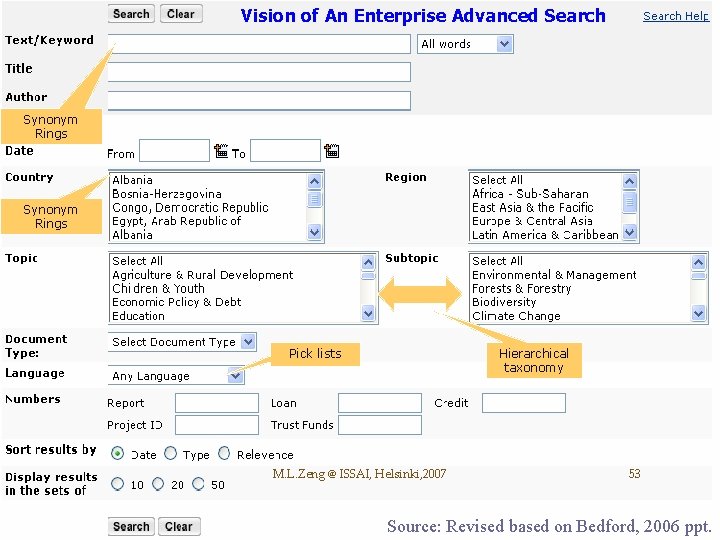
Vision of An Enterprise Advanced Search Synonym Rings Pick lists Hierarchical taxonomy M. L. Zeng @ ISSAI, Helsinki, 2007 53 Source: Revised based on Bedford, 2006 ppt.
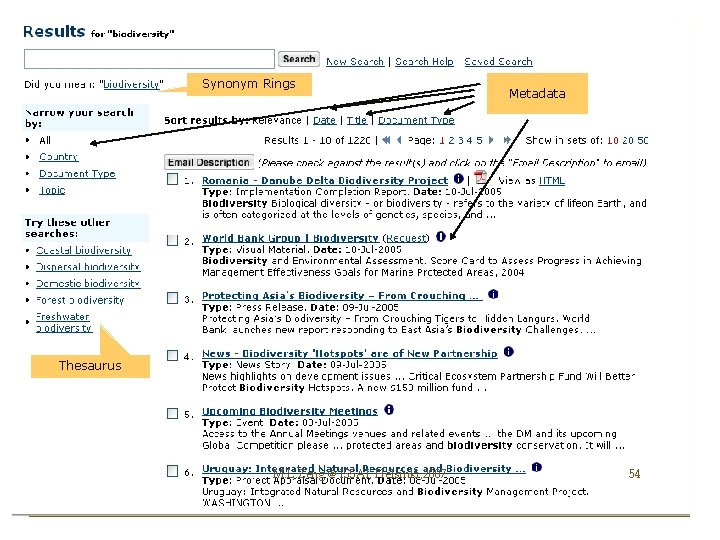
Synonym Rings Metadata Thesaurus M. L. Zeng @ ISSAI, Helsinki, 2007 54 Source: Revised based on Bedford, 2006 ppt.
2. Fundamentals of KOS Approaches • 2. 1 Eliminating ambiguity • 2. 2 Controlling synonyms or equivalents • 2. 3 Making explicit semantic relationships – Hierarchical relationships – hierarchical + other associate relationships • 2. 4 Presenting relationships as well as properties of concepts M. L. Zeng @ ISSAI, Helsinki, 2007 55
2. 4 Presenting relationships as well as properties of concepts • Entity types • Relationship types • Properties M. L. Zeng @ ISSAI, Helsinki, 2007 56
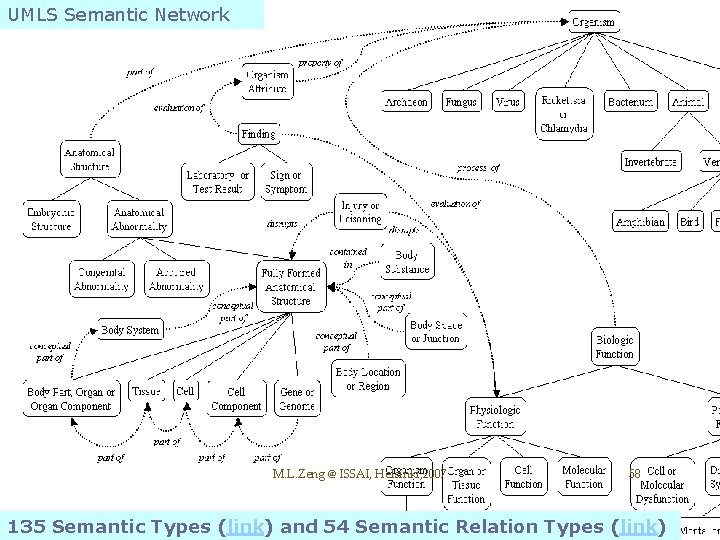
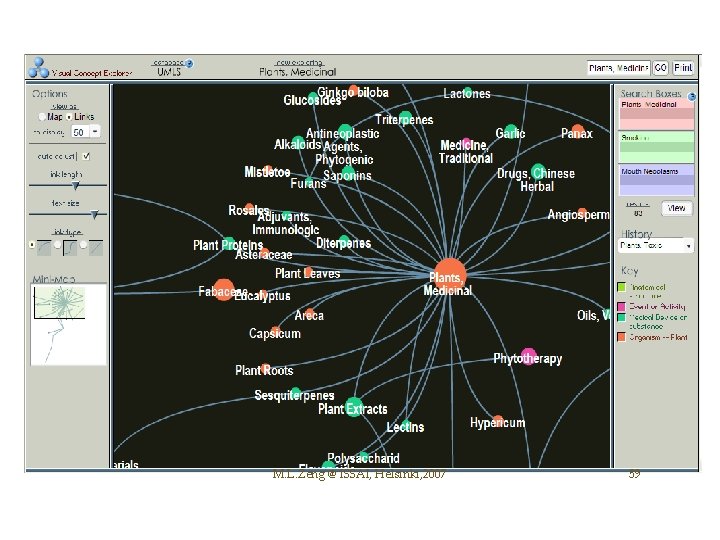
Semantic networks organize sets of terms representing concepts, modeled as the nodes in a network of variable relationship types. M. L. Zeng @ ISSAI, Helsinki, 2007 57
UMLS Semantic Network M. L. Zeng @ ISSAI, Helsinki, 2007 58 135 Semantic Types (link) and 54 Semantic Relation Types (link)
M. L. Zeng @ ISSAI, Helsinki, 2007 59
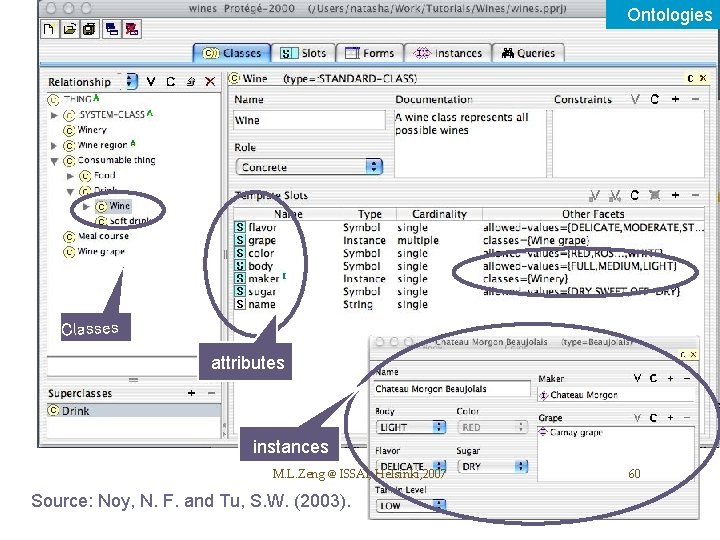
Ontologies Classes attributes instances M. L. Zeng @ ISSAI, Helsinki, 2007 Source: Noy, N. F. and Tu, S. W. (2003). 60
M. L. Zeng @ ISSAI, Helsinki, 2007 61
M. L. Zeng @ ISSAI, Helsinki, 2007 62
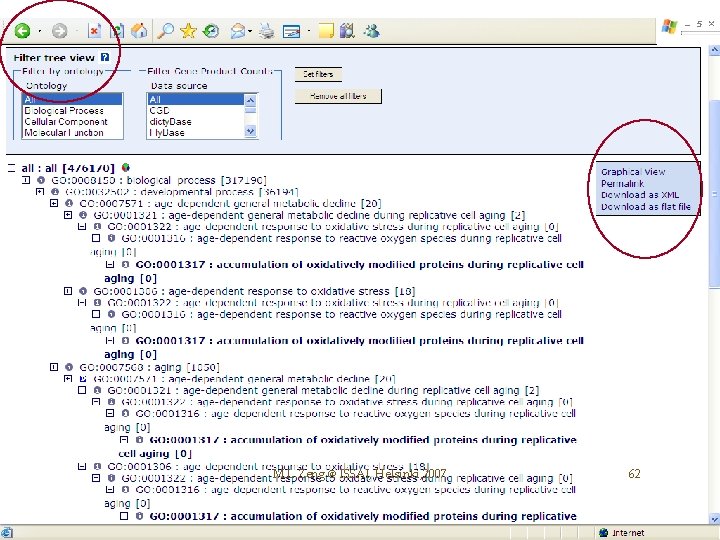
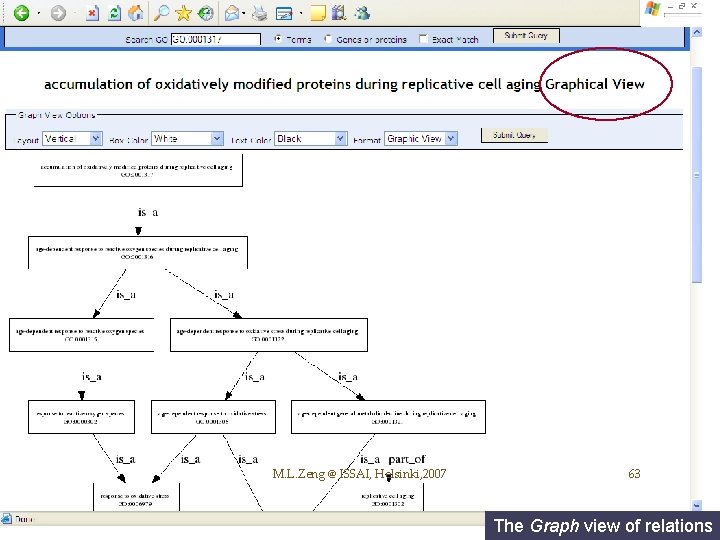
M. L. Zeng @ ISSAI, Helsinki, 2007 63 The Graph view of relations
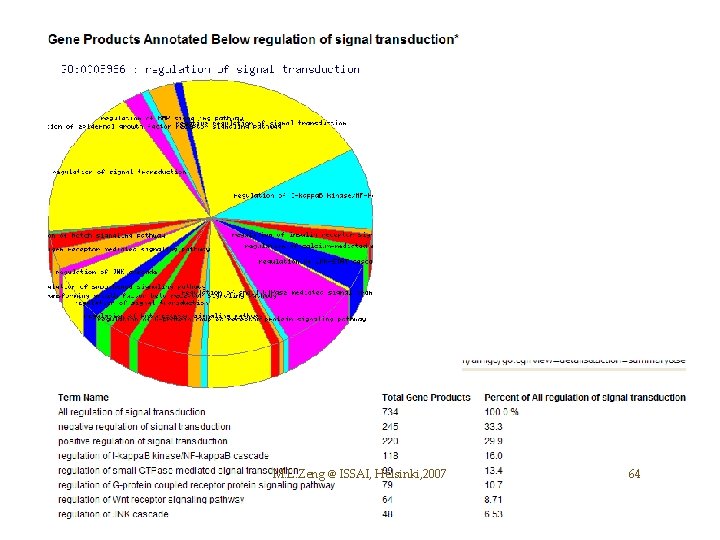
M. L. Zeng @ ISSAI, Helsinki, 2007 64
A Taxonomy of KOS © 2007 Zeng structure : Relationship Models Multiple dimensions Classification & Categorization: Two dimensions Flat Metadata-like Models: Term Lists: Ontologies Semantic networks Thesauri Classification schemes Taxonomies Categorization schemes Subject Headings Gazetteers Directories Authority Files Synonym Rings Glossaries/Dictionaries Pick lists Major functions function eliminating ambiguity controlling synonyms establishing relationships: hierarchical establishing relationships: associative presenting properties xxxx xxxx xxx xxx M. L. Zeng @ ISSAI, Helsinki, 2007 xxxxx 65 xxxxx
Networked KOS NKOS • KOS are not used in isolation; • KOS may be used, re-used, and repurposed in web-based services; • KOS are used for: – organizing, indexing, cataloging, and searching, AND – learning, knowledge modeling, reasoning, etc. • NKOS need to be machine-processable, machine-understandable – (more to discuss later today) M. L. Zeng @ ISSAI, Helsinki, 2007 66
References • Hodge, Gail (2000). Systems of Knowledge Organization for Digital Libraries: Beyond Traditional Authority Files. Washington, DC: Council on Library and Information Resources. http: //www. clir. org/pubs/reports/pub 91/contents. html http: //www. clir. org/pubs/reports/pub 91. pdf • Hill, Linda, Buchel, Olha, Janee, Greg, and Zeng, Marcia L. 2002. Integration of knowledge organization systems into digital library architectures: In: Mai, Jens-Erik, et al. ed. : Advances of classification research, volume 13, proceedings of the 13 th ASIST SIG/CR Workshop, 17 November 2002 Philadelphia PA, pp. 62 -68. • Koch, Traugott and Tudhope, Douglas. 2004. User-centred approaches to Networked Knowledge Organization Systems/Services (NKOS): Background. http: //www 2. db. dk/nkos-workshop/#Background M. L. Zeng @ ISSAI, Helsinki, 2007 67