
Introductory Psychology Lectures A series of Power Point

- Slides: 16
Introductory Psychology Lectures A series of Power. Point lectures to accompany the introductory psychology textbooks offered by Worth publishers Editor: Harvey G. Shulman, Ph. D. Subcortical Structures Joe Williams The Ohio State University Department of Psychology © 1999 The Ohio State University & Worth Publishers. 1 1
Subcortical Brain Structures z Subcortical - underneath the cortex yhypothalamus and pituitary ybasal ganglia ylimbic system yhindbrain and brainstem structures © 1999 The Ohio State University & Worth Publishers. 2 2
Hindbrain Structures z Cerebellum z Brainstem ymedulla yreticular formation ypons © 1999 The Ohio State University & Worth Publishers. 3 3
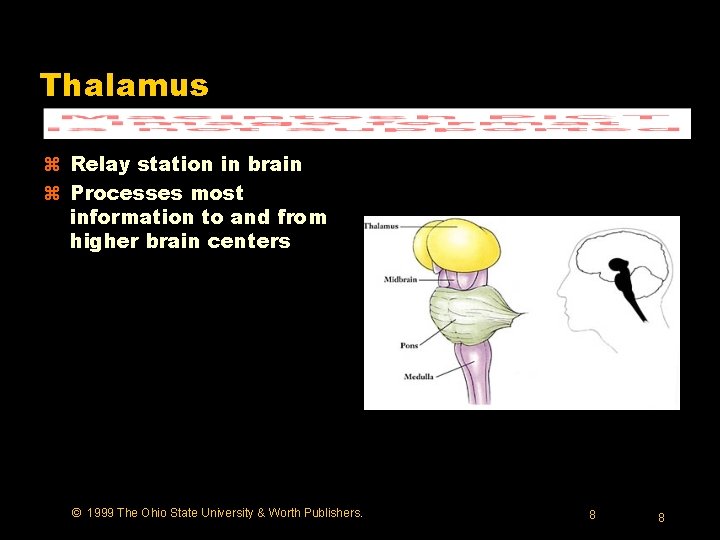
Thalamus z Relay station in brain z Processes most information to and from higher brain centers © 1999 The Ohio State University & Worth Publishers. 8 8
The Limbic System z Hypothalamus z Amygdala z Hippocampus © 1999 The Ohio State University & Worth Publishers. 9 9
Hypothalamus z Contains nuclei involved in a variety of behaviors y sexual behavior y hunger, thirst y sleep y water and salt balance y body temperature regulation y circadian rhythms y role in hormone secretion © 1999 The Ohio State University & Worth Publishers. 10 10
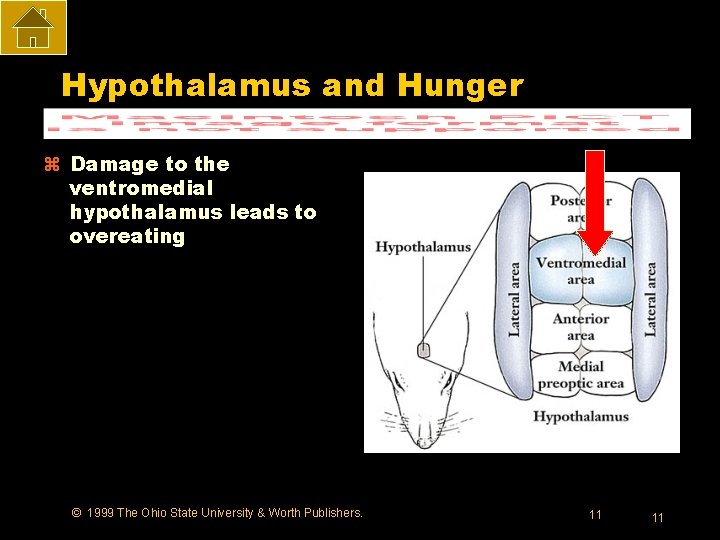
Hypothalamus and Hunger z Damage to the ventromedial hypothalamus leads to overeating © 1999 The Ohio State University & Worth Publishers. 11 11
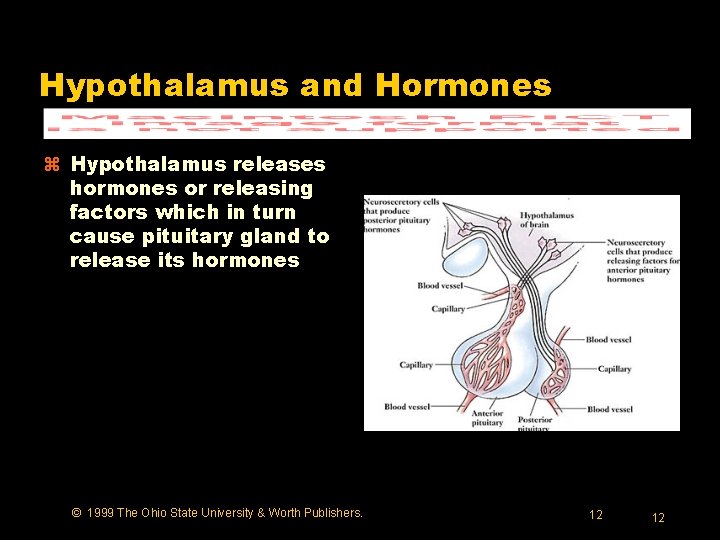
Hypothalamus and Hormones z Hypothalamus releases hormones or releasing factors which in turn cause pituitary gland to release its hormones © 1999 The Ohio State University & Worth Publishers. 12 12
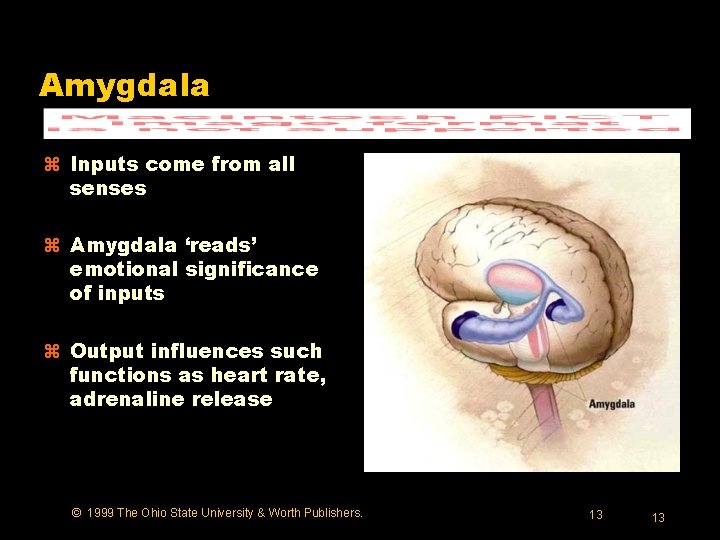
Amygdala z Inputs come from all senses z Amygdala ‘reads’ emotional significance of inputs z Output influences such functions as heart rate, adrenaline release © 1999 The Ohio State University & Worth Publishers. 13 13
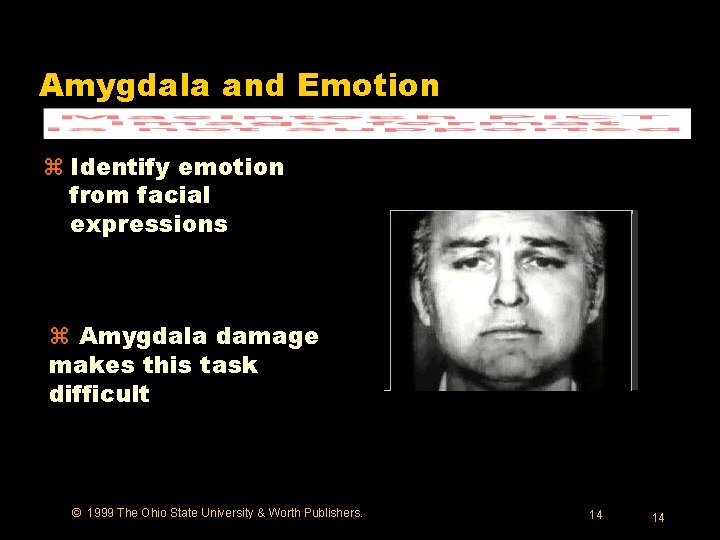
Amygdala and Emotion z Identify emotion from facial expressions z Amygdala damage makes this task difficult © 1999 The Ohio State University & Worth Publishers. 14 14
Hippocampus z Important in forming new memories © 1999 The Ohio State University & Worth Publishers. 15 15
Basal Ganglia z Slow, deliberate movements z Parkinson’s disease is the result of abnormalities in the basal ganglia © 1999 The Ohio State University & Worth Publishers. 16 16
Dopamine z Involved in movement, attention and learning z Dopamine imbalance also involved in schizophrenia z Loss of dopamineproducing neurons is cause of Parkinson’s disease © 1999 The Ohio State University & Worth Publishers. 17 17
Parkinson’s Disease z Results from loss of dopamine-producing neurons in the substantia nigra z Symptoms include ydifficulty starting and stopping voluntary movements ytremors at rest ystooped posture yrigidity ypoor balance © 1999 The Ohio State University & Worth Publishers. 18 18
Parkinson’s Disease z Treatments y. L-dopa ytransplants of fetal dopamine-producing substantia nigra cells yadrenal gland transplants yelectrical stimulation of the thalamus has been used to stop tremors © 1999 The Ohio State University & Worth Publishers. 19 19
Copyright 1999 by Worth Publishers, New York, NY and by The Ohio State University. All rights reserved. No part of the material protected by this copyright may be reproduced or utilized in any form or by any means, electronic or mechanical, including photocopying, recording, or by any information storage and retrieval system, without written permission of the copyright owners. © 1999 The Ohio State University & Worth Publishers. 20 20