
Introductory Physics for the Life Sciences at East
- Slides: 1
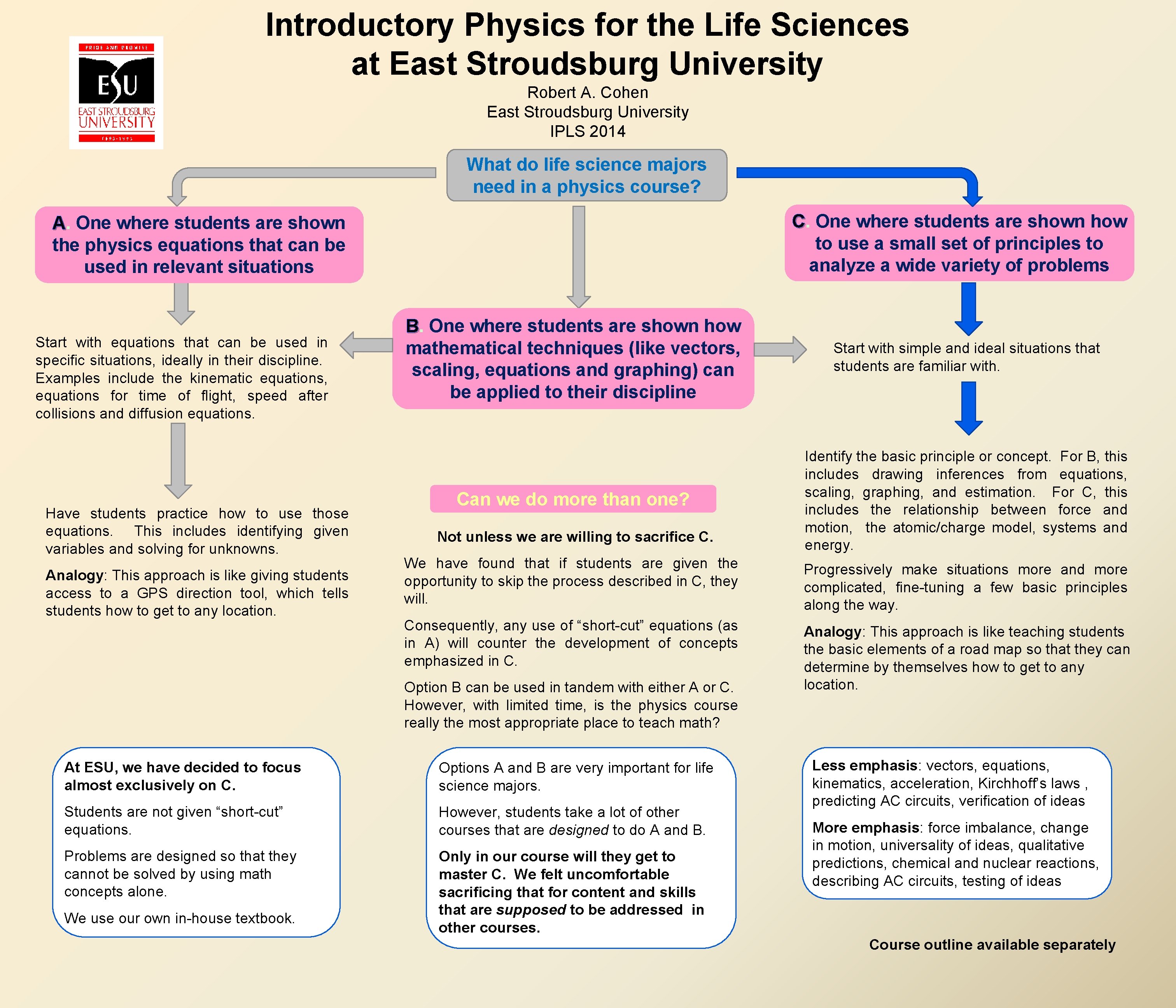
Introductory Physics for the Life Sciences at East Stroudsburg University Robert A. Cohen East Stroudsburg University IPLS 2014 What do life science majors need in a physics course? C. One where students are shown how to use a small set of principles to analyze a wide variety of problems A. One where students are shown the physics equations that can be used in relevant situations Start with equations that can be used in specific situations, ideally in their discipline. Examples include the kinematic equations, equations for time of flight, speed after collisions and diffusion equations. Have students practice how to use those equations. This includes identifying given variables and solving for unknowns. Analogy: This approach is like giving students access to a GPS direction tool, which tells students how to get to any location. B. One where students are shown how mathematical techniques (like vectors, scaling, equations and graphing) can be applied to their discipline Start with simple and ideal situations that students are familiar with. Can we do more than one? Identify the basic principle or concept. For B, this includes drawing inferences from equations, scaling, graphing, and estimation. For C, this includes the relationship between force and motion, the atomic/charge model, systems and energy. Not unless we are willing to sacrifice C. We have found that if students are given the opportunity to skip the process described in C, they will. Progressively make situations more and more complicated, fine-tuning a few basic principles along the way. Consequently, any use of “short-cut” equations (as in A) will counter the development of concepts emphasized in C. Analogy: This approach is like teaching students the basic elements of a road map so that they can determine by themselves how to get to any location. Option B can be used in tandem with either A or C. However, with limited time, is the physics course really the most appropriate place to teach math? At ESU, we have decided to focus almost exclusively on C. Options A and B are very important for life science majors. Students are not given “short-cut” equations. However, students take a lot of other courses that are designed to do A and B. Problems are designed so that they cannot be solved by using math concepts alone. Only in our course will they get to master C. We felt uncomfortable sacrificing that for content and skills that are supposed to be addressed in other courses. We use our own in-house textbook. Less emphasis: vectors, equations, kinematics, acceleration, Kirchhoff’s laws , predicting AC circuits, verification of ideas More emphasis: force imbalance, change in motion, universality of ideas, qualitative predictions, chemical and nuclear reactions, describing AC circuits, testing of ideas Course outline available separately