
Introductory Nanotechnology Basic Condensed Matter Physics Atsufumi Hirohata

Introductory Nanotechnology ~ Basic Condensed Matter Physics ~ Atsufumi Hirohata Department of Electronics
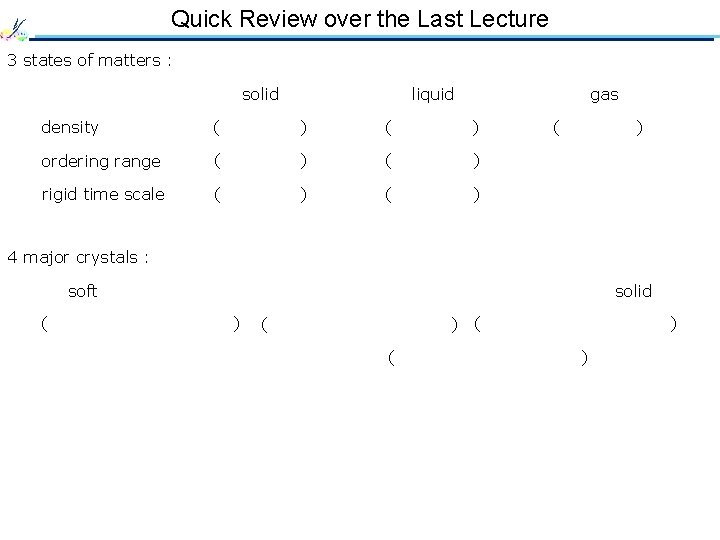
Quick Review over the Last Lecture 3 states of matters : solid gas liquid density ( large ) ordering range ( long ) ( short ) rigid time scale ( long ) ( short ) ( small ) 4 major crystals : soft ( van der Waals crystal ) solid ( metallic crystal ( ) ( covalent crystal ionic crystal ) )
Contents of Introductory Nanotechnology First half of the course : Basic condensed matter physics 1. Why solids are solid ? 2. What is the most common atom on the earth ? 3. How does an electron travel in a material ? 4. How does lattices vibrate thermally ? 5. What is a semi-conductor ? 6. How does an electron tunnel through a barrier ? 7. Why does a magnet attract / retract ? 8. What happens at interfaces ? Second half of the course : Introduction to nanotechnology (nano-fabrication / application)
What Is the Most Common Atom on the earth? Phase diagram • Free electron model • Electron transport • • Electron Potential • • • Degeneracy Brillouin Zone Fermi Distribution
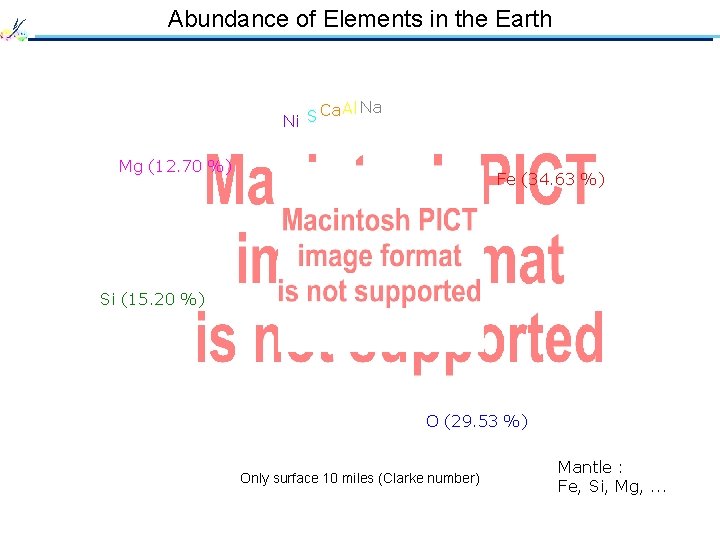
Abundance of Elements in the Earth Ca Al Ni S Na Mg (12. 70 %) Fe (34. 63 %) Si (15. 20 %) O (29. 53 %) Only surface 10 miles (Clarke number) Mantle : Fe, Si, Mg, . . .
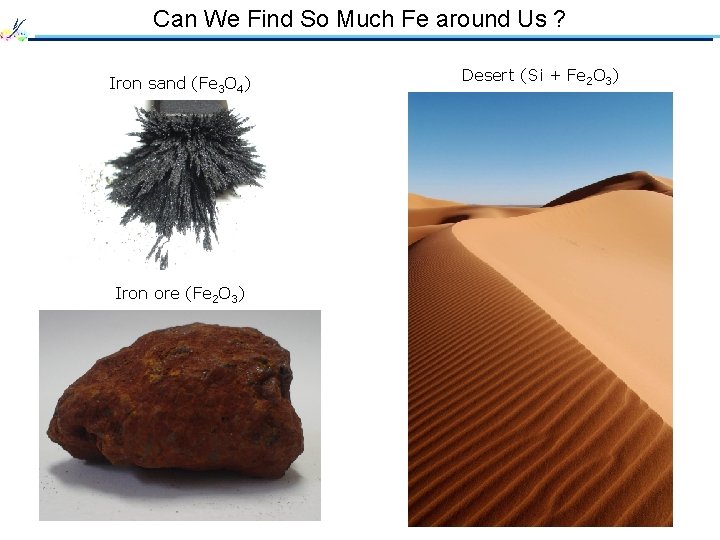
Can We Find So Much Fe around Us ? Iron sand (Fe 3 O 4) Iron ore (Fe 2 O 3) Desert (Si + Fe 2 O 3)
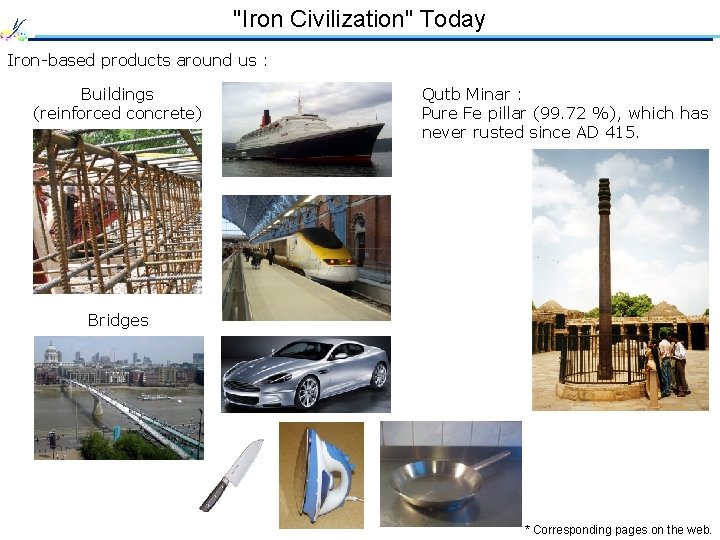
"Iron Civilization" Today Iron-based products around us : Buildings (reinforced concrete) Qutb Minar : Pure Fe pillar (99. 72 %), which has never rusted since AD 415. Bridges * Corresponding pages on the web.
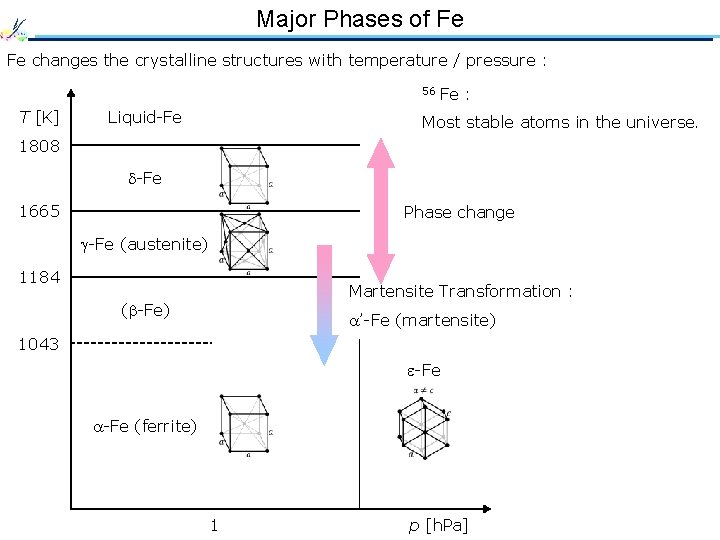
Major Phases of Fe Fe changes the crystalline structures with temperature / pressure : 56 T [K] Liquid-Fe Fe : Most stable atoms in the universe. 1808 -Fe bcc 1665 Phase change -Fe (austenite) fcc 1184 Martensite Transformation : ( -Fe) ’-Fe (martensite) 1043 -Fe (ferrite) bcc hcp 1 p [h. Pa]
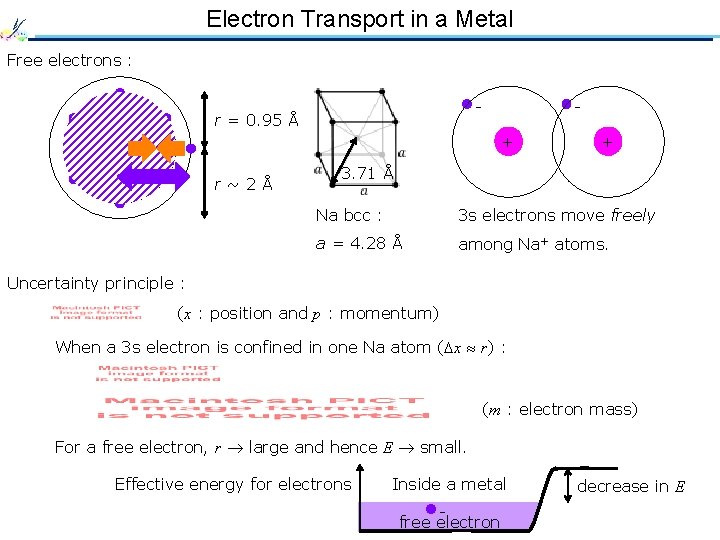
Electron Transport in a Metal Free electrons : - r = 0. 95 Å + Na r~2Å + 3. 71 Å Na bcc : 3 s electrons move freely a = 4. 28 Å among Na+ atoms. Uncertainty principle : (x : position and p : momentum) When a 3 s electron is confined in one Na atom ( x r) : (m : electron mass) For a free electron, r large and hence E small. Effective energy for electrons Inside a metal - free electron decrease in E
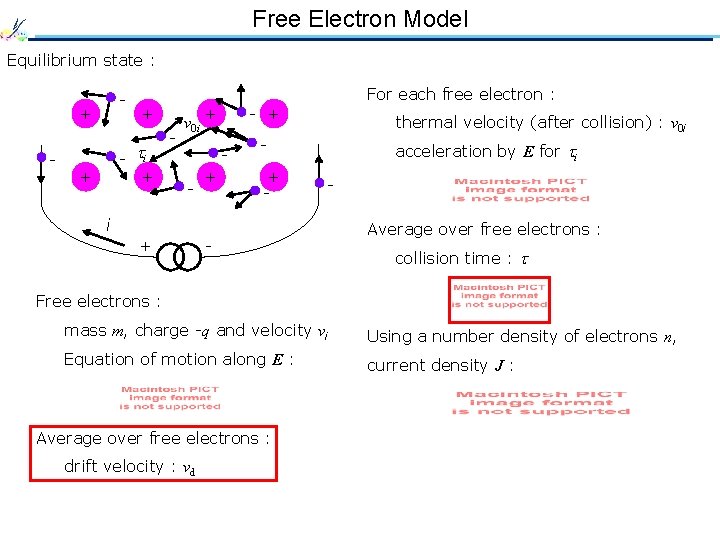
Free Electron Model Equilibrium state : - + + v 0 i + - i + + + - For each free electron : - thermal velocity (after collision) : v 0 i acceleration by E for i - i + - Average over free electrons : collision time : Free electrons : mass m, charge -q and velocity vi Using a number density of electrons n, Equation of motion along E : current density J : Average over free electrons : drift velocity : vd
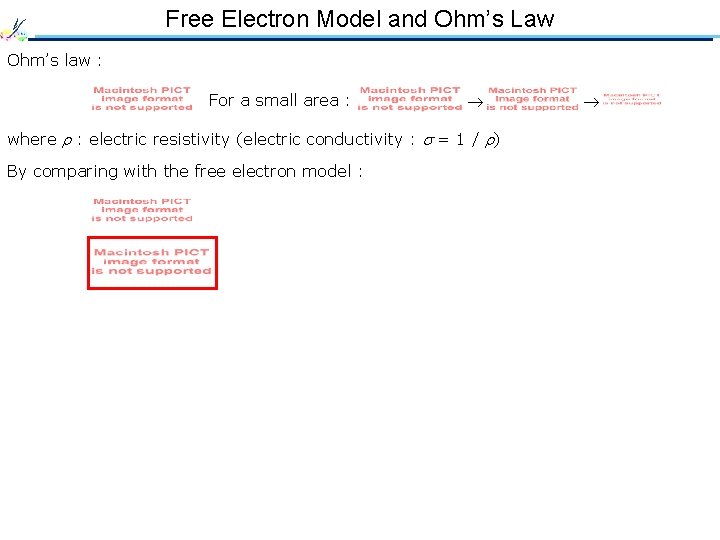
Free Electron Model and Ohm’s Law Ohm’s law : For a small area : where : electric resistivity (electric conductivity : = 1 / ) By comparing with the free electron model :
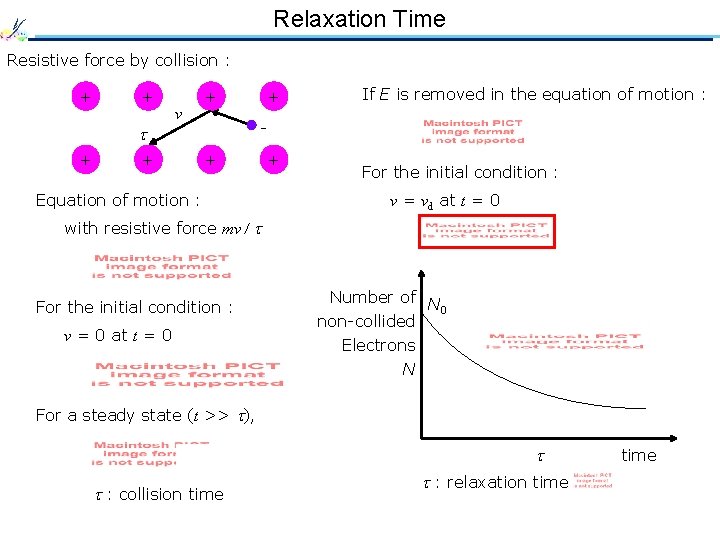
Relaxation Time Resistive force by collision : + + v + + If E is removed in the equation of motion : - + + + Equation of motion : + For the initial condition : v = vd at t = 0 with resistive force mv / For the initial condition : v = 0 at t = 0 Number of N 0 non-collided Electrons N For a steady state (t >> ), : collision time : relaxation time
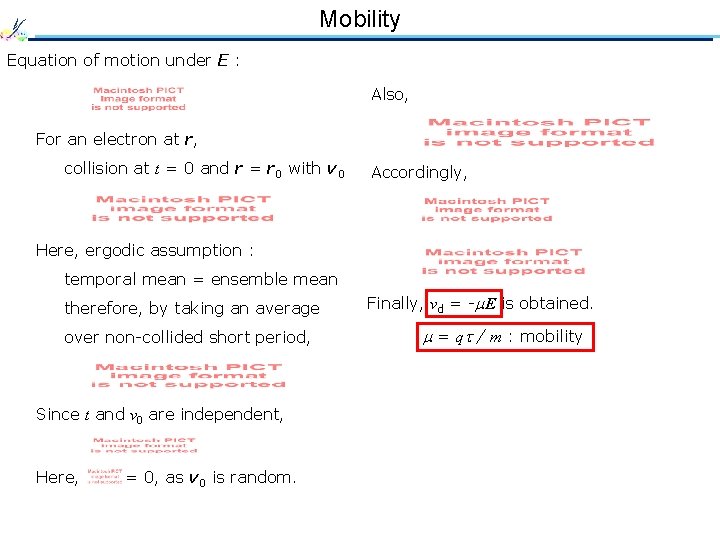
Mobility Equation of motion under E : Also, For an electron at r, collision at t = 0 and r = r 0 with v 0 Accordingly, Here, ergodic assumption : temporal mean = ensemble mean therefore, by taking an average over non-collided short period, Since t and v 0 are independent, Here, = 0, as v 0 is random. Finally, vd = - E is obtained. = q / m : mobility
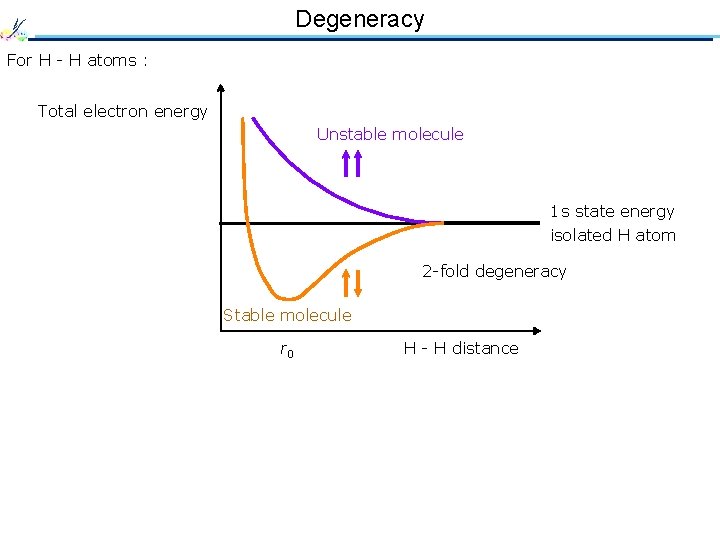
Degeneracy For H - H atoms : Total electron energy Unstable molecule 1 s state energy isolated H atom 2 -fold degeneracy Stable molecule r 0 H - H distance
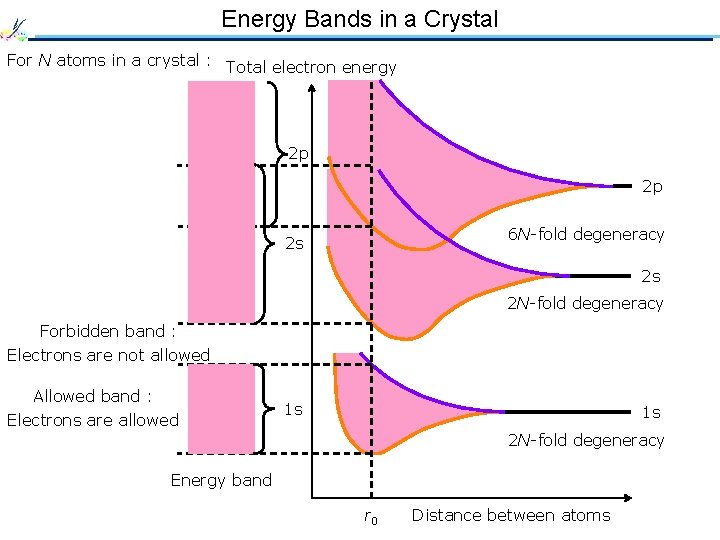
Energy Bands in a Crystal For N atoms in a crystal : Total electron energy 2 p 2 p 6 N-fold degeneracy 2 s 2 s 2 N-fold degeneracy Forbidden band : Electrons are not allowed Allowed band : Electrons are allowed 1 s 1 s 2 N-fold degeneracy Energy band r 0 Distance between atoms
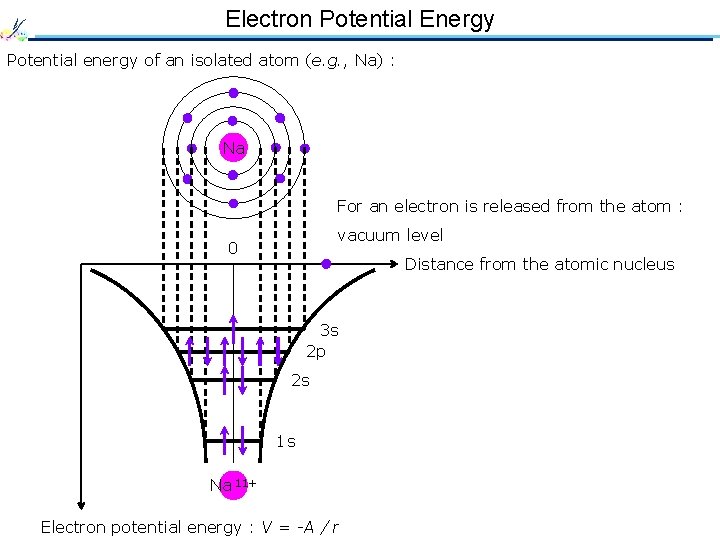
Electron Potential Energy Potential energy of an isolated atom (e. g. , Na) : Na For an electron is released from the atom : vacuum level 0 Distance from the atomic nucleus 3 s 2 p 2 s 1 s Na 11+ Electron potential energy : V = -A / r
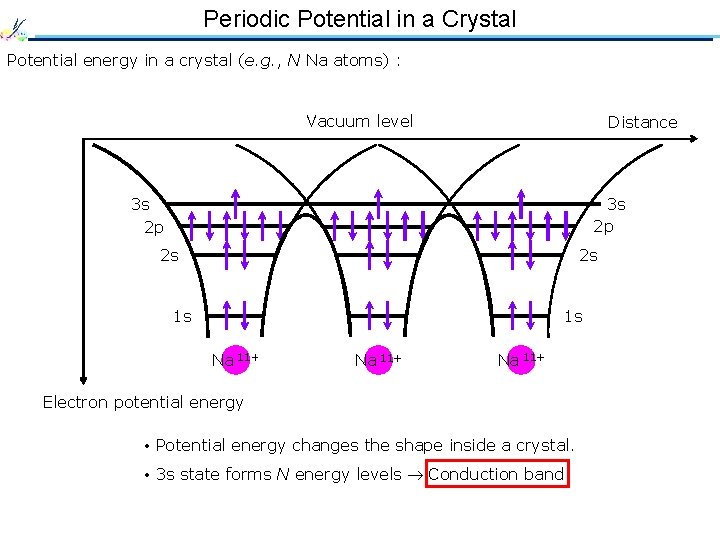
Periodic Potential in a Crystal Potential energy in a crystal (e. g. , N Na atoms) : Vacuum level Distance 3 s 2 p 2 s 2 s 1 s 1 s Na 11+ Electron potential energy • Potential energy changes the shape inside a crystal. • 3 s state forms N energy levels Conduction band
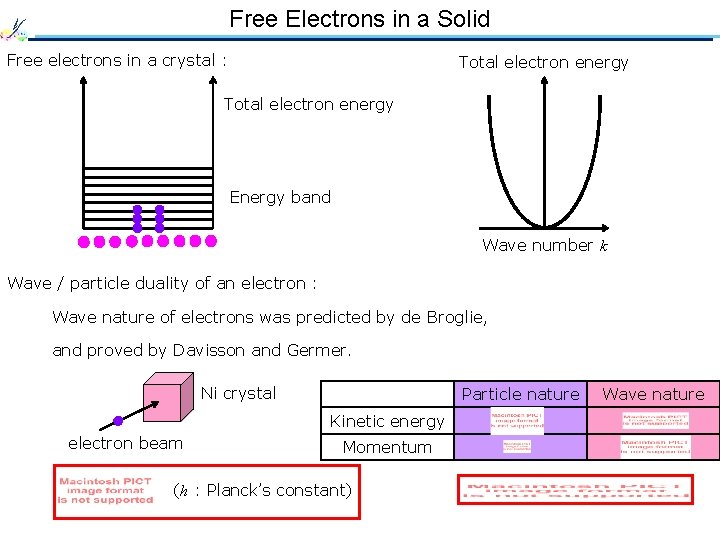
Free Electrons in a Solid Free electrons in a crystal : Total electron energy Energy band Wave number k Wave / particle duality of an electron : Wave nature of electrons was predicted by de Broglie, and proved by Davisson and Germer. Ni crystal Particle nature Kinetic energy electron beam Momentum (h : Planck’s constant) Wave nature
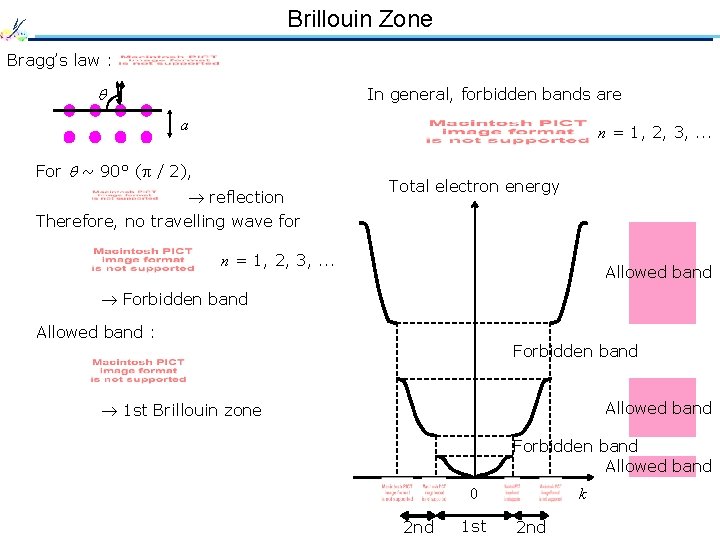
Brillouin Zone Bragg’s law : In general, forbidden bands are a n = 1, 2, 3, . . . For ~ 90° ( / 2), reflection Total electron energy Therefore, no travelling wave for n = 1, 2, 3, . . . Allowed band Forbidden band Allowed band : Forbidden band Allowed band 1 st Brillouin zone Forbidden band Allowed band k 0 2 nd 1 st 2 nd
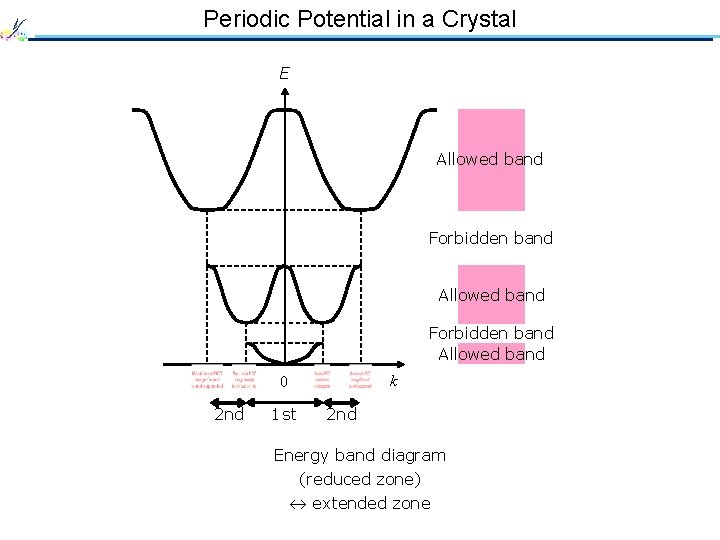
Periodic Potential in a Crystal E Allowed band Forbidden band Allowed band k 0 2 nd 1 st 2 nd Energy band diagram (reduced zone) extended zone
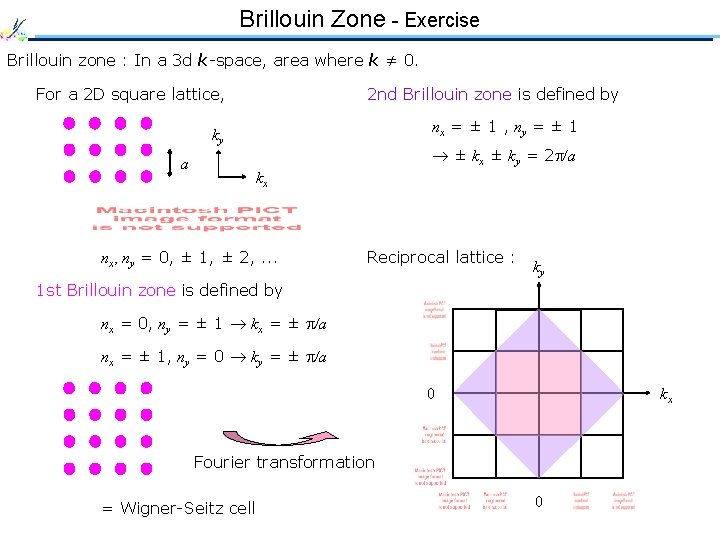
Brillouin Zone - Exercise Brillouin zone : In a 3 d k-space, area where k ≠ 0. For a 2 D square lattice, 2 nd Brillouin zone is defined by nx = ± 1 , ny = ± 1 ky a ± kx ± ky = 2 /a kx nx, ny = 0, ± 1, ± 2, . . . Reciprocal lattice : ky 1 st Brillouin zone is defined by nx = 0, ny = ± 1 kx = ± /a nx = ± 1, ny = 0 ky = ± /a 0 kx Fourier transformation = Wigner-Seitz cell 0
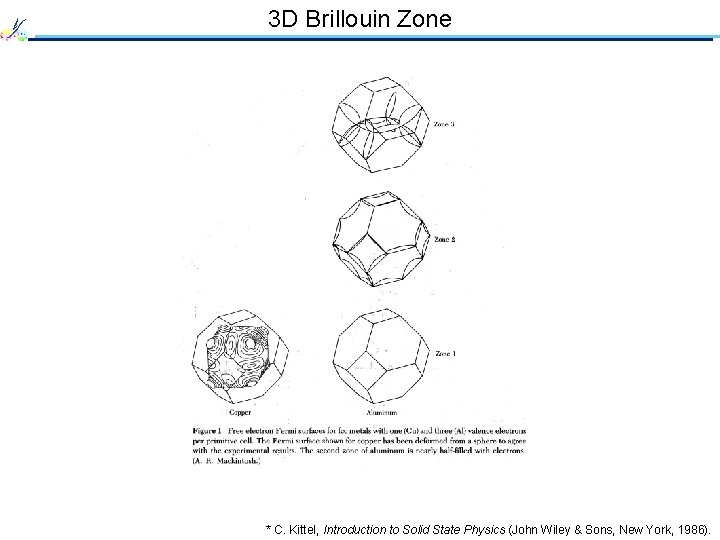
3 D Brillouin Zone * C. Kittel, Introduction to Solid State Physics (John Wiley & Sons, New York, 1986).
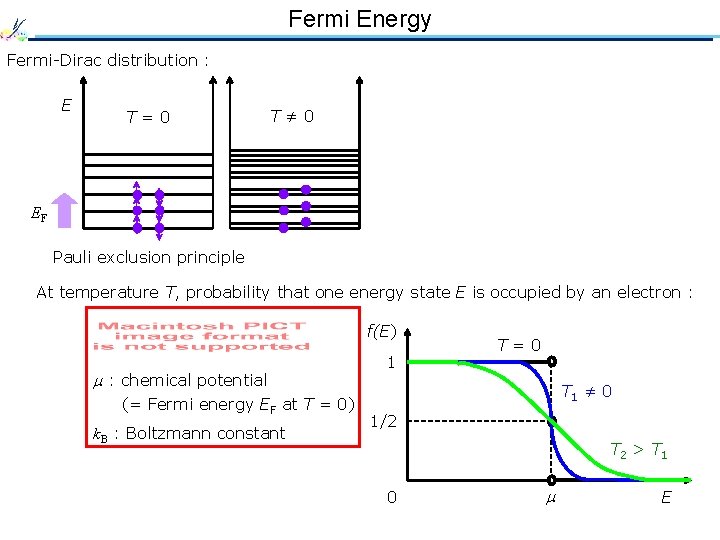
Fermi Energy Fermi-Dirac distribution : E T=0 T≠ 0 EF Pauli exclusion principle At temperature T, probability that one energy state E is occupied by an electron : f(E) : chemical potential (= Fermi energy EF at T = 0) k. B : Boltzmann constant 1 T=0 T 1 ≠ 0 1/2 T 2 > T 1 0 E
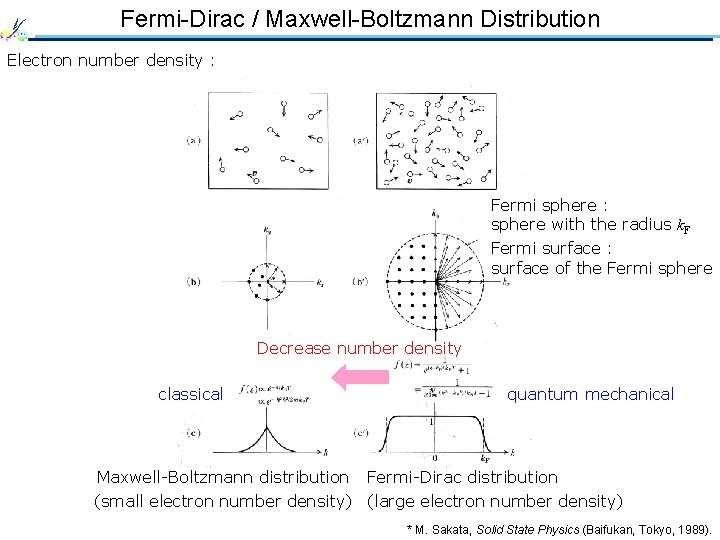
Fermi-Dirac / Maxwell-Boltzmann Distribution Electron number density : Fermi sphere : sphere with the radius k. F Fermi surface : surface of the Fermi sphere Decrease number density classical Maxwell-Boltzmann distribution quantum mechanical Fermi-Dirac distribution (small electron number density) (large electron number density) * M. Sakata, Solid State Physics (Baifukan, Tokyo, 1989).
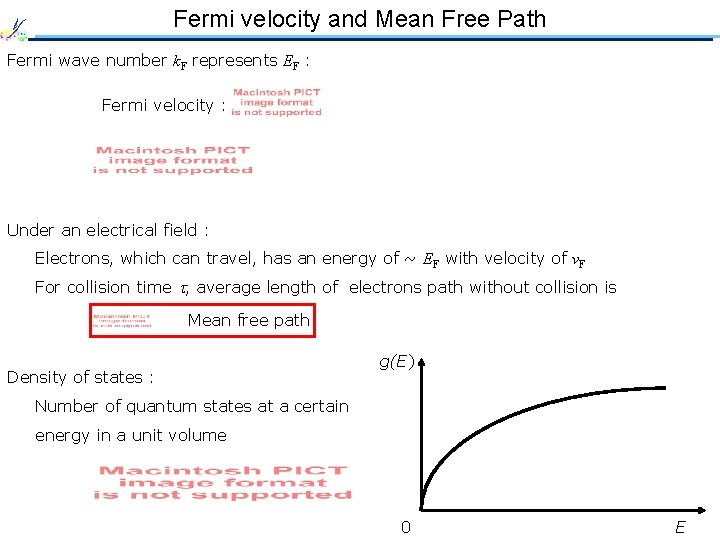
Fermi velocity and Mean Free Path Fermi wave number k. F represents EF : Fermi velocity : Under an electrical field : Electrons, which can travel, has an energy of ~ EF with velocity of v. F For collision time , average length of electrons path without collision is Mean free path Density of states : g(E) Number of quantum states at a certain energy in a unit volume 0 E
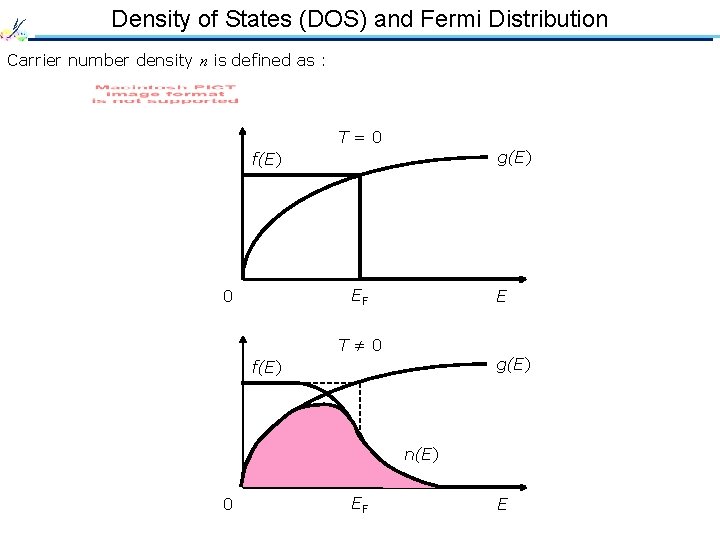
Density of States (DOS) and Fermi Distribution Carrier number density n is defined as : T=0 g(E) f(E) EF 0 E T≠ 0 g(E) f(E) n(E) 0 EF E
- Slides: 26