
Introductory Microbiology MICRB 201 Why study Microbes Syllabus

Introductory Microbiology MICRB 201 Why study Microbes? Syllabus Overview Who are the Microbes? (Neisseria gonorrhoeae in human white blood cells. )
Why Study Microbes? 1) Microbes and Man in Sickness and Health. 2) Major Modern Applications. 3) The Role of Microbes in Ecosystems. 4) Microbes in Human Civilization.
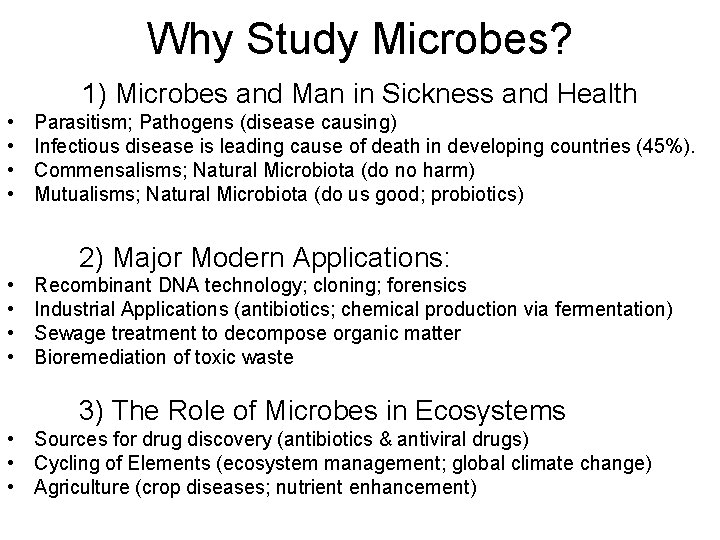
Why Study Microbes? 1) Microbes and Man in Sickness and Health • • Parasitism; Pathogens (disease causing) Infectious disease is leading cause of death in developing countries (45%). Commensalisms; Natural Microbiota (do no harm) Mutualisms; Natural Microbiota (do us good; probiotics) 2) Major Modern Applications: • • Recombinant DNA technology; cloning; forensics Industrial Applications (antibiotics; chemical production via fermentation) Sewage treatment to decompose organic matter Bioremediation of toxic waste 3) The Role of Microbes in Ecosystems • Sources for drug discovery (antibiotics & antiviral drugs) • Cycling of Elements (ecosystem management; global climate change) • Agriculture (crop diseases; nutrient enhancement)

4) Microbes in Human Civilization: • Food and Beverage preservation (pre-history) • Turns in History – • Moses leads Israelites out of Egypt facilitated by plague (1500 BC). • Athenians (Greeks) lost Peloponnesian War in 404 BC due to plague (Yersinia pestis; bacterial disease). • Fall of Rome (565 AD) due to overcrowding exacerbated by Attila the Hun’s (barbarians’) army cutting off water supplies to Rome – epidemic malaria (protist disease) and other infectious diseases. • Spanish conquering the Aztec civilization (1500’s) by introducing small pox and measles (viral disease). • Salem Witch Hunt (1692): Puritan rye gets infected by Ergot (Claviceps purpurea; fungal plant pathogen); bread makes them loony. • Great Famine (Ireland 1850’s): potato blight (Phytophthora infestans; oomycete fungi) starved ten’s of thousands to death; over a million immigrated to America.
Read the Syllabus!!!! • Take the lab (MICRB 202)! • Flow of Topics • Evaluation – – 3 Quizzes/homework (15%) 3 Exams (65 %) “Bad Bug” Talk (10 %) Participation (10 %) • Policies – – – Make-up Requirements Guidelines Academic Integrity Disability Statement
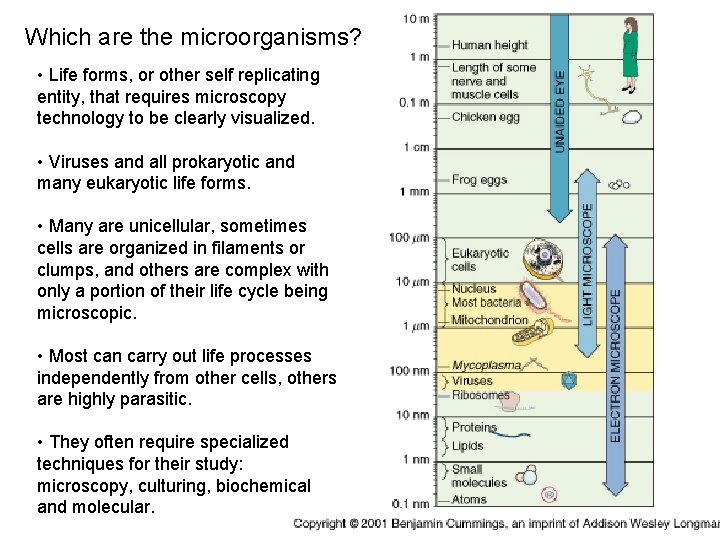
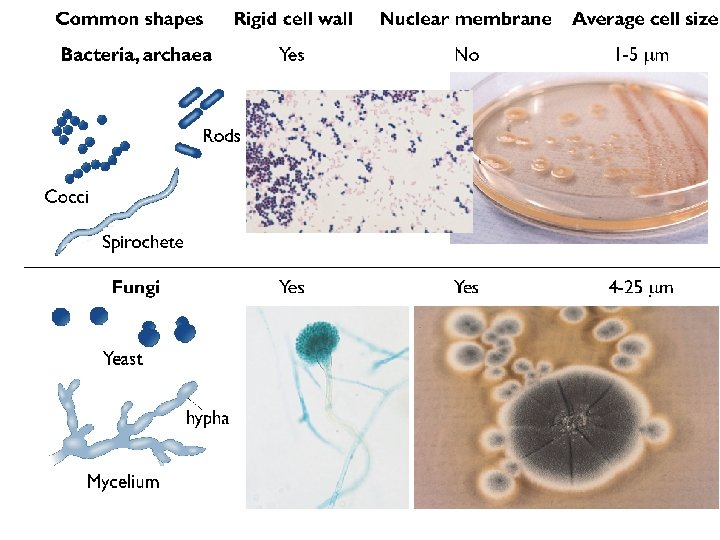
Which are the microorganisms? • Life forms, or other self replicating entity, that requires microscopy technology to be clearly visualized. • Viruses and all prokaryotic and many eukaryotic life forms. • Many are unicellular, sometimes cells are organized in filaments or clumps, and others are complex with only a portion of their life cycle being microscopic. • Most can carry out life processes independently from other cells, others are highly parasitic. • They often require specialized techniques for their study: microscopy, culturing, biochemical and molecular.
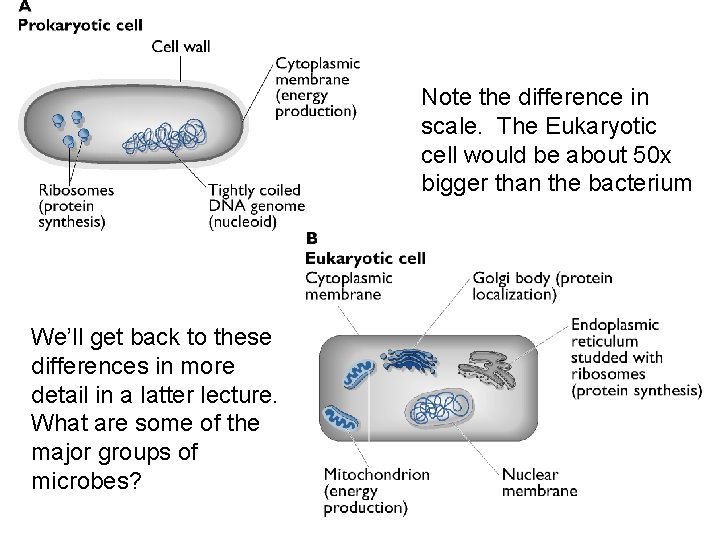
Note the difference in scale. The Eukaryotic cell would be about 50 x bigger than the bacterium We’ll get back to these differences in more detail in a latter lecture. What are some of the major groups of microbes?
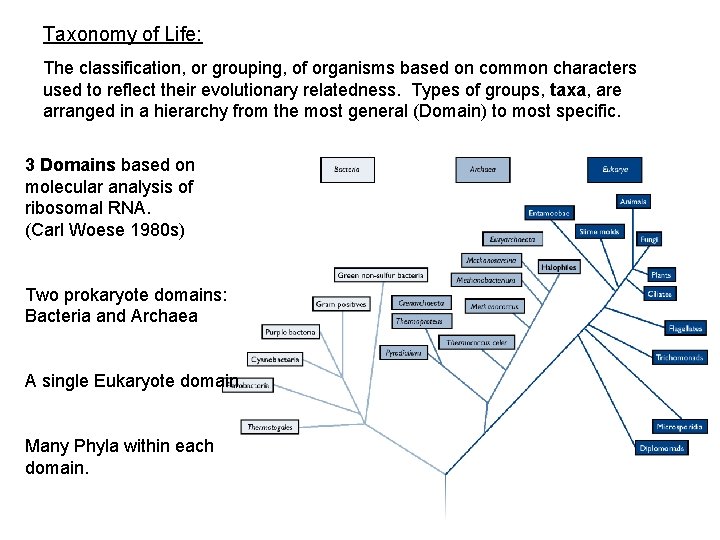
Taxonomy of Life: The classification, or grouping, of organisms based on common characters used to reflect their evolutionary relatedness. Types of groups, taxa, are arranged in a hierarchy from the most general (Domain) to most specific. 3 Domains based on molecular analysis of ribosomal RNA. (Carl Woese 1980 s) Two prokaryote domains: Bacteria and Archaea A single Eukaryote domain. Many Phyla within each domain.
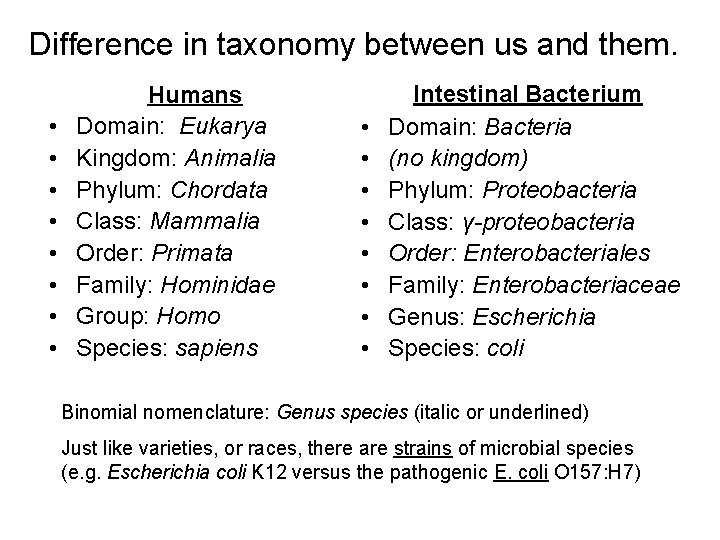
Difference in taxonomy between us and them. • • Humans Domain: Eukarya Kingdom: Animalia Phylum: Chordata Class: Mammalia Order: Primata Family: Hominidae Group: Homo Species: sapiens • • Intestinal Bacterium Domain: Bacteria (no kingdom) Phylum: Proteobacteria Class: γ-proteobacteria Order: Enterobacteriales Family: Enterobacteriaceae Genus: Escherichia Species: coli Binomial nomenclature: Genus species (italic or underlined) Just like varieties, or races, there are strains of microbial species (e. g. Escherichia coli K 12 versus the pathogenic E. coli O 157: H 7)
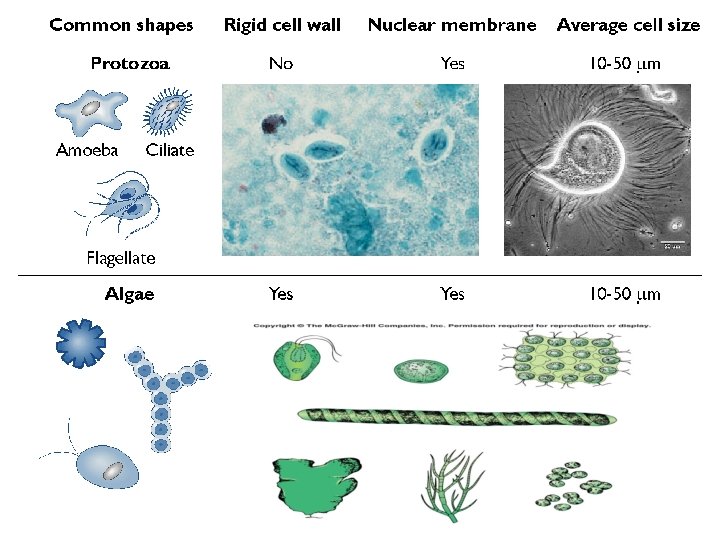
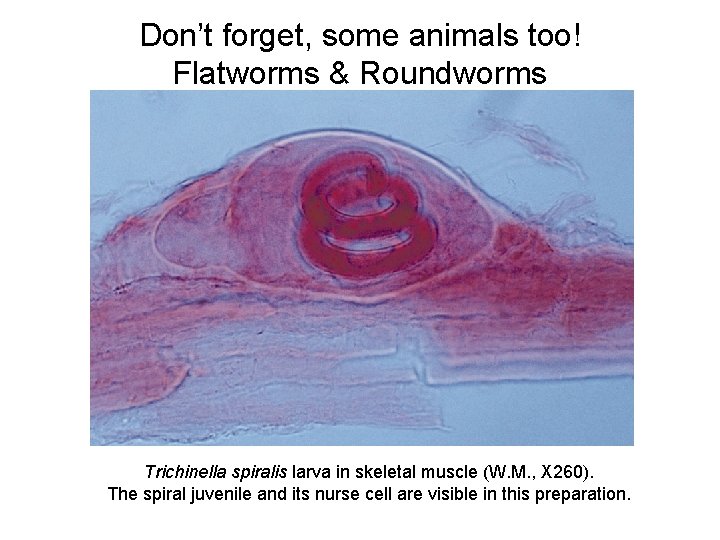
Don’t forget, some animals too! Flatworms & Roundworms Trichinella spiralis larva in skeletal muscle (W. M. , X 260). The spiral juvenile and its nurse cell are visible in this preparation.
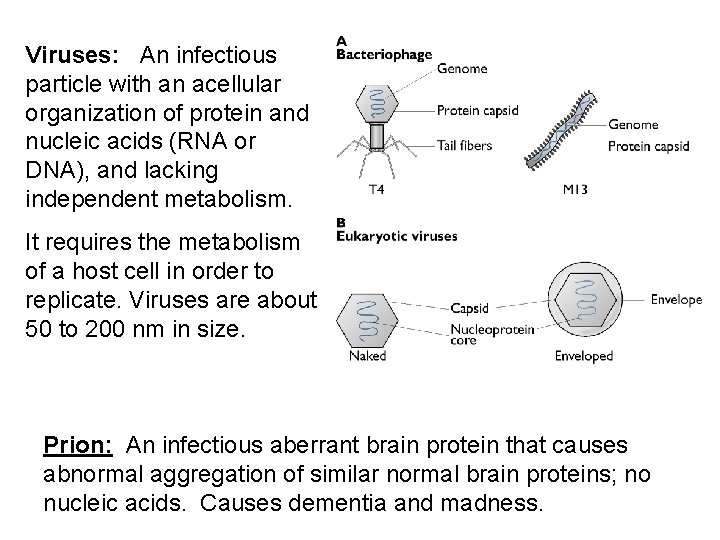
Viruses: An infectious particle with an acellular organization of protein and nucleic acids (RNA or DNA), and lacking independent metabolism. It requires the metabolism of a host cell in order to replicate. Viruses are about 50 to 200 nm in size. Prion: An infectious aberrant brain protein that causes abnormal aggregation of similar normal brain proteins; no nucleic acids. Causes dementia and madness.
- Slides: 13