
Introductory Lecture on Cellular Automata Modified and upgraded
- Slides: 64
Introductory Lecture on Cellular Automata Modified and upgraded slides of Martijn Schut schut@cs. vu. nl Vrij Universiteit Amsterdam Lubomir Ivanov Department of Computer Science Iona College and anonymous from Internet
Overview • Conway’s Game of Life • Cellular Automata • Self Reproduction } Artificial Life • Universal Machines
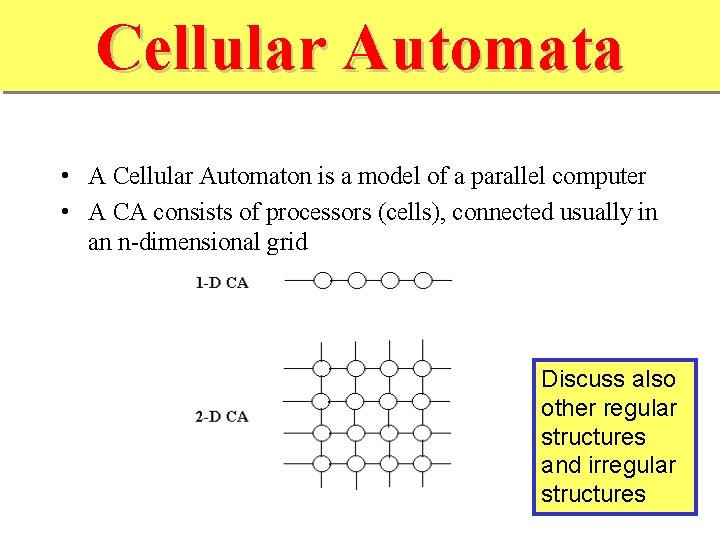
Cellular Automata • A Cellular Automaton is a model of a parallel computer • A CA consists of processors (cells), connected usually in an n-dimensional grid Discuss also other regular structures and irregular structures
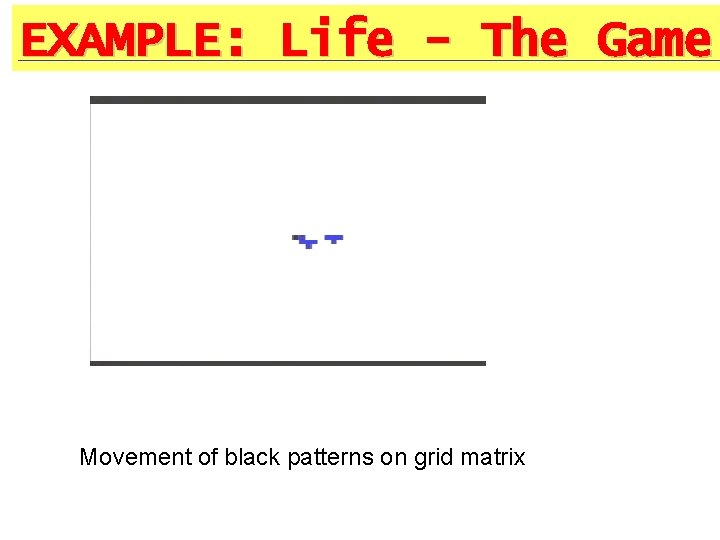
EXAMPLE: Life - The Game Movement of black patterns on grid matrix
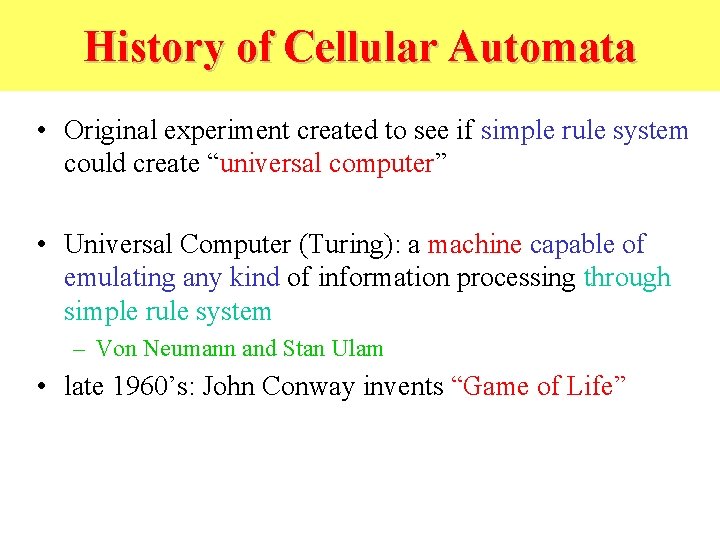
History of Cellular Automata • Original experiment created to see if simple rule system could create “universal computer” • Universal Computer (Turing): a machine capable of emulating any kind of information processing through simple rule system – Von Neumann and Stan Ulam • late 1960’s: John Conway invents “Game of Life”
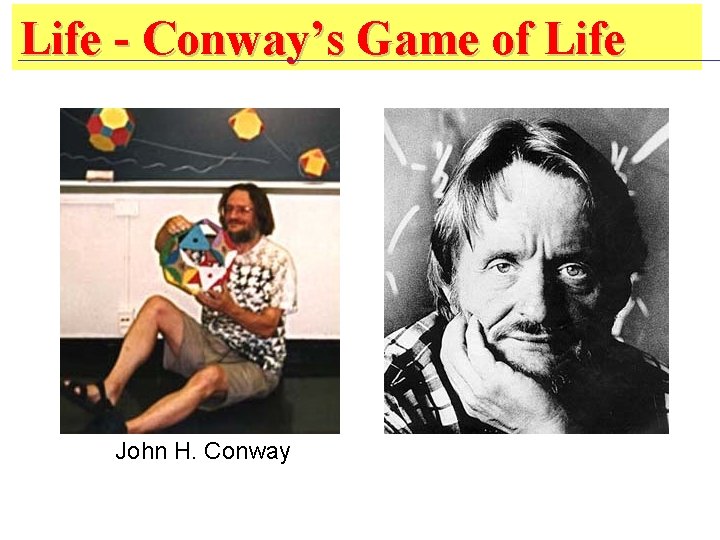
Life - Conway’s Game of Life John H. Conway
Life - Conway’s Game of Life • Simplest possible universe capable of computation • Basic design: rectangular grid of “living” (on) and “dead” (off) cells • Complex patterns result from simple structures • In each generation, cells are governed by three simple rules • Which patterns lead to stability? To chaos?
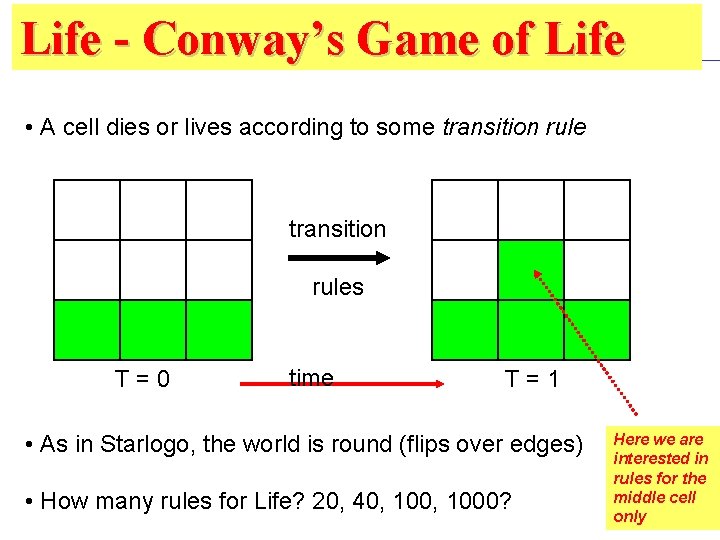
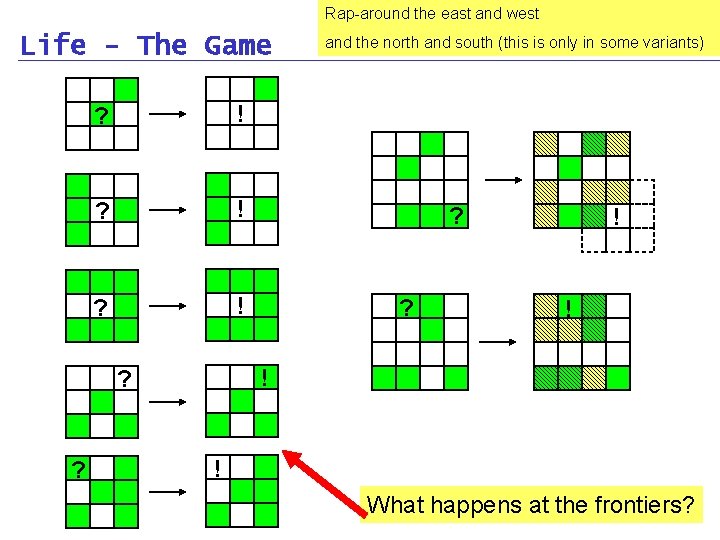
Life - Conway’s Game of Life - The Game • A cell dies or lives according to some transition rules T=0 time T=1 • As in Starlogo, the world is round (flips over edges) • How many rules for Life? 20, 40, 1000? Here we are interested in rules for the middle cell only
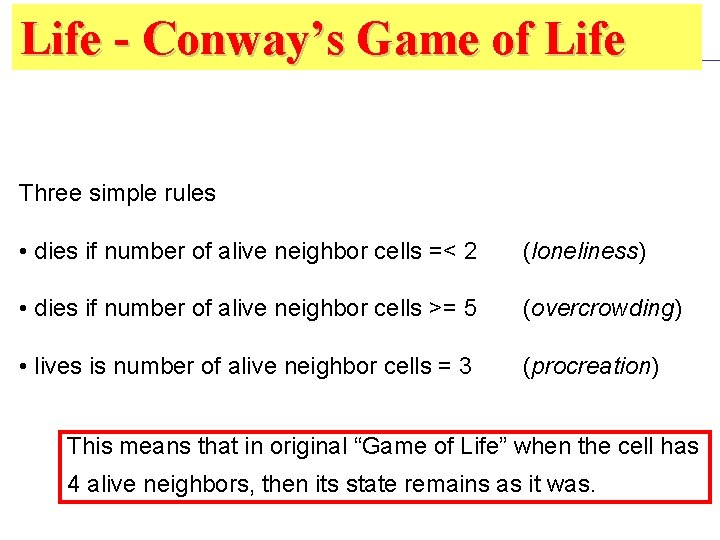
Life - Conway’s Game of Life - The Game Three simple rules • dies if number of alive neighbor cells =< 2 (loneliness) • dies if number of alive neighbor cells >= 5 (overcrowding) • lives is number of alive neighbor cells = 3 (procreation) This means that in original “Game of Life” when the cell has 4 alive neighbors, then its state remains as it was.
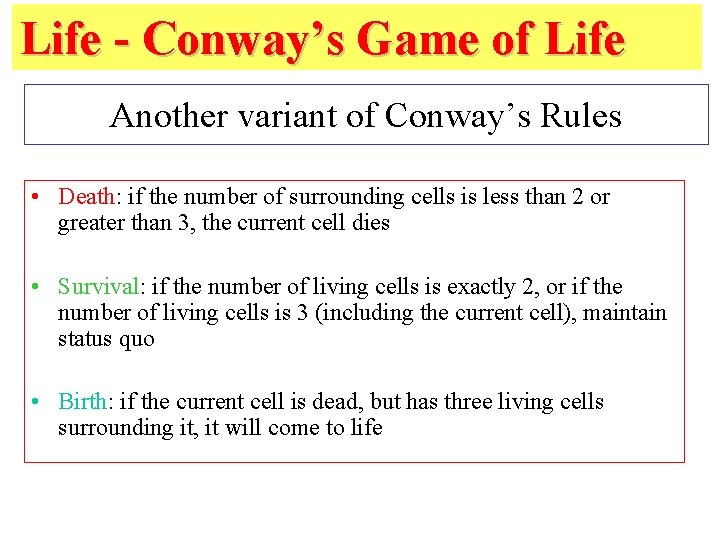
Life - Conway’s Game of Life Another variant of Conway’s Rules • Death: if the number of surrounding cells is less than 2 or greater than 3, the current cell dies • Survival: if the number of living cells is exactly 2, or if the number of living cells is 3 (including the current cell), maintain status quo • Birth: if the current cell is dead, but has three living cells surrounding it, it will come to life
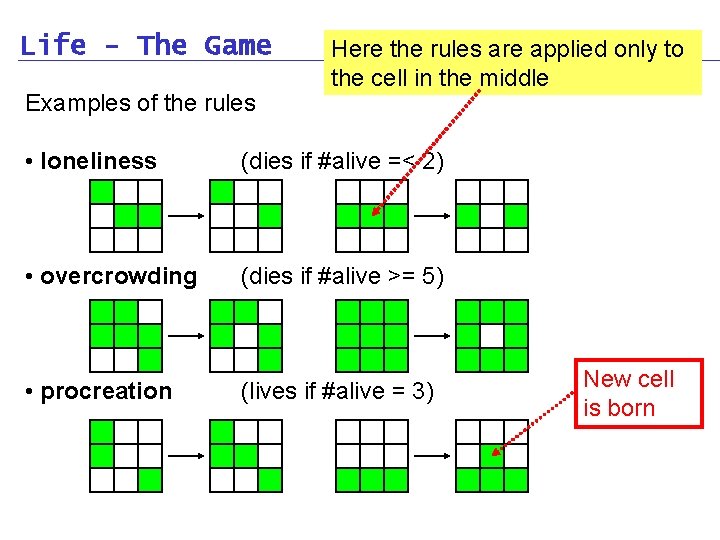
Life - The Game Examples of the rules Here the rules are applied only to the cell in the middle • loneliness (dies if #alive =< 2) • overcrowding (dies if #alive >= 5) • procreation (lives if #alive = 3) New cell is born
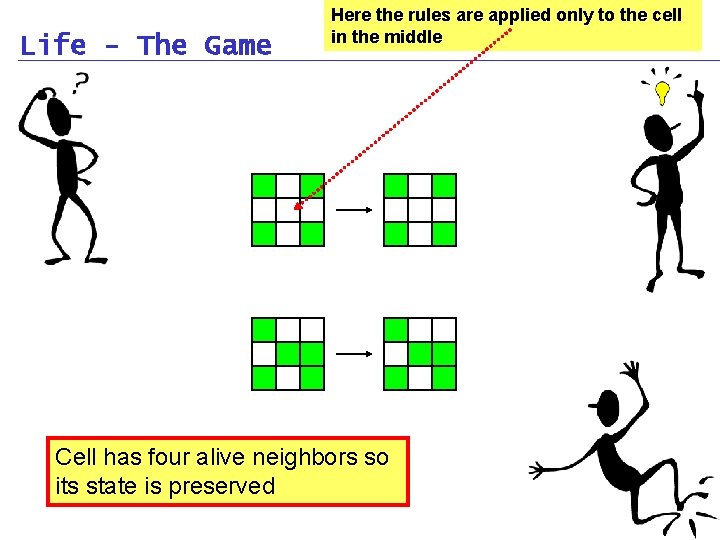
Life - The Game Here the rules are applied only to the cell in the middle Cell has four alive neighbors so its state is preserved
Rap-around the east and west Life - The Game ? ! ? ? ! ! ! ? ? and the north and south (this is only in some variants) ! What happens at the frontiers?
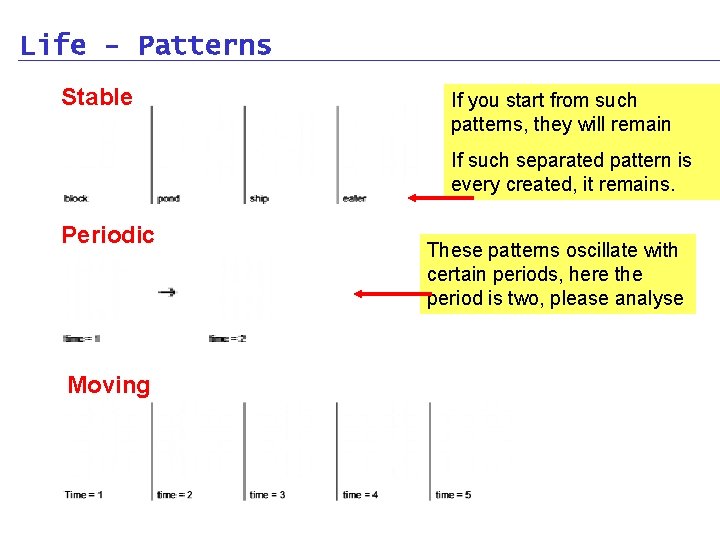
Life - Patterns Stable If you start from such patterns, they will remain If such separated pattern is every created, it remains. Periodic Moving These patterns oscillate with certain periods, here the period is two, please analyse
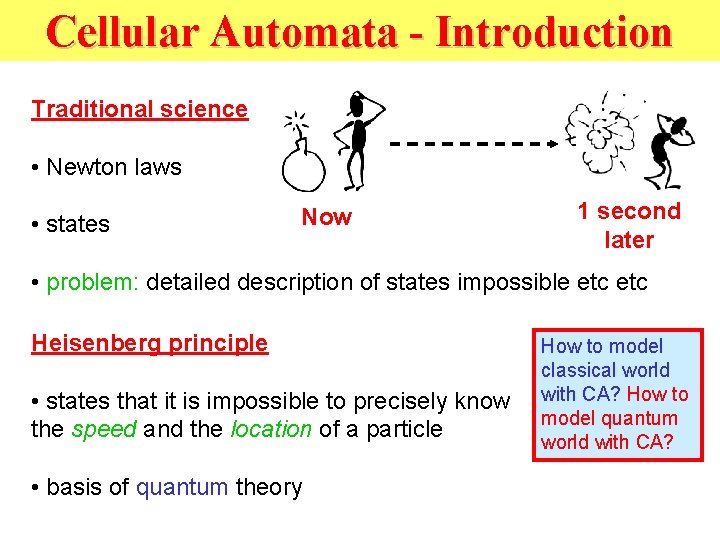
Cellular Automata - Introduction Traditional science • Newton laws • states Now 1 second later • problem: detailed description of states impossible etc Heisenberg principle • states that it is impossible to precisely know the speed and the location of a particle • basis of quantum theory How to model classical world with CA? How to model quantum world with CA?
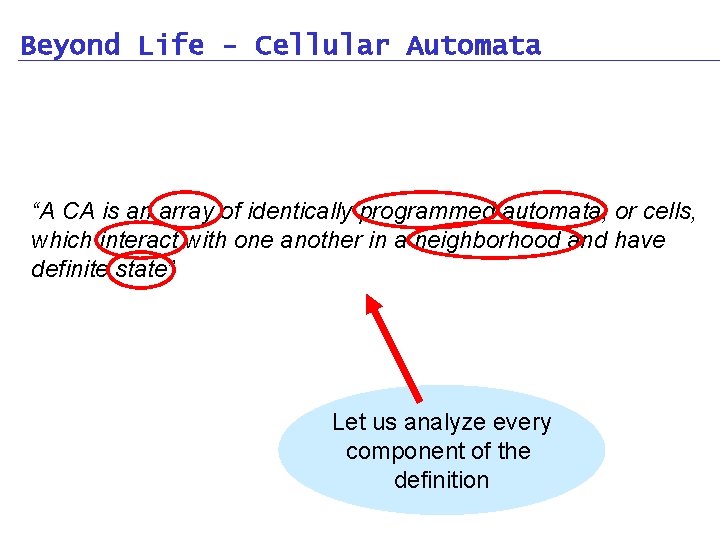
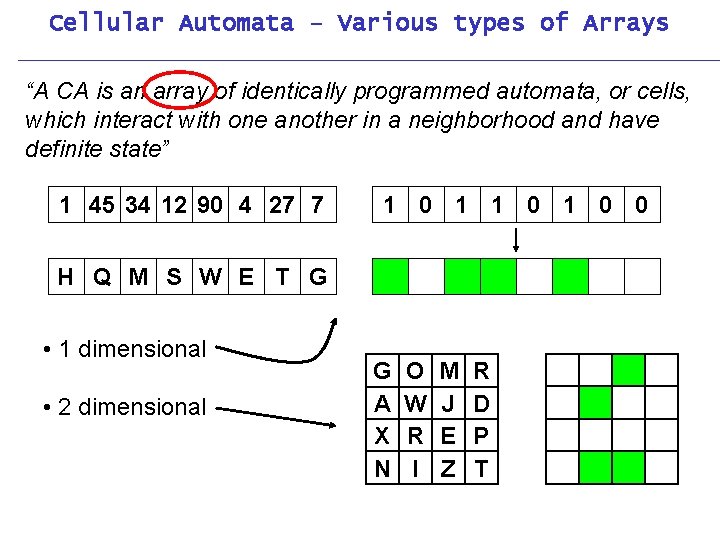
Beyond Life - Cellular Automata “A CA is an array of identically programmed automata, or cells, which interact with one another in a neighborhood and have definite state” Let us analyze every component of the definition
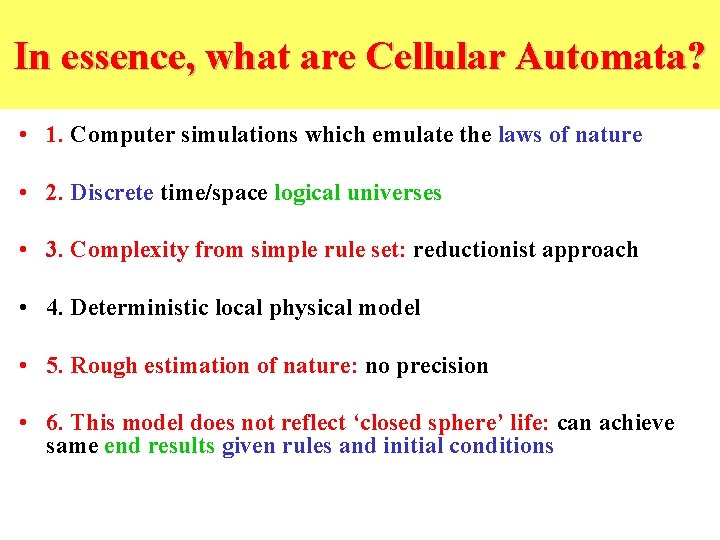
In essence, what are Cellular Automata? • 1. Computer simulations which emulate the laws of nature • 2. Discrete time/space logical universes • 3. Complexity from simple rule set: reductionist approach • 4. Deterministic local physical model • 5. Rough estimation of nature: no precision • 6. This model does not reflect ‘closed sphere’ life: can achieve same end results given rules and initial conditions
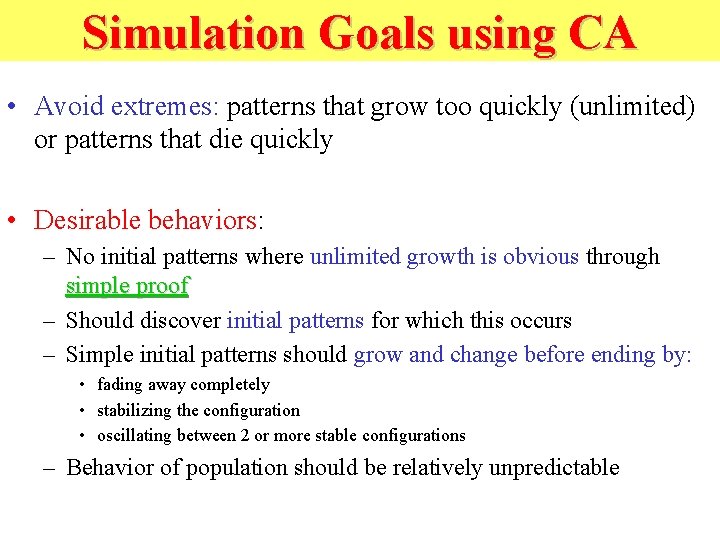
Simulation Goals using CA • Avoid extremes: patterns that grow too quickly (unlimited) or patterns that die quickly • Desirable behaviors: – No initial patterns where unlimited growth is obvious through simple proof – Should discover initial patterns for which this occurs – Simple initial patterns should grow and change before ending by: • fading away completely • stabilizing the configuration • oscillating between 2 or more stable configurations – Behavior of population should be relatively unpredictable
Cellular Automata – Various types of Arrays “A CA is an array of identically programmed automata, or cells, which interact with one another in a neighborhood and have definite state” 1 45 34 12 90 4 27 7 1 0 1 0 0 H Q M S W E T G • 1 dimensional • 2 dimensional G A X N O W R I M J E Z R D P T
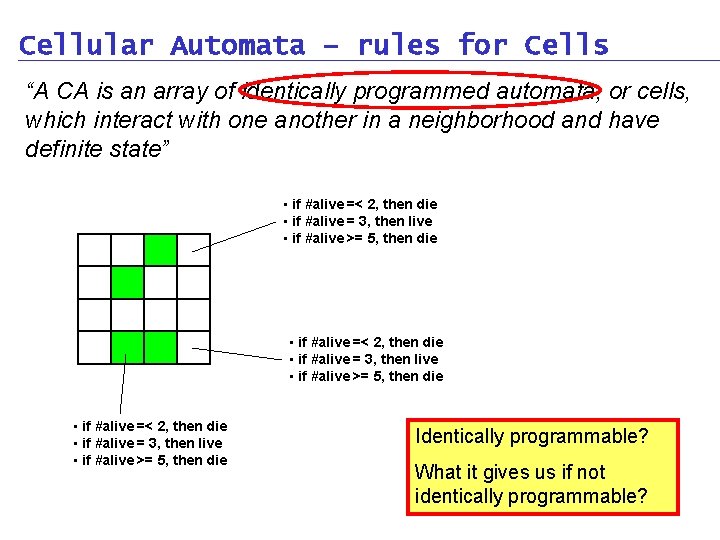
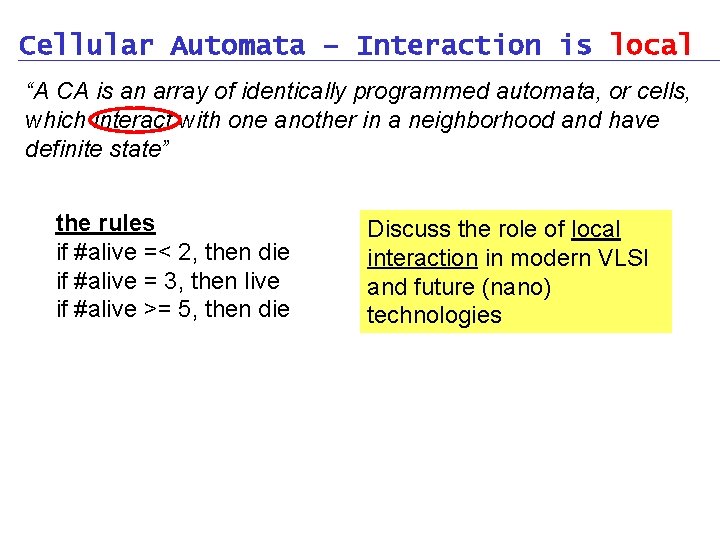
Cellular Automata – rules for Cells “A CA is an array of identically programmed automata, or cells, which interact with one another in a neighborhood and have definite state” • if #alive =< 2, then die • if #alive = 3, then live • if #alive >= 5, then die Identically programmable? What it gives us if not identically programmable?
Cellular Automata – Interaction is local “A CA is an array of identically programmed automata, or cells, which interact with one another in a neighborhood and have definite state” the rules if #alive =< 2, then die if #alive = 3, then live if #alive >= 5, then die Discuss the role of local interaction in modern VLSI and future (nano) technologies
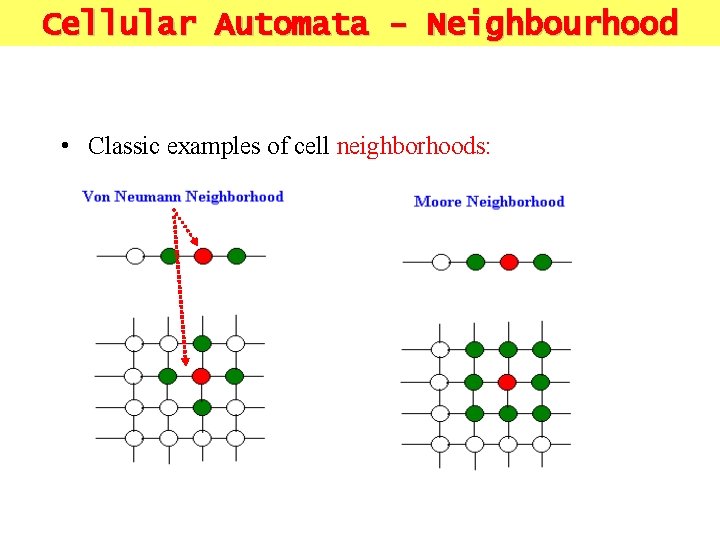
Cellular Automata - Neighbourhood • Classic examples of cell neighborhoods:
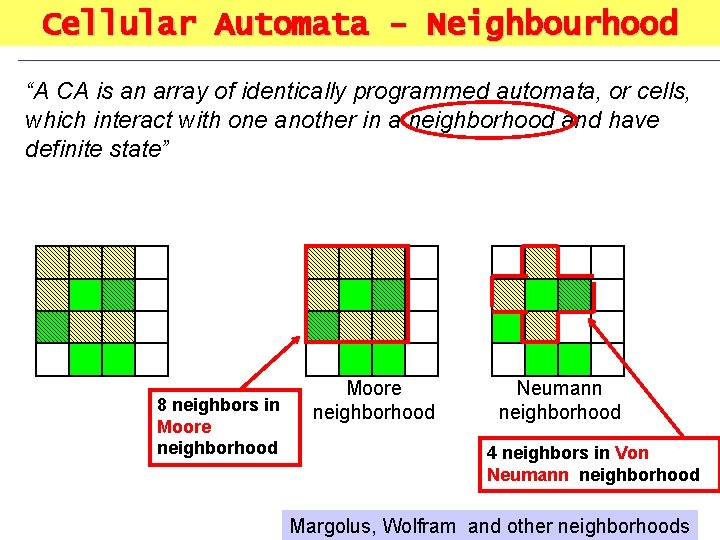
Cellular Automata - Neighbourhood “A CA is an array of identically programmed automata, or cells, which interact with one another in a neighborhood and have definite state” 8 neighbors in Moore neighborhood Neumann neighborhood 4 neighbors in Von Neumann neighborhood Margolus, Wolfram and other neighborhoods
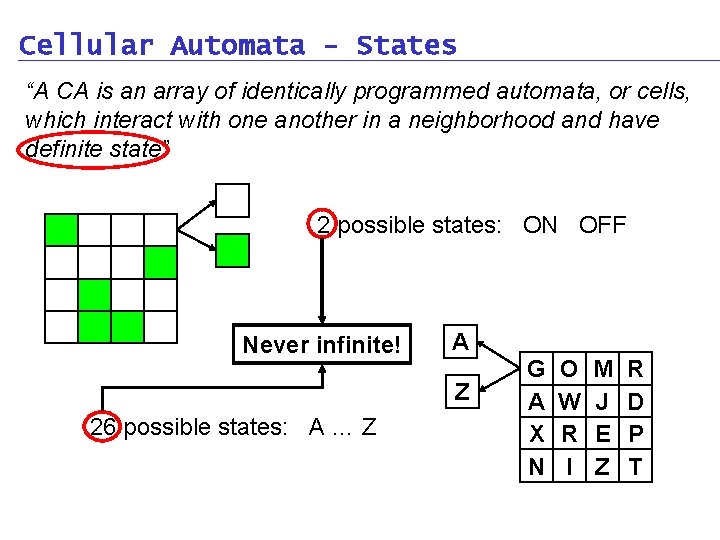
Cellular Automata - States “A CA is an array of identically programmed automata, or cells, which interact with one another in a neighborhood and have definite state” 2 possible states: ON OFF Never infinite! A Z 26 possible states: A … Z G A X N O W R I M J E Z R D P T
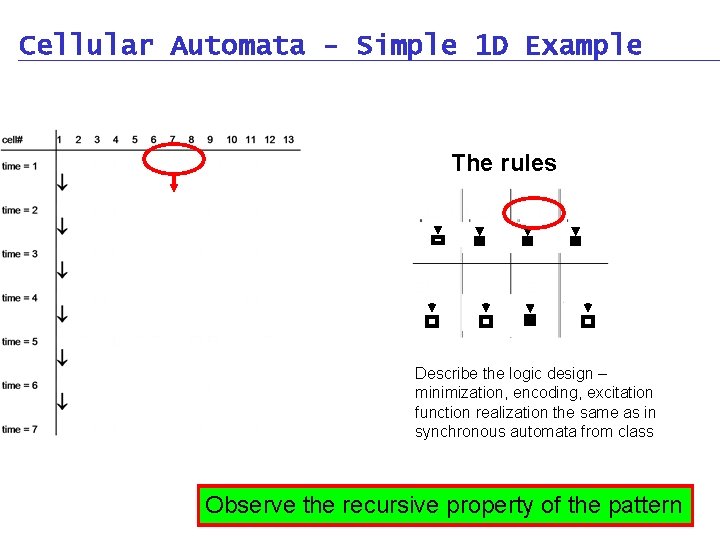
Cellular Automata - Simple 1 D Example The rules Describe the logic design – minimization, encoding, excitation function realization the same as in synchronous automata from class Observe the recursive property of the pattern
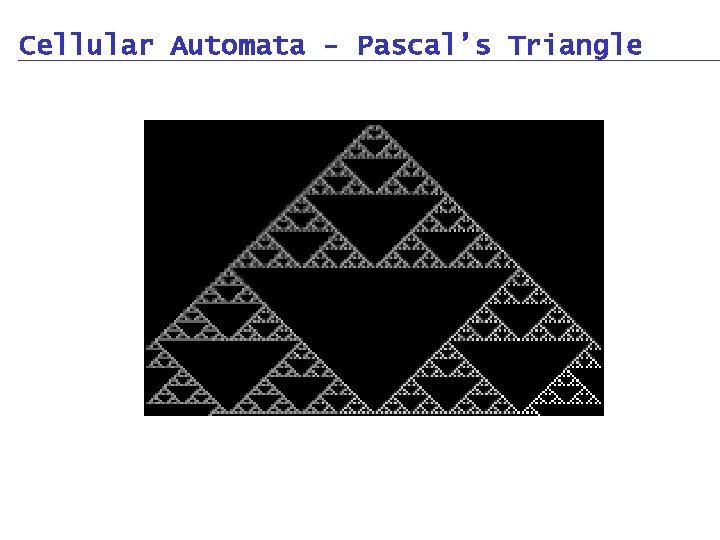
Cellular Automata - Pascal’s Triangle
Cellular Automata - Classification • dimension 1 D, 2 D … n. D • neighborhood Neumann, Moore for 1 D (2 D => r is used to denote the radius) • number of states 1, 2, …, n
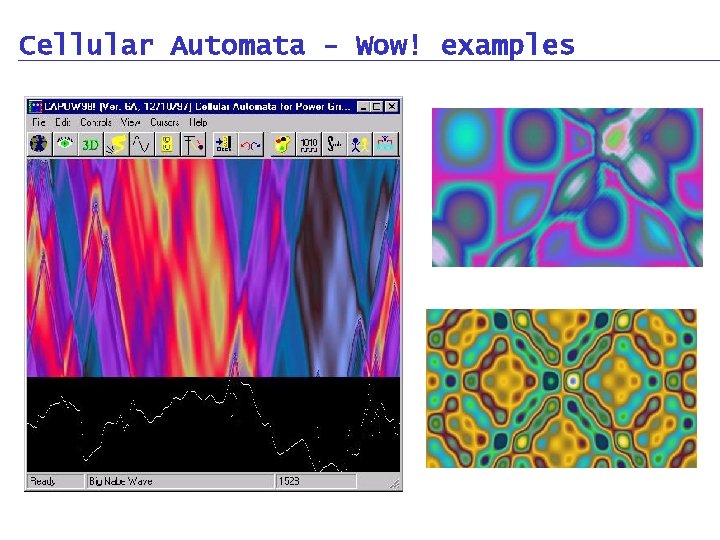
Cellular Automata - Wow! examples
… a little bit of formalism…. Automata Theory is a branch of Computer Science which: a) Attempts to answer questions like: • “What can computers do” • “what is beyond computer capabilities? ” Helps create and study new models of computation in a clear, unambiguous way. b) Contrary to popular belief, has very practical implications and is the basis for many real-world applications c)
Cellular Automata Formalism • An important component of a Cellular Automaton is its interconnection graph, G. – – This graph is, typically, an n-dimensional grid. But it can be other grid, Or slightly irregular Or irregular • Each cell of the CA can be in one of several possible states. The state set, Q, of a Cellular Automaton is the set of all possible states that a cell can be in. • The pair (G, Q) is usually referred to as a Cell Space of the CA.
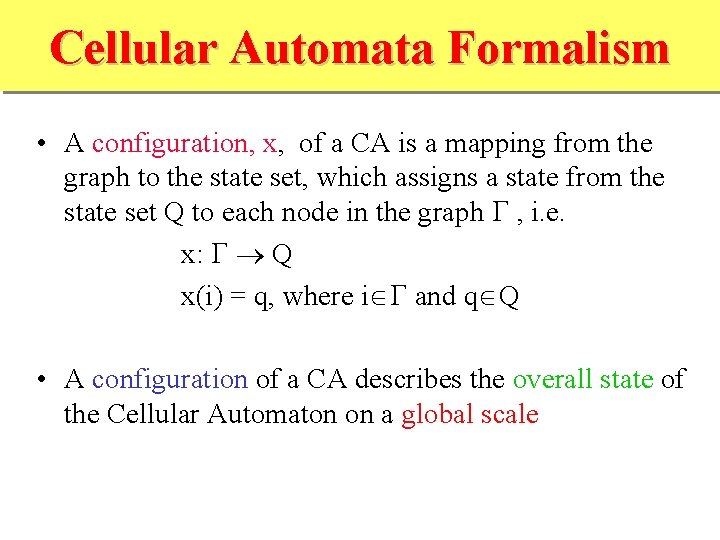
Cellular Automata Formalism • A configuration, x, of a CA is a mapping from the graph to the state set, which assigns a state from the state set Q to each node in the graph G , i. e. x: G ® Q x(i) = q, where iÎG and qÎQ • A configuration of a CA describes the overall state of the Cellular Automaton on a global scale
Cellular Automata Formalism • The computation of CAs, though, is a local process. The next state of each cell depends on its current state, and the states of its closest neighbors only. • Thus, we need to define the concept of a cell neighborhood. • A neighborhood of a cell in a cellular automaton, is the collection of cells situated at a “distance” r or less from the cell in question.
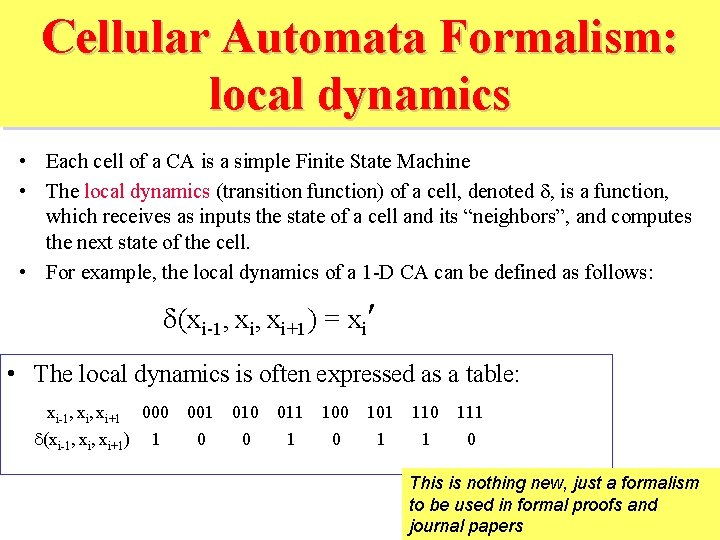
Cellular Automata Formalism: local dynamics • Each cell of a CA is a simple Finite State Machine • The local dynamics (transition function) of a cell, denoted d, is a function, which receives as inputs the state of a cell and its “neighbors”, and computes the next state of the cell. • For example, the local dynamics of a 1 -D CA can be defined as follows: d(xi-1, xi+1) = xi¢ • The local dynamics is often expressed as a table: xi-1, xi+1 000 001 010 011 100 101 110 111 d(xi-1, xi+1) 1 0 0 1 1 0 This is nothing new, just a formalism to be used in formal proofs and journal papers
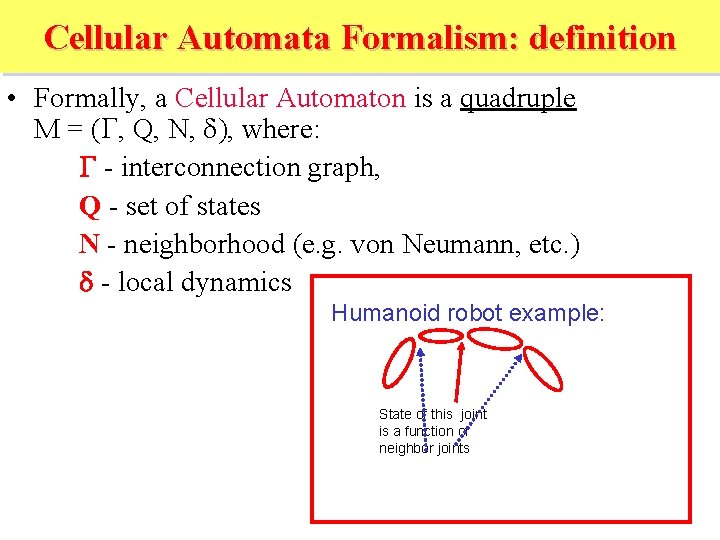
Cellular Automata Formalism: definition • Formally, a Cellular Automaton is a quadruple M = (G, Q, N, d), where: G - interconnection graph, Q - set of states N - neighborhood (e. g. von Neumann, etc. ) d - local dynamics Humanoid robot example: State of this joint is a function of neighbor joints
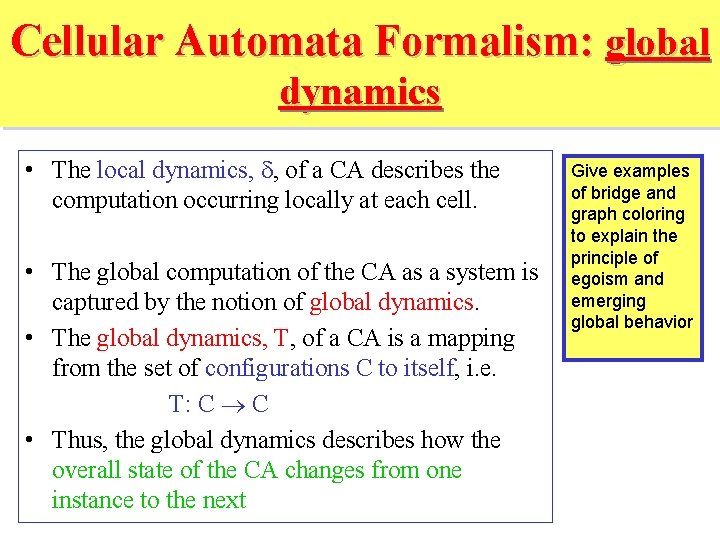
Cellular Automata Formalism: global dynamics • The local dynamics, d, of a CA describes the computation occurring locally at each cell. • The global computation of the CA as a system is captured by the notion of global dynamics. • The global dynamics, T, of a CA is a mapping from the set of configurations C to itself, i. e. T: C ® C • Thus, the global dynamics describes how the overall state of the CA changes from one instance to the next Give examples of bridge and graph coloring to explain the principle of egoism and emerging global behavior
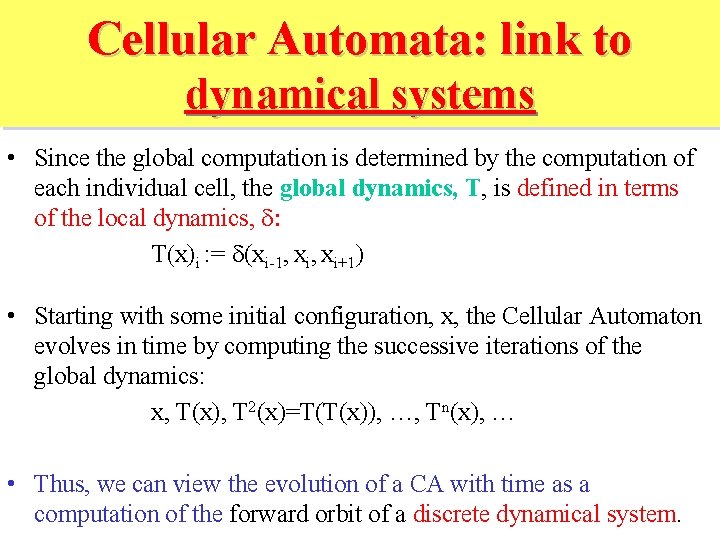
Cellular Automata: link to dynamical systems • Since the global computation is determined by the computation of each individual cell, the global dynamics, T, is defined in terms of the local dynamics, d: T(x)i : = d(xi-1, xi+1) • Starting with some initial configuration, x, the Cellular Automaton evolves in time by computing the successive iterations of the global dynamics: x, T(x), T 2(x)=T(T(x)), …, Tn(x), … • Thus, we can view the evolution of a CA with time as a computation of the forward orbit of a discrete dynamical system.
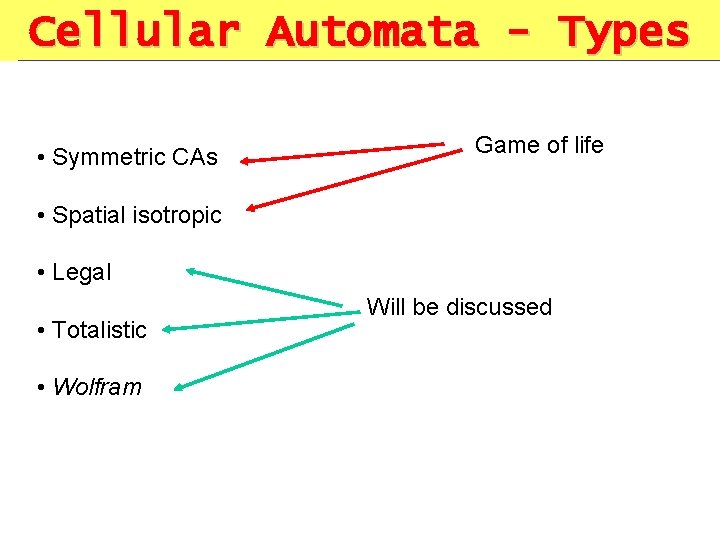
Cellular Automata - Types • Symmetric CAs Game of life • Spatial isotropic • Legal • Totalistic • Wolfram Will be discussed
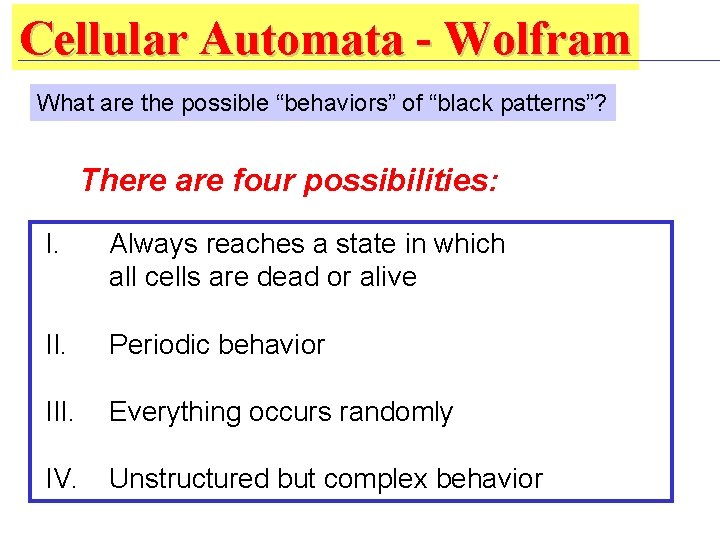
Cellular Automata - Wolfram What are the possible “behaviors” of “black patterns”? There are four possibilities: I. Always reaches a state in which all cells are dead or alive II. Periodic behavior III. Everything occurs randomly IV. Unstructured but complex behavior
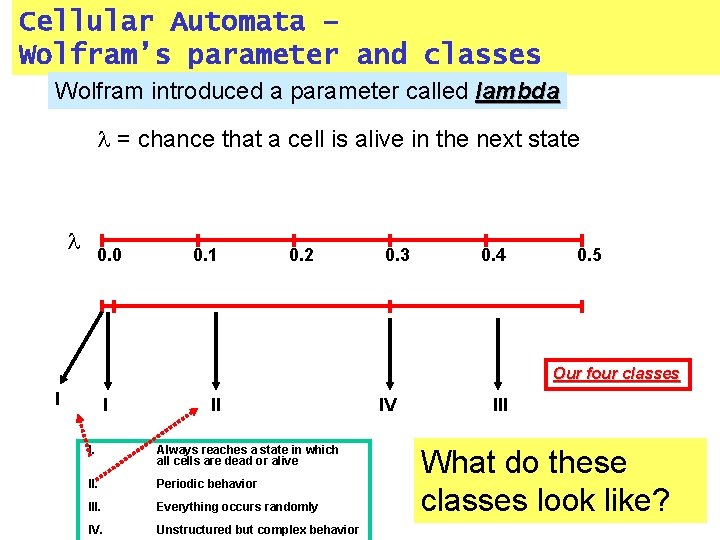
Cellular Automata – Wolfram’s parameter and classes Wolfram introduced a parameter called lambda = chance that a cell is alive in the next state 0. 0 0. 1 0. 2 0. 3 0. 4 0. 5 Our four classes I I II I. Always reaches a state in which all cells are dead or alive II. Periodic behavior III. Everything occurs randomly IV. Unstructured but complex behavior IV III What do these classes look like?
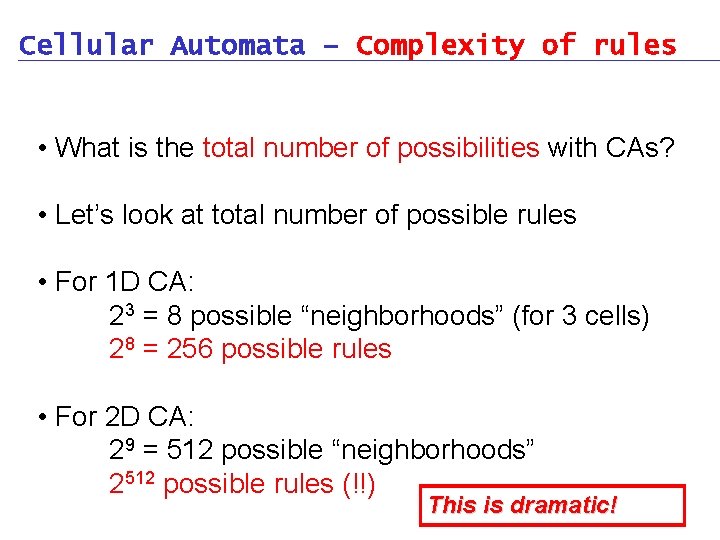
Cellular Automata – Complexity of rules • What is the total number of possibilities with CAs? • Let’s look at total number of possible rules • For 1 D CA: 23 = 8 possible “neighborhoods” (for 3 cells) 28 = 256 possible rules • For 2 D CA: 29 = 512 possible “neighborhoods” 2512 possible rules (!!) This is dramatic!
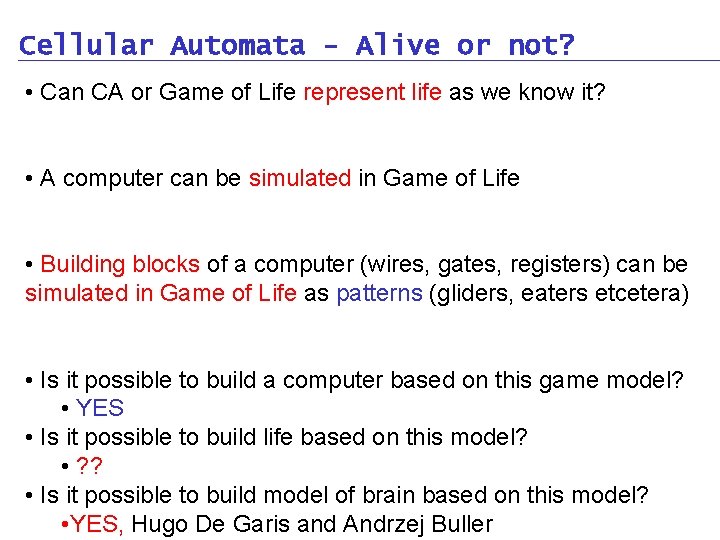
Cellular Automata - Alive or not? • Can CA or Game of Life represent life as we know it? • A computer can be simulated in Game of Life • Building blocks of a computer (wires, gates, registers) can be simulated in Game of Life as patterns (gliders, eaters etcetera) • Is it possible to build a computer based on this game model? • YES • Is it possible to build life based on this model? • ? ? • Is it possible to build model of brain based on this model? • YES, Hugo De Garis and Andrzej Buller
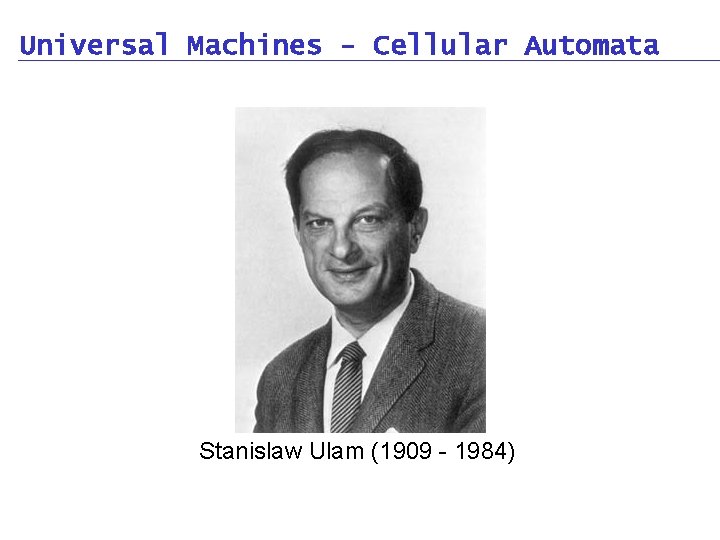
Universal Machines - Cellular Automata Stanislaw Ulam (1909 - 1984)
Universal Machines - Cellular Automata • conceived in the 1940 s • Stanislaw Ulam - evolution of graphic constructions generated by simple rules • Szkocka Café in Lwow, Poland now Ukraine • Ulam asked two questions: • can recursive mechanisms explain the complexity of the real? • Is complexity then only appearant, the rules themselves being simple? Stanislaw Ulam Memorial Lectures
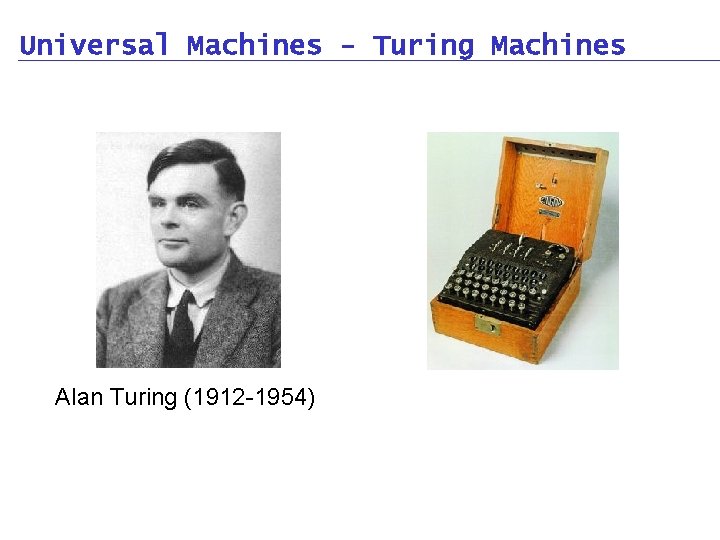
Universal Machines - Turing Machines Alan Turing (1912 -1954)
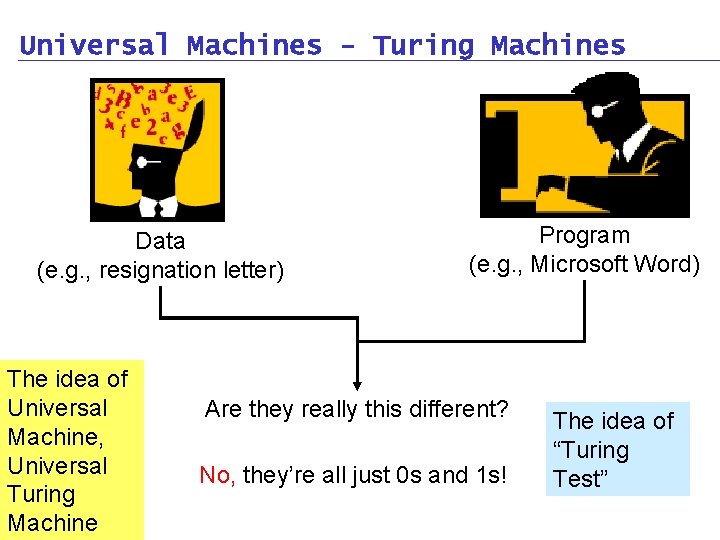
Universal Machines - Turing Machines Data (e. g. , resignation letter) The idea of Universal Machine, Universal Turing Machine Program (e. g. , Microsoft Word) Are they really this different? No, they’re all just 0 s and 1 s! The idea of “Turing Test”
Universal Machines - Neumann Machines John von Neumann (1903 - 1957)
Universal Machines - Neumann Machines • John von Neumann interests himself on theory of self-reproductive automata • worked on a self-reproducing “kinematon” (like the monolith in “ 2001 Space Odyssey”) • Ulam suggested von Neumann to use “cellular spaces” • extremely simplified universe
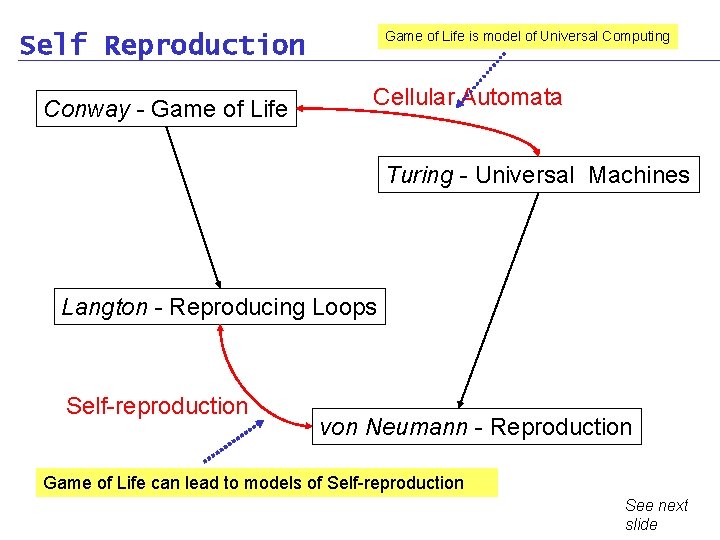
Game of Life is model of Universal Computing Self Reproduction Conway - Game of Life Cellular Automata Turing - Universal Machines Langton - Reproducing Loops Self-reproduction von Neumann - Reproduction Game of Life can lead to models of Self-reproduction See next slide
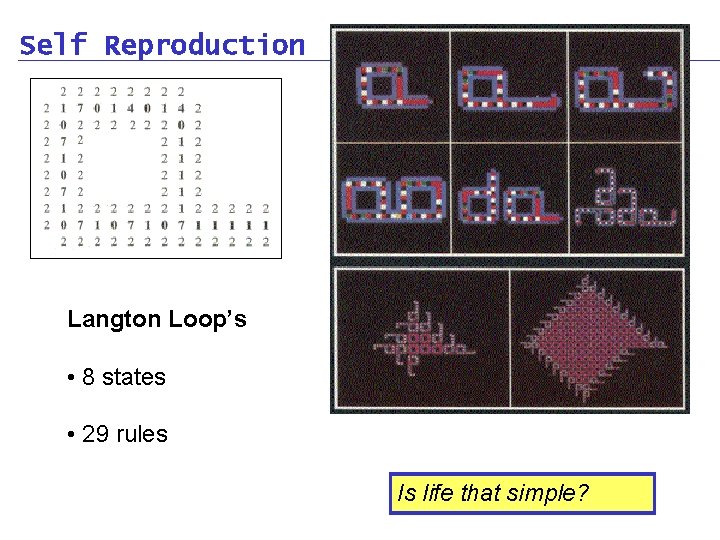
Self Reproduction Langton Loop’s • 8 states • 29 rules Is life that simple?
Cellular Automata as Dynamical Systems Chaos Theory Chaotic Behavior of Dynamical Systems
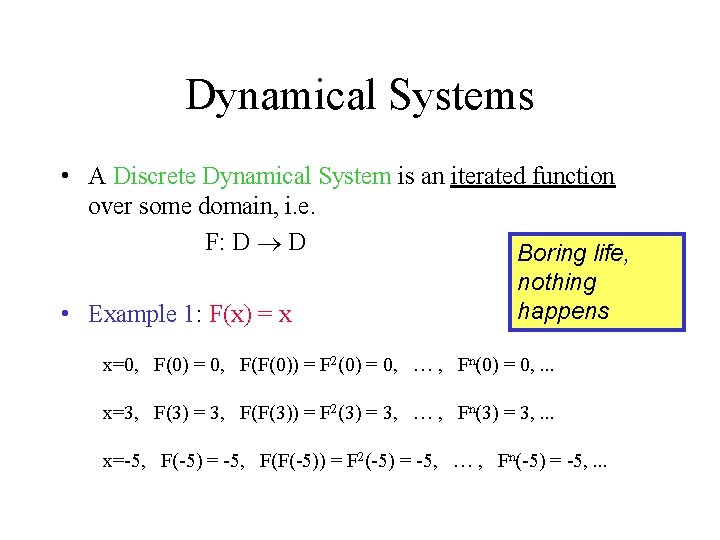
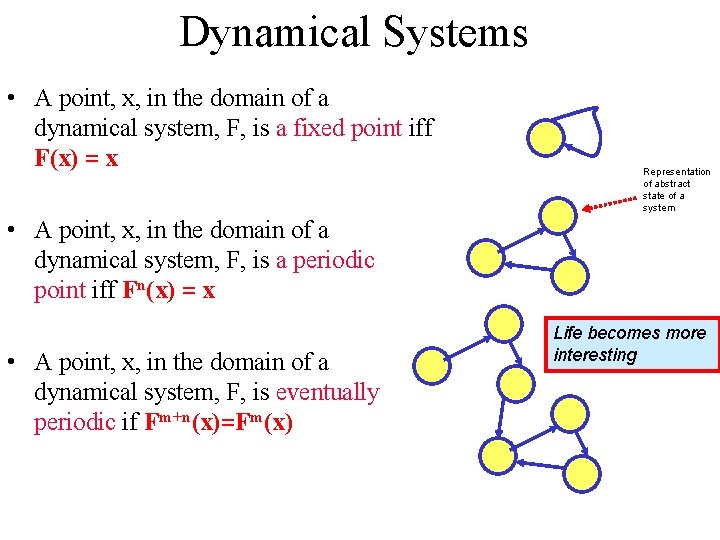
Dynamical Systems • A Discrete Dynamical System is an iterated function over some domain, i. e. F: D ® D Boring life, • Example 1: F(x) = x nothing happens x=0, F(0) = 0, F(F(0)) = F 2(0) = 0, … , Fn(0) = 0, . . . x=3, F(3) = 3, F(F(3)) = F 2(3) = 3, … , Fn(3) = 3, . . . x=-5, F(-5) = -5, F(F(-5)) = F 2(-5) = -5, … , Fn(-5) = -5, . . .
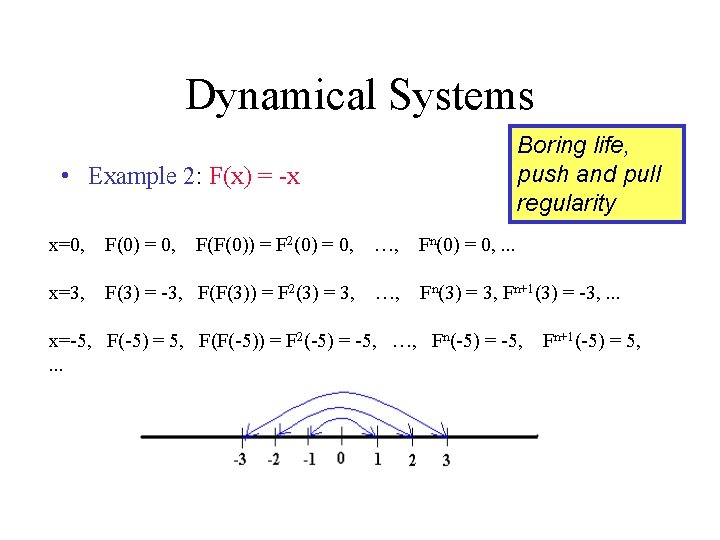
Dynamical Systems Boring life, push and pull regularity • Example 2: F(x) = -x x=0, F(0) = 0, F(F(0)) = F 2(0) = 0, …, Fn(0) = 0, . . . x=3, F(3) = -3, F(F(3)) = F 2(3) = 3, …, Fn(3) = 3, Fn+1(3) = -3, . . . x=-5, F(-5) = 5, F(F(-5)) = F 2(-5) = -5, …, Fn(-5) = -5, . . . Fn+1(-5) = 5,
Dynamical Systems • A point, x, in the domain of a dynamical system, F, is a fixed point iff F(x) = x Representation of abstract state of a system • A point, x, in the domain of a dynamical system, F, is a periodic point iff Fn(x) = x • A point, x, in the domain of a dynamical system, F, is eventually periodic if Fm+n(x)=Fm(x) Life becomes more interesting
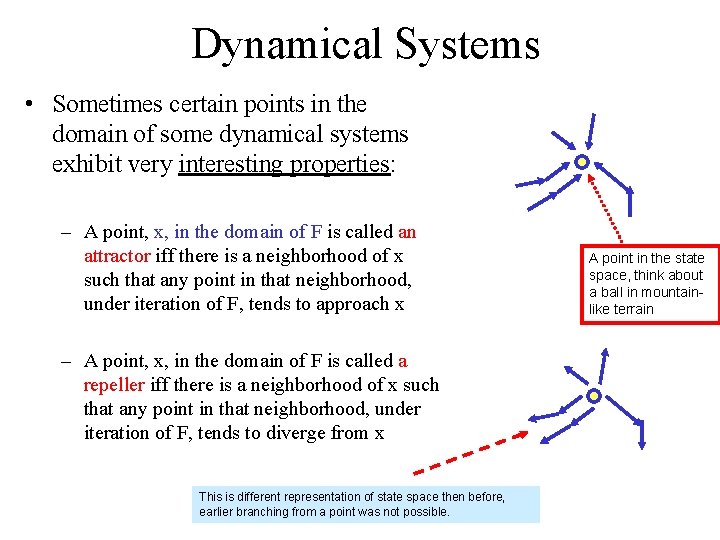
Dynamical Systems • Sometimes certain points in the domain of some dynamical systems exhibit very interesting properties: – A point, x, in the domain of F is called an attractor iff there is a neighborhood of x such that any point in that neighborhood, under iteration of F, tends to approach x – A point, x, in the domain of F is called a repeller iff there is a neighborhood of x such that any point in that neighborhood, under iteration of F, tends to diverge from x This is different representation of state space then before, earlier branching from a point was not possible. A point in the state space, think about a ball in mountainlike terrain
Dynamical Systems: interesting research questions • Our goals, when studying a dynamical system are: a) To predict the long-term, asymptotic behavior of the system given some initial point, x, and b) To identify interesting points in the domain of the system, such as: • • attractors, repellers, periodic points, etc.
Dynamical Systems • For some simple dynamical systems, predicting the long-term, asymptotic behavior is fairly simple (recall examples 1 and 2) • For other systems, one cannot predict more than just a few iterations into the future. – Such unpredictable systems are usually called chaotic.
Chaotic Dynamics • A chaotic dynamical system has 3 distinguishing characteristics: a) Topological Transitivity - this implies that the system cannot be decomposed and studied piece-by-piece b) Sensitive Dependence on Initial Conditions - this implies that numerical simulations are useless, since small errors get magnified under iteration, and soon the orbit we are computing looks nothing like the real orbit of the system c) The set of periodic points is dense in the domain of the system - amidst unpredictability, there is an element of regularity
Cellular Automata as Dynamical Systems • As we saw earlier, the behavior of a Cellular Automaton in terms of iterating its global dynamics, T, can be considered a dynamical system. • Depending on the initial configuration and the choice of local dynamics, d, the CA can exhibit any kind of behavior typical for a dynamical system - fixed, periodic, or even chaotic • Since CAs can accurately model numerous real-world phenomena and systems, understanding the behavior of Cellular Automata will lead to a better understanding of the world around us!
Summary • Ulam • Universal Machines • Turing Machines • von Neumann Machines • Conway • Game of Life • Langton • Self Reproduction
New Research and Interesting Examples • Image Processing - shifter example from Friday’s Meetings • GAPP - Geometric Array Processor of Martin Marietta - used in (in)famous Patriot Missiles • Cube Calculus Machine - a controlled one dimensional Cellular Automaton to operate on Multiple-Valued Functions • Applications in Physics • CAM 8 Machine of Margolus • CBM machine of Korkin and Hugo De Garis • Applications in biology, psychology, models of societies, religions, species domination, World Models. • Self Reproduction for future Nano-technologies
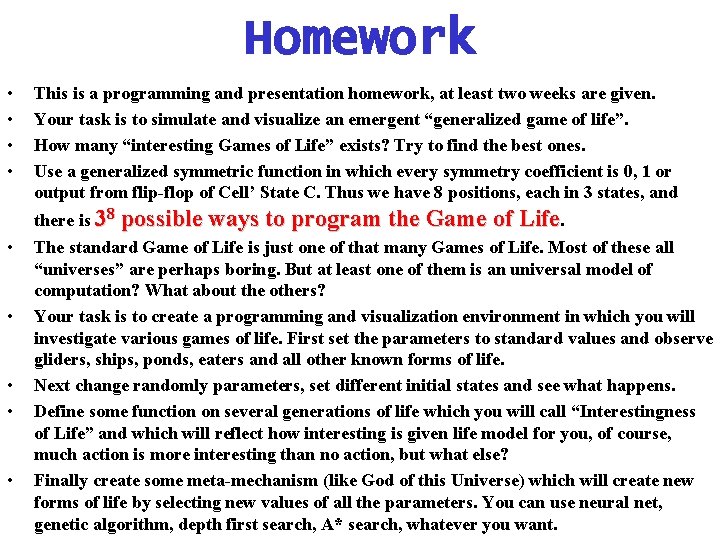
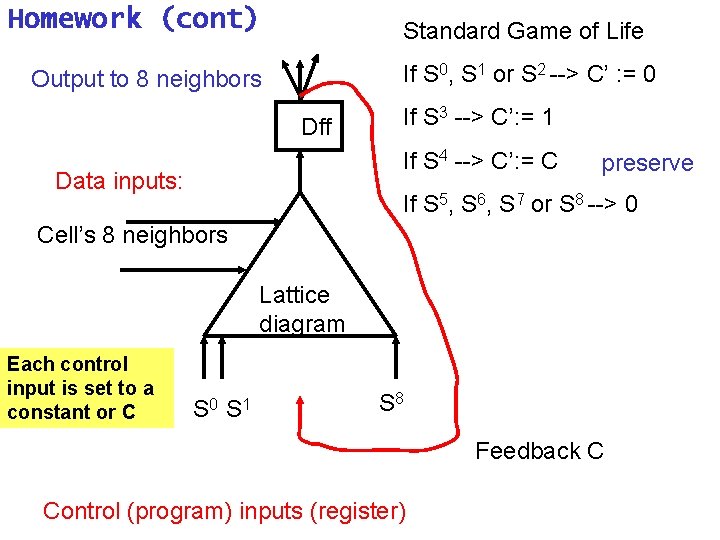
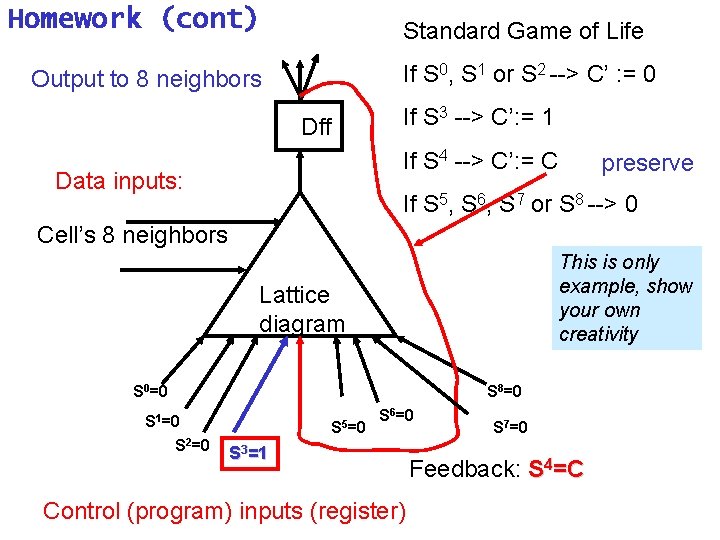
Homework • • This is a programming and presentation homework, at least two weeks are given. Your task is to simulate and visualize an emergent “generalized game of life”. How many “interesting Games of Life” exists? Try to find the best ones. Use a generalized symmetric function in which every symmetry coefficient is 0, 1 or output from flip-flop of Cell’ State C. Thus we have 8 positions, each in 3 states, and there is 38 possible ways to program the Game of Life. • • • The standard Game of Life is just one of that many Games of Life. Most of these all “universes” are perhaps boring. But at least one of them is an universal model of computation? What about the others? Your task is to create a programming and visualization environment in which you will investigate various games of life. First set the parameters to standard values and observe gliders, ships, ponds, eaters and all other known forms of life. Next change randomly parameters, set different initial states and see what happens. Define some function on several generations of life which you will call “Interestingness of Life” and which will reflect how interesting is given life model for you, of course, much action is more interesting than no action, but what else? Finally create some meta-mechanism (like God of this Universe) which will create new forms of life by selecting new values of all the parameters. You can use neural net, genetic algorithm, depth first search, A* search, whatever you want.
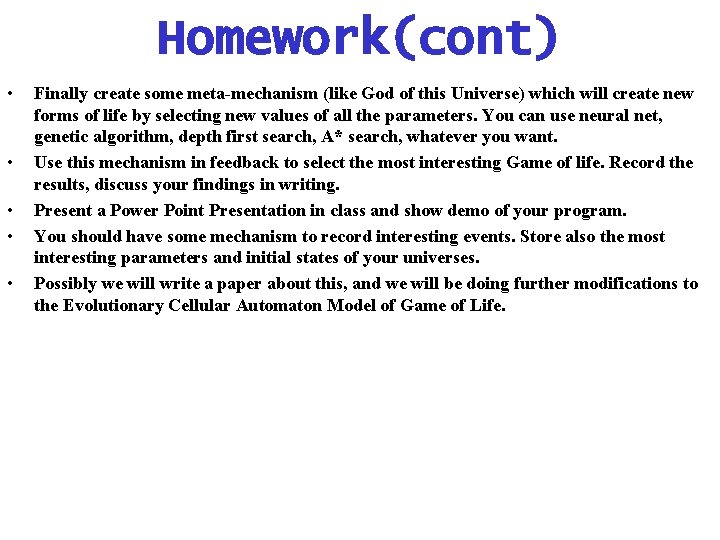
Homework(cont) • • • Finally create some meta-mechanism (like God of this Universe) which will create new forms of life by selecting new values of all the parameters. You can use neural net, genetic algorithm, depth first search, A* search, whatever you want. Use this mechanism in feedback to select the most interesting Game of life. Record the results, discuss your findings in writing. Present a Power Point Presentation in class and show demo of your program. You should have some mechanism to record interesting events. Store also the most interesting parameters and initial states of your universes. Possibly we will write a paper about this, and we will be doing further modifications to the Evolutionary Cellular Automaton Model of Game of Life.
Homework (cont) Standard Game of Life If S 0, S 1 or S 2 --> C’ : = 0 Output to 8 neighbors Dff If S 3 --> C’: = 1 If S 4 --> C’: = C Data inputs: preserve If S 5, S 6, S 7 or S 8 --> 0 Cell’s 8 neighbors Lattice diagram Each control input is set to a constant or C S 0 S 1 S 8 Feedback C Control (program) inputs (register)
Homework (cont) Standard Game of Life If S 0, S 1 or S 2 --> C’ : = 0 Output to 8 neighbors Dff If S 3 --> C’: = 1 If S 4 --> C’: = C Data inputs: preserve If S 5, S 6, S 7 or S 8 --> 0 Cell’s 8 neighbors This is only example, show your own creativity Lattice diagram S 0=0 S 1=0 S 2=0 S 8=0 S 5=0 S 6=0 S 3=1 Control (program) inputs (register) S 7=0 Feedback: S 4=C