
Introductory concepts Symmetry Jon Goss http aimpro ncl
- Slides: 54
Introductory concepts: Symmetry Jon Goss http: //aimpro. ncl. ac. uk MMG Skills Lecture Series
Outline Atomic orbitals to molecular orbitals Point group vs space group Point groups and diatomic MOs Correlation tables “Little groups” and k-point sampling Direct products Dipole selection rules for optical transitions Vibrational mode selection rules 2 MMG Skills Lecture Series
Introduction From concepts of atomic orbital theory, we already have some understanding of the s, p, d, … These orbitals are all spherically symmetric E. g. s, or (px, py, pz) For collections of atoms, to a first order approximation we can construct molecular orbitals which are linear combinations of atomic orbitals (LCAO approximation). This approach can be very informative. It is useful to be able to determine and even predict the overall symmetry of the MOs. 3 MMG Skills Lecture Series
Symmetry operations What are the possible symmetry operations of a molecule? 4 MMG Skills Lecture Series
Symmetry operations: Point groups Reflection (σh, σv, σd) Rotation (Cn) Inversion (i) Improper rotation, which are combinations of rotation and perpendicular reflection (Sn) Also there is an identity operation (E) 5 MMG Skills Lecture Series
Symmetry operations What additional operations are possible in a crystal? 6 MMG Skills Lecture Series
Symmetry operations: Space groups Translation Screw (translation and rotation) Glide (translation and reflection) We’re focusing on point groups in this lecture. 7 MMG Skills Lecture Series
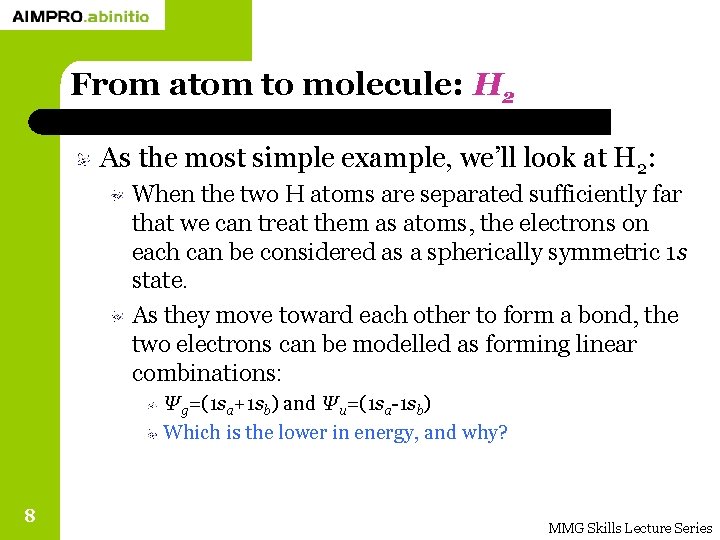
From atom to molecule: H 2 As the most simple example, we’ll look at H 2: When the two H atoms are separated sufficiently far that we can treat them as atoms, the electrons on each can be considered as a spherically symmetric 1 s state. As they move toward each other to form a bond, the two electrons can be modelled as forming linear combinations: Ψg=(1 sa+1 sb) and Ψu=(1 sa-1 sb) Which is the lower in energy, and why? 8 MMG Skills Lecture Series
From atom to molecule: H 2 To move on, we need to have a nomenclature for the symmetry of the molecule and those of the wave functions. First, what are the symmetry operations of H 2? 9 MMG Skills Lecture Series
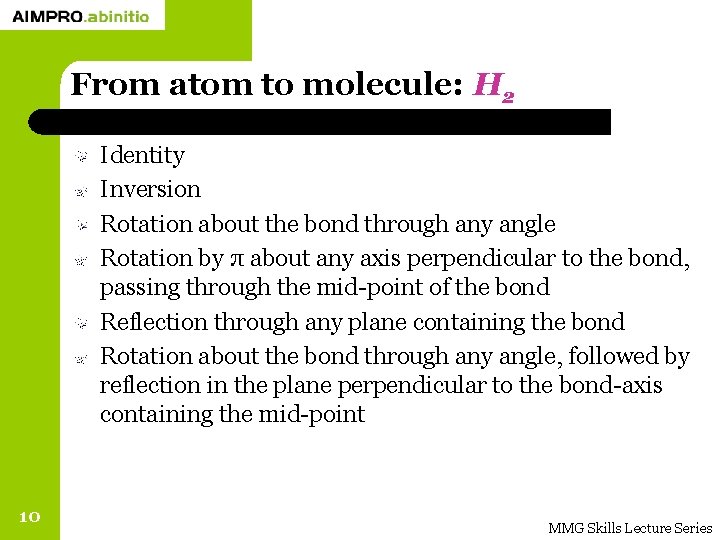
From atom to molecule: H 2 Identity Inversion Rotation about the bond through any angle Rotation by π about any axis perpendicular to the bond, passing through the mid-point of the bond Reflection through any plane containing the bond Rotation about the bond through any angle, followed by reflection in the plane perpendicular to the bond-axis containing the mid-point 10 MMG Skills Lecture Series
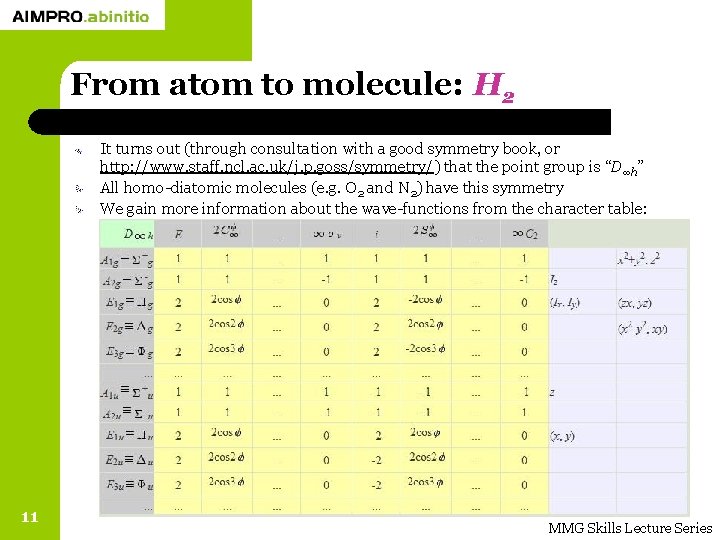
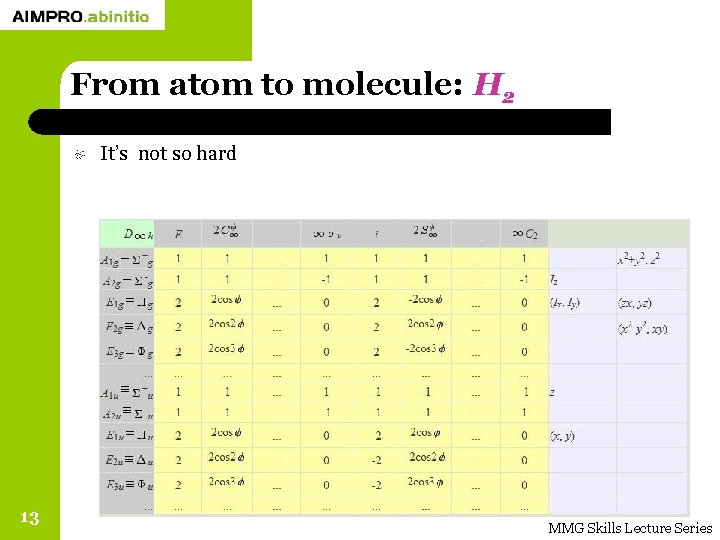
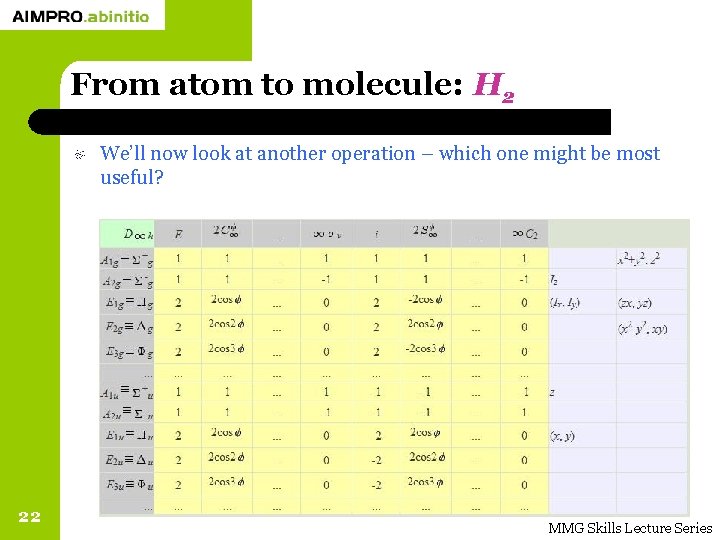
From atom to molecule: H 2 It turns out (through consultation with a good symmetry book, or http: //www. staff. ncl. ac. uk/j. p. goss/symmetry/) that the point group is “D∞h” All homo-diatomic molecules (e. g. O 2 and N 2) have this symmetry We gain more information about the wave-functions from the character table: 11 MMG Skills Lecture Series
From atom to molecule: H 2 12 MMG Skills Lecture Series
From atom to molecule: H 2 It’s not so hard 13 MMG Skills Lecture Series
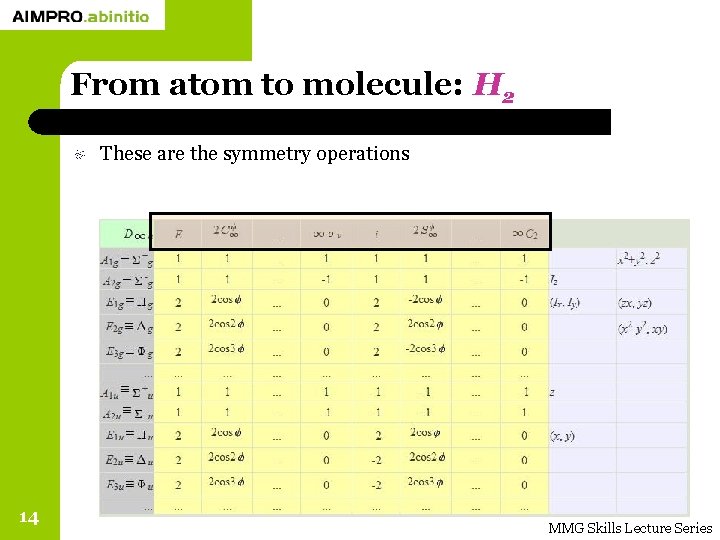
From atom to molecule: H 2 These are the symmetry operations 14 MMG Skills Lecture Series
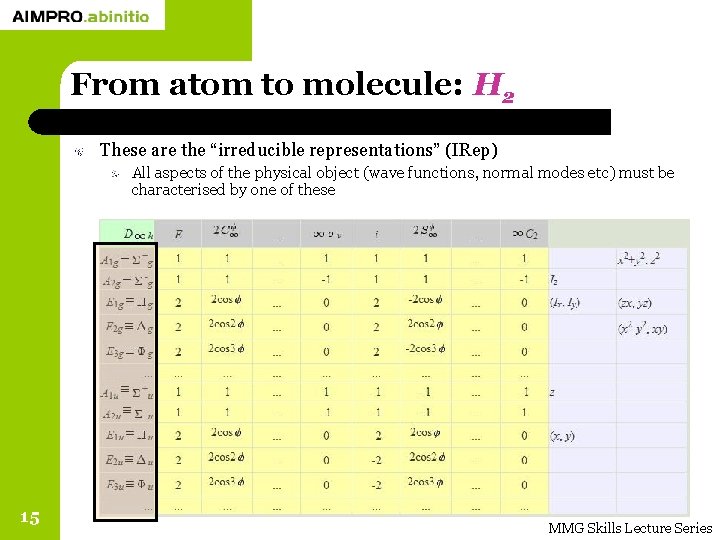
From atom to molecule: H 2 These are the “irreducible representations” (IRep) All aspects of the physical object (wave functions, normal modes etc) must be characterised by one of these 15 MMG Skills Lecture Series
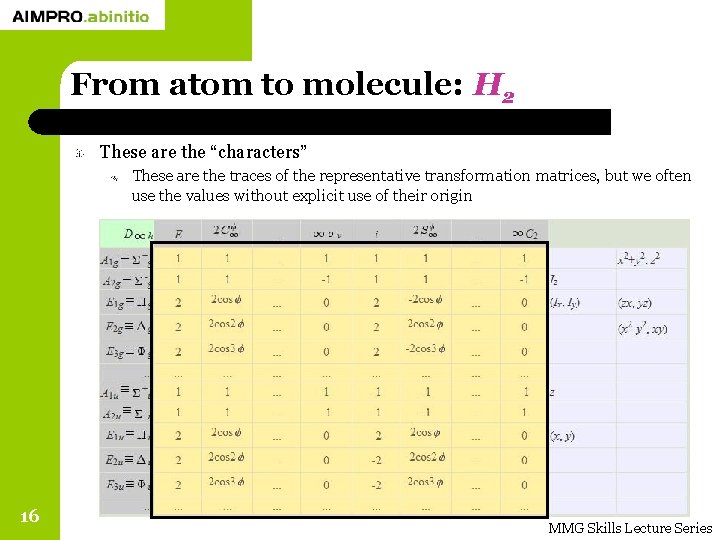
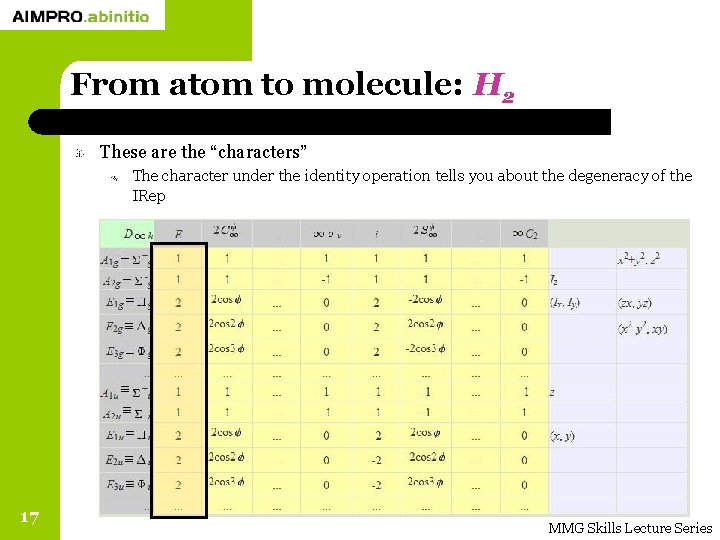
From atom to molecule: H 2 These are the “characters” These are the traces of the representative transformation matrices, but we often use the values without explicit use of their origin 16 MMG Skills Lecture Series
From atom to molecule: H 2 These are the “characters” The character under the identity operation tells you about the degeneracy of the IRep 17 MMG Skills Lecture Series
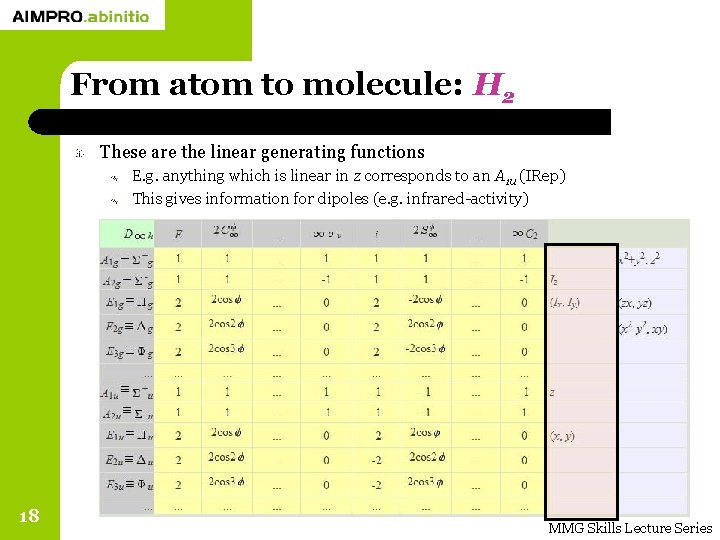
From atom to molecule: H 2 These are the linear generating functions E. g. anything which is linear in z corresponds to an A 1 u (IRep) This gives information for dipoles (e. g. infrared-activity) 18 MMG Skills Lecture Series
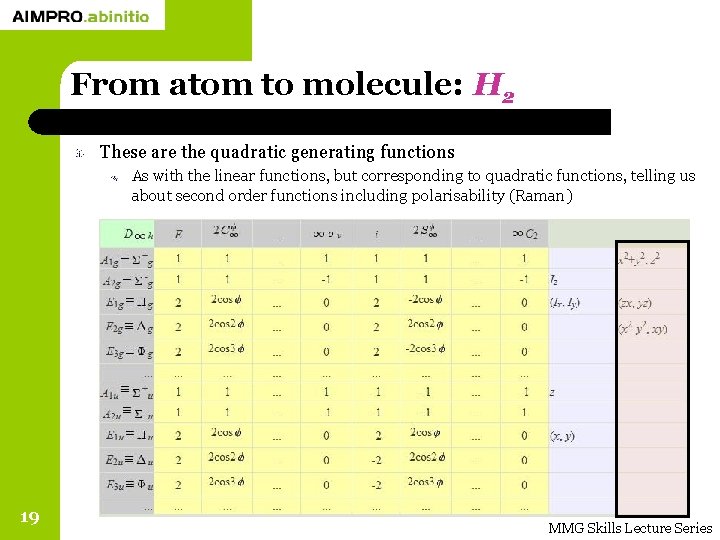
From atom to molecule: H 2 These are the quadratic generating functions As with the linear functions, but corresponding to quadratic functions, telling us about second order functions including polarisability (Raman) 19 MMG Skills Lecture Series
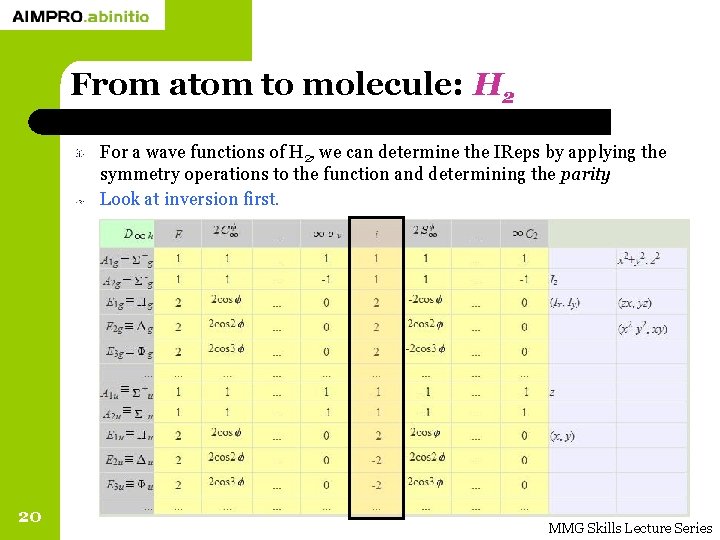
From atom to molecule: H 2 For a wave functions of H 2, we can determine the IReps by applying the symmetry operations to the function and determining the parity Look at inversion first. 20 MMG Skills Lecture Series
From atom to molecule: H 2 Remember, Ψg=(1 sa+1 sb) and Ψu=(1 sa-1 sb) i Ψg=Ψg i Ψu=-Ψu Since both functions are non-degenerate, the IReps of a and b must be Ag and Au, respectively. However, we are yet to be precise! 21 MMG Skills Lecture Series
From atom to molecule: H 2 We’ll now look at another operation – which one might be most useful? 22 MMG Skills Lecture Series
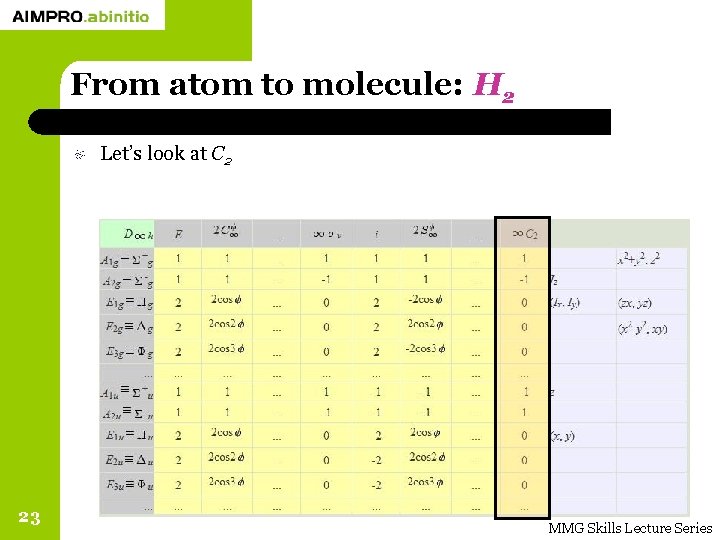
From atom to molecule: H 2 Let’s look at C 2 23 MMG Skills Lecture Series
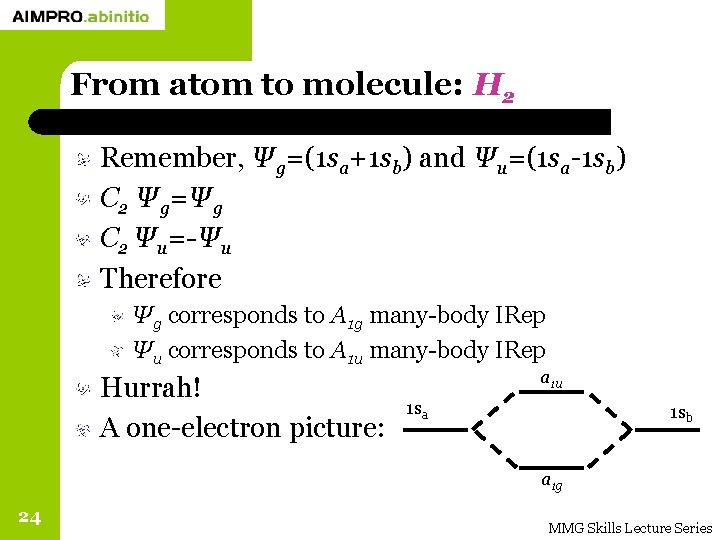
From atom to molecule: H 2 Remember, Ψg=(1 sa+1 sb) and Ψu=(1 sa-1 sb) C 2 Ψg=Ψg C 2 Ψu=-Ψu Therefore Ψg corresponds to A 1 g many-body IRep Ψu corresponds to A 1 u many-body IRep Hurrah! A one-electron picture: a 1 u 1 sa 1 sb a 1 g 24 MMG Skills Lecture Series
From atom to molecule: HF What symmetry operations are lost relative to H 2? 25 MMG Skills Lecture Series
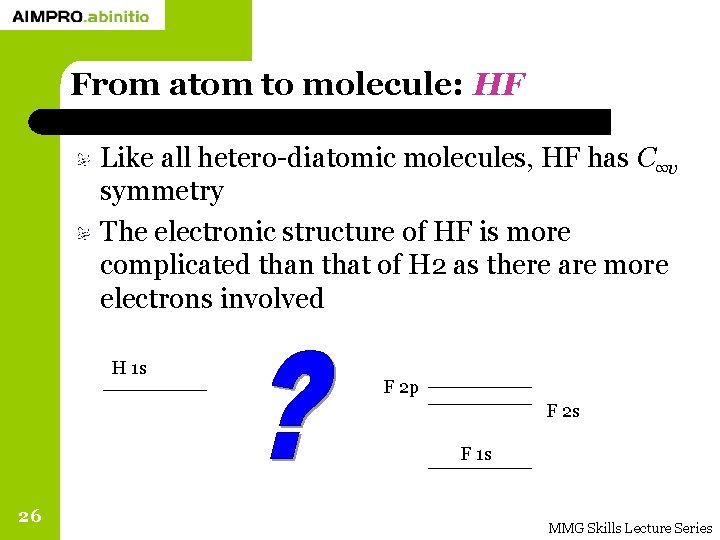
From atom to molecule: HF Like all hetero-diatomic molecules, HF has C∞v symmetry The electronic structure of HF is more complicated than that of H 2 as there are more electrons involved H 1 s F 2 p F 2 s F 1 s 26 MMG Skills Lecture Series
From atom to molecule: HF We now have a more complicated problem as the atomic orbitals we start with include degeneracies. How does the loss of spherical symmetry in HF affect the 2 p orbitals? (Choose the HF axis along z and consider px, py and pz. ) This is an elementary example of a crystal field splitting. 27 MMG Skills Lecture Series
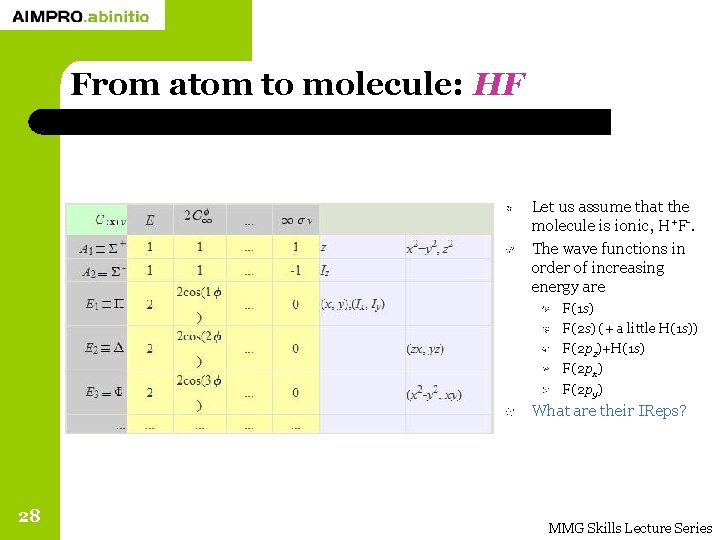
From atom to molecule: HF Let us assume that the molecule is ionic, H+F-. The wave functions in order of increasing energy are F(1 s) F(2 s) (+ a little H(1 s)) F(2 pz)+H(1 s) F(2 px) F(2 py) What are their IReps? 28 MMG Skills Lecture Series
Correlation If you look carefully at the character tables of the H 2 and HF molecule examples, you’ll see that the latter is a subset of the former. The C∞v group is a sub-group of D∞h. The IReps of the sub-group are all correlated with IReps in the main-group. For example, the A 1 g IRep in D∞h is correlated with A 1 in C∞v. This is a very useful relationship to know about. 29 MMG Skills Lecture Series
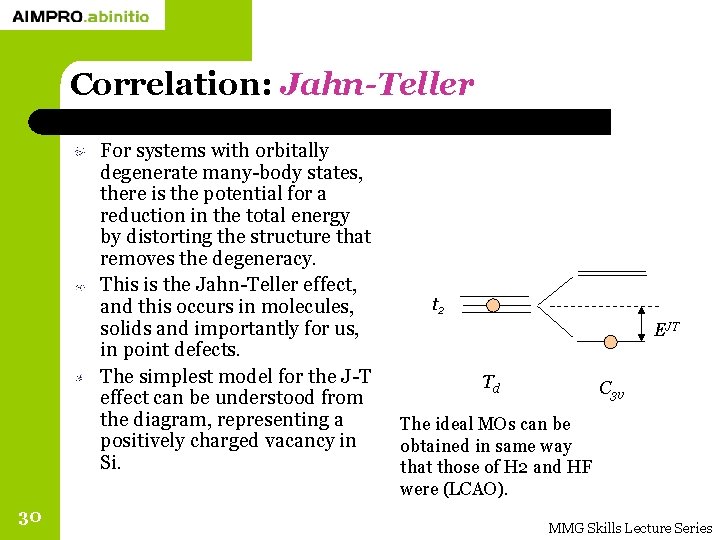
Correlation: Jahn-Teller For systems with orbitally degenerate many-body states, there is the potential for a reduction in the total energy by distorting the structure that removes the degeneracy. This is the Jahn-Teller effect, and this occurs in molecules, solids and importantly for us, in point defects. The simplest model for the J-T effect can be understood from the diagram, representing a positively charged vacancy in Si. 30 t 2 EJT Td C 3 v The ideal MOs can be obtained in same way that those of H 2 and HF were (LCAO). MMG Skills Lecture Series
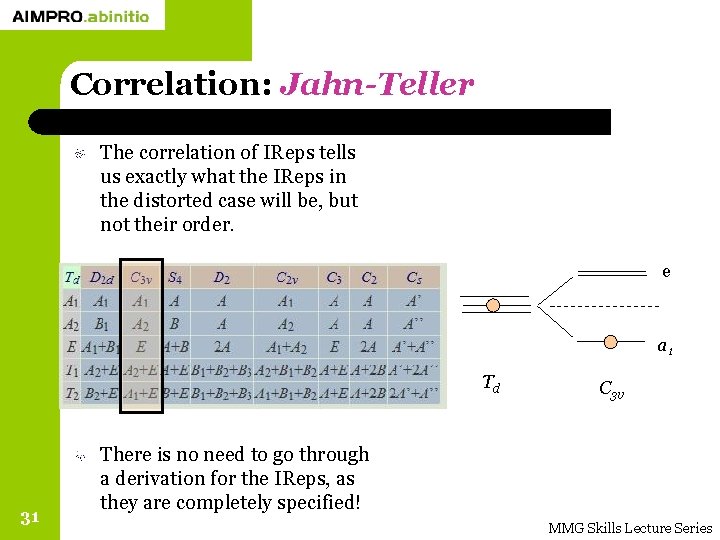
Correlation: Jahn-Teller The correlation of IReps tells us exactly what the IReps in the distorted case will be, but not their order. e a 1 Td 31 C 3 v There is no need to go through a derivation for the IReps, as they are completely specified! MMG Skills Lecture Series
Correlation: Little groups Correlation also serves us in the splitting of bands in the Brillouinzone for non-zero k. The wave-functions at the Γ-point reflect the symmetry of the atomic geometry At other points, the wave-vector of the electron in general acts as distortion The symmetry of the wave-functions for a general k-point must be a sub-group of that at the Γ-point. Therefore the splitting of degenerate band along a high-symmetry branch in reciprocal space (such as those at the valence band top of a cubic material such as diamond, silicon, Ga. As, …) can be qualitatively predicted purely on symmetry grounds. For example, along the <111> branch of a cubic material, the little groups are trigonal: triply degenerate bands are split into e and a. Looking at such features may help you spot problems in calculations! 32 MMG Skills Lecture Series
Correlation: Little groups In the diamond bandstructure along Γ-X, what do you expect to happen to the four valence bands which are a and t at the zone centre? Hint: what is happening along y and z? 33 MMG Skills Lecture Series
Direct products In the final part of the lecture, we’ll look at another use of the IReps: determining which electronic and vibrational transitions are optically active. To do this we need to know how to combine IReps together (i. e. what is the IRep of a two functions for which we know the IReps? ) 34 MMG Skills Lecture Series
Direct products: Electronic transitions The probability for a transition between electronic states Ψ 0 and Ψ 1 coupled by an electric dipole (photon) with electric field pointing along a given direction v is related to ∫Ψ 0 vΨ 1 d. V We have already seen how to determine the IReps of the wave functions, and actually, we’ve also seen how to get the IRep for the electric dipole field (the linear generating function). It can be shown that the integral will be exactly zero if the IRep of the product is other than even parity for all symmetry operations: generally A, A 1, Ag or A’. This can be qualitatively understood by an extension of the idea that the integral between symmetric limits of an odd function is always zero. So, how do we obtain the IRep of the product? 35 MMG Skills Lecture Series
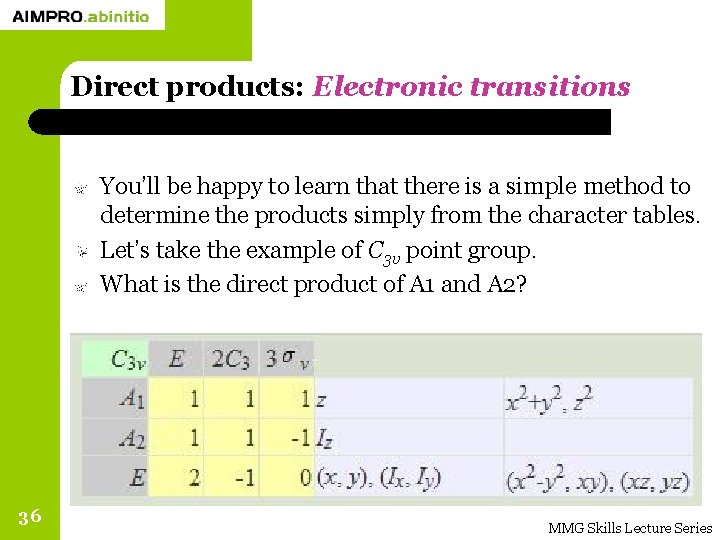
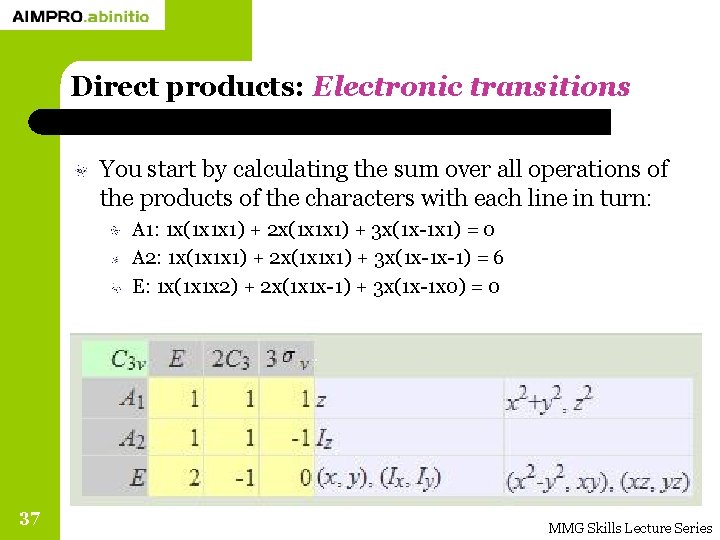
Direct products: Electronic transitions You’ll be happy to learn that there is a simple method to determine the products simply from the character tables. Let’s take the example of C 3 v point group. What is the direct product of A 1 and A 2? 36 MMG Skills Lecture Series
Direct products: Electronic transitions You start by calculating the sum over all operations of the products of the characters with each line in turn: A 1: 1 x(1 x 1 x 1) + 2 x(1 x 1 x 1) + 3 x(1 x-1 x 1) = 0 A 2: 1 x(1 x 1 x 1) + 2 x(1 x 1 x 1) + 3 x(1 x-1 x-1) = 6 E: 1 x(1 x 1 x 2) + 2 x(1 x 1 x-1) + 3 x(1 x-1 x 0) = 0 37 MMG Skills Lecture Series
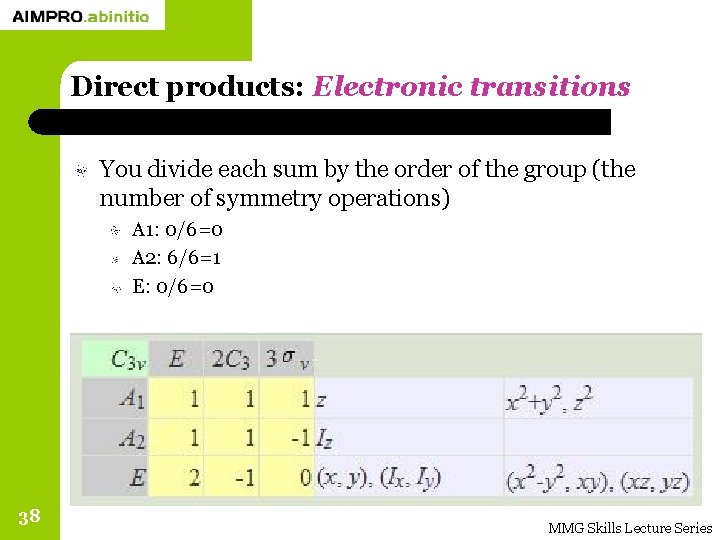
Direct products: Electronic transitions You divide each sum by the order of the group (the number of symmetry operations) A 1: 0/6=0 A 2: 6/6=1 E: 0/6=0 38 MMG Skills Lecture Series
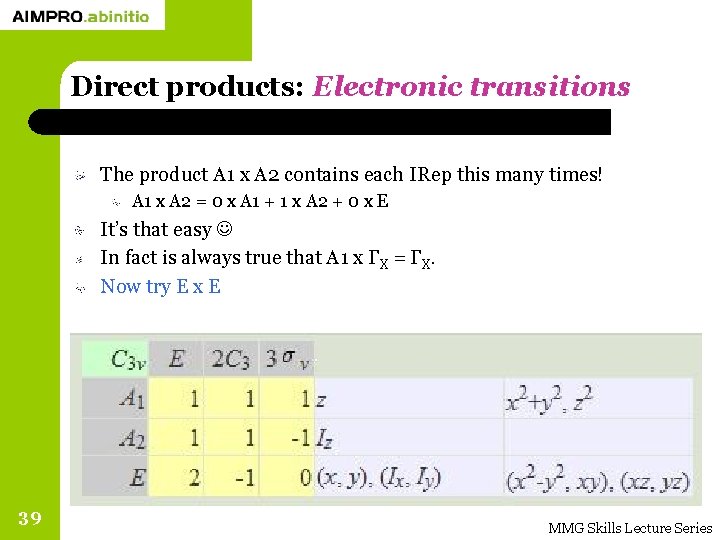
Direct products: Electronic transitions The product A 1 x A 2 contains each IRep this many times! A 1 x A 2 = 0 x A 1 + 1 x A 2 + 0 x E It’s that easy In fact is always true that A 1 x ΓX = ΓX. Now try E x E 39 MMG Skills Lecture Series
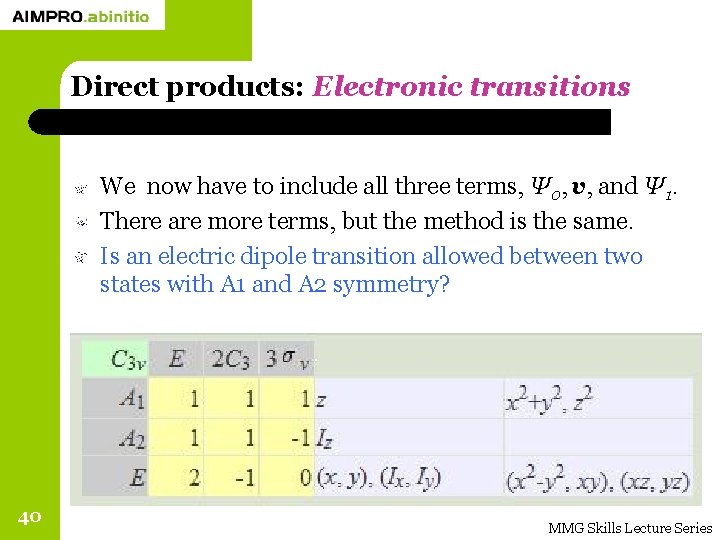
Direct products: Electronic transitions We now have to include all three terms, Ψ 0, v, and Ψ 1. There are more terms, but the method is the same. Is an electric dipole transition allowed between two states with A 1 and A 2 symmetry? 40 MMG Skills Lecture Series
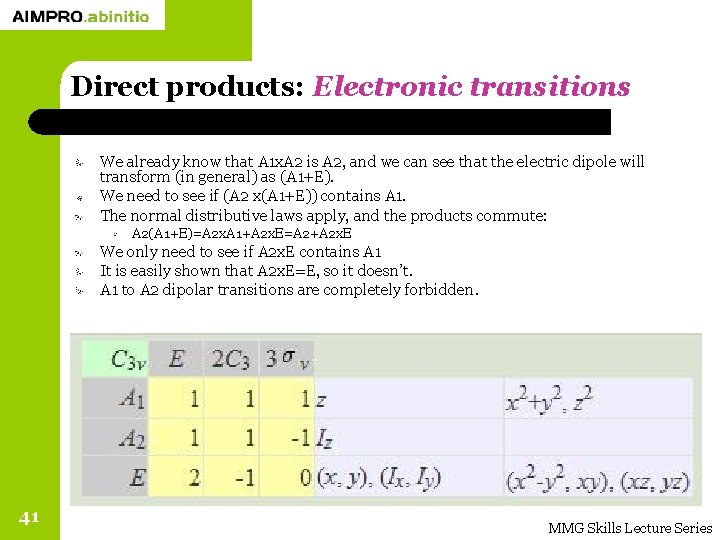
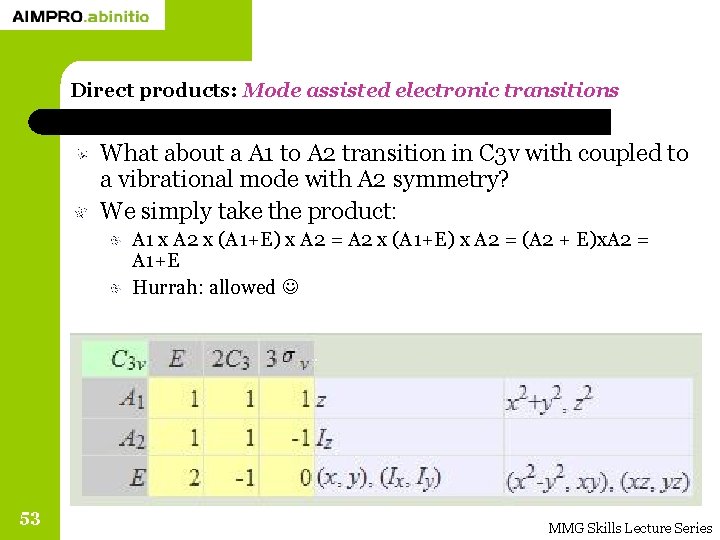
Direct products: Electronic transitions We already know that A 1 x. A 2 is A 2, and we can see that the electric dipole will transform (in general) as (A 1+E). We need to see if (A 2 x(A 1+E)) contains A 1. The normal distributive laws apply, and the products commute: A 2(A 1+E)=A 2 x. A 1+A 2 x. E=A 2+A 2 x. E We only need to see if A 2 x. E contains A 1 It is easily shown that A 2 x. E=E, so it doesn’t. A 1 to A 2 dipolar transitions are completely forbidden. 41 MMG Skills Lecture Series
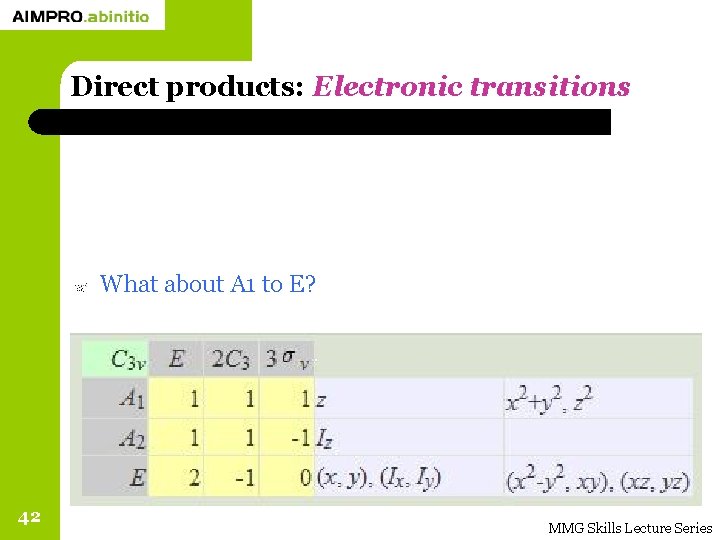
Direct products: Electronic transitions What about A 1 to E? 42 MMG Skills Lecture Series
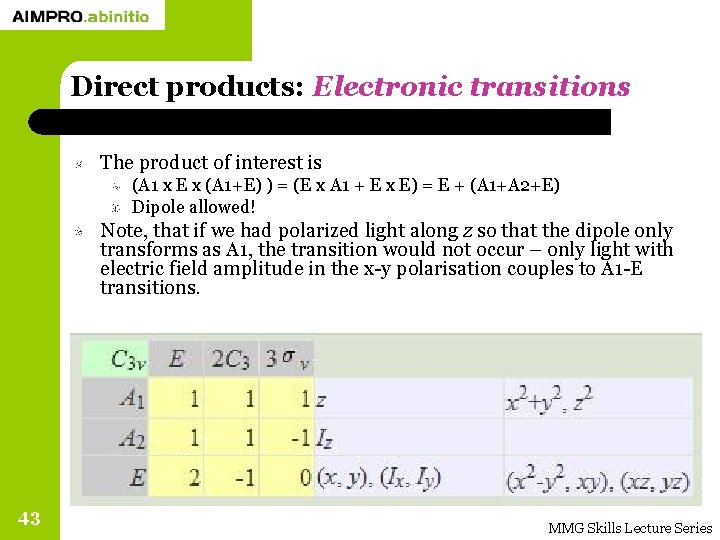
Direct products: Electronic transitions The product of interest is (A 1 x E x (A 1+E) ) = (E x A 1 + E x E) = E + (A 1+A 2+E) Dipole allowed! Note, that if we had polarized light along z so that the dipole only transforms as A 1, the transition would not occur – only light with electric field amplitude in the x-y polarisation couples to A 1 -E transitions. 43 MMG Skills Lecture Series
Direct products: Electronic transitions Are dipole forbidden transitions ever seen in reality? 44 MMG Skills Lecture Series
Infrared and Raman modes The final section is on vibrational mode characterisation. Vibrational modes are IR-active or Raman active depending upon symmetry. Formally, the IR-active mode selection rule is the same as that of the dipole transitions, but now we’re talking about vibrational wave functions, not electronic ones. Just like electronic problems, the characterisation of which modes can be seen experimentally is dependent (at least in part) upon the assignment of IReps to the modes of vibration. 45 MMG Skills Lecture Series
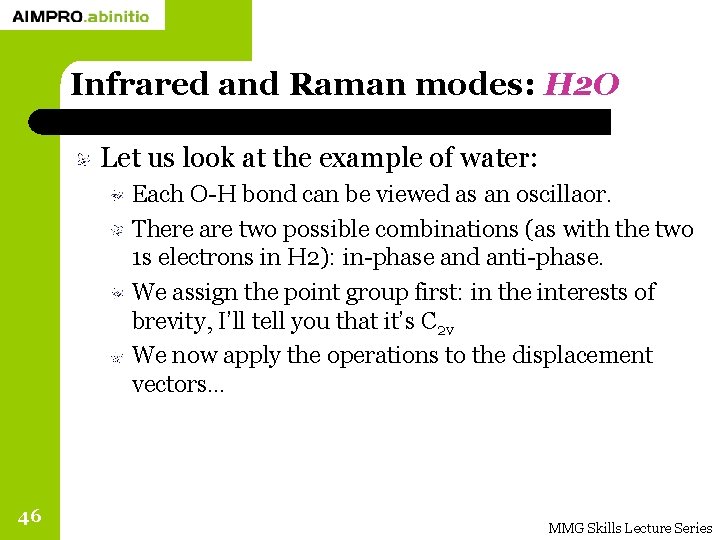
Infrared and Raman modes: H 2 O Let us look at the example of water: Each O-H bond can be viewed as an oscillaor. There are two possible combinations (as with the two 1 s electrons in H 2): in-phase and anti-phase. We assign the point group first: in the interests of brevity, I’ll tell you that it’s C 2 v We now apply the operations to the displacement vectors… 46 MMG Skills Lecture Series
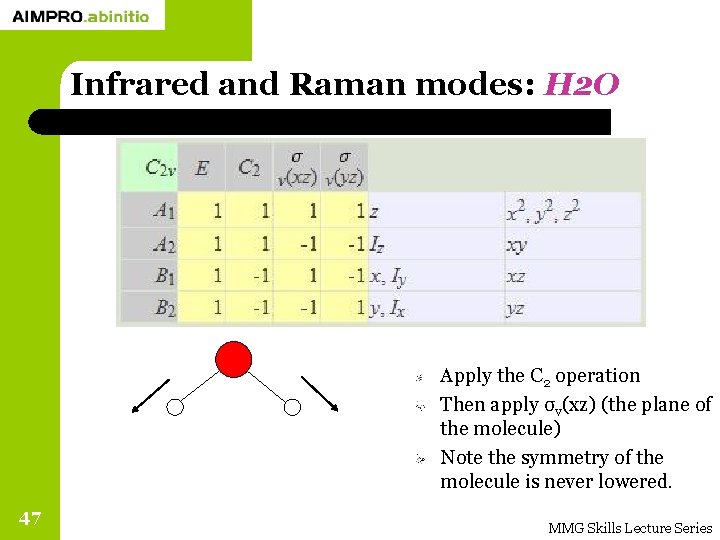
Infrared and Raman modes: H 2 O Apply the C 2 operation Then apply σv(xz) (the plane of the molecule) Note the symmetry of the molecule is never lowered. 47 MMG Skills Lecture Series
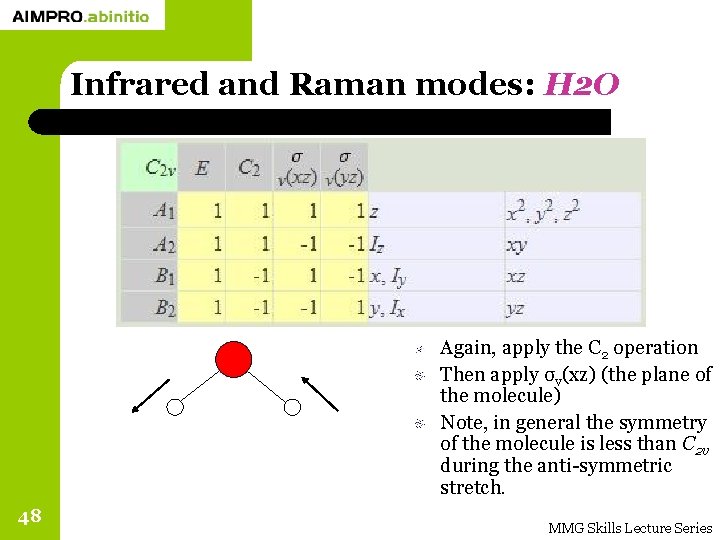
Infrared and Raman modes: H 2 O Again, apply the C 2 operation Then apply σv(xz) (the plane of the molecule) Note, in general the symmetry of the molecule is less than C 2 v during the anti-symmetric stretch. 48 MMG Skills Lecture Series
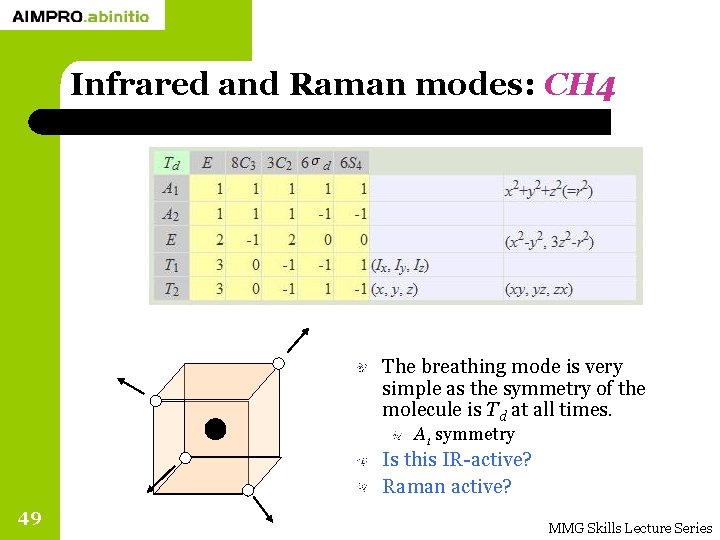
Infrared and Raman modes: CH 4 The breathing mode is very simple as the symmetry of the molecule is Td at all times. A 1 symmetry Is this IR-active? Raman active? 49 MMG Skills Lecture Series
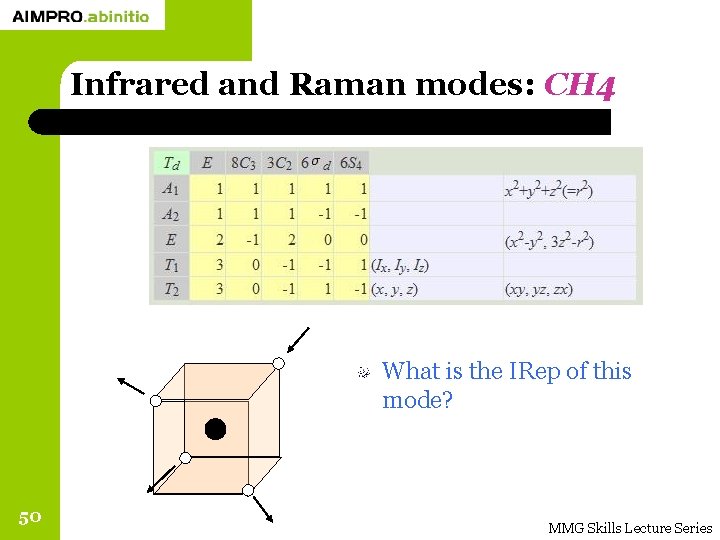
Infrared and Raman modes: CH 4 What is the IRep of this mode? 50 MMG Skills Lecture Series
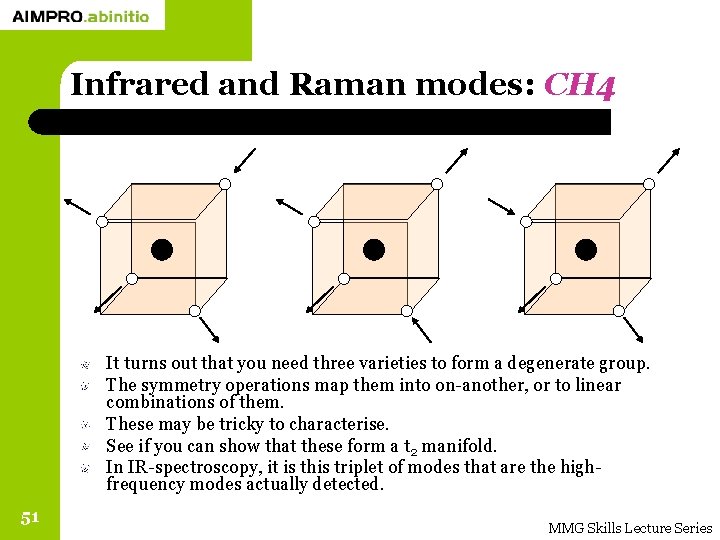
Infrared and Raman modes: CH 4 It turns out that you need three varieties to form a degenerate group. The symmetry operations map them into on-another, or to linear combinations of them. These may be tricky to characterise. See if you can show that these form a t 2 manifold. In IR-spectroscopy, it is this triplet of modes that are the highfrequency modes actually detected. 51 MMG Skills Lecture Series
Local mode replica. The final part of this final part is the idea that vibrational modes may couple to an electronic transition, or convert a dipole-forbidden electronic transition into an allowed transition. We adapt the previous selection rule by adding the local mode symmetry to the product: ∫Ψ 0χ0 vΨ 1χ1 d. V We assume (without any loss of generality) that the vibrational ground state is totally symmetric. We need the IRep product of the two electronic states, the dipole operator and the vibrational mode. 52 MMG Skills Lecture Series
Direct products: Mode assisted electronic transitions What about a A 1 to A 2 transition in C 3 v with coupled to a vibrational mode with A 2 symmetry? We simply take the product: A 1 x A 2 x (A 1+E) x A 2 = (A 2 + E)x. A 2 = A 1+E Hurrah: allowed 53 MMG Skills Lecture Series
Final summary From this introduction, you have seen some important ideas: Point group symmetry The assignment of irreducible representations to electronic and vibrational wave functions The correlation of IReps Jahn-Teller Little groups in k-space The application of selection rules for spectroscopy 54 MMG Skills Lecture Series