
Introductory Biostatistics Chapter 12 Summary Review Last revised
Introductory Biostatistics Chapter 12: Summary & Review (Last revised: 4 -Apr-2018) Weaver: Introductory Biostatistics 12. Summary & Review 1
Where We Have Been Ø The topics we have covered fall into the following broad categories § The Foundations § Methods for Analyzing Quantitative Variables § Methods for Analyzing Categorical Variables § Methods for Analyzing Ranks Weaver: Introductory Biostatistics 12. Summary & Review 2
The Foundations Ø Measurement Ø Descriptive Statistics Ø Random Sampling & Probability Ø The Binomial Distribution Ø The Normal Distribution & Standard Scores Ø Sampling Distributions, Standard Errors & Confidence Intervals Ø Introduction to Hypothesis Testing Weaver: Introductory Biostatistics 12. Summary & Review 3
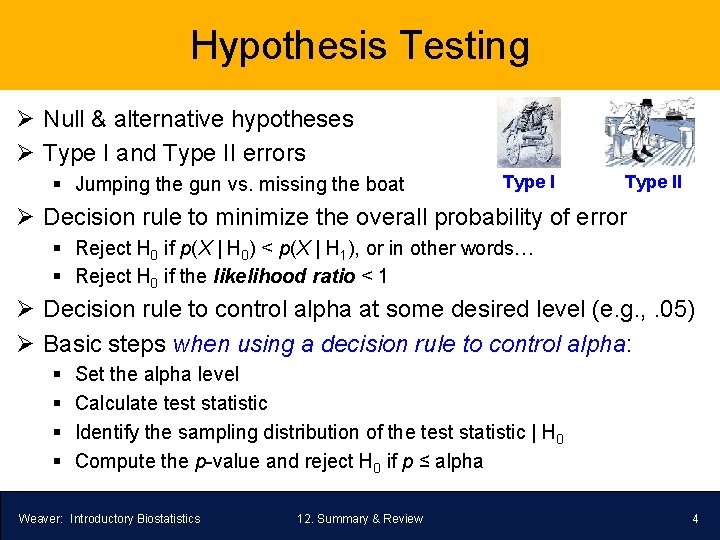
Hypothesis Testing Ø Null & alternative hypotheses Ø Type I and Type II errors § Jumping the gun vs. missing the boat Type II Ø Decision rule to minimize the overall probability of error § Reject H 0 if p(X | H 0) < p(X | H 1), or in other words… § Reject H 0 if the likelihood ratio < 1 Ø Decision rule to control alpha at some desired level (e. g. , . 05) Ø Basic steps when using a decision rule to control alpha: § § Set the alpha level Calculate test statistic Identify the sampling distribution of the test statistic | H 0 Compute the p-value and reject H 0 if p ≤ alpha Weaver: Introductory Biostatistics 12. Summary & Review 4
Where We Have Been Ø The topics we have covered fall into the following broad categories § The Foundations § Methods for Analyzing Quantitative Variables § Methods for Analyzing Categorical Variables § Methods for Analyzing Ranks Weaver: Introductory Biostatistics 12. Summary & Review 5
Analyzing Quantitative Variables Ø Z- and t-tests § Plus a very brief overview of ANOVA models Ø Simple linear regression & correlation § Plus a scandalously brief intro to multiple linear regression Weaver: Introductory Biostatistics 12. Summary & Review 6
Where We Have Been Ø The topics we have covered fall into the following broad categories § The Foundations § Methods for Analyzing Quantitative Variables § Methods for Analyzing Categorical Variables § Methods for Analyzing Ranks Weaver: Introductory Biostatistics 12. Summary & Review 7
Analyzing Categorical Variables Ø Tests for proportions § Exact (binomial test), z-tests, and Chi-square tests Ø Confidence intervals for proportions § Exact vs. approximate (various methods) § SPSS syntax files ciprop. SPS and ciprop 2. SPS § I recommended the Wilson score method (which is one of the methods included in the two syntax files) Weaver: Introductory Biostatistics 12. Summary & Review 8
Where We Have Been Ø The topics we have covered fall into the following broad categories § The Foundations § Methods for Analyzing Quantitative Variables § Methods for Analyzing Categorical Variables § Methods for Analyzing Ranks Weaver: Introductory Biostatistics 12. Summary & Review 9
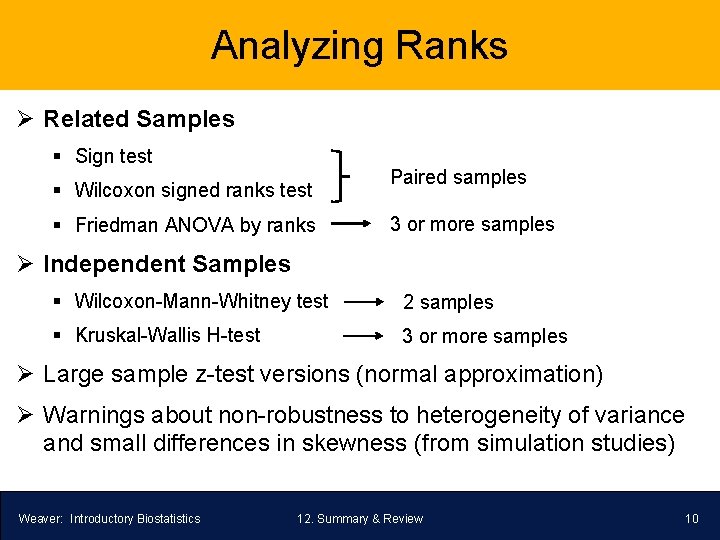
Analyzing Ranks Ø Related Samples § Sign test § Wilcoxon signed ranks test § Friedman ANOVA by ranks Paired samples 3 or more samples Ø Independent Samples § Wilcoxon-Mann-Whitney test 2 samples § Kruskal-Wallis H-test 3 or more samples Ø Large sample z-test versions (normal approximation) Ø Warnings about non-robustness to heterogeneity of variance and small differences in skewness (from simulation studies) Weaver: Introductory Biostatistics 12. Summary & Review 10
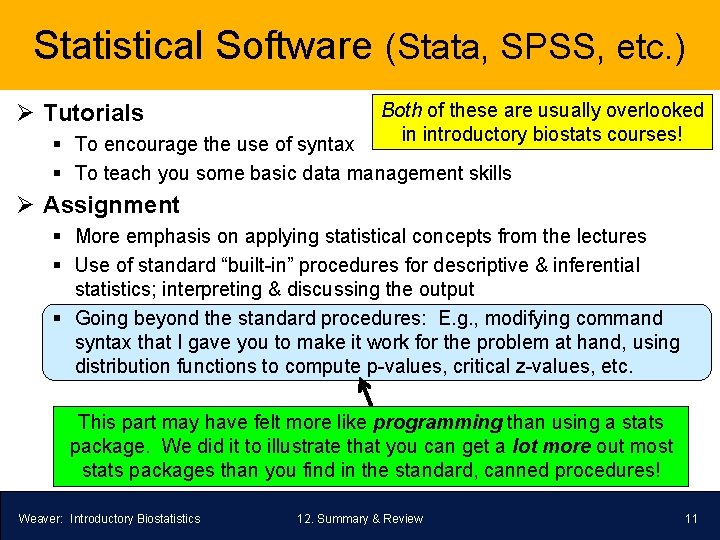
Statistical Software (Stata, SPSS, etc. ) Ø Tutorials Both of these are usually overlooked in introductory biostats courses! § To encourage the use of syntax § To teach you some basic data management skills Ø Assignment § More emphasis on applying statistical concepts from the lectures § Use of standard “built-in” procedures for descriptive & inferential statistics; interpreting & discussing the output § Going beyond the standard procedures: E. g. , modifying command syntax that I gave you to make it work for the problem at hand, using distribution functions to compute p-values, critical z-values, etc. This part may have felt more like programming than using a stats package. We did it to illustrate that you can get a lot more out most stats packages than you find in the standard, canned procedures! Weaver: Introductory Biostatistics 12. Summary & Review 11
Where We Could Go Next… If only there was more time! Weaver: Introductory Biostatistics 12. Summary & Review 12
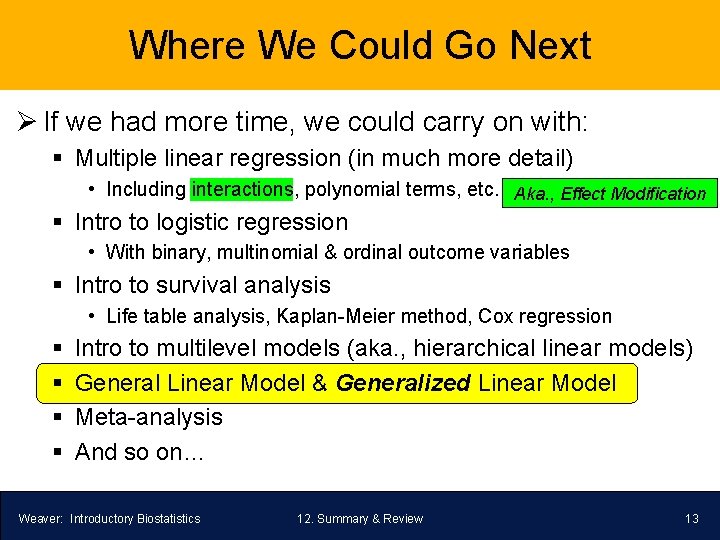
Where We Could Go Next Ø If we had more time, we could carry on with: § Multiple linear regression (in much more detail) • Including interactions, polynomial terms, etc. Aka. , Effect Modification § Intro to logistic regression • With binary, multinomial & ordinal outcome variables § Intro to survival analysis • Life table analysis, Kaplan-Meier method, Cox regression § § Intro to multilevel models (aka. , hierarchical linear models) General Linear Model & Generalized Linear Model Meta-analysis And so on… Weaver: Introductory Biostatistics 12. Summary & Review 13
Regression, ANOVA, the General Linear Model, and the Generalized Linear Model Weaver: Introductory Biostatistics 12. Summary & Review 14
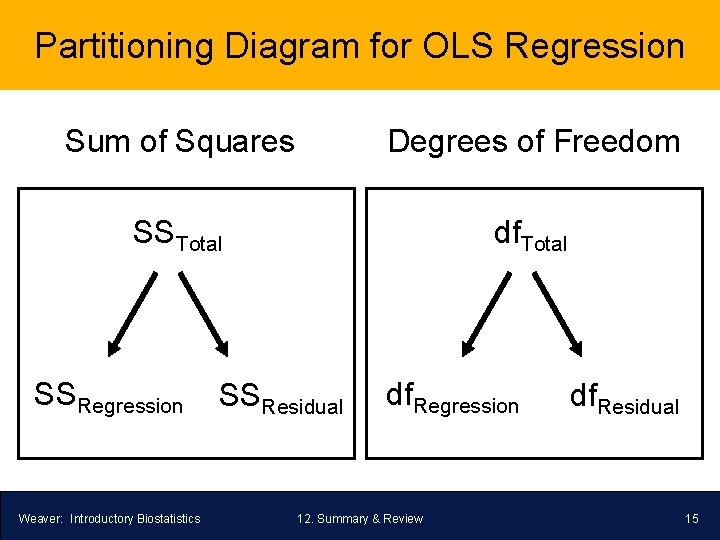
Partitioning Diagram for OLS Regression Sum of Squares Degrees of Freedom SSTotal df. Total SSRegression Weaver: Introductory Biostatistics SSResidual df. Regression 12. Summary & Review df. Residual 15
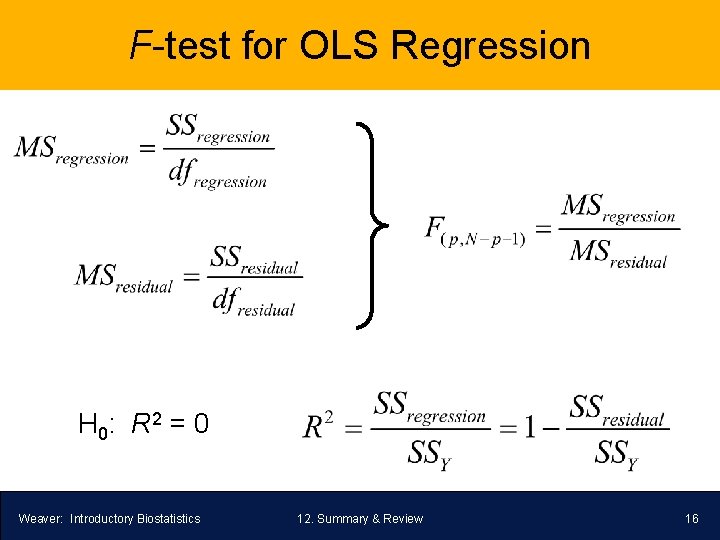
F-test for OLS Regression H 0: R 2 = 0 Weaver: Introductory Biostatistics 12. Summary & Review 16
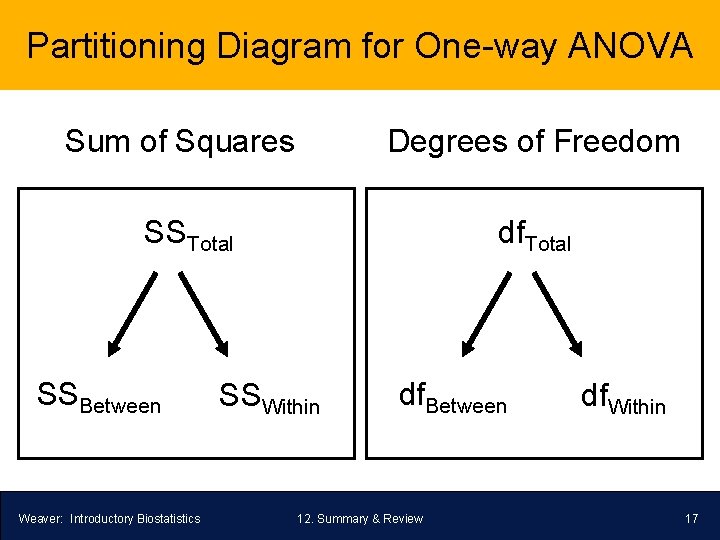
Partitioning Diagram for One-way ANOVA Sum of Squares Degrees of Freedom SSTotal df. Total SSBetween Weaver: Introductory Biostatistics SSWithin df. Between 12. Summary & Review df. Within 17
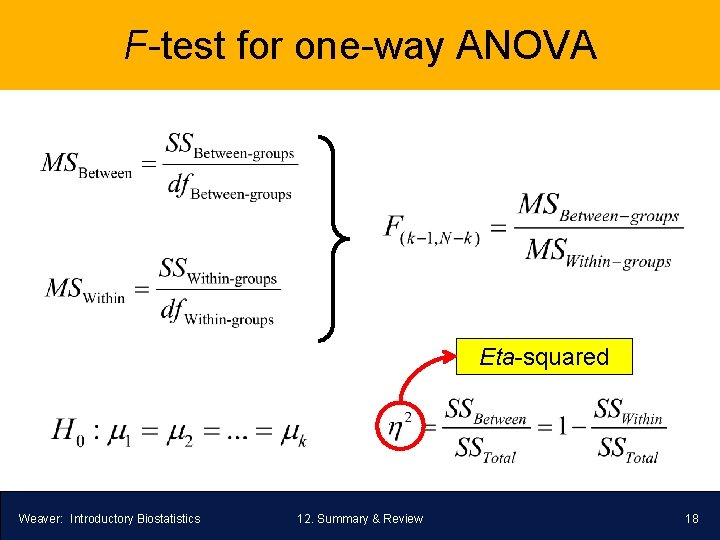
F-test for one-way ANOVA Eta-squared Weaver: Introductory Biostatistics 12. Summary & Review 18
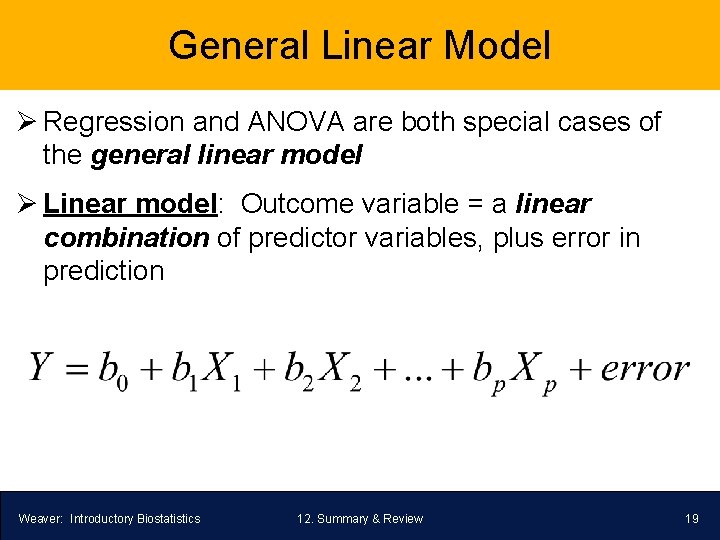
General Linear Model Ø Regression and ANOVA are both special cases of the general linear model Ø Linear model: Outcome variable = a linear combination of predictor variables, plus error in prediction Weaver: Introductory Biostatistics 12. Summary & Review 19
Some common linear models Ø Next slide lists several common linear models Ø For all models listed, the outcome variables are interval or ratio scaled Weaver: Introductory Biostatistics 12. Summary & Review 20
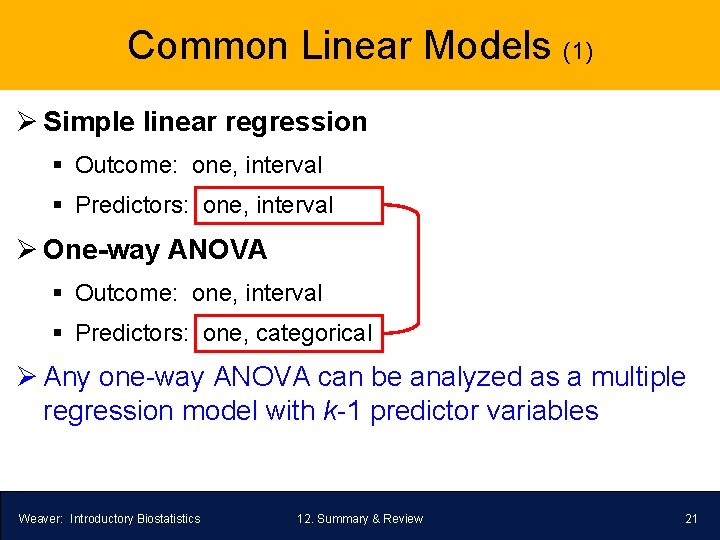
Common Linear Models (1) Ø Simple linear regression § Outcome: one, interval § Predictors: one, interval Ø One-way ANOVA § Outcome: one, interval § Predictors: one, categorical Ø Any one-way ANOVA can be analyzed as a multiple regression model with k-1 predictor variables Weaver: Introductory Biostatistics 12. Summary & Review 21
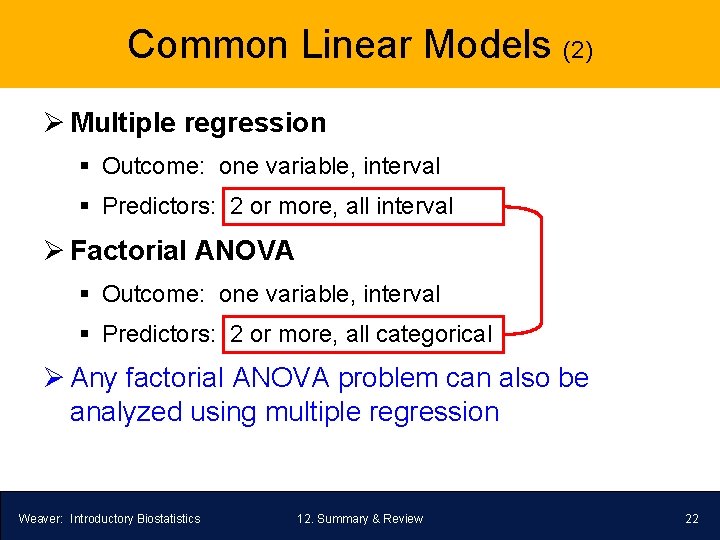
Common Linear Models (2) Ø Multiple regression § Outcome: one variable, interval § Predictors: 2 or more, all interval Ø Factorial ANOVA § Outcome: one variable, interval § Predictors: 2 or more, all categorical Ø Any factorial ANOVA problem can also be analyzed using multiple regression Weaver: Introductory Biostatistics 12. Summary & Review 22
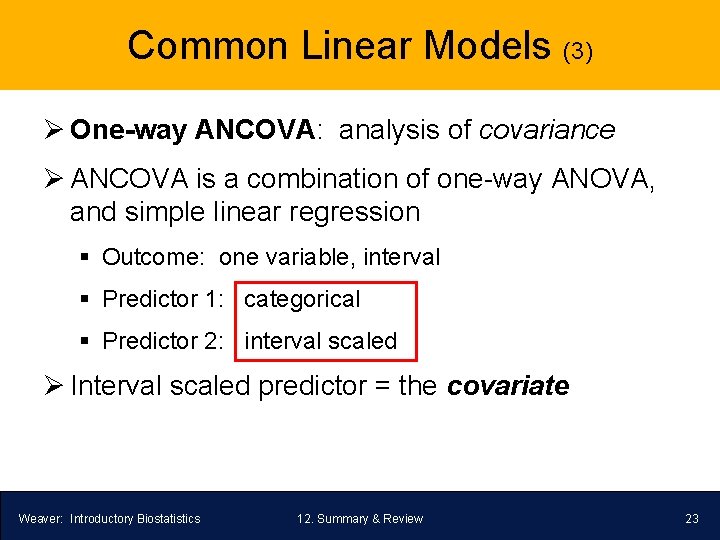
Common Linear Models (3) Ø One-way ANCOVA: analysis of covariance Ø ANCOVA is a combination of one-way ANOVA, and simple linear regression § Outcome: one variable, interval § Predictor 1: categorical § Predictor 2: interval scaled Ø Interval scaled predictor = the covariate Weaver: Introductory Biostatistics 12. Summary & Review 23
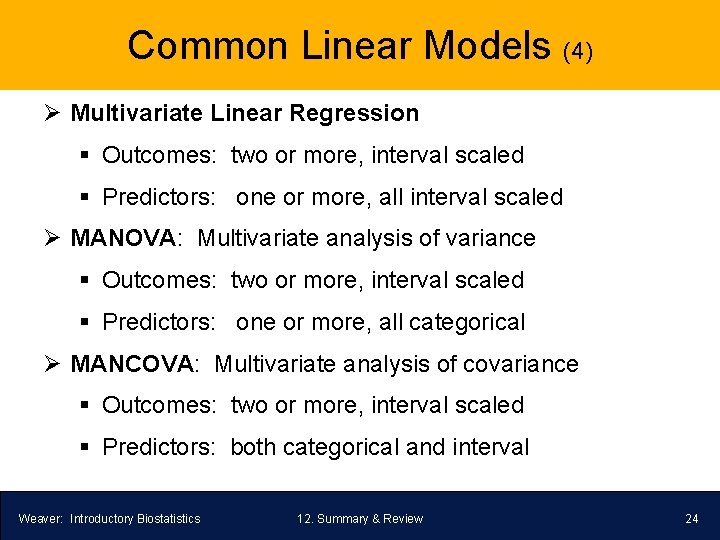
Common Linear Models (4) Ø Multivariate Linear Regression § Outcomes: two or more, interval scaled § Predictors: one or more, all interval scaled Ø MANOVA: Multivariate analysis of variance § Outcomes: two or more, interval scaled § Predictors: one or more, all categorical Ø MANCOVA: Multivariate analysis of covariance § Outcomes: two or more, interval scaled § Predictors: both categorical and interval Weaver: Introductory Biostatistics 12. Summary & Review 24
The Generalized Linear Model Ø General linear model refers to situations where the outcome variable is interval or ratio scaled Ø Other types of outcomes are possible § Binary outcome (died/survived) § Time to event (i. e. , survival analysis), etc. Ø Generalized linear model is used to refer to this broader class of models Ø General linear model = generalized linear model with restriction that outcome variable is interval scaled Weaver: Introductory Biostatistics 12. Summary & Review 25
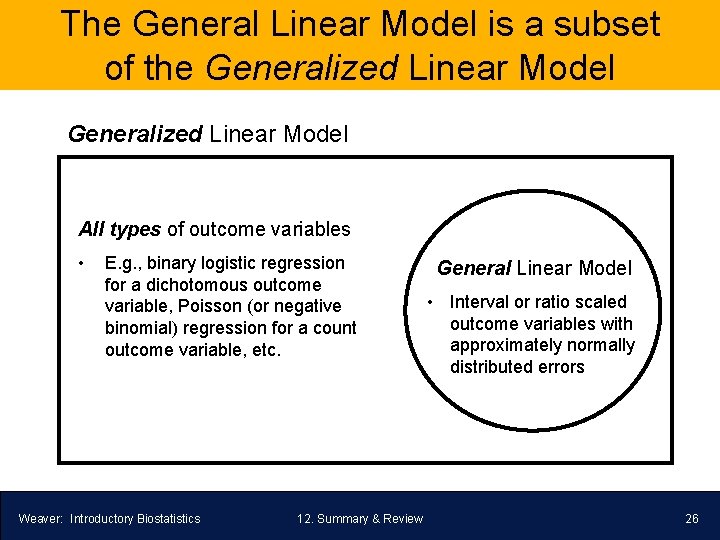
The General Linear Model is a subset of the Generalized Linear Model All types of outcome variables • E. g. , binary logistic regression for a dichotomous outcome variable, Poisson (or negative binomial) regression for a count outcome variable, etc. Weaver: Introductory Biostatistics 12. Summary & Review General Linear Model • Interval or ratio scaled outcome variables with approximately normally distributed errors 26
If only there was a Biostats II course! So in other words, this course has been very introductory, and there is an awful lot more that we could still learn about the wonderful world of biostatistics? Yes! That is correct! Weaver: Introductory Biostatistics 12. Summary & Review 27
Okay…it’s over! Time to wake up! Any Questions? bweaver@lakeheadu. ca Weaver: Introductory Biostatistics 12. Summary & Review 28
- Slides: 28