
Introduction WSP Alignment Process The Work Style Patterns
![Introduction Work. Style Orientation Definitions — [W/T] Worker/TASK— identifies directly with the Product or](https://slidetodoc.com/presentation_image_h2/08686e1fe57e1e7f736f49a33bac3663/image-21.jpg "Introduction Work. Style Orientation Definitions — [W/T] Worker/TASK— identifies directly with the Product or")
- Slides: 45
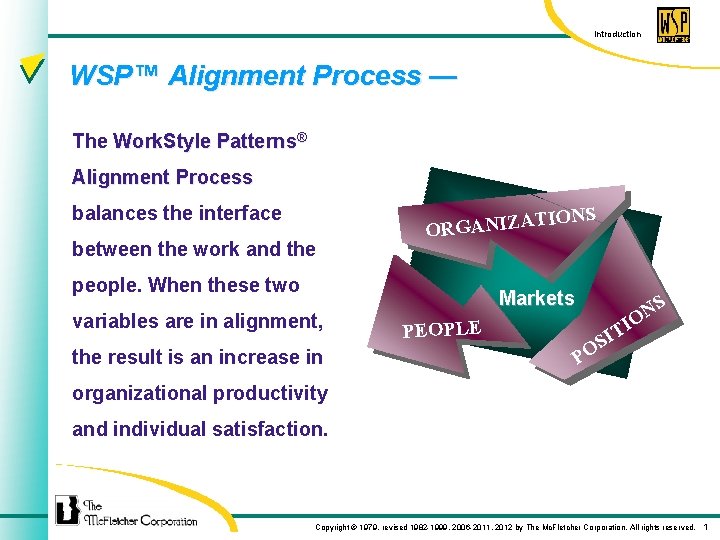
Introduction WSP™ Alignment Process — The Work. Style Patterns® Alignment Process balances the interface between the work and the TI ORGANIZA Markets people. When these two variables are in alignment, the result is an increase in ONS PEOPLE S N O I T SI PO organizational productivity and individual satisfaction. Copyright © 1979, revised 1982 -1999, 2006 -2011, 2012 by The Mc. Fletcher Corporation. All rights reserved. 1
Introduction WSP™ Inventories Administration — PURPOSE Information Sharing — Copyright © 1979, revised 1982 -1999, 2006 -2011, 2012 by The Mc. Fletcher Corporation. All rights reserved. 2
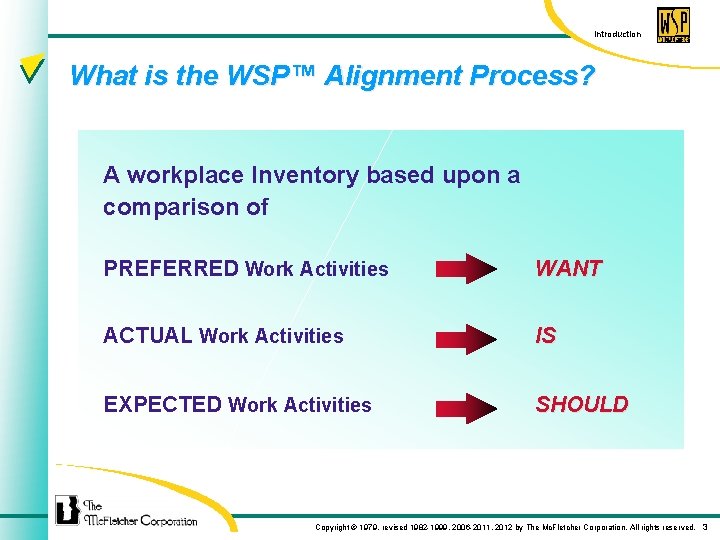
Introduction What is the WSP™ Alignment Process? A workplace Inventory based upon a comparison of PREFERRED Work Activities WANT ACTUAL Work Activities IS EXPECTED Work Activities SHOULD Copyright © 1979, revised 1982 -1999, 2006 -2011, 2012 by The Mc. Fletcher Corporation. All rights reserved. 3
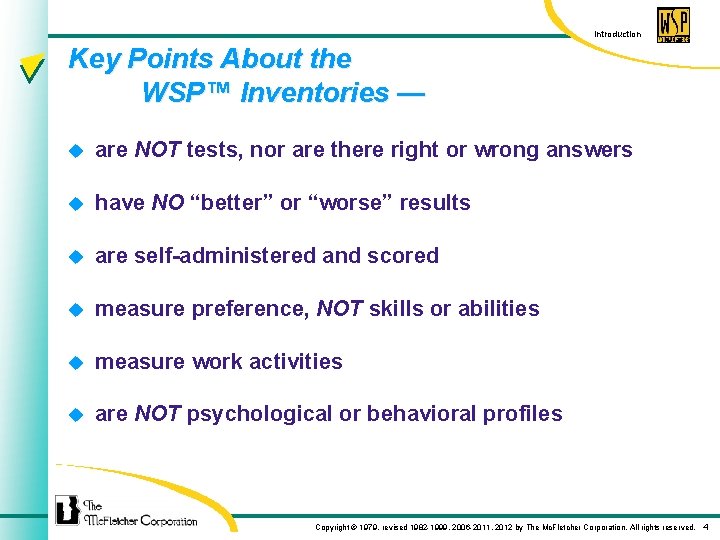
Introduction Key Points About the WSP™ Inventories — are NOT tests, nor are there right or wrong answers have NO “better” or “worse” results are self-administered and scored measure preference, NOT skills or abilities measure work activities are NOT psychological or behavioral profiles Copyright © 1979, revised 1982 -1999, 2006 -2011, 2012 by The Mc. Fletcher Corporation. All rights reserved. 4
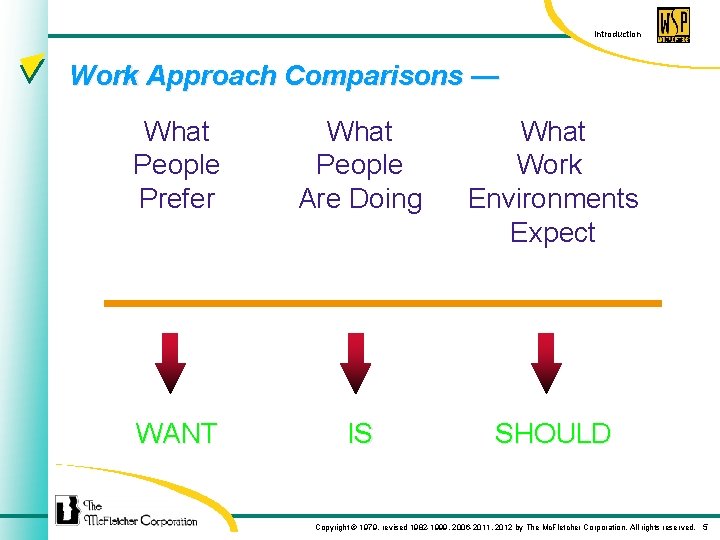
Introduction Work Approach Comparisons — What People Prefer What People Are Doing What Work Environments Expect WANT IS SHOULD Copyright © 1979, revised 1982 -1999, 2006 -2011, 2012 by The Mc. Fletcher Corporation. All rights reserved. 5
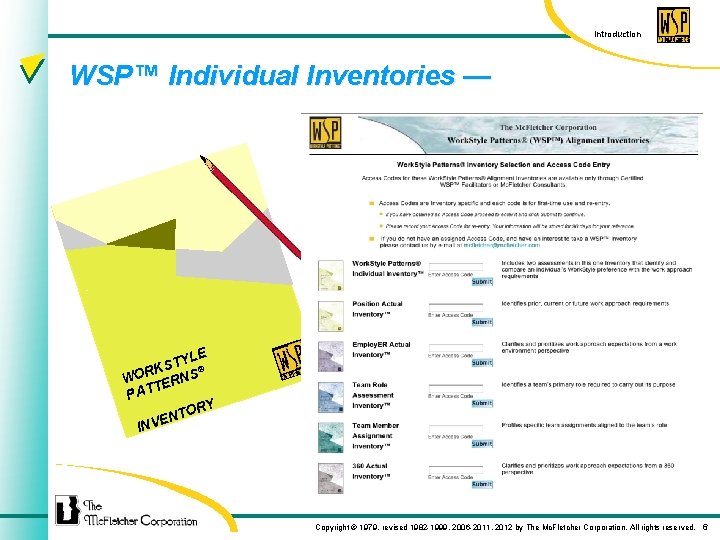
Introduction WSP™ Individual Inventories — YLE T S ® RK WO ERNS T PAT ORY T N E INV Copyright © 1979, revised 1982 -1999, 2006 -2011, 2012 by The Mc. Fletcher Corporation. All rights reserved. 6
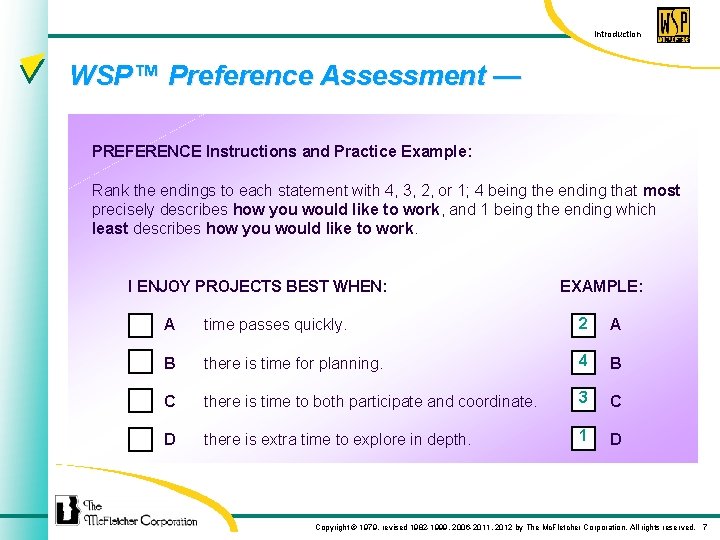
Introduction WSP™ Preference Assessment — PREFERENCE Instructions and Practice Example: Rank the endings to each statement with 4, 3, 2, or 1; 4 being the ending that most precisely describes how you would like to work, and 1 being the ending which least describes how you would like to work. I ENJOY PROJECTS BEST WHEN: EXAMPLE: A time passes quickly. 2 A B there is time for planning. 4 B C there is time to both participate and coordinate. 3 C D there is extra time to explore in depth. 1 D Copyright © 1979, revised 1982 -1999, 2006 -2011, 2012 by The Mc. Fletcher Corporation. All rights reserved. 7
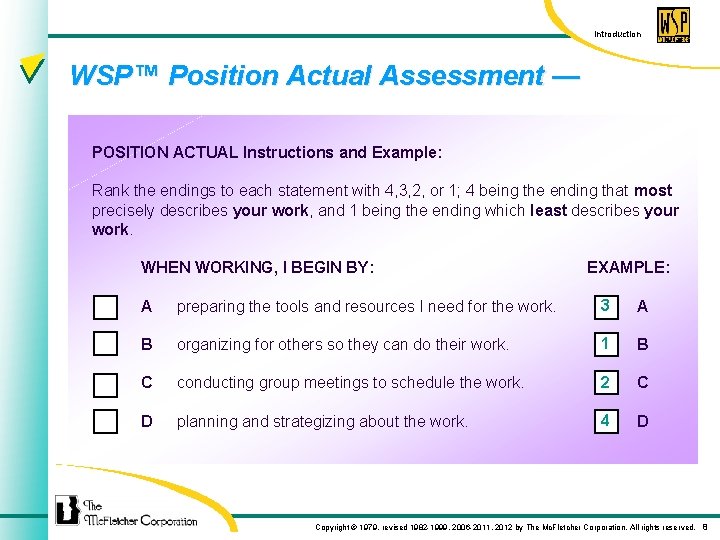
Introduction WSP™ Position Actual Assessment — POSITION ACTUAL Instructions and Example: Rank the endings to each statement with 4, 3, 2, or 1; 4 being the ending that most precisely describes your work, and 1 being the ending which least describes your work. WHEN WORKING, I BEGIN BY: EXAMPLE: A preparing the tools and resources I need for the work. 3 A B organizing for others so they can do their work. 1 B C conducting group meetings to schedule the work. 2 C D planning and strategizing about the work. 4 D Copyright © 1979, revised 1982 -1999, 2006 -2011, 2012 by The Mc. Fletcher Corporation. All rights reserved. 8
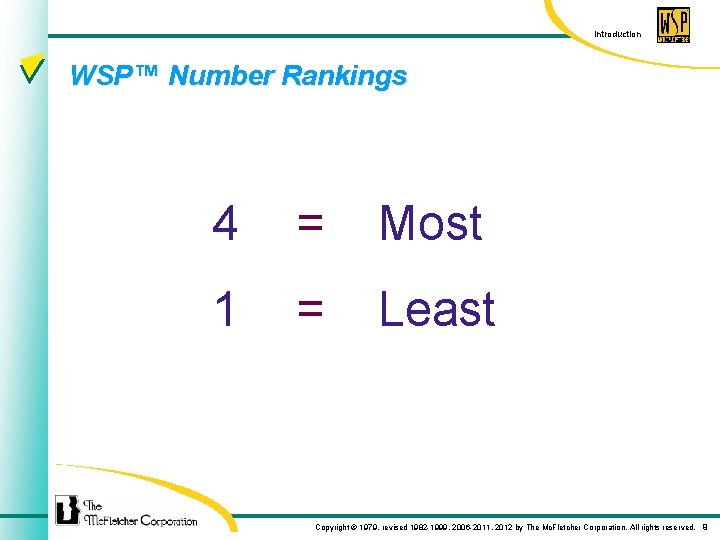
Introduction WSP™ Number Rankings 4 = Most 1 = Least Copyright © 1979, revised 1982 -1999, 2006 -2011, 2012 by The Mc. Fletcher Corporation. All rights reserved. 9
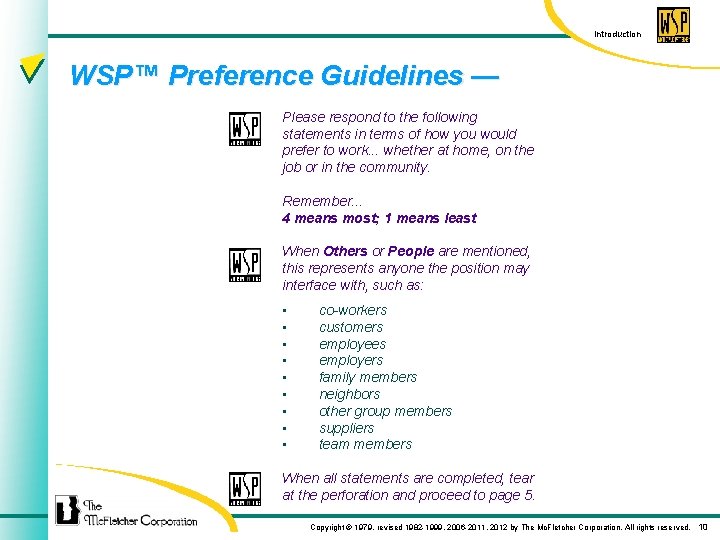
Introduction WSP™ Preference Guidelines — Please respond to the following statements in terms of how you would prefer to work. . . whether at home, on the job or in the community. Remember. . . 4 means most; 1 means least When Others or People are mentioned, this represents anyone the position may interface with, such as: • • • co-workers customers employees employers family members neighbors other group members suppliers team members When all statements are completed, tear at the perforation and proceed to page 5. Copyright © 1979, revised 1982 -1999, 2006 -2011, 2012 by The Mc. Fletcher Corporation. All rights reserved. 10
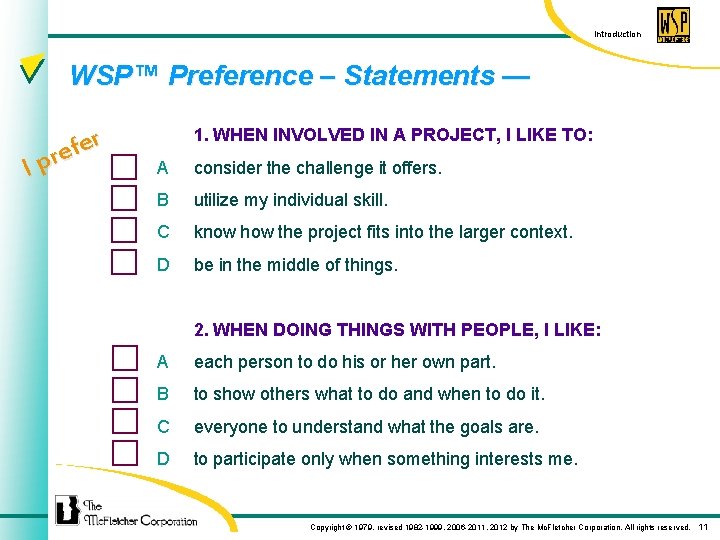
Introduction WSP™ Preference – Statements — r e f e r p I 1. WHEN INVOLVED IN A PROJECT, I LIKE TO: A consider the challenge it offers. B utilize my individual skill. C know how the project fits into the larger context. D be in the middle of things. 2. WHEN DOING THINGS WITH PEOPLE, I LIKE: A each person to do his or her own part. B to show others what to do and when to do it. C everyone to understand what the goals are. D to participate only when something interests me. Copyright © 1979, revised 1982 -1999, 2006 -2011, 2012 by The Mc. Fletcher Corporation. All rights reserved. 11
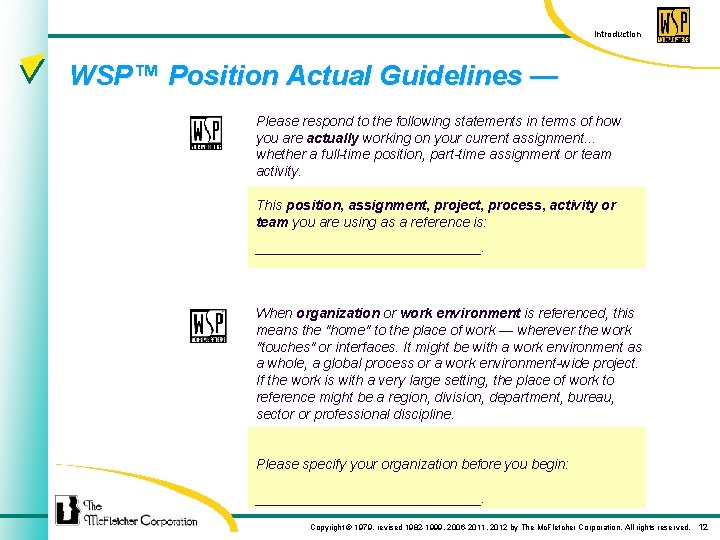
Introduction WSP™ Position Actual Guidelines — Please respond to the following statements in terms of how you are actually working on your current assignment. . . whether a full-time position, part-time assignment or team activity. This position, assignment, project, process, activity or team you are using as a reference is: _______________. When organization or work environment is referenced, this means the "home" to the place of work — wherever the work "touches" or interfaces. It might be with a work environment as a whole, a global process or a work environment-wide project. If the work is with a very large setting, the place of work to reference might be a region, division, department, bureau, sector or professional discipline. Please specify your organization before you begin: _______________. Copyright © 1979, revised 1982 -1999, 2006 -2011, 2012 by The Mc. Fletcher Corporation. All rights reserved. 12
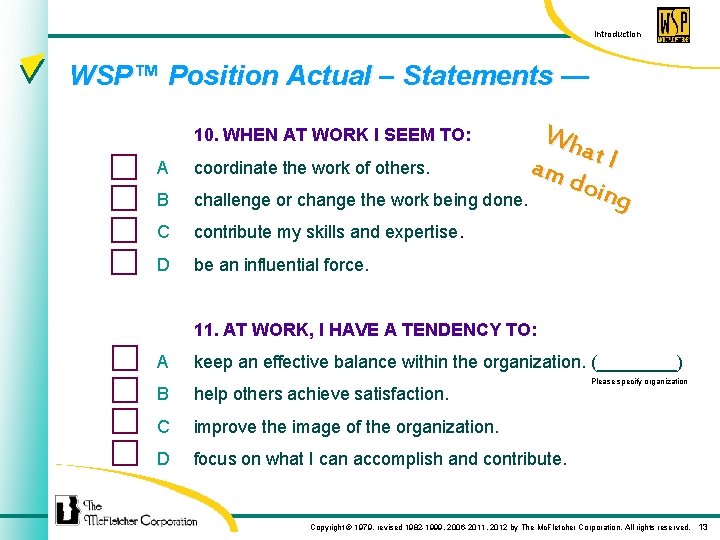
Introduction WSP™ Position Actual – Statements — B Wh at I am coordinate the work of others. doin g challenge or change the work being done. C contribute my skills and expertise. D be an influential force. 10. WHEN AT WORK I SEEM TO: A 11. AT WORK, I HAVE A TENDENCY TO: A keep an effective balance within the organization. (____) B help others achieve satisfaction. C improve the image of the organization. D focus on what I can accomplish and contribute. Please specify organization Copyright © 1979, revised 1982 -1999, 2006 -2011, 2012 by The Mc. Fletcher Corporation. All rights reserved. 13
WSP™ Score Sheet — Introduction Copyright © 1979, revised 1982 -1999, 2006 -2011, 2012 by The Mc. Fletcher Corporation. All rights reserved. 14
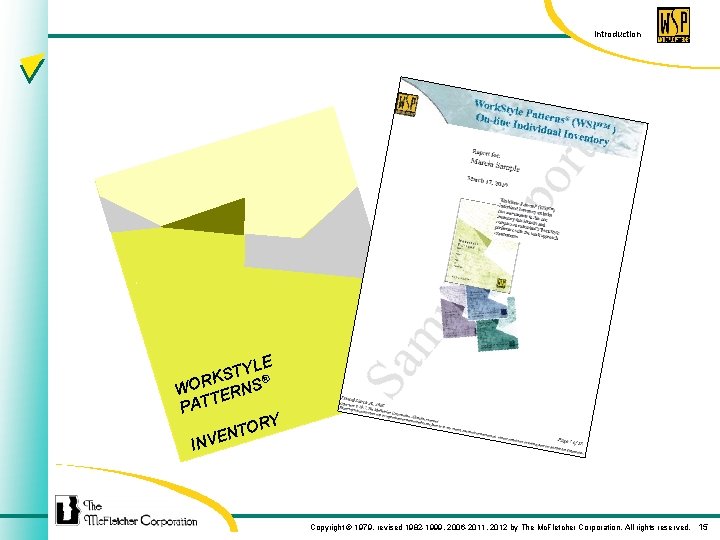
Introduction YLE T S ® RK WO ERNS T PAT RY O T N INVE Copyright © 1979, revised 1982 -1999, 2006 -2011, 2012 by The Mc. Fletcher Corporation. All rights reserved. 15
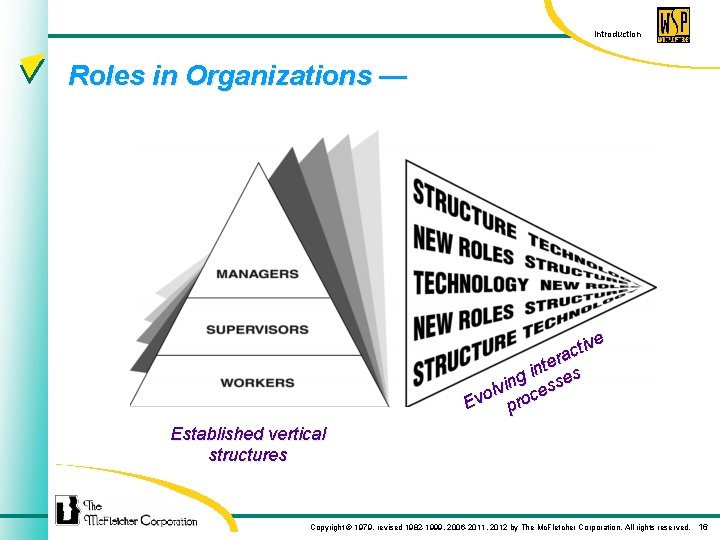
Introduction Roles in Organizations — ive t c ra e t g in sses n i olv roce v E p Established vertical structures Copyright © 1979, revised 1982 -1999, 2006 -2011, 2012 by The Mc. Fletcher Corporation. All rights reserved. 16
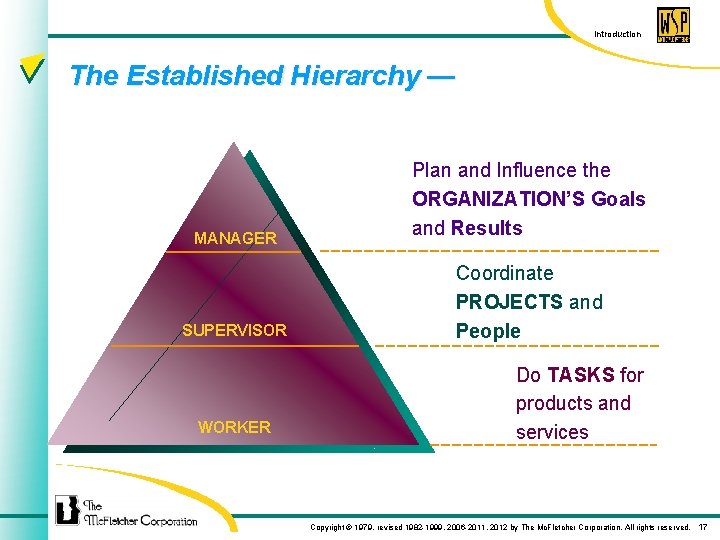
Introduction The Established Hierarchy — MANAGER Plan and Influence the ORGANIZATION’S Goals and Results SUPERVISOR Coordinate PROJECTS and People WORKER Do TASKS for products and services Copyright © 1979, revised 1982 -1999, 2006 -2011, 2012 by The Mc. Fletcher Corporation. All rights reserved. 17
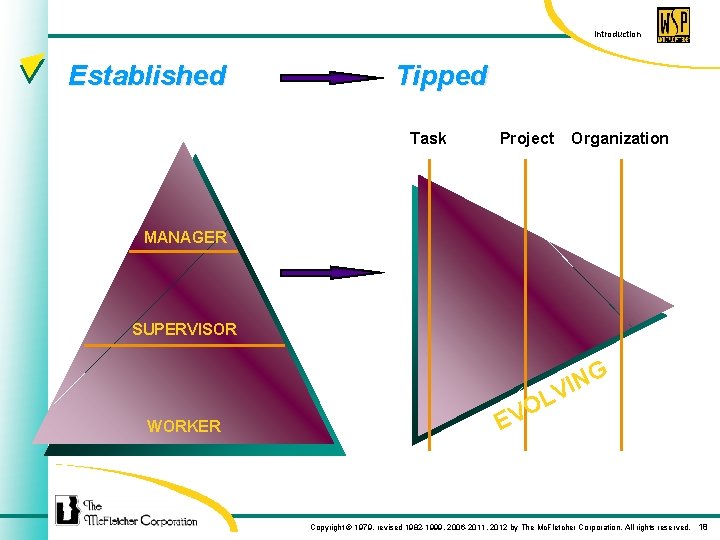
Introduction Established Tipped Task Project Organization MANAGER SUPERVISOR WORKER EV G N I V L O Copyright © 1979, revised 1982 -1999, 2006 -2011, 2012 by The Mc. Fletcher Corporation. All rights reserved. 18
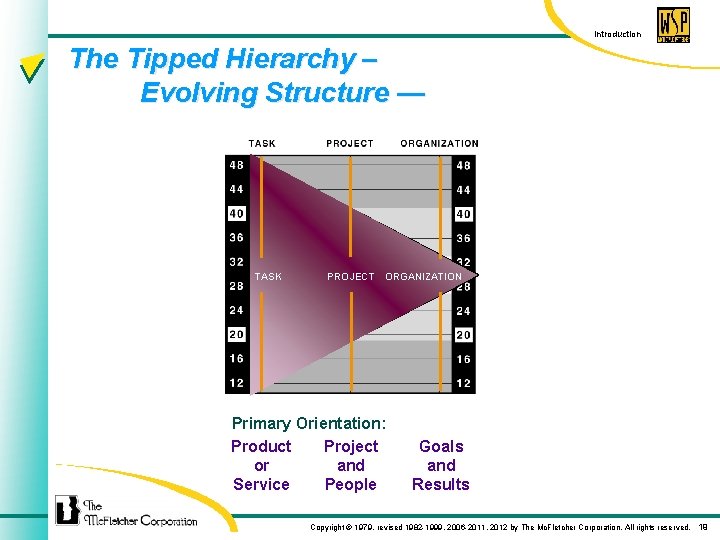
Introduction The Tipped Hierarchy – Evolving Structure — TASK PROJECT ORGANIZATION Primary Orientation: Product Project or and Service People Goals and Results Copyright © 1979, revised 1982 -1999, 2006 -2011, 2012 by The Mc. Fletcher Corporation. All rights reserved. 19
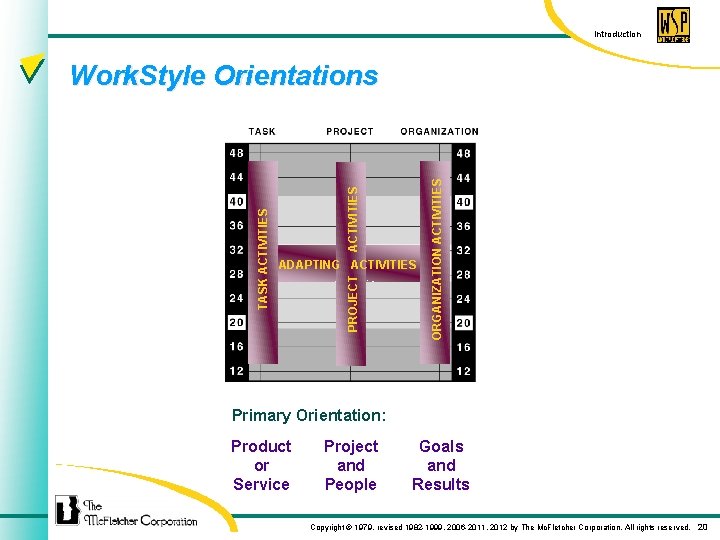
Introduction ORGANIZATION ACTIVITIES ADAPTING ACTIVITIES PROJECT TASK ACTIVITIES Work. Style Orientations Primary Orientation: Product or Service Project and People Goals and Results Copyright © 1979, revised 1982 -1999, 2006 -2011, 2012 by The Mc. Fletcher Corporation. All rights reserved. 20
Introduction Work. Style Orientation Definitions — [W/T] Worker/TASK— identifies directly with the Product or Service; performs specific work activities — work to be performed through individual contribution [S/P] [M/O] [ADAPTING] Supervisor/PROJECT— identifies with the Project and its People; coordinates work activities — work to be implemented for performance of others through systems / coordination / interface Manager/ORGANIZATION — identifies with the Goal and Results; initiates organizational activities — work for performance of the work environment through influence / impact / outcomes ADAPTING ― a combined Orientation that balances activities with all three W/T, S/P and M/O Orientations — work to be performed simultaneously through own performance, implementation for performance of others and influence for performance of the work environment Copyright © 1979, revised 1982 -1999, 2006 -2011, 2012 by The Mc. Fletcher Corporation. All rights reserved. 21
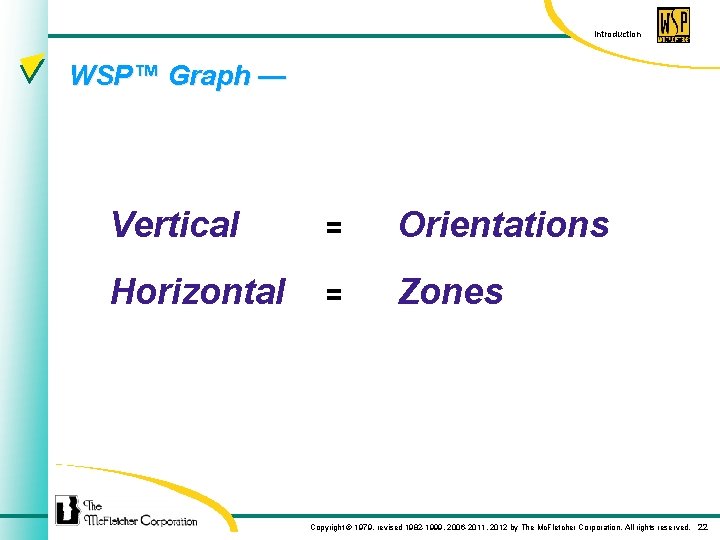
Introduction WSP™ Graph — Vertical = Orientations Horizontal = Zones Copyright © 1979, revised 1982 -1999, 2006 -2011, 2012 by The Mc. Fletcher Corporation. All rights reserved. 22
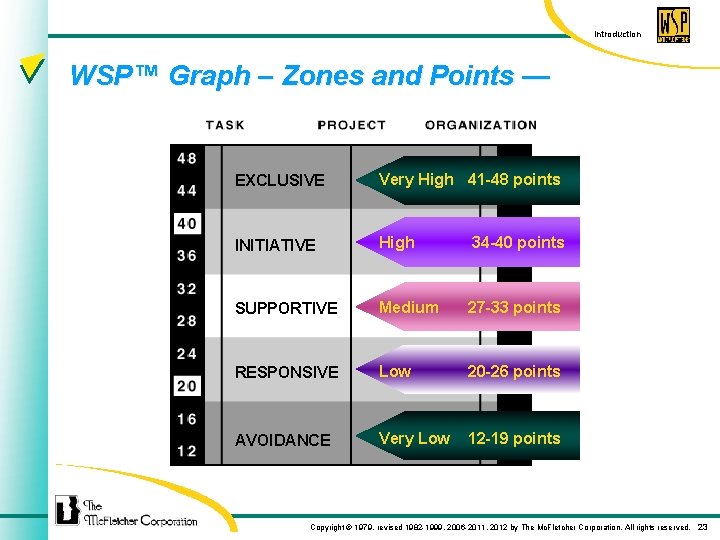
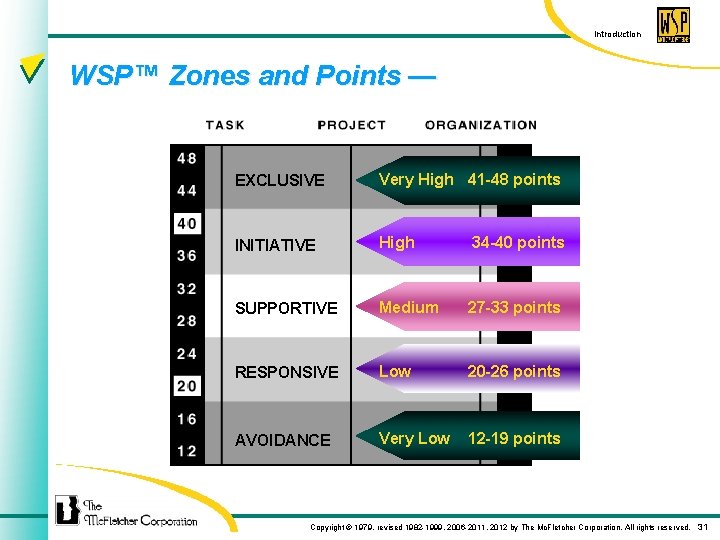
Introduction WSP™ Graph – Zones and Points — EXCLUSIVE Very High 41 -48 points INITIATIVE High 34 -40 points SUPPORTIVE Medium 27 -33 points RESPONSIVE Low 20 -26 points AVOIDANCE Very Low 12 -19 points Copyright © 1979, revised 1982 -1999, 2006 -2011, 2012 by The Mc. Fletcher Corporation. All rights reserved. 23
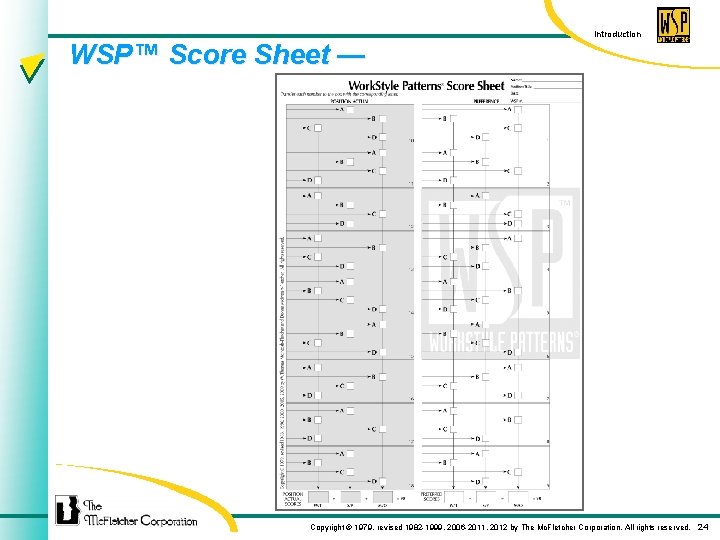
WSP™ Score Sheet — Introduction Copyright © 1979, revised 1982 -1999, 2006 -2011, 2012 by The Mc. Fletcher Corporation. All rights reserved. 24
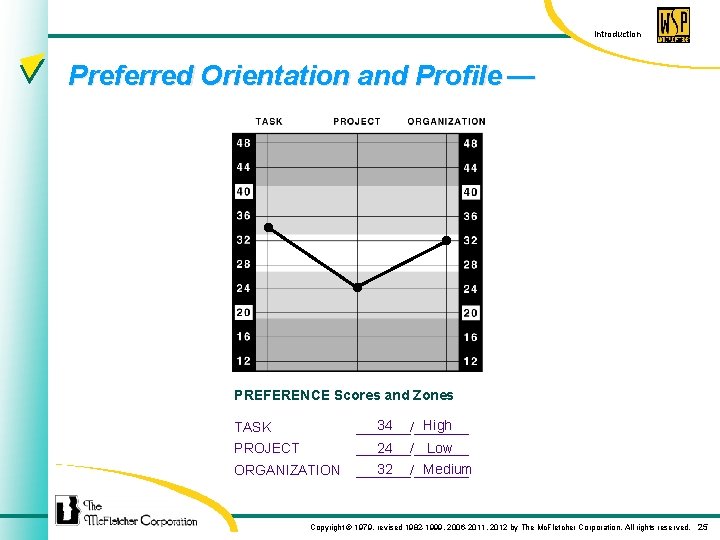
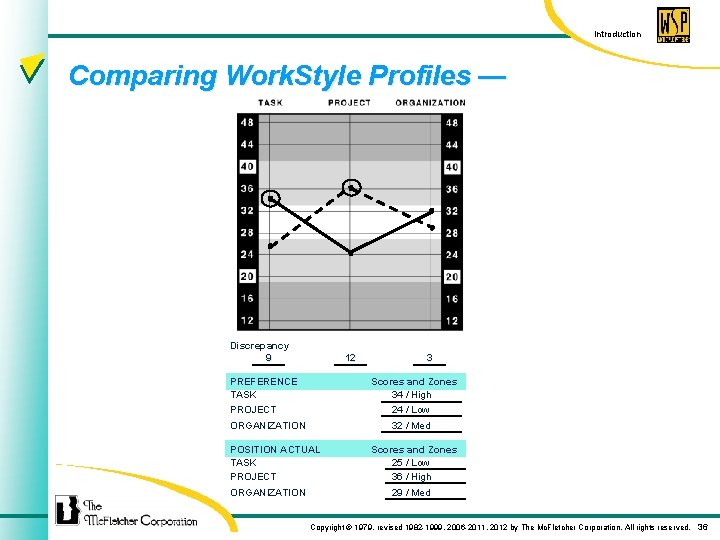
Introduction Preferred Orientation and Profile — PREFERENCE Scores and Zones TASK 34 High _______/_______ PROJECT 24 Low _______/_______ 32 Medium _______/_______ ORGANIZATION Copyright © 1979, revised 1982 -1999, 2006 -2011, 2012 by The Mc. Fletcher Corporation. All rights reserved. 25
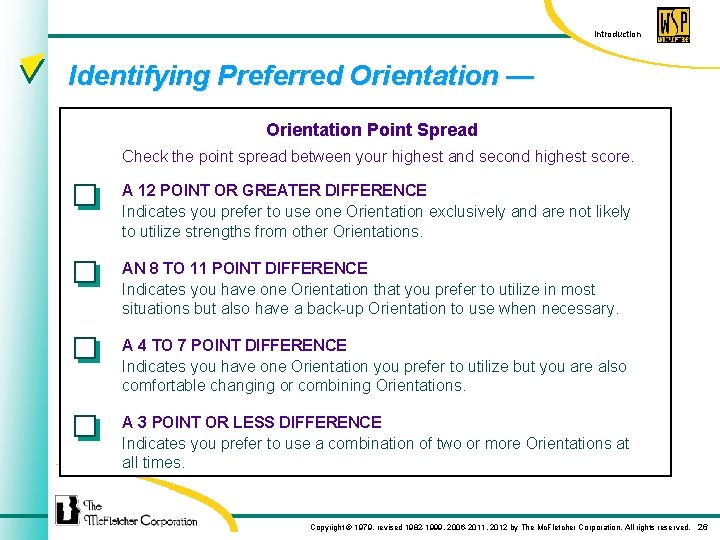
Introduction Identifying Preferred Orientation — Orientation Point Spread Check the point spread between your highest and second highest score. A 12 POINT OR GREATER DIFFERENCE Indicates you prefer to use one Orientation exclusively and are not likely to utilize strengths from other Orientations. AN 8 TO 11 POINT DIFFERENCE Indicates you have one Orientation that you prefer to utilize in most situations but also have a back-up Orientation to use when necessary. A 4 TO 7 POINT DIFFERENCE Indicates you have one Orientation you prefer to utilize but you are also comfortable changing or combining Orientations. A 3 POINT OR LESS DIFFERENCE Indicates you prefer to use a combination of two or more Orientations at all times. Copyright © 1979, revised 1982 -1999, 2006 -2011, 2012 by The Mc. Fletcher Corporation. All rights reserved. 26
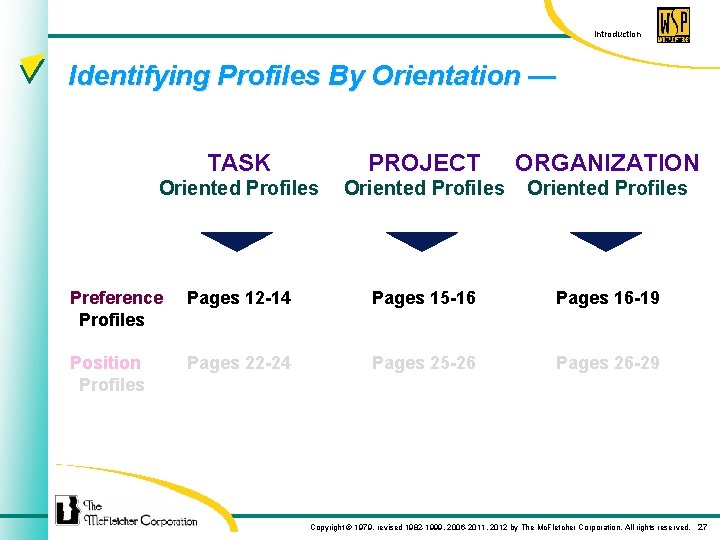
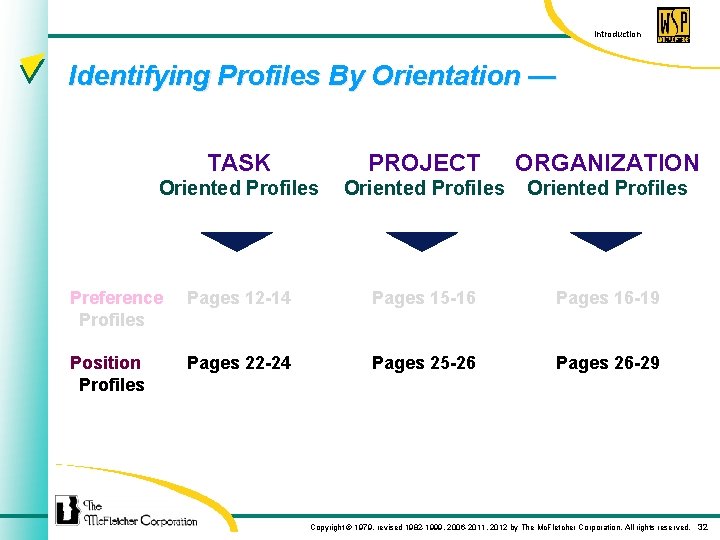
Introduction Identifying Profiles By Orientation — TASK PROJECT ORGANIZATION Oriented Profiles Preference Profiles Pages 12 -14 Pages 15 -16 Pages 16 -19 Position Profiles Pages 22 -24 Pages 25 -26 Pages 26 -29 Copyright © 1979, revised 1982 -1999, 2006 -2011, 2012 by The Mc. Fletcher Corporation. All rights reserved. 27
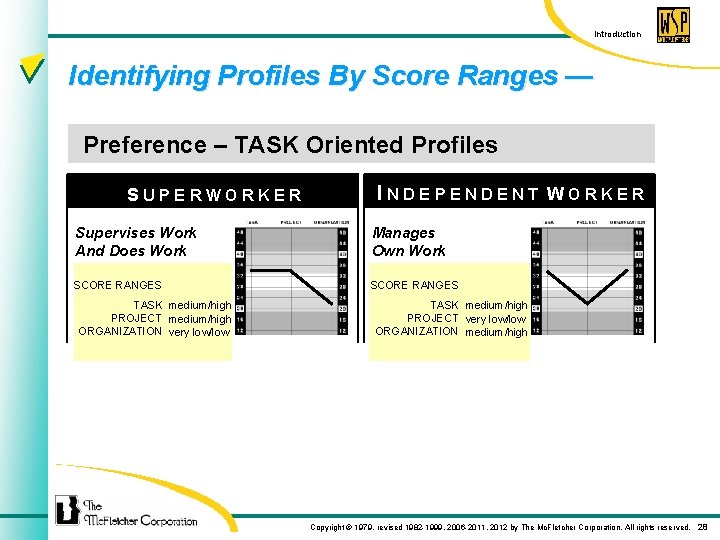
Introduction Identifying Profiles By Score Ranges — Preference – TASK Oriented Profiles SUPERWORKER INDEPENDENT WORKER Supervises Work And Does Work Manages Own Work SCORE RANGES TASK medium/high PROJECT medium/high ORGANIZATION very low/low TASK medium/high PROJECT very low/low ORGANIZATION medium/high Copyright © 1979, revised 1982 -1999, 2006 -2011, 2012 by The Mc. Fletcher Corporation. All rights reserved. 28
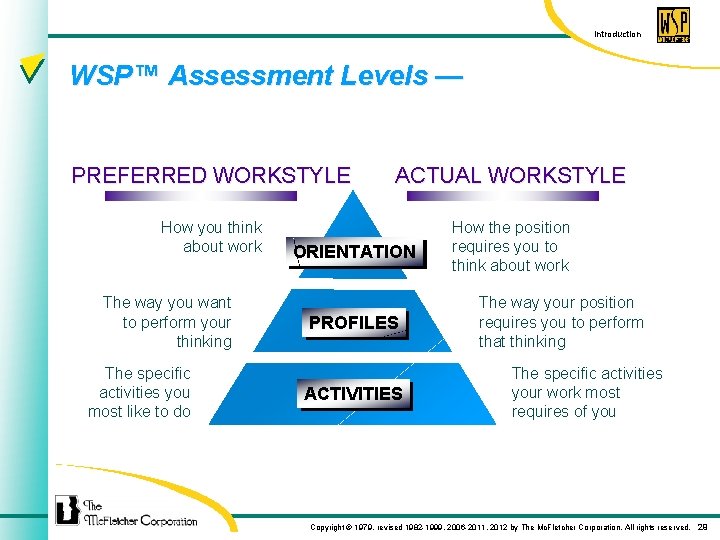
Introduction WSP™ Assessment Levels — PREFERRED WORKSTYLE ACTUAL WORKSTYLE How you think about work How the position requires you to think about work The way you want to perform your thinking The specific activities you most like to do ORIENTATION PROFILES ACTIVITIES The way your position requires you to perform that thinking The specific activities your work most requires of you Copyright © 1979, revised 1982 -1999, 2006 -2011, 2012 by The Mc. Fletcher Corporation. All rights reserved. 29
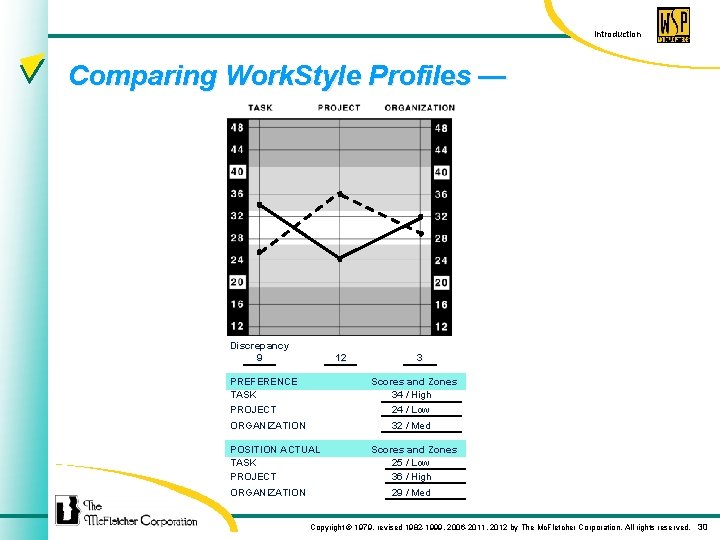
Introduction Comparing Work. Style Profiles — Discrepancy 9 12 PREFERENCE TASK PROJECT Scores and Zones 34 / High 24 / Low ORGANIZATION 32 / Med POSITION ACTUAL TASK PROJECT ORGANIZATION 3 Scores and Zones 25 / Low 36 / High 29 / Med Copyright © 1979, revised 1982 -1999, 2006 -2011, 2012 by The Mc. Fletcher Corporation. All rights reserved. 30
Introduction WSP™ Zones and Points — EXCLUSIVE Very High 41 -48 points INITIATIVE High 34 -40 points SUPPORTIVE Medium 27 -33 points RESPONSIVE Low 20 -26 points AVOIDANCE Very Low 12 -19 points Copyright © 1979, revised 1982 -1999, 2006 -2011, 2012 by The Mc. Fletcher Corporation. All rights reserved. 31
Introduction Identifying Profiles By Orientation — TASK PROJECT ORGANIZATION Oriented Profiles Preference Profiles Pages 12 -14 Pages 15 -16 Pages 16 -19 Position Profiles Pages 22 -24 Pages 25 -26 Pages 26 -29 Copyright © 1979, revised 1982 -1999, 2006 -2011, 2012 by The Mc. Fletcher Corporation. All rights reserved. 32
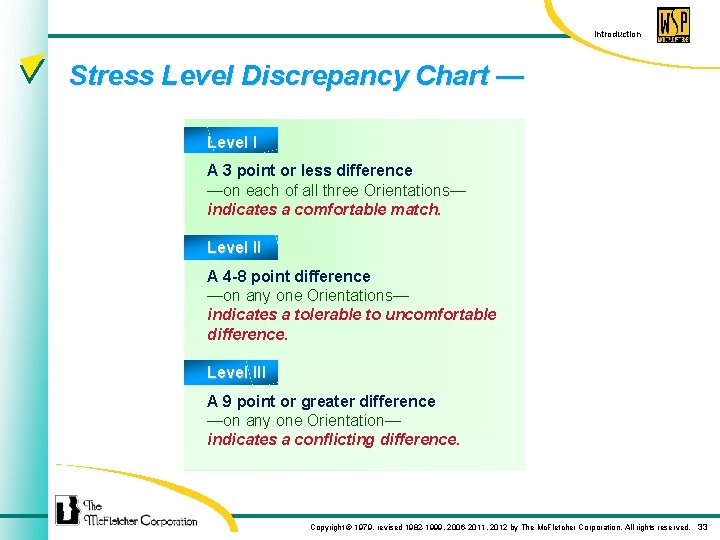
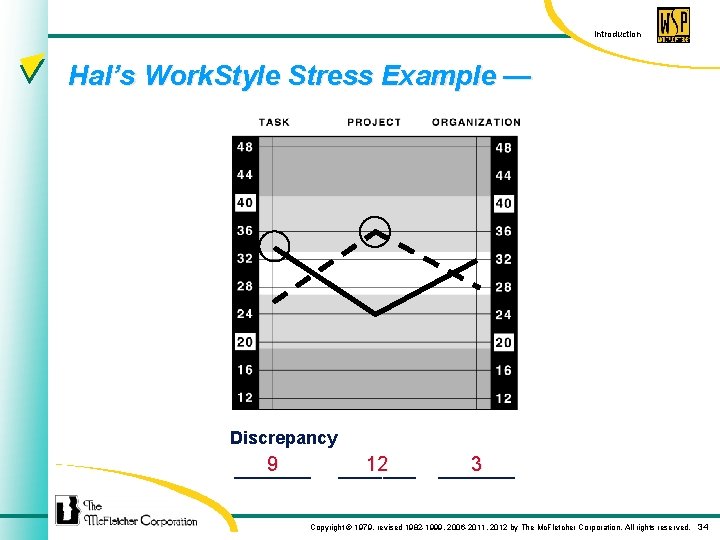
Introduction Stress Level Discrepancy Chart — Level I A 3 point or less difference —on each of all three Orientations— indicates a comfortable match. Level II A 4 -8 point difference —on any one Orientations— indicates a tolerable to uncomfortable difference. Level III A 9 point or greater difference —on any one Orientation— indicates a conflicting difference. Copyright © 1979, revised 1982 -1999, 2006 -2011, 2012 by The Mc. Fletcher Corporation. All rights reserved. 33
Introduction Hal’s Work. Style Stress Example — Discrepancy 9 _______ 12 _______ 3 _______ Copyright © 1979, revised 1982 -1999, 2006 -2011, 2012 by The Mc. Fletcher Corporation. All rights reserved. 34
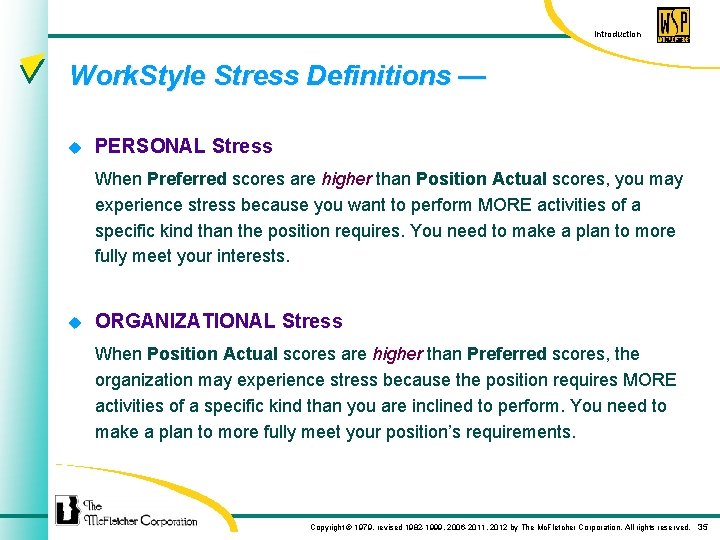
Introduction Work. Style Stress Definitions — PERSONAL Stress When Preferred scores are higher than Position Actual scores, you may experience stress because you want to perform MORE activities of a specific kind than the position requires. You need to make a plan to more fully meet your interests. ORGANIZATIONAL Stress When Position Actual scores are higher than Preferred scores, the organization may experience stress because the position requires MORE activities of a specific kind than you are inclined to perform. You need to make a plan to more fully meet your position’s requirements. Copyright © 1979, revised 1982 -1999, 2006 -2011, 2012 by The Mc. Fletcher Corporation. All rights reserved. 35
Introduction Comparing Work. Style Profiles — Discrepancy 9 12 PREFERENCE TASK PROJECT Scores and Zones 34 / High 24 / Low ORGANIZATION 32 / Med POSITION ACTUAL TASK PROJECT ORGANIZATION 3 Scores and Zones 25 / Low 36 / High 29 / Med Copyright © 1979, revised 1982 -1999, 2006 -2011, 2012 by The Mc. Fletcher Corporation. All rights reserved. 36
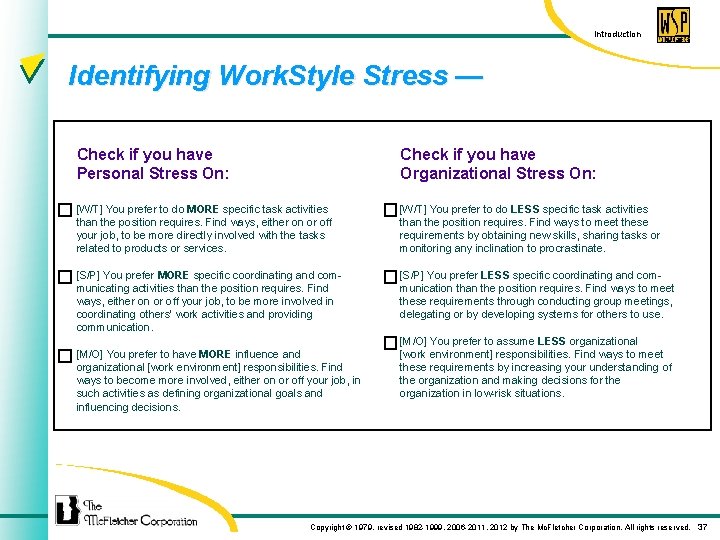
Introduction Identifying Work. Style Stress — Check if you have Personal Stress On: Check if you have Organizational Stress On: [W/T] You prefer to do MORE specific task activities than the position requires. Find ways, either on or off your job, to be more directly involved with the tasks related to products or services. [W/T] You prefer to do LESS specific task activities than the position requires. Find ways to meet these requirements by obtaining new skills, sharing tasks or monitoring any inclination to procrastinate. [S/P] You prefer MORE specific coordinating and communicating activities than the position requires. Find ways, either on or off your job, to be more involved in coordinating others’ work activities and providing communication. [S/P] You prefer LESS specific coordinating and communication than the position requires. Find ways to meet these requirements through conducting group meetings, delegating or by developing systems for others to use. [M/O] You prefer to have MORE influence and organizational [work environment] responsibilities. Find ways to become more involved, either on or off your job, in such activities as defining organizational goals and influencing decisions. [M/O] You prefer to assume LESS organizational [work environment] responsibilities. Find ways to meet these requirements by increasing your understanding of the organization and making decisions for the organization in low-risk situations. Copyright © 1979, revised 1982 -1999, 2006 -2011, 2012 by The Mc. Fletcher Corporation. All rights reserved. 37
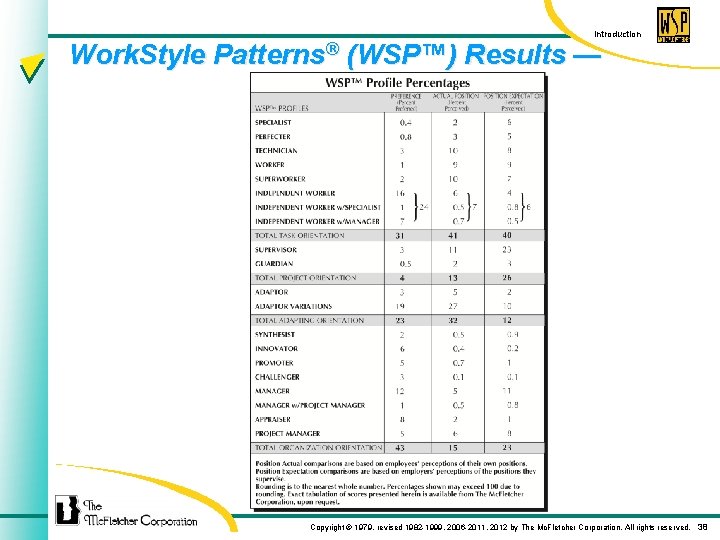
Introduction Work. Style Patterns® (WSP™) Results — Copyright © 1979, revised 1982 -1999, 2006 -2011, 2012 by The Mc. Fletcher Corporation. All rights reserved. 38
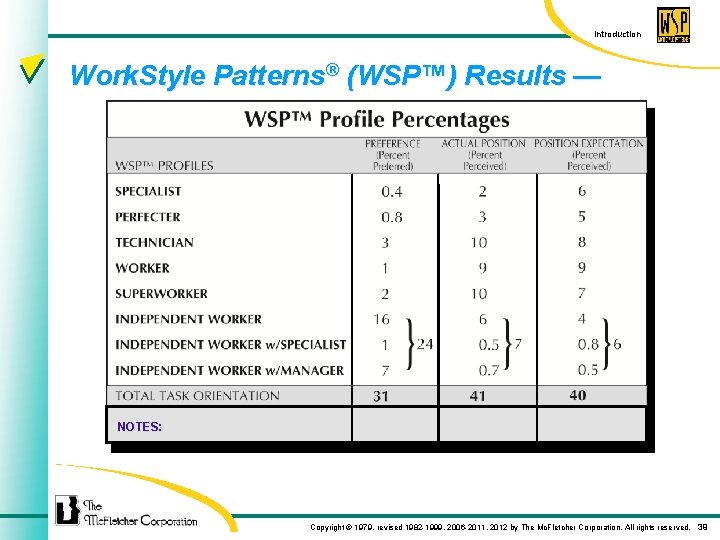
Introduction Work. Style Patterns® (WSP™) Results — NOTES: Copyright © 1979, revised 1982 -1999, 2006 -2011, 2012 by The Mc. Fletcher Corporation. All rights reserved. 39
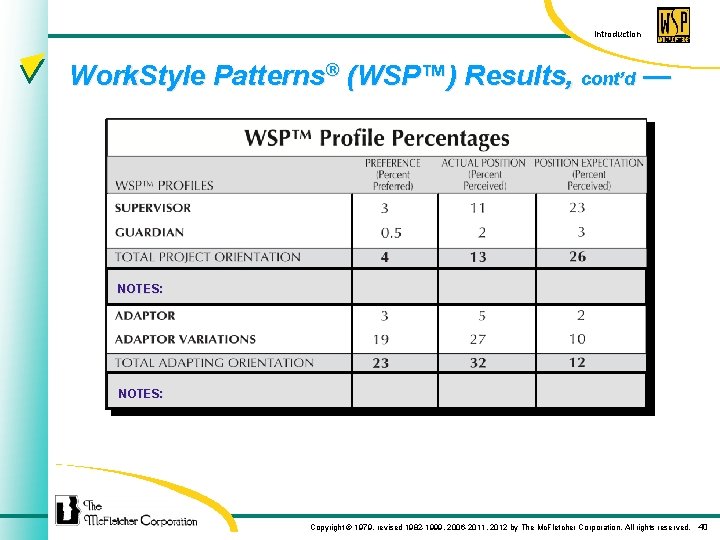
Introduction Work. Style Patterns® (WSP™) Results, cont’d — NOTES: Copyright © 1979, revised 1982 -1999, 2006 -2011, 2012 by The Mc. Fletcher Corporation. All rights reserved. 40
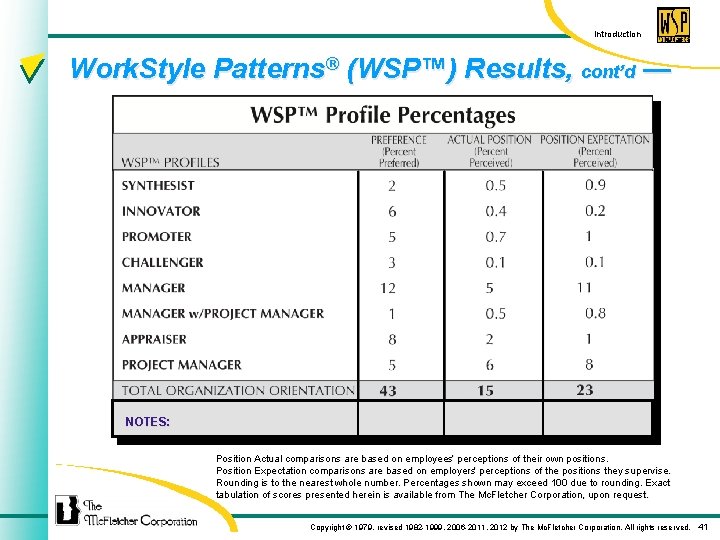
Introduction Work. Style Patterns® (WSP™) Results, cont’d — NOTES: Position Actual comparisons are based on employees’ perceptions of their own positions. Position Expectation comparisons are based on employers’ perceptions of the positions they supervise. Rounding is to the nearest whole number. Percentages shown may exceed 100 due to rounding. Exact tabulation of scores presented herein is available from The Mc. Fletcher Corporation, upon request. Copyright © 1979, revised 1982 -1999, 2006 -2011, 2012 by The Mc. Fletcher Corporation. All rights reserved. 41
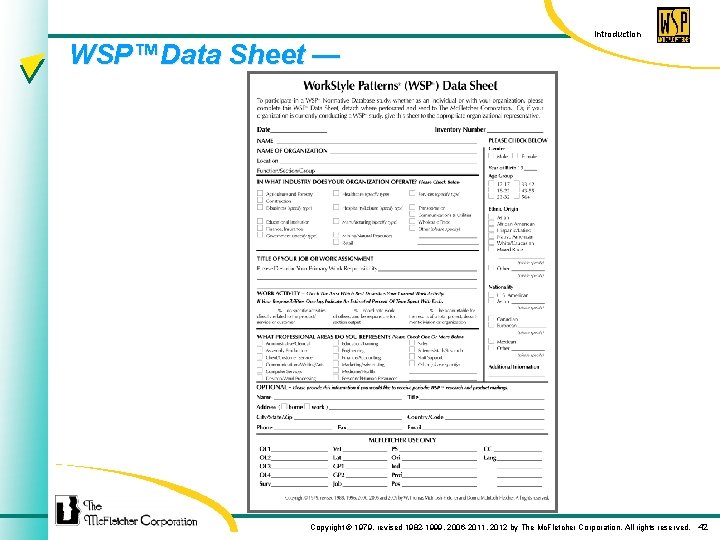
WSP™Data Sheet — Introduction Copyright © 1979, revised 1982 -1999, 2006 -2011, 2012 by The Mc. Fletcher Corporation. All rights reserved. 42
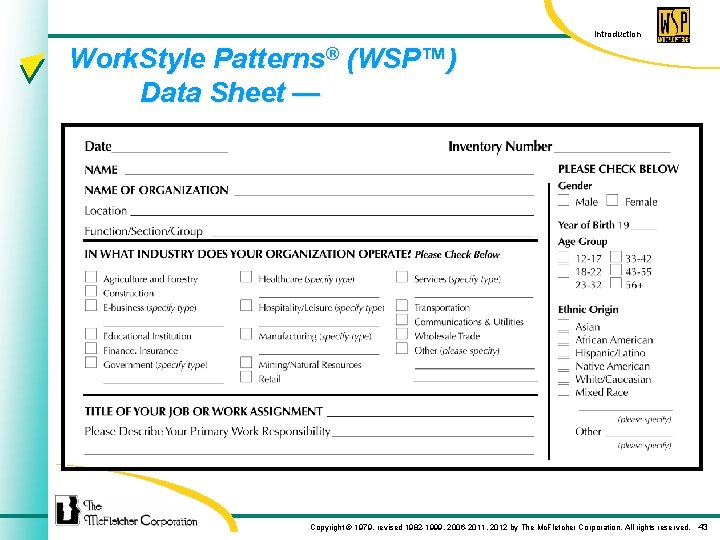
Introduction Work. Style Patterns® (WSP™) Data Sheet — Copyright © 1979, revised 1982 -1999, 2006 -2011, 2012 by The Mc. Fletcher Corporation. All rights reserved. 43
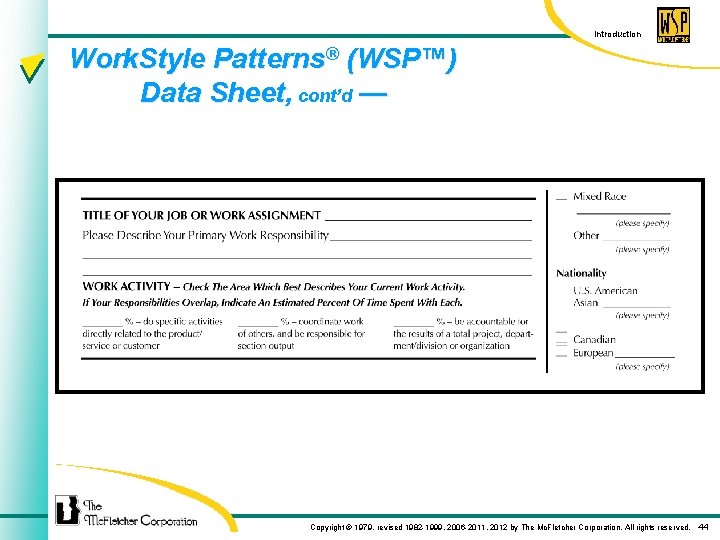
Introduction Work. Style Patterns® (WSP™) Data Sheet, cont’d — Copyright © 1979, revised 1982 -1999, 2006 -2011, 2012 by The Mc. Fletcher Corporation. All rights reserved. 44
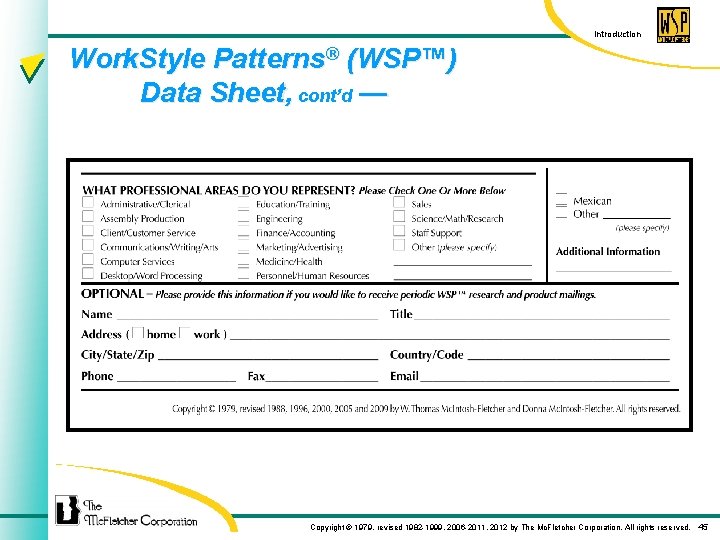
Introduction Work. Style Patterns® (WSP™) Data Sheet, cont’d — Copyright © 1979, revised 1982 -1999, 2006 -2011, 2012 by The Mc. Fletcher Corporation. All rights reserved. 45