
Introduction What is soil What is Soil Soil


- Slides: 30
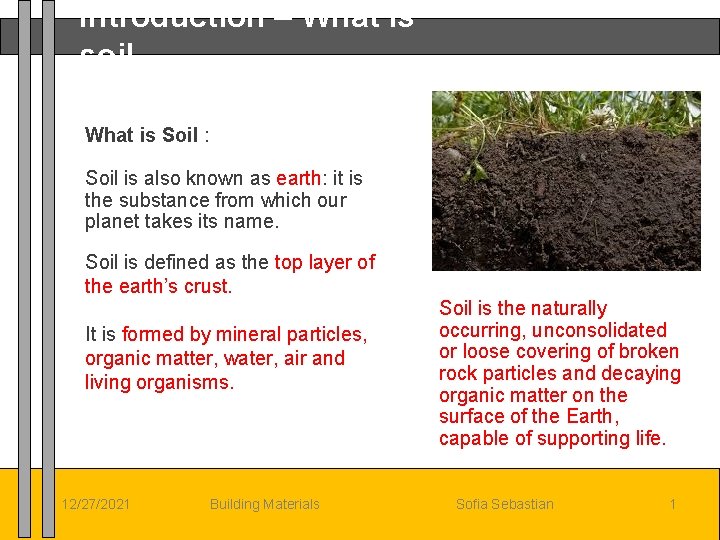
Introduction – What is soil What is Soil : Soil is also known as earth: it is the substance from which our planet takes its name. Soil is defined as the top layer of the earth’s crust. It is formed by mineral particles, organic matter, water, air and living organisms. 12/27/2021 Building Materials Soil is the naturally occurring, unconsolidated or loose covering of broken rock particles and decaying organic matter on the surface of the Earth, capable of supporting life. Sofia Sebastian 1
Soils – 3 state system Soil particles pack loosely, forming a soil structure filled with pore spaces. These pores contain soil solution (liquid) and air (gas). Accordingly, soils are often treated as a three state system (Solid, liquid, and gas). Types of soil 1. Colour 2. Structure 3. Texture 4. Electrical resistivity 12/27/2021 Building Materials Sofia Sebastian 2
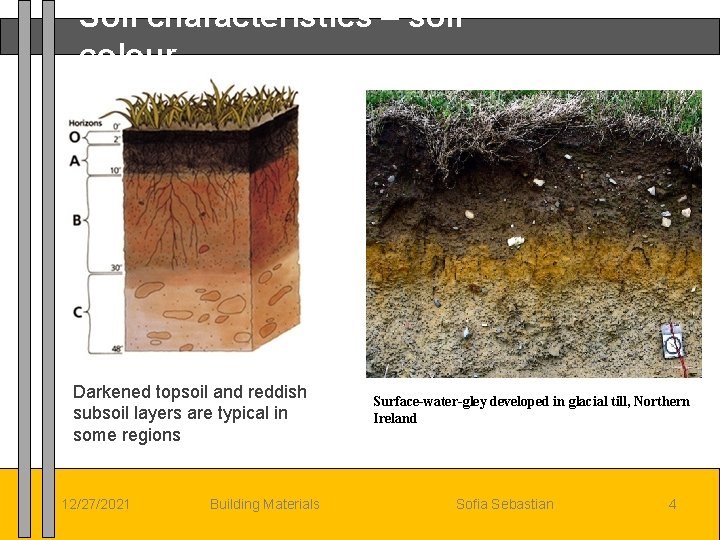
Soil characteristics – soil colour Soil colour is the first impression one has when viewing soil. Soil colour results from chemical and biological weathering. As the primary minerals in materials is weathered, the elements combine into new and colourful compounds: Iron forms secondary minerals with a yellow or red color; organic matter decomposes into brown compounds; and manganese, sulphur and nitrogen can form black soil. 12/27/2021 Building Materials Sofia Sebastian 3
Soil characteristics – soil colour Darkened topsoil and reddish subsoil layers are typical in some regions 12/27/2021 Building Materials Surface-water-gley developed in glacial till, Northern Ireland Sofia Sebastian 4
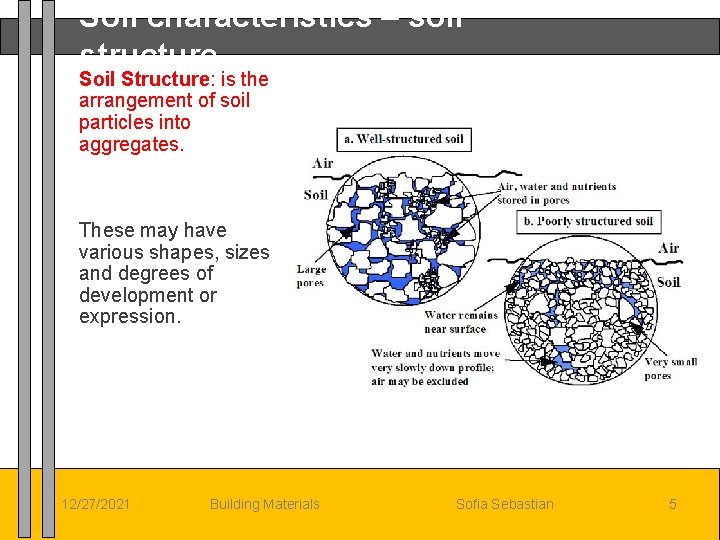
Soil characteristics – soil structure Soil Structure: is the arrangement of soil particles into aggregates. These may have various shapes, sizes and degrees of development or expression. 12/27/2021 Building Materials Sofia Sebastian 5
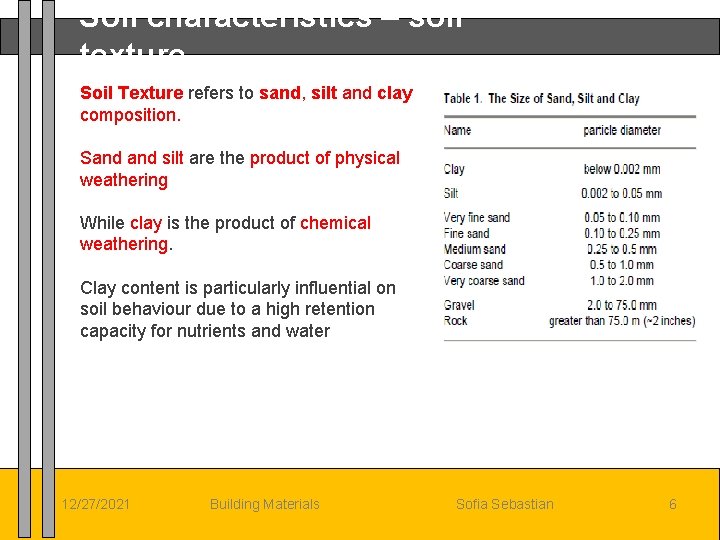
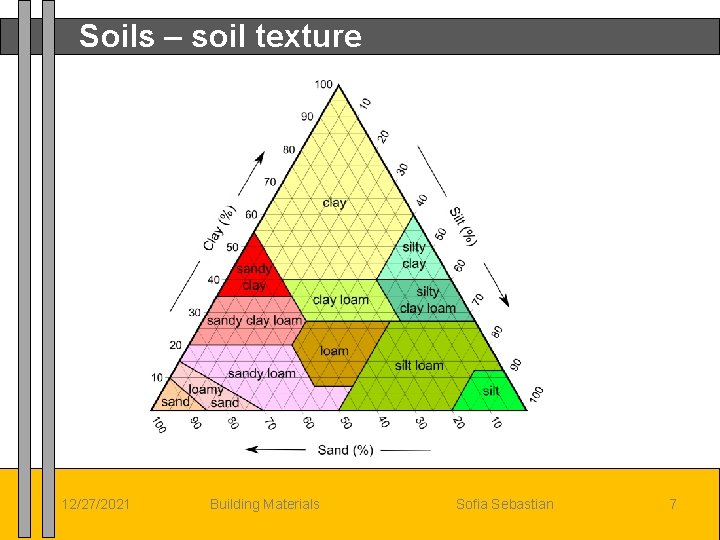
Soil characteristics – soil texture Soil Texture refers to sand, silt and clay composition. Sand silt are the product of physical weathering While clay is the product of chemical weathering. Clay content is particularly influential on soil behaviour due to a high retention capacity for nutrients and water 12/27/2021 Building Materials Sofia Sebastian 6
Soils – soil texture 12/27/2021 Building Materials Sofia Sebastian 7
Soil characteristics – soil electrical resistivity The electrical resistivity of soil can affect the rate of galvanic corrosion of metallic structures in contact with it. Higher moisture content or increased electrolyte concentration can lower the resistivity and thereby increase the rate of corrosion. 12/27/2021 Building Materials Sofia Sebastian 8
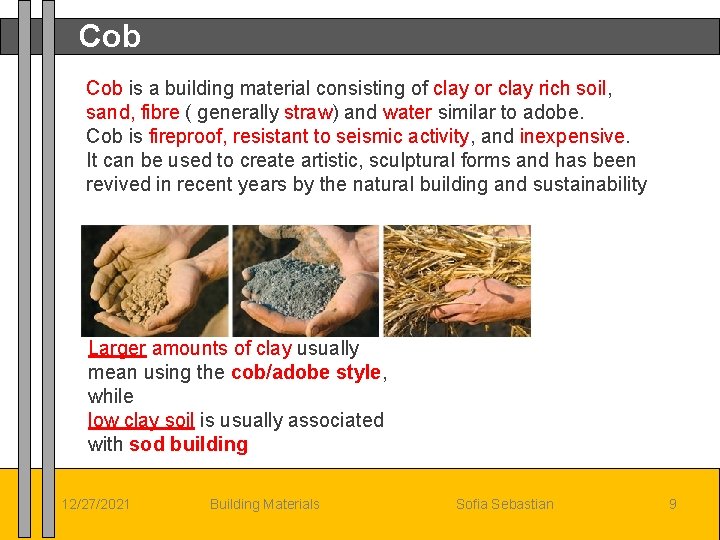
Cob is a building material consisting of clay or clay rich soil, sand, fibre ( generally straw) and water similar to adobe. Cob is fireproof, resistant to seismic activity, and inexpensive. It can be used to create artistic, sculptural forms and has been revived in recent years by the natural building and sustainability Larger amounts of clay usually mean using the cob/adobe style, while low clay soil is usually associated with sod building 12/27/2021 Building Materials Sofia Sebastian 9
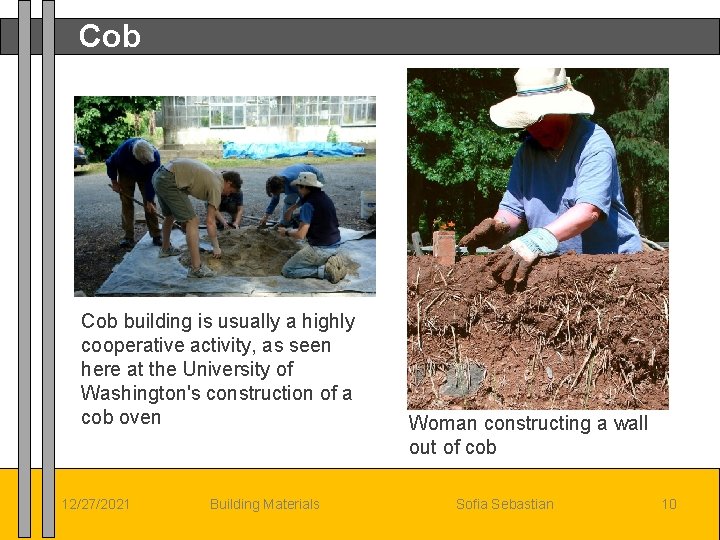
Cob building is usually a highly cooperative activity, as seen here at the University of Washington's construction of a cob oven 12/27/2021 Building Materials Woman constructing a wall out of cob Sofia Sebastian 10
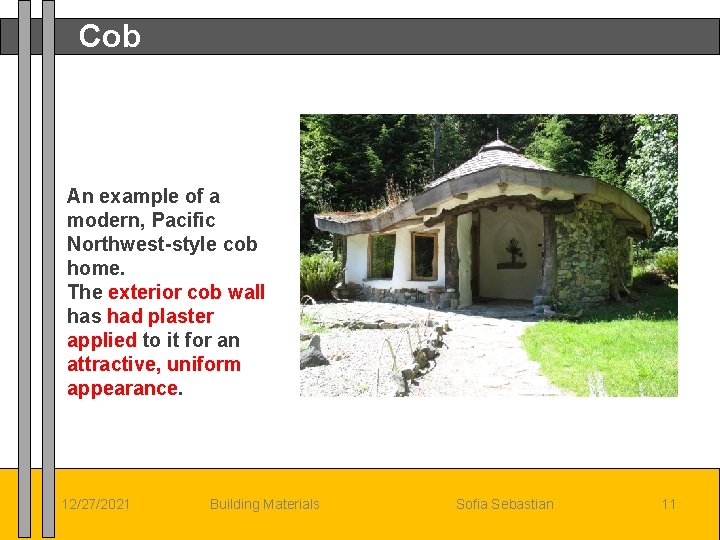
Cob An example of a modern, Pacific Northwest-style cob home. The exterior cob wall has had plaster applied to it for an attractive, uniform appearance. 12/27/2021 Building Materials Sofia Sebastian 11
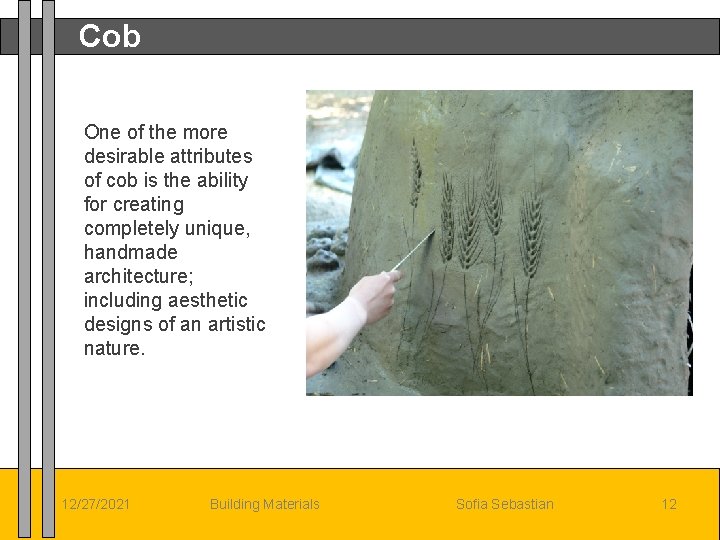
Cob One of the more desirable attributes of cob is the ability for creating completely unique, handmade architecture; including aesthetic designs of an artistic nature. 12/27/2021 Building Materials Sofia Sebastian 12
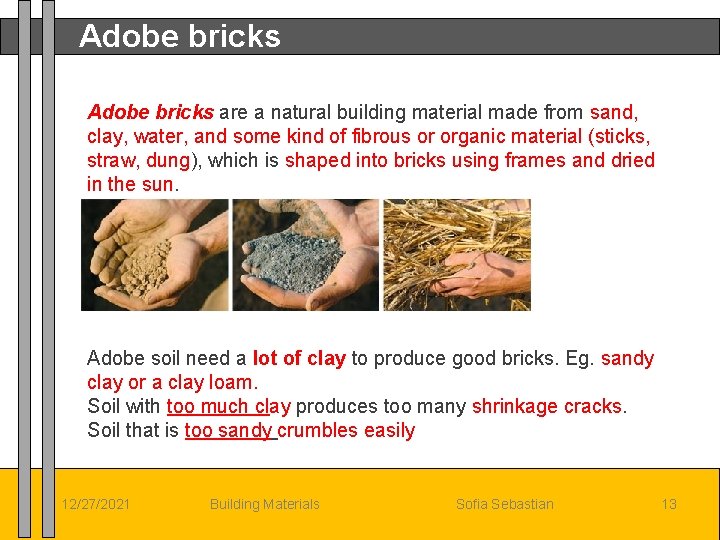
Adobe bricks are a natural building material made from sand, clay, water, and some kind of fibrous or organic material (sticks, straw, dung), which is shaped into bricks using frames and dried in the sun. Adobe soil need a lot of clay to produce good bricks. Eg. sandy clay or a clay loam. Soil with too much clay produces too many shrinkage cracks. Soil that is too sandy crumbles easily 12/27/2021 Building Materials Sofia Sebastian 13
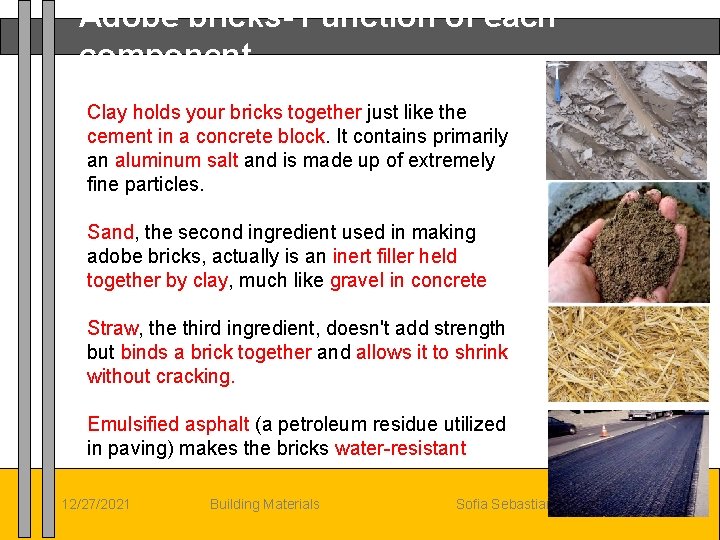
Adobe bricks- Function of each component Clay holds your bricks together just like the cement in a concrete block. It contains primarily an aluminum salt and is made up of extremely fine particles. Sand, the second ingredient used in making adobe bricks, actually is an inert filler held together by clay, much like gravel in concrete Straw, the third ingredient, doesn't add strength but binds a brick together and allows it to shrink without cracking. Emulsified asphalt (a petroleum residue utilized in paving) makes the bricks water-resistant 12/27/2021 Building Materials Sofia Sebastian 14
Adobe brick - properties • It is similar to cob and mudbrick. • Adobe structures are extremely durable and account for the oldest extant buildings on the planet. • • In hot climates, compared to wooden buildings, adobe buildings offer significant advantages due to their greater thermal mass, • but they are known to be particularly susceptible to seismic damage in an event such as an earthquake. . 12/27/2021 Building Materials Sofia Sebastian 15
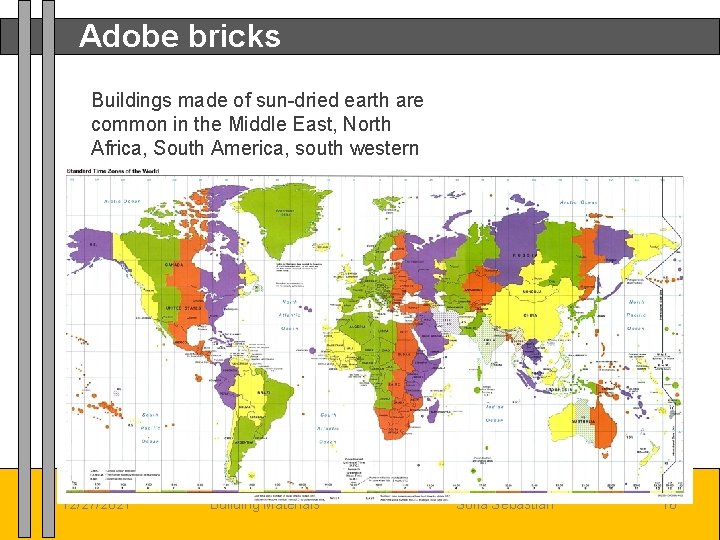
Adobe bricks Buildings made of sun-dried earth are common in the Middle East, North Africa, South America, south western North America, and in Spain 12/27/2021 Building Materials Sofia Sebastian 16
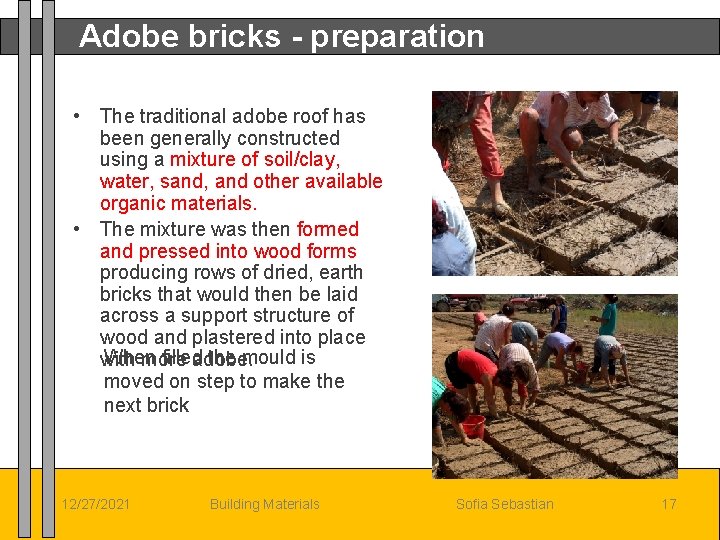
Adobe bricks - preparation • The traditional adobe roof has been generally constructed using a mixture of soil/clay, water, sand, and other available organic materials. • The mixture was then formed and pressed into wood forms producing rows of dried, earth bricks that would then be laid across a support structure of wood and plastered into place When filled the mould is with more adobe. moved on step to make the next brick 12/27/2021 Building Materials Sofia Sebastian 17
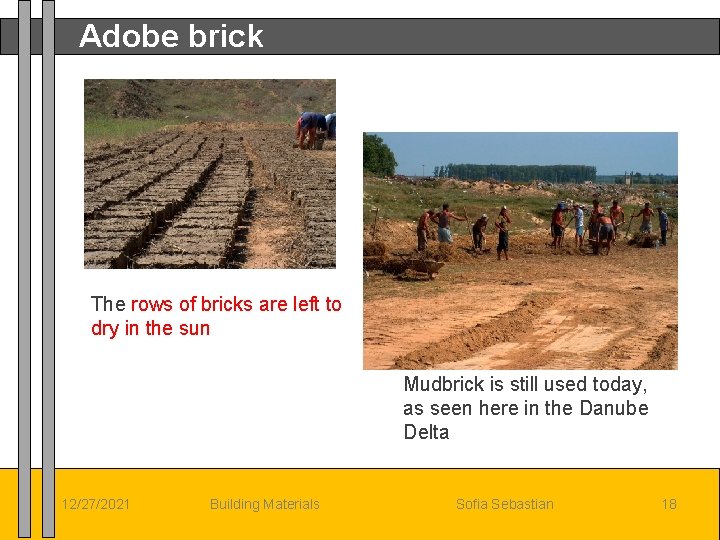
Adobe brick The rows of bricks are left to dry in the sun Mudbrick is still used today, as seen here in the Danube Delta 12/27/2021 Building Materials Sofia Sebastian 18
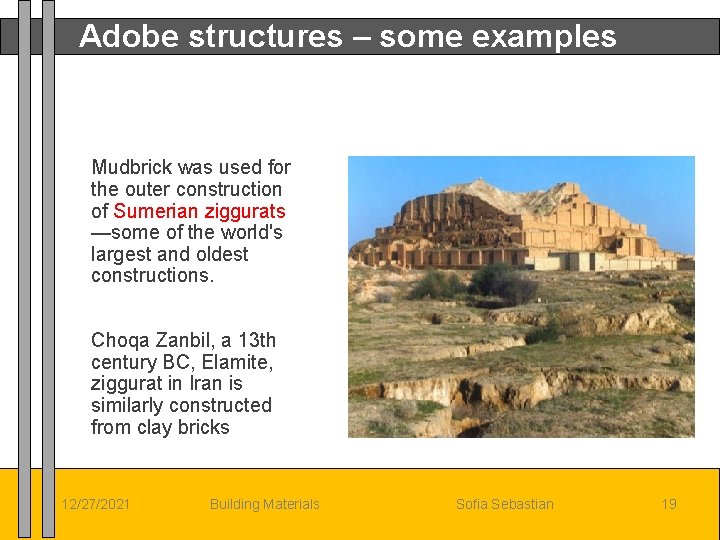
Adobe structures – some examples Mudbrick was used for the outer construction of Sumerian ziggurats —some of the world's largest and oldest constructions. Choqa Zanbil, a 13 th century BC, Elamite, ziggurat in Iran is similarly constructed from clay bricks 12/27/2021 Building Materials Sofia Sebastian 19
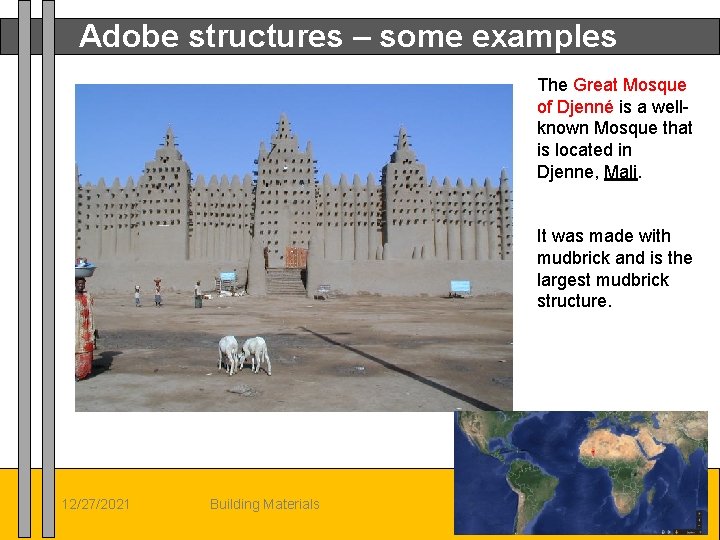
Adobe structures – some examples The Great Mosque of Djenné is a wellknown Mosque that is located in Djenne, Mali. It was made with mudbrick and is the largest mudbrick structure. 12/27/2021 Building Materials Sofia Sebastian 20
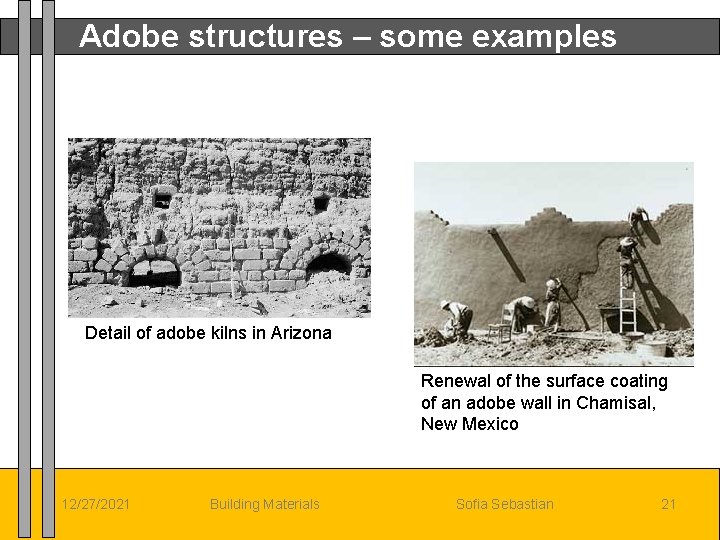
Adobe structures – some examples Detail of adobe kilns in Arizona Renewal of the surface coating of an adobe wall in Chamisal, New Mexico 12/27/2021 Building Materials Sofia Sebastian 21
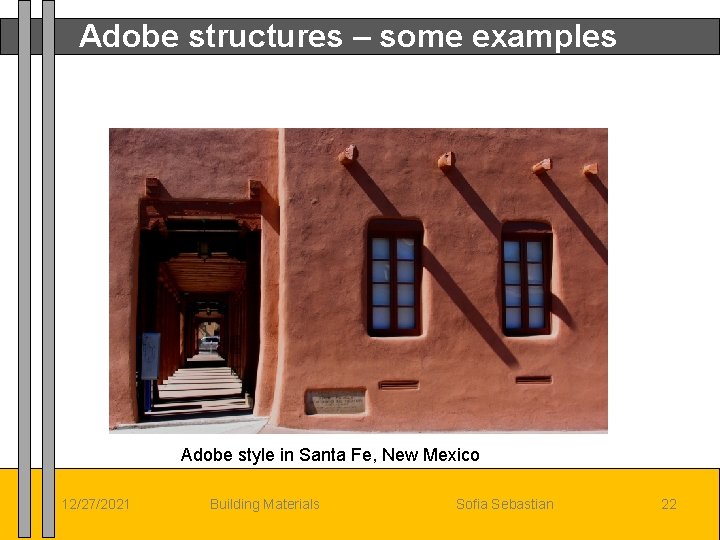
Adobe structures – some examples Adobe style in Santa Fe, New Mexico 12/27/2021 Building Materials Sofia Sebastian 22
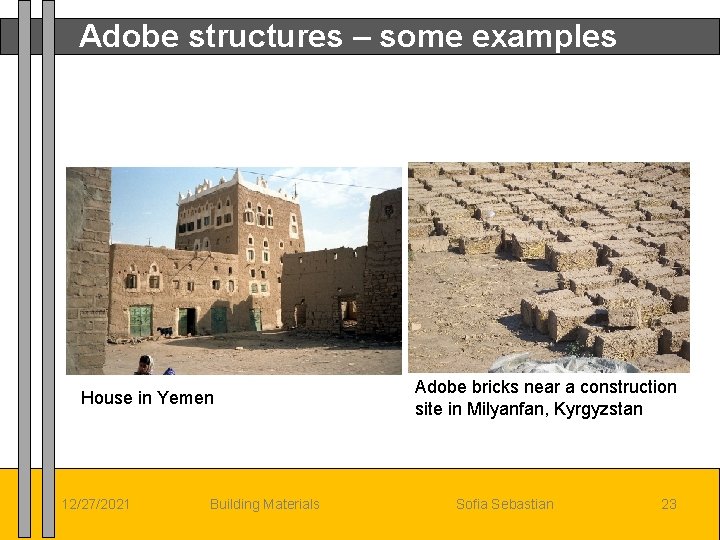
Adobe structures – some examples House in Yemen 12/27/2021 Building Materials Adobe bricks near a construction site in Milyanfan, Kyrgyzstan Sofia Sebastian 23
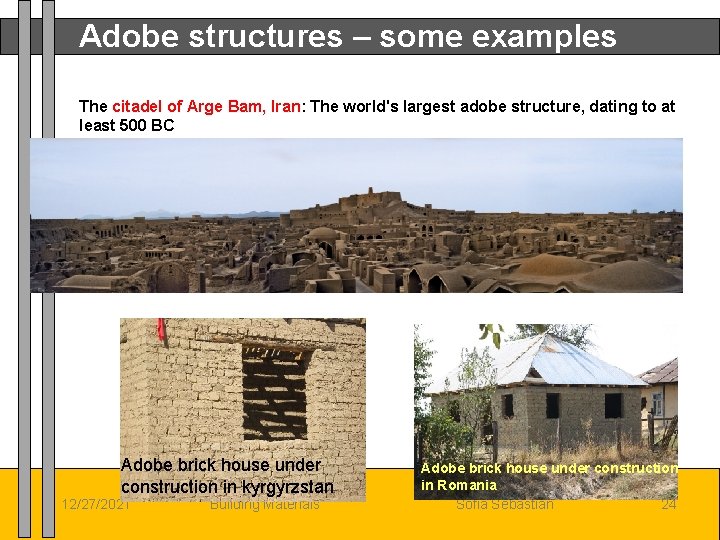
Adobe structures – some examples The citadel of Arge Bam, Iran: The world's largest adobe structure, dating to at least 500 BC Adobe brick house under construction in kyrgyrzstan 12/27/2021 Building Materials Adobe brick house under construction in Romania Sofia Sebastian 24
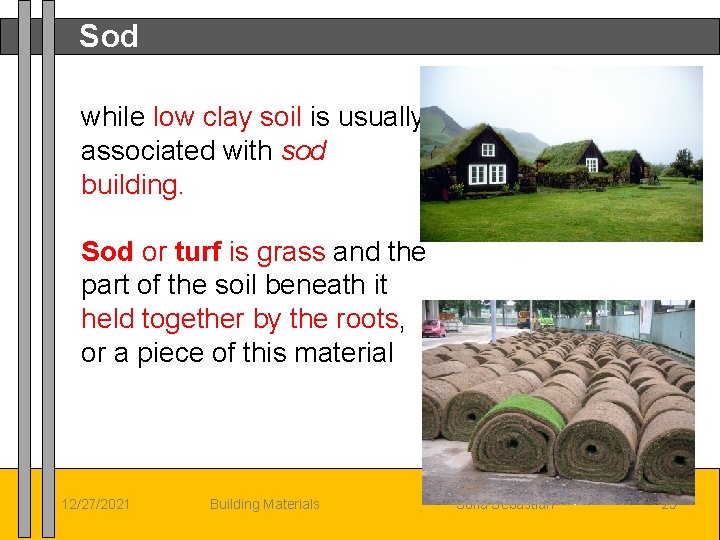
Sod while low clay soil is usually associated with sod building. Sod or turf is grass and the part of the soil beneath it held together by the roots, or a piece of this material 12/27/2021 Building Materials Sofia Sebastian 25
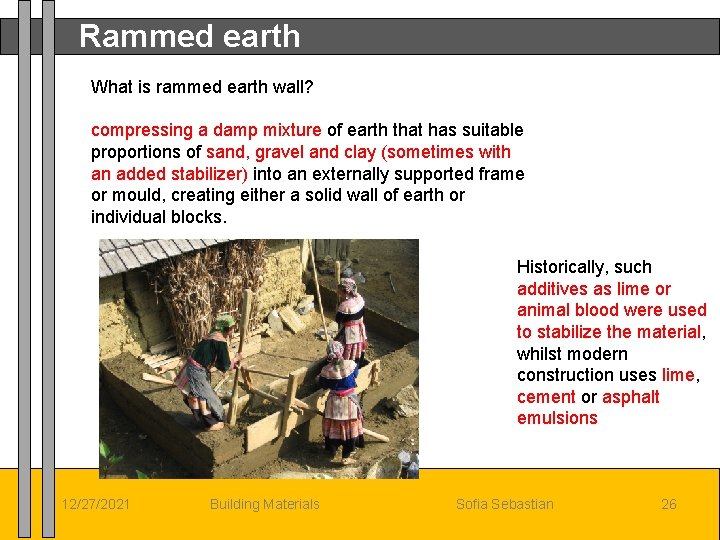
Rammed earth What is rammed earth wall? compressing a damp mixture of earth that has suitable proportions of sand, gravel and clay (sometimes with an added stabilizer) into an externally supported frame or mould, creating either a solid wall of earth or individual blocks. Historically, such additives as lime or animal blood were used to stabilize the material, whilst modern construction uses lime, cement or asphalt emulsions 12/27/2021 Building Materials Sofia Sebastian 26
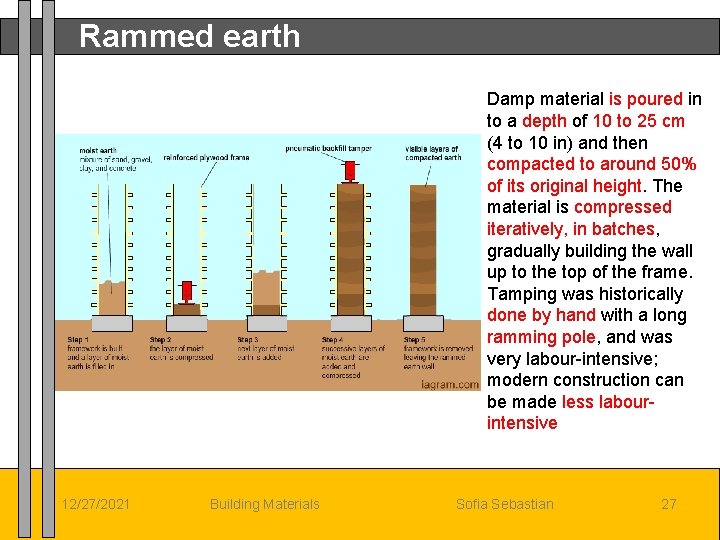
Rammed earth Damp material is poured in to a depth of 10 to 25 cm (4 to 10 in) and then compacted to around 50% of its original height. The material is compressed iteratively, in batches, gradually building the wall up to the top of the frame. Tamping was historically done by hand with a long ramming pole, and was very labour-intensive; modern construction can be made less labourintensive 12/27/2021 Building Materials Sofia Sebastian 27
Rammed earth buildings 12/27/2021 Building Materials Sofia Sebastian 28
Clay is a naturally occurring material composed primarily of finegrained minerals, which show plasticity through a variable range of water contents, and which can be hardened when dried and/or fired. Clay was a primary ingredient in many natural building techniques, clay is used to create adobe, cob and rammed earth structures and building elements such as wattle and daub, clay plaster, clay render case, clay floors and clay paints and ceramic building material. Clay was used as a mortar in brick chimneys and stone walls where protected from water. 12/27/2021 Building Materials Sofia Sebastian 29
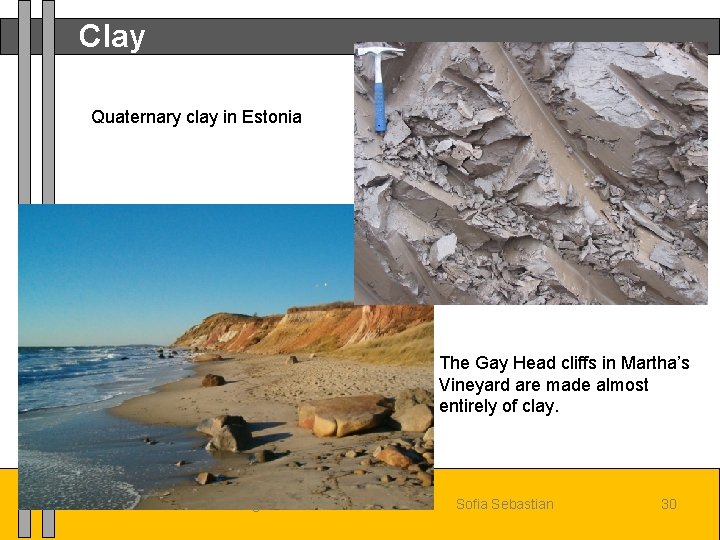
Clay Quaternary clay in Estonia The Gay Head cliffs in Martha’s Vineyard are made almost entirely of clay. 12/27/2021 Building Materials Sofia Sebastian 30