
Introduction What is Global Marketing How is it
Introduction • What is Global Marketing? • How is it different from regular marketing?
Introduction • Marketing – Process of planning and executing the conception pricing, promotion and distribution of ideas, goods and services to create exchanges that satisfy individual and organization goals • Global Marketing – Focuses resources on global market opportunities and threats; the main difference is the scope of activities because global marketing occurs in markets outside the organization’s home country
Reasons for Global Marketing • Growth – Access to new markets – Access to resources • Survival – Against competitors with lower costs (due to increased access to resources) • Other – Economies of scale – Transfer of experience – Uniform global image
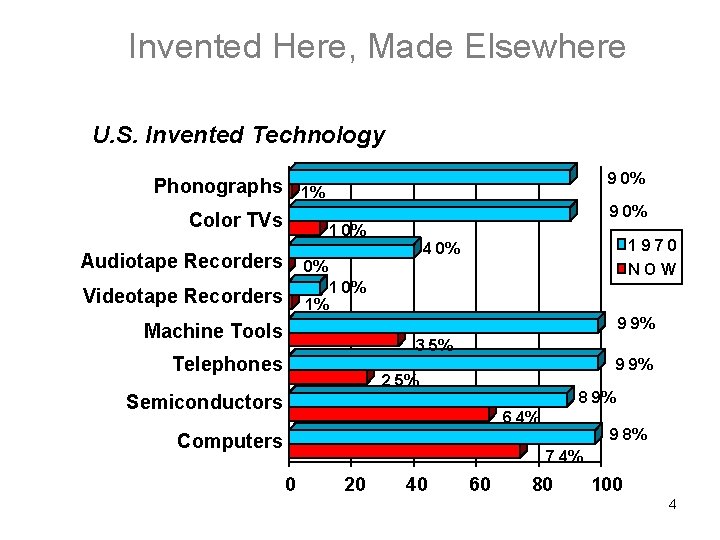
Invented Here, Made Elsewhere U. S. Invented Technology Phonographs 9 0% 1% 9 0% Color TVs 1 0% 1970 4 0% Audiotape Recorders 0% Videotape Recorders 1% NOW 1 0% 9 9% Machine Tools 3 5% Telephones 9 9% 2 5% 8 9% Semiconductors 6 4% Computers 9 8% 7 4% 0 20 40 60 80 100 4
Overview of Marketing • One of the functional areas of a business that is distinct from finance and operations • Primary tools in marketing are product, price, place, and promotion • Marketing is an activity that comprises the firm’s value chain • Current trend is to involve marketers in all value-related decisions – called boundaryless marketing
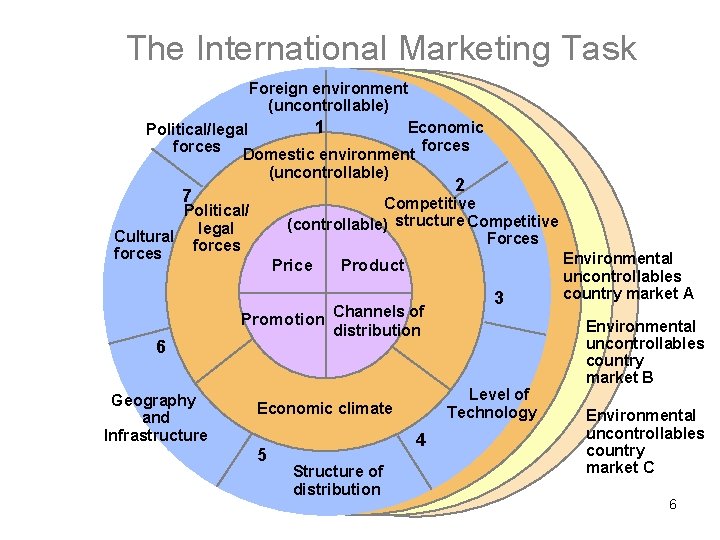
The International Marketing Task Foreign environment (uncontrollable) 1 Economic Political/legal forces Domestic environment (uncontrollable) 2 7 Competitive (controllable) structure Competitive Forces Political/ legal Cultural forces Price Product 7 Promotion Channels of distribution 6 Geography and Infrastructure 3 Level of Technology Economic climate 5 4 Structure of distribution Environmental uncontrollables country market A Environmental uncontrollables country market B Environmental uncontrollables country market C 6

Boundaryless Marketing • Goal is to eliminate communication barriers between marketing and other business functional areas • Properly implemented it ensures that a market orientation permeates all value creating activities

Goal of Marketing • Surpass the competition at the task of creating perceived value for customers • The Guide line is the value equation – Value = Benefits/Price (Money, Time, Effort, Etc. )
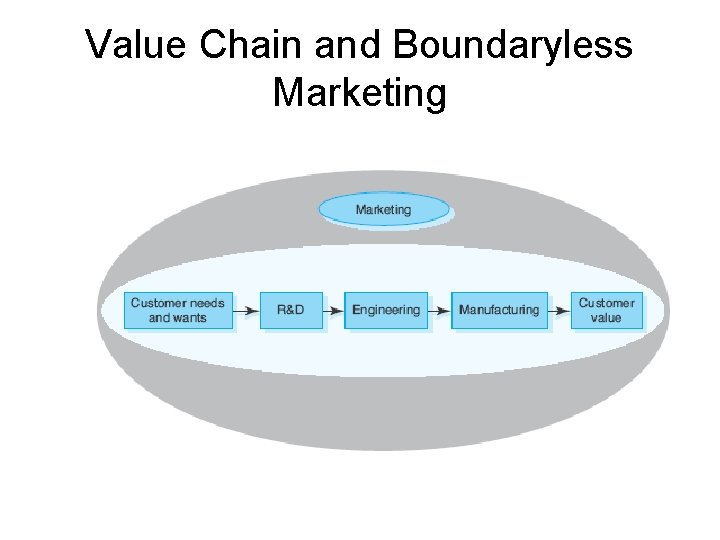
Value Chain and Boundaryless Marketing
Competitive Advantage • Success over competition in industry at value creation • Achieved by integrating and leveraging operations on a worldwide scale
Globalization • Globalization is the inexorable integration of markets, nation-states, and technologies to a degree never witnessed before - in a way that is enabling individuals, corporations, and nationstates to reach around the world farther, faster, deeper and cheaper than ever before, and in a way that is enabling the world to reach into individuals, corporations, and nation-states farther, faster, deeper, and cheaper than ever before. » Thomas Friedman
Global Industries • An industry is global to the extent that a company’s industry position in one country is interdependent with its industry position in another country • Indicators of globalization: – Ratio of cross-border trade to total worldwide production – Ratio of cross-border investment to total capital investment – Proportion of industry revenue generated by companies that compete in key world regions
Competitive Advantage, Globalization and Global Industries • Focus – Concentration and attention on core business and competence Nestle is focused: We are food and beverages. We are not running bicycle shops. Even in food we are not in all fields. There are certain areas we do not touch…. . We have no soft drinks because I have said we will either buy Coca-Cola or we leave it alone. This is focus. Helmut Maucher
Global Marketing: What it is and What it isn’t • Strategy development comes down to two main issues similar to single country marketing – Target market – Marketing Mix
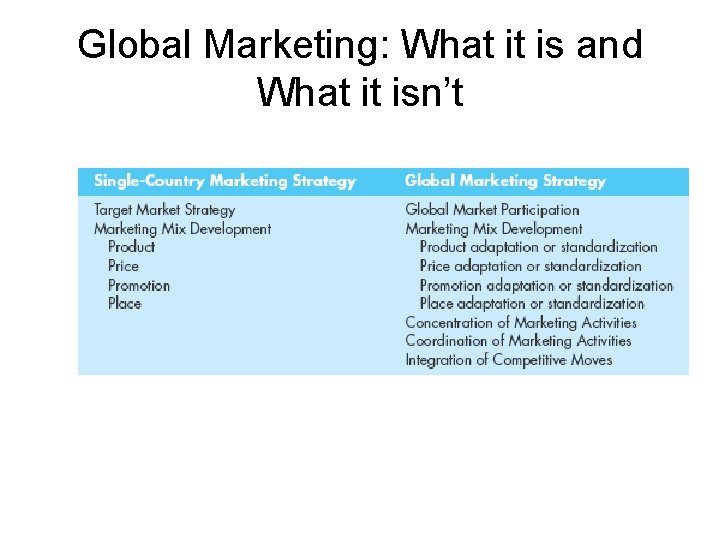
Global Marketing: What it is and What it isn’t
Global Marketing: What it is and What it isn’t • Global marketing does not mean doing business in all of the 200 -plus country markets • Global marketing does mean widening business horizons to encompass the world in scanning for opportunity and threat
Standardization versus Adaptation • Globalization (Standardization) – Developing standardized products marketed worldwide with a standardized marketing mix – Essence of mass marketing • Global localization (Adaptation) – Mixing standardization and customization in a way that minimizes costs while maximizing satisfaction – Essence of segmentation – Think globally, act locally
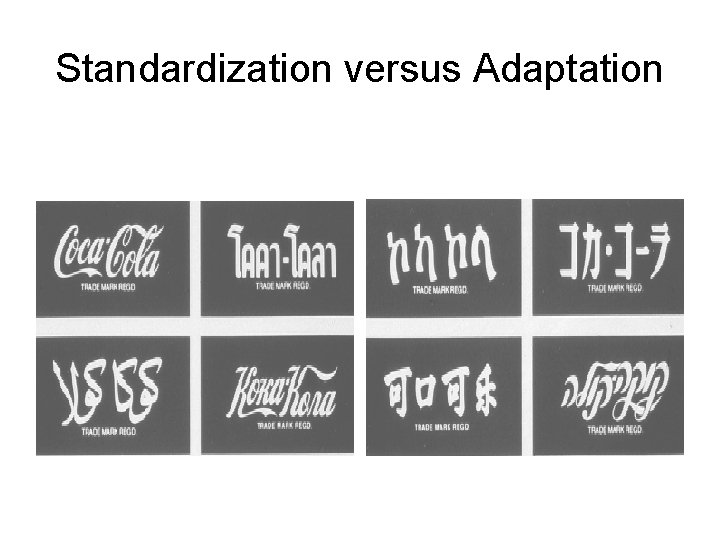
Standardization versus Adaptation
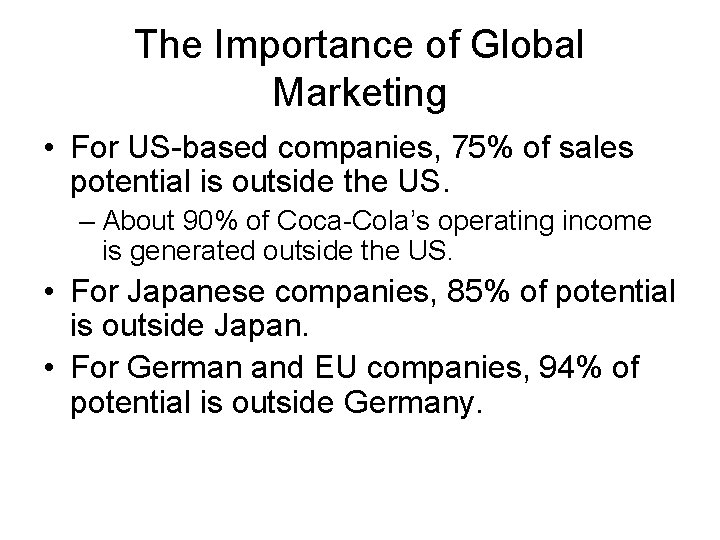
The Importance of Global Marketing • For US-based companies, 75% of sales potential is outside the US. – About 90% of Coca-Cola’s operating income is generated outside the US. • For Japanese companies, 85% of potential is outside Japan. • For German and EU companies, 94% of potential is outside Germany.
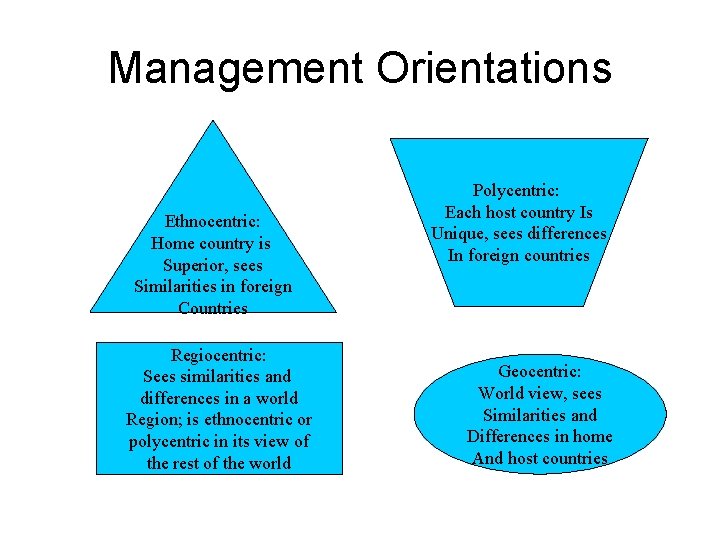
Management Orientations Ethnocentric: Home country is Superior, sees Similarities in foreign Countries Regiocentric: Sees similarities and differences in a world Region; is ethnocentric or polycentric in its view of the rest of the world Polycentric: Each host country Is Unique, sees differences In foreign countries Geocentric: World view, sees Similarities and Differences in home And host countries
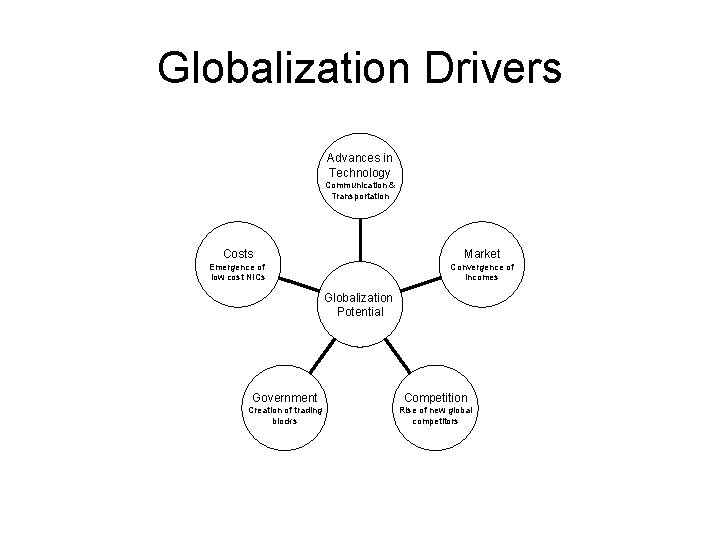
Globalization Drivers Advances in Technology Communication & Transportation Costs Market Emergence of low cost NICs Convergence of incomes Globalization Potential Government Competition Creation of trading blocks Rise of new global competitors
- Slides: 21