
Introduction What increments are each of these scales
- Slides: 17
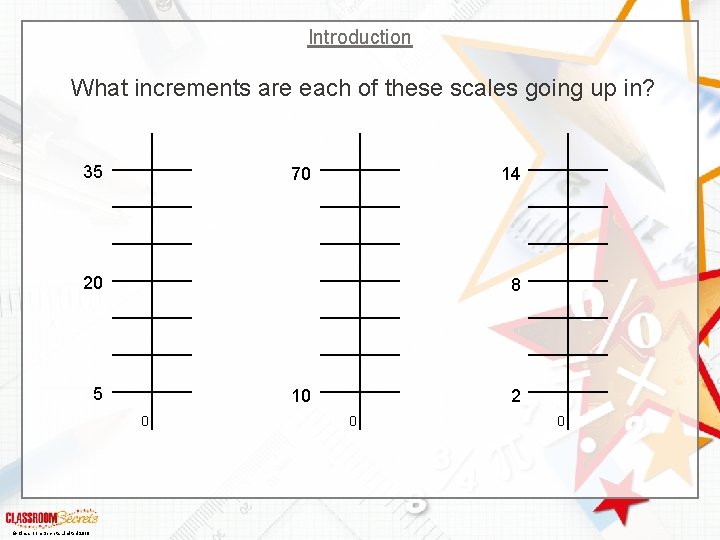
Introduction What increments are each of these scales going up in? 35 70 14 20 8 5 10 0 © Classroom Secrets Limited 2018 2 0 0
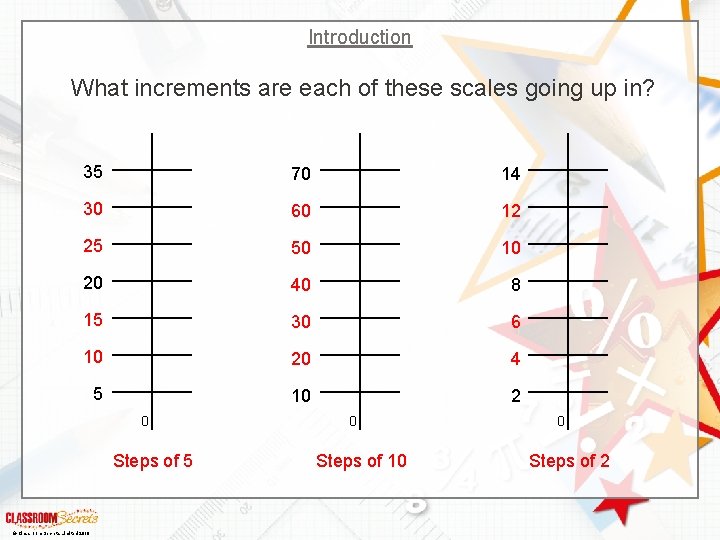
Introduction What increments are each of these scales going up in? 35 70 14 30 60 12 25 50 10 20 40 8 15 30 6 10 20 4 5 10 2 0 Steps of 5 © Classroom Secrets Limited 2018 0 Steps of 10 0 Steps of 2
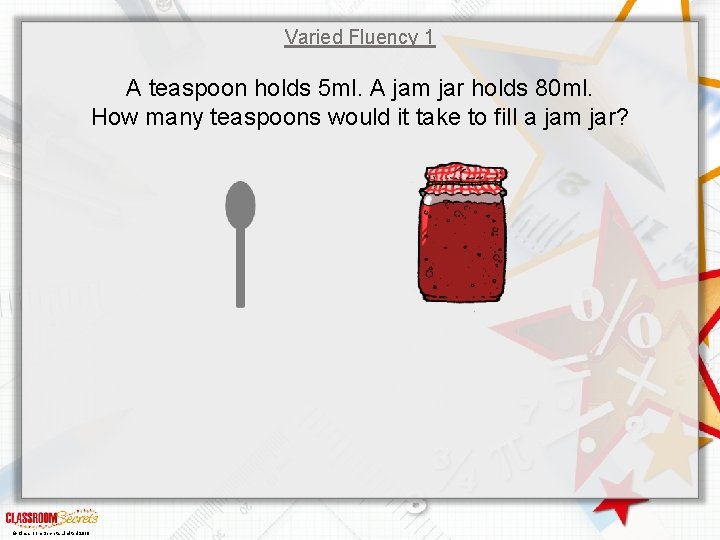
Varied Fluency 1 A teaspoon holds 5 ml. A jam jar holds 80 ml. How many teaspoons would it take to fill a jam jar? © Classroom Secrets Limited 2018
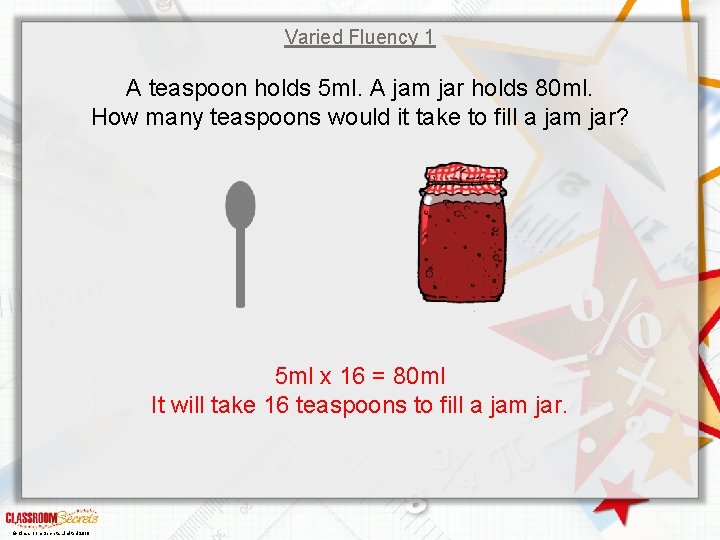
Varied Fluency 1 A teaspoon holds 5 ml. A jam jar holds 80 ml. How many teaspoons would it take to fill a jam jar? 5 ml x 16 = 80 ml It will take 16 teaspoons to fill a jam jar. © Classroom Secrets Limited 2018
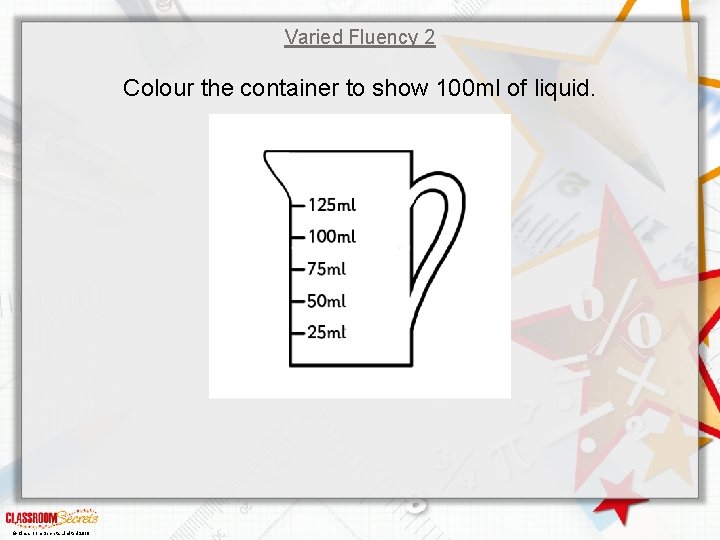
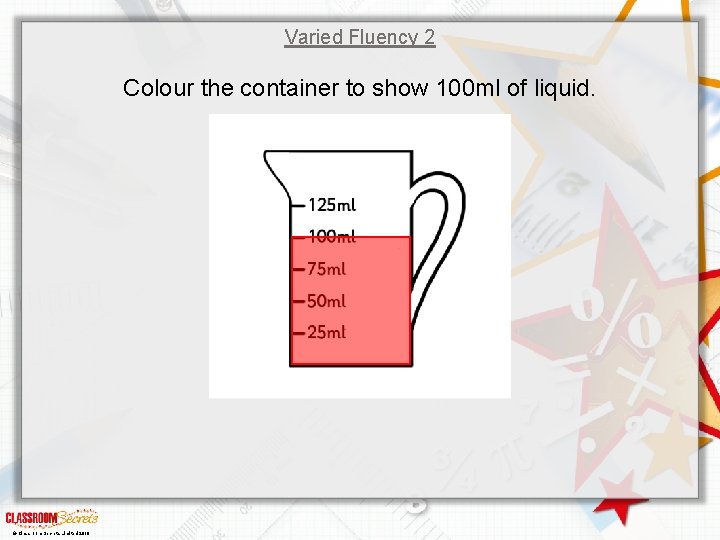
Varied Fluency 2 Colour the container to show 100 ml of liquid. © Classroom Secrets Limited 2018
Varied Fluency 2 Colour the container to show 100 ml of liquid. © Classroom Secrets Limited 2018
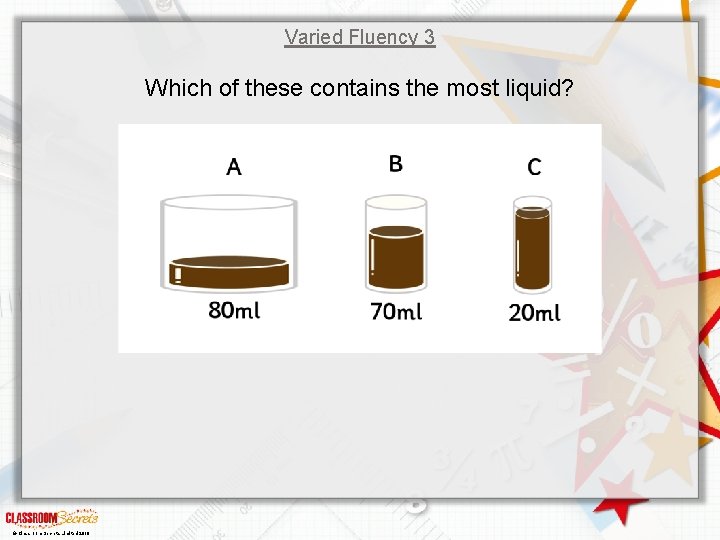
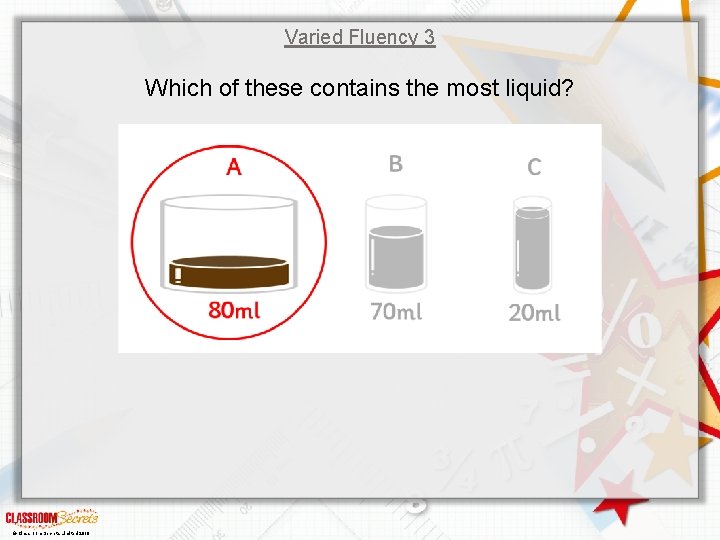
Varied Fluency 3 Which of these contains the most liquid? © Classroom Secrets Limited 2018
Varied Fluency 3 Which of these contains the most liquid? © Classroom Secrets Limited 2018
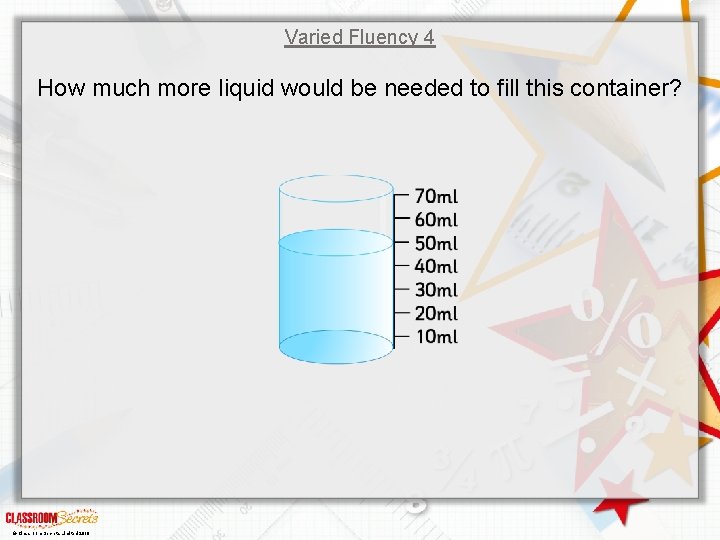
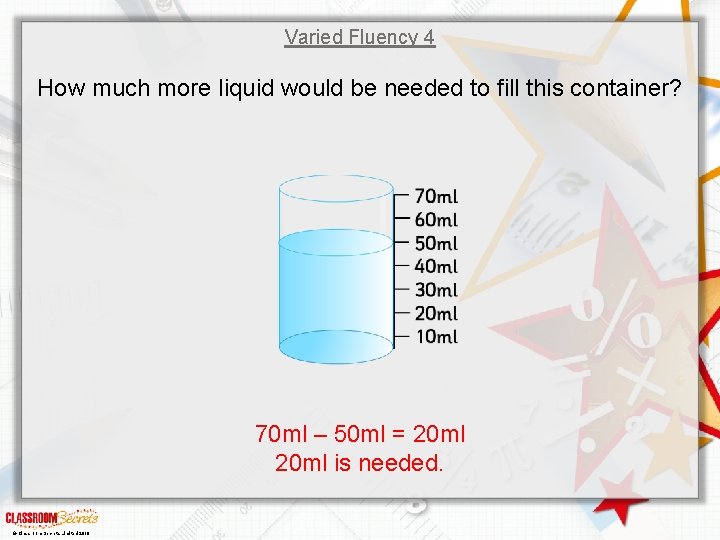
Varied Fluency 4 How much more liquid would be needed to fill this container? © Classroom Secrets Limited 2018
Varied Fluency 4 How much more liquid would be needed to fill this container? 70 ml – 50 ml = 20 ml is needed. © Classroom Secrets Limited 2018
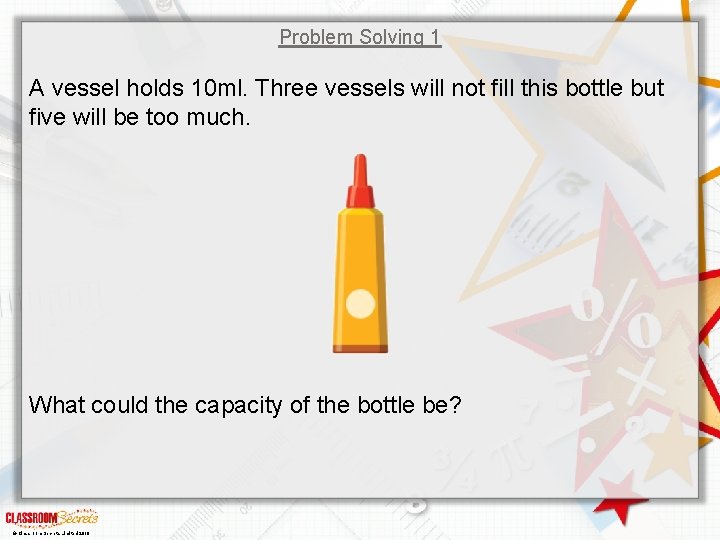
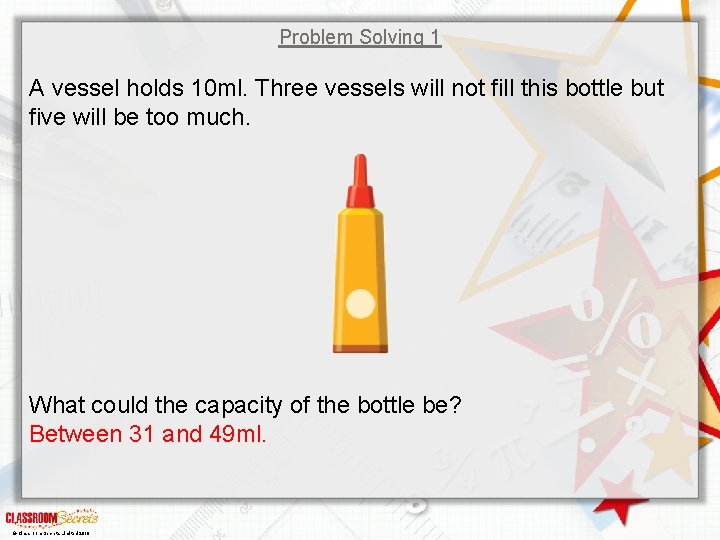
Problem Solving 1 A vessel holds 10 ml. Three vessels will not fill this bottle but five will be too much. What could the capacity of the bottle be? © Classroom Secrets Limited 2018
Problem Solving 1 A vessel holds 10 ml. Three vessels will not fill this bottle but five will be too much. What could the capacity of the bottle be? Between 31 and 49 ml. © Classroom Secrets Limited 2018
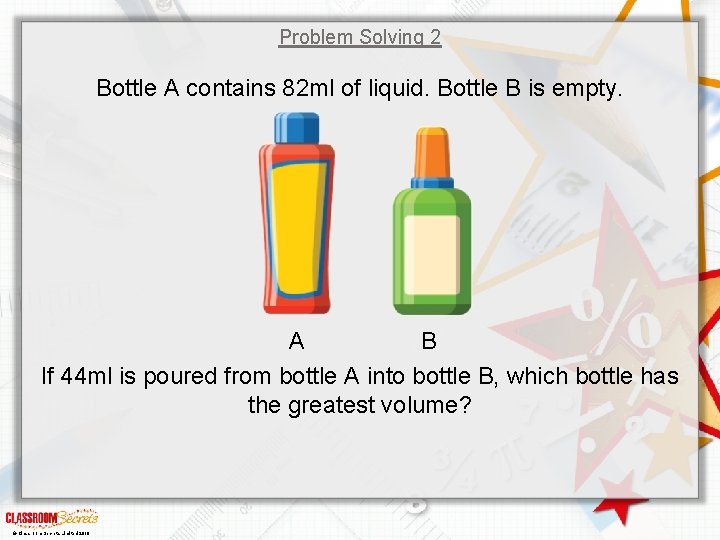
Problem Solving 2 Bottle A contains 82 ml of liquid. Bottle B is empty. B A If 44 ml is poured from bottle A into bottle B, which bottle has the greatest volume? © Classroom Secrets Limited 2018
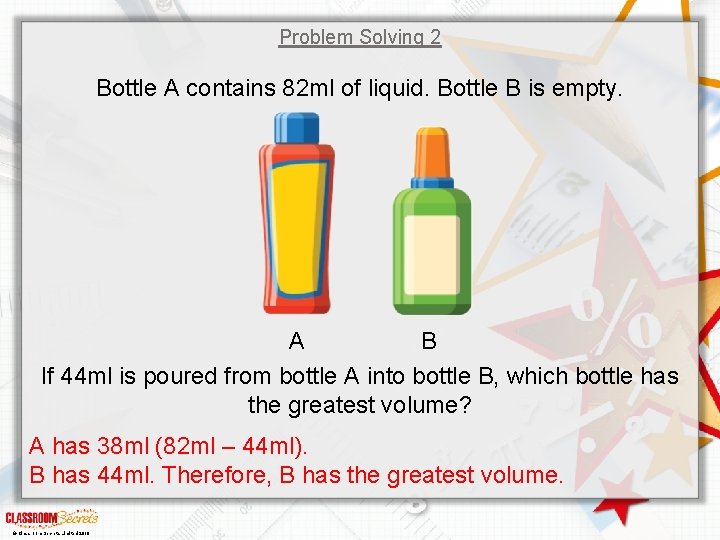
Problem Solving 2 Bottle A contains 82 ml of liquid. Bottle B is empty. B A If 44 ml is poured from bottle A into bottle B, which bottle has the greatest volume? A has 38 ml (82 ml – 44 ml). B has 44 ml. Therefore, B has the greatest volume. © Classroom Secrets Limited 2018
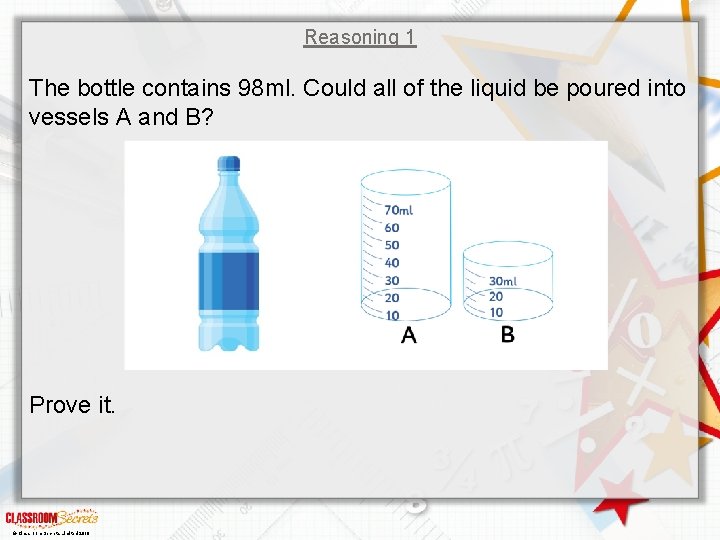
Reasoning 1 The bottle contains 98 ml. Could all of the liquid be poured into vessels A and B? Prove it. © Classroom Secrets Limited 2018
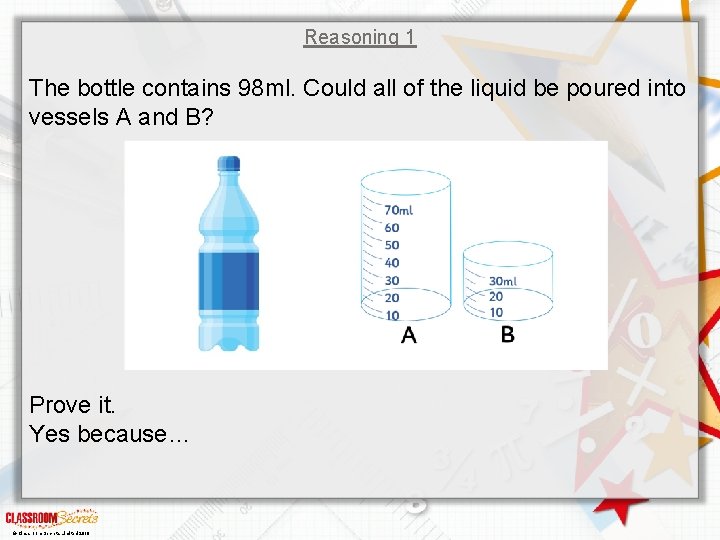
Reasoning 1 The bottle contains 98 ml. Could all of the liquid be poured into vessels A and B? Prove it. Yes because… © Classroom Secrets Limited 2018
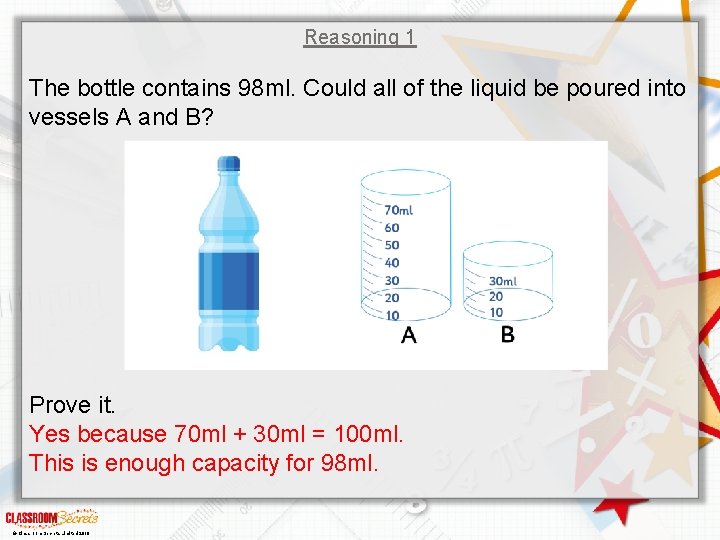
Reasoning 1 The bottle contains 98 ml. Could all of the liquid be poured into vessels A and B? Prove it. Yes because 70 ml + 30 ml = 100 ml. This is enough capacity for 98 ml. © Classroom Secrets Limited 2018