
Introduction to zOS Basics Chapter 10 Compiling and
Introduction to z/OS Basics Chapter 10: Compiling and link-editing a program on z/OS © 2006 IBM Corporation
Chapter 10 Compile and Link-Edit Chapter objectives § Be able to: § § § 2 Explain the purpose of a compiler Compile a source program Create executable code from a program compiled Explain the difference between an object module and a load module Run a program on z/OS © 2006 IBM Corporation
Chapter 10 Compile and Link-Edit Key terms in this chapter § binder § procedure § copybook § procedure library § linkage-editor § program library § load module § relocatable § object module § source module § object-oriented code 3 © 2006 IBM Corporation
Chapter 10 Compile and Link-Edit Source, object, and load modules § A source program can be divided into logical units – or modules -- that perform specific functions. § Each module is assembled or compiled by one of the language translators § Input to a language translator is a source module § Output from a language translator is an object module § Object modules must be processed by the binder before they can be executed § Output of the binder is a load module. 4 © 2006 IBM Corporation
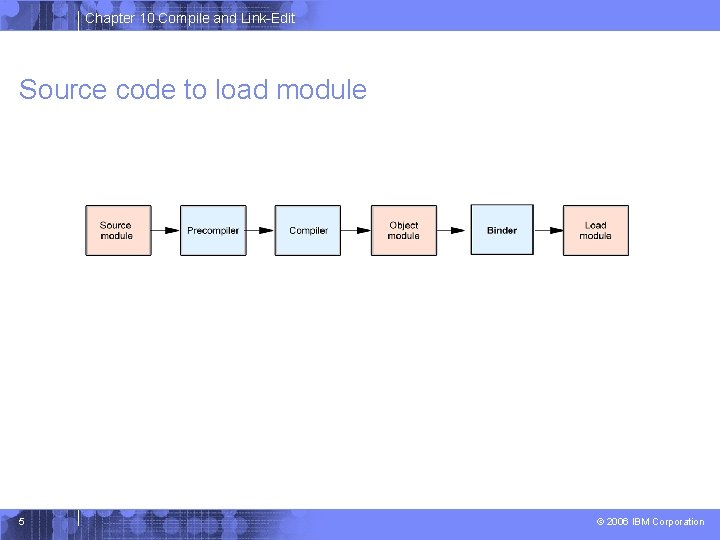
Chapter 10 Compile and Link-Edit Source code to load module 5 © 2006 IBM Corporation
Chapter 10 Compile and Link-Edit Object module § An object module: – Is a collection of one or more compilation units produced by an assembler, compiler, or other language translator and used as input to the binder (or linkage editor) – Is in relocatable format with machine code that is not executable – Is stored in an object library 6 © 2006 IBM Corporation
Chapter 10 Compile and Link-Edit Load module § A load module: – is also relocatable, but with executable machine code – is in a format that can be loaded into virtual storage and relocated by program manager, a program that prepares load modules for execution by loading them at specific storage locations. 7 © 2006 IBM Corporation
Chapter 10 Compile and Link-Edit More about object modules and load modules § Object modules and load modules consist of: – Information (control dictionaries) to resolve crossreferences between sections of different modules – Text, containing the instructions and data of the program – An end-of-module indication (END statement) 8 © 2006 IBM Corporation
Chapter 10 Compile and Link-Edit What are source libraries? § Source programs are stored in a PDS known as source library § Source libraries contain the source code to be: – submitted for a compilation process – retrieved for modification by an application programmer § A copybook is a source library containing prewritten text; it is used to copy text into a source program, at compile time. 9 © 2006 IBM Corporation
Chapter 10 Compile and Link-Edit Compiling programs on z/OS § Compilers: – Translate source code into object code – Assign relative addresses to all instructions, data elements, and labels, starting from zero (required in a virtual storage operating system) § Addresses are in the form of a base address plus a displacement (to allow programs to be relocated) § References to external programs or subroutines are left as unresolved 10 © 2006 IBM Corporation

Chapter 10 Compile and Link-Edit Compiling programs on z/OS § Various ways to compile programs on z/OS: – batch job – under TSO/E through commands, CLISTs, or ISPF panels – for COBOL programs, you can compile programs in a z/OS UNIX shell by using the cob 2 command. 11 © 2006 IBM Corporation
Chapter 10 Compile and Link-Edit Compilation step § Define the data sets needed for the compilation § Also, specify any compiler options needed by the program 12 © 2006 IBM Corporation
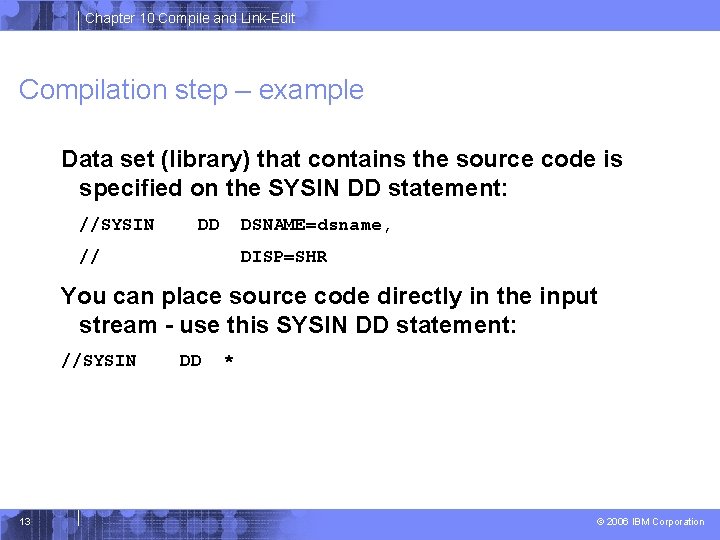
Chapter 10 Compile and Link-Edit Compilation step – example Data set (library) that contains the source code is specified on the SYSIN DD statement: //SYSIN DD DSNAME=dsname, // DISP=SHR You can place source code directly in the input stream - use this SYSIN DD statement: //SYSIN 13 DD * © 2006 IBM Corporation
Chapter 10 Compile and Link-Edit Compiling with cataloged procedures (PROCs) § A common way to compile a program under z/OS is by using a batch job with a cataloged procedure or PROC § A PROC contains a set of JCL statements placed in a data set called the procedure library (PROCLIB) § The PROC must include the following information: – Job description – Execution statement to invoke the compiler – Definitions for the data sets needed but not supplied by the PROC 14 © 2006 IBM Corporation
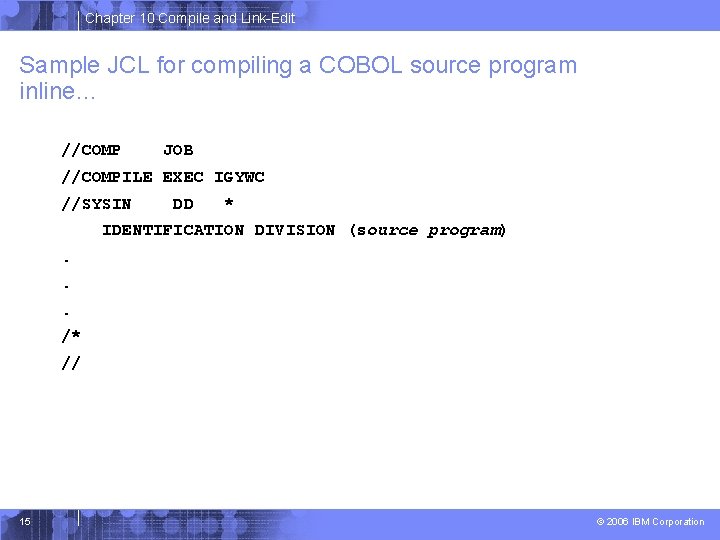
Chapter 10 Compile and Link-Edit Sample JCL for compiling a COBOL source program inline… //COMP JOB //COMPILE EXEC IGYWC //SYSIN DD * IDENTIFICATION DIVISION (source program). . . /* // 15 © 2006 IBM Corporation
Chapter 10 Compile and Link-Edit COBOL compile, link & go PROC § JCL in next slide executes the IGYWCLG PROC § PROC is a three-step procedure for compiling a source program, linking it into a load library and executing the load module – The first two steps are the same as those in the compile and link example – We do not need to permanently save the load module in order to execute it § Result of running the JCL is to: – compile our inline source program – link-edit the object code – store the load module (either temporarily or permanently) – execute the load module 16 © 2006 IBM Corporation
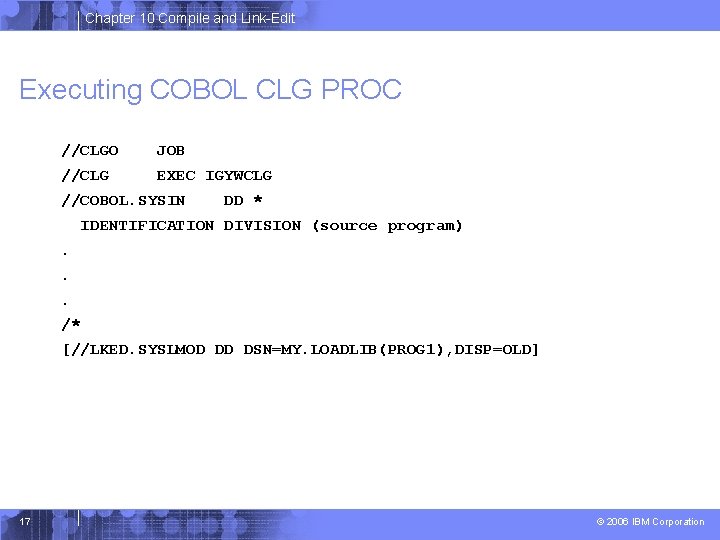
Chapter 10 Compile and Link-Edit Executing COBOL CLG PROC //CLGO JOB //CLG EXEC IGYWCLG //COBOL. SYSIN DD * IDENTIFICATION DIVISION (source program). . . /* [//LKED. SYSLMOD DD DSN=MY. LOADLIB(PROG 1), DISP=OLD] 17 © 2006 IBM Corporation
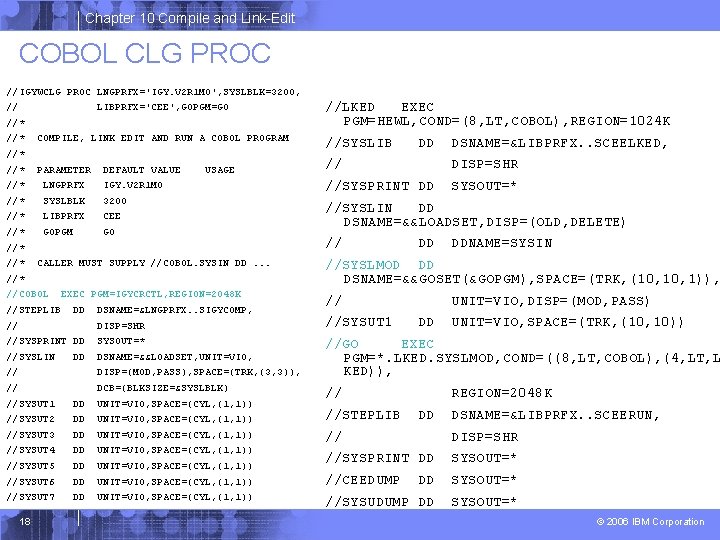
Chapter 10 Compile and Link-Edit COBOL CLG PROC //IGYWCLG PROC LNGPRFX='IGY. V 2 R 1 M 0', SYSLBLK=3200, // LIBPRFX='CEE', GOPGM=GO //* COMPILE, LINK EDIT AND RUN A COBOL PROGRAM //* //SYSPRINT DD SYSOUT=* 3200 //SYSLIN DD DSNAME=&&LOADSET, DISP=(OLD, DELETE) LNGPRFX //* SYSLBLK //* LIBPRFX CEE //* GOPGM GO DEFAULT VALUE USAGE //* CALLER MUST SUPPLY //COBOL. SYSIN DD. . . //* EXEC PGM=IGYCRCTL, REGION=2048 K DD // DSNAME=&LNGPRFX. . SIGYCOMP, DISP=SHR //SYSPRINT DD SYSOUT=* //SYSLIN DSNAME=&&LOADSET, UNIT=VIO, DD DSNAME=&LIBPRFX. . SCEELKED, IGY. V 2 R 1 M 0 //* //STEPLIB DD DISP=SHR PARAMETER //COBOL //SYSLIB // //* //LKED EXEC PGM=HEWL, COND=(8, LT, COBOL), REGION=1024 K // DISP=(MOD, PASS), SPACE=(TRK, (3, 3)), // DCB=(BLKSIZE=&SYSLBLK) // DD DDNAME=SYSIN //SYSLMOD DD DSNAME=&&GOSET(&GOPGM), SPACE=(TRK, (10, 1)), // //SYSUT 1 UNIT=VIO, DISP=(MOD, PASS) DD UNIT=VIO, SPACE=(TRK, (10, 10)) //GO EXEC PGM=*. LKED. SYSLMOD, COND=((8, LT, COBOL), (4, LT, L KED)), // REGION=2048 K //SYSUT 1 DD UNIT=VIO, SPACE=(CYL, (1, 1)) //SYSUT 2 DD UNIT=VIO, SPACE=(CYL, (1, 1)) //STEPLIB //SYSUT 3 DD UNIT=VIO, SPACE=(CYL, (1, 1)) // DISP=SHR //SYSUT 4 DD UNIT=VIO, SPACE=(CYL, (1, 1)) //SYSUT 5 DD UNIT=VIO, SPACE=(CYL, (1, 1)) //SYSPRINT DD SYSOUT=* //SYSUT 6 DD UNIT=VIO, SPACE=(CYL, (1, 1)) //CEEDUMP DD SYSOUT=* //SYSUT 7 DD UNIT=VIO, SPACE=(CYL, (1, 1)) //SYSUDUMP DD SYSOUT=* 18 DD DSNAME=&LIBPRFX. . SCEERUN, © 2006 IBM Corporation
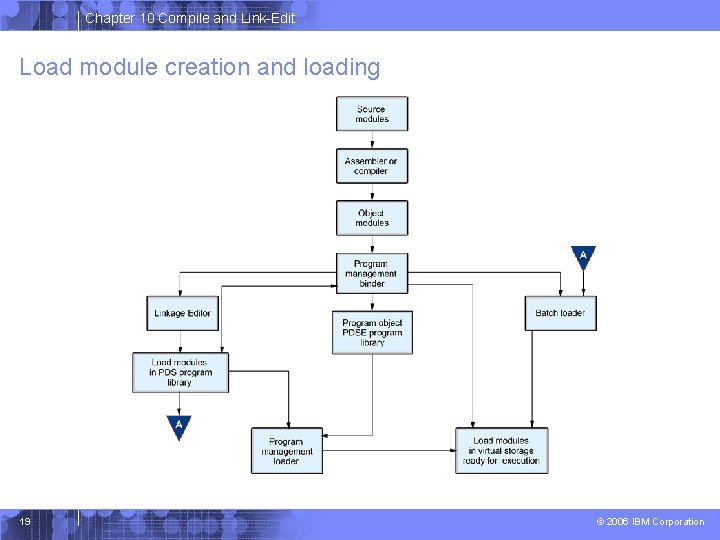
Chapter 10 Compile and Link-Edit Load module creation and loading 19 © 2006 IBM Corporation
Chapter 10 Compile and Link-Edit Linkage Editor § The linkage editor prepares a load module to be brought into real storage for execution § As input, the linkage editor accepts object modules, control statements, and user-specified input. § Output of the linkage editor is: – A load module placed in a library (a PDS) as a named member – Diagnostic output produced as a sequential data set 20 © 2006 IBM Corporation
Chapter 10 Compile and Link-Edit How a load module is created § The linkage editor assign virtual storage addresses to control sections of the module and resolves references between them. § The output load module contains the input object modules and input load modules processed by the linkage editor § The load module also contains the text from each input module, and an end-of-module indicator 21 © 2006 IBM Corporation
Chapter 10 Compile and Link-Edit Using the binder § Performs all of the functions of the linkage editor § Can also process program objects stored in PDSE data sets § Binder removes restrictions of the linkage editor § Input can include traditional data sets and z/OS UNIX files 22 © 2006 IBM Corporation
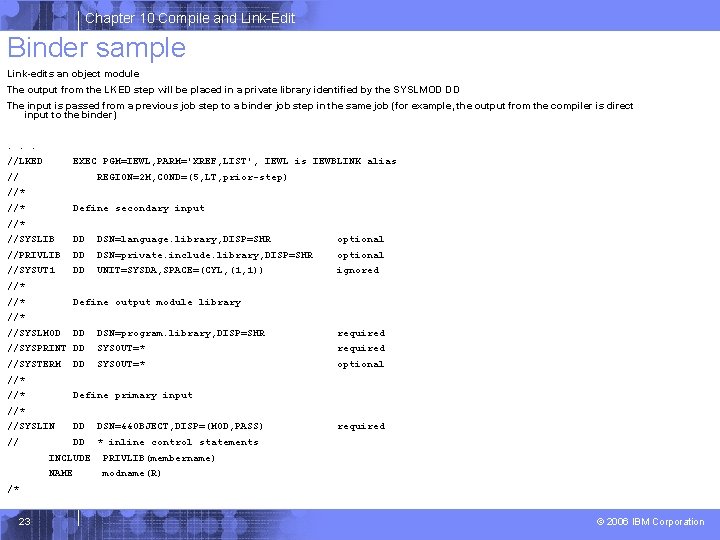
Chapter 10 Compile and Link-Edit Binder sample Link-edits an object module The output from the LKED step will be placed in a private library identified by the SYSLMOD DD The input is passed from a previous job step to a binder job step in the same job (for example, the output from the compiler is direct input to the binder). . . //LKED EXEC PGM=IEWL, PARM='XREF, LIST', IEWL is IEWBLINK alias // REGION=2 M, COND=(5, LT, prior-step) //* Define secondary input //* //SYSLIB DD DSN=language. library, DISP=SHR optional //PRIVLIB DD DSN=private. include. library, DISP=SHR optional //SYSUT 1 DD UNIT=SYSDA, SPACE=(CYL, (1, 1)) ignored //* Define output module library //* //SYSLMOD DD DSN=program. library, DISP=SHR required //SYSPRINT DD SYSOUT=* required //SYSTERM SYSOUT=* optional DD //* Define primary input //* //SYSLIN DD DSN=&&OBJECT, DISP=(MOD, PASS) // DD * inline control statements INCLUDE PRIVLIB(membername) NAME modname(R) required /* 23 © 2006 IBM Corporation
Chapter 10 Compile and Link-Edit Creating load modules for executable programs § A load module is an executable program stored in a partitioned data set program library § Creating a load module to execute only will require that you use a batch loader or program management loader § Creating a load module that can be stored in a program library requires that you use the binder or linkage editor 24 © 2006 IBM Corporation
Chapter 10 Compile and Link-Edit Creating load modules for executable programs (continued) § In all cases, the load module is relocatable – That is, it can be located at any address in virtual storage within the confines of the residency mode (RMODE) § Relocatable programs allow an identical copy of a program to be loaded in many different address spaces, each being loaded at a different starting address 25 © 2006 IBM Corporation
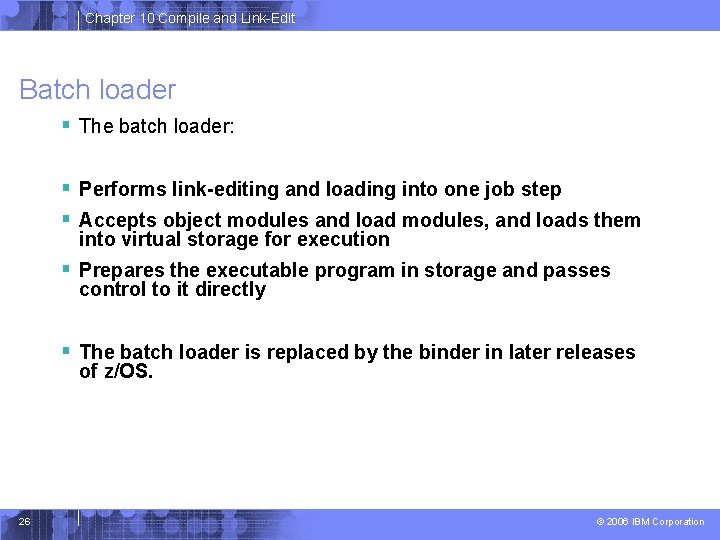
Chapter 10 Compile and Link-Edit Batch loader § The batch loader: § Performs link-editing and loading into one job step § Accepts object modules and load modules, and loads them into virtual storage for execution § Prepares the executable program in storage and passes control to it directly § The batch loader is replaced by the binder in later releases of z/OS. 26 © 2006 IBM Corporation
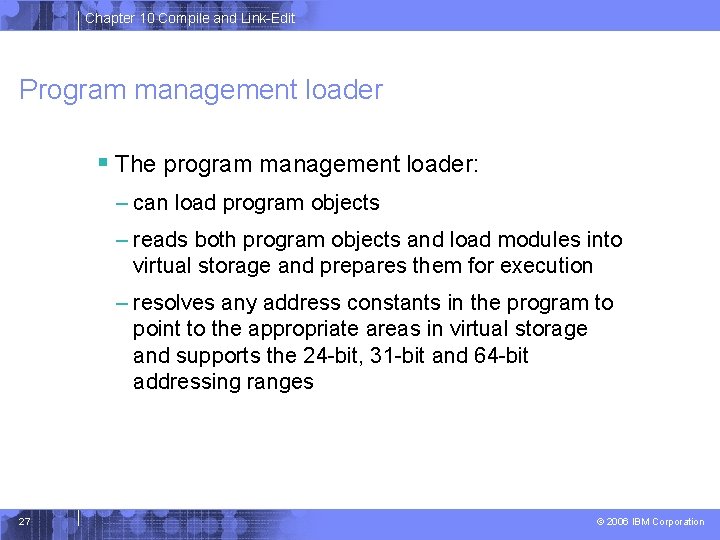
Chapter 10 Compile and Link-Edit Program management loader § The program management loader: – can load program objects – reads both program objects and load modules into virtual storage and prepares them for execution – resolves any address constants in the program to point to the appropriate areas in virtual storage and supports the 24 -bit, 31 -bit and 64 -bit addressing ranges 27 © 2006 IBM Corporation
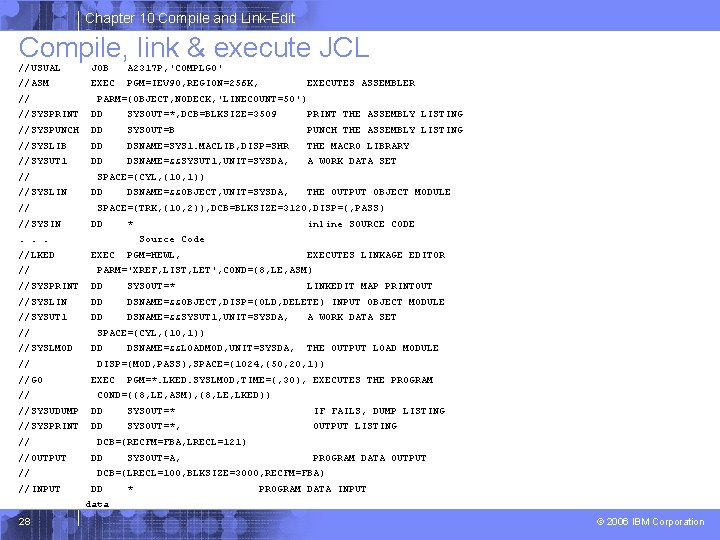
Chapter 10 Compile and Link-Edit Compile, link & execute JCL //USUAL JOB A 2317 P, 'COMPLGO' //ASM EXEC PGM=IEV 90, REGION=256 K, // EXECUTES ASSEMBLER PARM=(OBJECT, NODECK, 'LINECOUNT=50') //SYSPRINT DD SYSOUT=*, DCB=BLKSIZE=3509 PRINT THE ASSEMBLY LISTING //SYSPUNCH DD SYSOUT=B PUNCH THE ASSEMBLY LISTING //SYSLIB DD DSNAME=SYS 1. MACLIB, DISP=SHR THE MACRO LIBRARY //SYSUT 1 DD DSNAME=&&SYSUT 1, UNIT=SYSDA, A WORK DATA SET // //SYSLIN // //SYSIN SPACE=(CYL, (10, 1)) DD DSNAME=&&OBJECT, UNIT=SYSDA, SPACE=(TRK, (10, 2)), DCB=BLKSIZE=3120, DISP=(, PASS) DD * . . . //LKED // THE OUTPUT OBJECT MODULE inline SOURCE CODE Source Code EXEC PGM=HEWL, EXECUTES LINKAGE EDITOR PARM='XREF, LIST, LET', COND=(8, LE, ASM) //SYSPRINT DD SYSOUT=* //SYSLIN DD DSNAME=&&OBJECT, DISP=(OLD, DELETE) INPUT OBJECT MODULE //SYSUT 1 DD DSNAME=&&SYSUT 1, UNIT=SYSDA, // //SYSLMOD // //GO // LINKEDIT MAP PRINTOUT A WORK DATA SET SPACE=(CYL, (10, 1)) DD DSNAME=&&LOADMOD, UNIT=SYSDA, THE OUTPUT LOAD MODULE DISP=(MOD, PASS), SPACE=(1024, (50, 20, 1)) EXEC PGM=*. LKED. SYSLMOD, TIME=(, 30), EXECUTES THE PROGRAM COND=((8, LE, ASM), (8, LE, LKED)) //SYSUDUMP DD SYSOUT=* IF FAILS, DUMP LISTING //SYSPRINT DD SYSOUT=*, OUTPUT LISTING // //OUTPUT // //INPUT DCB=(RECFM=FBA, LRECL=121) DD SYSOUT=A, PROGRAM DATA OUTPUT DCB=(LRECL=100, BLKSIZE=3000, RECFM=FBA) DD * PROGRAM DATA INPUT data // 28 © 2006 IBM Corporation
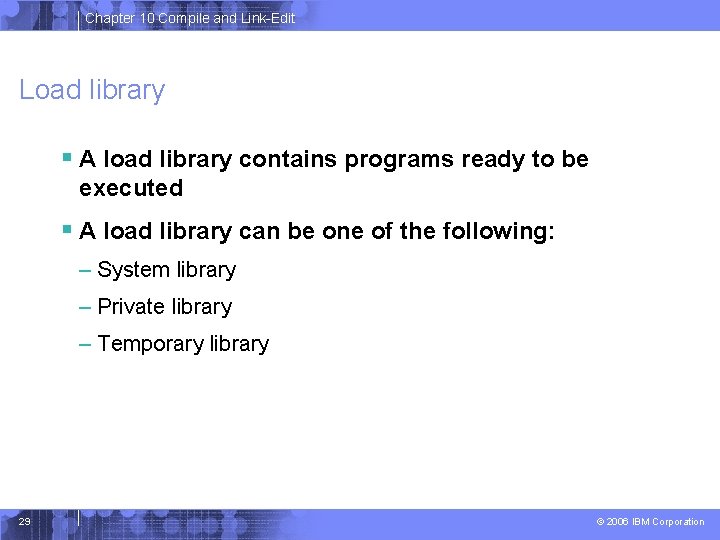
Chapter 10 Compile and Link-Edit Load library § A load library contains programs ready to be executed § A load library can be one of the following: – System library – Private library – Temporary library 29 © 2006 IBM Corporation
Chapter 10 Compile and Link-Edit System library § Unless a job or step specifies a private library, the system searches for a program in the system libraries when you code: § //stepname EXEC PGM=program-name § The system looks in the libraries for a member with a name or alias that is the same as the specified program-name § The most used system library is SYS 1. LINKLIB, which contains executable programs that have been processed by the linkage editor 30 © 2006 IBM Corporation
Chapter 10 Compile and Link-Edit Private library § Private libraries are useful for storing programs too seldom needed to be stored in a system library § User-written programs are usually stored as members in a private library § To indicate that a program is in a private library, you code the DD statement defining the library with JOBLIB or STEPLIB § Result: The system searches for the program to be executed in the library defined by the JOBLIB or STEPLIB DD statement before searching in the system libraries. 31 © 2006 IBM Corporation

Chapter 10 Compile and Link-Edit Overview of compilation to execution 32 © 2006 IBM Corporation
Chapter 10 Compile and Link-Edit Using procedures § Saves time and prevents errors § Consist of job control statements placed in a PDS or PDSE known as a procedure library § When stored in the system procedure library SYS 1. PROCLIB (or an installation-defined procedure library) is called a cataloged procedure § A procedure in an input stream is called an inline procedure § Limit of 15 inline procedures per job. 33 © 2006 IBM Corporation

Chapter 10 Compile and Link-Edit Sample definition of a procedure //DEF PROC STATUS=OLD, LIBRARY=SYSLIB, NUMBER=777777 //NOTIFY EXEC PGM=ACCUM //DD 1 DD DSNAME=MGMT, DISP=(&STATUS, KEEP), UNIT=3400 -6, // //DD 2 // 34 VOLUME=SER=888888 DD DSNAME=&LIBRARY, DISP=(OLD, KEEP), UNIT=3350, VOLUME=SER=&NUMBER © 2006 IBM Corporation
Chapter 10 Compile and Link-Edit Summary § 35 The basic steps for turning a source program into an executable load module are: 1. compile 2. link-edit 3. bind § The compile step translates source code into relocatable machine language, in the form of object code. § Object code must be processed by a binder (or linkage editor or loader) before it can be executed. © 2006 IBM Corporation
Chapter 10 Compile and Link-Edit Summary (continued) § The binder resolves unresolved references in the object code and ensures that everything needed by the program is included in the final load module. § To execute a load module, the binder loads the module into real storage and then transfers control to it to begin execution. 36 © 2006 IBM Corporation
- Slides: 36