
Introduction to YAXT Yet Another e Xchange Tool

![Doing the exchange and clean up. int src_data[1] = {…}; int tgt_data[4]; xt_redist_s_exchange 1(](https://slidetodoc.com/presentation_image_h/043561edaf1605486a77e4c92717a87e/image-13.jpg "Doing the exchange and clean up. int src_data[1] = {…}; int tgt_data[4]; xt_redist_s_exchange 1(")
![MPIOM [TP 04 L 40: 8 x 4] Load Balance 1. Wet-point-only optimized Ø](https://slidetodoc.com/presentation_image_h/043561edaf1605486a77e4c92717a87e/image-37.jpg "MPIOM [TP 04 L 40: 8 x 4] Load Balance 1. Wet-point-only optimized Ø")
- Slides: 39
Introduction to YAXT (Yet Another e. Xchange Tool, DKRZ 2012 -2013) Jörg Behrens, Moritz Hanke, Thomas Jahns
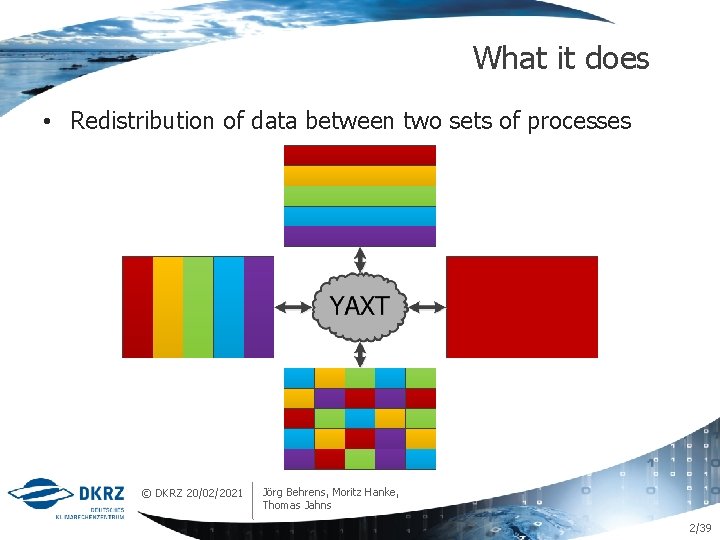
What it does • Redistribution of data between two sets of processes © DKRZ 20/02/2021 Jörg Behrens, Moritz Hanke, Thomas Jahns 2 /39
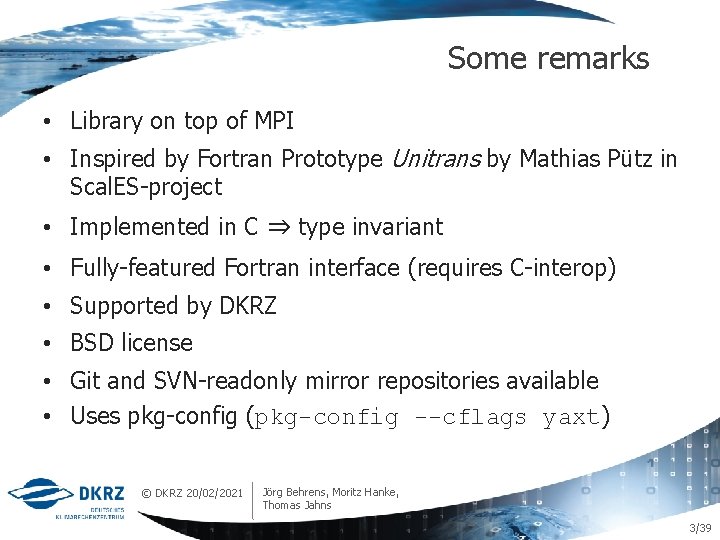
Some remarks • Library on top of MPI • Inspired by Fortran Prototype Unitrans by Mathias Pütz in Scal. ES-project • Implemented in C ⇒ type invariant • Fully-featured Fortran interface (requires C-interop) • Supported by DKRZ • BSD license • Git and SVN-readonly mirror repositories available • Uses pkg-config (pkg-config --cflags yaxt) © DKRZ 20/02/2021 Jörg Behrens, Moritz Hanke, Thomas Jahns 3 /39
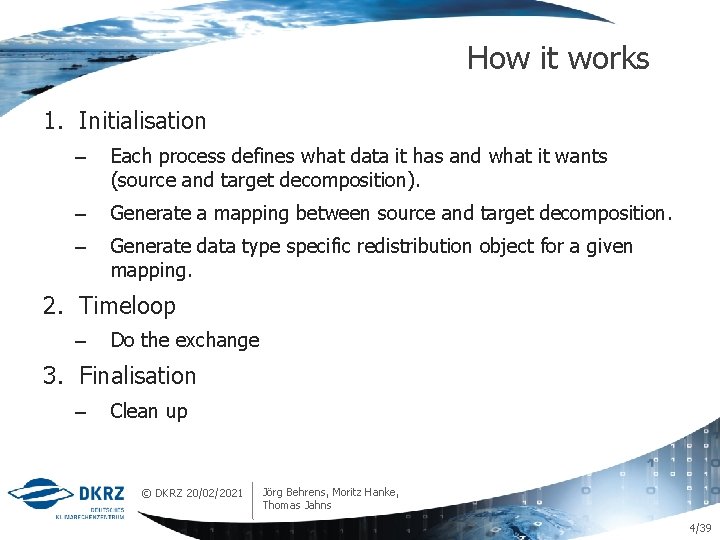
How it works 1. Initialisation – Each process defines what data it has and what it wants (source and target decomposition). – Generate a mapping between source and target decomposition. – Generate data type specific redistribution object for a given mapping. 2. Timeloop – Do the exchange 3. Finalisation – Clean up © DKRZ 20/02/2021 Jörg Behrens, Moritz Hanke, Thomas Jahns 4 /39
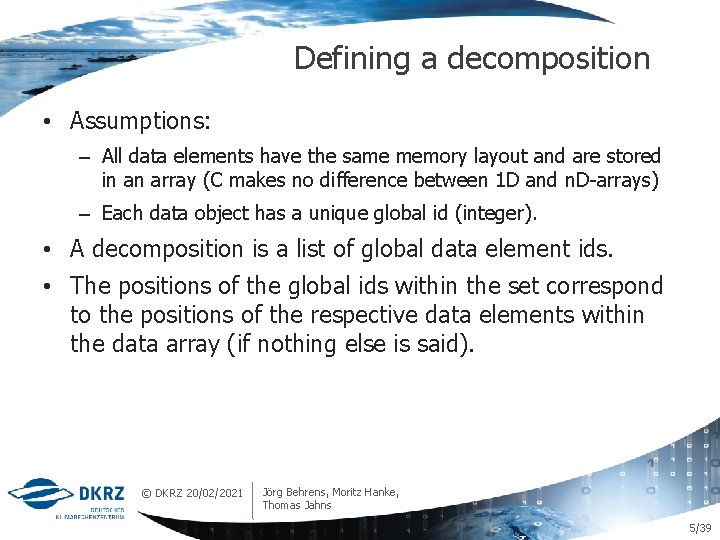
Defining a decomposition • Assumptions: – All data elements have the same memory layout and are stored in an array (C makes no difference between 1 D and n. D-arrays) – Each data object has a unique global id (integer). • A decomposition is a list of global data element ids. • The positions of the global ids within the set correspond to the positions of the respective data elements within the data array (if nothing else is said). © DKRZ 20/02/2021 Jörg Behrens, Moritz Hanke, Thomas Jahns 5 /39
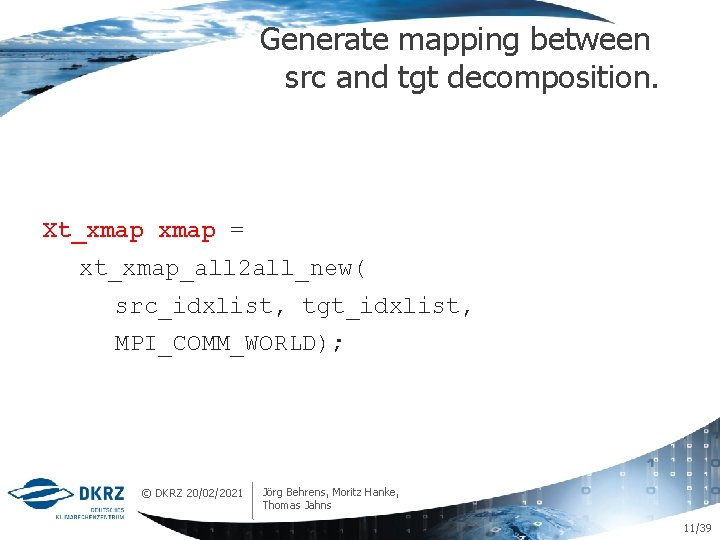
Generate mapping between src and tgt decomposition • To generate a mapping you need to provide the two decompositions and a MPI communicator. • The operation is collective for all processes within the given communicator. © DKRZ 20/02/2021 Jörg Behrens, Moritz Hanke, Thomas Jahns 6 /39
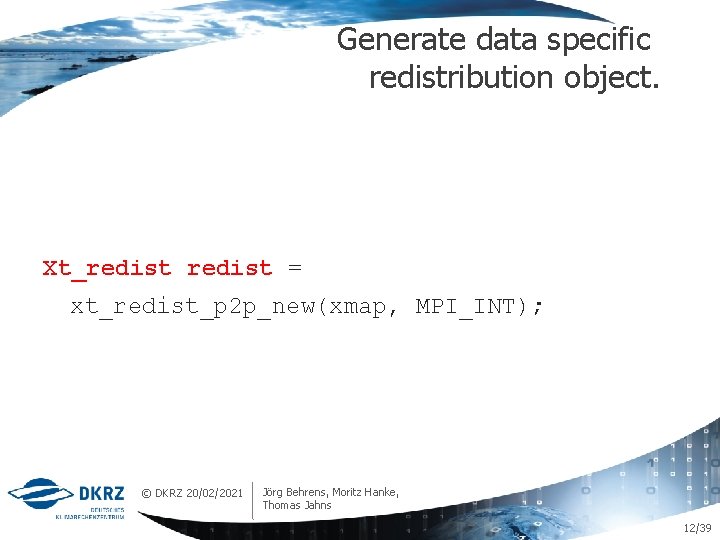
Generate data specific redistribution object • To generate a data specific redistribution object the user needs to provide a mapping object and the MPI data type for the data elements. • It is possible to combine multiple existing redistribution objects (useful for aggregation of data exchanges). © DKRZ 20/02/2021 Jörg Behrens, Moritz Hanke, Thomas Jahns 7 /39
Doing the exchange and clean up • To do the exchange the user needs to call the exchange routine and provide a redistribution object and the source and target array(s) (passed via C_LOC from Fortran). • All objects generated by YAXT can be destroyed by calling the respective destructor. © DKRZ 20/02/2021 Jörg Behrens, Moritz Hanke, Thomas Jahns 8 /39
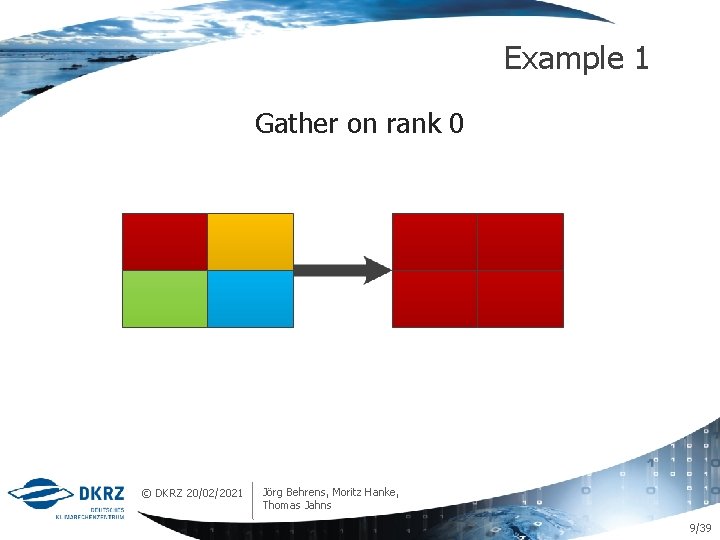
Example 1 Gather on rank 0 © DKRZ 20/02/2021 Jörg Behrens, Moritz Hanke, Thomas Jahns 9 /39
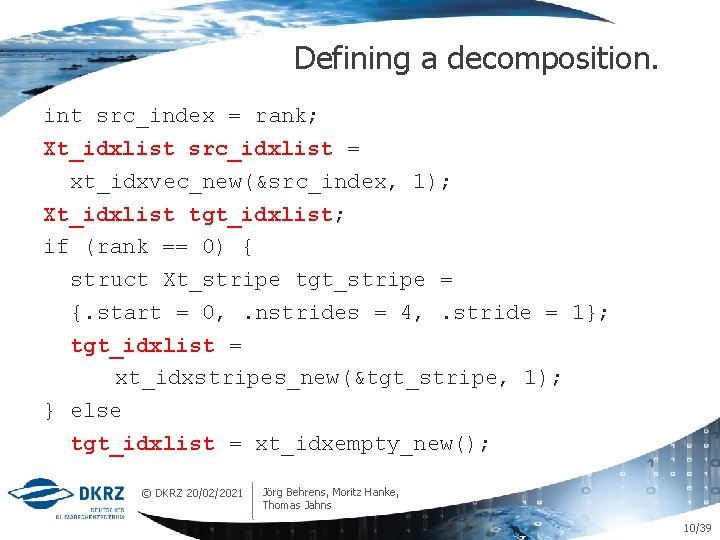
Defining a decomposition. int src_index = rank; Xt_idxlist src_idxlist = xt_idxvec_new(&src_index, 1); Xt_idxlist tgt_idxlist; if (rank == 0) { struct Xt_stripe tgt_stripe = {. start = 0, . nstrides = 4, . stride = 1}; tgt_idxlist = xt_idxstripes_new(&tgt_stripe, 1); } else tgt_idxlist = xt_idxempty_new(); © DKRZ 20/02/2021 Jörg Behrens, Moritz Hanke, Thomas Jahns 10 /39
Generate mapping between src and tgt decomposition. Xt_xmap = xt_xmap_all 2 all_new( src_idxlist, tgt_idxlist, MPI_COMM_WORLD); © DKRZ 20/02/2021 Jörg Behrens, Moritz Hanke, Thomas Jahns 11 /39
Generate data specific redistribution object. Xt_redist = xt_redist_p 2 p_new(xmap, MPI_INT); © DKRZ 20/02/2021 Jörg Behrens, Moritz Hanke, Thomas Jahns 12 /39
Doing the exchange and clean up. int src_data[1] = {…}; int tgt_data[4]; xt_redist_s_exchange 1( redist, src_data, tgt_data); xt_redist_delete(redist); xt_xmap_delete(xmap); xt_idxlist_delete(tgt_idxlist); xt_idxlist_delete(src_idxlist); © DKRZ 20/02/2021 Jörg Behrens, Moritz Hanke, Thomas Jahns 13 /39
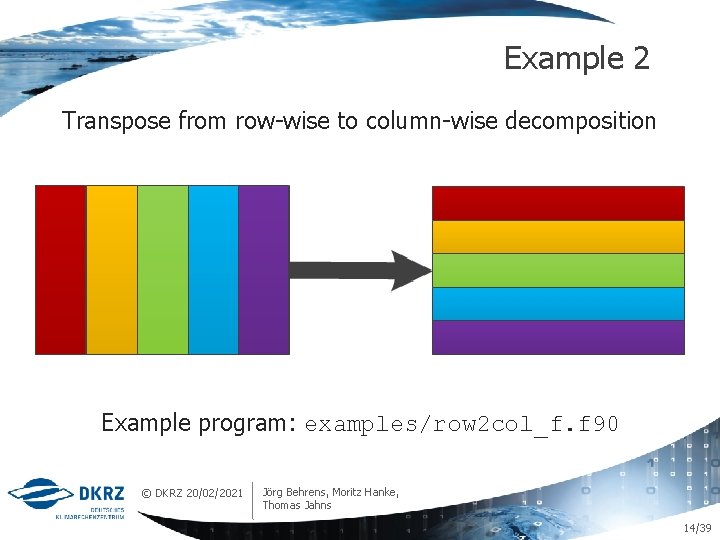
Example 2 Transpose from row-wise to column-wise decomposition Example program: examples/row 2 col_f. f 90 © DKRZ 20/02/2021 Jörg Behrens, Moritz Hanke, Thomas Jahns 14 /39
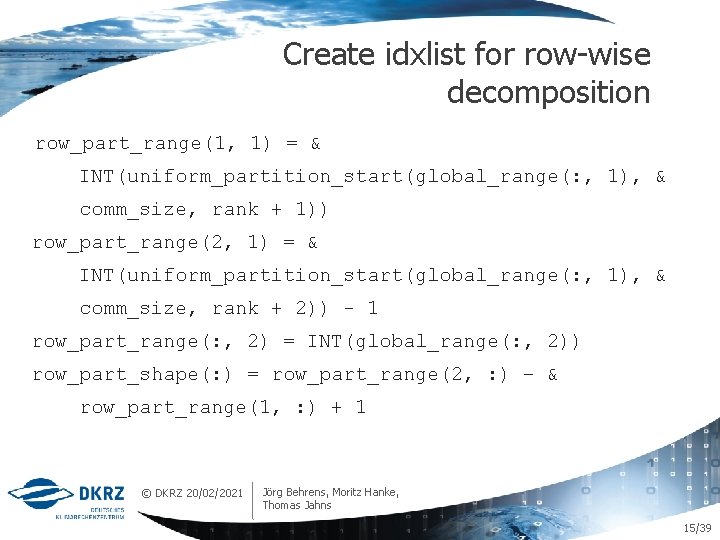
Create idxlist for row-wise decomposition row_part_range(1, 1) = & INT(uniform_partition_start(global_range(: , 1), & comm_size, rank + 1)) row_part_range(2, 1) = & INT(uniform_partition_start(global_range(: , 1), & comm_size, rank + 2)) - 1 row_part_range(: , 2) = INT(global_range(: , 2)) row_part_shape(: ) = row_part_range(2, : ) – & row_part_range(1, : ) + 1 © DKRZ 20/02/2021 Jörg Behrens, Moritz Hanke, Thomas Jahns 15 /39
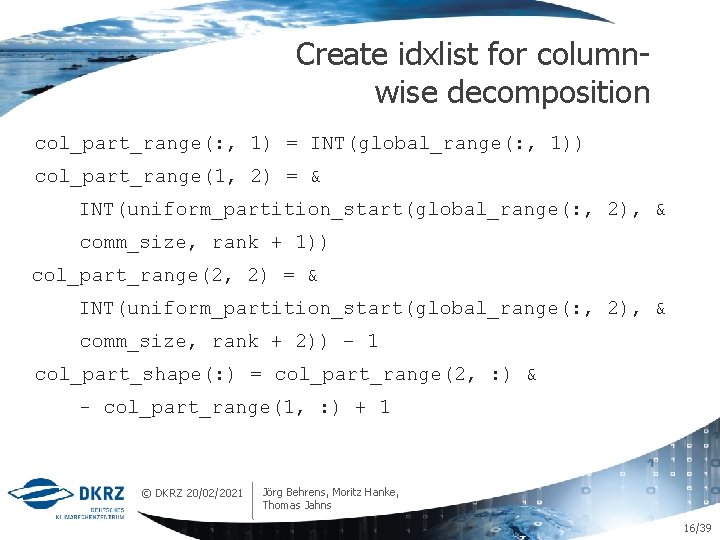
Create idxlist for columnwise decomposition col_part_range(: , 1) = INT(global_range(: , 1)) col_part_range(1, 2) = & INT(uniform_partition_start(global_range(: , 2), & comm_size, rank + 1)) col_part_range(2, 2) = & INT(uniform_partition_start(global_range(: , 2), & comm_size, rank + 2)) – 1 col_part_shape(: ) = col_part_range(2, : ) & - col_part_range(1, : ) + 1 © DKRZ 20/02/2021 Jörg Behrens, Moritz Hanke, Thomas Jahns 16 /39
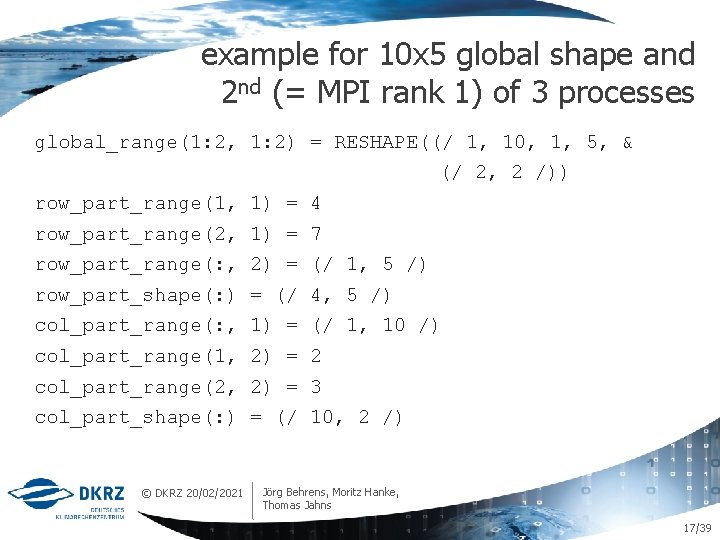
example for 10 x 5 global shape and 2 nd (= MPI rank 1) of 3 processes global_range(1: 2, 1: 2) = RESHAPE((/ 1, 10, 1, 5, & (/ 2, 2 /)) row_part_range(1, 1) = 4 row_part_range(2, 1) = 7 row_part_range(: , 2) = (/ 1, 5 /) row_part_shape(: ) = (/ 4, 5 /) col_part_range(: , 1) = (/ 1, 10 /) col_part_range(1, 2) = 2 col_part_range(2, 2) = 3 col_part_shape(: ) = (/ 10, 2 /) © DKRZ 20/02/2021 Jörg Behrens, Moritz Hanke, Thomas Jahns 17 /39
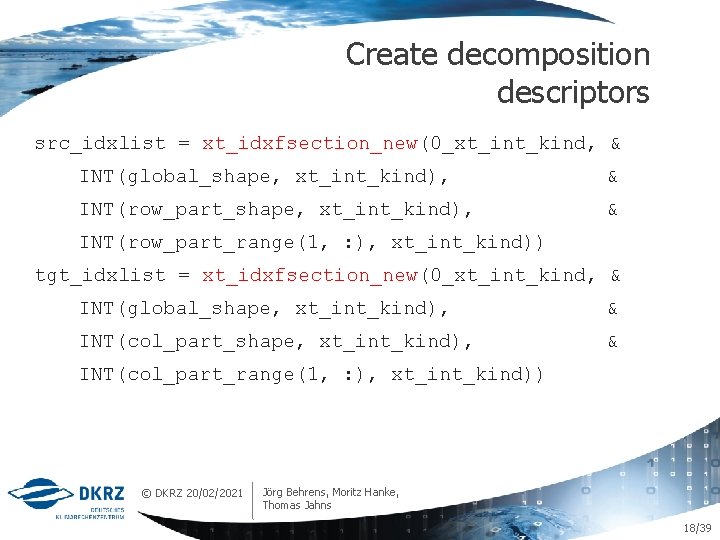
Create decomposition descriptors src_idxlist = xt_idxfsection_new(0_xt_int_kind, & INT(global_shape, xt_int_kind), & INT(row_part_range(1, : ), xt_int_kind)) tgt_idxlist = xt_idxfsection_new(0_xt_int_kind, & INT(global_shape, xt_int_kind), & INT(col_part_range(1, : ), xt_int_kind)) © DKRZ 20/02/2021 Jörg Behrens, Moritz Hanke, Thomas Jahns 18 /39
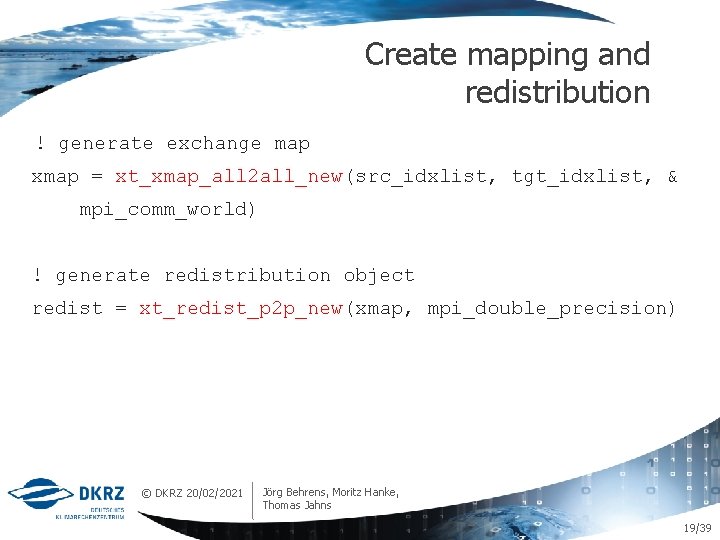
Create mapping and redistribution ! generate exchange map xmap = xt_xmap_all 2 all_new(src_idxlist, tgt_idxlist, & mpi_comm_world) ! generate redistribution object redist = xt_redist_p 2 p_new(xmap, mpi_double_precision) © DKRZ 20/02/2021 Jörg Behrens, Moritz Hanke, Thomas Jahns 19 /39
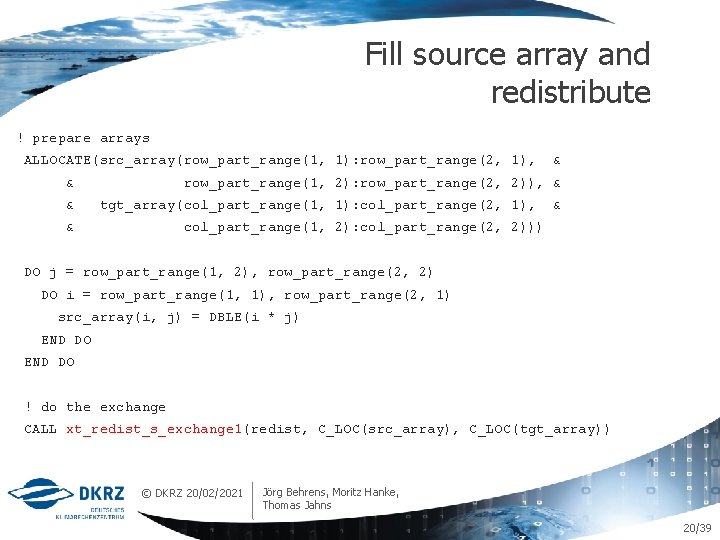
Fill source array and redistribute ! prepare arrays ALLOCATE(src_array(row_part_range(1, 1): row_part_range(2, 1), & & & row_part_range(1, 2): row_part_range(2, 2)), & tgt_array(col_part_range(1, 1): col_part_range(2, 1), & & col_part_range(1, 2): col_part_range(2, 2))) DO j = row_part_range(1, 2), row_part_range(2, 2) DO i = row_part_range(1, 1), row_part_range(2, 1) src_array(i, j) = DBLE(i * j) END DO ! do the exchange CALL xt_redist_s_exchange 1(redist, C_LOC(src_array), C_LOC(tgt_array)) © DKRZ 20/02/2021 Jörg Behrens, Moritz Hanke, Thomas Jahns 20 /39
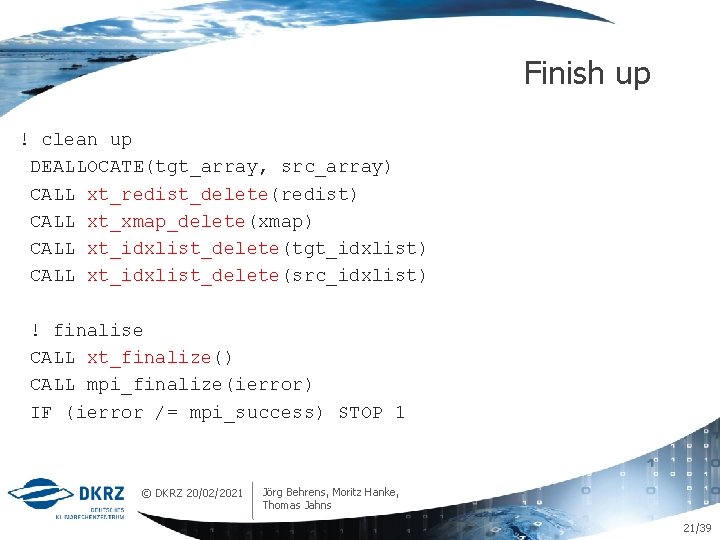
Finish up ! clean up DEALLOCATE(tgt_array, src_array) CALL xt_redist_delete(redist) CALL xt_xmap_delete(xmap) CALL xt_idxlist_delete(tgt_idxlist) CALL xt_idxlist_delete(src_idxlist) ! finalise CALL xt_finalize() CALL mpi_finalize(ierror) IF (ierror /= mpi_success) STOP 1 © DKRZ 20/02/2021 Jörg Behrens, Moritz Hanke, Thomas Jahns 21 /39
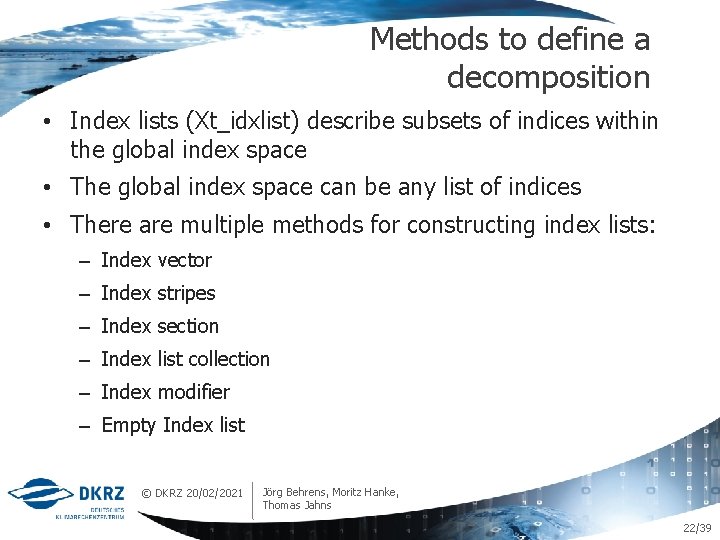
Methods to define a decomposition • Index lists (Xt_idxlist) describe subsets of indices within the global index space • The global index space can be any list of indices • There are multiple methods for constructing index lists: – Index vector – Index stripes – Index section – Index list collection – Index modifier – Empty Index list © DKRZ 20/02/2021 Jörg Behrens, Moritz Hanke, Thomas Jahns 22 /39
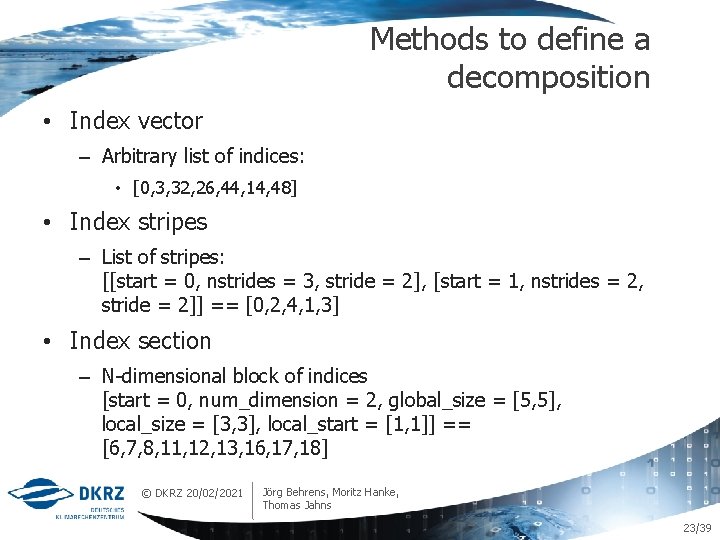
Methods to define a decomposition • Index vector – Arbitrary list of indices: • [0, 3, 32, 26, 44, 14, 48] • Index stripes – List of stripes: [[start = 0, nstrides = 3, stride = 2], [start = 1, nstrides = 2, stride = 2]] == [0, 2, 4, 1, 3] • Index section – N-dimensional block of indices [start = 0, num_dimension = 2, global_size = [5, 5], local_size = [3, 3], local_start = [1, 1]] == [6, 7, 8, 11, 12, 13, 16, 17, 18] © DKRZ 20/02/2021 Jörg Behrens, Moritz Hanke, Thomas Jahns 23 /39
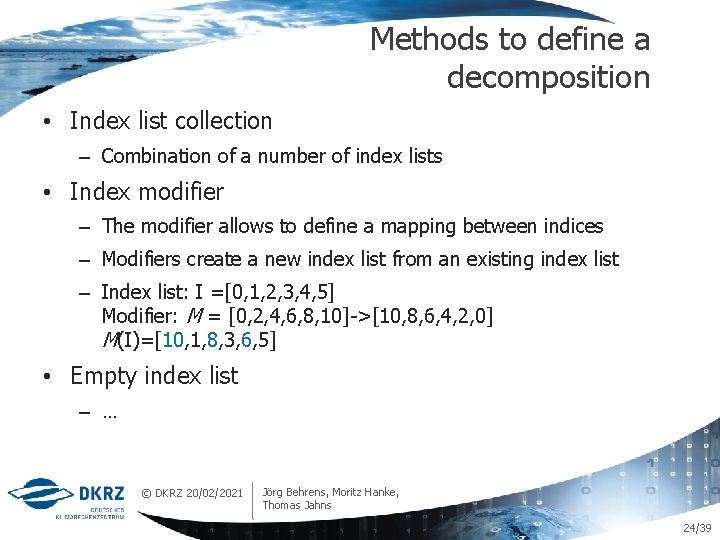
Methods to define a decomposition • Index list collection – Combination of a number of index lists • Index modifier – The modifier allows to define a mapping between indices – Modifiers create a new index list from an existing index list – Index list: I =[0, 1, 2, 3, 4, 5] Modifier: M = [0, 2, 4, 6, 8, 10]->[10, 8, 6, 4, 2, 0] M(I)=[10, 1, 8, 3, 6, 5] • Empty index list – … © DKRZ 20/02/2021 Jörg Behrens, Moritz Hanke, Thomas Jahns 24 /39
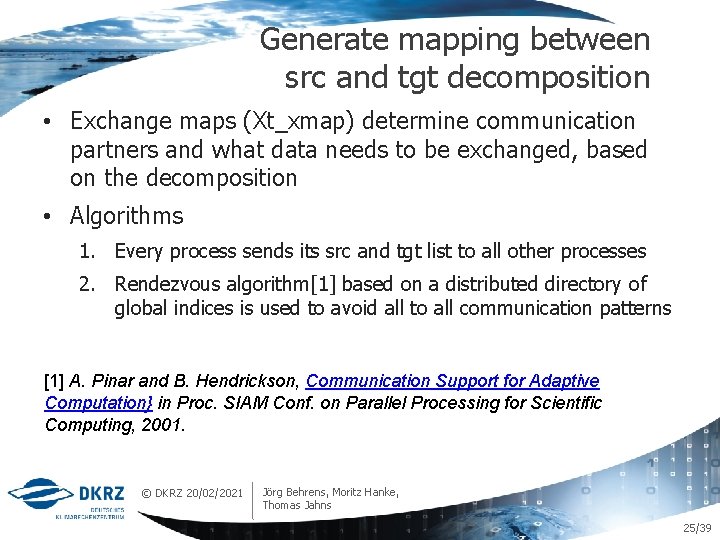
Generate mapping between src and tgt decomposition • Exchange maps (Xt_xmap) determine communication partners and what data needs to be exchanged, based on the decomposition • Algorithms 1. Every process sends its src and tgt list to all other processes 2. Rendezvous algorithm[1] based on a distributed directory of global indices is used to avoid all to all communication patterns [1] A. Pinar and B. Hendrickson, Communication Support for Adaptive Computation} in Proc. SIAM Conf. on Parallel Processing for Scientific Computing, 2001. © DKRZ 20/02/2021 Jörg Behrens, Moritz Hanke, Thomas Jahns 25 /39
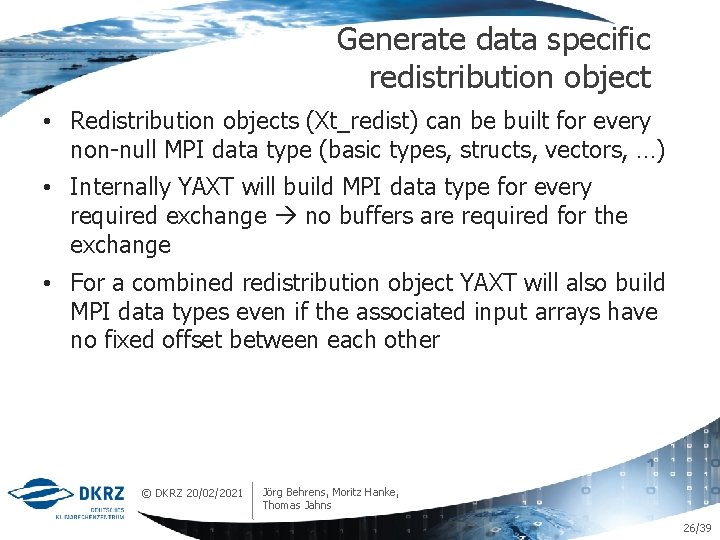
Generate data specific redistribution object • Redistribution objects (Xt_redist) can be built for every non-null MPI data type (basic types, structs, vectors, …) • Internally YAXT will build MPI data type for every required exchange no buffers are required for the exchange • For a combined redistribution object YAXT will also build MPI data types even if the associated input arrays have no fixed offset between each other © DKRZ 20/02/2021 Jörg Behrens, Moritz Hanke, Thomas Jahns 26 /39
Doing the exchange • YAXT currently supports blocking redistribution of data. © DKRZ 20/02/2021 Jörg Behrens, Moritz Hanke, Thomas Jahns 27 /39
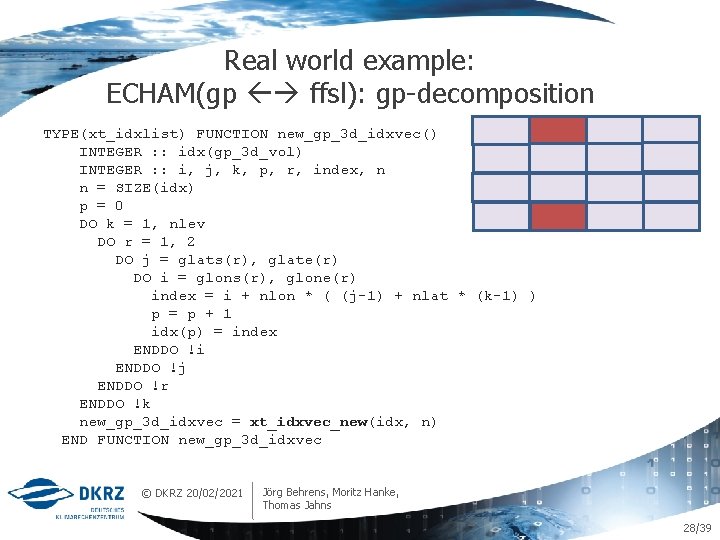
Real world example: ECHAM(gp ffsl): gp-decomposition TYPE(xt_idxlist) FUNCTION new_gp_3 d_idxvec() INTEGER : : idx(gp_3 d_vol) INTEGER : : i, j, k, p, r, index, n n = SIZE(idx) p = 0 DO k = 1, nlev DO r = 1, 2 DO j = glats(r), glate(r) DO i = glons(r), glone(r) index = i + nlon * ( (j-1) + nlat * (k-1) ) p = p + 1 idx(p) = index ENDDO !i ENDDO !j ENDDO !r ENDDO !k new_gp_3 d_idxvec = xt_idxvec_new(idx, n) END FUNCTION new_gp_3 d_idxvec © DKRZ 20/02/2021 Jörg Behrens, Moritz Hanke, Thomas Jahns 28 /39
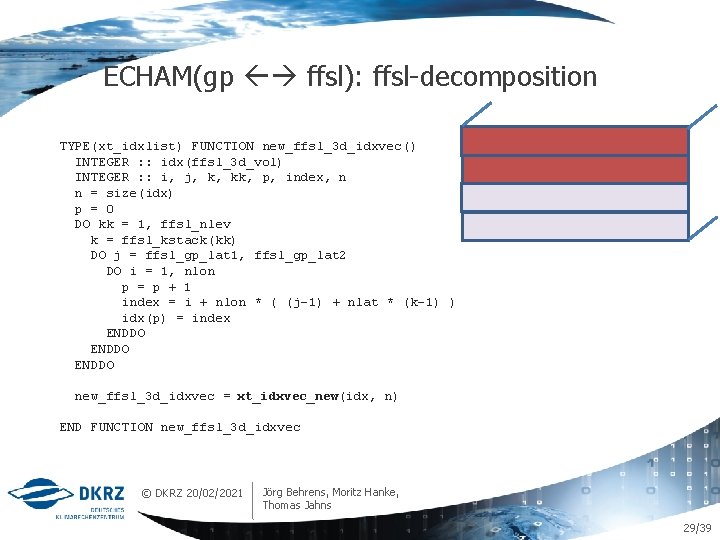
ECHAM(gp ffsl): ffsl-decomposition TYPE(xt_idxlist) FUNCTION new_ffsl_3 d_idxvec() INTEGER : : idx(ffsl_3 d_vol) INTEGER : : i, j, k, kk, p, index, n n = size(idx) p = 0 DO kk = 1, ffsl_nlev k = ffsl_kstack(kk) DO j = ffsl_gp_lat 1, ffsl_gp_lat 2 DO i = 1, nlon p = p + 1 index = i + nlon * ( (j-1) + nlat * (k-1) ) idx(p) = index ENDDO new_ffsl_3 d_idxvec = xt_idxvec_new(idx, n) END FUNCTION new_ffsl_3 d_idxvec © DKRZ 20/02/2021 Jörg Behrens, Moritz Hanke, Thomas Jahns 29 /39
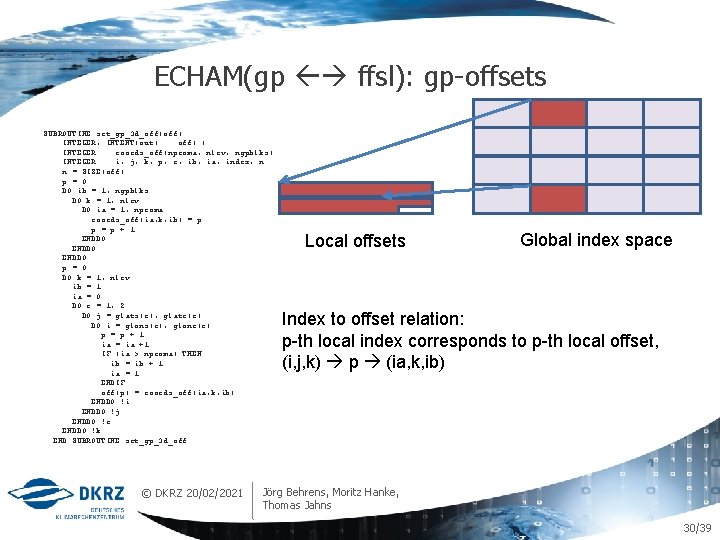
ECHAM(gp ffsl): gp-offsets SUBROUTINE set_gp_3 d_off(off) INTEGER, INTENT(out) : : off(: ) INTEGER : : coords_off(nproma, nlev, ngpblks) INTEGER : : i, j, k, p, r, ib, ia, index, n n = SIZE(off) p = 0 DO ib = 1, ngpblks DO k = 1, nlev DO ia = 1, nproma coords_off(ia, k, ib) = p p = p + 1 ENDDO p = 0 DO k = 1, nlev ib = 1 ia = 0 DO r = 1, 2 DO j = glats(r), glate(r) DO i = glons(r), glone(r) p = p + 1 ia = ia +1 IF (ia > nproma) THEN ib = ib + 1 ia = 1 ENDIF off(p) = coords_off(ia, k, ib) ENDDO !i ENDDO !j ENDDO !r ENDDO !k END SUBROUTINE set_gp_3 d_off © DKRZ 20/02/2021 Local offsets Global index space Index to offset relation: p-th local index corresponds to p-th local offset, (i, j, k) p (ia, k, ib) Jörg Behrens, Moritz Hanke, Thomas Jahns 30 /39
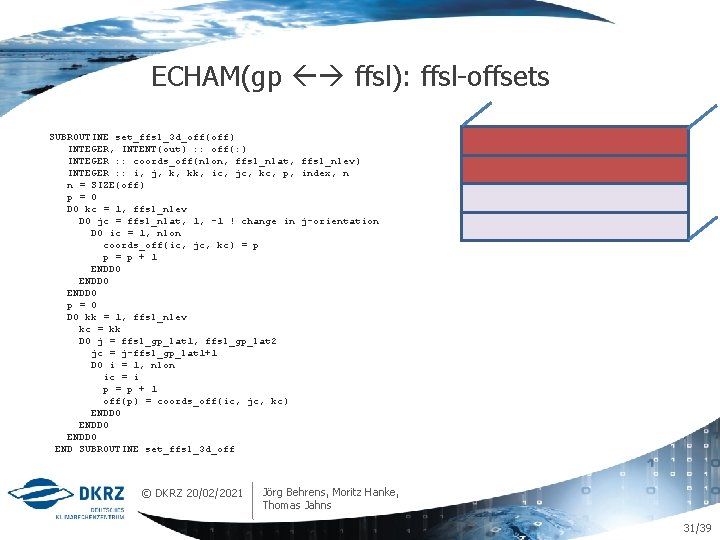
ECHAM(gp ffsl): ffsl-offsets SUBROUTINE set_ffsl_3 d_off(off) INTEGER, INTENT(out) : : off(: ) INTEGER : : coords_off(nlon, ffsl_nlat, ffsl_nlev) INTEGER : : i, j, k, kk, ic, jc, kc, p, index, n n = SIZE(off) p = 0 DO kc = 1, ffsl_nlev DO jc = ffsl_nlat, 1, -1 ! change in j-orientation DO ic = 1, nlon coords_off(ic, jc, kc) = p p = p + 1 ENDDO p = 0 DO kk = 1, ffsl_nlev kc = kk DO j = ffsl_gp_lat 1, ffsl_gp_lat 2 jc = j-ffsl_gp_lat 1+1 DO i = 1, nlon ic = i p = p + 1 off(p) = coords_off(ic, jc, kc) ENDDO END SUBROUTINE set_ffsl_3 d_off © DKRZ 20/02/2021 Jörg Behrens, Moritz Hanke, Thomas Jahns 31 /39
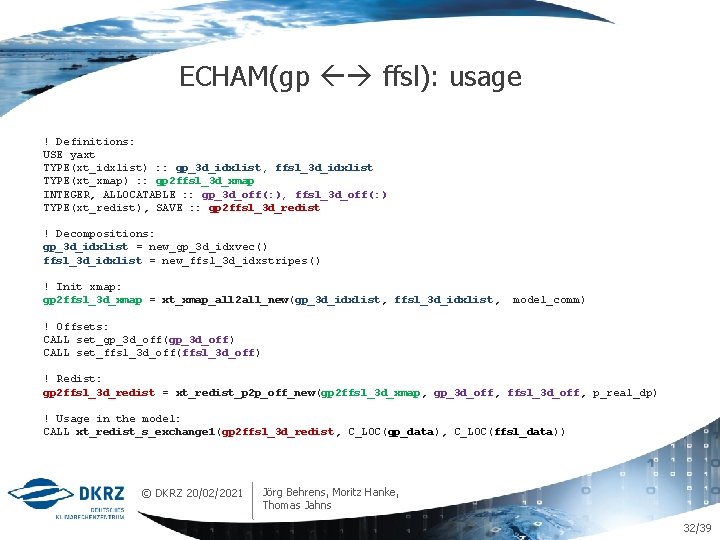
ECHAM(gp ffsl): usage ! Definitions: USE yaxt TYPE(xt_idxlist) : : gp_3 d_idxlist, ffsl_3 d_idxlist TYPE(xt_xmap) : : gp 2 ffsl_3 d_xmap INTEGER, ALLOCATABLE : : gp_3 d_off(: ), ffsl_3 d_off(: ) TYPE(xt_redist), SAVE : : gp 2 ffsl_3 d_redist ! Decompositions: gp_3 d_idxlist = new_gp_3 d_idxvec() ffsl_3 d_idxlist = new_ffsl_3 d_idxstripes() ! Init xmap: gp 2 ffsl_3 d_xmap = xt_xmap_all 2 all_new(gp_3 d_idxlist, ffsl_3 d_idxlist, model_comm) ! Offsets: CALL set_gp_3 d_off(gp_3 d_off) CALL set_ffsl_3 d_off(ffsl_3 d_off) ! Redist: gp 2 ffsl_3 d_redist = xt_redist_p 2 p_off_new(gp 2 ffsl_3 d_xmap, gp_3 d_off, ffsl_3 d_off, p_real_dp) ! Usage in the model: CALL xt_redist_s_exchange 1(gp 2 ffsl_3 d_redist, C_LOC(gp_data), C_LOC(ffsl_data)) © DKRZ 20/02/2021 Jörg Behrens, Moritz Hanke, Thomas Jahns 32 /39
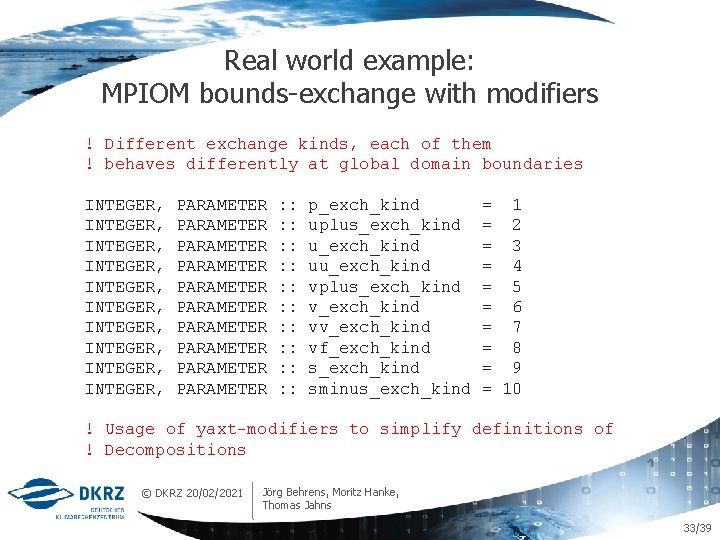
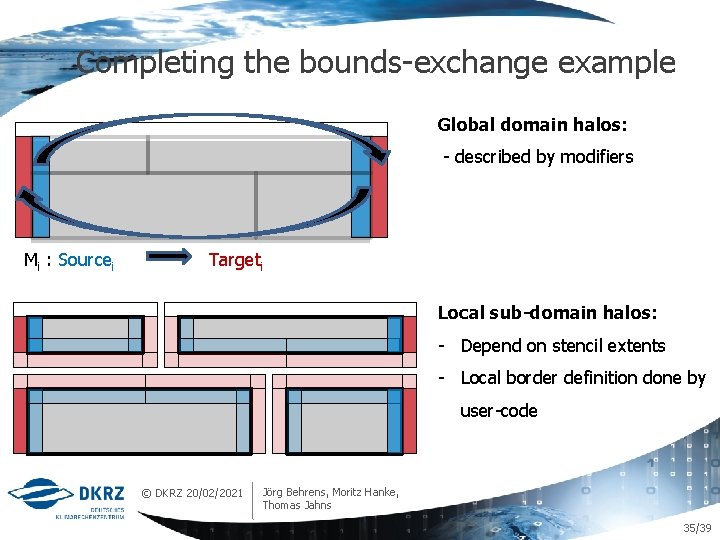
Real world example: MPIOM bounds-exchange with modifiers ! Different exchange kinds, each of them ! behaves differently at global domain boundaries INTEGER, INTEGER, INTEGER, PARAMETER PARAMETER PARAMETER : : : : : p_exch_kind uplus_exch_kind uu_exch_kind vplus_exch_kind vv_exch_kind vf_exch_kind sminus_exch_kind = 1 = 2 = 3 = 4 = 5 = 6 = 7 = 8 = 9 = 10 ! Usage of yaxt-modifiers to simplify definitions of ! Decompositions © DKRZ 20/02/2021 Jörg Behrens, Moritz Hanke, Thomas Jahns 33 /39
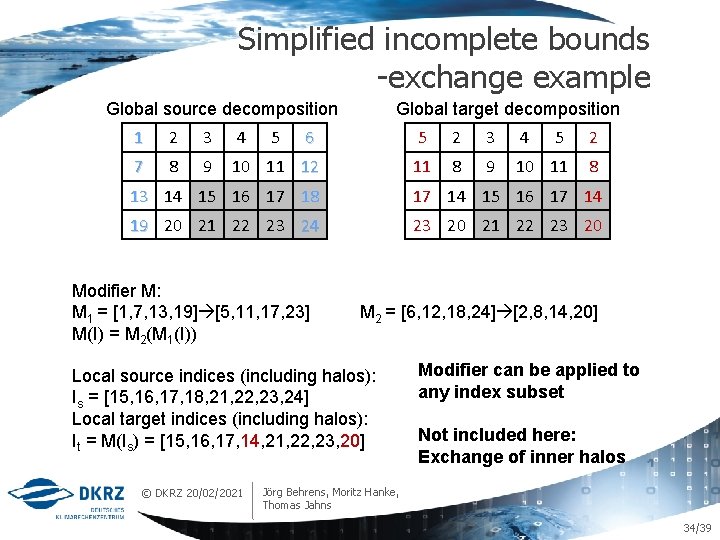
Simplified incomplete bounds -exchange example Global source decomposition 5 Global target decomposition 1 2 3 4 6 5 2 3 4 5 2 7 8 9 10 11 12 11 8 9 10 11 8 13 14 15 16 17 18 17 14 15 16 17 14 19 20 21 22 23 24 23 20 21 22 23 20 Modifier M: M 1 = [1, 7, 13, 19] [5, 11, 17, 23] M(I) = M 2(M 1(I)) M 2 = [6, 12, 18, 24] [2, 8, 14, 20] Local source indices (including halos): Is = [15, 16, 17, 18, 21, 22, 23, 24] Local target indices (including halos): It = M(Is) = [15, 16, 17, 14, 21, 22, 23, 20] © DKRZ 20/02/2021 Modifier can be applied to any index subset Not included here: Exchange of inner halos Jörg Behrens, Moritz Hanke, Thomas Jahns 34 /39
Completing the bounds-exchange example Global domain halos: - described by modifiers Mi : Sourcei Targeti Local sub-domain halos: - Depend on stencil extents - Local border definition done by user-code © DKRZ 20/02/2021 Jörg Behrens, Moritz Hanke, Thomas Jahns 35 /39
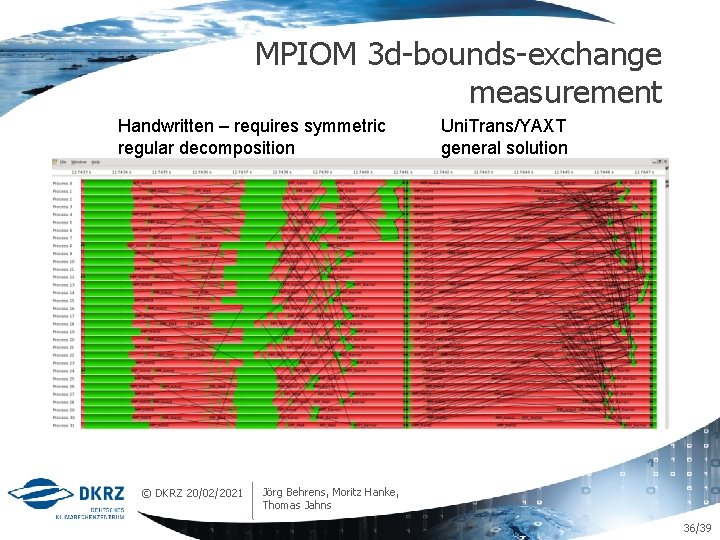
MPIOM 3 d-bounds-exchange measurement Handwritten – requires symmetric regular decomposition © DKRZ 20/02/2021 Uni. Trans/YAXT general solution Jörg Behrens, Moritz Hanke, Thomas Jahns 36 /39
MPIOM [TP 04 L 40: 8 x 4] Load Balance 1. Wet-point-only optimized Ø Workload changed Ø Unfit legacy decomposition Ø Nothing gained 2. Adapted decomposition Ø Old boundary exchange fails Ø Reprogramming exchange? Ø YAXT-formulation: Ø works for both cases © DKRZ 20/02/2021 Jörg Behrens, Moritz Hanke, Thomas Jahns Ø faster 37 /39
Future plans • Support asynchronous redistributions • In-Place redistributions • Multi-Phase exchanges • Use YAXT in MPIOM, ECHAM, ICON and CDI-PIO © DKRZ 20/02/2021 Jörg Behrens, Moritz Hanke, Thomas Jahns 38 /39
Questions? Documentation: https: //redmine. dkrz. de/doc/yaxt/html/index. html Redmine: https: //www. dkrz. de/redmine/projects/yaxt Download: https: //www. dkrz. de/redmine/projects/yaxt/wiki/Downloads © DKRZ 20/02/2021 Jörg Behrens, Moritz Hanke, Thomas Jahns 39 /39