
Introduction to Xray Absorption Spectroscopy Introduction to XAFS
Introduction to X-ray Absorption Spectroscopy: Introduction to XAFS Theory K. Klementiev, Alba synchrotron - CELLS 18. 02. 2008 1
Introduction In the present lecture: • Channels of interaction between x-rays and matter • Discussion on Fermi’s Golden Rule • General steps in derivation of EXAFS formula, early formulation • Modern formulation • Qualitative picture of XANES 18. 02. 2008 2
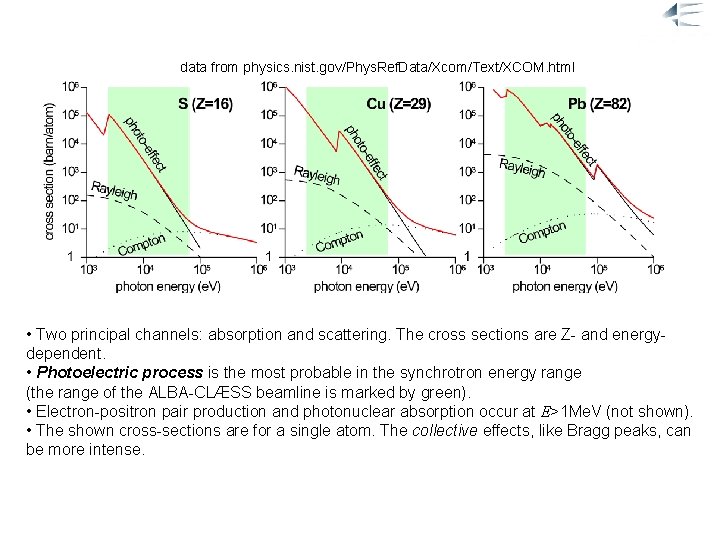
Interaction cross sections data from physics. nist. gov/Phys. Ref. Data/Xcom/Text/XCOM. html • Two principal channels: absorption and scattering. The cross sections are Z- and energydependent. • Photoelectric process is the most probable in the synchrotron energy range (the range of the ALBA-CLÆSS beamline is marked by green). • Electron-positron pair production and photonuclear absorption occur at E>1 Me. V (not shown). • The shown cross-sections are for a single atom. The collective effects, like Bragg peaks, can be more intense. 18. 02. 2008 3
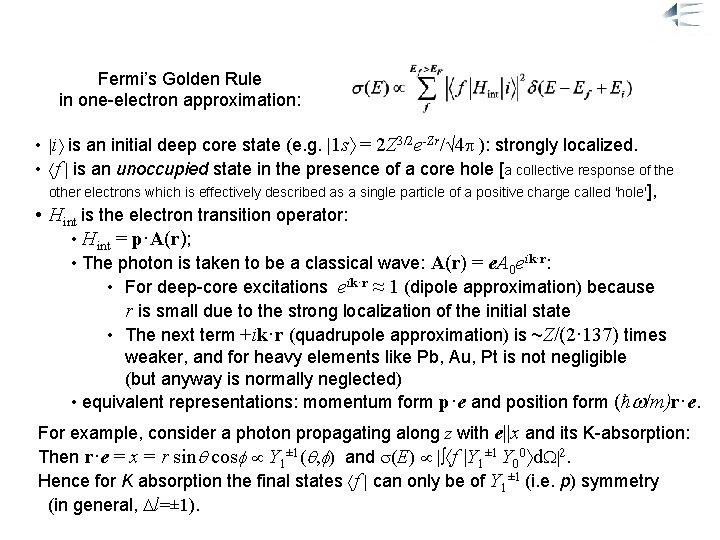
Fermi’s Golden Rule in one-electron approximation: • i is an initial deep core state (e. g. |1 s = 2 Z 3/2 e-Zr/√ 4 ): strongly localized. • f is an unoccupied state in the presence of a core hole [a collective response of the other electrons which is effectively described as a single particle of a positive charge called 'hole'], • Hint is the electron transition operator: • Hint = p·A(r); • The photon is taken to be a classical wave: A(r) = e. A 0 eik·r: • For deep-core excitations eik·r ≈ 1 (dipole approximation) because r is small due to the strong localization of the initial state • The next term +ik·r (quadrupole approximation) is ~Z/(2· 137) times weaker, and for heavy elements like Pb, Au, Pt is not negligible (but anyway is normally neglected) • equivalent representations: momentum form p·e and position form (ħ /m)r·e. For example, consider a photon propagating along z with e||x and its K-absorption: Then r·e = x = r sin cos Y 1± 1( ) and (E) | f Y 1± 1 Y 00 d . Hence for K absorption the final states f can only be of Y 1± 1 (i. e. p) symmetry (in general, l=± 1). 18. 02. 2008 4

Fermi’s Golden Rule. Summary • Photo-electric absorption is the main process in the x-ray range of photon energies (apart from coherent effects). • XAS is element specific because the photon energy is tuned to a specific absorption edge. All elements can be selected, there are no spectroscopically silent ones. • Due to the selection rules the empty states can be selected (via selecting the absorption edge). A common error: angular momenta are always about the origin! A p orbital on a neighbor is not a p orbital with respect to the central atom! • XAS is sensitive to the filling of the final state bands (because we sum over the final states) and thus sensitive to valence. • The scalar product r·e means sensitivity to anisotropy in respect to photon polarization. Oriented samples provide more information on low symmetry sites. 18. 02. 2008 5
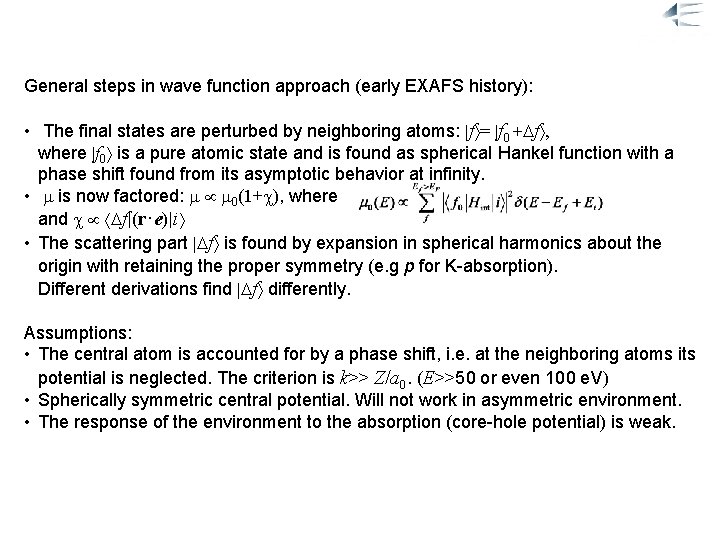
Simple derivation of EXAFS General steps in wave function approach (early EXAFS history): • The final states are perturbed by neighboring atoms: f = f 0+ f , where f 0 is a pure atomic state and is found as spherical Hankel function with a phase shift found from its asymptotic behavior at infinity. • is now factored: 0(1+ ), where and f|(r·e)|i • The scattering part f is found by expansion in spherical harmonics about the origin with retaining the proper symmetry (e. g p for K-absorption). Different derivations find f differently. Assumptions: • The central atom is accounted for by a phase shift, i. e. at the neighboring atoms its potential is neglected. The criterion is k>> Z/a 0. (E>>50 or even 100 e. V) • Spherically symmetric central potential. Will not work in asymmetric environment. • The response of the environment to the absorption (core-hole potential) is weak. 18. 02. 2008 6
![Early EXAFS expression Finally, in the photoelectron momentum space, k = [2(E–EF)]½, the function](http://slidetodoc.com/presentation_image_h/e2e1d8189d370aef6e7df259981ebc5c/image-7.jpg "Early EXAFS expression Finally, in the photoelectron momentum space, k = [2(E–EF)]½, the function")
Early EXAFS expression Finally, in the photoelectron momentum space, k = [2(E–EF)]½, the function was parameterized as [Stern, Sayers, Lytle]: For each coordination shell j: rj, Nj, 2 j are the structural parameters (distance, coord. number and distance variance), (k) is the phase shift due to (only!) the central atom, f(k) is the global scattering factor. Note: There was no shell-attributed phase shift and the amplitude was global. Nevertheless, first Fourier analysis was successfully applied to invert the EXAFS equation: Stern, Sayers, Lytle, Phys. Rev. Lett. 1971 (beginning of modern EXAFS history). 18. 02. 2008 7
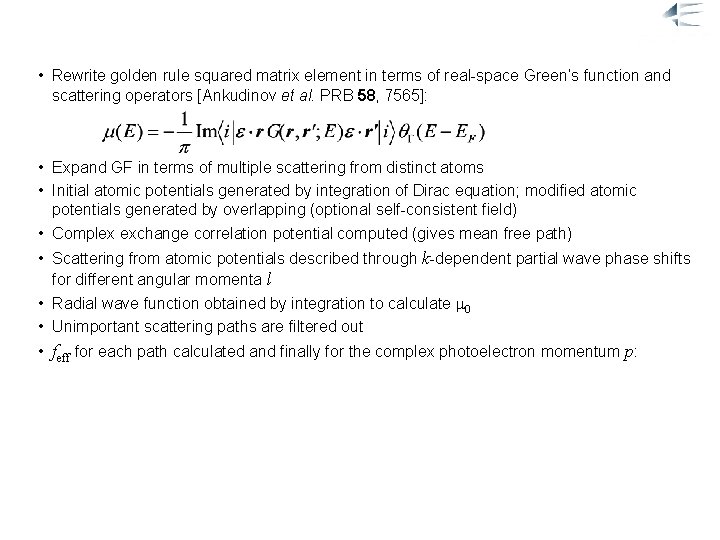
Modern EXAFS expression, FEFF • Rewrite golden rule squared matrix element in terms of real-space Green’s function and scattering operators [Ankudinov et al. PRB 58, 7565]: • Expand GF in terms of multiple scattering from distinct atoms • Initial atomic potentials generated by integration of Dirac equation; modified atomic potentials generated by overlapping (optional self-consistent field) • Complex exchange correlation potential computed (gives mean free path) • Scattering from atomic potentials described through k-dependent partial wave phase shifts for different angular momenta l • Radial wave function obtained by integration to calculate 0 • Unimportant scattering paths are filtered out • feff for each path calculated and finally for the complex photoelectron momentum p: 18. 02. 2008 8
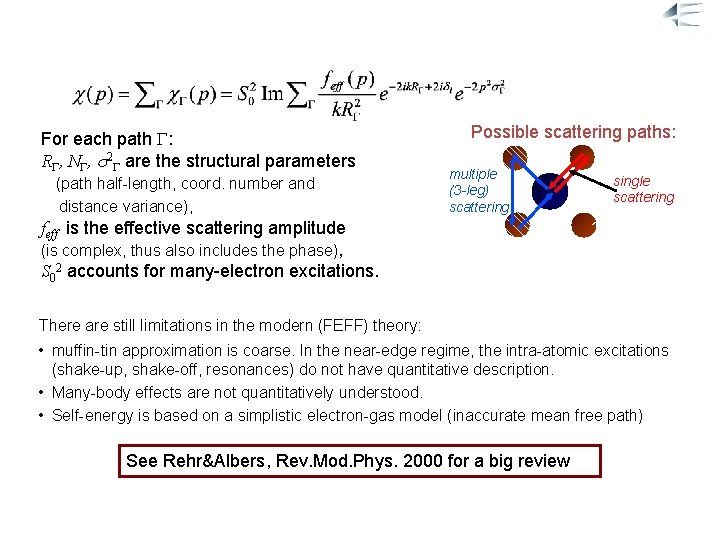
Modern EXAFS expression, FEFF For each path : R , N , 2 are the structural parameters (path half-length, coord. number and distance variance), Possible scattering paths: multiple (3 -leg) scattering single scattering feff is the effective scattering amplitude (is complex, thus also includes the phase), S 02 accounts for many-electron excitations. There are still limitations in the modern (FEFF) theory: • muffin-tin approximation is coarse. In the near-edge regime, the intra-atomic excitations (shake-up, shake-off, resonances) do not have quantitative description. • Many-body effects are not quantitatively understood. • Self-energy is based on a simplistic electron-gas model (inaccurate mean free path) See Rehr&Albers, Rev. Mod. Phys. 2000 for a big review 18. 02. 2008 9
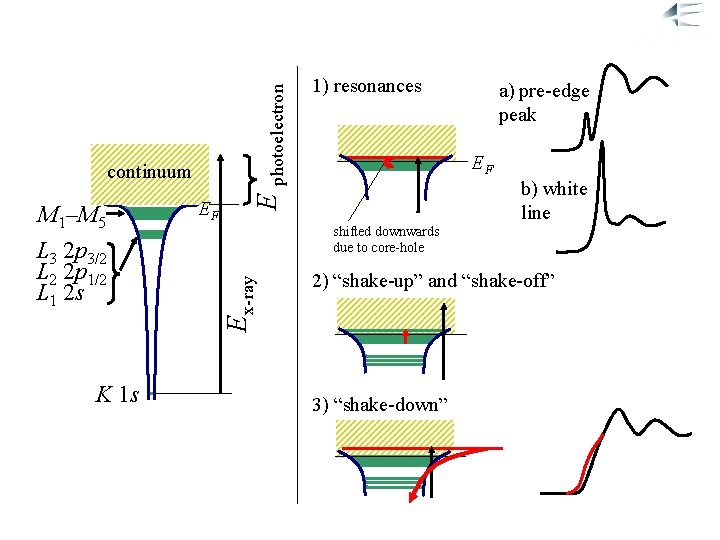
M 1–M 5 L 3 2 p 3/2 L 2 2 p 1/2 L 1 2 s K 1 s 18. 02. 2008 EF 1) resonances a) pre-edge peak EF shifted downwards due to core-hole Ex-ray continuum E photoelectron Qualitative Picture of XANES (difficulties) b) white line 2) “shake-up” and “shake-off” 3) “shake-down” 10
Conclusions • The fact that already the old derivation worked acceptably well tells us that when first applied to a reference material and tuned, EXAFS can give reliable results. Remember about references: this is an important logical step even when using modern theory (yes, there are still some manually tweaked inputs) • The modern EXAFS calculations (e. g. with FEFF) are quite reliable. The amplitude factors still have some uncertainty due to inaccurate self-energy, simplified manybody effects and weak energy dependence of the neglected quadrupolar contribution. The phases are more reliable. • There are more and more XANES calculations appearing showing success also in the near-edge region. To my point of view, quantitative agreement is still exception rather than a rule. I haven’t seen a single example where a good agreement was got after a fully automatic calculation, without good manipulation in inputs in these ‘ab-initio’ codes. • The qualitative picture of XANES is well understood. XANES is mostly used for fingerprint analysis (symmetric-asymmetric, oxidized-reduced) and for analysis of mixtures. 18. 02. 2008 11
- Slides: 11