
Introduction to Xray Absorption Spectroscopy Experiment K Klementiev
Introduction to X-ray Absorption Spectroscopy: Experiment K. Klementiev, Alba synchrotron - CELLS • Some important notes about optics • Detection of x-rays • Samples 18. 02. 2008 1
1. Optics What you need to know about x-ray optics 18. 02. 2008 2
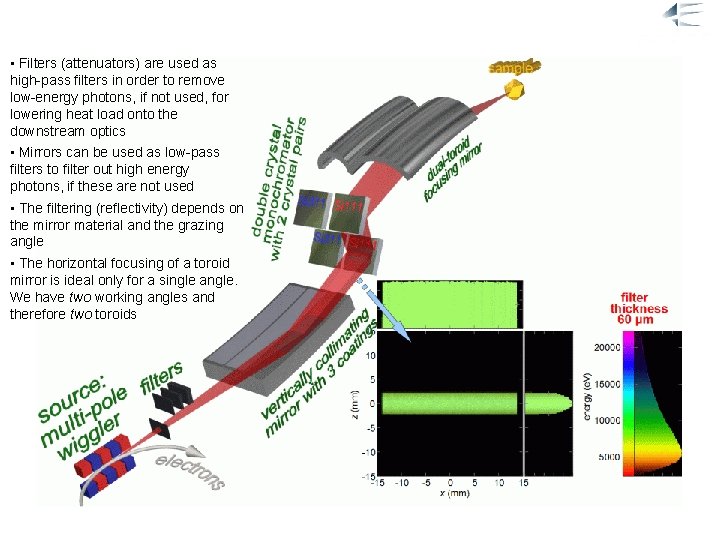
Main optical elements • Filters (attenuators) are used as high-pass filters in order to remove low-energy photons, if not used, for lowering heat load onto the downstream optics • Mirrors can be used as low-pass filters to filter out high energy photons, if these are not used • The filtering (reflectivity) depends on the mirror material and the grazing angle • The horizontal focusing of a toroid mirror is ideal only for a single angle. We have two working angles and therefore two toroids 18. 02. 2008 3
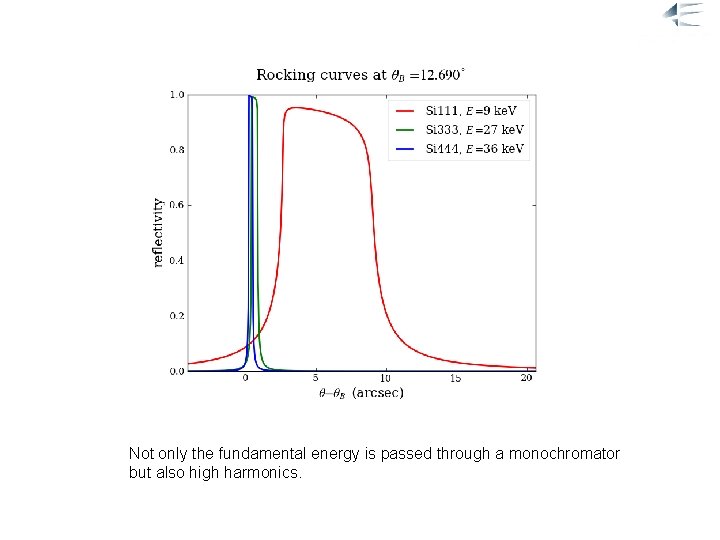
Harmonics in monochromator Not only the fundamental energy is passed through a monochromator but also high harmonics. 18. 02. 2008 4

Mirror reflectivity With appropriate mirrors (coatings) at appropriate incidence angles the harmonics can be suppressed due to reflectivity properties. 18. 02. 2008 5

Importance of harmonics Consider a transmission experiment with two ionization chambers. Their signals i 0 and i 1 give the absorption coefficient: µd = ln[i 0/i 1]. i 0 and i 1 are strongly correlated. You can check this if you take i 0 and i 1 from different repetitions of the same scan; the resulted µd would be much noisier. Therefore it is important to always keep the two signals in the ratio. Let the beam be contaminated by some harmonics. The experimental absorption is then µd = ln[(i 0+h 0)/(i 1+h 1)] and the fluctuations in i 0 and i 1 do not cancel and thus the spectrum is noisier. In summary, in the presence of harmonics the absorption coefficient µd: 1) is distorted (typically suppressed) and 2) is noisier. Therefore you should select the right mirrors and/or detune the monochromator. 18. 02. 2008 6
2. Detection Your samples determine which detection to choose 18. 02. 2008 7
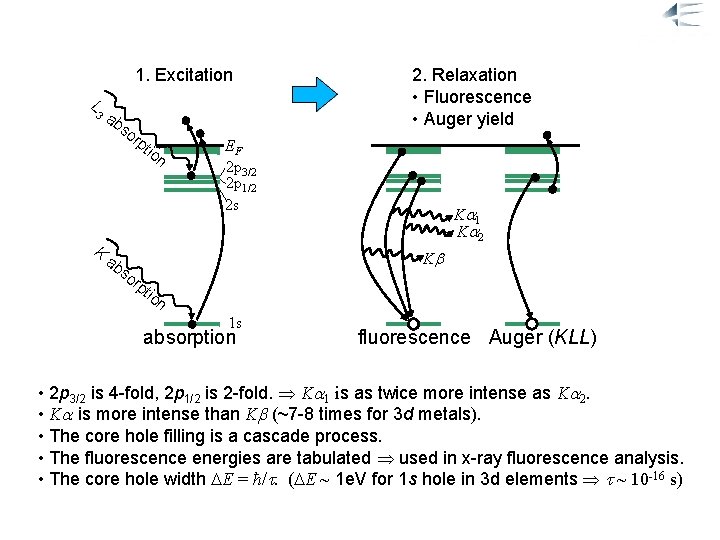
Relaxation channels 1. Excitation L 3 ab so rp K ab so tio n 2. Relaxation • Fluorescence • Auger yield EF 2 p 3/2 2 p 1/2 2 s K 1 K 2 K rp tio n 1 s absorption fluorescence Auger (KLL) • 2 p 3/2 is 4 -fold, 2 p 1/2 is 2 -fold. K 1 is as twice more intense as K 2. • K is more intense than K (~7 -8 times for 3 d metals). • The core hole filling is a cascade process. • The fluorescence energies are tabulated used in x-ray fluorescence analysis. • The core hole width E = ħ/. ( E ~ 1 e. V for 1 s hole in 3 d elements ~ 10 -16 s) 18. 02. 2008 8

One-electron approximation We see that many electrons are involved. Is the one-electron approximation valid? Both decay channels (fluorescence and Auger yield) keep no memory of the excitation photon Photoionization from the chosen atomic level and excitation of the remaining system can be considered as independent processes The measured spectrum as a probability density of two independent random processes is a convolution of a one-electron spectrum with the excitation (core-hole) spectrum In the 1 st approximation the measured spectrum is just a broadened oneelectron spectrum [one-particle problems can be calculated]. 18. 02. 2008 9

Ways of detection 1. Direct intensity measurements in transmission geometry • ionization chambers • photodiodes with scattering foils 2. Fluorescence yield • semiconductor detectors, e. g. Ge and Si(Li) • crystal analyzers • Lytle detector 3. Total electron yield • current from biased collector electrode • channeltron 18. 02. 2008 10
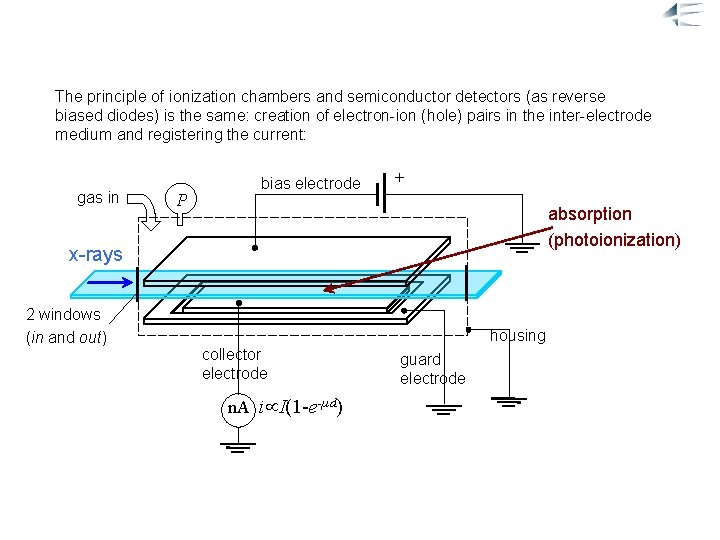
Ionization chamber The principle of ionization chambers and semiconductor detectors (as reverse biased diodes) is the same: creation of electron-ion (hole) pairs in the inter-electrode medium and registering the current: gas in P bias electrode + absorption (photoionization) x-rays 2 windows (in and out) housing collector electrode guard electrode n. A i I(1 -e-µd) 18. 02. 2008 11
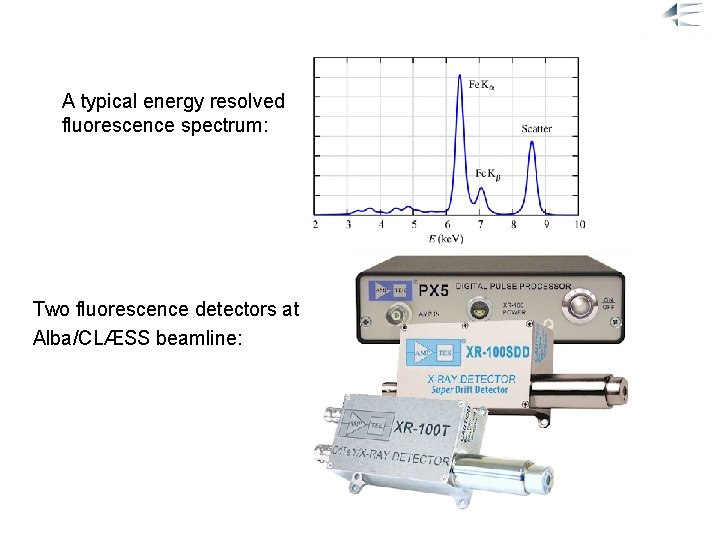
Fluorescence detectors A typical energy resolved fluorescence spectrum: Two fluorescence detectors at Alba/CLÆSS beamline: 18. 02. 2008 12
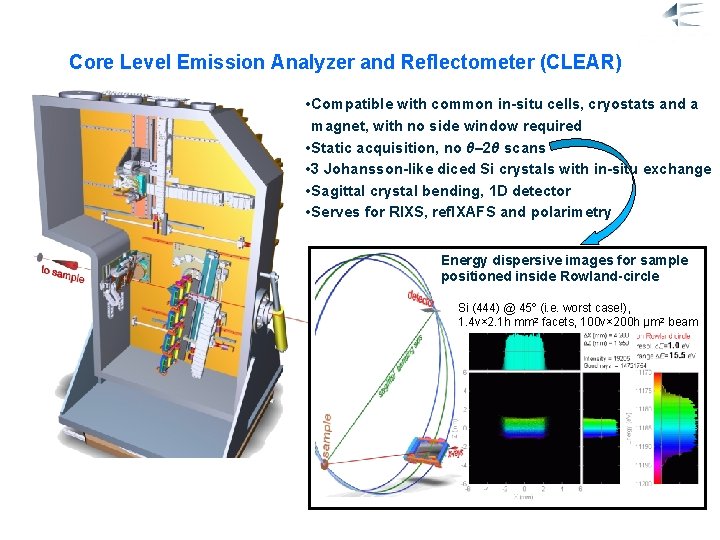
Fluorescence detection in high resolution Core Level Emission Analyzer and Reflectometer (CLEAR) • Compatible with common in-situ cells, cryostats and a magnet, with no side window required • Static acquisition, no θ– 2θ scans • 3 Johansson-like diced Si crystals with in-situ exchange • Sagittal crystal bending, 1 D detector • Serves for RIXS, refl. XAFS and polarimetry Energy dispersive images for sample positioned inside Rowland-circle Si (444) @ 45º (i. e. worst case!), 1. 4 v× 2. 1 h mm 2 facets, 100 v× 200 h µm 2 beam 18. 02. 2008 13
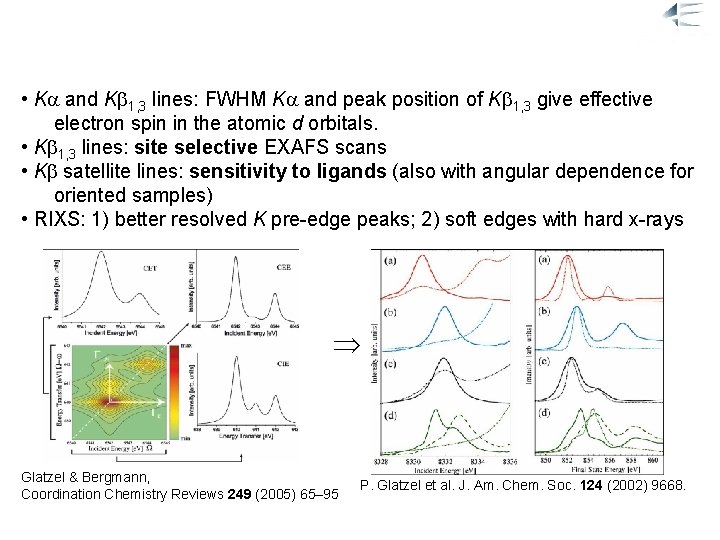
X-ray emission analyzer. Application examples • K and K 1, 3 lines: FWHM K and peak position of K 1, 3 give effective electron spin in the atomic d orbitals. • K 1, 3 lines: site selective EXAFS scans • K satellite lines: sensitivity to ligands (also with angular dependence for oriented samples) • RIXS: 1) better resolved K pre-edge peaks; 2) soft edges with hard x-rays Glatzel & Bergmann, Coordination Chemistry Reviews 249 (2005) 65– 95 18. 02. 2008 P. Glatzel et al. J. Am. Chem. Soc. 124 (2002) 9668. 14

Total electron yield A sample holder for electron (Auger) yield measurements with He gas as amplifying media x-rays 18. 02. 2008 Bias voltage ~100 V Current ~ 100 p. A – 10 n. A 15

Summary on detection. Applicability Which detection mode to use: • concentrated samples, transparent to x-rays – transmission • dilute samples – fluorescence • not transparent samples (low-E or thick) – total electron yield or fluorescence (with self-absorption correction) Probing depth: • transmission: the full sample thickness (bulk sensitivity) • fluorescence: ~(absorption length) * sin(φ), 0. 1 – 10 µm • total electron yield: ~electron mean free path, 10 – 100 Å 18. 02. 2008 16
3. Samples How to prepare your samples 18. 02. 2008 17
Suitable samples There are good reviews on sample preparation, for example: goo • Matt Newville, Anatomy of an XAFS Measurement gle f • Rob Scarrow, Sample Preparation for EXAFS Spectroscopy or them • General requirements • uniform on a scale of the absorption length of the material (typ. ~ 10 µm) • prepared without pinholes • Shape, aggregative state • Solids: powders, foils etc. ; single crystals and thin foils can utilize polarization properties of SR. • Liquids • Gases • Concentrations • for transmission: typ. >1 wt% • for fluorescence: typ. >100 ppm and 1 m. M 18. 02. 2008 18
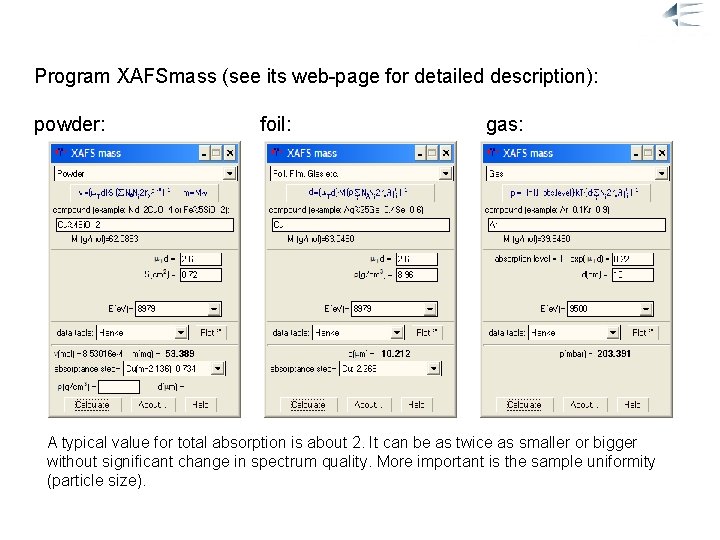
Suitable amount Program XAFSmass (see its web-page for detailed description): powder: foil: gas: A typical value for total absorption is about 2. It can be as twice as smaller or bigger without significant change in spectrum quality. More important is the sample uniformity (particle size). 18. 02. 2008 19
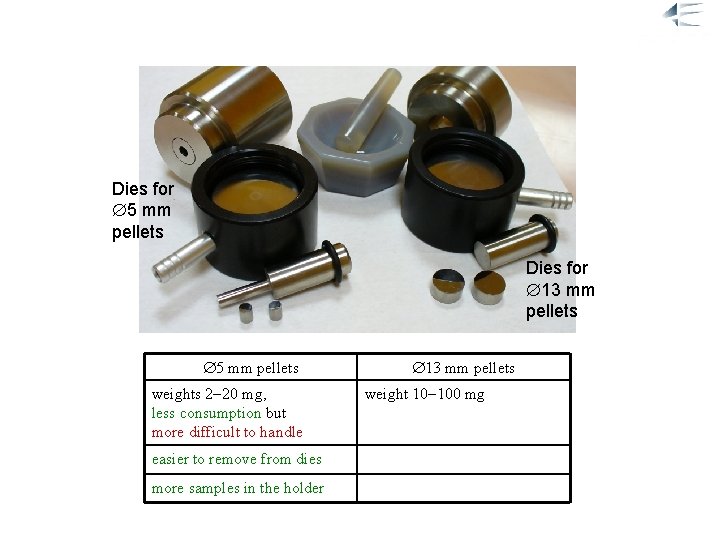
Pellets Dies for 5 mm pellets Dies for 13 mm pellets 5 mm pellets weights 2 20 mg, less consumption but more difficult to handle 13 mm pellets weight 10 100 mg easier to remove from dies more samples in the holder 18. 02. 2008 20
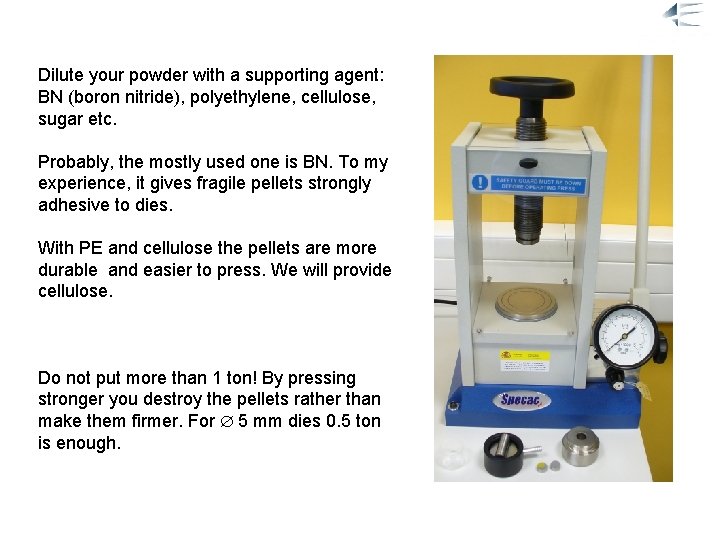
Mixing and pressing Dilute your powder with a supporting agent: BN (boron nitride), polyethylene, cellulose, sugar etc. Probably, the mostly used one is BN. To my experience, it gives fragile pellets strongly adhesive to dies. With PE and cellulose the pellets are more durable and easier to press. We will provide cellulose. Do not put more than 1 ton! By pressing stronger you destroy the pellets rather than make them firmer. For 5 mm dies 0. 5 ton is enough. 18. 02. 2008 21

XAS of Metallobiomolecules XAS can provide unique information about the kinds of ligands holding a particular metal in a metallobiomolecule. Symmetry information provided by XANES can help determine qualitatively the molecular geometry. For example, there is often a significant distinction between tetrahedral 4 -coordinate and square planar 4 -coordinate. XAS is particularly good at elucidating differences between one sample and another: e. g. active site before and after addition of substrate, or competitive inhibitor, or reductant/oxidant etc. Sample Limitations Amorphous frozen solutions with glassing agent (e. g. , 20% glycerol); cryogenic T to avoid radiation damage. Concentration ~1 m. M or even ~0. 2 m. M (for 3 d metals) Volume ~0. 05 -0. 2 ml. Homogenous metal site structure! XAS is not able to distinguish multiple site structures within a given sample: the resulting XAS-derived structure is an ”average” one. 18. 02. 2008 22
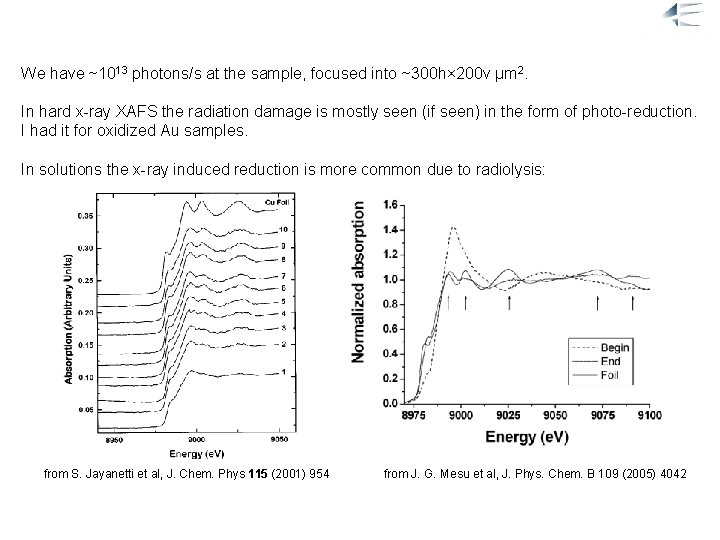
Radiation damage We have ~1013 photons/s at the sample, focused into ~300 h× 200 v µm 2. In hard x-ray XAFS the radiation damage is mostly seen (if seen) in the form of photo-reduction. I had it for oxidized Au samples. In solutions the x-ray induced reduction is more common due to radiolysis: from S. Jayanetti et al, J. Chem. Phys 115 (2001) 954 18. 02. 2008 from J. G. Mesu et al, J. Phys. Chem. B 109 (2005) 4042 23
Samples. Conclusions Make your samples as uniform as you can. Powders: with the finest possible grinding. Liquids: without bubbles and fast decantation. The ALBA-CLÆSS beamline will have a stack of attenuators for detecting and solving the problem of radiation damage. 18. 02. 2008 24
- Slides: 24