
Introduction to Xray Absorption Spectroscopy an element sensitive
Introduction to X-ray Absorption Spectroscopy: an element sensitive method for local spatial and electronic structure K. Klementiev, Alba synchrotron - CELLS After this introductory lecture: 2. Introduction to theory 3. Data analysis (EXAFS, XANES) 4. Experiment (general and @CLÆSS) 5. Hands-on exercises 18. 02. 2008 1
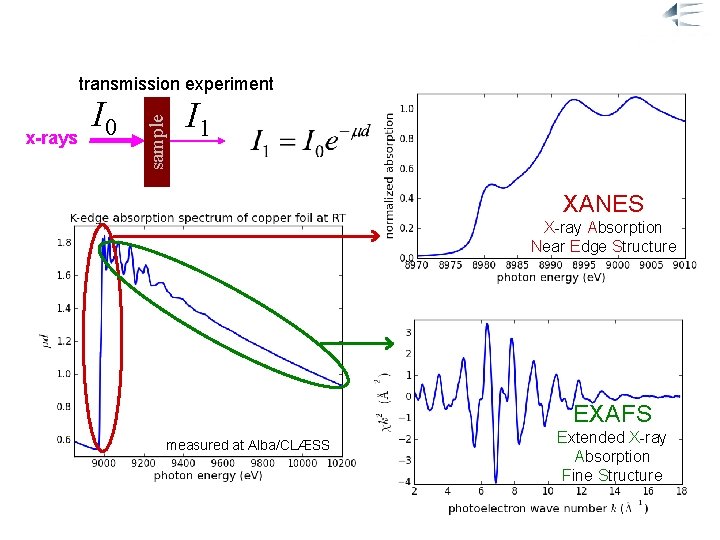
X-ray Absorption Spectra x-rays I 0 sample transmission experiment I 1 XANES X-ray Absorption Near Edge Structure EXAFS measured at Alba/CLÆSS 18. 02. 2008 Extended X-ray Absorption Fine Structure 2
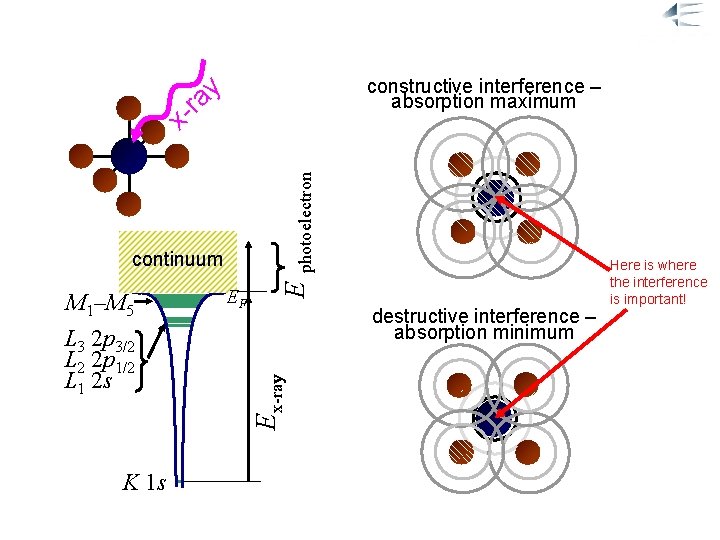
Qualitative Picture of XAFS M 1–M 5 L 3 2 p 3/2 L 2 2 p 1/2 L 1 2 s EF destructive interference – absorption minimum Here is where the interference is important! Ex-ray continuum E photoelectron x- ra y constructive interference – absorption maximum K 1 s 18. 02. 2008 3
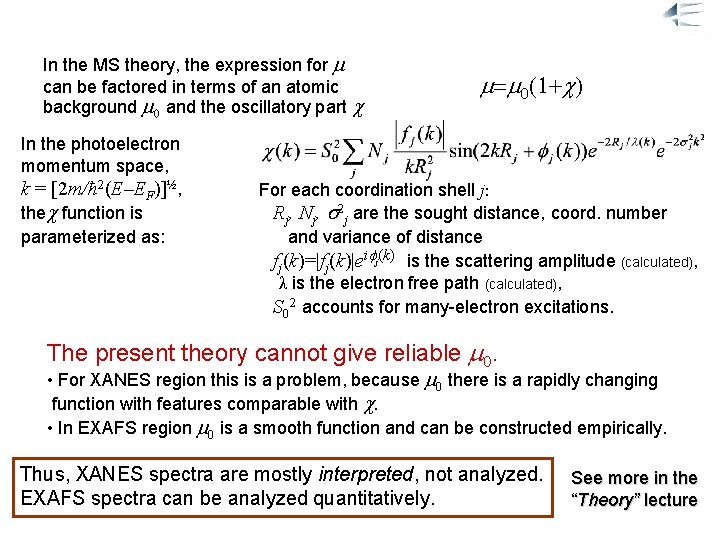
Theoretical Description In the MS theory, the expression for can be factored in terms of an atomic background and the oscillatory part In the photoelectron momentum space, k = [2 m/ħ 2(E–EF)]½, the function is parameterized as: For each coordination shell j: Rj, Nj, 2 j are the sought distance, coord. number and variance of distance fj(k)=|fj(k)|ei j(k) is the scattering amplitude (calculated), λ is the electron free path (calculated), S 02 accounts for many-electron excitations. The present theory cannot give reliable 0. • For XANES region this is a problem, because 0 there is a rapidly changing function with features comparable with . • In EXAFS region 0 is a smooth function and can be constructed empirically. Thus, XANES spectra are mostly interpreted, not analyzed. EXAFS spectra can be analyzed quantitatively. 18. 02. 2008 See more in the “Theory” lecture 4
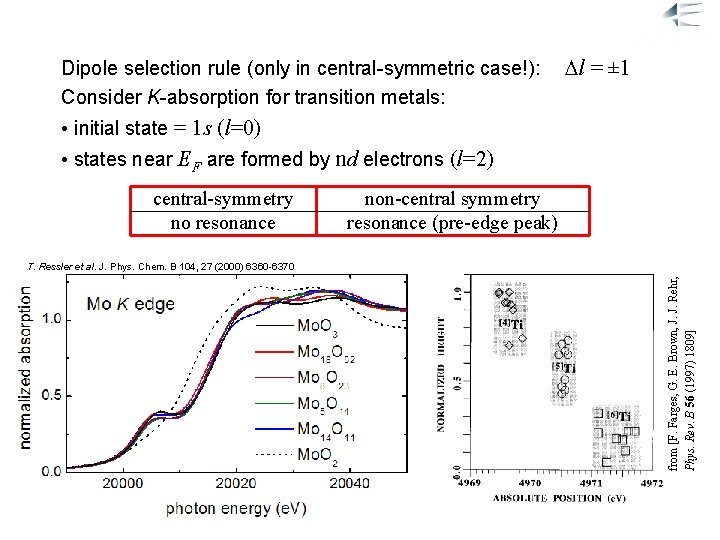
What we can learn from XANES: a) Pre-edge Peak Dipole selection rule (only in central-symmetric case!): Consider K-absorption for transition metals: l = ± 1 • initial state = 1 s (l=0) • states near EF are formed by nd electrons (l=2) central-symmetry no resonance non-central symmetry resonance (pre-edge peak) from [F. Farges, G. E. Brown, J. J. Rehr, Phys. Rev. B 56 (1997) 1809] T. Ressler et al. J. Phys. Chem. B 104, 27 (2000) 6360 -6370 18. 02. 2008 5
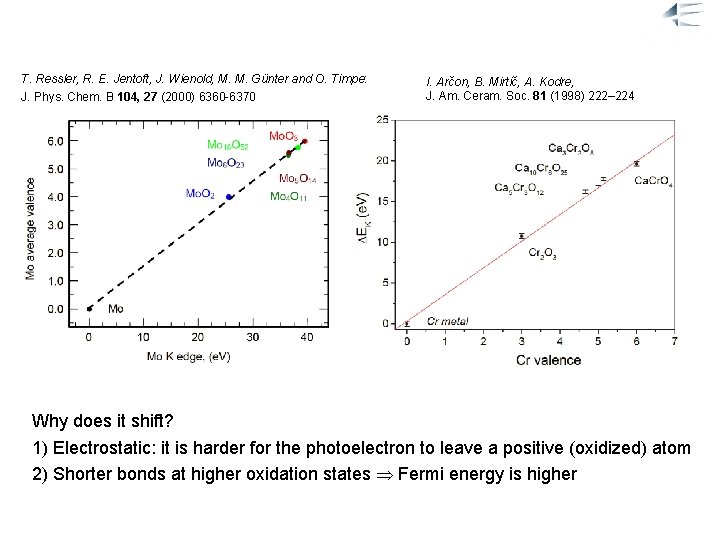
What we can learn from XANES: b) Edge Shift T. Ressler, R. E. Jentoft, J. Wienold, M. M. Günter and O. Timpe: J. Phys. Chem. B 104, 27 (2000) 6360 -6370 I. Arčon, B. Mirtič, A. Kodre, J. Am. Ceram. Soc. 81 (1998) 222– 224 Why does it shift? 1) Electrostatic: it is harder for the photoelectron to leave a positive (oxidized) atom 2) Shorter bonds at higher oxidation states Fermi energy is higher 18. 02. 2008 6

L 3 absorption edges for 5 d metals: (transition 2 p 3/2 5 d) G. Meitzner, G. H. Via, F. W. Lytle, and J. H. Sinfelt, J. Phys. Chem. 96 (1992) 4960 Intensity is proportional to the number of free 5 d states and also depends on valence state. But… 18. 02. 2008 …white line also depends on particle size and morphology: from A. L. Ankudinov, J. J. Rehr, J. J. Low, and S. R. Bare, J. Chem. Phys. 116 (2002) 1911 a) Pt 3 triangle (dashes), Pt 4 tetrahedron (solid), Pt 5 triangular bipyramid (dash-dot), and Pt 6 octahedron (dash-dot); (b) Pt 7 and Pt 4 clusters of different shape: planar ‘‘ honeycomb, (dashes), D 5 h bipyramid (solid) , single-capped octahedron (long dashdot), Pt 4 tetrahedron (dots), and Pt 4 planar rhombus (dash-dot). What we can learn from XANES: c) White Line 7
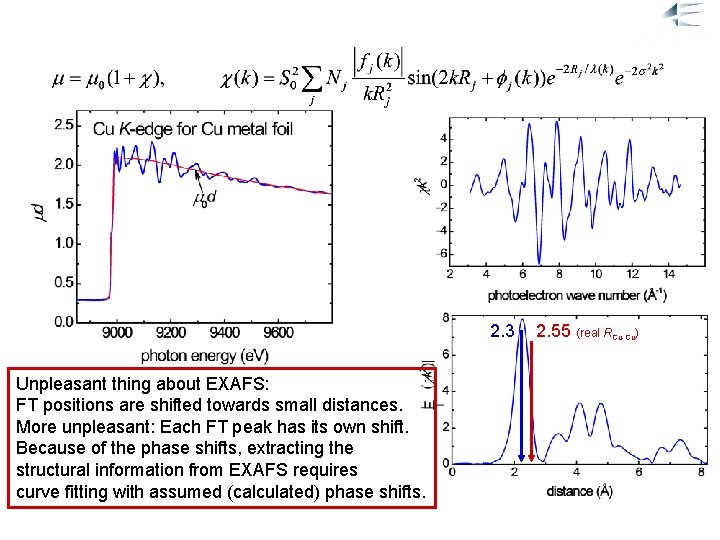
What we can learn from EXAFS 2. 3 2. 55 (real RCu-Cu) Unpleasant thing about EXAFS: FT positions are shifted towards small distances. More unpleasant: Each FT peak has its own shift. Because of the phase shifts, extracting the structural information from EXAFS requires curve fitting with assumed (calculated) phase shifts. 18. 02. 2008 8
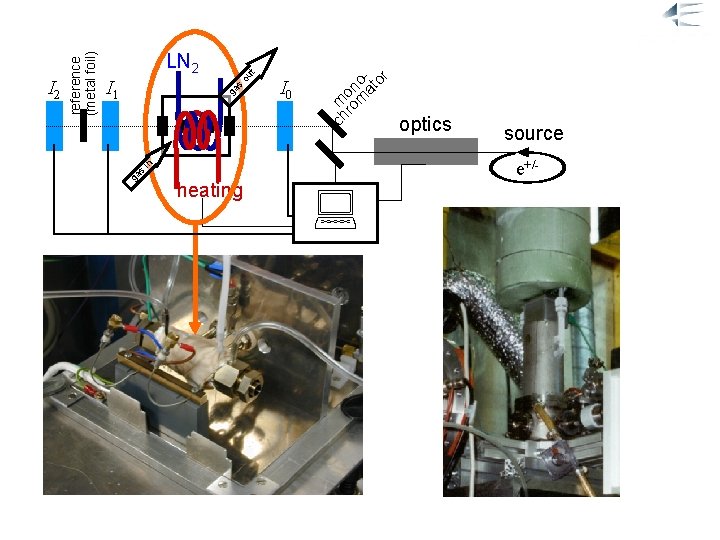
I 0 ch m ro on m oat or ga s I 1 ou t LN 2 ga s 18. 02. 2008 optics source e+/- in I 2 reference (metal foil) Experimental Setup (a) heating 9
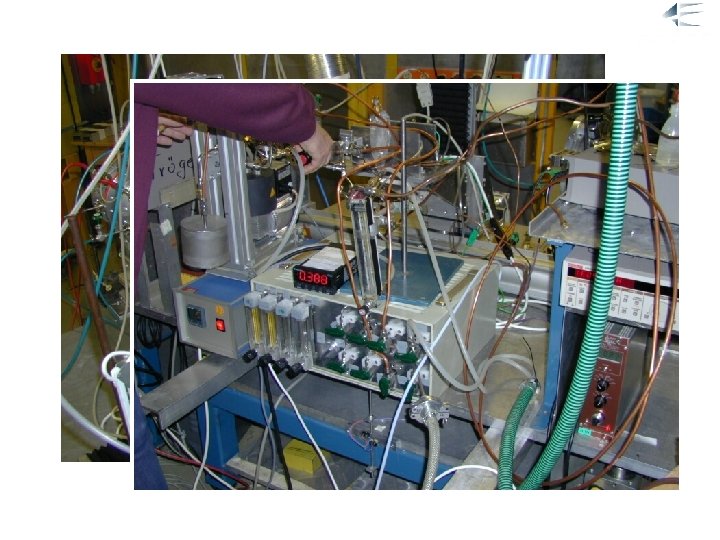
Experimental Setup (b) 18. 02. 2008 10
Example: Application of EXAFS to Pd, Pt/C Catalysts (a) Supported noble metal catalysts are used in a number of commercial chemical processes (Pd, Pt/C toluene and benzene hydrogenation). Pd, Pt/C catalyst • Support: graphite-like carbon (sibunit) • Preparation: mild oxidative treatment of the support followed by ion exchange with Pd or Pt amine complexes • Characterization: XPS, TPR, catalytic studies • Outcome: highly dispersed metal clusters with ~1. 1 wt% of Pd and ~0. 9 wt% of Pt XAFS measurements • X 1 beamline at Hasylab/DESY with a Si 311 double crystal monochromator, transmission mode • Samples: non-pressed powders 18. 02. 2008 11
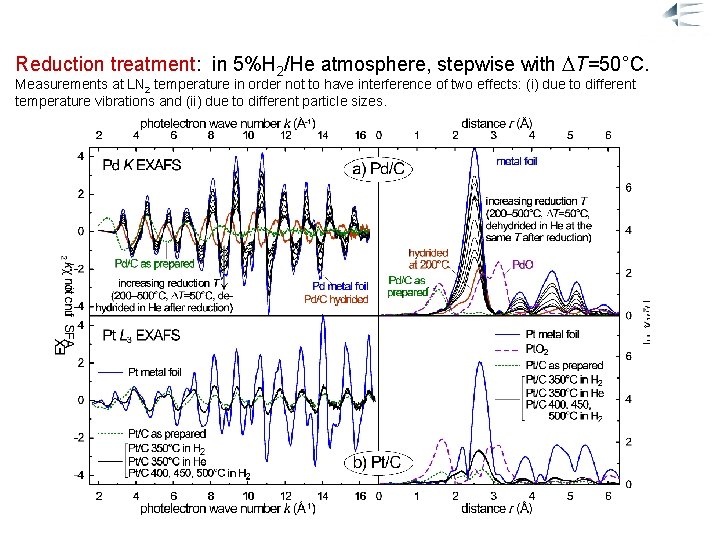
Example: Application of EXAFS to Pd, Pt/C Catalysts (b) Reduction treatment: in 5%H 2/He atmosphere, stepwise with T=50°C. Measurements at LN 2 temperature in order not to have interference of two effects: (i) due to different temperature vibrations and (ii) due to different particle sizes. 18. 02. 2008 12
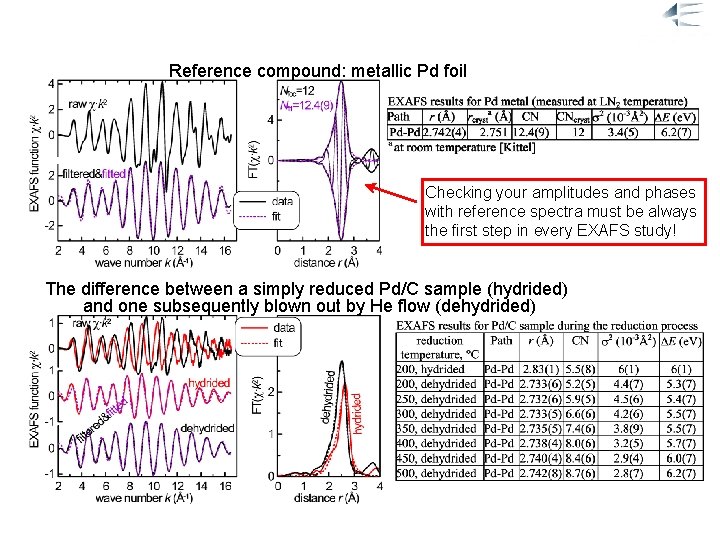
Example: Application of EXAFS to Pd, Pt/C Catalysts (c) Reference compound: metallic Pd foil Checking your amplitudes and phases with reference spectra must be always the first step in every EXAFS study! The difference between a simply reduced Pd/C sample (hydrided) and one subsequently blown out by He flow (dehydrided) 18. 02. 2008 13
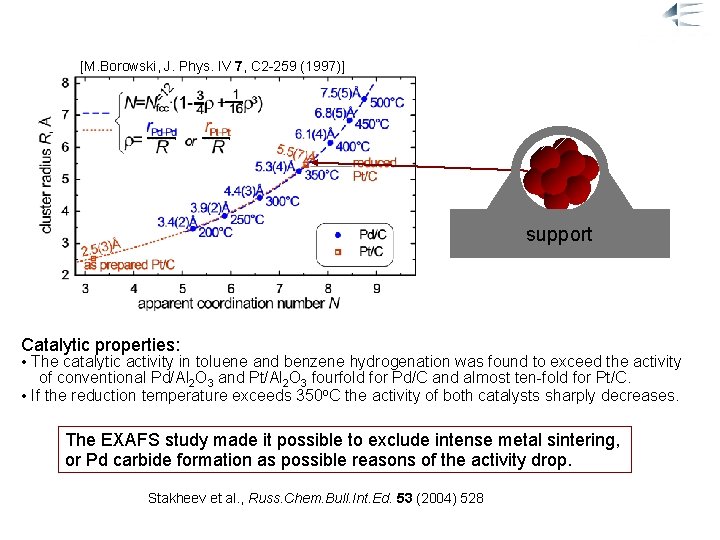
Example: Application of EXAFS to Pd, Pt/C Catalysts (d) [M. Borowski, J. Phys. IV 7, C 2 -259 (1997)] support Catalytic properties: • The catalytic activity in toluene and benzene hydrogenation was found to exceed the activity of conventional Pd/Al 2 O 3 and Pt/Al 2 O 3 fourfold for Pd/C and almost ten-fold for Pt/C. • If the reduction temperature exceeds 350 o. C the activity of both catalysts sharply decreases. The EXAFS study made it possible to exclude intense metal sintering, or Pd carbide formation as possible reasons of the activity drop. Stakheev et al. , Russ. Chem. Bull. Int. Ed. 53 (2004) 528 18. 02. 2008 14

Conclusions • XAFS (XANES and EXAFS) spectroscopies: • suitable under reaction conditions • does not require long-range order • element specific • XANES spectroscopy for: • symmetry information from the pre-edge peaks • valence state from the edge shift • analysis of mixtures using basis spectra • XANES is experimentally simpler than EXAFS • signal is stronger (one can measure faster and at lower concentrations) • does not depend on T (if without phase transitions, of course) • EXAFS gives: • inter-atomic distances and coordination numbers • identification of neighbor atoms 18. 02. 2008 15
- Slides: 15