
INTRODUCTION TO WORLD RELIGIONS STUDENTS NAME IF THE





- Slides: 26
INTRODUCTION TO WORLD RELIGIONS STUDENTS NAME: _______________ __
IF THE WORLD WAS A VILLAGE OF 100 PEOPLE 59 would be Asian 14 would be American (North, Central and South) 14 would be African 12 would be European 1 would be from the South Pacific 51 would be women, 49 would be men 30 would be children, 70 would be adults. 70 would be nonwhite, 30 would be white 33 would be Christians 21 would be Moslems 15 would be Hindus 6 would be Buddhists 5 would be Animists 6 would believe in other religions 14 would be without any religion or atheist.
WHO ARE WE? ______Have An Innate (_____) Tendency To Make _______ Of ___________ Is There Which Is _____ Or _______ To ________ -________ attempt to understand ________ is also restricted by human __________ Humans Seek _______ Through Four Areas: The _________ The Communal The Rational (________) ____________ Experience -Our ________ means we seek to _________ reality our _____ for meaning leads us to encounter ________. Two responses are: 1. ________ 2. ________
WHAT IS RELIGION? Religion comes from _____meaning “to ______”. ______ yourself to sacred ______. It is the ____ to the ______. related to a ______. employing a set of _______. Attempts To Answer Questions Like: _________________________? Is there _________? What is the “_______”? What is _______ and what is _______?
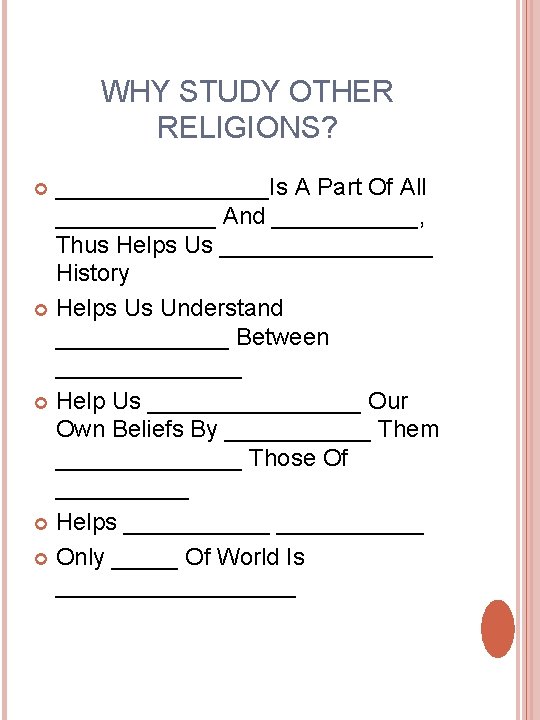
WHY STUDY OTHER RELIGIONS? ________Is A Part Of All ______ And ______, Thus Helps Us ________ History Helps Us Understand _______ Between _______ Help Us ________ Our Own Beliefs By ______ Them _______ Those Of _____ Helps ___________ Only _____ Of World Is _________
WHY DO PEOPLE TURN TO RELIGION? _______ Need It During ______ Times _____ It Gives Life ___________
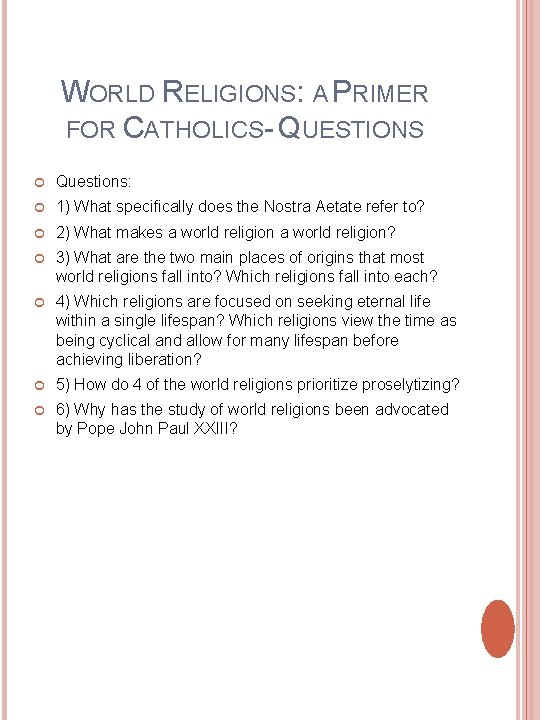
WORLD RELIGIONS: A PRIMER FOR CATHOLICS- QUESTIONS Questions: 1) What specifically does the Nostra Aetate refer to? 2) What makes a world religion? 3) What are the two main places of origins that most world religions fall into? Which religions fall into each? 4) Which religions are focused on seeking eternal life within a single lifespan? Which religions view the time as being cyclical and allow for many lifespan before achieving liberation? 5) How do 4 of the world religions prioritize proselytizing? 6) Why has the study of world religions been advocated by Pope John Paul XXIII?
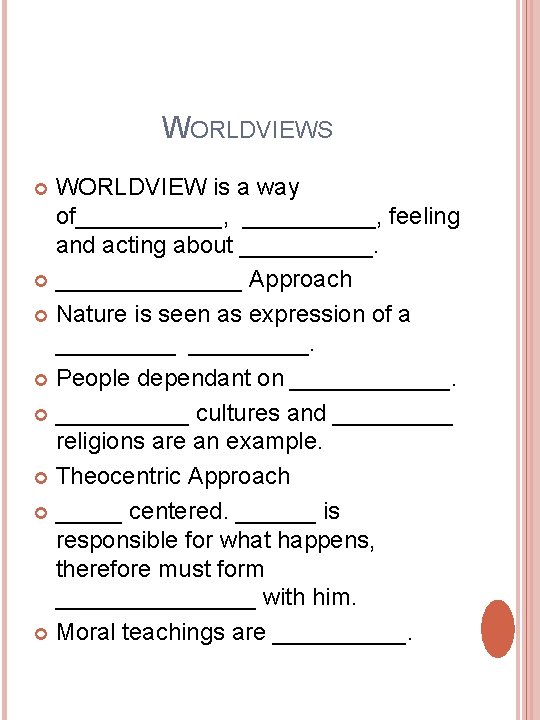
WORLDVIEWS WORLDVIEW is a way of______, feeling and acting about _______ Approach Nature is seen as expression of a _________. People dependant on ______. _____ cultures and _____ religions are an example. Theocentric Approach _____ centered. ______ is responsible for what happens, therefore must form ________ with him. Moral teachings are _____.
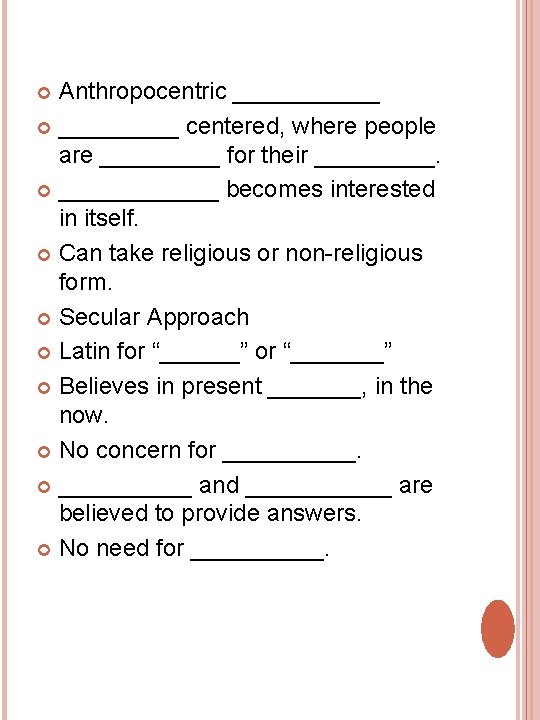
Anthropocentric ______ centered, where people are _____ for their ______ becomes interested in itself. Can take religious or non-religious form. Secular Approach Latin for “______” or “_______” Believes in present _______, in the now. No concern for _____ and ______ are believed to provide answers. No need for _____.
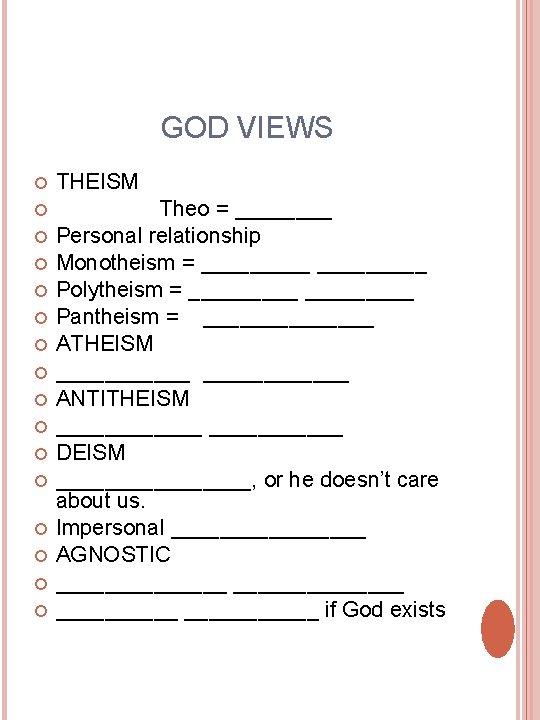
GOD VIEWS THEISM Theo = ____ Personal relationship Monotheism = _________ Polytheism = _________ Pantheism = _______ ATHEISM ____________ ANTITHEISM ______ DEISM ________, or he doesn’t care about us. Impersonal ________ AGNOSTIC ______________ if God exists
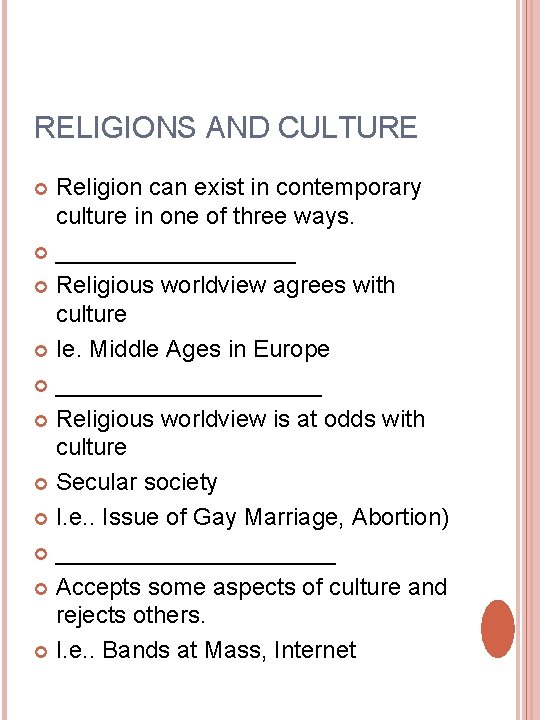
RELIGIONS AND CULTURE Religion can exist in contemporary culture in one of three ways. _________ Religious worldview agrees with culture Ie. Middle Ages in Europe __________ Religious worldview is at odds with culture Secular society I. e. . Issue of Gay Marriage, Abortion) ___________ Accepts some aspects of culture and rejects others. I. e. . Bands at Mass, Internet
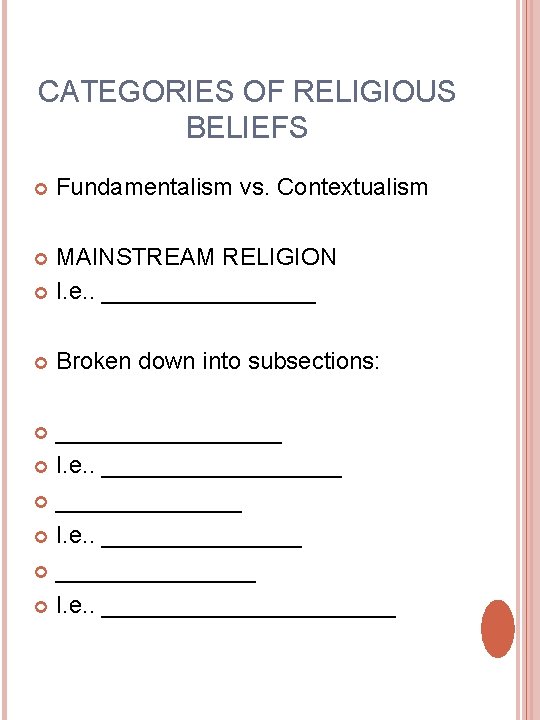
CATEGORIES OF RELIGIOUS BELIEFS Fundamentalism vs. Contextualism MAINSTREAM RELIGION I. e. . ________ Broken down into subsections: _________ I. e. . _______________ I. e. . ___________
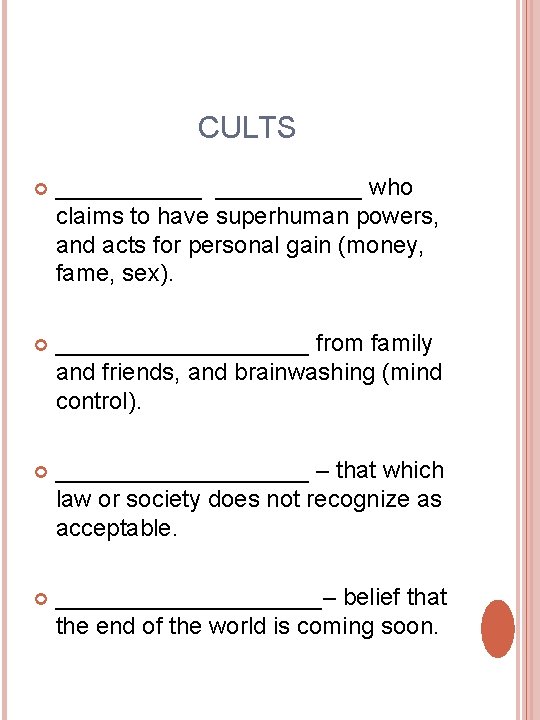
CULTS ___________ who claims to have superhuman powers, and acts for personal gain (money, fame, sex). __________ from family and friends, and brainwashing (mind control). __________ – that which law or society does not recognize as acceptable. __________– belief that the end of the world is coming soon.
ELEMENTS OF RELIGION _______ Story of ______ life and their interaction with ______________ Story of religion from ___________ till ______ day. _______________ system of the religion. ______________
Grade 11 – World Religions THE PERFECT RELIGION ASSIGNMENT Working in pairs (or on your own if you wish), you are to create a fictitious (not real) “Perfect Religion”. It must contain all the elements of religion we have discussed thus far this semester. The purpose of this assignment is NOT to promote belief in another religion, but to help students become familiar with the basic concepts. Please include: The name of your religion – Make it up! Origin – the sacred story of the founder. How did he/she experience the sacred (God)? Create a story. History of the early community, leading up to present time. How did the followers originally worship? Did they go to a certain place to do so? How has the religion changed over time? Teachings of the Religion Creed – statement of beliefs (i. e. Apostle’s Creed) Cult – how and where do they worship Code – what moral code do they follow Create a symbol – one that is Bright, Colorful, and Attractive. One full page on blank sheet of white paper. Explain why this is the perfect religion. Present your religion to the class. **Please note: All religions are inherently good. Also, you are trying to create the “perfect religion” which, if all in the world followed the rules and traditions, would lead to a “good” society. Therefore a religion such as “lazy-ism” could not possibly work since if all the world were “lazy” nothing would every get accomplished. It is important for you to ask your teacher before proceeding with the assignment if you are unsure. **
PRIMITIVE RELIGIONS Primitive – _______ – – _____ Originated when ______ started questioning their reality Begun Around _______ thousand years ago Also referred to as ______ religions Three examples of aboriginal religions today: Deri – _______ Yoruba – ______ Lakota – __________ Each share similar elements.
COMMON BELIEFS OF ABORIGINAL RELIGIONS _________ mythical beings who roamed the earth during a mystical period _________ mythical ______ when ancestors roamed the earth _________ Geography Explanation of earth geography using _____and _________ Ability to _________ with the spirit ________
_______ Certain roles are seen as __________________ Figure _______ mythical ______ which acts as a medium between humans and gods.
-North American ______ first migrated across the _______ land bridge approximately _______ years ago. -They formed many groups, tribes and nations. Each tribe had its own set of beliefs and morality. The ___________nations form the “typical” __________culture. These groups became the model for the ________ religion (a movement that unites many tribes).
______ – A plains tribe. Also known as the Western “____” (meaning ______). The ______ led a confederacy of ______ against Gen. Custer (_________ massacre in 1876). _________ – The Lakota supreme reality meaning, ________, “Great Mysterious”, “Most Sacred” The Lakota have _______ separate deities of this Spirit. (_______).
Creation Myth – Usually the creation myth/stories involves supernatural beings. One of the more significant is ______(“spider”), a ___________. This deity _______ between the ________and the human world and teachers customs, morals and rituals. The trickster’s mistakes teach his “________” Afterlife – Every individual has _______ which depart and go in different directions. An ________ judges one soul for entry to the _________ (ancestor world or ghost). Other souls re -enter world as _______or into ______.
_________ – This is a rite a passage to mark the transition from childhood to ________. This ceremony involves ________ (usually performed in ________), a confession and, finally, removal from the camp for a time. The youth prays, fasts and endures the elements for several days while awaiting a ________. The vision usually appears in the form of a ______. The ______ is usually called upon to help interpret the dream or vision.