
Introduction to World Missions The Mission of God
- Slides: 24
Introduction to World Missions The Mission of God
Missio Dei (Mission of God) • Why was humanity created? – Accident – God was lonely – Needs to be worshipped – To glorify God – God of love (relationship) God of love Entering into that relationship and living and serving with Jesus as Lord glorifies God
Missio Dei (Mission of God) • Mission began by God • Mission continues with God • Mission ends with God
Missio Dei (Mission of God) • What are the challenges in the world? – Pride, hatred and power • Wars, Genocide, Terrorism – Immorality and self-centered desires • Amoral lifestyle, Life unrelated to God, poverty – Disease and natural disasters • Cancer, AIDS, Earthquakes, Sunami – Worldview differences • Pluralism, Secularism, Materialism, Consumerism
Missio Dei (Mission of God) • How does God view His creation? – Communicates and interacts with His creation – Provides guidance – Provides means to approach Him – People in need of knowing God and reconciliation – God so loved the world that …. . • How should Christians view the world?
Missio Dei (Mission of God) • How should Christians view the world? – World created by God – People created in God’s image – People loved by God – Sin is a problem for all cultures of the world – People are worth redeeming – Reconciliation to God is God’s desire – Believers are sent into the world as Jesus was
Missio Dei (Mission of God) • What are believers responsibility to the world? – Practice the two greatest commandments – Represent God’s love in the world – Represent God’s life style in the world – Share God’s truth in the world – Share God’s answer to people in the world – Work to do good for greater justice and people’s wellbeing
Missio Dei (Mission of God) “It is not so much the case that God has a mission for his church in the world, as that God has a church for his mission in the world. Mission was not made for the church; the church was made for mission – God’s mission. ” ---Christopher Wright, The Mission of God, p. 62)
Missio Dei (Mission of God) The Bible displays the story of God’s mission. A story of God’s work in the world to reconcile humanity to Himself.
Missio Dei (Mission of God) • Why study mission/missions? – Mission is God’s action in this world – People are the center of God’s concern (mission) – His followers are participants in His mission – The church’s role is to be missional as God is – Entering God’s mission is central to who we are as Christians
Mission Terminology Mission refers to the mission of God (Missio Dei), God’s work in this world including through human ambassadors to reconcile sinful humanity to Himself (Jn. 3: 16 -18; 2 Cor. 5: 18 -20).
Mission Terminology • Implications of the Missio Dei – God is theological foundation – God is the source of power – God provides the message – God provides the means of salvation – God defines the mission
Mission Terminology Missions is the plans and strategies used by committed believers to accomplish the mission of God.
Mission Terminology • Implications for missions – God’s people enter the mission of God – Believers live and share the message – Believers strive to see the world as God does, in need of reconciliation – Going and being sent (Mt. 28: 18; Jn. 17: 18; 20: 21; Rom. 15: 20) – Ambassadors of Christ (2 Cor. 5: 18 -21)
Mission Terminology Missionary The term missionary comes originally from the Greek word “apostles” through Latin “missio” to English meaning sent ones.
Mission Terminology • Biblical use of apostlos (missionary) – Used to describe the twelve selected from Jesus’ disciples – Used of Paul – Other people in N. T. sent out by churches • • Barnabas (Acts 14: 14) James, the Lord’s brother (1 Cor. 15: 7; Gal. 1: 19) Janias and Andronicus (Rom. 16: 7) Epaphroditus (Phil. 2: 25)
Mission Terminology • Missionary today – Generally used for Christians sent out crossculturally – It is a term that can apply to any Christian sent out for ministry – Types of missionary • • Cross-cultural Domestic Non-resident Vocational (tent-making)
Mission Terminology • Ten misunderstandings about missionaries – Super spiritual – Misfits in their own cultures – Adventure seekers – Always good with languages – Always of a strong calling from God – Bigoted, cultural imperialists (Poison Wood Bible, Mitchner - Hawaii) – No longer needed – Always go overseas – Live in the bush – Sign their lives away
Mission Terminology Missiology “The formal study of Christian mission in its theological, biblical, historical, cultural, and strategic dimensions as well as it present and future aspects” (Kaiser).
Mission Terminology • Elements of Missiology – Biblical – the biblical foundation and mandate – reveals God’s mission – Theological – understanding the word & applying it – Historical – history of it practice – Cultural – the context in which mission takes place – Strategic – principles, strategies, methods used – Present and future oriented – present & eternal dimensions
Mission Terminology Theology – The “discipline which strives to give a coherent statement of the doctrines of the Christian faith, based primarily on scripture, placed within the context of culture in general, worded in contemporary idiom, and related to issues of life. ” (Erickson, 1985, p. 21) Faith seeking understanding (Anselm of Canterbury 1033 -1109; Bevans argues this is theology)
Mission Terminology Contextualization -- communicating the gospel in a new context in a way that is understandable to the recipients in order for them to do theology, develop church life, be involved in ministry that is biblically based and culturally appropriate.
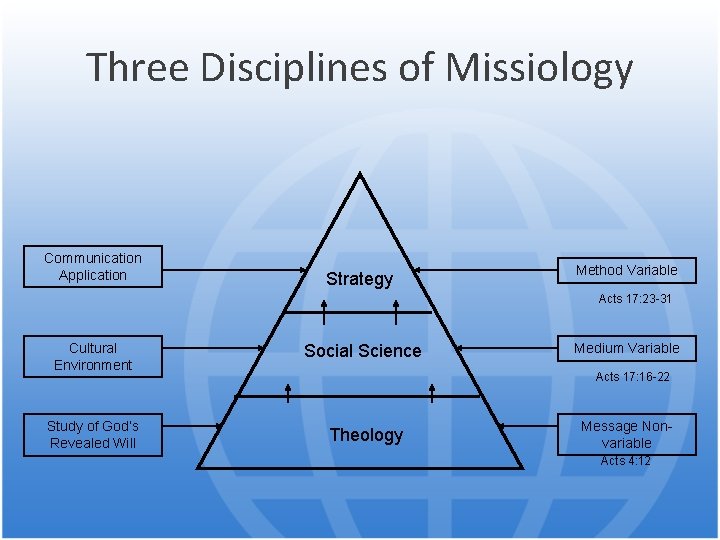
Three Disciplines of Missiology Communication Application Strategy Method Variable Acts 17: 23 -31 Cultural Environment Social Science Study of God’s Revealed Will Theology Medium Variable Acts 17: 16 -22 Message Nonvariable Acts 4: 12
Three Disciplines of Missiology Strategy – Deals with the methods for communication of the message through living, teaching, and serving for God’s purpose in the world Social Sciences – Study of the cultural environment or medium in which we carry out God’s mission Theology – Study of God’s message and applying it to living under God’s lordship