
Introduction to Wireless Sensor Networks Spread Spectrum and
- Slides: 16
Introduction to Wireless Sensor Networks Spread Spectrum and CDMA 24 February 2005 The University of Iowa. Copyright© 2005 1 A. Kruger
Organizational Class Website www. engineering. uiowa. edu/~ece 195/2005/ Class Time Monday 4: 30 -5: 20 Room 4511 SC Thursday 12: 30 -1: 20 Room 3220 SC Please note that the room numbers are different for Mondays and Thursdays. Midterm Exam Time: March 10, 2005 The University of Iowa. Copyright© 2005 2 A. Kruger
Modulation Schemes • Basic Question – Why do we modulate at all? • • • AM – amplitude modulation FM frequency modulation OOK – On/Of Keying PAM, M-PAM… FSK, PSK, QPSK, OQPSK, M-PSK, MSK, GMSK The University of Iowa. Copyright© 2005 3 A. Kruger
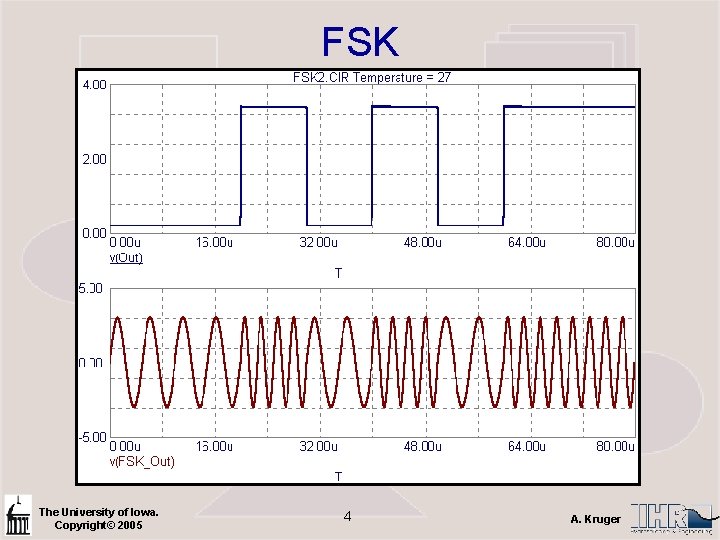
FSK The University of Iowa. Copyright© 2005 4 A. Kruger
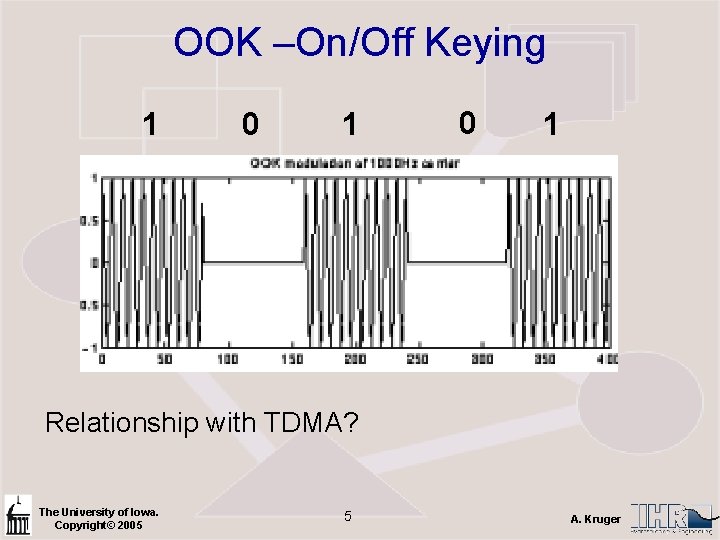
OOK –On/Off Keying 1 0 1 Relationship with TDMA? The University of Iowa. Copyright© 2005 5 A. Kruger
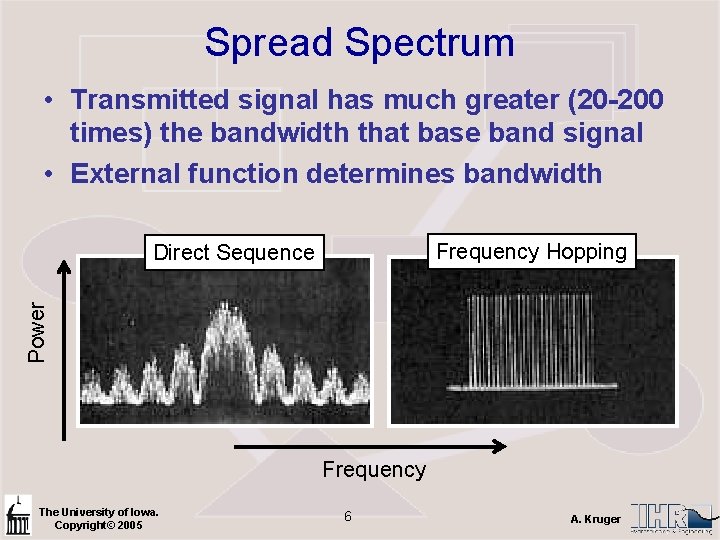
Spread Spectrum • Transmitted signal has much greater (20 -200 times) the bandwidth that base band signal • External function determines bandwidth Frequency Hopping Power Direct Sequence Frequency The University of Iowa. Copyright© 2005 6 A. Kruger
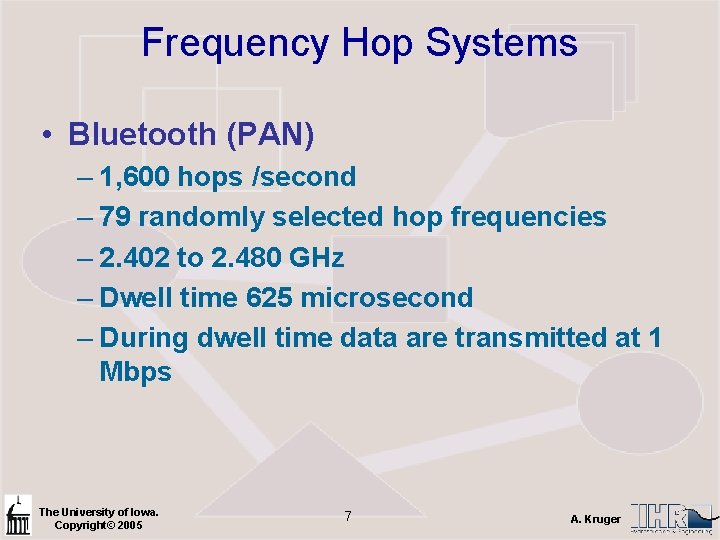
Frequency Hop Systems • Bluetooth (PAN) – 1, 600 hops /second – 79 randomly selected hop frequencies – 2. 402 to 2. 480 GHz – Dwell time 625 microsecond – During dwell time data are transmitted at 1 Mbps The University of Iowa. Copyright© 2005 7 A. Kruger
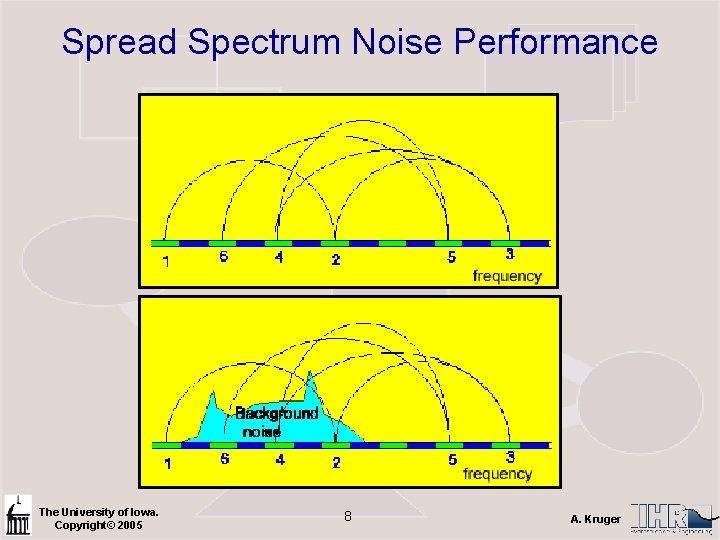
Spread Spectrum Noise Performance The University of Iowa. Copyright© 2005 8 A. Kruger
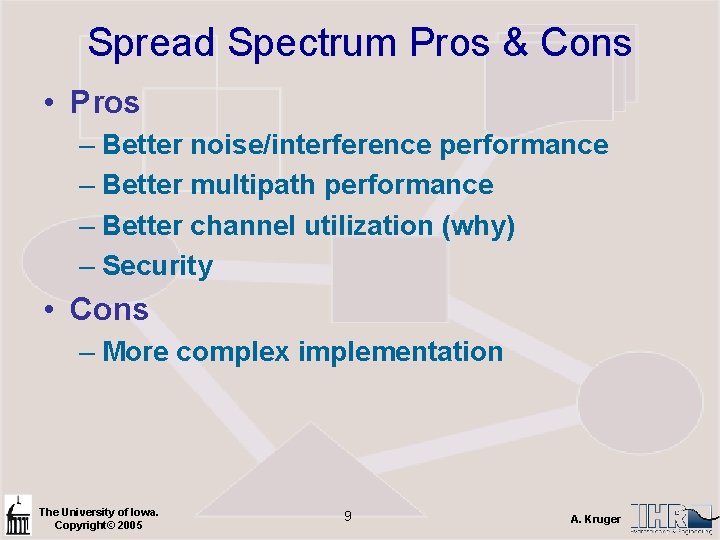
Spread Spectrum Pros & Cons • Pros – Better noise/interference performance – Better multipath performance – Better channel utilization (why) – Security • Cons – More complex implementation The University of Iowa. Copyright© 2005 9 A. Kruger
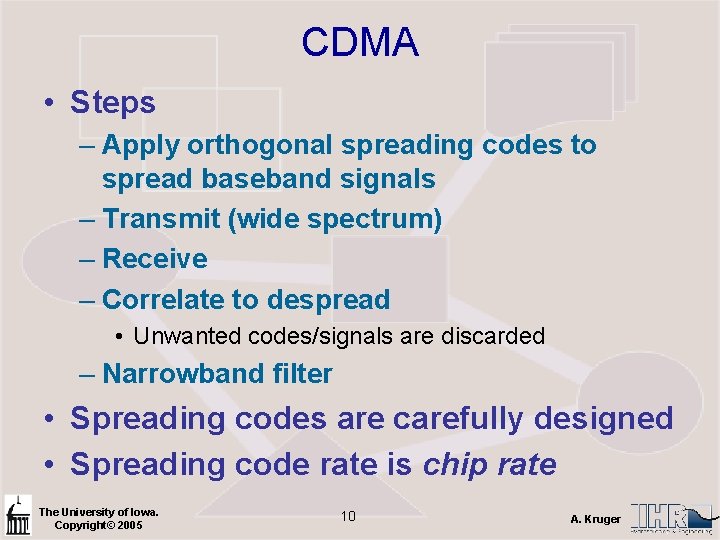
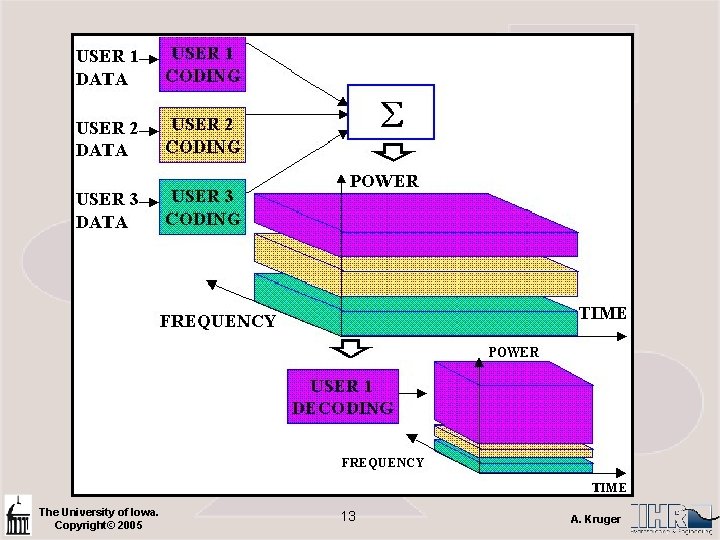
CDMA • Steps – Apply orthogonal spreading codes to spread baseband signals – Transmit (wide spectrum) – Receive – Correlate to despread • Unwanted codes/signals are discarded – Narrowband filter • Spreading codes are carefully designed • Spreading code rate is chip rate The University of Iowa. Copyright© 2005 10 A. Kruger
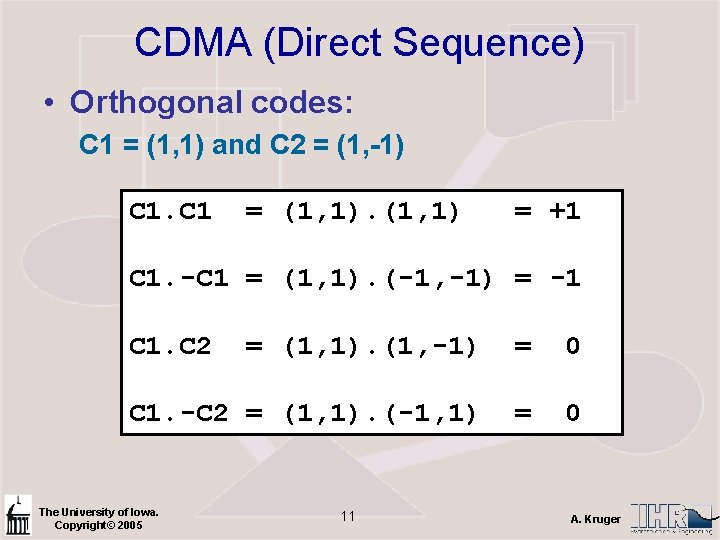
CDMA (Direct Sequence) • Orthogonal codes: C 1 = (1, 1) and C 2 = (1, -1) C 1 = (1, 1) = +1 C 1. -C 1 = (1, 1). (-1, -1) = -1 C 1. C 2 = (1, 1). (1, -1) = 0 C 1. -C 2 = (1, 1). (-1, 1) = 0 The University of Iowa. Copyright© 2005 11 A. Kruger
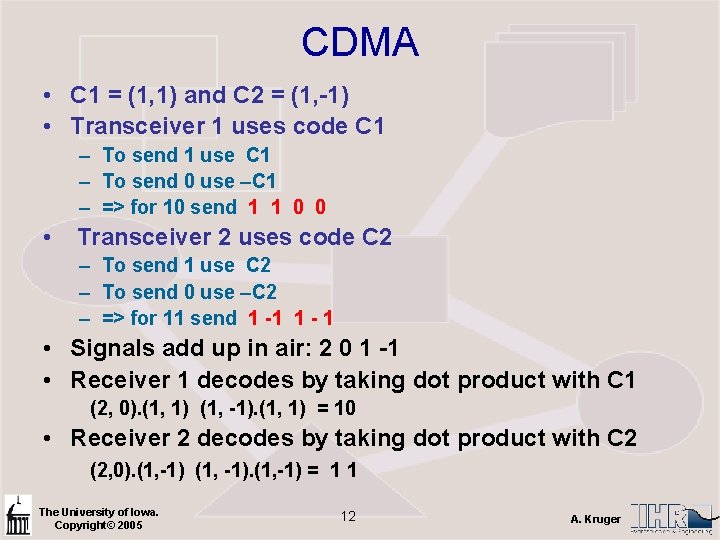
CDMA • C 1 = (1, 1) and C 2 = (1, -1) • Transceiver 1 uses code C 1 – To send 1 use C 1 – To send 0 use –C 1 – => for 10 send 1 1 0 0 • Transceiver 2 uses code C 2 – To send 1 use C 2 – To send 0 use –C 2 – => for 11 send 1 -1 1 - 1 • Signals add up in air: 2 0 1 -1 • Receiver 1 decodes by taking dot product with C 1 (2, 0). (1, 1) (1, -1). (1, 1) = 10 • Receiver 2 decodes by taking dot product with C 2 (2, 0). (1, -1) = 1 1 The University of Iowa. Copyright© 2005 12 A. Kruger
The University of Iowa. Copyright© 2005 13 A. Kruger
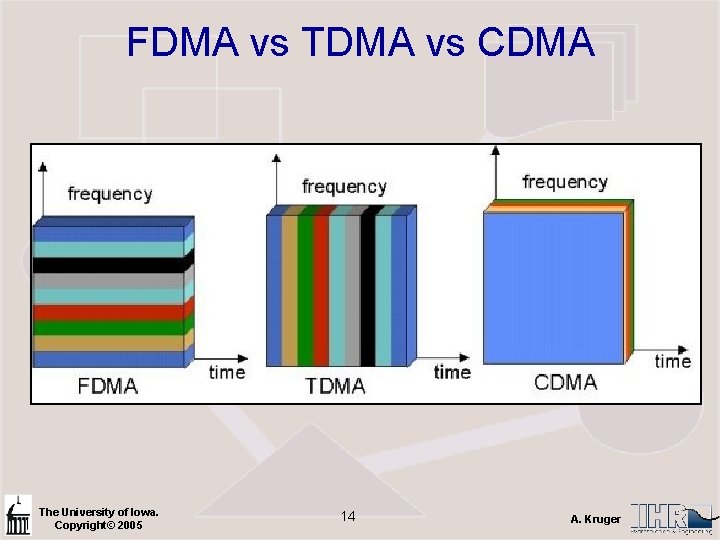
FDMA vs TDMA vs CDMA The University of Iowa. Copyright© 2005 14 A. Kruger
Review Questions • Explain in a paragraph what frequency-hopping spread spectrum is. • What is an orthogonal code? Give an example of an orthogonal code. • Explain why spread spectrum techniques can provide better channel utilization than conventional (e. g. , AM, FM). • List an briefly explain four advantages of spread spectrum. • What is a disadvantage of spread spectrum modulation? • True or false – CDMA can be seen as an example of what is known a direct sequence spread spectrum? • What is FSK and OOK? Use simple figures to explain. The University of Iowa. Copyright© 2005 15 A. Kruger
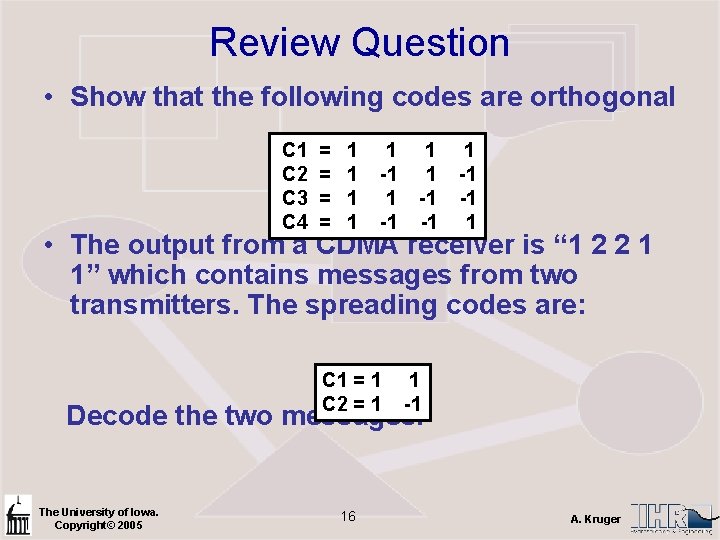
Review Question • Show that the following codes are orthogonal C 1 = 1 1 C 2 = 1 -1 C 3 = 1 1 -1 C 4 = 1 -1 1 • The output from a CDMA receiver is “ 1 2 2 1 1” which contains messages from two transmitters. The spreading codes are: C 1 = 1 1 C 2 = 1 -1 Decode the two messages. The University of Iowa. Copyright© 2005 16 A. Kruger