
Introduction to Waves Mechanical Wave Interactions MSPS 4
- Slides: 14
Introduction to Waves Mechanical Wave Interactions MS-PS 4 -2
How do waves interact with matter? • Waves interact with matter in many ways. • Waves can be reflected by matter. • Waves can change direction when they travel from one material to another. • Also, as waves move through matter, some of the energy they carry can be transferred to the matter.
Interaction of Waves With Matter • When waves reach the surface of a material, they can be reflected. • Reflection is the bouncing of a wave off a surface. • All waves reflect when they hit a surface. • An echo is an example of a sound wave reflecting. • Ocean waves reflect off boats, islands, and piers. • Reflection causes waves to change direction. • When you drop a basketball at an angle, it bounces up at the same angle but in the opposite direction. • When waves reflect from a surface, they change direction like a basketball bouncing off a surface.
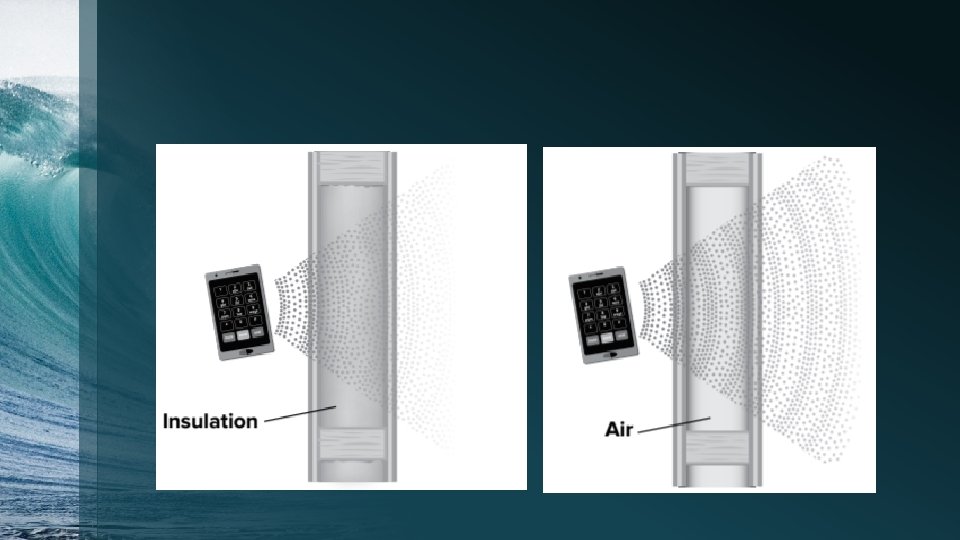
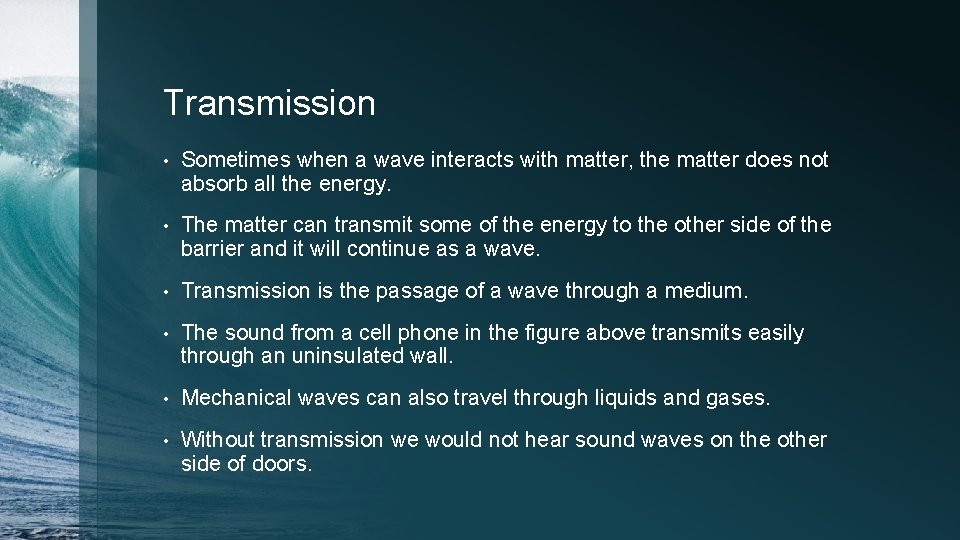
Absorption • When you shout, you create sound waves. • As the waves travel in air, some of their energy transfers to particles in the air. • As waves travel through matter, the energy they carry decreases. • Absorption is the transfer of energy by a wave to the medium through which it travels. • The amount of energy absorbed depends on the type of wave and the material in which it moves. • In the figure below, the sound from the cell phone is absorbed by the insulation in the wall.
Transmission • Sometimes when a wave interacts with matter, the matter does not absorb all the energy. • The matter can transmit some of the energy to the other side of the barrier and it will continue as a wave. • Transmission is the passage of a wave through a medium. • The sound from a cell phone in the figure above transmits easily through an uninsulated wall. • Mechanical waves can also travel through liquids and gases. • Without transmission we would not hear sound waves on the other side of doors.
Engineering Connection • Acoustical engineers must take interactions of sound waves into account when they are designing a concert hall. • Engineers carefully choose the shapes and materials to control sound waves. • The stage has a wooden floor to improve vibrations. • The curved panels on the ceiling reflect sound waves in different directions to fill the space. • Highway sound barriers are another example of controlling sound waves. • The barriers are often made from wood, concrete, or metal. • The barriers keep highway noise away from neighborhoods. • Higher walls reflect more sound from the hard surface.
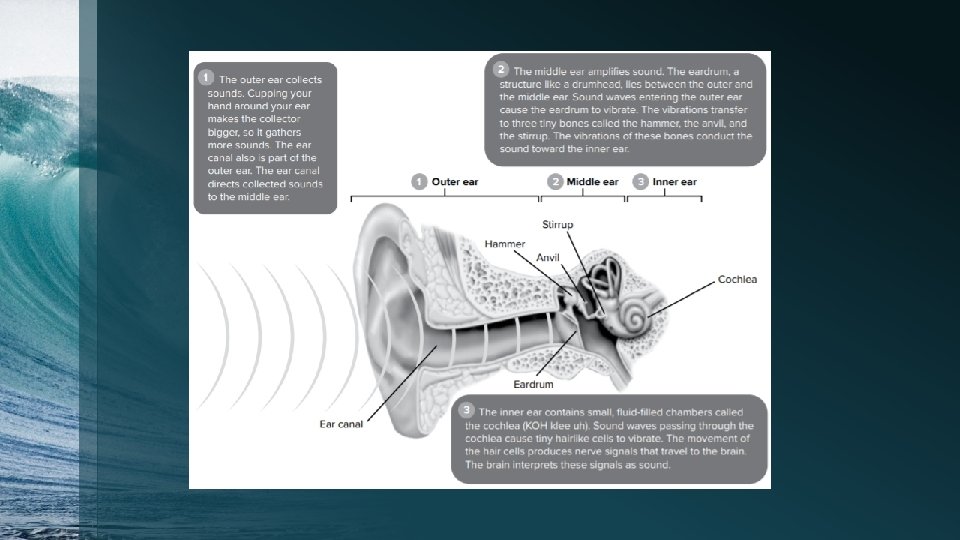
Life Science Connection • Waves interact with matter when we hear sound. • Sound waves enter the ears with information about the environment. • The human ear has three main parts, as shown in the figure below. • Sound waves interact with different medium and structures within the ear as the waves move.
What affects how a wave travels through matter? • Consider how quickly an ocean wave comes to shore or how a car horn can be heard almost immediately. • Do all waves interact with matter in the same way? • Different factors such as density and temperature affect the movement of waves. • Let’s explore how sound waves interact with different materials.
Speed of Sound • Sound waves traveling through air cause most of the sounds you hear every day. • Recall that sound waves can also travel through liquids and solids. • Like all types of waves, the speed of a sound wave depends on the material in which it travels. • Sound waves travel at different speeds in different materials. • The denser the material is, the faster a sound wave can move through it. • Solids and liquids are usually denser than gases. Sound waves move fastest through solids and slowest through gases.
• A sound wave’s speed also depends on the strength of the forces between the particles—atoms or molecules—in the material. • The stronger these forces, the faster a sound wave can move through the material. • These forces are usually strongest in solids and weakest in gases. • Overall, sound waves usually travel faster in solids than in liquids or gases. • The temperature of a material also affects the speed of a sound wave. • The speed of a sound wave in a material increases as the temperature of the material increases. • For example, the speed of a sound wave in dry air increases from 331 m/s to 343 m/s as the air temperature increases from 0°C to 20°C. • Therefore, sound waves in air travel faster on a warm, summer day than on a cold, winter day.
Diffraction • Waves can also change direction as they travel by objects. • Have you ever heard people talking in a room before you got to the open doorway? • You heard some of the sound waves because they changed direction and spread out as they traveled through the doorway.
Diffraction • Diffraction is the change in direction of a wave when it travels by the edge of an object or through an opening. • Diffraction causes waves to travel around the edges of an object. • Diffraction also causes waves to spread out after they travel through an opening. • More diffraction occurs as the size of the object or opening becomes similar in size to the wavelength of the wave.