
Introduction to Water Law the Central Arizona Project
- Slides: 18
Introduction to Water Law & the Central Arizona Project (CAP)
BACKGROUND • One of the biggest environmental and socio-political issues of our time is the conflict over water, and the "water wars" (often literally) will only intensify in the future as demands for water increase globally. • In southern Arizona, we have been using water (surface and ground water) faster than it replenishes due to urban expansion and increasing agricultural demand. • The Central Arizona Project (CAP) was built to import water from the Colorado River to southern Arizona.
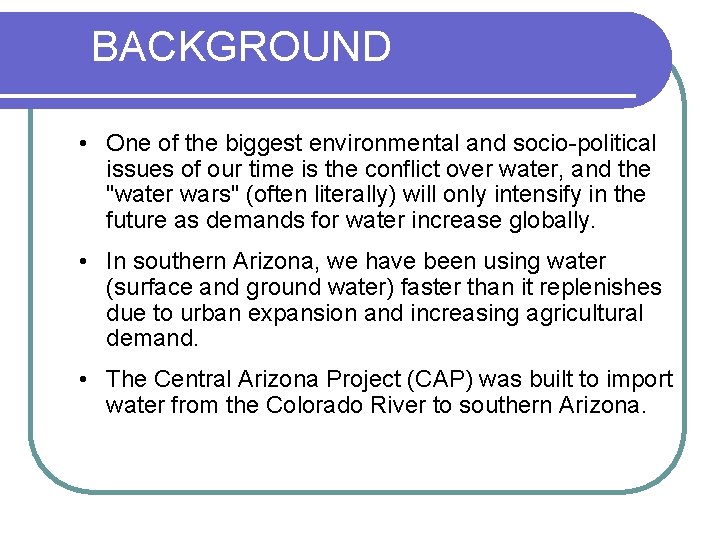
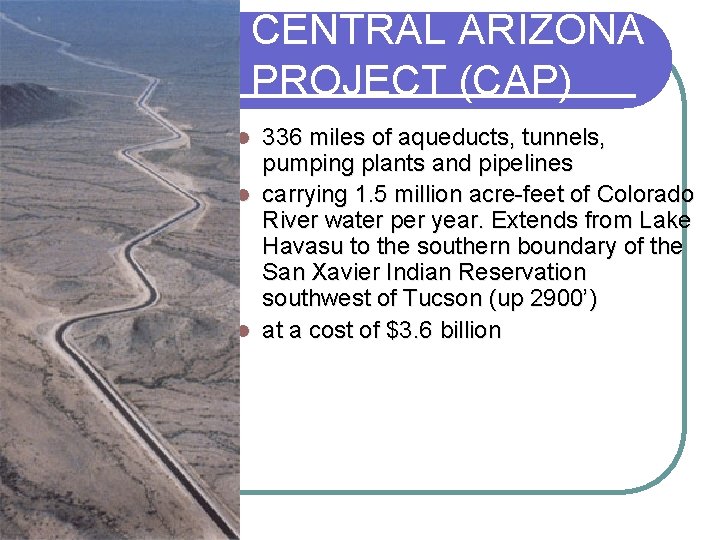
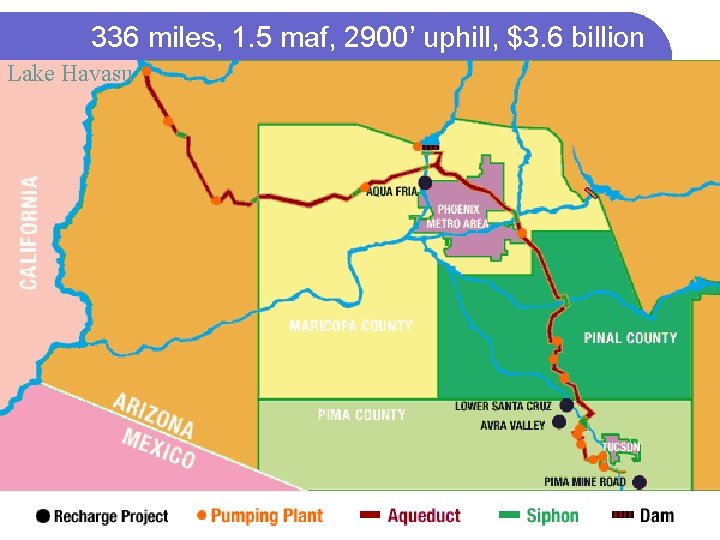
CENTRAL ARIZONA PROJECT (CAP) 336 miles of aqueducts, tunnels, pumping plants and pipelines l carrying 1. 5 million acre-feet of Colorado River water per year. Extends from Lake Havasu to the southern boundary of the San Xavier Indian Reservation southwest of Tucson (up 2900’) l at a cost of $3. 6 billion l
336 miles, 1. 5 maf, 2900’ uphill, $3. 6 billion Lake Havasu
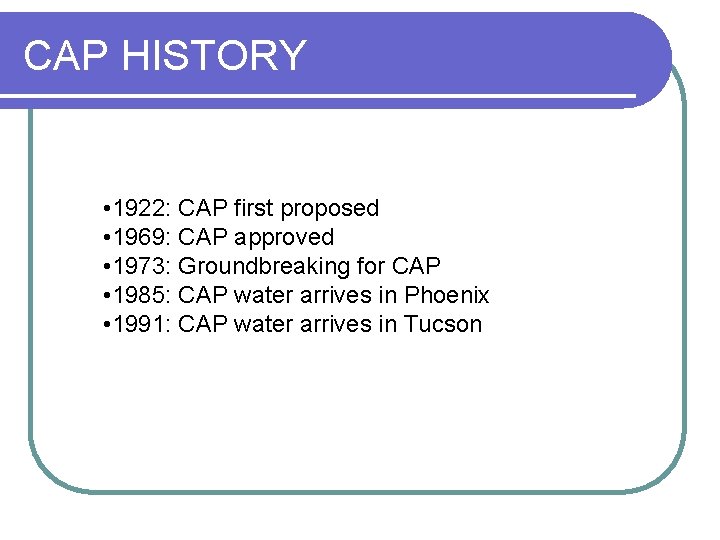
CAP HISTORY • 1922: CAP first proposed • 1969: CAP approved • 1973: Groundbreaking for CAP • 1985: CAP water arrives in Phoenix • 1991: CAP water arrives in Tucson
State Law l First in time, first in right: First person to claim surface water to beneficial use, owns the water as a property right. Known as the prior appropriation law. l Note: “beneficial use” has meant, until recently, human use for monetary gain.
State Law l Use it or lose it. If a water right is not put to beneficial use for a period of 5 years, it is lost and can be claimed by others. l Arizona Revised Statute 45 -141 gives the following priority of water uses (in descending order): domestic, municipal, irrigation, stock watering, power and mining uses, and wildlife.
State Law l State Groundwater Code of 1980 prohibits mining groundwater (using groundwater faster than it is recharged) after 2025.
Federal Law l The federal government owns the water which is on public land or land held by the federal government in trust for Native Americans. l 1908 Winters Decision by the US Supreme Court implied at the time of the establishment of an Indian reservation that enough water be reserved for the reservation's purposes.
The Colorado River is Overcommited Here’s why……. .
1922 Compact l The average flow of the Colorado River was determined (from data in the 1920's) to be 15 million acre feet (maf) per year. l This is an overestimate l A Univ. of Arizona study found the average to be 13. 5 maf per year (according to their research, the last time the average was 15 maf was in the 1600 s).
1922 Compact The water shall be divided equally (7. 5 maf each) between Upper Basin States (CO, WY, UT, NM) and Lower Basin States (AZ, NV, CA). Actually, the Upper Basin States must release 75 maf over a ten year period, allowing the actual amount for any particular year to be greater or less than 7. 5 maf. Thus, there is no guarantee of 7. 5 maf each year. l In a drought, the Upper Basin states could release just Mexico's allotment and use all the rest, as long as they release enough during the wet years to make up the ten year commitment. l
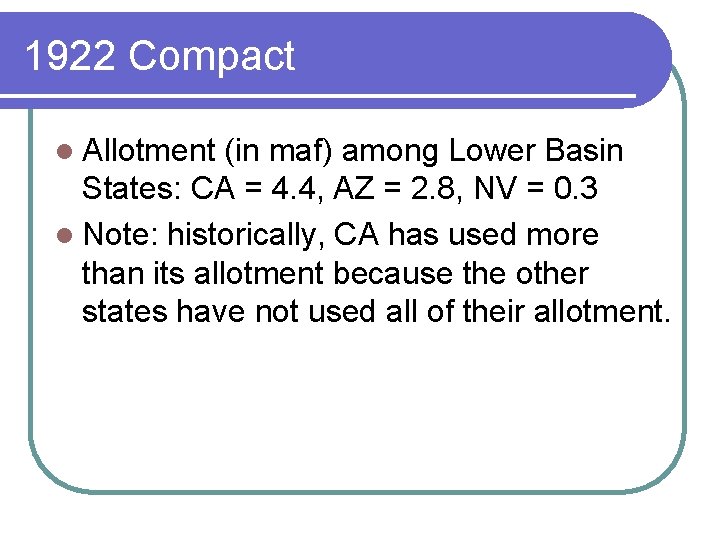
1922 Compact l Allotment (in maf) among Lower Basin States: CA = 4. 4, AZ = 2. 8, NV = 0. 3 l Note: historically, CA has used more than its allotment because the other states have not used all of their allotment.
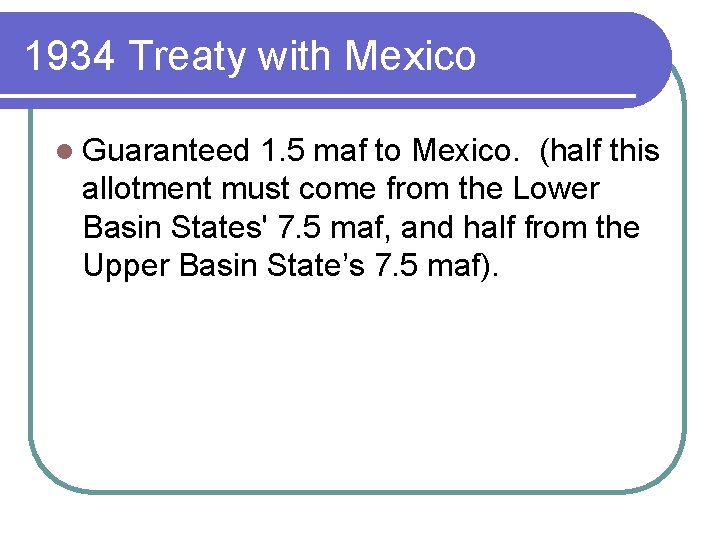
1934 Treaty with Mexico l Guaranteed 1. 5 maf to Mexico. (half this allotment must come from the Lower Basin States' 7. 5 maf, and half from the Upper Basin State’s 7. 5 maf).
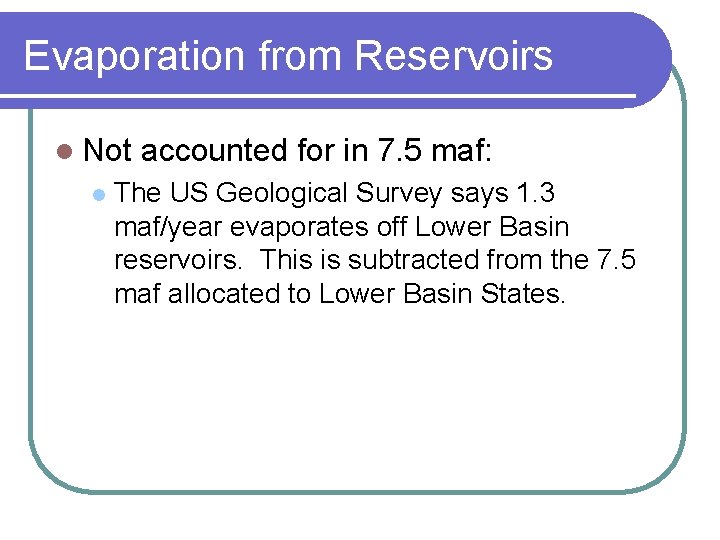
Evaporation from Reservoirs l Not l accounted for in 7. 5 maf: The US Geological Survey says 1. 3 maf/year evaporates off Lower Basin reservoirs. This is subtracted from the 7. 5 maf allocated to Lower Basin States.
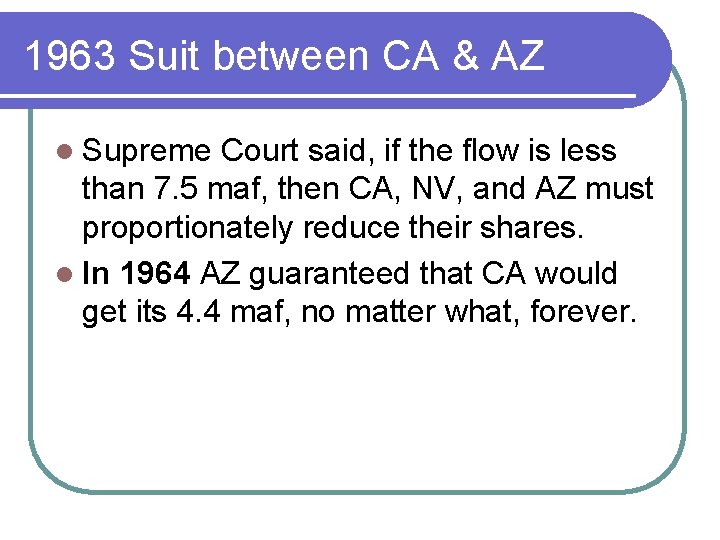
1963 Suit between CA & AZ l Supreme Court said, if the flow is less than 7. 5 maf, then CA, NV, and AZ must proportionately reduce their shares. l In 1964 AZ guaranteed that CA would get its 4. 4 maf, no matter what, forever.
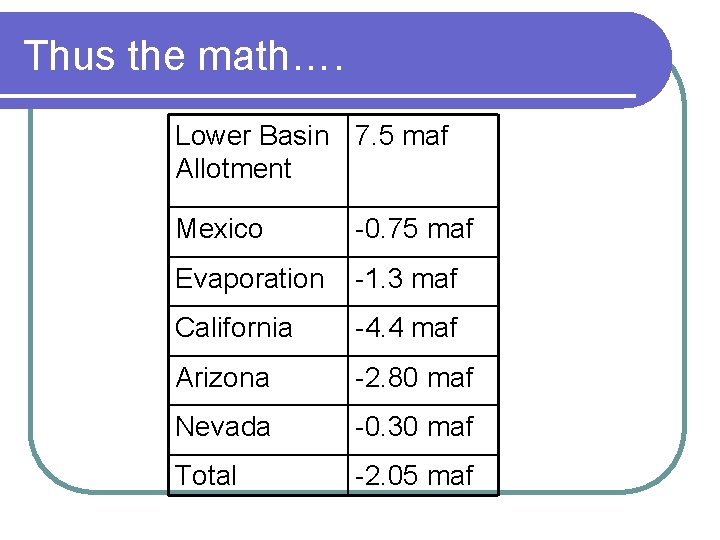
Thus the math…. Lower Basin 7. 5 maf Allotment Mexico -0. 75 maf Evaporation -1. 3 maf California -4. 4 maf Arizona -2. 80 maf Nevada -0. 30 maf Total -2. 05 maf
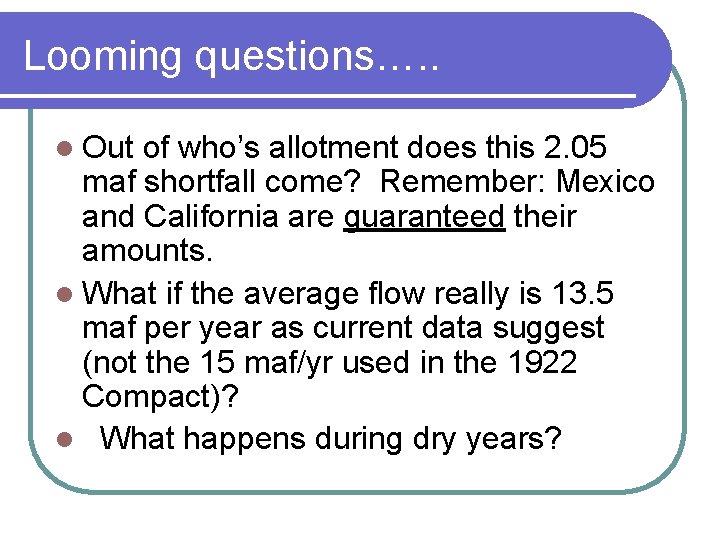
Looming questions…. . l Out of who’s allotment does this 2. 05 maf shortfall come? Remember: Mexico and California are guaranteed their amounts. l What if the average flow really is 13. 5 maf per year as current data suggest (not the 15 maf/yr used in the 1922 Compact)? l What happens during dry years?