
Introduction to VLSI Testing KuenJong Lee Dept of


- Slides: 41
Introduction to VLSI Testing 李昆忠 Kuen-Jong Lee Dept. of Electrical Engineering National Cheng-Kung University Tainan, Taiwan VLSI Testing Class
Problems to Think How are you going to test VLSI Testing • A 32 bit adder • A 32 bit counter • A 32 Mb cache memory • A 107 -transistor CPU • A 109 -transistor SOC Introduction. 2 NCKUEE-KJLEE
OUTLINE • Introduction • Fault modeling • Fault simulation • Test generation • Automatic test pattern generation (ATPG) • Design for testability • Built-in self test • Synthesis for testability • An example VLSI Testing Introduction. 3 NCKUEE-KJLEE
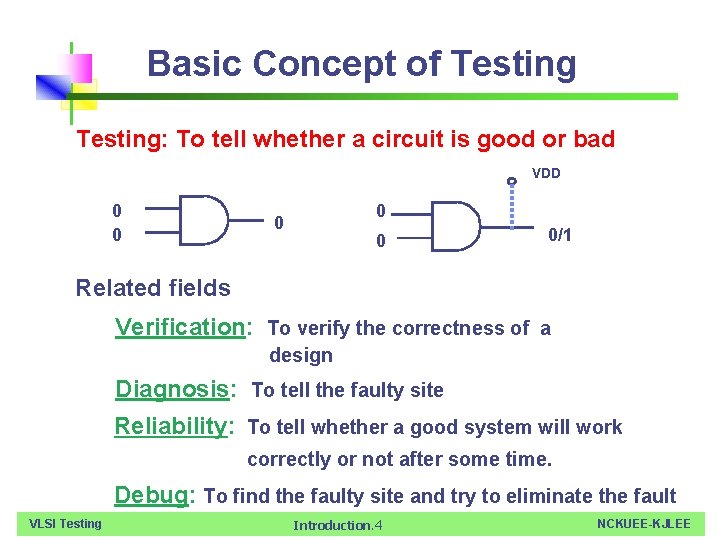
Basic Concept of Testing: To tell whether a circuit is good or bad VDD 0 0 0/1 Related fields Verification: To verify the correctness of a design Diagnosis: To tell the faulty site Reliability: To tell whether a good system will work correctly or not after some time. Debug: To find the faulty site and try to eliminate the fault VLSI Testing Introduction. 4 NCKUEE-KJLEE
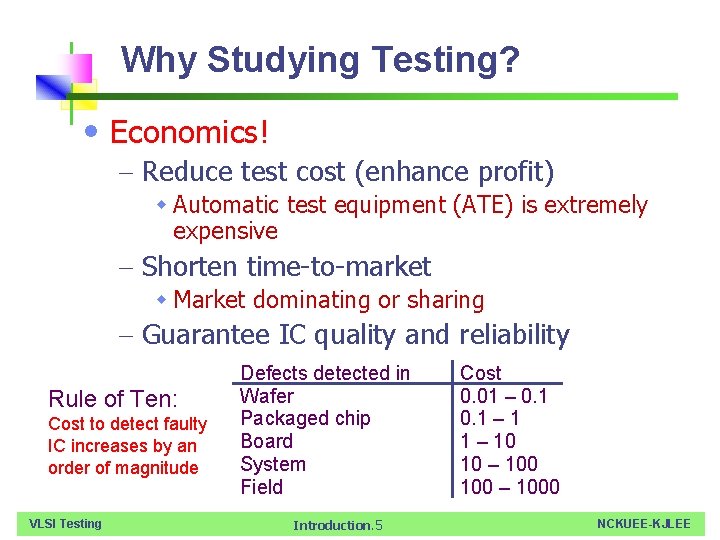
Why Studying Testing? • Economics! - Reduce test cost (enhance profit) w Automatic test equipment (ATE) is extremely expensive - Shorten time-to-market w Market dominating or sharing - Guarantee IC quality and reliability Rule of Ten: Cost to detect faulty IC increases by an order of magnitude VLSI Testing Defects detected in Wafer Packaged chip Board System Field Introduction. 5 Cost 0. 01 – 0. 1 – 10 10 – 1000 NCKUEE-KJLEE
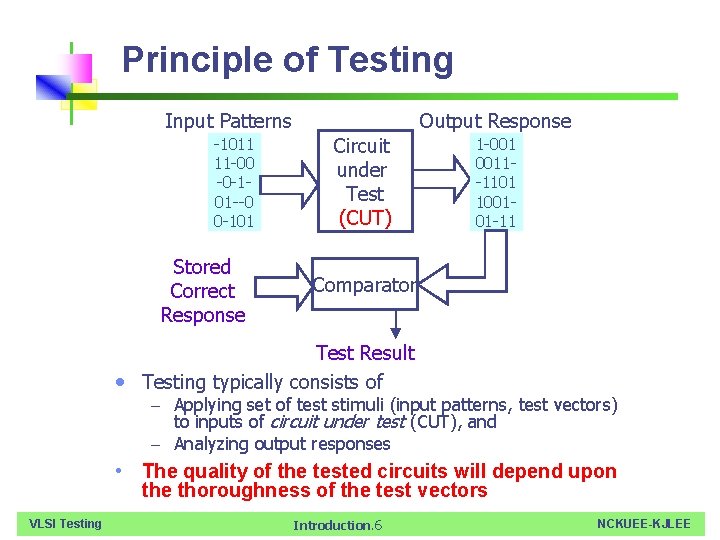
Principle of Testing Input Patterns -1011 11 -00 -0 -101 --0 0 -101 Stored Correct Response Output Response Circuit under Test (CUT) 1 -001 0011 -1101 100101 -11 Comparator Test Result • Testing typically consists of - Applying set of test stimuli (input patterns, test vectors) to inputs of circuit under test (CUT), and - Analyzing output responses • The quality of the tested circuits will depend upon the thoroughness of the test vectors VLSI Testing Introduction. 6 NCKUEE-KJLEE
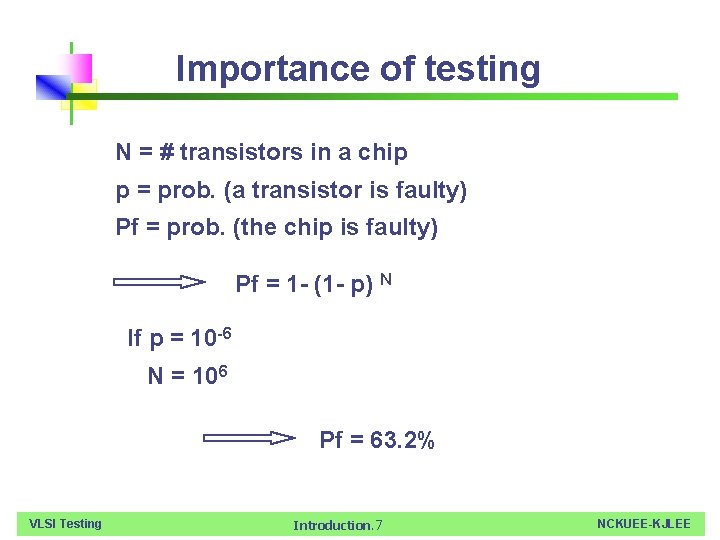
Importance of testing N = # transistors in a chip p = prob. (a transistor is faulty) Pf = prob. (the chip is faulty) Pf = 1 - (1 - p) N If p = 10 -6 N = 106 Pf = 63. 2% VLSI Testing Introduction. 7 NCKUEE-KJLEE
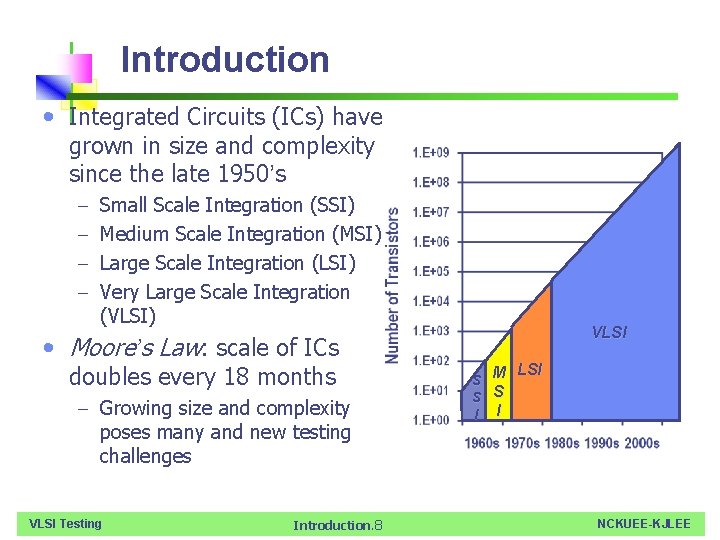
Introduction • Integrated Circuits (ICs) have grown in size and complexity since the late 1950’s - Small Scale Integration (SSI) Medium Scale Integration (MSI) Large Scale Integration (LSI) Very Large Scale Integration (VLSI) • Moore’s Law: scale of ICs doubles every 18 months - Growing size and complexity poses many and new testing challenges VLSI Testing Introduction. 8 VLSI M LSI S S S I I NCKUEE-KJLEE
Importance of Testing • Moore’s Law results from decreasing feature size (dimensions) - from 10 s of m to 10 s of nm for transistors and interconnecting wires • Operating frequencies have increased from 100 KHz to several GHz • Decreasing feature size increases probability of defects during manufacturing process - A single faulty transistor or wire results in faulty IC - Testing required to guarantee fault-free products VLSI Testing Introduction. 9 NCKUEE-KJLEE
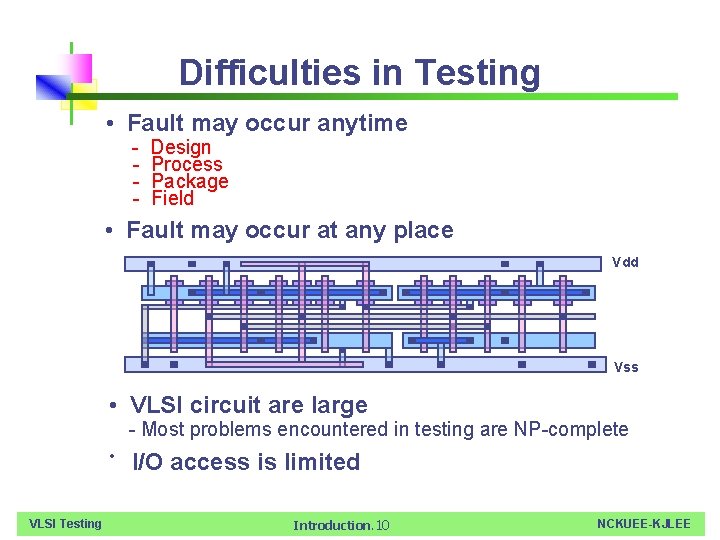
Difficulties in Testing • Fault may occur anytime - Design Process Package Field • Fault may occur at any place Vdd Vss • VLSI circuit are large - Most problems encountered in testing are NP-complete • VLSI Testing I/O access is limited Introduction. 10 NCKUEE-KJLEE
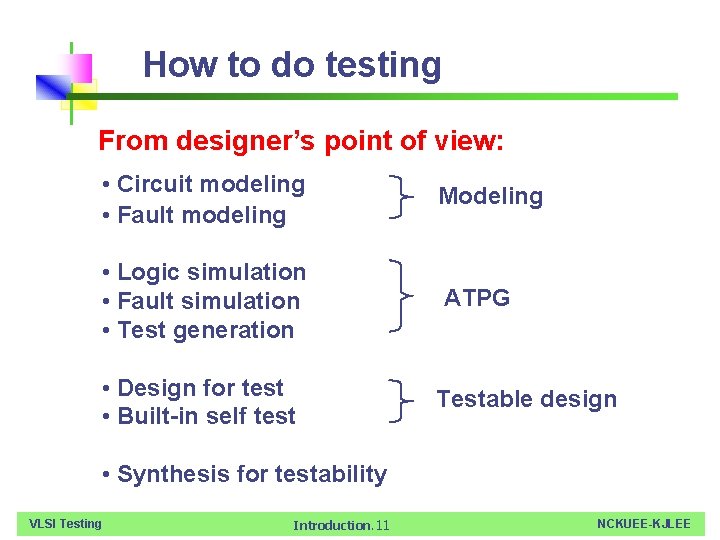
How to do testing From designer’s point of view: • Circuit modeling • Fault modeling Modeling • Logic simulation • Fault simulation • Test generation ATPG • Design for test • Built-in self test Testable design • Synthesis for testability VLSI Testing Introduction. 11 NCKUEE-KJLEE
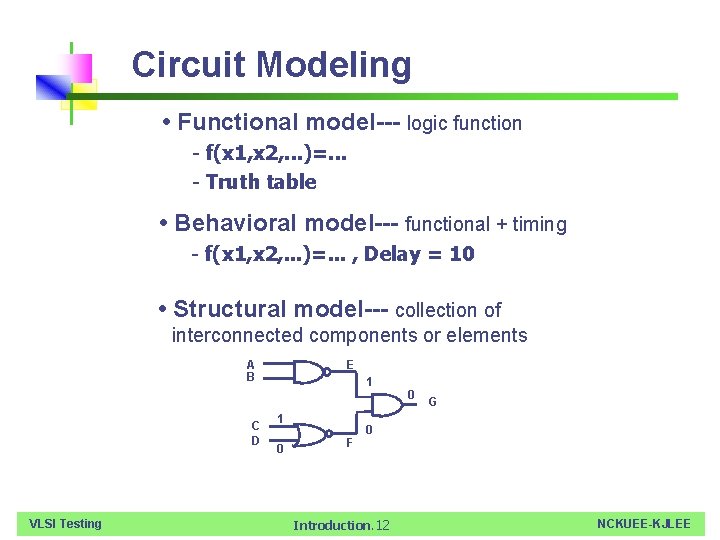
Circuit Modeling • Functional model--- logic function - f(x 1, x 2, . . . )=. . . - Truth table • Behavioral model--- functional + timing - f(x 1, x 2, . . . )=. . . , Delay = 10 • Structural model--- collection of interconnected components or elements A B E 1 0 C D VLSI Testing 1 0 G 0 F Introduction. 12 NCKUEE-KJLEE
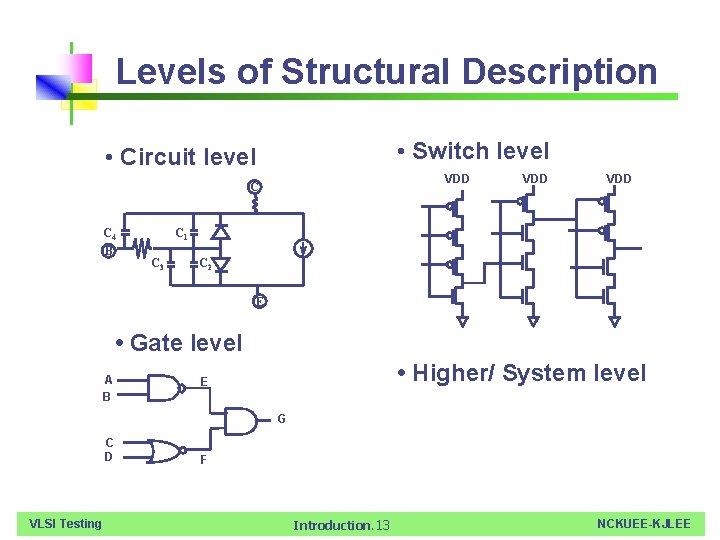
Levels of Structural Description • Switch level • Circuit level VDD C C 4 B VDD C 1 C 3 C 2 E • Gate level A B • Higher/ System level E G C D VLSI Testing F Introduction. 13 NCKUEE-KJLEE
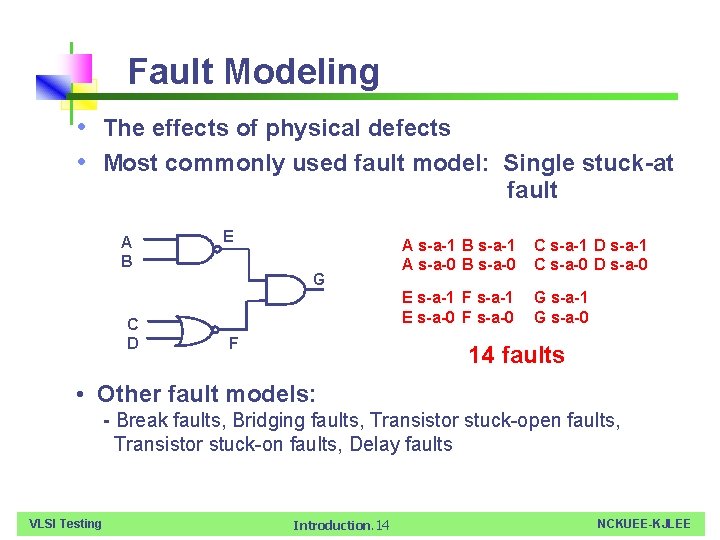
Fault Modeling • The effects of physical defects • Most commonly used fault model: Single stuck-at fault A B E G C D F A s-a-1 B s-a-1 A s-a-0 B s-a-0 C s-a-1 D s-a-1 C s-a-0 D s-a-0 E s-a-1 F s-a-1 E s-a-0 F s-a-0 G s-a-1 G s-a-0 14 faults • Other fault models: - Break faults, Bridging faults, Transistor stuck-open faults, Transistor stuck-on faults, Delay faults VLSI Testing Introduction. 14 NCKUEE-KJLEE
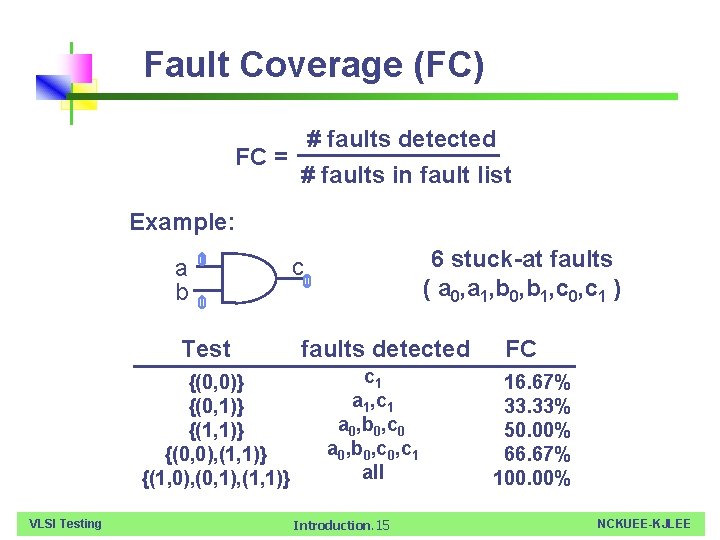
Fault Coverage (FC) FC = # faults detected # faults in fault list Example: a b 1 0 0 1 0 Test {(0, 0)} {(0, 1)} {(1, 1)} {(0, 0), (1, 1)} {(1, 0), (0, 1), (1, 1)} VLSI Testing 6 stuck-at faults ( a 0, a 1, b 0, b 1, c 0, c 1 ) c 1 faults detected c 1 a 1, c 1 a 0, b 0, c 1 all Introduction. 15 FC 16. 67% 33. 33% 50. 00% 66. 67% 100. 00% NCKUEE-KJLEE
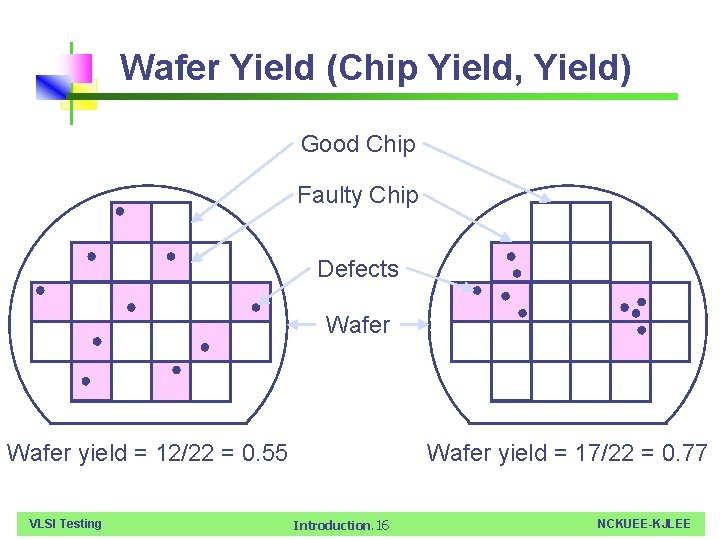
Wafer Yield (Chip Yield, Yield) Good Chip Faulty Chip Defects Wafer yield = 12/22 = 0. 55 VLSI Testing Wafer yield = 17/22 = 0. 77 Introduction. 16 NCKUEE-KJLEE
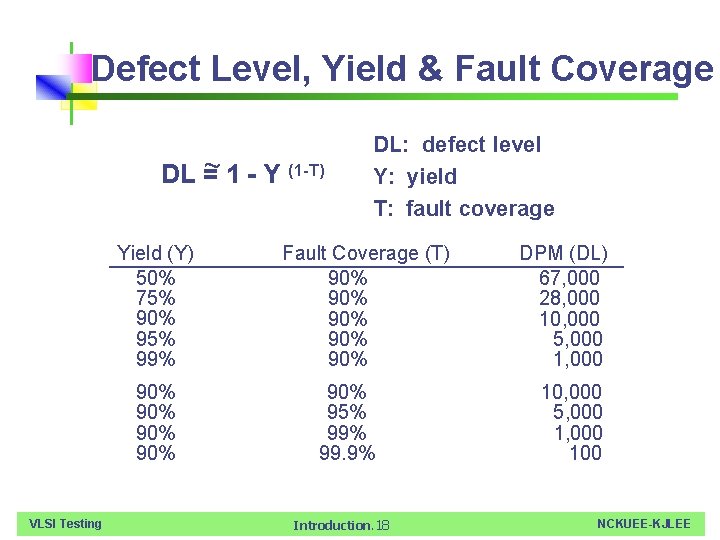
Testing and Quality IC Fabrication Shipped Parts Testing Yield: Fraction of good parts Rejects Quality: Defective parts per million (DPM) • Quality of shipped parts is a function of yield Y and the test (fault) coverage T • Defect level (DL, reject rate in textbook): fraction of shipped parts that are defective VLSI Testing Introduction. 17 NCKUEE-KJLEE
Defect Level, Yield & Fault Coverage DL ~ = 1 - Y (1 -T) Yield (Y) 50% 75% 90% 95% 99% 90% 90% VLSI Testing DL: defect level Y: yield T: fault coverage Fault Coverage (T) 90% 90% 90% 95% 99. 9% Introduction. 18 DPM (DL) 67, 000 28, 000 10, 000 5, 000 1, 000 100 NCKUEE-KJLEE
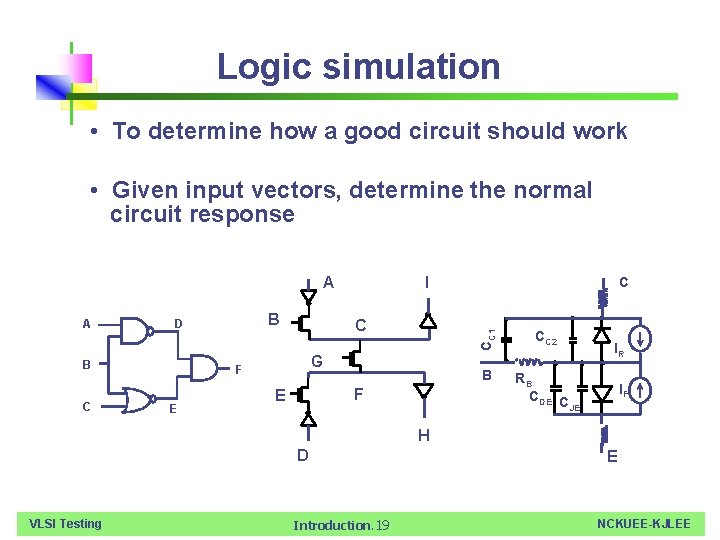
Logic simulation • To determine how a good circuit should work • Given input vectors, determine the normal circuit response A B C B D C G F E C CC 1 A I CC 2 B RB CDE C JE IR IF H D VLSI Testing Introduction. 19 E NCKUEE-KJLEE
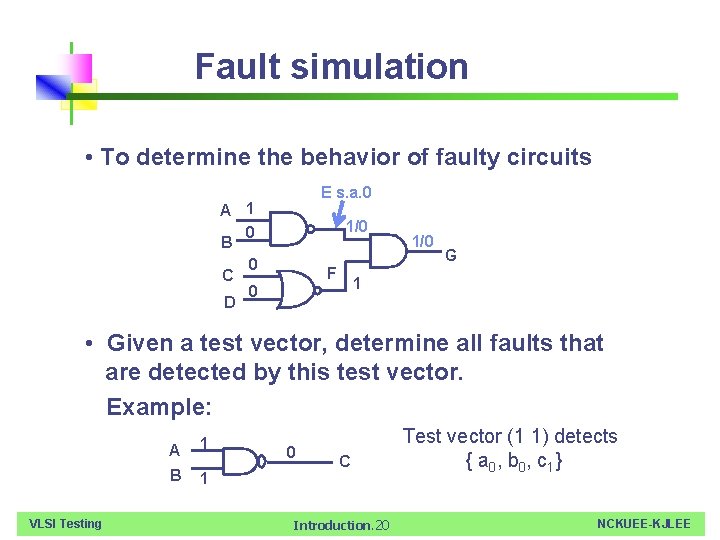
Fault simulation • To determine the behavior of faulty circuits E s. a. 0 A 1 0 B 0 C 0 D 1/0 1 F 1/0 1 G 1 • Given a test vector, determine all faults that are detected by this test vector. Example: VLSI Testing A 1 B 1 0 C Introduction. 20 Test vector (1 1) detects { a 0, b 0, c 1} NCKUEE-KJLEE
Test generation • Given a fault, identify a test to detect this fault 1 Example: 0 1/0 A B D 1 1/0 F 1 C 0 E To detect D s-a-0, D must be set to 1. Thus A=B=1. To propagate fault effect to the primary output E must be 1. Thus C must be 0. Test vector: A=1, B=1, C=0 VLSI Testing Introduction. 21 NCKUEE-KJLEE
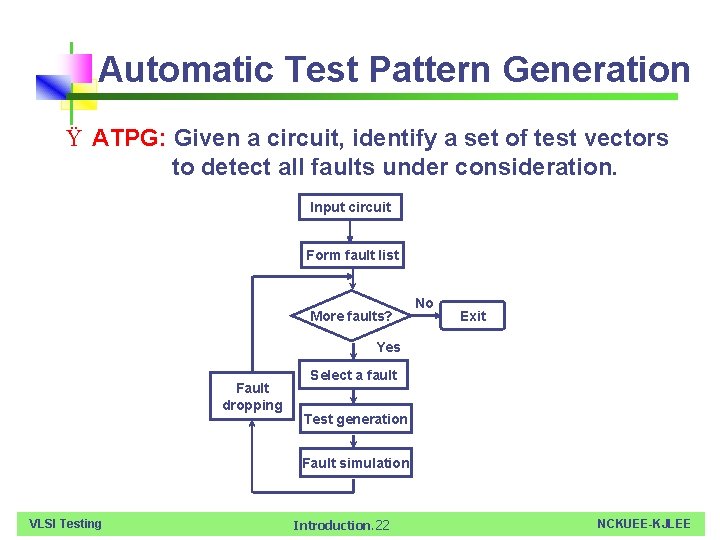
Automatic Test Pattern Generation Ÿ ATPG: Given a circuit, identify a set of test vectors to detect all faults under consideration. Input circuit Form fault list More faults? No Exit Yes Fault dropping Select a fault Test generation Fault simulation VLSI Testing Introduction. 22 NCKUEE-KJLEE
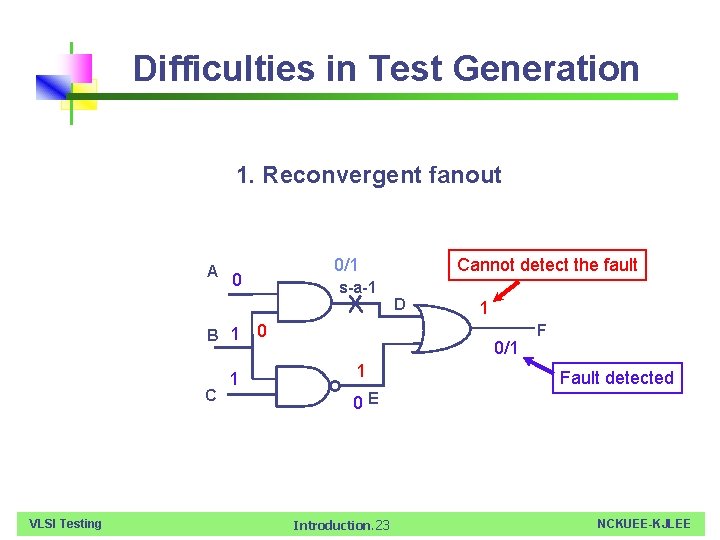
Difficulties in Test Generation 1. Reconvergent fanout A 0 B 1 C VLSI Testing 0/1 1 s-a-1 0 Cannot detect the fault D 1 0/1 1 F Fault detected 0 E Introduction. 23 NCKUEE-KJLEE
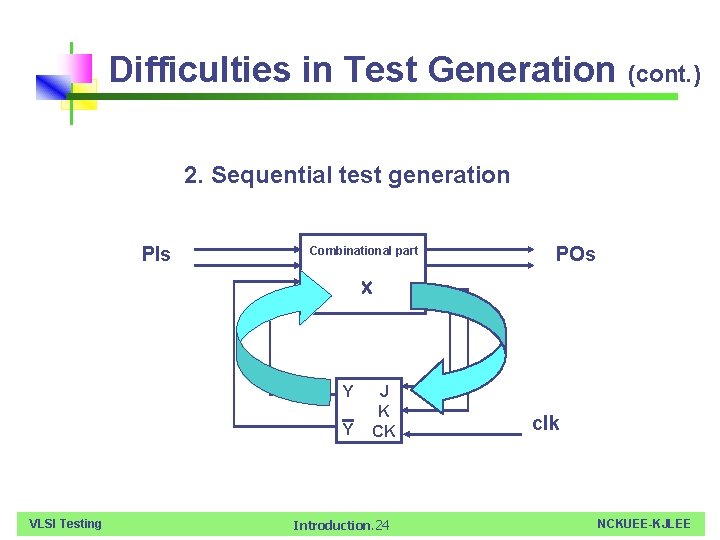
Difficulties in Test Generation (cont. ) 2. Sequential test generation PIs Combinational part Y Y VLSI Testing J K CK Introduction. 24 POs clk NCKUEE-KJLEE
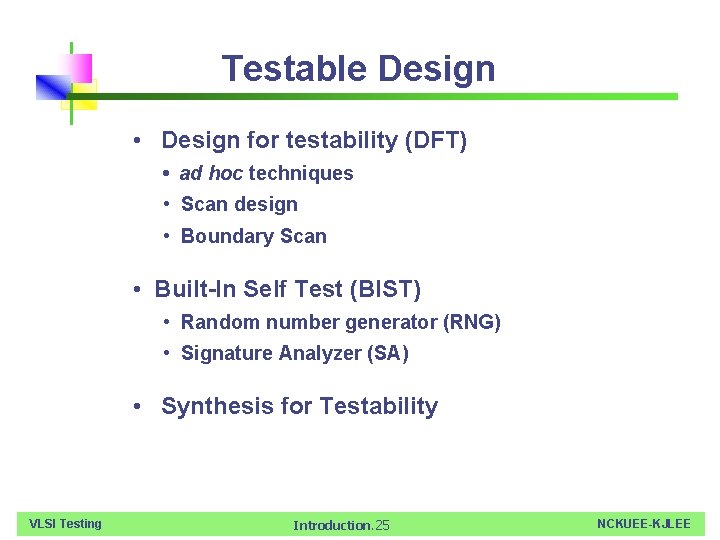
Testable Design • Design for testability (DFT) • ad hoc techniques • Scan design • Boundary Scan • Built-In Self Test (BIST) • Random number generator (RNG) • Signature Analyzer (SA) • Synthesis for Testability VLSI Testing Introduction. 25 NCKUEE-KJLEE
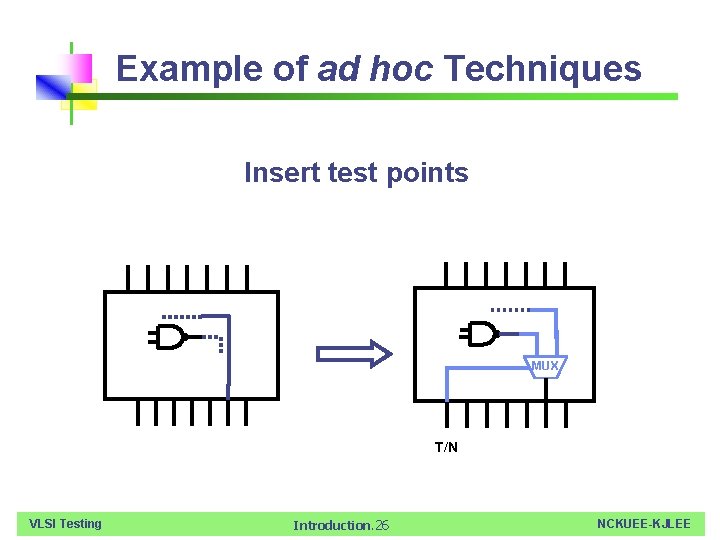
Example of ad hoc Techniques Insert test points MUX T/N VLSI Testing Introduction. 26 NCKUEE-KJLEE
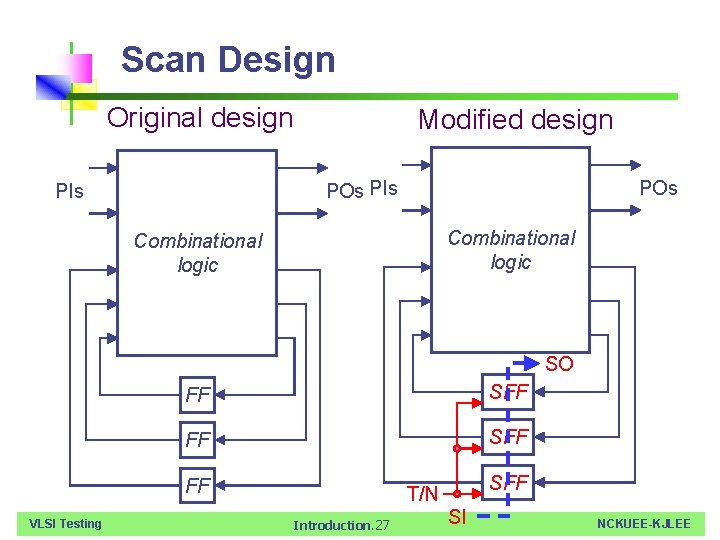
Scan Design Original design Modified design POs PIs POs Combinational logic SO FF SFF FF VLSI Testing SFF T/N Introduction. 27 SI NCKUEE-KJLEE
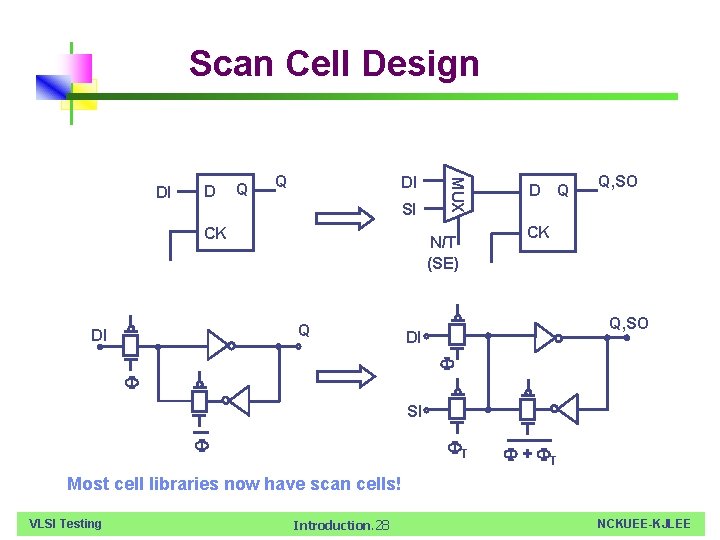
Scan Cell Design D Q Q DI SI CK N/T (SE) Q DI MUX DI D Q Q, SO CK Q, SO DI F F SI F FT F + FT Most cell libraries now have scan cells! VLSI Testing Introduction. 28 NCKUEE-KJLEE
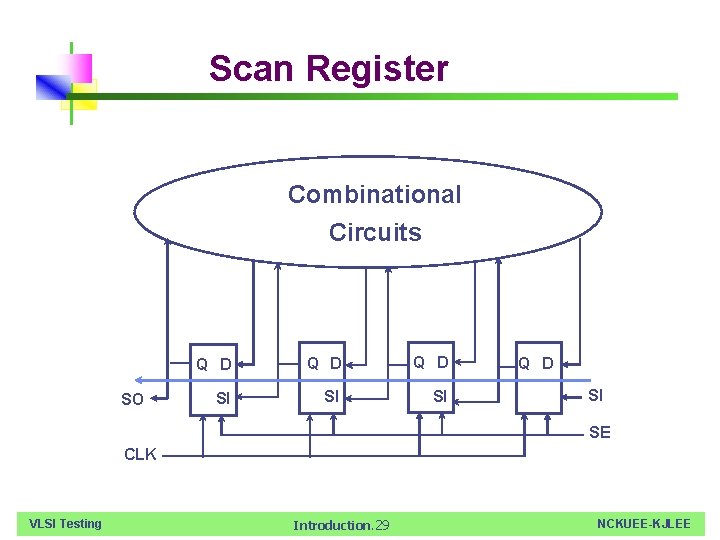
Scan Register Combinational Circuits SO Q D Q D SI SI SI Q D SI SE CLK VLSI Testing Introduction. 29 NCKUEE-KJLEE
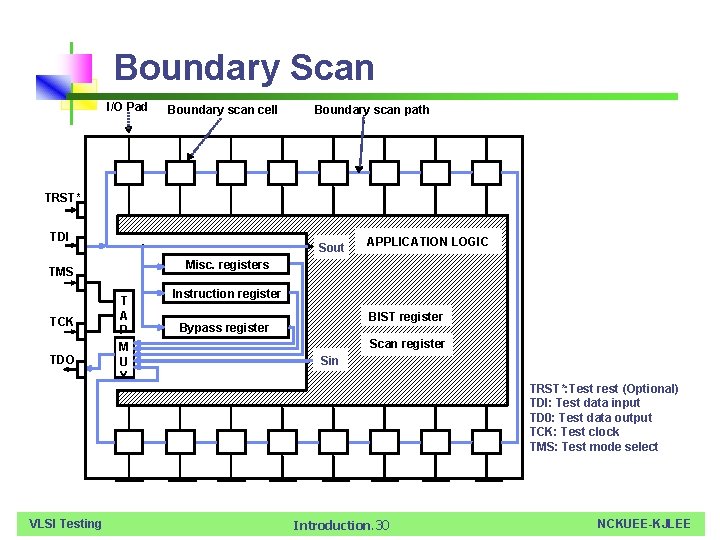
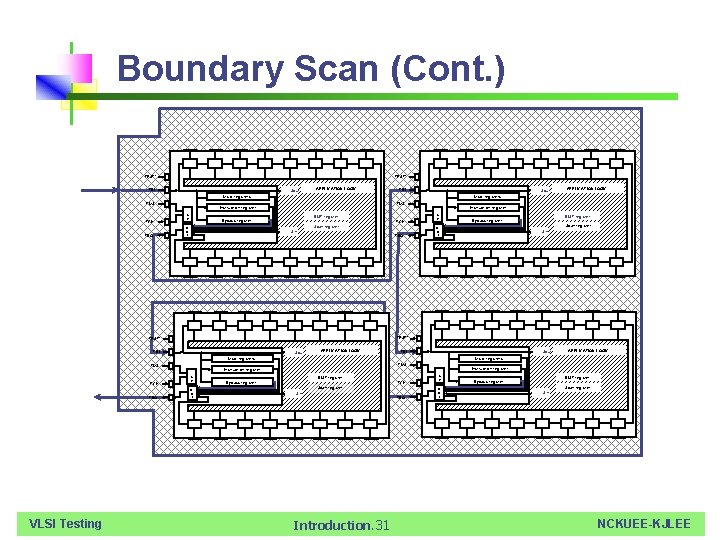
Boundary Scan I/O Pad Boundary scan cell Boundary scan path TRST* TDI Sout Misc. registers TMS TCK TDO VLSI Testing APPLICATION LOGIC T A P M U X Instruction register BIST register Bypass register Scan register Sin TRST*: Test rest (Optional) TDI: Test data input TD 0: Test data output TCK: Test clock TMS: Test mode select Introduction. 30 NCKUEE-KJLEE
Boundary Scan (Cont. ) TRST* TDI Sout APPLICATION LOGIC TDI Sout Misc. registers TMS TCK BIST register Bypass register TCK Scan register M U X TDO TMS Instruction register T A P Sin TDO T A P TDI Sout APPLICATION LOGIC Scan register Sin TDI Sout T A P M U X APPLICATION LOGIC Misc. registers TMS VLSI Testing BIST register Bypass register M U X Misc. registers TDO Instruction register TRST* TCK APPLICATION LOGIC Misc. registers Instruction register BIST register Bypass register TCK Scan register Sin Introduction. 31 TDO T A P M U X Instruction register BIST register Bypass register Scan register Sin NCKUEE-KJLEE
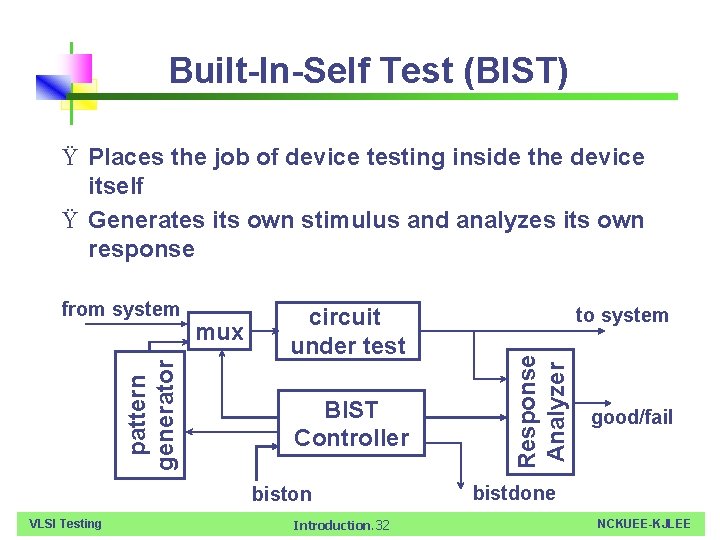
Built-In-Self Test (BIST) Ÿ Places the job of device testing inside the device itself Ÿ Generates its own stimulus and analyzes its own response mux circuit under test BIST Controller biston VLSI Testing Introduction. 32 to system Response Analyzer pattern generator from system good/fail bistdone NCKUEE-KJLEE
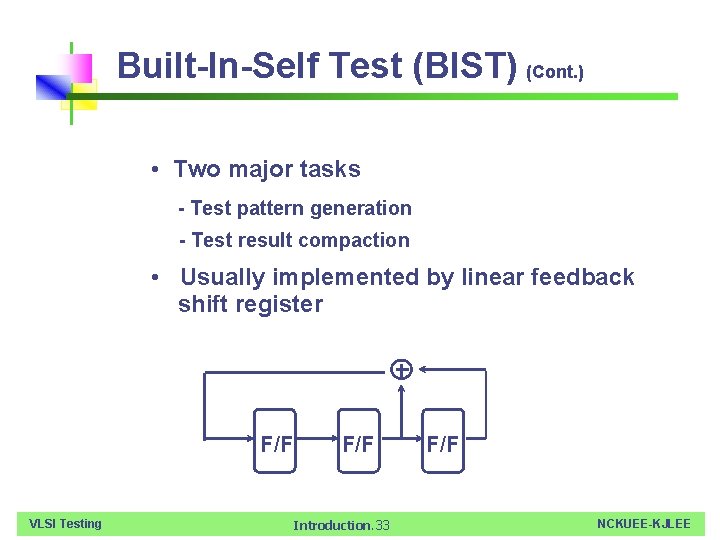
Built-In-Self Test (BIST) (Cont. ) • Two major tasks - Test pattern generation - Test result compaction • Usually implemented by linear feedback shift register F/F VLSI Testing F/F Introduction. 33 F/F NCKUEE-KJLEE
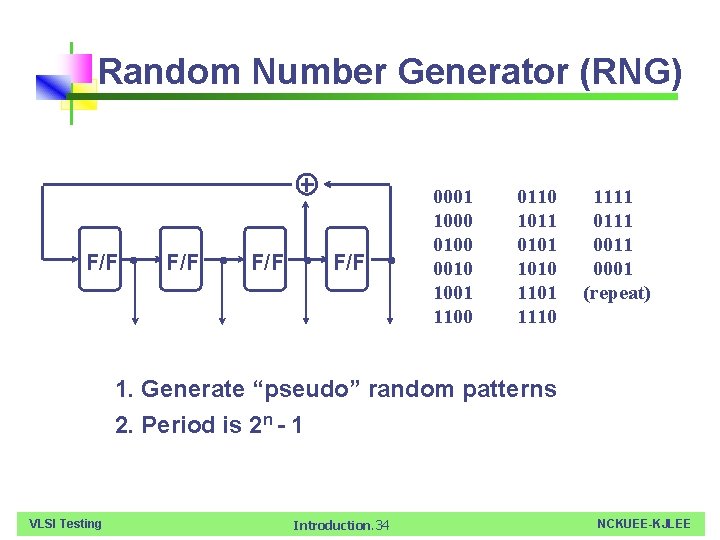
Random Number Generator (RNG) F/F · 0001 1000 0100 0010 1001 1100 0110 1011 0101 1010 1101 1110 1111 0011 0001 (repeat) 1. Generate “pseudo” random patterns 2. Period is 2 n - 1 VLSI Testing Introduction. 34 NCKUEE-KJLEE
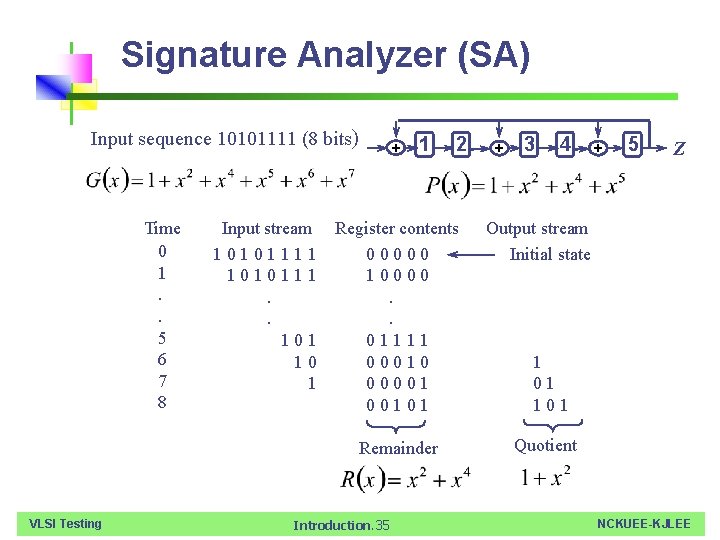
Signature Analyzer (SA) Input sequence 10101111 (8 bits) Time 0 1. . 5 6 7 8 + 1 Input stream Register contents 10101111 00000 1010111 10000. . 101 01111 10 00010 1 00001 00101 Remainder VLSI Testing 2 Introduction. 35 + 3 4 + 5 Z Output stream Initial state 1 01 101 Quotient NCKUEE-KJLEE
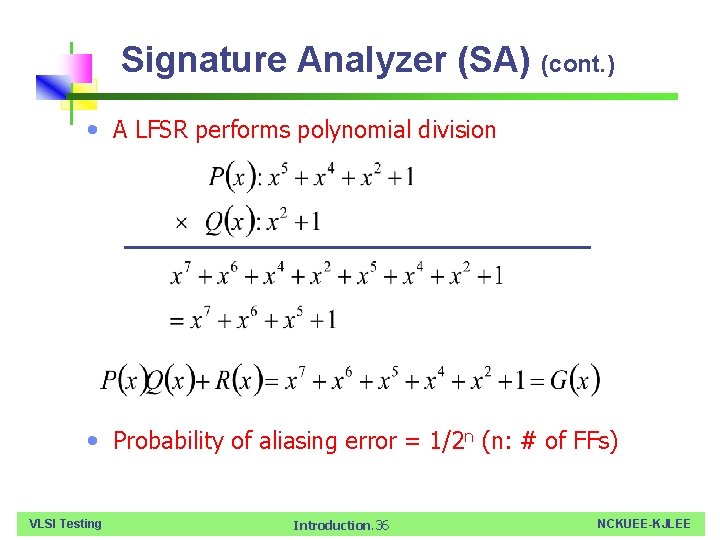
Signature Analyzer (SA) (cont. ) • A LFSR performs polynomial division • Probability of aliasing error = 1/2 n (n: # of FFs) VLSI Testing Introduction. 36 NCKUEE-KJLEE
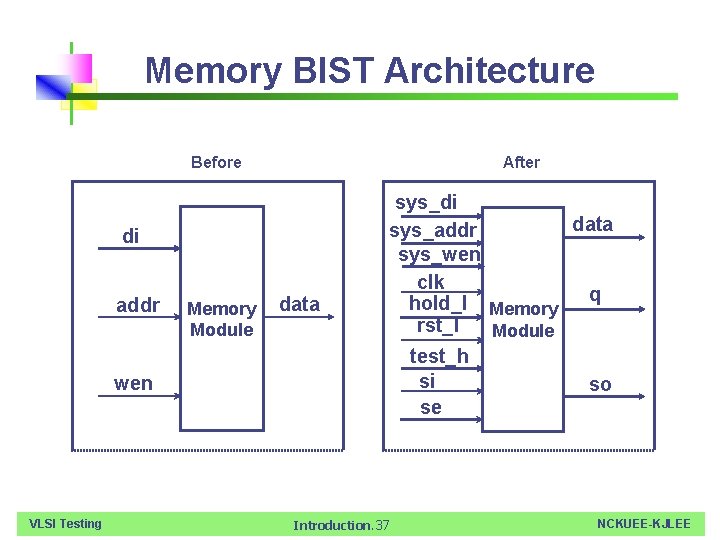
Memory BIST Architecture Before After di addr Memory Module data sys_di data sys_addr sys_wen clk q hold_l Memory rst_l Module test_h si se wen VLSI Testing Introduction. 37 so NCKUEE-KJLEE
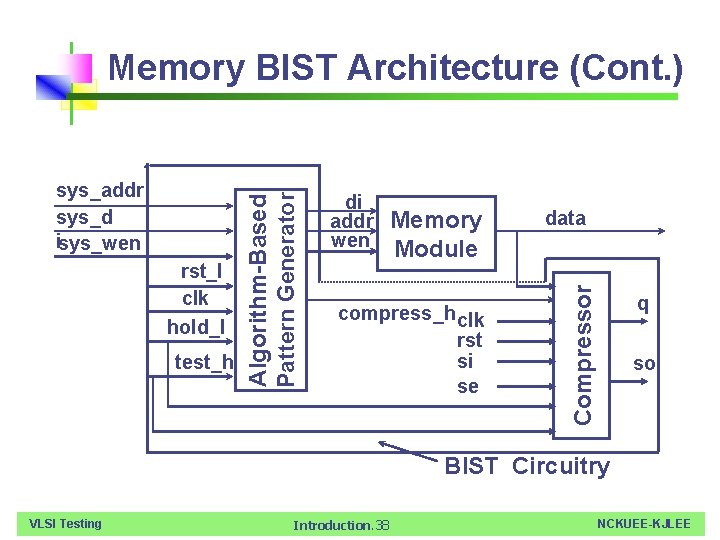
rst_l clk hold_l test_h di addr wen Memory Module compress_h clk rst si se data Compressor sys_addr sys_d isys_wen Algorithm-Based Pattern Generator Memory BIST Architecture (Cont. ) q so BIST Circuitry VLSI Testing Introduction. 38 NCKUEE-KJLEE
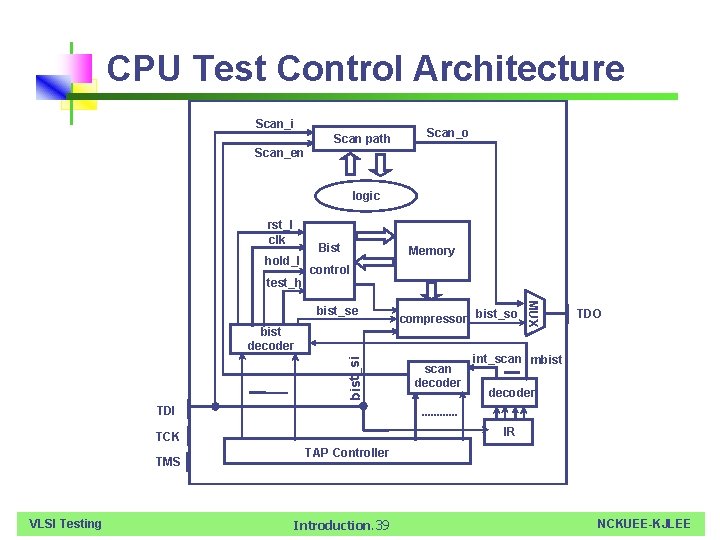
CPU Test Control Architecture Scan_i Scan path Scan_o Scan_en logic rst_l clk hold_l test_h Bist Memory control bist_si bist decoder compressor bist_so scan decoder MUX bist_se TDO int_scan mbist decoder TDI IR TCK TMS VLSI Testing TAP Controller Introduction. 39 NCKUEE-KJLEE
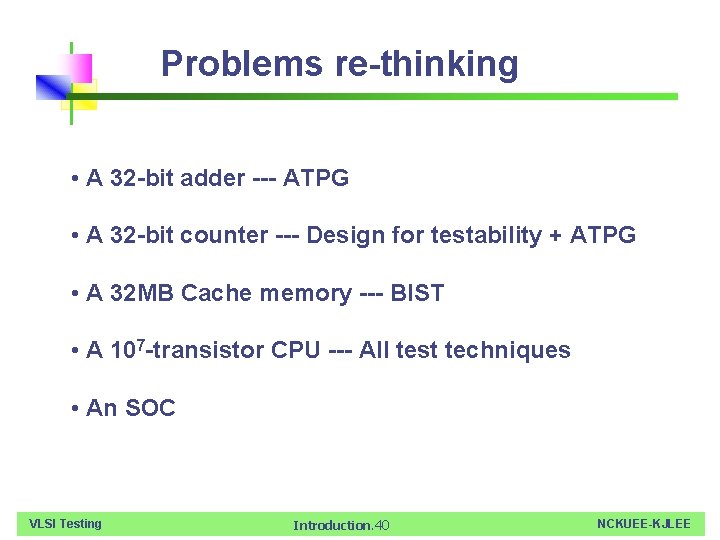
Problems re-thinking • A 32 -bit adder --- ATPG • A 32 -bit counter --- Design for testability + ATPG • A 32 MB Cache memory --- BIST • A 107 -transistor CPU --- All test techniques • An SOC VLSI Testing Introduction. 40 NCKUEE-KJLEE
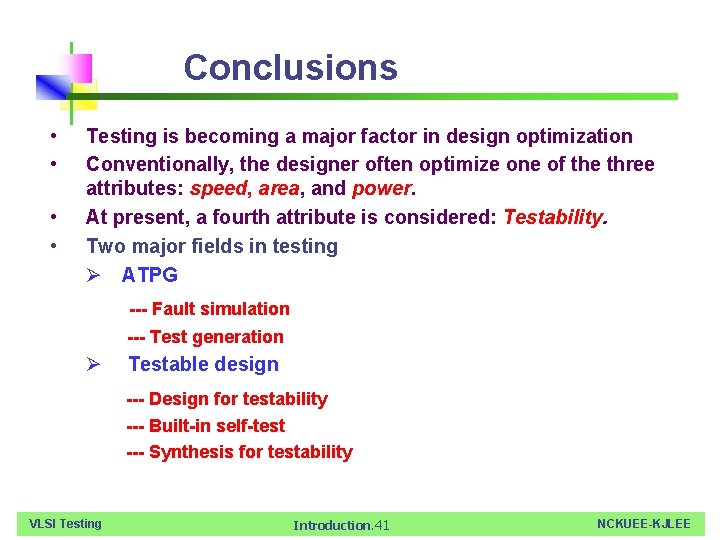
Conclusions • • Testing is becoming a major factor in design optimization Conventionally, the designer often optimize one of the three attributes: speed, area, and power. At present, a fourth attribute is considered: Testability. Two major fields in testing Ø ATPG --- Fault simulation --- Test generation Ø Testable design --- Design for testability --- Built-in self-test --- Synthesis for testability VLSI Testing Introduction. 41 NCKUEE-KJLEE